Hodges' Model: Welcome to the QUAD: commerce

Hodges' model is a conceptual framework to support reflection and critical thinking. Situated, the model can help integrate all disciplines (academic and professional). Amid news items, are posts that illustrate the scope and application of the model. A bibliography and A4 template are provided in the sidebar. Welcome to the QUAD ...

Showing posts with label commerce. Show all posts

Saturday, June 13, 2026

Hodges' model: An antidote to "Cognitive Surrender"*

'The pope's counterpoint that humanity flourishes "not despite limitations but often through them" is one that many people are becoming more aware of in the case of "cognitive surrender": the realisation that making things easier through AI can diminish rather than enhance our abilities. It is in a similar vein that the FT commits to always keeping human judgement at the centre of our journalism.'

* - and burnout?

The FT View, The ethical dilemmas of artificial intelligence. FTWeekend, 6-7 June 2026, p.12.
https://www.ft.com/content/d2c90246-11d7-4169-ac35-988de7fdb2af?syn-25a6b1a6=1

See also: https://www.futureofbeinghuman.com/p/magnifica-humanitas-and-being-human

Previously: 'ai' : 'language'

Monday, December 08, 2025

Remember (if you can) in each care domain ...

... there is an elephant in the 'room'!


individual
|
INTERPERSONAL : SCIENCES
humanistic -------------------------------------------  mechanistic
SOCIOLOGY : POLITICAL
|
group-population
'If there is one product that symbolises the absurdities of the EU's single market in goods, it might be a cuddly elephant. The Djungelskog toy from Ikea may only be 12cm tall and cost less than €2, but it has a 20cm-long label protruding from its behind.

Environmental rules from France and EU textile legislation account for much of the length. But the elongated label reflects a strategic even a philosophical, problem for Europe as its companies battle to compete globally.

The single market in goods should be the EU's crowning achievement. Compared with free movement of people, services or capital, it is the area that has come furthest in more than 30 years since the common market was established.

Yet there remain small, often invisible barriers to trade that, taken together, amount to what the IMF estimates is a drag on Europe's economy equivalent to a tariff of 44 per cent.'


RICHARD MILNE - OSLO and SAM JOINER - LONDON, Elephant in the room hampers frictionless EU trade, FTWeekend, 6-7 December 2025, p.6.

Related?

Jones, P. (1996) Nursing Technology and Elephants - Part 1: Technology as a beast of burden. IT in Nursing. 8,1,4-6.

Jones, P. (1996) Nursing Technology and Elephants - Part 2: Technology as a serpent. IT in Nursing. 8,2,5-7.

Jones, P. (1996) Nursing Technology and Elephants - Part 3: Technology rope to save humanity and health care, IT in Nursing. 8,3,5-7.

Tuesday, October 21, 2025

The Sveriges Riksbank Prize in Economic Sciences in Memory of Alfred Nobel 2025

individual
|
INTERPERSONAL : SCIENCES
humanistic -------------------------------------------  mechanistic
SOCIOLOGY : POLITICAL
|
group-population


'This year’s prize relates to the explanations for sustained growth based on technological innovation. Economic historian Joel Mokyr is rewarded with one half of the prize for his description of the mecha­nisms that enable scientific breakthroughs and practical applications to enhance each other and create a self-generating process, leading to sustained economic growth. Because this is a process that challenges prevailing interests, he also demonstrates the importance of a society that is open to new ideas and permits change.'

'The other half of the prize is awarded to the economists Philippe Aghion and Peter Howitt. In a joint publica­tion from 1992, they constructed a mathematical model of how companies invest in improved pro­duction processes and new, better-quality prod­ucts, while the companies that previously had the best products are outcompeted. Growth arises through creative destruction. This process is creative because it builds upon innovation, but it is also destructive because older products become obsolete and lose their commercial value.'


'It is apparent that, in the long run, sustained growth does not only have positive consequences for human wellbeing. First, sustained growth is not synonymous with sustainable growth. Innovations can have significant negative side effects. Mokyr argues that such negative effects sometimes initiate processes that uncover solutions to problems, making technological development a self-correcting pro­cess. Clearly, however, this often requires well-designed policies, such as in the areas of climate change, pollution, antibiotic resistance, increasing inequality and the unsustainable use of natural resources.'


Previously on W2tQ: 'Nobel prize' : 'socio-economics'

Sunday, September 14, 2025

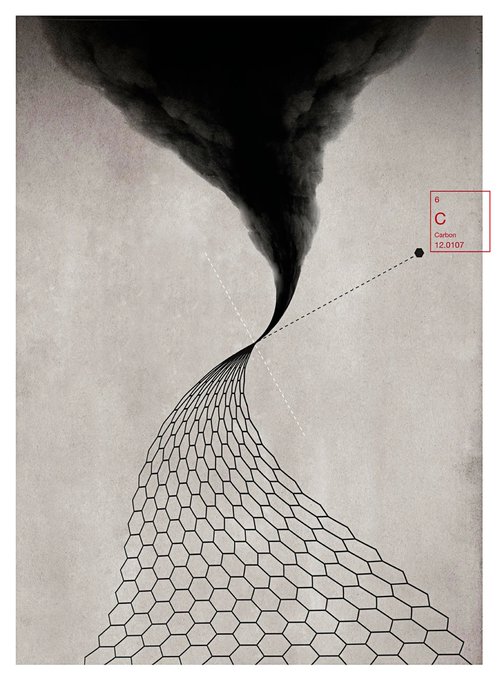
Graphene just broke a fundamental law of physics

Graphene just broke a fundamental law of physics.

Its electrons just did something physicists thought was impossible. For nearly 200 years, metals have obeyed the Wiedemann-Franz law – the rule that electrical conductivity and thermal conductivity always rise and fall together. 

But in ultra-clean graphene, researchers at the Indian Institute of Science found the opposite. As electrical conductivity increased, thermal conductivity dropped, shattering a principle taught in every physics textbook. 

The key lies at the “Dirac point,” a strange electronic tipping point where graphene is neither a metal nor an insulator. Here, electrons stop behaving like individual particles. Instead, they flow collectively as a nearly perfect fluid – a state called a “Dirac fluid.” 

This discovery doesn’t just rewrite the rules for graphene. It provides a tabletop window into extreme physics usually reserved for black holes and high-energy colliders. Scientists say this behavior could help probe mysteries of quantum entanglement, black hole thermodynamics, and the very fabric of matter itself.

 ["Universality in quantum critical flow of charge and heat in ultraclean graphene." Nature Physics, 2025] ...
Individual
|
      INTERPERSONAL    :     SCIENCES               
HUMANISTIC  --------------------------------------  MECHANISTIC      
 SOCIOLOGY  :    POLITICAL 
|
Group
While I can't fully understand this paper (even the abstract!), I realise that it is taking what seems a long time^ for industry and business to understand and realise the potential of graphene in industrial and technological applications. 


Hopefully, applications will emerge, that are beneficial to all. Reducing energy use, improving efficiency, removing pollutants even more effectively, imcreasing the durability and hence lifetime of materials and products, and more.

Also, marvellous to see global collaboration at work, as science continues to asks questions.

^I could have written exploitation there, but could we put the collective and planetary first?


Majumdar, Aniket and Chadha, Nisarg and Pal, Pritam and Gugnani, Akash and Ghawri, Bhaskar and Watanabe, Kenji and Taniguchi, Takashi and Mukerjee, Subroto and Ghosh, Arindam. (2025) Universality in quantum critical flow of charge and heat in ultraclean graphene, Nature Physics. http://dx.doi.org/10.1038/s41567-025-02972-z

My source: https://x.com/Rainmaker1973/status/1966896966316474505

Which includes a video 5m 'Quantum Critical Flow in Graphene: Charge & Heat Dynamics'

https://www.youtube.com/watch?v=LrImy9PAHGk

See also on W2tQ: 'physics : 'women'

Thursday, December 07, 2023

Kathryn Jackson - Dow Jones Dealing Room 1994

 Individual
  |
     INTERPERSONAL    :     SCIENCES               
HUMANISTIC --------------------------------------  MECHANISTIC      
SOCIOLOGY  :   POLITICAL 
|
GROUP


Ack. Kathryn Jackson. Dow Jones Dealing Room (1994) 3-D collage

My source:
Jackson, K. another dimension, Artists & Illustrators, June 1998, 141, pp.22-23.

Wednesday, December 28, 2022

Paper - "The concept of legal space: A topological approach to addressing multiple legalities"

 INDIVIDUAL
|
 INTERPERSONAL    :     SCIENCES               
HUMANISTIC --------------------------------------  MECHANISTIC      
SOCIOLOGY  :   POLITICAL 
|
GROUP

"5 An early reference to topology in psychology has been developed by Kurt Lewin, Principles of Topological Psychology (McGraw-Hill, New York, 1936). Linking literature and topology, Angus Fletcher, The Topological Imagination: Spheres, Edges, and Islands (Harvard University Press, Cambridge, MA, 2016). For an overview of philosophical approaches related to topology, see Daniel Parrochia, Mathematics and Philosophy (Wiley, Chichester, 2018) Ch 11. Using a topological approach to law, Müller-Mall (n 4). This last contribution constructs a topological approach for assessing perspectives in law (such as reflected in judicial decisions on a certain legal question) and situating them within ‘reference frames’ (in particular 117 et seq)." p.520.

"Law is fragmented ‘along issue-specific rather than territorial lines’, as exemplified by regulatory regimes for environmental and health issues or the private regulation of the cyberspace and of transnational commercial activities.20 Some authors have described this as a ‘deterritorialization’ of law.21 One reason for such a deterritorialization is the increasing amount of regulatory objects that cannot, or can only with difficulty, be linked to any territory – particularly salient in the case of digitalized data and its fluid location." p.522.

"... the notion of legal space suggested here comprises various features that are guided by concepts from topology, a branch of mathematics that analyses the qualitative nature of spaces. This approach has been adopted in an interdisciplinary manner, including in various disciplines of social science."5(See above). pp.519-520.


Global Constitutionalism


Burchardt, D. (2022). The concept of legal space: A topological approach to addressing multiple legalities. Global Constitutionalism, 11(3), 518-547. doi:10.1017/S2045381722000041

Wednesday, December 21, 2022

Herbert Spencer: The Sociology domain

 INDIVIDUAL
|
 INTERPERSONAL    :     SCIENCES               
HUMANISTIC --------------------------------------  MECHANISTIC      
SOCIOLOGY  :   POLITICAL 
|
GROUP

"In man we see the highest manifestation of this tendency. By virtue of his complexity of structure, he is furthest removed from the inorganic world in which there is least individuality. Again, his intelligence and adaptability commonly enable him to maintain life to old age - to complete the cycle of his existence; that is, to fill out the limits of his individuality to the full. Again, he is self-conscious; that is, he recognizes his own individuality." p.238.

"Spencer's key concept was 'evolution', by which he meant the process of increasing differentiation (that is to say specialization of functions) and integration (by which he meant mutual interdependence of the structurally differentiated parts and co-ordination of their functions.)" p.8.

"Here we see longitudinal and transverse integration going on simultaneously; ..." p.66.

"Having invented the word sociology, Comte is often treated as the founder of the study itself, although his contribution to empirical knowledge is meagre, and cannot be even remotely equated with that of Montesquieu or John Millar. His excellence lies in methodology in which field he laid the foundations for the systematic (or scientific, if you like) study of society." p.15.


"There is no sudden leap from the house-hold type to the factory-type, but a gradual transition. The first step is shown us in the rules of trade-guilds under which, to the members of the family, might be added an apprentice (possibly at first a relation), who, as Brentano says, 'became a member of the family of his master, who instructed him in his trade, and who, like a father, had to watch over his morals, as well as his work'; practically, an adopted son. ... With  development of this modified household-group, the master grew into a seller of goods made, not by his own family only, but by others; and, as his business enlarged, necessarily ceased to be a worker, and became wholly a distributor - a channel through which went out the products, not as a few sons, but of many unrelated artisans." pp.135-136.


Herbert Spencer, Stanislav Andreski, (1971) Herbert Spencer : structure, function, and evolution. London: Nelson.

As you can tell - I'm still sorting through books!

Thursday, December 15, 2022

Spark! Strike! c/o - Ack Lemn Sissay


 INDIVIDUAL
|
 INTERPERSONAL    :     SCIENCES               
HUMANISTIC --------------------------------------  MECHANISTIC      
SOCIOLOGY  :   POLITICAL 
|
GROUP


"Long before the Bryant and May Factory was opened in Fairfield Road, Bow in East London, Charles Dickens wrote, in 1852, about the risks of ‘phossy jaw' in matchmaking factories. Yet, when the factory was opened in 1861, they proceeded to use the dangerous white phosphorus that caused the disease."

https://www.matchgirls1888.org/the-story-of-the-strike

Spark Catchers by Lemn Sissay

"...

The greatest threat to their lives was
The sulferuous spite filled spit of diablo
The molten madness of a spark

They became spark catchers and on the word “strike”
a parched arched woman would dive
With hand outstretched to catch the light.

And Land like a crouching tiger with fist high
Holding the malevolent flare tight
‘til it became an ash dot in the palm. Strike.


..."


Monday, November 21, 2022

MADE in the UK - SOLD to the World


MADE
 in the UK

SOLD to the World


Well, yes.
I'm certainly trying to 'sell' something to the World ...
but this thing - #h2cm is free ...


... it provides a means to listen, make, and see the world and each other, in ways that can help us all face and solve the problems of this century and those to follow - because there is more than hope in humanity
.


c/o GOV.UK Export Strategy


Images: 

https://www.adsgroup.org.uk/blog/made-in-the-uk-sold-to-the-world/

https://www.knightslowe.co.uk/made-in-the-uk-sold-to-the-world-how-will-britains-new-trading-strategy-boost-exports/

Previous posts:

'global'

'justice'

Sunday, August 22, 2021

Why the posts about books?

Since I started this blog in April 2006 book tagged posts are numerous; almost 300 in fact.

https://hodges-model.blogspot.com/search?q=book

As with the previous post "Spare Parts" many are not even a review of the book in question. Use of about here is a misnomer. Currently, there are 51 posts tagged 'review', probably not all text book.

So, why bother? These posts are intended to suggest and possibly show the scope of Hodges' model. The placement of the book within a particular care (knowledge) domain is no accident.

Even though there is often overlap between the domains there is often a primary placement. 

This is were you the reader (learner, teacher, policy maker ...) come in, as the model invites you to interrogate the book's title and often, its very informative (for commercial reasons) subtitle.


Thursday, May 06, 2021

Book: Empire of Pain

individual
|
INTERPERSONAL : SCIENCES
humanistic ----------------------------------------------- mechanistic
SOCIOLOGY : POLITICAL
|
group
PSYCHOLOGICAL PAIN
Empire of Pain
How do governments recognise individual pain?

How do governments recognise individual trauma?
A protest sculpture of a bent heroin spoon is placed outside the Purdue Pharma headquarters in Connecticut in 2018 © New York Times / Redux / eyevine c/o FT.

Gapper, J., Deadly Painkillers, Life&Arts, FTWeekend, 1-2 May, 2021. p.8.

Online: https://www.ft.com/content/1db7800f-78d5-474e-9b1e-744b1c1a837c

Book cover: https://www.foyles.co.uk/

BBC Radio 4: Start the Week, The opioid crisis and erosion of trust

Wednesday, February 24, 2021

'Design Thinking' in and out of four boxes...

In 2019 Charles Orton-Jones gave a brief (single page) account of design thinking in sales, with a description of its five components:

Empathise

Define the problem

Ideate

Prototype

Testing

Below, I've mapped each to Hodges' model (and in parallel):

INDIVIDUAL
|
INTERPERSONAL : SCIENCES
HUMANISTIC----------------------------------------------- MECHANISTIC
SOCIOLOGY : POLITICAL
|
  GROUP
Empathise
Ideate
Define the Problem
Prototype

Define the Problem
Prototype
Testing

Empathise
Ideate
Define the Problem
Prototype
Testing

Empathise
Ideate
Define the Problem
Prototype
Testing


There is often conceptual overlap and relationships when considering the most mundane, taken-for-granted of phenomena and events. This overlap increases rapidly with more complicated situations. This applies in the case of 'design thinking'. Ideate I take as a mental activity, but it is the flow and interplay of ideas: communication that counts. Empathy is imbued individually, but it is delivered and is realised in the social domain - as empathise suggests. Hopefully, from empathy with group rapport, trust, dignity and respect coherence will follow.

Politically, funding, team constraints, leadership may all influence defining the problem, prototyping and testing. Ideation is 'political' too. We forget this at our peril. Are we sure the protected characteristics have been factored in? You might also test the prototype against the original idea(s): thereby bringing in values. While this application is commercial sales, you are in personalised and specialised 'sales' in healthcare. 

While the above looks like duplication, the parallel approach can help assure the design thinking process as a whole. There is an open question here, but I'm sure despite the duplication and 'travel' to-and-fro within the model the structure helps instill some discipline with efficiency - economy of effort? The model acts as a marshalling (classification) yard.

As an example, this was brought home today on twitter, with a question about dealing with people who have a fear of needles. This may be children, a percentage of the general population and people with a learning disability. We see then how this overlap can be important. By default then working with the above design thinking + h2cm approach to achieve (variously) individualised, integrated, collaborative care then you might also be doing co-design and co-creation. Now that is sales ...!

My source: Orton-Jones, C. Design thinking is making an impact, Raconteur, 20.6.19. p.18.


Saturday, December 12, 2020

AI: Watch your P's and Q's

individual
|
INTERPERSONAL : SCIENCES
humanistic ----------------------------------------------- mechanistic
SOCIOLOGY : POLITICAL
|
group
"How to Talk When
a Machine Is Listening:
PROCESS
PRACTICE
Corporate Disclosure
in the Age of AI" ...


... and still ensure that corporate responsibilities are achieved (surpassed), value and values - ethical and social are upheld.

Cao, Sean S. and Jiang, Wei and Yang, Baozhong and Zhang, Alan L., How to Talk When a Machine is Listening: Corporate Disclosure in the Age of AI (August 31, 2020). Available at SSRN: https://ssrn.com/abstract=3683802 or http://dx.doi.org/10.2139/ssrn.3683802

My source:

Wigglesworth, R. (2020) Robo-surveillance shifts tone of CEO earnings calls, FT Weekend, 5-6 December, p.19. 


The 4P's in Hodges' model:

SCIENCES: Process

INTRA- INTERPERSONAL: Purpose

SOCIOLOGY: Practice

POLITICAL: Policy

Thursday, October 29, 2020

Book review: "The Power of the 2 x 2 Matrix" iii

Business and healthcare share an ongoing fascination with integration. A several decades long preoccupation, I now see as a legacy issue. One, that is set to continue: a clear objective but  tantalizingly always out of reach.

Not that I'm drawn to figures, but there's a double helix (figure 2.4, p.33) to illustrate the distinctions and dependencies that operate between:

INTEGRAL and MODULAR

products

VERTICAL and HORIZONTAL

industry

Pressure to 

DISINTEGRATE - INTEGRATE

Hopefully, you can see what is going on here - the attraction, the fit? Chapter 2 on Form, Method and Mastery presents the foundations of what is to follow, with chapter 3 on the Eight Archetypal Dilemmas. While the context is business the insights here are applicable generally:

Head - Heart*

Inside - Outside

Product - Market

Change - Stability

Content - Process


As in Hodges' model, a situated perspective is called for and in designing 2x2 matrices the author's outline individual and group activities. Their step 3, 'Catalogue' - creating an inventory of interesting and important aspects of the situation is mirrored in Hodges' model - care concepts, patient or carer priorities - and general problem solving. A key difference in the business context is that the quadrants are not pre-defined but must be 'Named'. The critical question, Lowy and Hood write (p.68), is proof: "Are there four real quadrants?"

The Power of the 2 x 2 Matrix

A 'good' book makes / helps you think. In prompting the next blog post this is proof for me of a good book.

More to follow ('care architecture'?) ...

Here are the previous posts:

Q. What is Hodges' model? A. It is NOT a 2x2 matrix


Alex Lowy, Phil Hood (2004) The Power of the 2 x 2 Matrix: Using 2 x 2 Thinking to Solve Business Problems and Make Better Decisions, San Francisco, CA: Jossey-Bass. ISBN: 978-1-118-00879-9

With many thanks to the publisher for my review copy.

*See also:

https://twitter.com/h2cm/status/1321177843863375883?s=20

Tuesday, October 27, 2020

Book review: "The Power of the 2 x 2 Matrix" ii

The Power of the 2 x 2 Matrix


Once again I will start by referring to a previous post:

Q. What is Hodges' model? A. It is NOT a 2x2 matrix.

 
The structure of Hodges' model, the two axes immediately suggests opposition, dichotomy and thoughts of polarities. 

 
Page 30, table 2.2 Principles of 2 x 2 Mastery, includes:
"Opposition: 

Opposition between forces is either direct or complementary. Direct opposition is Hot versus Cold or On versus Off. Complementary opposition is Size versus Speed or Growth versus Profit. Recognize the nature of opposition, and work with it." p.30.
Of the others, the creative tension in health is manifold. Out of a professional foundation comes the therapeutic relationship nurse - patient and then the tension of trying to provide person-centred care that also has integrity in having the courage to advocate or engage independent advocacy and address the political issues that may (will) arise. Iteration here is a gift in that Hodges' model is situated and can address the multiplicity of contexts that are encountered in health, education and business too. Iteration for me implies travel, movement between the domains in search of a new perspective, (ad-)vantage point. Combined with integrity, this can mean going were you are not necessarily comfortable and perhaps seeking help. I like transcendence a great deal as it refers to "Learning requires unlearning". This points to the outcomes of interventions and application of knowledge, skills supported by Hodges' model with positive change. Transcendence can encompass liminality as described in therapy and education - threshold concepts in particular.

If you seek proof of complexity in healthcare, nursing and medicine look no further than a business book. The book is a marvellous reference text on 2x2 frameworks. In the introduction the authors stress the work is not intended to be read cover to cover. Business readers will be drawn to specific types of framework. Well referenced and researched the index is also comprehensive (with one framework missing (of course!). As the year of publication indicates the references and business examples that are outlined are dated, but they still deliver in readable and meaningful terms the utility of the framework described.

The layout and organisation of the chapters retains a 'current' appeal. I mention proof of complexity after reading:

 "Strategy is the art and science of competing more effectively than one's competitors." p.91.

In healthcare the 'competitors' may be the patients themselves (self-stigmatising, fearing the future, helplessness, hopelessness, fatigue). Competition may lie in other agencies depending on the politics of local health care delivery. Some may argue that the commodification of health is a creative tension not a political one. Also in the sense that 'we' are duty bound to heal, cure, treat you and have you care for yourself in future. Art and science are needed in print and book-loads at present as COVID-19 pushes out other diseases, illnesses that patients and families still face.

More to follow ...

 
Book review: "The Power of the 2 x 2 Matrix" i

Alex Lowy, Phil Hood (2004) The Power of the 2 x 2 Matrix: Using 2 x 2 Thinking to Solve Business Problems and Make Better Decisions, San Francisco, CA: Jossey-Bass ISBN: 978-1-118-00879-9

With many thanks to the publisher for my review copy.

Tuesday, October 13, 2020

Book review: "The Power of the 2 x 2 Matrix"

I'll start this post as I did a previous one on this book:

Q. What is Hodges' model? A. It is NOT a 2x2 matrix.


Regular visitors / readers of W2tQ will be familiar with this rendering of Hodges' model:
 
individual
|
INTERPERSONAL : SCIENCES
humanistic ----------------------------------------------- mechanistic
SOCIOLOGY : POLITICAL
|
group - population


The separation of axes and domains above is contrived to overcome some of the limitations of HTML.

An image can re-solve and integrate to show the model as intended: two axis that intersect that then gives rise to four quadrants, or that can be described as care, or knowledge domains:

Hodges' model: The axes and domains

There's another answer to the question posed above.

I was wrong AND right.

Hodges' model is not a 2x2 matrix as per the many established and very powerful examples described in Lowy and Hood's book, The Power of the 2x2 Matrix. 

It is a 2x2 matrix as I have often explained to people. I have also stressed the model's generic status, so while Hodges' model can be used in a business context, this merely highlights the model's generic potential and its situatedness.

In numerous workshops I've adopted a Socratic approach. The audience 'formulate' Hodges' model from the questions they are asked. 

The word instrument conjures ambivalence for me. Who wants to be an instrument of the State - and yet we all are? Have I been championing, advocating for what is an instrument for the past three decades and more? Do I trust the instruments? While instruments are probably associated with the sciences and mechanism (whether analogue or digital) Hodges' model is an instrument for dialectical method.

 "When Plato described Socrates' logic as dialectical, he was referring to the intensely honest and courageous investigations of important subjects, including or perhaps especially, the self and reality. The Socratic method as used by to adroitly elicit curiosity and promote learning is the practical application of this form of dialectic." pp.26-27.

"From the Greek dialektikḗ, the origin of the term dialectic is literally the art of (techne) of philosophical discussion. ... The dialectical perspective pushes us to search for meaning beyond the level of obvious, visible evidence, focusing on the dynamic relationship between things and how they evolve. The benefits for problem solving and design are significant. Dialectical thinkers are better and faster at framing, exploring, and resolving problems. Dialectical thinkers are able to wend their way through complex and difficult challenges because they are less likely to ignore messages that trouble them." pp.24-25.


INTRA- INTERPERSONAL
SCIENCES
SOCIOLOGY
POLITICAL


More to follow ...

Alex Lowy, Phil Hood (2004) The Power of the 2 x 2 Matrix: Using 2 x 2 Thinking to Solve Business Problems and Make Better Decisions, San Francisco, CA: Jossey-Bass ISBN: 978-1-118-00879-9

With many thanks to the publisher for my review copy.


Friday, December 27, 2019

The gravitas of Groups - and inertia

INDIVIDUAL
|
INTER-PERSONAL : SCIENCES
HUMANISTIC -------------------------------------------------- MECHANISTIC
SOCIOLOGY : POLITICAL
|
 GROUP 
talk green
walk the talk


'X'
marks the spot
the impact of inertia elsewhere


Group of Twenty

Group of Eight
Group of Seven


the G20 and other G's
despite their nomenclature
do they recognise the gravity of the situation?

the road is long
time is short
life is the essence
and the 'road' part of the problem ...


On Wikipedia:
Group of Seven
Group of Eight
Group of Twenty


Saturday, August 24, 2019

Was that last post 'really' sponsored?*

It occurred to me that the last post would be ideal as a 'sponsored' effort. Many posts are incidentally, or voluntarily 'sponsored'. I wish a few were in fact. This commercial thought was prompted by an email three weeks ago that referred to mention of 'due diligence' in a post from 2009. The suggestion was that if I could add a link to an article by this real estate company, and let them know, then they could 'syndicate' this W2tQ. Reply sent, but nothing heard as yet.

In that last post I was careful to avoid referring to 'c*sme*ic', lest the floodgates open ;-) and this blog's potential 'long tail' be revealed.

In between the 'Barber's model' post: another email.

This, points to a post in March 2016 and (again) the possibility of collaboration. Their focus is Python and data libraries. Well this is really encouraging! I've replied, but I'm not sure if there will be a sponsored post, or something in the side bar. I've no time to fully understand 'SEO' and advertising. That is not the blog's objective. I am aware though that this blog is ancient and Google's algorithms have and continue to change.

Some income would help with conference registrations, accommodation and travel; and to revisit hosting which I cancelled recently (as unused). My main laptop (2017) is poorly too. They do get hammered a bit. Being conscious of 'false economy' in the politics of health, social care and the environment, perhaps I should return to the MacBook fold?

*It wasn't.

Friday, May 24, 2019

Dear McKinsey and Company, Re. "The era of exponential improvement in healthcare?"

Re. Your article:

The era of exponential improvement in healthcare?

(By Shubham Singhal and Stephanie Carlto)
Technology-driven innovation holds the potential to improve our understanding of patients, enable the delivery of more convenient, individualized care—and create $345 billion to $420 billion in value by 2025.

Healthcare advances have delivered great benefits to society, bringing material improvements in average life spans and quality of life.1 Yet these improvements have come at a cost—an ever-expanding portion of the US GDP is being consumed by healthcare expenses.2 Could technology, enabling delivery of healthcare advances while improving affordability, be part of the solution? We have reviewed the evidence, done the math, and identified technology-enabled use cases that could create between $350 billion and $410 billion in annual value by 2025 (out of the $5.34 trillion in healthcare spending projected for that year3 ).
Read more ...
<>

But how would we recognise the era of exponential improvement in healthcare?


SELF - individual
|
INTERPERSONAL : SCIENCES
humanistic ----------------------------------------------- mechanistic
SOCIOLOGY : POLITICAL
|
group - POPULATION
The exponential benefits realised 'elsewhere' in global, local and glocal health and healthcare systems finally sees the achievement of parity of esteem with mental health not only fully funded, but designated as the key that must be turned 4 happiness. Despite the diametrical opposition of this domain to the political domain, there is a breakthrough in policy makers and the body politic prioritising "The Long Now"
"Predictions of an exponential increase in people living with dementia in the coming 30 years require evidence-based strategies for advancing dementia care and maximizing independent living. However, the evidence required to inform priorities for enabling improvements in dementia care is rarely presented in a way that stimulates and sustains political interests."  Martin, O’Connor, & Jackson (2018).


Community-based healthcare becomes
 the norm and the educational,
preventive and sustainable ethos for
health and healthcare systems
is adopted globally.
Look at the readiness and response-to potential epidemic crises, plus
 interventions in population health. 
Exponential benefits are accrued.
Evidence - look at the number of
 (new) hospital beds.
The community IS the market.


Exponential growth in global
healthcare funding, health information
for all, access to universal health care.
 Social Determinants of Health not
just a vision: but enacted and ongoing
#SDoH-X.
Evidence - climate change slowing,
air quality improving -
the 21st Century truly begins ...


Martin, A., O’Connor, S., & Jackson, C. (2018). A scoping review of gaps and priorities in dementia care in Europe. Dementia. https://doi.org/10.1177/1471301218816250

My source:
email - McKinsey Insights

Saturday, December 29, 2018

The Art & Science of Health: [conceptual scraps i]

The role that both art and science have to play in health, medicine and nursing is recognised by all. The distinction can be made in a great many ways using Hodges' model. Now: there is an exercise for a new group of student nurses ... ?

As I hope is evident in numerous blog posts and subjects of relevance to h2cm, notably, conceptual spaces and threshold concepts, concepts are a basic element in nursing scholarship and debate within art.
 
In the FT Weekend June 9-10, 2012, p.11 I read: "Conceptual: only worth the paper it's written on" (Georgina Adam). From a healthcare perspective, Adam's opening question seems fairly innocuous:

"How do you prove that you own a work of conceptual art?"
Amid the ongoing revelations involving user's personal data and the governance and values of social media companies lies the question of ownership. First though, back to Adams:
"This is an interesting issue in today’s art market, with the trend towards the dematerialisation of art, and the primacy of the idea over its physical presence.
For example, the late US artist Félix González-Torres’s works include “Candy Spills”, in which wrapped sweets are piled on the floor or in a corner, to be taken and eaten by viewers. When the pile has gone, the owner of the work replenishes it. So what stops anyone making and selling their own “Candy Spill”?

The answer is the certificate of authenticity issued by the artist or their estate. This scrap of paper is, in fact, the only proof that the work of art genuinely belongs to you, and this is actually what you buy and sell.

So losing it is a disaster."
The contrast of this within health care and its 'record' is quite stark. There are at least two ways to  distinguish between the scraps of paper we use ...:

to be continued...