Hodges' Model: Welcome to the QUAD: humanity

Hodges' model is a conceptual framework to support reflection and critical thinking. Situated, the model can help integrate all disciplines (academic and professional). Amid news items, are posts that illustrate the scope and application of the model. A bibliography and A4 template are provided in the sidebar. Welcome to the QUAD ...

Showing posts with label humanity. Show all posts

Friday, August 21, 2026

"Poetics of Relation" by Édouard Glissant

'The Slave Trade came through the cramped doorway of the slave ship, leaving a wake like that of crawling desert caravans. It might be drawn like this:

African countries to the East; the lands of America to the West. This creature is in the image of a fibril.

African languages became deterritorialized, thus contributing to creolization in the West. This is the most completely known confrontation between the powers of the written word and the impulses of orality. The only written thing on slave ships was the account book listing the exchange value of slaves. Within the ship's space the cry of those deported was stifled, as it would be in the realm of the Plantations. This confrontation still reverberates to this day.' p.5.
'Not just a specific knowledge, appetite, suffering, and delight of one particular people, not only that, but knowledge of the Whole, greater from having been at the abyss and freeing knowledge of Relation within the Whole.' p.8.

 
Édouard Glissant. (1990, 2025) The Open Boat. Poetics of Relation. Dublin: Penguin.

The above image runs within the text in the book.

My image source: https://annstreetgallery.org/Nolan-Oswald-Dennis

Saturday, June 13, 2026

Hodges' model: An antidote to "Cognitive Surrender"*

'The pope's counterpoint that humanity flourishes "not despite limitations but often through them" is one that many people are becoming more aware of in the case of "cognitive surrender": the realisation that making things easier through AI can diminish rather than enhance our abilities. It is in a similar vein that the FT commits to always keeping human judgement at the centre of our journalism.'

* - and burnout?

The FT View, The ethical dilemmas of artificial intelligence. FTWeekend, 6-7 June 2026, p.12.
https://www.ft.com/content/d2c90246-11d7-4169-ac35-988de7fdb2af?syn-25a6b1a6=1

See also: https://www.futureofbeinghuman.com/p/magnifica-humanitas-and-being-human

Previously: 'ai' : 'language'

Monday, May 18, 2026

Call for Abstracts: Prototypes for Humanity - Submission Deadline 22 May 2026

Dear Colleagues, 

I am pleased to invite the submission of abstracts to the Prototypes for Humanity 2026 Short Papers Platform. 

Abstract Submission Deadline: 22nd May 2026
Invitations to Successful Authors: 8th July 2026
Conference Dates: 15th - 19th November, Dubai, UAE 

** Description **

The Short Papers Platform provides a forum for professors to share their research and engage in interdisciplinary dialogue, fostering global collaboration and knowledge exchange, with a focus on driving real-world impact through academic research.

For 2026, Prototypes for Humanity is delighted to announce the launch of a strategic partnership with the Investment Corporation of Dubai (ICD), for the Short Papers Platform. This joint effort reinforces the programme’s commitment to advancing impactful innovation through collaboration between academia and industry, focusing on the key sectors and themes that reflect international research priorities and that are relevant to the city and to the fund. 

Themes 
  • Wellbeing and Human Performance
  • Infrastructures and Cities
  • Autonomous Systems and Advanced Manufacturing
  • Environment, Sustainability and Energy
  • Mobility and Logistics
  • Socio-Economic Empowerment, Digital Economies and Future Markets
  • Open and Speculative
Awards

As part of the programme’s ongoing commitment to research translation, ICD will award a $50,000 prize to one of the short papers presented at the conference. The award recognises academic work with strong potential for practical application, identified through engagement with ICD industry experts, and will support the winning project’s next stage of development towards implementation.

Submissions

Full details can be found at: https://www.prototypesforhumanity.com/press-releases/stories/Call_For_Abstracts_2026

Apply here: https://form.jotform.com/260705028532451?source=https://www.jisc.ac.uk

Deadline for abstract submission: 22 May, 2026

We strongly encourage you to apply where your interests and research aligns with the programme’s thematic areas.

If you have any questions, please contact us at professors AT prototypesforhumanity.com

Sarah Ward
University Relations Manager
Prototypes for Humanity

E: sarah.ward AT prototypesforhumanity.com

My source: Email - https://www.bcs-sgai.org/

Saturday, May 09, 2026

v WCCS26: World Conference on Complex Systems 20-22nd April

Day 2 Tuesday 21st April (Revisiting) Keynote Speaker: Abderrazak El Albani - 
Emergence of Intercellular Cooperation: At the Origins of Eukaryotic Complexity
Session Chair: Khawla Tadist

This keynote was fasacinating. As I begin this post on the 100th birthday of Sir David Attenborough, who would have us all see life in the broadest terms, value life and diverse habits, and Earth as our collective and shared home.

Abderrazak El Albani explained the search for LUCA the last universal common ancestor - 3.8 billion years ago. Many dates in the emergence story of humanity, have been progressively pushed back. The first fire, art, languages, our co-habitation and intimate relationships with Neanderthals.

In healthcare, as a practitioner you have to be aware of your scope of practice. At WCCS, scale (as in iv) was ever present across research in complexity, and complex systems. Not just physical size nano-to-mega but temporal too, as we journeyed billions of years. Several of the slides are presented here:

https://www.synchrotron-soleil.fr/en/news/discovery-oldest-macroscopic-planktonic-eukaryotes-contribution-nanoscopium-beamline (with a reference).

There is a video (French): https://www.youtube.com/watch?v=bh3t26cU7xc

I asked a question, which may have been psychological preparation for own presentation to follow. Listening, I could see how the work Abderrazak El Albani and his team are doing, could be readily translated to the search for life on Mars. There has been a 'routine' interchange of planetary material between Earth and Mars over the aeons. Fitting surely that the sedimentary rocks sought lie in  A key lesson, is that light helps us see, but not all lights are equal. Light sources brighter than the sun become incredible scientific instruments. The longevity of the dinosaurs was highlighted, at least 140 million years. There is no comparison with homo sapiens then, even as those dates have been pushed further back in time. Time defeated me as I tried to make the observation that even the dinosaurs did not make it to their first galactic birthday (c.250 million years - and what a carousel). I like the thought (slide) of 'Earth as Memory'. 

What really counted was the expressed concern about what is happening now: in the Anthropocene.

The second keynote:
Nigel Gilbert - Policy in a Complex World: Towards Complexity-Aware Policymaking
Session Chair: Ali Idri 

Was helpful to me, as the dated conundrum of benefits realisation from our technologies, and evidence-based policy still leaves a gap (for me) within the POLITICAL care/knowledge domain of Hodges' model. The illustration/graphic elements of Prof. Gilbert's slides were a brilliant complement to the content:

Prof. Nigel Gilbert - WCCS26 21st April

I wonder if within policy the constant in the equation is continuity and as a quantity it is an unknown? This seems to the case in health policy, across successive governments. You may (also) find this chart informative: https://www.cecan.ac.uk/news/the-visual-representation-of-complexity/

Perhaps, a key factor in complexity is the fact that nothing stays the same, so continuity is nuanced? Michael Quinn Patton's book Developmental Evaluation was noted re. learning while doing. Now I wish I'd held on to Qualitative Research & Evaluation Methods (4th ed.). The discussion of 'obesity system map' and 'whole systems analysis' was appreciated here.*

Since Marrakech and WCCS, I've noticed acknowledgement in the literature that 'research' is currently flooded with AI tools. I'm sure PRSM - Participatory System Mapper is a welcome addition, (as noted in iv) tools to facilitate participation are much needed:

Collaborative Creativity

The Participatory System Mapper (PRSM) is an app that makes it easy to draw networks (or 'maps') of systems, working together collaboratively.'

I will definitely check this resource out; and CECAN. After Prof. Gilbert, the next Track included my contribution, which I will return to. Rather distracted, I have a somewhat blurred slide, with: 'The global tensor of educational research is' then headed 'Learning poverty. Being unable to read and understsand a simple text; with points 1-4.'. I'm not sure which presentation this was, but zeroed in on the literacy theme, and the word tensor. Another slide refers to '6. Topological substitution for Success'. I think it is (writing this is helping recall!):

Harvey Spencer Sánchez-Restrepo, Jorge Louçã, Martha Belén Carmona-Soto and Sofialeticia Morales-Garza
Topological Patterns of Academic Success: Insights from Complex Network Analysis

'Always Label Your Axes' - Zazzle.

Before that there was another model, as the next keynote speaker: Chris Bauch demonstrated during the conference wearing a t-shirt:

Critical Transitions in Coupled Human-and-Natural Systems and their Early Warning Signals
Session Chair: Mohamed Essaaidi  

Previously: 'nexus'


*Jones P, Wirnitzer K. Hodges’ model: the Sustainable Development Goals and public health – universal health coverage demands a universal framework. BMJ Nutrition, Prevention & Health 2022;5: doi:10.1136/bmjnph-2021-000254

Wirnitzer, KC. et al. (2025) Toward a roadmap for addressing today's health dilemma – The 101-statement consensus report. Frontiers in Nutrition. Volume 12.
https://frontiersin.org/journals/nutrition/articles/10.3389/fnut.2025.1676080 DOI:10.3389/fnut.2025.1676080

S. Bettiol, P. Jones, H. A. Onyedikachi, and W. G. Kernohan, (2026) Bridging Gaps in Oral Health Frameworks: Mapping With Hodges' Health Career - Care Domains - Model, Journal of Public Health Dentistry. 1–14, https://doi.org/10.1111/jphd.70034

Friday, May 08, 2026

iv WCCS26: World Conference on Complex Systems 20-22nd April

Day 1: Panel 2 - Rethinking Knowledge in the Age of Complexity

  • Helena Knyazeva - Dancing with Complexity: How the World Thinks Through Us
  • Carlos Gershenson - The Implications of Complexity
  • Leonardo Rodríguez Zoya - Can Statistics Think? Complexity, Future, and Freedom in the Age of Large Language Models
    Panel Chair: Nigel Gilbert 

Courage is one of the 6Cs in nursing, and was on display at WCCS26.

Carlos Gershon began by offering two references, the first:

De Domenico, et al., (2019). Complexity explained: A grassroot collaborative initiative to create a set of essential concepts of complex systems. https://complexityexplained.github.io

This is a brief 20 pages, larger text, and provides a helpful primer to complexity and related concepts covering:

Interactions
Emergence 
Dynamics 
Self-organization
Adaptation
Interdisciplinarity
Methods

For each concept, the authors explain:

Definition/Description
Examples
Relevant Concepts
References

Plus, secondly:

Gershenson, C. The Implications of Interactions for Science and Philosophy. Found Sci 18, 781–790 (2013). https://doi.org/10.1007/s10699-012-9305-8

I liked the practical feel here, the encouragement to think anew, and perhaps taste the "flavors of emergence": synchronic - space; diachronic - time, weak and strong feedback, transversal of scale - upwards and downwards.

There is further conference on complexity later this year (and also online!):

CCS 2026:
The 2026 Conference on Complex Systems
OCTOBER 9 - 16, 2026 BINGHAMTON, NY, USA & ONLINE

In my search I also found:

Carlos Gershenson; Complexity, Artificial Life, and Artificial Intelligence. Artif Life 2025; 31 (3): 289–303. doi:https://doi.org/10.1162/artl_a_00462

Gershenson, C. Self-organizing systems: what, how, and why?. npj Complex 2, 10 (2025). https://doi.org/10.1038/s44260-025-00031-5

Leonardo Rodríguez Zoya's presentation helpfully connected social practice, interdisciplinary bridges, statistical rationality, complex (human) rationality and the future(s): desirable, possible, latent and probable.

individual
|
INTERPERSONAL : SCIENCES
humanistic ------------------------------- mechanistic
SOCIOLOGY : POLITICAL
|
group
COMPLEX (HUMAN) RATIONALITY
 
cognition

STATISTICAL RATIONALITY
Techopraxis
LLMs - technology

socio-
HUMAN PROBLEMS
SOCIAL PRACTICE
PRACTICE (one of the 4Ps)

ELECTION - CAMPAIGN SPENDING
PEACE NEGOTIATIONS
ISLAND ECONOMY
CRYPTOCURRENCY

To answer the prompt - 

"Give me a less likely but more fruitful interpretation of this [concept]*."

*Replace with a significant concept in your practice

Would it might help to have a simple, and yet complexity (and simplicity!) primed conceptual framework to assist reflection, argumentation, and progress?
 
I missed the poster at the afternoon break, and followed track 1. I greatly enjoyed Julian Arevalo's - Adaptive Readiness: an Agent-Based Model of Peace Negotiations. Perhaps this accounts for my having no notes or photos for this track except for one. I realise now we did speak, sitting together for the conference dinner. I'm sure I remember Negotiation Lab 1.0 - 

https://www.comses.net/codebases/1256dc74-9ae4-4f49-a235-1ec129be1930/releases/1.0.0/
 
This past week I heard discussion (BBC Radio 4) of the 'income' Norway obtains from its expertise and engagement in peace negotiations.
 
Nicholas Roxburgh, and colleagues Rachel Creaney, Mindi Premarathne and Ruth Wilson through 
Exploring Interdependencies in an Island Economy, reminded me of public engagement in research. Especially when it involves their community; and that community is somewhat rural, or remote.
 
Remah Dahdoul, with Jan Korbel and Stefan Thurner presented -
Campaign-Spending Driven Polarization Transition in a Double-Random Field Model of Elections. The following paper brings home the mathematics in complex systems. The reference is:
 
Jan Korbel and Remah Dahdoul and Stefan Thurner. (2026) Empirical validation of the polarization transition in a double-random field model of elections. arXiv. https://arxiv.org/abs/2510.00612.  doi.org/10.1103/9gjj-1df6.
 
The paper by Saida Hachimi El Idrissi and Mohamed Nemiche is not open access, but the abstract follows. 
 
S. H. El Idrissi and M. Nemiche, "Formation of Complex Societies: An Agent-Based Model Inspired by Freudian Theory," 2024 World Conference on Complex Systems (WCCS), Mohammedia, Morocco, 2024, pp.1-6, doi: 10.1109/WCCS62745.2024.10765573.
Abstract: The rise and emergence of complex societies in the Old World mark a pivotal chapter in human history, characterized by the transition from small, kin-based communities to large, hierarchical states. This transformation raises fundamental questions: How did human societies progress from small, cohesive groups characterized by face-to-face cooperation to the expansive, anonymous societies of today, often organized as states? What factors account for the significant variation in different human populations' capacity to construct stable and functional state structures? To address these questions, we developed an agent-based model grounded in Freud's hypothesis, which posits that civilization could neither emerge nor evolve without the repression of human desires. In the context of social evolution, this repression of desires can be interpreted as the repression of intra-societal competition, ultimately strengthening the society and facilitating the formation of complex social structures. We implemented this model within a realistic representation of the Afroeurasian landmass, incorporating various geographical factors. To validate our model, we compared our simulated results with historical data. The model-predicted pattern of expansion of complex societies demonstrated remarkable congruence with the observed historical patterns in the Old World. The emergence, growth, and distribution of large-scale societies predicted by our computational model showed remarkable consistency with the archaeological and historical record.

keywords: {Analytical models; Computational modeling; Predictive models; Data models; Agriculture; Rivers; History; Complex systems; component; Agent-based Modeling; Repression of satisfaction; cooperation; competition; Social Simulation},
URL: https://ieeexplore.ieee.org/stamp/stamp.jsp?tp=&arnumber=10765573&isnumber=10765499 
Unless you are a microsurgeon (increasingly with robotic co-workers), is the word practice, more likely to manifest what is larger, the big picture, a sense of space, even at a societal or continental scale? In reading, I came across four forms of attractors. For me, how they fit into the question of scale makes this paper worthy of seeking out. 

M. Nemiche was unable to attend the conference, and was greatly missed.

Monday, May 04, 2026

iii WCCS26: World Conference on Complex Systems 20-22nd April

Chaos
Making a New Science 
by James Gleick


When I first learned of WCCS26, I saw a connection, an affinity across the conference themes. This was reinforced when I read the final program for WCCS. Here was a home for the model, a way-point for Hodges' model. For an independent scholar, it was quite a trip to Ben Guerir, to the north of Marrakech; 13 hours (brief by global standards). It was a place to wave wildly, making use of the opportunity to present Hodges' model, to say - "Dear All, can you do anything with this?".


It is almost 40 years since I read James Gleik's, Chaos: Making a New Science. That was in Cornwall I think? Now, something more than book - a complexity conference.  

 After the first two keynotes - two panels: 

 Panel 1 - Complexity, Society & Global Challenges

▪ Carlos Álvarez Pereira - No Limits to Hope: Escaping from the unreasonable effectiveness of Modernity
▪ David Chavalarias - The Artificialization of Cultural Evolution: the Impact of Very Large Digital Infrastructures on Individuals and Society
▪ Louis Klein - Noospheric Singularity and the Mirror of Tamkeen
Panel Chair: Karima Kadaoui

These confirmed I was in the right place. Well, it was bit late if I wasn't! I was reminded of the slow movement, and how in healthcare, specifically client-nurse intereactions you had time to manage your time, that is your caseload to deliver person-centred care. I don't mean time-wasting, as in social chat, tea and custard creams either. This is what being professional is about, truly trying to make a difference - that lasts. So we worked through: What is; (science) what we understand; and (tech and law) what should be. Ecologically, we often refer to the size of our footprints. Panel one considered this individually and collectively - institutionally. Fascinating to reflect upon these themes and how modernity is stamping about in a rather chaotic way? We are seemingly power-less to stop this.

c/o Carlos Álvarez Pereira
No Limits to Hope: Escaping from the unreasonable effectiveness of Modernity

Three reports to the Club of Rome were displayed, spanning 'NO LIMITS TO LEARNING - Bridging the human gap' 1979; 'Limits and Beyond' 2022; 'NO LIMITS TO HOPE - Liberate the potential for Collective Learning' 2026. Should we be troubled, worried even, that the latest followed after a mere four years? There are of course, many reports as per the link above.

David Chavalarias - The Artificialization of Cultural Evolution: the Impact of Very Large Digital Infrastructures on Individuals and Society spoke about the beneficial and malign impacts of social media AI tools. Covid featured as might be expected. Within the sciences, what was worrying, was an innovation slowdown associated with AI, non-AI use, chartered around a central point (centroid). I believe the slide referred to:

Qianyue Hao & Fengli Xu & Yong Li & James Evans, 2026. "Artificial intelligence tools expand scientists’ impact but contract science’s focus," Nature, vol. 649(8099), pages 1237-1243, January. 

There was one slide:


Is this the demise of any efforts to achieve SOCIO-technical synergy? Even to the extent of realising benefits for the human in socio-technical systems? Did Covid not teach us anything about the informational difference technology can make? When so many technologies are muted by a virus? This is what we need: things to think about, question and critique. 

There used to be a series of A3 step-by-step oil painting magazines in the 1970s. One presented a desert campfire, clearly set in the east. I did try it, though not sure were the result is now. ... Such a scenario was presented by Louis Kleinand the Noospheric Singularity and the Tamkeen Process - Regenerative Hermeneutics, with the following reference provided:

Klein, L., & Kadaoui, K. (2024). Realising metamorphic transformation in the mirror of Tamkeen: Growing a shared understanding from co-reflected lived experiences. Systems Research and Behavioral Science, 41(5), 738–749. https://doi.org/10.1002/sres.3058 

There was much I could identify with. And, once again, I cannot continue at this pace. We have only covered (touched!) panel one. Hopefully you now have an idea of the depth of the conference programme. More however, will follow.

See also: thefifthelement.earth

Chaos - cover: https://www.goodreads.com/book/show/826080.Chaos

Saturday, April 04, 2026

Apollo - Artemis II and the Joy of Earth

Since Artemis II was launched, several more-senior people in the media have been interviewed, with their reflections on certain lunar events in 1969 with the Apollo programme.
 
I too remember being woken up, taking several giant steps down the stairs and huddling around the black & white TV set in the early hours. I'm so glad I did that.
 
Thanks mum and dad. X
 
Following the livestream from Artemis, it's brilliant to see Christina Koch and Victor Glover onboard too.
 
INDIVIDUAL
|
    INTERPERSONAL    :     SCIENCES               
HUMANISTIC --------------------------------------  MECHANISTIC      
SOCIOLOGY  :   POLITICAL 
|
GROUP
 

art002e008487 (April 4, 2026) - NASA astronaut and Artemis II mission specialist Christina Koch peers out of one of the Orion spacecraft's main cabin windows, looking back at Earth, as the crew travels towards the Moon.


"I have not complained about the weather one single time. I'm glad there is weather. I've not complained about traffic. I'm glad there are people around. One of the things that I did when I got home - I went down to shopping centers, and I'd just go around there, get an ice cream cone or something, just watch the people go by, and think: "Boy, we're lucky to be here. Why do people complain about the Earth? We are living in the garden of Eden."

                    Alan Bean. Apollo 12


Thursday, March 19, 2026

'Loud' noises and silences - Martin Luther King

INDIVIDUAL
|
    INTERPERSONAL    :     SCIENCES               
HUMANISTIC --------------------------------------  MECHANISTIC      
SOCIOLOGY  :   POLITICAL 
|
GROUP


... We are confronted with the fierce urgency of now. In this unfolding conundrum of life and history, there is such a thing as being too late. Procrastination is still the thief of time. Life often leaves us standing bare, naked, and dejected with a lost opportunity. ... We may cry out desperately for time to pause in her passage, but time is adamant to every plea and rushes on. Over the bleached bones and jumbled residues of numerous civilizations are written the words, "Too late." There is an invisible book of life that faithfully records our vigilance or our neglect. Omar Khayyam is right: "The moving finger writes, and having writ moves on."
    -DR. MARTIN LUTHER KING, J.,
    Beyond Vietnam - A Time to Break Silence


Saturday, March 07, 2026

A definition of the 'Psycho-Political'

Clearing books, magazines and journals (to make space for a few new acquisitions) on a trip to Hay-on-Wye, I bought a secondhand copy of:

Weizsacker, Carl Friedrich von. (1980). The Unity of Nature.

I noticed chapters on the definition of health and illness, and information.

Models of Health and Illness, Good and Evil, Truth and Falseness

Chapter  Jun 2014 
https://doi.org/10.1007/978-3-319-03671-7
In book: Carl Friedrich von Weizsäcker: Major Texts in Philosophy (pp.74-89)

Abstract

This essay is the core of our reflections on cybernetics. It is the only essay in this Part that tries to describe concretely what cybernetics can achieve. Written in the fall of 1967 but unpublished until now, it was inspired by a lecture on “Peacelessness as Mental Illness” delivered in Bethel in 1967 (published in Der ungesicherte Friede; Göttingen: Vandenhoeck & Ruprecht, 1969). On that occasion the question arose whether it is medically justifiable, or merely metaphoric, to call the inability to maintain peace an illness. As far as I can see, contemporary medicine lacks a sufficiently clear concept of illness to decide this question. Since I had no desire to merely skirt the issue, I was faced with the task of outlining a scientifically justifiable definition of illness. The result is presented in Sect. 6.2 of this essay; its social application is very briefly sketched in Sect. 6.4.

(My emphasis)
Unfortunately, I cannot find a copy of the lecture. In my softback copy the title is "Lack of Peace as Psychic Illness".

We don't tend to think of mental illness in the collective, but history provides many examples within and extended across communities - 'mass psychogenic illness'. More recently there is a literature on the mental health, competency of global leaders, also known as 'hubris syndrome' previously. Even the history of Carl Friedrich von Weizsäcker is controversial, his World War II record and knowledge of nuclear physics.

We have a veritable storm across all the domains of Hodges' model (including the spiritual) that point to the model's ongoing  relevance, consider:

  • climate crisis;
  • pollution (air, water ...)
  • geopolitics;
  • disruption of the international rules-based order;
  • the status and reputation of global organisations (were they ever 'international'?);
  • the record of current global political leadership;
  • the need to protect Political titles (not just Professional titles, Dr, Nurse, ...)?;
  • the rise of artificial intelligence.


Link: 
https://www.researchgate.net/publication/300477492_Models_of_Health_and_Illness_Good_and_Evil_Truth_and_Falseness?

Wednesday, March 04, 2026

The invention of language

7 After the Fall
'Adam's one task in the Garden had been to invent language, to give each creature and thing its name. In that state of innocence, his tongue had gone straight to the quick of the world. His words had not been merely appended to the things he saw, they had revealed their essences, had literally brought them to life. A thing and its name were interchangeable. After the fall, this was no longer true. Names became detached from things, words devolved into a collection of arbitrary signs; language had been severed fom God. The story of the Garden, therefore, records not only the fall of man, but the fall of language.' 

    Paul Auster

In, Robert C. Stalnaker (2008) Our Knowledge of the Internal World. Oxford, GB: Oxford University Press. hb. p.132.

Auster, P. (1985) The New York Trilogy (New York: Penguin Books). p.52.

Tuesday, February 24, 2026

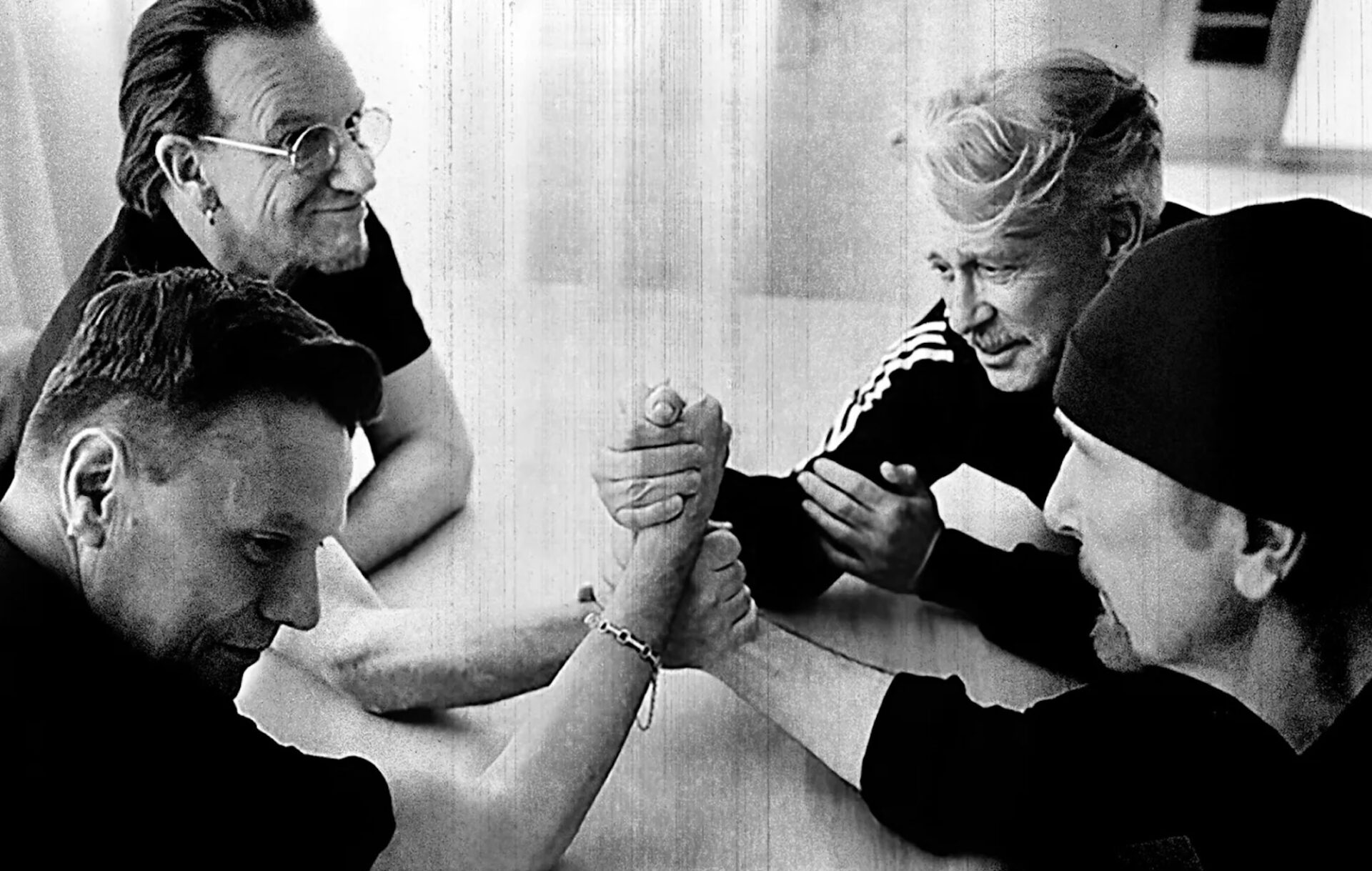
c/o RollingStone UK - "U2 surprise-drop politically charged ‘Days of Ash’ EP with six new songs"

The collection delves into ICE, Israel, the West Bank, Ukraine, Iran — and features a guest vocal by Ed Sheeran

U2 (RollingStone UK - Picture: Anton Corbijn) 

By Andy Greene

'U2 have emerged from a long hiatus with a surprise six-song EP, Days of Ash, available now, in which they address political flashpoints around the world, including ICE raids in the US, the Iranian uprisings, the war in Ukraine, and Israeli settlements in the West Bank.

The six songs — ‘American Obituary’, ‘The Tears of Things’, ‘Song of the Future’, ‘Wildpeace’, ‘One Life at a Time’ and ‘Yours Eternally’ (featuring Ed Sheeran and Taras Topolia) — are all on streaming platforms. They’ve also created lyric videos for each one.' 

Continued ...


Previously: conflict : war : hope : peace

Monday, October 13, 2025

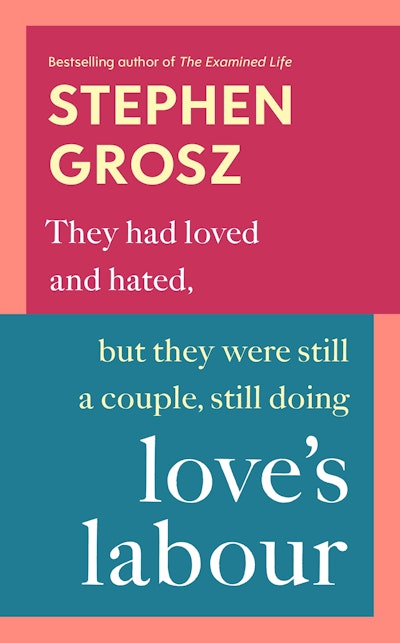
Book: Love's Labour by Stephen Grosz

They had loved and hated,
but they were still a couple, 
still doing love's labour ...

Luminous and necessary stories from the psychoanalyst's consulting room; on desire, heartbreak and learning how to love.

When it comes to love why do we find things so difficult? Drawing on over forty years of candid and surprising conversations with his patients, Stephen Grosz asks, what gets in the way of our falling in love? And what must we do to stay there? Penguin UK.
<>
'Ravi, a maths lecturer, is tormented by his wife Sonal's supposed infidelity, but won't look at the CCTV - even though that might reveal her to be innocent. This chapter has a sting in its tail when 19 years later Grosz is contacted by Sonal. She is dying of cancer and Ravi is cruelly neglecting her. Grosz feels that he missed a vital clue all those years ago, concerning Ravi's ingratitude and envy.

This moment of "failure" on Grosz's part forms an aspect of this small book's power. It shows that the psychoanalyst is not a machine, and the process is fallible. But it is also a testament to human complexity. When he hasn't understood the patient sufficiently, Grosz brings the case to his supervisor, and we, the reader, are witness to their exchange.' Life&Arts, FTWeekend.
Individual
|
      INTERPERSONAL    :     SCIENCES               
HUMANISTIC =========================  MECHANISTIC      
 SOCIOLOGY  :    POLITICAL 
|
My source: Kathy O'Shaughnessy. The hard work of seeing ourselves. Books, Life&Arts, FTWeekend, 27-28 September 2025, p.11.


Iamge: https://cdn2.penguin.com.au/covers/400/9780701188979.jpg

Sunday, August 24, 2025

Nothing new under the Sun . . .

"The quadrangle is the token of a new humanity. The square is to us what the cross was to the early Christians". 

Theo van Doesburg

Tate Liverpool visit 13th June 2008.

Saturday, August 16, 2025

Women, human rights after 4 years ...

. . . in Afghanistan


Individual
|
      INTERPERSONAL    :     SCIENCES               
HUMANISTIC  --------------------------------------  MECHANISTIC      
 SOCIOLOGY  :    POLITICAL 
|
Group

A woman
A girl

Personhood
Personal identity
Dehumanisation
Self-expression


objectification
defined


A girl
A women

Cultural life
Psycho-Social
Community life
- denied


Gender crimes against girls & women
Human Rights denial
Law?

National identity
Nationhood?

Previously: 'women' : 'girls' : 'boys' : 'gender'

Monday, June 30, 2025

Assisted Dying Bill - UK

Individual
|
      INTERPERSONAL    :     SCIENCES               
HUMANISTIC  --------------------------------------  MECHANISTIC      
 SOCIOLOGY  :    POLITICAL 
|
Group


Choice by dying person of how they die

Anticipation of role of AI

Where does mental illness 'lie'?

Decision needs approval by two doctors

Change in relationship between:
INDIVIDUAL -
Prognosis of < 6 months

Terminal diagnosis

Anticipation of role of AI

Seek assistance to end their life

Decision needs approval by two doctors

What of patients who are comatose?^
Profound Societal Change

Quality of Life

Quality of Death

Impact of 'poor' death on others - friends and family

Vulnerabiity of certain groups

Lest we forget what happened to the nursing and care home sector during COVID*

and the STATE

UK - House of Lords

Oversight Panel: 
Legal figure e.g., King's Counsel; and a Psychiatrist

Doctors and care workers not compelled to take part in assisted dying

What about the psycho-POLITICS of anorexia, severe depression?


^Brian M. Rosenthal. They woke as doctors prepared to remove their organs. The New York Times International Edition, 11 June 2025, p.6. 
https://www.nytimes.com/2025/06/06/us/kentucky-organ-donations.html

Saturday, May 31, 2025

Globally - seeking the ink of scholars

The Ink of the Scholars:
Reflections on Philosophy in Africa


Since the late 1980s, in trying to understand Hodges' model, especially its political dimensions beyond nurses as advocates, the mental health act, choice and self-determination. To be followed by consent, then informed consent, mental capacity, human rights, equality, protected characteristics, safeguarding, equity, social in-justice; I've then questioned my assumed neutrality of the model. 

Allied to this is the fact that Hodges' model is one of many models and frameworks, largely created in the developed world. What alternative viewpointsof nursing, care and philosophies are there? Do these challenge Hodges' model? Or, can Hodges' model also encompass them, in a complementary manner?

Serendipity, or ADHD, seems to follow me around. In addition determined to extract value from my purchase and reading of the weekend FT, I learned of potential key read:


Prempeh, C. THE AESTHETE. Koyo Kouoh, The curator of 2026 Venice Biennale talks whisky sours, working from bed and being the "high priestess of the okra church". HTSI, FTWeekend, 3 May 2025,pp.21-22.

'THE BEST BOOK I'VE READ IN THE PAST YEAR is a book on African philosophers, The Ink of the Scholars: Reflections on Philosophy in Africa, by Souleymane Bachir Diagne, one of our most brilliant thinkers. He challenges the idea that there isn't a philosophical framework to African societies. There are ideas around Africans being the great architects of hospitality and Diagne reflects on what the African approach to humanity is. What does it mean to be careful, mindful and caring? It's not just about welcoming people to your home or feeding them. Hospitality is carrying people, making people feel comfortable in your environment - it's intellectual and emotional. Everyone should read Diagne, full stop.' p.21. 
 

Shocked: I have just read of Koyo Kouoh's passing - RIP. 

Souleymane Bachir Diagne, & Jonathan Adjemian. (2016, May 23). The Ink of the Scholars: Reflections on Philosophy in Africa. CODESRIA Books Publication System. CODESRIA
https://publication.codesria.org/index.php/pub/catalog/book/40

See also: 'hospitality'

Wednesday, February 12, 2025

Book review #3: Handbook on the Ethics of AI

I've started several 'gap' lists, including a draft post or two. Seeking to help bridge the theory-practice gap is an original purpose for Hodges' model.

Friedman's chapter 5 Responding to the (techno) Responsibility Gap(s). It is almost as if Friedman's title is parameterised. We could insert the domains of Hodges' model (plus, spiritual - safeguarding!) in there. Then there is the magic of languages, for responsibility substitute accountability and do a deep-dive applying Hodges' model in a specific domain. Friedman notes it is not entirely accurate to talk of a single "responsibility gap". Can this provide evidence for the situated potentiality of Hodges' model's and role in fostering situational awareness? Although there is an ongoing roll-back of CSR - corporate social responsibility, I scribbled in the margin:

INDIVIDUAL
|
      INTERPERSONAL    :     SCIENCES               
HUMANISTIC  --------------------------------------  MECHANISTIC      
 SOCIOLOGY  :    POLITICAL 
|
GROUP
user
user
user
corporate

Of course, 'user' still applies in the political domain, as we are all citizens; users of the State (note also the socio-technical utility of keeping the 'user' in sight). There is also personal ethics, and the legal duty of care - as a nurse (in my case) and for a member of the public. Discussion on notions of responsibility, in light of AI, especially self-driving vehicles, and autonomous machines (weapons) is much needed. Regulatory gaps are recognised; amid current news of debate on the degree of regulation of national and international financial systems. Nyholm's four-fold formulation on responsibility is invaluable as examples are provided. There is a reference to nine notions of responsibility, and the link to accountability and retribution.  I like Friedman's  discussion of responses to responsibility gaps as; optimists - technological approach; human-centred and hybrid approaches; plus pessimists (4.3). The latter includes debate and campaigns to 'stop the killer robots'. Did this chapter, have a positive effect in extending thoughts about events in the middle east? There are two points here I will return to in the final post.

For students, Schwarz's chapter 6 takes readers back to a literally pivotal development in ethical thought and debate: Trolleyology, with the addition of algorithms and killer robots. What Searle's Chinese Room (noted p.276 here) argument is to AI; so trolley-based dilemmas are to ethics. A point made by Schwarz, referring to the development of subsequent variations. (Following on from #2, Brian Magee's interviews with John Searle on philosophy of language and Wittgenstein are also well worth a listen.) Schwarz's chapter (and the whole book) could be read in preparation for an undergraduate course: computing, law, policy, philosophy, and ethics, for example. The challenge of determining responsibility and accountability "the problem of many hands" (p.71), is not limited to AI. This is a global issue in achieving justice for many previously healthy, competent, quite 'ordinary' people.

The question posed above, applies "equally"(!) here too: 3. mathematical morality for war. Ever since reading of argumentation through the Open University and other sources, I'm sure this is applicable to Hodges' model (with its 'own' algebra)? I'm no mathematician but the book provoked excitement rather than anxiety as I read: 'Principle of Permissible Harm (PPH) and probabilistic reasoning - with formulae (pp.88-89). There are some important (imho) 'take-away' messages here, but I don't want to spoil things. Nurses need mathematical skills, in drug calculations and are assessed on the same. Statistics are used in research, of course but maths is hardly the primary motivation for entry into the care professions: 
'Designing technologies in a way that takes into account broader human-centric values is an important and laudable approach to responding to new and emerging technologies in any arena. It cannot, however, serve as a substitute for moral deliberation and the act of taking moral responsibility for harmful acts, especially when lives are at stake. Reducing this to a mathematical problem ignores everything that cannot be captured in discrete numerical terms or as data points. And in situations where people and their lives become nothing more than data points, non-computational aspects, such as relational or embodied dimensions of human life, are marginalized if not entirely obscured. The real world is not reducible to binary logic, it is rife with contested, contradictory, and clashing values that might all be equally relevant It is complex in ways that cannot always be neatly captured or mathematically modeled. In other words, ethics cannot be "solved."' p.91.
More to follow ...

Handbook on the Ethics of Artificial Intelligence. David J. Gunkel (ed.). Cheltenham, UK: Edward Elgar Publishing Ltd. ISBN: 978 1 80392 671 1245

https://www.e-elgar.com/shop/gbp/handbook-on-the-ethics-of-artificial-intelligence-9781803926711.html


Related previous posts: 'general + AI'

Monday, February 10, 2025

Book review: Handbook on the Ethics of AI #2

Well, I am sold. So, encouraging again to read 'reflect -ion' on the first page and throughout chapter 1:

'... why the very idea of AI gives rise to (or should give rise to) ethical reflection.' (p.21), and I'm sure the book as a whole.

Most readers may pass this by, but to me this matters. Ethics scholars however will see how important and conjoint reflection is to deliberation and argumentation of ethics. Especially, as noted in post #1 the five part division of the text Foundations and Context; Responsibilities; Rights; Politics and Power; and Thinking Otherwise. 

Tables break up and inform the text. I like the way for many tables the source is: Author's own elaboration.
Given the subject matter, yes, the authors have the literature but they are also formulating their chosen theme against the present, near future, socio-political scenarios and much more. So, reflection - this should be expected. With Hodges' model I'm often asked why are those concepts placed in that particular domain? Perhaps that is a question for general artificial intelligence? Subjectivity is a key challenge, and its effective communication.

If I say, chapter 1 is a great primer on What Is This Thing Called the Ethics of AI and What Calls for It? I'd sell the book short, the whole text fulfills this purpose. The definitions and responses to What is A.I. are very helpful, taking into account ancient to more recent history. I've a book in a box by David Chalmers (sorry Prof.) - one day - which helps here discussing intelligence and consciousness.

I'm primed to pick up on 'gaps' (Theory-Practice) and in human experience they are inevitably legion. The responsibility gap (and meaningfulness!) c/o Sven Nyholm is a place to return to, to debate why A.I. raises such a broad range of ethical issues. Patiency is never far away. Here, the patient is stark: in  moral agents and moral patients (p.20 and 89). This blog is littered with posts on Drupal, which to date I have never mastered. I remember sitting in DrupalCon presentations, in the midst very skilled professional coders. A member of the community stood at the podium recounting their lived experience of impostor syndrome. In November with a presentation of my own, I had my own encounter. Well into reading this book, it really did help. The conclusion of chapter 1 contrasts the frequent need for a big-picture overview and reflection on more specific issues. That's quite fitting for me.

I am biased in the encouraging kernels I find: as seek them I do. Yes, as chapter 2 AI Ethics before Frankenstein begins: 'there remains work to be done in charting the long-range conceptual development of  AI in the history of political thought.' (p.27, my emphasis). And much more I hope. Chapter 2 combines literature, myth and I enjoyed the discussion on techne, Prometheus, Hobbes, the interdisciplinary bridge of techno-politics and articulating the mechanistic in our lives. Focussed recently on thresholds and threshold concepts in revising two papers: Hunt writes, 'Frankenstein is a "threshold" text for "modern political science fiction" (p.31). 

This  resonated - especially 'for its prediction that the nascent Enlightenment-era sciences of chemistry, anatomy, and electricity could be used to artificially make a human being' (p.31). The exploration of bad education and bad governance through Shelley and social history is other-worldly in itself. Hunt's conclusion which includes 'Wollstonecraft was the pivotal figure in the process of refracting ideas of AI from Hobbes to Shelley, ...' left me wondering about the refactoring of code. 

Chapter 3, Smith's Faith, Tech, and Ethics of AI brings more reflect -ion with the bonus for me of Descartes. On faith, the human situation is also repeatedly stressed. Delving into creation too, this is detailed on forms of theology - Augustine, Bede, for example, and philosophy Bacon, Hume, Kant and their role in diminishing the influence of religious thought and epistemology (p.39). How long a push was that? Surely it is ongoing - in some quarters? Medieval thought is discussed, and I recall this broad period also being regarded as misunderstood [Medieval Philosophy - Bryan Magee & Anthony Kenny (1987)] . 

On a personal level, I've always placed belief in the intra- interpersonal domain of Hodges' model. In psychosis, depression, anxiety, phobias in short mental health, beliefs can be disrupted, and influenced of course when all is well. Religion I have framed at the individual and socio-political level. Clinically, it is the individual patient's beliefs, if they follow a particular religion that we also need to be cognizant of as health personnel. Machine, or human; object or being as Smith asks:

SELF / INDIVIDUAL  -  OBJECT / THING
|
      INTERPERSONAL    :     SCIENCES               
HUMANISTIC  --------------------------------------  MECHANISTIC      
 SOCIOLOGY  :    POLITICAL 
|
GROUP

the human -

the machine -


- can become machine

- can become human


socio-


-political

There is depth of discussion too: in AI and Power; a Christian response to AI ethics. This handbook is not just for quick reference. There is indeed redemption (p.43) to be found:

'It is easier to cover a blemish than examine why it resulted in the first place: genetics, diet, stress, or lack of self-care.'

I argue for Hodges' model as a tool to identify, (re)present, and relate the determinants of health: all of them. The points and paragraphs on theology, mind, body and self are well worth revisiting.

Johnson's chapter 4, What are Responsible AI researchers really arguing about? provides support for my ongoing belief in the value of sociotechnical theories and approaches, and another book on enactivism. Given the ethics of the global south (and technological/electronic colonialism) more could perhaps be made of LMIC, but the point is made in Table 4.1 (Examples of functionalist evaluations of AI models, p.52). Constructivism 2.2 is a rich seam for me. Table 4.2 touches on medical diagnosis and socio-technical. Johnson notes that in seeking answers to AI ethics problems, scientists see constructivist approaches and '.. constructivism as a metaethic, holding a rich space for more research into pluralistic AI-Alignment', (p.53). And, the potential for much more. This is suggested (for me) in reference to the need for a holistic view of AI model's genesis, and 'two sides of one coin' - dichotomy, polarity, oppositions, binary reductions ... ? 

Johnson's conclusion is an indirect thumbs up (cue Arnie style - of course) to Hodges' model as a project. Conceptual frameworks can indeed:
'... offer unique perspectives on the methods commonly employed and to understand and mitigate the risks and dangers of AI.' (p.62).
If ethics gets 'technical' then the book's full title is well-earned. Two case studies demonstrate functionalist and constructivist debates in responsible AI. I don't remember Capt. Kirk et al. stating to a malign alien 'intelligence' "The trophy doesn't fit in the suitcase because it's too large (small)," (p.58). The writer's put other solutions to the characters lips. Spock, however, would find the discussion here on 'Artificial General Intelligence, 4E Cognition and Enactivism' - "Fascinating!"

Much more to follow ...

Handbook on the Ethics of Artificial Intelligence. David J. Gunkel (ed.). Cheltenham, UK: Edward Elgar Publishing Ltd. ISBN: 978 1 80392 671 1245
https://www.e-elgar.com/shop/gbp/handbook-on-the-ethics-of-artificial-intelligence-9781803926711.html


Related previous posts: 'general + AI'