Hodges' Model: Welcome to the QUAD: peoples

Hodges' model is a conceptual framework to support reflection and critical thinking. Situated, the model can help integrate all disciplines (academic and professional). Amid news items, are posts that illustrate the scope and application of the model. A bibliography and A4 template are provided in the sidebar. Welcome to the QUAD ...

Showing posts with label peoples. Show all posts

Tuesday, February 24, 2026

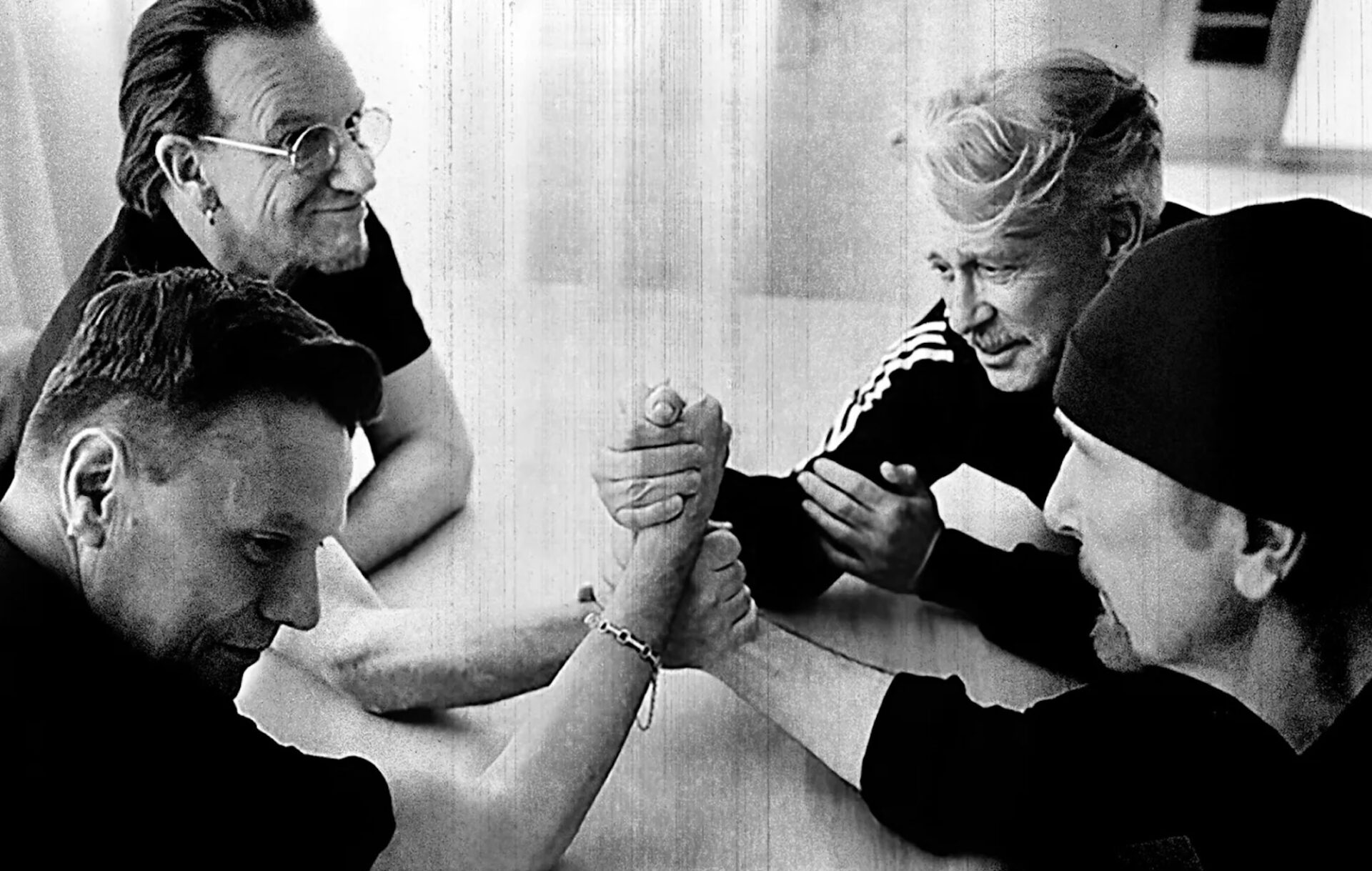
c/o RollingStone UK - "U2 surprise-drop politically charged ‘Days of Ash’ EP with six new songs"

The collection delves into ICE, Israel, the West Bank, Ukraine, Iran — and features a guest vocal by Ed Sheeran

U2 (RollingStone UK - Picture: Anton Corbijn) 

By Andy Greene

'U2 have emerged from a long hiatus with a surprise six-song EP, Days of Ash, available now, in which they address political flashpoints around the world, including ICE raids in the US, the Iranian uprisings, the war in Ukraine, and Israeli settlements in the West Bank.

The six songs — ‘American Obituary’, ‘The Tears of Things’, ‘Song of the Future’, ‘Wildpeace’, ‘One Life at a Time’ and ‘Yours Eternally’ (featuring Ed Sheeran and Taras Topolia) — are all on streaming platforms. They’ve also created lyric videos for each one.' 

Continued ...


Previously: conflict : war : hope : peace

Thursday, December 04, 2025

Yuki Kihara: Darwin in Paradise Camp - The Whitworth, Manchester

3 October 2025 – 1 March 2026

'A visually stunning exhibition centring Indigenous, queer worlds by Japanese-Sāmoan artist Yuki Kihara.
The Whitworth is proud to present Yuki Kihara’s acclaimed installation Paradise Camp (2022), first presented at the Aotearoa New Zealand Pavilion in the 59th Venice Biennale in 2022, and a new video work, Darwin Drag (2025).

Kihara delves into art histories and archives to unpick the effects of colonialism on the peoples and ecologies of the Pacific. Her visually compelling projects centre and empower the Fa’afafine and Fa’atama in Sāmoa, traditional yet marginalised third gender communities to which the artist belongs. In this exhibition, Kihara focuses on two celebrated Western figures – French modernist artist Paul Gauguin and evolutionary biologist Charles Darwin (1809-1882) – who each shaped Western understandings of the Pacific.

Paradise Camp responds to famous paintings of Tahiti and its people by French modernist artist Paul Gauguin (1848-1903). Through archival research, Kihara links Gauguin’s paintings to colonial photographs taken in Sāmoa. Described by Kihara as an act of 'upcycling', she recreates Gauguin’s compositions in a series of 12 resplendent high definition photographs, shot on location in Upolu Island. Collaborating with Fa’afafine models and production crew, Kihara repurposes these cultural artefacts to speak to, and from, queer Indigenous worlds in a profound gesture of reclamation.'

My source:

Josh Lustig. Yuki Kihara, Gallery, FT Magazine, November 22, 2025, #1152. pp.12-13.

Tuesday, August 12, 2025

Revisiting the G7 ... G20

'Under the Trump administration, the US is retreating from the global leadership role it has played since the end of the second world war. The world is bedevilled with challenges and there is a desperate need for stability and co-ordinated solutions to global problems. Where will the leadership to solve them come from? 

Some have argued that we are now in a "G zero" world in which no one is in charge. There is great uncertainty and the powerful dictate solutions to smaller players. Others say we are moving to a regional carve up - a G3 where the US. Russia and China have spheres of influence in a modern day version of the Three Emperors League. 
Some version of a new multi-polar order may yet take shape. But it also seems clear that a G minus one world is starting to fill the vacuum in some domains — with countries coming together to find solutions to global problems without the US.' p.11.
 
Individual
|
      INTERPERSONAL    :     SCIENCES               
HUMANISTIC  --------------------------------------  MECHANISTIC      
 SOCIOLOGY  :    POLITICAL 
|
Group
imaginary -

*You cast your vote and get the 
global leadership we all deserve. ...

- numbers


... Discuss.

G20
G7
G-0?
Goto*


My source: 
Minouche Shafik, How to live in a G minus one world, Opinion, FTWeekend. 26-27 July 2025, p.11.
https://www.ft.com/content/7b884f20-e44e-4afe-9c0c-0c602f76b3f6

Previously: 'G7'

Friday, July 04, 2025

Diagrams - AMO/OMA at Prada Foundation Venice

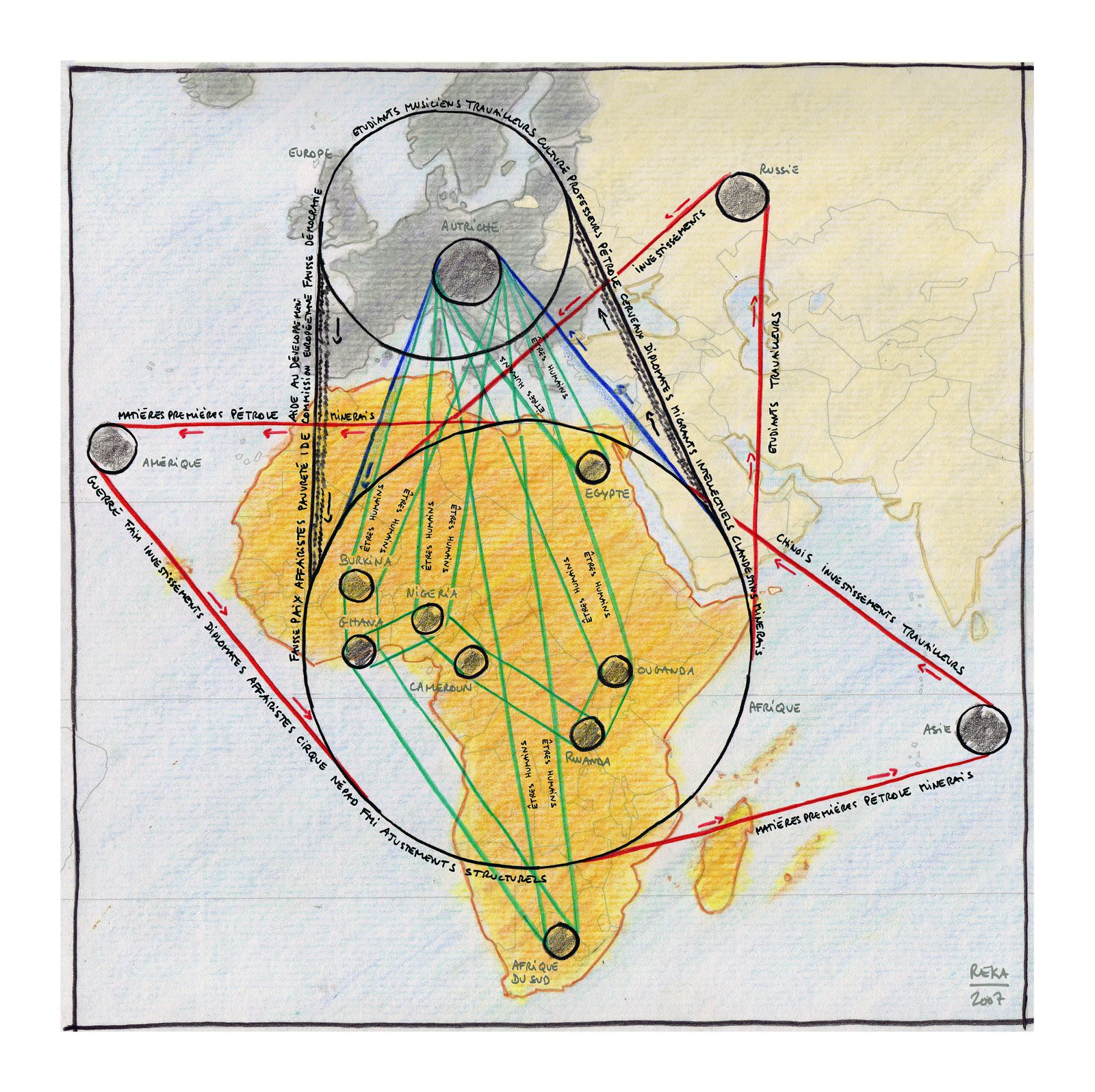
"There is no such thing as an innocent map, observes Philippe Rekacewicz in his catalogue essay that accompanies Diagrams, a new exhibition at the Prada Foundation in Venice.

A renowned cartographer, the Paris-born Rekacewicz is well aware of his medium's capacity to transform narratives for good and ill. His own work includes maps that illustrate the deaths of migrants as they bid for new lives in Europe. "A map," Rekacewicz continues, "is above all a social and political act - and therefore inherently subjective."' p.5.

Individual
|
      INTERPERSONAL    :     SCIENCES               
HUMANISTIC  --------------------------------------  MECHANISTIC      
 SOCIOLOGY  :    POLITICAL 
|
Group
Am I Free?

My history ...
Philippe Rekacewicz / The African big wheel, 2007
The wheel symbolizes permanence and continuity in the context of a profoundly unequal exchange, drawing, color pencil and ink, exhibition copy.
Courtesy Philippe Rekacewicz
(Image credit: Philippe Rekacewicz)

SOCIETY

... is our history ...

Freedom

National & International Law

Justice


'Other pictures are equally revealing for what they conceal. Consider the diagram entitled "Universal commercial history", a visual analysis drawn up by the Scottish engineer William Playfair in 1805 which traces the rise and fall of global wealth since 1500 BC against what he terms "Remarkable Events Relative to Commerce". Playfair, who is said to have invented the pie chart, includes moments such as "Rome founded" "Mahomet's Flight" and "America discovered". He never mentions slavery.

With such a broad-brush approach, lacunae are inevitable. It is a shame that the work of Viennese social scientist Otto Neurath - who, along with his wife Marie and colleague Gerd Arntz, invented the Isotype (International System of Typographic Picture Education) - is not on show. Based on pictograms, Neurath's Isotypes are an lmportant forerunner to the digital vernacular (from emojis to icons) so familiar to us today. Nor does the exhibition include maps of the devastation of Gaza since October 2023, such as those made by investigative research agency Forensic Architecture, which are proving among the most critical diagrams of our time.' p.5.

Philippe Rekacewicz - https://www.grida.no/resources/10988

My source:
Rachel Spence. Hidden truths in the best laid plans. Diagrams | What charts, maps and graphics can - and can't - tell us. Collecting, FTWeekend. 26-27 April 2025. p.5. 
With many thanks acknowledging length of quotation.

Image source:
https://www.wallpaper.com/architecture/oma-amo-diagrams-prada-foundation-venice

See also: 'icon' : 'symbols' : 'diagram' : 'map' : 'Forensic Architecture'

Archived listing Links II Sciences - inc. 'Diagrams' & 'Visualization I' and 'II': 

Thursday, May 29, 2025

Health Policy Watch: WHO’s Big Push to Integrate Traditional Medicine into Global Healthcare Framework

This is quite a development for the lived experience of all individuals, global health and for Hodges' model. Not only for Hodges' model as a universal framework (template) and model for / of care, but the capacity of Hodges' model to conceptually and culturally encompass all data, information, knowledge and wisdom.

c/o HIFA list:

Full text: https://healthpolicy-watch.news/whos-big-push-to-integrate-traditional-medicine-into-global-healthcare-framework/

'The World Health Assembly delivered a landmark victory for traditional medicine and indigenous cultures Monday evening, approving a strategy that calls for increased investment in research and integrating ancient healing practices into modern healthcare systems worldwide.
'The approval marks a breakthrough moment for advocates of traditional medicine, with nations across Asia, Africa, the Middle East and Latin America celebrating the decision. Iran called it “a visionary yet realistic roadmap” to integrate thousands of years of medical like its own.

'But the strategy text shows WHO walking a careful tightrope, embracing practices that represent “accumulated wisdom and healing practices passed down through generations” while demanding they meet modern scientific evidence standards that could take decades to satisfy...'
Best wishes, Neil

HIFA profile: Neil Pakenham-Walsh is coordinator of HIFA (Healthcare Information For All), a global health community that brings all stakeholders together around the shared goal of universal access to reliable healthcare information.

See also: 'Oceania' : 'indigenous' : 'ancient' : 'map' : 'nature'

Wednesday, April 30, 2025

Global South - Global Perspectives

As mentioned before, I try to keep grounded, in terms of my parochial perspective on the world, even as technology brings this world, and many others to so many screens.

 BBC Radio 4 'PM' 1700-1800 UT today mentioned this news and an event to follow:

Mākereti "Maggie" Papakura was an internationally renowned Whakarewarewa guide.

  • 'Oxford University will award a posthumous Master of Philosophy degree to pioneering Māori scholar Mākereti Papakura.
  • Papakura, known as Guide Maggie, was the first indigenous woman to study at Oxford.
  • Her work, published posthumously, was the first ethnographic study by a Māori author.
Pioneering Maori scholar and famed Whakarewarewa guide Mākereti Papakura will be honoured with a posthumous degree more than 100 years after she began her studies, Oxford University has announced.

Her family and iwi say they are grateful for the tribute to her memory, and it is testament to her determination to ensure Māori stories would not be forgotten.

Born in 1873 at Matatā, Papakura is believed to be the first indigenous woman to study at the university, Oxford’s School of Anthropology and Museum Ethnography said in a statement.

She made her name as the pre-eminent guide at Whakarewarewa in the early 1900s and was known as Guide Maggie'. . . .

...  I will watch for further news. 

The above stood out as last evening I greatly enjoyed listening to Discovery on the BBC World Service:

'Dr Julia Ravey and Dr Ella Hubber are both scientists, but it turns out there’s a lot they don’t know about the women that came before them. In Unstoppable, Julia and Ella tell each other the hidden, world-shaping stories of the scientists, engineers and innovators that they wish they’d known about when they were starting out in science. This week, a Māori marine scientist is combining indigenous knowledge with marine science to save the oceans that are so integral to her heritage. ...'

Image and text:
https://www.nzherald.co.nz/rotorua-daily-post/news/te-arawas-makereti-papakura-to-receive-posthumous-degree-from-oxford-university/SBI3TR733RHZBOAS3BLDAZPMTU/

Previously: 'Oceania'

Thursday, December 12, 2024

forms of Hygiene

A gift for Hodges' model:

 'good prose is like a windowpane'

George Orwell, WHY I WRITE


'How is it that Orwell has become the single answer to so many questions, in so many different subjects, for so many people? His name conjures an amorphous idea of fair play and “common sense”; his spare prose supposedly brings cool nonpartisanship to a world of impassioned blusterers. In keeping your sentences clean, the theory goes, you practise intellectual hygiene (“good prose is like a windowpane” and all that). A single word, “Orwellian”, evokes the great man’s foresight about the dangers of an overweening nanny state, a censorious far-left or whatever else may be getting your goat that day.'
Naoise Dolan, Why weak thinkers love Orwell, FT Weekend Magazine, October 19/20, 2024, pp.16-18.


INDIVIDUAL
|
INTERPERSONAL : SCIENCES              
humanistic ------------------------------- mechanistic
SOCIOLOGY : POLITICAL   
|
GROUP
INTELLECTUAL
MENTAL - EMOTIONAL - SPIRITUAL
(Coping with the 21st Century)

SELF-LIFE SKILLS
(control anxiety - being organised)


Health Literacy: Knowledge and aptitude for forms of HYGIENE

PERSONAL
ENVIRONMENTAL
DOMESTIC
FOOD

HANDS (How to sneeze, cough)
ORAL - DENTAL
CLOTHES
BODY
HAIR (frequency?)

Sustainability - balance


SOCIAL
COMMUNITY/RACIAL HYGIENE
Insertion of memory lest we forget
Insertion of a hook to do - think as we
tolerance for x,y,z


POLITICAL HYGIENE
aka. The Paradox
To Vote : To be counted
CIVIC


Reflecting about this in some contexts, more than others(?) I'm struck by the overlap between hygiene and literacy.

Completing, or attending to, being motivated to undertake - complete hygiene duties depends on knowledge and ability to act. Having basic needs met.
'
'Opening windows always ...'

literature : window

Saturday, September 28, 2024

'It takes a village ...

individual
|
INTERPERSONAL : SCIENCES
humanistic ------------------------------- mechanistic
SOCIOLOGY : POLITICAL
|
group

... to raise a child.'

"The artist returned to this subject almost  twenty years after he had drawn his red chalk  studies of children walking and standing,  shown nearby. As was typical in Rembrandt's  later works, facial expressions and gestures  are indicated with sparse and abbreviated  lines. It is remarkable that with such economy  the artist conveys an encouraging atmosphere  from the figures who surround the child, as it  takes its first steps. The British artist David  Hockney described this as 'a perfect drawing' in an interview in 2016."

1912,0416.2'


Rembrandt van Rijn (1606-1669)
A child being taught to walk, around 1656
 
Pen and brown ink on grey-brown paper.


The British Museum, Room 90. 28th September 2024.
https://www.britishmuseum.org/exhibitions/new-life-rembrandt-and-children


Sunday, August 04, 2024

"No argument, we should teach critical thinking" by Julian Richer

Spring and summer reading includes Our Housing Disaster. Julian Richer's weekly column in the Sunday Times is very interesting; business yes, but socially oriented and positive in the values conveyed.

I'm 100 pages into The Systems View of Life, posts to follow, but before getting to OHD, I noticed another of Richer's columns:

#36 "No argument, we should teach critical thinking"

Sunday 14th July 2024

"... all the successful bosses I’ve ever worked with encourage an open flow of communications in all directions (internally — up, down, across — and with the outside world, too) with no taboos. They try to surround themselves with good people who can see the world independently, draw their own conclusions and have the confidence to express their ideas."

"It’s very difficult to craft a culture of critical thinking and open debate in a business unless it’s been taught at school, as our parents tend to be more stuck in their ways. Unfortunately, schools spend so much time on teaching and testing reading, and particularly writing, that they don’t have enough time to teach thinking and speaking. These require practice, too. And they are also very important life and business skills."
 

The discussion on Parallel Histories reminds me of philosophical talk, virtue-seeking is not enough. It needs to applied practically, if it is to make a difference.


"An added benefit is that kids who have learnt calm and reasoned debate will use this knowledge to help them in their adult life. Certainly, those going on to join the business world will be very pleased to have received these negotiating and people skills, both essential."

Hodges' model provides a structure for reflection, reflective practice, and critical thinking and inevitably light-weight can be carried as lifelong learning resource and tool.

Wednesday, July 17, 2024

'Land Back' - Owens Valley, California

"The vast territory known as Owens Valley in California was home for centuries to Native Americans who lived along its rivers and creeks fed by snowmelt that cascaded down the eastern slopes of the Sierra Nevada. Then came the European settlers, and over time, the Native Americans tribes lost access to nearly all of that land. Eventually, the water was lost too: ...
Less familiar is what happened to the Owens Valley, and the people who lived there, after most of the water was sent south. Owens Lake is now a patchwork of saline pools covered in pink crystals and wetlands studded with gravel mounds designed to catch the dust. And today, the four recognized tribes in the area have less than 2,000 acres (800 hectares) of reservation land, estimated Teri Red owl, a local Native American leader. 
But things are changing, tribal members say. They have recently reclaimed corners of the valley, buoyed by the growing momentum across the United States to return land to Indigenous stewardship, also known as the "Land Back" movement." p.7.

Individual
|
      INTERPERSONAL    :     SCIENCES                   
HUMANISTIC  --------------------------------------  MECHANISTIC      
 SOCIOLOGY  :    POLITICAL 
|
Group


LAND
culture

indigenous peoples

history
BACK


justice


Cowan, J. Native Americans reclaim lost land in California, The New York Times International Edition, June 18, 2024. p.7.

Sunday, May 19, 2024

health - Human - LIFE: Career

As highlighted previously, the full title of Hodges' model was originally The Health Career Model.


Reference to 'career' in there, caused many visitors to the first website, and presumably readers of Brian's book chapter:

Hodges, B.E. (1989) The Health Career Model, IN, Hinchcliffe, S.M. (et al.) 1989 Nursing Practice and Health Care, 1st Edition only, London, Edward Arnold.

- to assume the model concerned professional careers, jobs, and employment.

For this reason after some discussion 'care domains' was added:

Hodges' Health Career - Care Domains - Model

A bit ungainly, but it is important that 'health career' was retained. After 5-10 years since first encountering and applying the model in a case study (1987-88), a key appeal of the model for me was its seeming increase in relevance. This may be a function of familiarity, preoccupation, (growing) obsession but the book below by Goldschmidt is confirmation for me.

Goldschmidt describes the 'Career and the Life Cycle' identifying several stages:
  • Infantile preadaptation
  • Training
  • Career launching
  • Career establishment
  • Career maintenance (pp.113-114).
The first, infantile preadaptation appears associate strongly with the idea of life chances. 

Goldschmidt begins: 
"Career is a lifetime process. The word process here is important. If the English language did not render it too awkward, it would be preferable to make a verb out of it: careering. The major phases in the process relate to the physiological changes as the individual moves from infancy toward his ultimate death." p.113.
"The pursuit of career is not merely a social phenomenon in the sense that the values and purposes are socially derived and hence attainment is reflexive of community attitudes, but because career performance always involves two highly social orientations: collaboration and identification. It is a social performance. No person achieves satisfaction going it alone; he must collaborate with diverse others, usually socially structured groups - family or household, clan, age-mates, work associates, or whatever." p.117.
We need to understand that life chances are often determined before life.


   Individual - Self         
|
      INTERPERSONAL    :     SCIENCES                   
HUMANISTIC  --------------------------------------  MECHANISTIC      
 SOCIOLOGY  :    POLITICAL 
|
   Dyad - Group - Culture - Population 
Identity

Work, roles, activity
 for all.

"The activities of the motivated individual can be conceptualized as his or her career. By career I mean that trajectory through life which each person undergoes, the activities he or she engages in to satisfy physical needs and wants and the even more important social needs and wants. The career, then, is activated in the service of both the physical being and the symbolic self."p.107.


The HUMAN CAREER

Policy
Politics

The health career and human career
of future generations
and all life.

Artificial Intelligence -
Future 'careers'?


Today, the health career entails consideration of the life cycle of all life as we not only contemplate planetary health, but seek to assure the biosphere.


Goldschmidt, W. (1990). The human career: The self in the symbolic world. Oxford: Basil Blackwell.

Book cover: https://biblio.co.nz/walter-goldschmidt/author/99497

Saturday, April 06, 2024

Re. 'Lagoonscapes' - previous post ...

It was the title of the journal in the previous post that caught my attention:

Individual
|
      INTERPERSONAL    :     SCIENCES               
HUMANISTIC  --------------------------------------  MECHANISTIC      
 SOCIOLOGY  :    POLITICAL 
|
Group


'Lagoonscapes' made me think of the periplus, used by ancient explorers - sailors to 'map' coastlines and their features.

I also realised that people living with:
  • more advanced stage dementias
  • reduced mobility / balance
  • partial sightedness
  • stroke
- may negotiate their immediate surroundings (living room ...) using 'furniture walking'.

The first explorers did likewise by analogy?


Is a lagoon - a resting place/space - an offering of respite (care)?

In 2018 the Oceania exhibition at the Royal Academy of Arts

https://www.royalacademy.org.uk/exhibition/oceania

- highlighted knowledge of the peoples who could read the currents, winds - perhaps in as differentiated manner similar to the Inuit and their environment and cultural beliefs?


Previously 'landscape'