Hodges' Model: Welcome to the QUAD: narratives

Hodges' model is a conceptual framework to support reflection and critical thinking. Situated, the model can help integrate all disciplines (academic and professional). Amid news items, are posts that illustrate the scope and application of the model. A bibliography and A4 template are provided in the sidebar. Welcome to the QUAD ...

Showing posts with label narratives. Show all posts

Saturday, June 14, 2025

Call for Papers: Compassionate Futures for Collective Well-Being

Despite an academic affiliation, without any (part-time) tutoring hours this past year, it may be difficult to avoid article processing fees (APCs). A shame as I believe that Hodges' model can address this call (below) in a somewhat novel manner. 
If anyone is interested in exploring a writing project framed around Hodges' model and employing a relational - diagrammatic approach please let me know.
The exercise would be greatly enhanced by:
  1. Engaging with one of more academics, adept in formal methods (maths, logic..?) and keen to apply their talents within the social sciences - humanities.
  2. And, exploring the possibility of working with early career researchers, including from developing nations, independent and 'late career'(!) scholars would also be very welcome.

Previously:

Jones, P. (2004) Viewpoint: Can informatics and holistic multidisciplinary care be harmonised? British Journal of Healthcare Computing & Information Management, 21, 6, 17-18.

Jones, P. (2004) The Four Care Domains: Situations Worthy of Research. Conference: Building & Bridging Community Networks: Knowledge, Innovation & Diversity through Communication, Brighton, UK.

Jones, P. (2008) Exploring Serres’ Atlas, Hodges’ Knowledge Domains and the Fusion of Informatics and Cultural Horizons, IN Kidd, T., Chen, I. (Eds.) Social Information Technology Connecting Society and Cultural Issues, Idea Group Publishing, Inc. Chap. 7, pp. 96-109.

Jones, P. (2009) Socio-Technical Structures, the Scope of Informatics and Hodges’ model, IN, Staudinger, R., Ostermann, H., Bettina Staudinger, B. (Eds.), Handbook of Research in Nursing Informatics and Socio-Technical Structures, Idea Group Publishing, Inc. Chap. 11, pp. 160-174.

Compassionate Futures for Collective Well-Being

Academic Editors: Karin Hannes (KU Leuven) and Natalia Martini (KU Leuven)

Deadline for Abstracts: 15 September 2025
Deadline for Articles: 30 January 2026

Social Inclusion, peer-reviewed journal indexed in the Social Sciences Citation Index (Web of Science; Impact Factor: 1.4) and Scopus (CiteScore: 3.5), welcomes new and exciting research papers for its upcoming issue "Compassionate Futures for Collective Well-Being," edited by Karin Hannes (KU Leuven) and Natalia Martini (KU Leuven).

In an increasingly unequal world, the concept of “compassionate futures” offers a new paradigm to address the pressing challenges of social inclusion. Compassionate futures recognize vulnerability, interdependency, and mutual responsibility as fundamental features of social relations, and emphasize care and empathy as fundamental principles in designing socio-cultural, economic, and political systems where the collective well-being of diverse actors, human and other-than-human, can flourish.

We encourage contributions that engage in an interdisciplinary dialogue among scholars, practitioners, and policymakers about what it means to create a caring society in the face of persistent inequalities. In addition, we welcome papers that demonstrate where and how humans take up the responsibility to conceptualize compassionate futures from a multi-species perspective, as well as those that focus on what hinders or supports the idea and the project of compassionate futures. We accept theoretical papers presenting frameworks on compassionate futures, prospective policy analyses, cases featuring the use of futures studies and co-creative approaches that promote compassion and care as central principles in re-imagining the future, and reflection papers focusing on global cooperation for fostering compassionate futures. Authors should connect to the general idea of how humans could or should relate to other agents with whom they share the planet or illustrate how the new narratives they developed support collective well-being.

Authors interested in submitting a paper to this issue are encouraged to read the full call for papers here:

https://www.cogitatiopress.com/socialinclusion/pages/view/nextissues#CompassionateFutures

Abstracts welcome until 15 September 2025.

Kindest regards,

Mariana
Mariana Pires
Social Inclusion
Cogitatio Press
1070-129 Lisbon 
Portugal
New issues (open access):
Public Participation Amidst Hostility: When the Uninvited Shape Matters of Collective Concern
https://www.cogitatiopress.com/socialinclusion/issue/view/419

Violence, Hate Speech, and Gender Bias: Challenges to an Inclusive Digital Environment
https://www.cogitatiopress.com/socialinclusion/issue/view/415

My source: https://www.jiscmail.ac.uk/cgi-bin/webadmin?A0=COMPLEXITY-PRIMARY-CARE

Wednesday, April 30, 2025

Global South - Global Perspectives

As mentioned before, I try to keep grounded, in terms of my parochial perspective on the world, even as technology brings this world, and many others to so many screens.

 BBC Radio 4 'PM' 1700-1800 UT today mentioned this news and an event to follow:

Mākereti "Maggie" Papakura was an internationally renowned Whakarewarewa guide.

  • 'Oxford University will award a posthumous Master of Philosophy degree to pioneering Māori scholar Mākereti Papakura.
  • Papakura, known as Guide Maggie, was the first indigenous woman to study at Oxford.
  • Her work, published posthumously, was the first ethnographic study by a Māori author.
Pioneering Maori scholar and famed Whakarewarewa guide Mākereti Papakura will be honoured with a posthumous degree more than 100 years after she began her studies, Oxford University has announced.

Her family and iwi say they are grateful for the tribute to her memory, and it is testament to her determination to ensure Māori stories would not be forgotten.

Born in 1873 at Matatā, Papakura is believed to be the first indigenous woman to study at the university, Oxford’s School of Anthropology and Museum Ethnography said in a statement.

She made her name as the pre-eminent guide at Whakarewarewa in the early 1900s and was known as Guide Maggie'. . . .

...  I will watch for further news. 

The above stood out as last evening I greatly enjoyed listening to Discovery on the BBC World Service:

'Dr Julia Ravey and Dr Ella Hubber are both scientists, but it turns out there’s a lot they don’t know about the women that came before them. In Unstoppable, Julia and Ella tell each other the hidden, world-shaping stories of the scientists, engineers and innovators that they wish they’d known about when they were starting out in science. This week, a Māori marine scientist is combining indigenous knowledge with marine science to save the oceans that are so integral to her heritage. ...'

Image and text:
https://www.nzherald.co.nz/rotorua-daily-post/news/te-arawas-makereti-papakura-to-receive-posthumous-degree-from-oxford-university/SBI3TR733RHZBOAS3BLDAZPMTU/

Previously: 'Oceania'

Friday, April 18, 2025

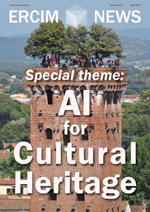
ERCIM News No. 141 Special theme: "AI for Cultural Heritage"

Dear ERCIM News reader,

The April 2025 issue of ERCIM News (Number 141) is now online! The articles featured in this issue highlight the wide spectrum of applications in the cultural heritage field that benefit from AI, as well as the diverse forms of AI being employed across the sector.

Including:

Who Are You, AI? – Artificial Intelligence as a Potential Metaphysical Humiliation of Humanity. pp.32-33.

By Michael Fleischhacker (University of Applied Sciences Burgenland), 
Igor Ivkić (University of Applied Sciences Burgenland and Lancaster University), and Friedrich Roithmayr (University of Applied Sciences Burgenland) 
'Artificial Intelligence as a potential fourth metaphysical humiliation—questioning human uniqueness in reason, freedom, and moral standing, and unsettling our place in the world after Copernicus, Darwin, and Freud.'

My source:
Peter Kunz
ERCIM
https://www.ercim.eu
https://ercim-news.ercim.eu

Follow us on LinkedIn: https://www.linkedin.com/company/ercim
Join the ERCIM LinkedIn Group: https://www.linkedin.com/groups/81390/
Follow us on X: https://x.com/ercim_news