Hodges' Model: Welcome to the QUAD: EU

Hodges' model is a conceptual framework to support reflection and critical thinking. Situated, the model can help integrate all disciplines (academic and professional). Amid news items, are posts that illustrate the scope and application of the model. A bibliography and A4 template are provided in the sidebar. Welcome to the QUAD ...

Showing posts with label EU. Show all posts

Tuesday, October 06, 2026

ERCIM News 146 Special Theme: "Quantum Technology"

ERCIM News 146 Cover

Dear ERCIM News reader,

Quantum technology is increasingly becoming part of real-world systems. 

This issue looks at quantum algorithms, secure communication, hybrid computing, software and sensing, highlighting recent advances and the challenges of putting them into practice. The Special Theme was guest edited by Miroslav Dobsicek (RISE), Sebastian Raubitzek (SBA Research) and Filippo Vella (CNR-ICAR).

Introduction

by Miroslav Dobsicek (RISE),  Sebastian Raubitzek (SBA Research) and Filippo Vella (CNR-ICAR)

In recent years, major advances in quantum hardware, algorithms and software have created great  opportunities for scientific discovery and industrial innovation. What can be observed is that quantum technology is entering a new phase where systems are becoming the central focus. Progress is no longer defined only by better qubits, individual algorithms or isolated demonstrations, but increasingly by whether quantum components can be integrated with classical computing, software, networks, sensing platforms and real applications. This transition, from quantum components to quantum systems, is changing both the research questions and the criteria by which progress should be judged
Read more ...

Includes:

Quantum Retina: A Quantum Eye on the Brain and Other Things, pp.43-44. (brain imaging, Parkinson's disease)

Read the October 2026 Issue

This issue in PDF

Next Issue

No. 147 — January 2027
Special Theme: Data Spaces
Call for Contributions

See also:

https://www.ercim.eu/events (AI - ethics, ...)

My source with thanks: peter.kunz AT ercim.eu

Friday, July 03, 2026

ERCIM News No. 145 Special theme: "E-Values - Statistical Testing for the 21st Century"

ERCIM NEWS No. 145 -

Dear ERCIM News reader, ever heard of e-values?

If not, you're probably not alone. 

Michael I. Jordan opens this issue with a keynote introducing the concept:

What is an “e-value” and why has it become an object of intense study in statistics and in the allied fields of machine learning, signal processing, and econometrics? To briefly introduce the basic idea, let us consider one of the core problems in statistics – the “hypothesis testing problem” of deciding whether observed data is consistent with some particular data-generating mechanism (often referred to as a “null hypothesis”) or is better explained by another mechanism (referred to as an “alternative hypothesis”). This problem is addressed by defining some function of the data (a “statistic”) whose distribution is as different as possible under the null and the alternative. Given an observed value of such a statistic, one then makes a choice between the two distributions, doing so in a way that minimizes the probability of errors. Classical statistical theory provides a unifying framework – the “p-value” – by which the choice between the null and alternative hypotheses reduces to a thresholding procedure.


Guest editors Peter Grünwald (CWI and Leiden University), Wouter Koolen (CWI and University of Twente) and Johanna Ziegel (ETH Zurich) guide readers through this emerging framework for quantifying statistical evidence. 

The articles in this special theme demonstrate how it is already finding applications across many areas of scientific research, from clinical trials and microbiome studies to political polls, AI evaluation and financial risk backtesting.


<>

I must admit when I read 'e-values', I thought of an e-rendering of ethics - humanities and sciences (qualitative-quantitative : subjective-objective : ...), but as always a welcome resource.

Includes:

p.6 Introduction to the Special Theme - E-values Statistical Testing for the 21st Century
by the guest editors Peter Grünwald (CWI and Leiden University), Wouter Koolen (CWI and University of Twente) and Johanna Ziegel (ETH Zurich) 

p.8 On Testing by Imaginary Betting^
by Glenn Shafer

'Cournot’s principle does a lot of work. We predict events that have very high probability. We use the happening of events with very small probabilities to discredit theories that attribute the small probabilities to them. (Here the small probabilities are called p-values.)'. p.8.

p.37 Large Language Models as Design Partners: Automating Graphical Mockups to Refine Requirements
by Giovanna Broccia, Maurice H. ter Beek (CNR-ISTI), and Alessio Ferrari (University College Dublin and CNR-ISTI) 

p.39 Challenges in Small-Scale Medical Data Exchange Platform Development
by Hubert Schölnast, Peter Kieseberg, Patrick Kochberger and Henri Ruotsalainen (University of Applied Sciences St. Pölten) 

p.42 SCIANCE: AI for Scientific Discovery in Europe
by András Benczúr, Edina Nemeth (SZTAKI), Jonas L'Haridon (European Science Foundation) and Magdalena Brus (EGI Foundation)

My source: Peter Kunz c/o ERCIM News

^As a community mental health nurse I have a problem with the betting and gambling industries. Yes, many participants 'gamble responsibly', they know when to take a break. They understand the house rules. For a significant number of the population, they are vulnerable. Bitcoin is another example. There the 'house' is continually re-built after successive collapses. But the mathematics here in p-values, v-values and in clinical reasoning is also significant as a crucial element whether naive or formal research.

I have always thought that -

  1. Hodges' model presents an implicit theory (as per many models - given their purpose).
  2. It follows, that Hodges' model can also do a lot of work.

Wednesday, April 22, 2026

ERCIM News No. 144 Special theme: "Advancing Open Science"


Dear ERCIM News reader,

ERCIM News 144 is now online [in PDF also]! This issue is dedicated to Advancing Open Science. Open Science is becoming an essential part of the European research landscape, shaping how knowledge, data, software, infrastructures and results are shared, reused and sustained.

The contributions collected in this special theme offer a cross-section insight into the current European effort to make research more open, transparent, collaborative and reusable.

This special theme was coordinated by our guest editors Leonardo Candela (CNR-ISTI) and Roberto Di Cosmo (Inria and University Paris Cité).

Includes: [PJ]

Rethinking Researcher Profiles in the Research Assessment Transition Era: The OpenAIRE Approach. pp.9-10.

P. Manghi, et al., “OpenAIRE Graph Dataset (10.6.0) [Data set]”, OpenAIRE.
https://doi.org/10.5281/zenodo.17725827

BibTexViz: Visualizing Research Productivity with Open Science Data. pp.10-12.

D. Hicks, et al., “The Leiden Manifesto for research metrics”, Nature 520, 429-431, 2015.
https://doi.org/10.1038/520429a
T. Munzner, “Visualization Analysis and Design”, CRC Press, 2014. https://doi.org/10.1201/b17511
M. Zaumanis, “Research Data Visualization and Scientific Graphics: For Papers, Presentations and Proposals”, Peer Recognized, 2021.

MOEBA-BIO: An Open and Extensible Framework for Evolutionary Biclustering in Biomedicine. pp.17-19.

Co-Creation as Infrastructure for Open Science Data Spaces. pp.24-25.

A Osterheider, et al., “Conceptualization of the Understanding of Participation and Co-Creation in Interdisciplinary Research Groups developing Digital Health Technology: An Exploratory Study: Conceptualization of the Understanding of Participation and Co-Creation”, Mensch und Computer 2023, 534–538, 2023. https://doi.org/10.1145/3603555.3608572

LICORICE: Deploying Privacy-Enhancing Technologies for Europe’s Digital Sovereignty. pp.30-31.

D4Science: An Enabling Infrastructure for Open Science. pp.38-39.

D. Schaap, M. Assante, et al., “Blue-Cloud: Exploring and demonstrating the potential of Open Science for ocean sustainability,” in Proc. 6th Int. Workshop on Metrology for the Sea; Learning to Measure Sea Health Parameters (MetroSea), IEEE, 2022, pp. 198–202, doi:10.1109/MetroSea55331.2022.9950819.

Next Issue - No. 145

Special Theme: E-values: Statistical Testing for the 21st Century

Call for Contributions

Thanks for reading ERCIM News. If you’ve enjoyed this issue, please feel free to forward it to colleagues who may find it interesting and help us reach even more readers by sharing it on LinkedIn.

If you’re considering an even deeper partnership, advertising in ERCIM News not only helps sustain our publication but also puts your message in front of an expert, highly qualified audience.

[ Posted from Marrakech 17th-27th April ] 

BCS SPECIALIST GROUP ON ARTIFICIAL INTELLIGENCE (SGAI) - Ethical and Legal Aspects of AI

The next in our series of free evening virtual seminars will be on Wednesday May 6th from 6 p.m. to 7.30 p.m. (UK time). The topic will be Ethical and Legal Aspects of AI.
 
The speakers will be

  • Prof. Bernd Stahl (University of Nottingham) on 'Artificial Intelligence for a Better Future - An Ecosystem Perspective on the Ethics of AI'
  • Prof. Dr. Griet Verhenneman (Ghent University, Belgium) on 'Patch Day in Brussels: How the EU AI Act ran into the unusual scenario of reform prior to application' and
  • Dr Uchenna Nnawuchi (Sheffield University) on 'The “Why” being Algorithmic Decision Making: Explainability as the Backbone of AI Governance'.
The seminar will be chaired by Dr. Carlisle George (Middlesex University).
 
The virtual seminar series is free and open to all. For further details and for the zoom link to use go to https://bcs-sgai.org/seminars/2026-05-06/.
 
Details of future SGAI events will be placed on the website at https://bcs-sgai.org as they become available. To register to be sent information about future SGAI events by email go to https://www.bcs-sgai.org/register/.
 
Max Bramer
Chair, BCS SGAI
----------------------------------------------------
Chair, British Computer Society Specialist Group on Artificial Intelligence
Emeritus Professor, School of Computing, University of Portsmouth, UK
http://www.maxbramer.org

My source: BCS SGAI list

Monday, December 08, 2025

Remember (if you can) in each care domain ...

... there is an elephant in the 'room'!


individual
|
INTERPERSONAL : SCIENCES
humanistic -------------------------------------------  mechanistic
SOCIOLOGY : POLITICAL
|
group-population
'If there is one product that symbolises the absurdities of the EU's single market in goods, it might be a cuddly elephant. The Djungelskog toy from Ikea may only be 12cm tall and cost less than €2, but it has a 20cm-long label protruding from its behind.

Environmental rules from France and EU textile legislation account for much of the length. But the elongated label reflects a strategic even a philosophical, problem for Europe as its companies battle to compete globally.

The single market in goods should be the EU's crowning achievement. Compared with free movement of people, services or capital, it is the area that has come furthest in more than 30 years since the common market was established.

Yet there remain small, often invisible barriers to trade that, taken together, amount to what the IMF estimates is a drag on Europe's economy equivalent to a tariff of 44 per cent.'


RICHARD MILNE - OSLO and SAM JOINER - LONDON, Elephant in the room hampers frictionless EU trade, FTWeekend, 6-7 December 2025, p.6.

Related?

Jones, P. (1996) Nursing Technology and Elephants - Part 1: Technology as a beast of burden. IT in Nursing. 8,1,4-6.

Jones, P. (1996) Nursing Technology and Elephants - Part 2: Technology as a serpent. IT in Nursing. 8,2,5-7.

Jones, P. (1996) Nursing Technology and Elephants - Part 3: Technology rope to save humanity and health care, IT in Nursing. 8,3,5-7.

Thursday, November 13, 2025

Wednesday, November 05, 2025

Book: Algorithmic Rule

ALGORITHMIC RULE
'The future is here and it is not simply digital; it is algorithmic. Algorithms now shape not only what we see and hear through the media, but also how public administrations function and how work is managed. Decisions about health, employment and even children’s education are increasingly outsourced to automated systems. This book explores the algorithmic present, and what can sometimes be described as algocracy – rule by algorithms. To navigate this new reality, we must ask not only technological but also democratic questions. This book is a guide to doing just that.
What national algorithmic scandals have already unfolded, and what lessons can be drawn from them? How is the future of work being reshaped, as employers rely on algorithmic management tools powered by constant workplace surveillance? Should artificial intelligence be allowed to make decisions in the public sector? Where can we find examples of local governments working for inclusion and transparency through open-source programming? How are institutions handling the massive and sensitive data flows that structure daily life? And what does it mean for democracy if the only face of the state becomes a ubiquitous chatbot?' 


Continued:

https://feps-europe.eu/publication/algorithmic-rule/ 


individual
|
INTERPERSONAL : SCIENCES
humanistic -------------------------------------------  mechanistic
SOCIOLOGY : POLITICAL
|
group-population


ALGORITHMIC


RULE


Friday, April 18, 2025

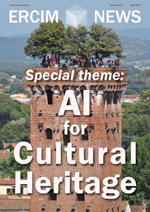
ERCIM News No. 141 Special theme: "AI for Cultural Heritage"

Dear ERCIM News reader,

The April 2025 issue of ERCIM News (Number 141) is now online! The articles featured in this issue highlight the wide spectrum of applications in the cultural heritage field that benefit from AI, as well as the diverse forms of AI being employed across the sector.

Including:

Who Are You, AI? – Artificial Intelligence as a Potential Metaphysical Humiliation of Humanity. pp.32-33.

By Michael Fleischhacker (University of Applied Sciences Burgenland), 
Igor Ivkić (University of Applied Sciences Burgenland and Lancaster University), and Friedrich Roithmayr (University of Applied Sciences Burgenland) 
'Artificial Intelligence as a potential fourth metaphysical humiliation—questioning human uniqueness in reason, freedom, and moral standing, and unsettling our place in the world after Copernicus, Darwin, and Freud.'

My source:
Peter Kunz
ERCIM
https://www.ercim.eu
https://ercim-news.ercim.eu

Follow us on LinkedIn: https://www.linkedin.com/company/ercim
Join the ERCIM LinkedIn Group: https://www.linkedin.com/groups/81390/
Follow us on X: https://x.com/ercim_news

Friday, May 03, 2024

ERCIM News No. 137 Special Theme "Extended Reality (XR)"

 Dear ERCIM News reader,

A new ERCIM News issue (Number 137) is online with a special Extended Reality (XR). This special theme on XR highlights the innovative ways researchers are addressing complex challenges and transforming our interaction with information and the world through immersive experiences and advanced data analytics.

You can access the issue at https://ercim-news.ercim.eu/

This special theme was coordinated by our guest editors Ioannis Chatzigiannakis (Sapienza University of Rome and CNIT), Holger Graf (Fraunhofer IGD), Manos Kamarianakis (University of Crete), and Aris Lalos (ISI).

Thank you for reading ERCIM News!

Please share this issue with anyone who might find it interesting. You can also support us on Twitter (@ercim_news) and LinkedIn (https://www.linkedin.com/company/ercim). Let's keep the conversation going and share the latest updates together!

Next issue:

No. 138, July 2024
Special Theme: "Sustainable Cities". Submissions are welcome! See call for contributions.

Announcements in this issue:

  • Call for Proposals: Dagstuhl Seminars and Perspectives Workshops - Schloss Dagstuhl – Leibniz-Zentrum für Informatik is accepting proposals for scientific seminars/workshops in all areas of computer science.
  • ERCIM "Alain Bensoussan" Fellowship Programme - Postdoctoral fellowships available at leading European research institutions. Simple application procedure. Next application deadline: 30 September 2024.
  • Call for Papers: Forum Beyond Compliance 2024: Research Ethics in the Digital Age
  • 43rd SAFECOMP 2024 and 19th DECSoS Workshop - Florence, Italy, 17-20 September 2024
  • Call for Papers: Edge AI Meets Swarm Intelligence - Dubrovnik, Croatia, 18 September 2024

ERCIM News is published quarterly by ERCIM, the European Research Consortium for Informatics and Mathematics. With the printed and online edition, ERCIM News reaches more than 10000 readers.
All issues published to date are available online.


About ERCIM

ERCIM - the European Research Consortium for Informatics and Mathematics - aims to foster collaborative work within the European research community and to increase cooperation with European industry. Leading European research institutes are members of ERCIM. ERCIM is the European host of W3C.

Peter Kunz                      	
ERCIM Office
2004, Route des Lucioles
BP93
F-06902 Sophia Antipolis Cedex

https://www.ercim.eu
https://ercim-news.ercim.eu

Wednesday, January 31, 2024

ERCIM News No. 136 Special Theme "Large Language Models (LLMs)"

Dear ERCIM News reader,

A new ERCIM News issue (136) is online with a special theme on Large Language Models (LLMs). This issue features articles on diverse topics, such as LLMs in education and professional training, ethics and fairness in public sector use, knowledge management, information retrieval, software modeling, LLM capability assessment, and advancements like enhanced pre-training efficiency.

You can access the issue at https://ercim-news.ercim.eu/

This special theme was coordinated by our guest editors Diego Collarana Vargas (Fraunhofer FIT) and Nassos Katsamanis (Athena RC).
Thank you for reading ERCIM News! Please share this issue with anyone who might find it interesting. You can also support us on Twitter (@ercim_news) and LinkedIn (https://www.linkedin.com/company/ercim). Let's keep the conversation going and share the latest updates together!


Next issue:

No. 137, April 2024
Special Theme: "Extended Reality". Submissions are welcome! See call for contributions.

ERCIM News is published quarterly by ERCIM, the European Research Consortium for Informatics and Mathematics. With the printed and online edition, ERCIM News reaches more than 10000 readers.
All issues published to date are available online.


About ERCIM

ERCIM - the European Research Consortium for Informatics and Mathematics - aims to foster collaborative work within the European research community and to increase co-operation with European industry. Leading European research institutes are members of ERCIM. ERCIM is the European host of W3C.

Subscribe to the ERCIM News quarterly alert

Peter Kunz*       	
ERCIM Office
2004, Route des Lucioles
BP93
F-06902 Sophia Antipolis Cedex

------------------------------
*My source with thanks.
Of note:
Chatbots & Socrates: Dialogues in Learning. pp.18-20.
Towards AI-Assisted Data Storytelling. pp.28-29.

Saturday, April 29, 2023

ERCIM News No. 133 Special theme: "Data Infrastructures and Management"

Dear ERCIM News reader,

ERCIM News No. 133 has just been published. This special theme of this issue highlights the advancements made in the field of data infrastructures and management through exploration of novel research and technologies.  

This special theme was coordinated by our guest editors Manolis Terrovitis (ATHENA RC) and Dominik Ślęzak (University of Warsaw).

Thank you for your interest in ERCIM News. Please forward this message to anyone who might be interested. We also appreciate you following us and talking about us on Twitter @ercim_news and other social media.

Includes:

p.11 The Data Portal of the European Plate Observing System – A New Tool for the Solid-earth Sciences in Europe
by Vasco Avramo (EPOS-ERIC), Daniele Bailo (EPOS-ERIC, INGV) and Rossana Paciello (EPOS-ERIC, INGV)

p.24 CyberSec4Europe - Securing and Preserving Privacy Sharing Health Data
by Raquel Cortés Carreras, Juan Carlos Pérez Baún and
Miryam Villegas Jimenez (Atos Spain S.A.)

p.44 Survival Skills in the Digital Era: Helping Teachers to Develop Digital Competences
by Angela Fessl and Katharina Maitz (TU Graz), Monica Divitini (NTNU)

Next issue:
No. 134,  July 2023
Special Theme: "Explainable AI". Submissions are welcome! See call for contributions.

Announcements in this issue:

Call for Proposals: Dagstuhl Seminars and Perspectives Workshops Schloss Dagstuhl – Leibniz-Zentrum für Informatik is accepting proposals for scientific seminars/workshops in all areas of computer science.


ERCIM "Alain Bensoussan" Fellowship Programme - postdoctoral fellowships available at leading European research institutions.
Simple application procedure. Next application deadlines: 30 April and 30 September 2022


ERCIM News is published quarterly by ERCIM, the European Research Consortium for Informatics and Mathematics. With the printed and online edition, ERCIM News reaches more than 10000 readers.
All issues published to date are available online. The previous four issues focuse on:

- Fighting Cybercrime

- Assistive Technologies

- Ethical Software Engineering

- Cognitive AI & Cobots


Advertise in ERCIM News

About ERCIM

ERCIM - the European Research Consortium for Informatics and Mathematics - aims to foster collaborative work within the European research community and to increase co-operation with European industry. Leading European research institutes are members of ERCIM. ERCIM is the European host of W3C.

https://www.ercim.eu/
https://twitter.com/ercim_news

ERCIM LinkedIn Group

Subscribe to the ERCIM News quarterly alert

Peter Kunz*                      	
ERCIM Office
2004, Route des Lucioles
BP93
F-06902 Sophia Antipolis Cedex

*My source.

Saturday, March 11, 2023

ICT and Brexit Change Survey – Extended deadline

Date:    Fri, 10 Mar 2023 09:16:49 +0000
From:    e.lomas AT UCL.AC.UK
Subject: ICT and Brexit change survey – extended deadline

Apologies for cross posting
We have been asked to extend this survey (https://opinio.ucl.ac.uk/s?s=80453) for a further month in line with the time previous surveys ran. It will therefore close on Tuesday 11th April straight after Easter. This is because a lot of people are part way through and in addition a number of people had not seen the save button which appears at the bottom of each survey page. We would further note that the survey is intended to be neither remain or leave in its questioning – both sides have queried this. We are keen to understand perspectives of the ICT/information sectors following Brexit. We appreciate everyone’s time and perspectives on this. Below is the original text when posted with an update on timeframes…

Brexit has been a significant change for the UK and EU, including in the contexts of  the ICT sector and those who manage information, whether in the public or private sectors. At the three-year departure point we are seeking the views of information professionals on the shifting opportunities and threats for the ICT/information sector in the light of Brexit. Whilst Brexit was a UK decision, it has had potentially global ramifications and therefore we are looking to draw in perspectives from across the globe. We understand that there will be differing views both negative and positive – we want to hear all these perspectives.

We would be so grateful if you would respond to this survey at  - it will take 10-20 minutes to complete depending on if you just check the multiple-choice boxes or if you wish to share further written comments. All questions are optional. The survey is anonymous and no IP addresses are being collected. We know that you are busy and appreciate your time. The survey will close on 11th April 2023.

Please do forward on this email so that we can reach as many people as possible and tweet:

Please complete survey on information/ICT professionals’ views on Brexit and  change https://opinio.ucl.ac.uk/s?s=80453 #Brexit #ICT

The results of this survey will be published in an open access form. Please note this survey follows four earlier surveys charting change through the Brexit process, the first immediately after the Referendum (written up at: https://journals.plos.org/plosone/article?id=10.1371/journal.pone.0186452), one at a mid-point which was accompanied by workshops (written up at: https://journals.plos.org/plosone/article?id=10.1371/journal.pone.0227089) and the others from the transition points onwards. Whether or not you have completed any earlier surveys, we would appreciate your input now. This is likely to be the last survey we publish tracing the changes.

The research is a partnership between the iSchools at UCL (Dr Elizabeth Lomas) and Northumbria University (Emerita Professor Julie McLeod). The survey is being facilitated by Dr Elizabeth Lomas (mailto:e.lomas AT ucl.ac.uk).

Thank you for your help.

Elizabeth and Julie

Dr Elizabeth Lomas
University College London
Email: e.lomas AT ucl.ac.uk

Emerita Professor Julie McLeod
Northumbria University
Email: julie.mcleod AT northumbria.ac.uk

My source:
www.jiscmail.ac.uk/FREEDOM-OF-INFORMATION
a mailing list hosted by www.jiscmail.ac.uk

Wednesday, October 26, 2022

Reflection = 'navel gazing'?

Individual and Collective reflection ...

THE NEED FOR HOLISTIC BANDWIDTH


 INDIVIDUAL
|
 INTERPERSONAL    :     SCIENCES               
HUMANISTIC --------------------------------------  MECHANISTIC      
SOCIOLOGY  :   POLITICAL 
|
GROUP

Reflection

Critique of reflective practice

Risk of navel gazing


"GLOBAL BRITAIN"

'Rules-based order' in the 21st C?

Government - Governance

Preoccupation with COVID-19, Brexit ...

"We have not had enough bandwidth to deal
with International issues to use our position on the security council and in the G7 ..."
Jeremy Bowen

Risk of navel gazing*


BBC Radio 4, Today, 25 October 2022 c.0816. Jeremy Bowen, International Editor.


Related:

Horta, H., Veloso, F., & Grediaga, R. (2010). Navel gazing: Academic inbreeding and scientific productivity. Management Science, 56(3), 41.

Ronald J. Pelias. (2009). Pledging Personal Allegiance to Qualitative Inquiry. International Review of Qualitative Research, 2(3), 351–356. http://www.jstor.org/stable/10.1525/irqr.2009.2.3.351

*A constant consideration here.


Saturday, October 15, 2022

ERCIM News No. 131 Special theme: "Ethical Software Engineering and Ethically Aligned Design"

Dear ERCIM News reader,


ERCIM News No. 131 contains a special theme "Ethical Software Engineering and Ethically Aligned Design" - see https://ercim-news.ercim.eu/

This special theme was coordinated by our guest editors Georgia Kapitsaki (University of Cyprus) and Erwin Schoitsch (AIT Austrian Institute of Technology).

Thank you for your interest in ERCIM News. Please forward this message to anyone who might be interested. We also appreciate you following and talking about us on Twitter @ercim_news and other social media.

Next issue:
No. 132,  January 2023
Special Theme: "Cognitive AI & Cobots". Submissions are welcome! See call for contributions.

Announcements in this issue:


Call for Proposals: Dagstuhl Seminars and Perspectives Workshops Schloss Dagstuhl – Leibniz-Zentrum für Informatik is accepting proposals for scientific seminars/workshops in all areas of computer science, in particular also in connection with other fields. 


ERCIM "Alain Bensoussan" Fellowship Programme - postdoctoral fellowships available at leading European research institutions.
Simple application procedure. Next application deadlines: 30 April and 30 September 2022


ERCIM News is published quarterly by ERCIM, the European Research Consortium for Informatics and Mathematics. With the printed and online edition, ERCIM News reaches more than 10000 readers.
All 131 issues published published to date are available online. The last four issues have focused on  Quantum Computing, Smart and Circular Cities, Privacy Preserving Computation and Assistive Technologies for a More Accessible and Inclusive Society

About ERCIM

ERCIM - the European Research Consortium for Informatics and Mathematics - aims to foster collaborative work within the European research community and to increase co-operation with European industry. Leading European research institutes are members of ERCIM. ERCIM is the European host of W3C.

Subscribe to the ERCIM News quarterly alert

Peter Kunz                      	
ERCIM Office
2004, Route des Lucioles
BP93
F-06902 Sophia Antipolis Cedex

https://www.ercim.eu
https://ercim-news.ercim.eu 
--------------------------------
@ercim_news
http://twitter.com/ercim_news

join the ERCIM Linkedin Group
https://www.linkedin.com/groups/81390/

Includes:
Plausible Reasoning that Mimics Human Argumentation
by Dave Raggett (W3C/ERCIM)

Why Might We fail to Develop Ethical AI/AS?
by Philippe Valoggia (Luxembourg Institute of Science and Technology)

Ethics and Human Aspects in Pandemic Management
by Karin Rainer (AGES), Viktoria Fischer (AGES), Alois Leidwein (AGES), and Georg Neubauer (AIT)

 
My source: Peter Kunz, ERCIM News quarterly alert.

Thursday, July 07, 2022

ERCIM News No. 130 Special Theme: "Assistive Technologies for a More Accessible and Inclusive Society"

Dear ERCIM News reader, 

Assistive Technologies for a More Accessible and Inclusive Society is the special theme of ERCIM News No.130, just published at https://ercim-news.ercim.eu/ 

ERCIM NEWS 130
This issue's Special Theme presents numerous contributions with studies in the field of assistive technology with different and complementary approaches. This special theme has been coordinated by our guest editors Christine Azevedo Coste (Inria) and Barbara Leporini (ISTI-CNR). 

 Thank you for your interest in ERCIM News. 

Feel free to forward this message to anyone who might be interested.

We are also happy if you follow us and talk about us on twitter @ercim_news and other social media. 

Next issue: No. 131, October 2022 Special Theme: "Ethical Software Engineering and Ethically Aligned Design". 

Submissions are welcome! See call for contributions. 

ERCIM News is published quarterly by ERCIM, the European Research Consortium for Informatics and Mathematics. With the printed and online edition, ERCIM News reaches more than 10000 readers. 

All 130 issues published published to date are available online. 

The last four issues have focused on Fighting Cybercrime, Quantum Computing, Smart and Circular Cities, and Privacy Preserving Computation. 

About ERCIM 

ERCIM - the European Research Consortium for Informatics and Mathematics - aims to foster collaborative work within the European research community and to increase co-operation with European industry. Leading European research institutes are members of ERCIM. ERCIM is the European host of W3C.

Join the ERCIM Linkedin Group https://www.linkedin.com/groups/81390/

Peter Kunz*            	
ERCIM Office
2004, Route des Lucioles
BP93
F-06902 Sophia Antipolis Cedex

https://www.ercim.eu
https://ercim-news.ercim.eu 
*My source. 

Thursday, March 03, 2022

"Information Disorder:" c/o Wardle and Derakhshan (2017) The transmission of ritual ...

INDIVIDUAL
|
 INTERPERSONAL    :     SCIENCES               
HUMANISTIC -----------------------------------  MECHANISTIC    
SOCIOLOGY  :   POLITICAL 
|
GROUP


“The transmission view of communication is the commonest in our culture — perhaps in all industrial cultures... It is defined by terms such as ‘imparting,’ ‘sending,’ ‘transmitting,’ or ‘giving information to others.’ ...


... The ‘ritual view of communication’, by contrast, is not about “the act of imparting information but the representation of shared beliefs.” pp.14-15.


Wardle, Claire, and Hossein Derakhshan. 2017. “Information Disorder: Toward an Interdisciplinary Framework for Research and Policy Making.” 162317GBR. Council of Europe. https://edoc.coe.int/en/media/7495-information-disorder-toward-an-interdisciplinary-framework-for-research-and-policy-making.html.

Previously:

WHO: Infodemic Management News Flash Thursday 4 November 2021 #25


Friday, July 09, 2021

ERCIM News No. 126 Special Theme: "Privacy-Preserving Computation"

Dear ERCIM News reader,

ERCIM News No. 126
ERCIM News No. 126 has just been published at https://ercim-news.ercim.eu/

The Special Theme of this issue focuses on current research on privacy-preserving computation, coordinated by our guest editors Rudolf Mayer (SBA Research) and Thijs Veugen (TNO and CWI).

Thank you for your interest in ERCIM News. Feel free to forward this message to anyone who might be interested.

Next issue:
No. 127,  October 2021
Special Theme: "Smart and Circular Cities" (submissions welcome!)

Peter Kunz  (with thanks)
ERCIM Office

2004, Route des Lucioles
BP93
F-06902 Sophia Antipolis Cedex

https://www.ercim.eu
--------------------------------
@ercim_news
http://twitter.com/ercim_news

join the ERCIM Linkedin Group
https://www.linkedin.com/groups/81390/

[I have edited to reduce the number of links.]

Wednesday, December 23, 2020

ERCIM News No. 124 Special Theme: "PANDEMIC - Modelling & Simulation"

Dear ERCIM News reader,

ERCIM NEWS

ERCIM News No. 124 has just been published at https://ercim-news.ercim.eu/ The Special Theme of this issue focuses on research surrounding the current epidemic emergency. The contributions address actions to understand and counteract the spread of the virus. This special theme has been coordinated by our guest editors Salvatore Rinzivillo (ISTI-CNR), Joakim Sundnes (SIMULA) and Karin Rainer (AGES).

In the section "Research and Society" some of our institutes describe how they are meeting the challenges of COVID-19.

Thank you for your interest in ERCIM News. Feel free to forward this message to anyone who might be interested.

Next issue:
No. 125,  April 2021
Special Theme: "Brain-Inspired Computing"

Announcements in this issue:


Call for Proposals: Dagstuhl Seminars and Perspectives Workshops
Schloss Dagstuhl – Leibniz-Zentrum für Informatik is accepting proposals for scientific seminars/workshops in all areas of computer science, in particular also in connection with other fields. https://www.dagstuhl.de/dsproposal

SAFECOMP 2021
York, UK, 7-10 September 2021
Call for Papers and Workshop Proposals

The GATEKEEPER 1st Open Call
600,000€ available for AI and Big Data Applications, tools or components


-- 
Peter Kunz                      	
ERCIM Office

Thursday, October 22, 2020

Erasmus+ Survey - Invite

Dear INHWE Members,

We need your help with a research proposal we are submitting soon. If you teach elements of leadership or IPE in your role then we would be delighted if you could spare 3 minutes of your time to complete the following survey: https://inhwe.org/erasmus-survey (Deadline: end of play Tuesday 27th October)

Also, you might be interested to know that we are now producing results (with more to come later this week) for our StoryAidEU project which you can view and download here: https://storyaid.eu/results/

If you would like to know more about our research projects or how to partner with us, feel free to get in touch.

Best wishes,

David

David Smith

Director | www.inhwe.org International Network for Health Workforce Education


Monday, October 12, 2020

Conference: Improving Child & Adolescent Health for better Public Health

Dear Ladies and Gentlemen,

Dear Professors and Researchers,

Dear Colleagues!

It is our pleasure to invite you to this international 2-day meeting and research exchange

held online on Tuesday & Wednesday, November 10 & 11 2020 – save the date!

Improving Child & Adolescent Health for better Public Health

– Fiction or within the scope of possibility?

to bring together researchers and stakeholders to introduce completed research projects as well as new research ideas

that address the complex challenges and needs of child & adolescent health for future collaborative projects in order to apply for national and international grants.

Please find attached a brief outline with preliminary program (contents, schedule).

We greatly appreciate your attendance and would ask for a confirmation by Friday, October 23, by replying to this email.

We also welcome your contribution in form of a short talk/pitch.

In order to finalize the program, please include the following information in your response to this e-mail:

120 Researchers from 56 Universities/Organizations around the world and cross-cutting disciplines and research interests are invited.

Please feel free to forward this invitation to any colleagues you think would be interested as well.

Further detailed information along with the final program will be provided as soon as it is finalized, but right in time before the event in November 2020.

We look forward to welcoming you to this international 2-day meeting on „Improving Child & Adolescent Health“!
 
 
Kind regards,
 
Katharina Wirnitzer, University College of Teacher Education Tyrol & Leopold-Franzens University, Innsbruck, AT

Prof. Clemens Drenowatz, University College of Teacher Education Upper Austria, Linz, AT

Prof. Nandu Goswami, Medical University of Graz, Graz, AT

Studienleitung (PI)

Member of Schools for Health in Europe – SHE Research Group

__________________________________

Dr. rer. nat. Katharina Wirnitzer (PhD)

Institut für fachdidaktische und bildungswissenschaftliche Forschung und Entwicklung

Pädagogische Hochschule Tirol

Department of Subject Didactics and Educational Research and Development

University College of Teacher Education Tyrol

Pastorstraße 7/A.008, 2. OG
A – 6010 Innsbruck

E  katharina.wirnitzer AT ph-tirol.ac.at
I    www.ph-tirol.ac.at