Hodges' Model: Welcome to the QUAD: vision

Hodges' model is a conceptual framework to support reflection and critical thinking. Situated, the model can help integrate all disciplines (academic and professional). Amid news items, are posts that illustrate the scope and application of the model. A bibliography and A4 template are provided in the sidebar. Welcome to the QUAD ...

Showing posts with label vision. Show all posts

Friday, September 18, 2026

Euclidean or Projective Care?

How many dimensions does a written - narrative record have?

Sketching out some ideas, I asked the question on Google and as usual an AI Overview response followed - snippet:
AI Overview

A physical written record has two primary spatial dimensions (length and breadth/width) as a flat document, or three dimensions (including thickness or depth/height) when considering its physical form or binding. [1, 2]

In archival and Records Continuum theory, a written record exists dynamically across four conceptual dimensions: [1, 2].

I put the question to the Records Management list with the above snippet and received several useful suggestions and sources. Perhaps I can share that at a future point? 

Acutely aware of not pursuing maths and category theory for its own sake, the query was driven by an attempt to look at Hodges' model in mathematical terms. Starting, rather obviously with the models structure and axes. When the model is assembled, as per many posts, the vertical axis:

INDIVIDUAL
|
GROUP

- shouts out the issue of parity and the distinction between mind and body. It does this at the individual and collective level. If we were to draw a silo, a cylinder springs to mind, and there are specific reasons for silos adopting this shape. Descartes gives us the perfect excuse, in the ongoing legacy. 

     Mathematical Visions

The question above came up from Joan L. Richards book 'Mathematical Visions' (c/o Lancaster Univ. library). Euclidean and the emergence of projective geometry is described. There is an interplay between 2D and 3D representation, that made me think about the health record and its dimensions. Not in a dataset sense (multi-dimensional), more generally and concretely(?). A patient's record on paper has physical dimensions (A4), there is a flow. An EHR has its virtual dimensions (discuss!). Abstractly the content is a time machine. At some point in a health encounter it is a literal 'history', the level of detail in accord with the context. The record might present the problem, premorbid situation, diagnosis, current state, observations and prognosis and much more.

I can revisit this, Richards provides a series of figures. We progress from two distinct circles (my silos) through to examples with a discussion of continuity and projection that sees the circles touching, then intersecting. This is a radical axis.

Richards, Joan L. (1988), Mathematical Visions: The Pursuit of Geometry in Victorian England, Boston: Academic Press, ISBN0-12-587445

Book cover: Amazon.

Sunday, August 30, 2026

A Scope with the Big Picture in Mind

Coverage plans are ready for NASA’s Nancy Grace Roman Space Telescope prelaunch and launch activities. Roman is NASA’s next-generation observatory designed to explore some of the universe’s biggest mysteries, including dark energy. NASA and SpaceX are targeting Roman’s liftoff for no earlier than 7:26 a.m. EDT Sunday, Aug. 30, aboard a SpaceX Falcon Heavy rocket from Launch Complex 39A at the agency’s Kennedy Space Center in Florida. Launch coverage begins at 6:20 a.m. Live coverage of these events will stream through a variety of platforms. Learn where to watch online: 


individual
|
INTERPERSONAL
: SCIENCES             
humanistic ------------------------------- mechanistic
SOCIOLOGY : POLITICAL   
|
group
education for ALL
life chances

Nancy Grace

STEMM
Observation
Scale

ROMAN

Girls - Women in Science

Political investment in Science for Public and Planetary Good

See also:

Nancy Grace Roman

https://science.nasa.gov/mission/roman-space-telescope/

Previously: 'women' : 'astronomy' : 'big picture'

Sunday, April 12, 2026

Seminar: 'MedGemma and HAI-DEF: A family of open models'


Dear Madam/Sir, 

We are glad to announce the following seminar: 

MedGemma and HAI-DEF: A family of open models by Andrew Sellergren, Software Engineer & Researcher at Google.

Save the date: 

Thursday, April 16, 2026 - 4:30 PM (CEST) 
Aula Pitagora - MT11 (Cubo 30B), Unical 
Hybrid Format / Live Streaming 

Link: https://dub.sh/medgemma2026

See also: https://goo.gle/medgemma

MedGemma Technical Report

My source: francesco.calimeri AT unical.it

Friday, April 10, 2026

'Healing grid' - the penultimate?

Healing grid by Ryota Kanai

Hodges' model is surely a clear winner 'healing grid'? Acting not only in healing, but in recovery, rehabilitation, reablement, palliative, illness and well-being too.

Quite a grid all-in-all (which also fascinate grandchildren).

My source: 

Previously: 'grids' : 'perception' : 'vision' : 'lines' : 'geometry'

#ArtemisSafeReturn #PrecisionGridManoeuvres

Wednesday, February 18, 2026

Move Over LLMS! AI Legends Yann LeCun and Alex LeBrun Debut AMI Labs' Bold Ambitions for World Models in Healthcare


My source: https://x.com/OffCallDotCom/status/2022708074105242035?s=20

Sunday, November 02, 2025

The poetry of presence c/o Kenner's 'Mechanic Muse'

'... Eliot's poetry responds to yet another of the new century's pervasive experiences, that of being talked to by people we cannot see. This happens whenever we pick up a telephone, a thing we do so many times a day we quite overlook the strangeness of what lappens next. A character in The Cocktail Party remarks that you can't tell the truth on the telephone, meaning probably that you lose three quarters of your communicative power when you cannot be seen and your breathing body is absent, and you must fabricate mere semantic sequences. Your words are only a fraction of what you say, and the telephone throws you back on nothing but words. It is in Sweeney Agonistes, the play that gives the telephone bell a wholly metrical speaking part, that we hear the famous phrase, "I gotta use words vhen I talk to you."
    When the phone rings in that play - 
    Ting a ling ling 
    Ting a ling ling

Dusty snatches it up and says,

Hello Hello are you there?' 


Kenner, H. (1987) The Mechanic Muse, Oxford: OUP. pp.34-35.

Thursday, October 09, 2025

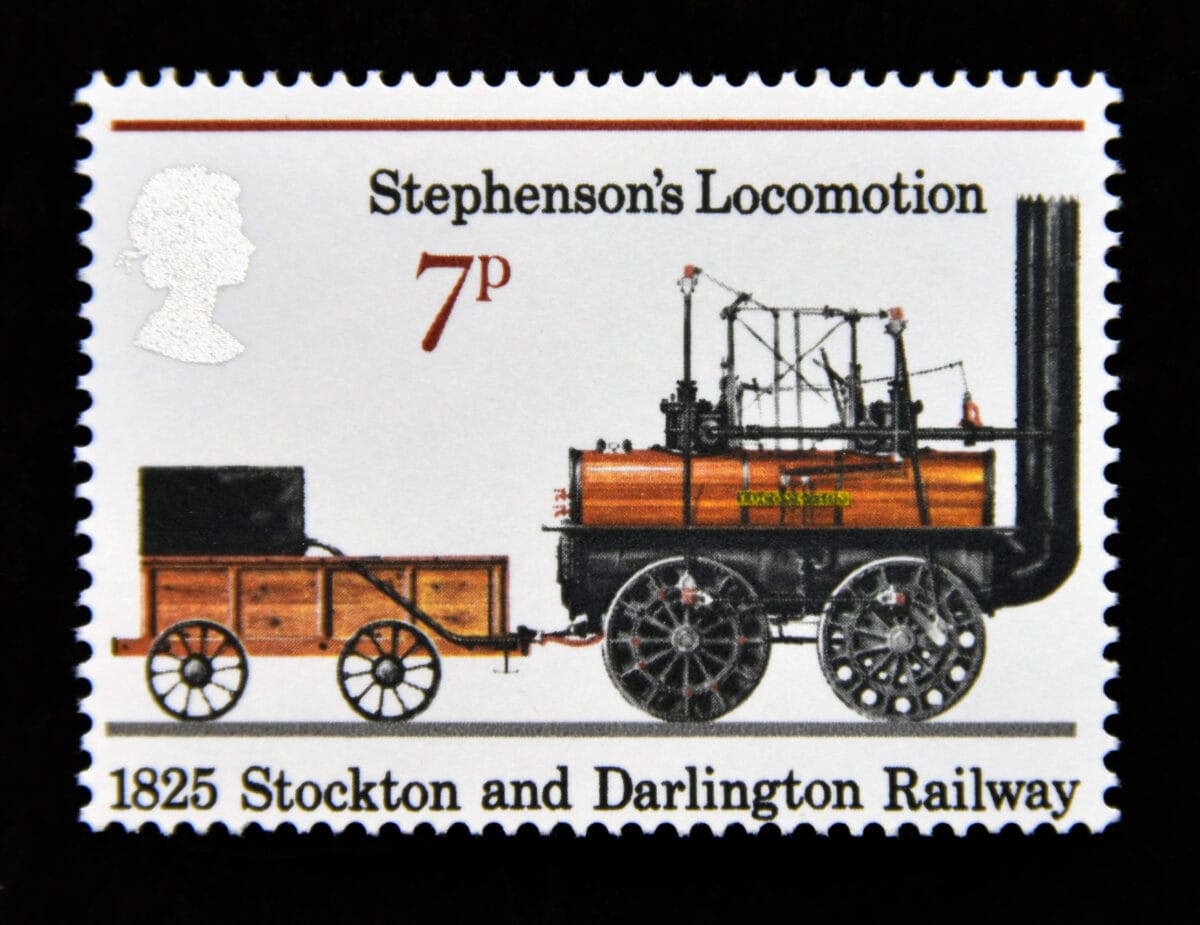
The creation of Hodges' model: "All aboard!" 200 years

28th May 1997
When I interviewed (Mr.) Brian Hodges in Manchester on 28th May 1997, I learned he had created the model in 1983, mainly while commuting to Manchester Polytechnical College by train from (Totley) Sheffield, and back. 

I wish I could have been sat by him, to strike up a conversation. Although (among other points) I'm not sure how much he relied upon, or was chasing down the visual side of the model, with some skethces and drawings. So would I have noticed him thinking, drawing, crossing-out, and labelling? This I would have noticed, not that I have a habit of 'spying' and being nosey. Although nowadays, with the repeated announcements on the trains: ‘See it. Say it. Sorted’; perhaps I should?

In 1983 I was a general student nurse (SRN), and still over a decade away from becoming a community psychiatric nurse in 1985, and being (well) taught by Brian and colleagues in 1987.

I also enjoy a (reliable!) train journey, and used to read a lot travelling from the NW England through the London underground (Euston-Waterloo) to Plymoth, and later to Portsmouth in the 1970s. Happy days, then and today; with the railways reasserting their relevance. A quality shared with a certain little-big model I know.

Individual
|
      INTERPERSONAL    :     SCIENCES               
HUMANISTIC =========================  MECHANISTIC      
 SOCIOLOGY  :    POLITICAL 
|
Group

Rail 200

Nationalised - Private
Private - Nationalised
Charity - CIC


Monday, September 08, 2025

ii Editorial: Persistent Positive Change in Challenging Times ...

To Howden's editorial it's worth highlighting that Hodges' model is situated. So, whether the 'challenge' that is faced is individual, or collective Hodges' model can help to identify the issues, problems, strengths, opportunities, threats, where we are, where we would like to be and more. Surely, reflection, critical thinking is about confiming, or regaining our perspective, correcting our orientation or improving alignment and synchronisation with others? The time this entails, whether exercised on paper, or cognitively (yes, humans thinking is still an option) this is equivalent to a time-out even if momentary. This can be critical in clinical encounters, were emotions are raised, or there is risk of escalation.

So whether the challenge is personal, lived experience, bullying, finance, physical, or mental health, simulation (fidelity, testing), ethical ...; or collective (a team) - service and organisational change, major incident, policy, clinical or management supervision, whistleblowing, public / patient engagement, complaints and challenging relationships; Hodges' model is a tool (one of many) to call upon.

It could be the context causes you to focus on one or two care (knowledge) domains. Or, there is a need to step back in order to 'see' the big picture (integrated care, risk assessment, holistic care, psychosocial view ...) - the spiritual too.

While Hodges' model is simple, please consider this: there aren't many tools that can facilitate articulation and dissemination of the 'big picture' in a form that is (imho) readily transferable and translatable.

Howden, S. (2025). Editorial: Persistent Positive Change in Challenging Times. International Journal of Practice-based Learning in Health and Social Care, 13(1), ii-iii.

Sunday, August 31, 2025

Play - “The Ballad of Crooked Lane” 6th & 7th Oct.

Media Release - 

Blind Poet’s Life to be Celebrated in New Play. 

The life of Edward Rushton, Blind Poet and key figure in the Campaign against Slavery, will be spotlighted in a new production by Valley Theatre Drama Group in Liverpool. The play – entitled “The Ballad of Crooked Lane” – is set on the day Rushton, now well into middle age, awaits eye surgery to regain his sight. While waiting, he goes over his eventful life with his friend and biographer, William Shepherd, the Minister of Gateacre Chapel.

“Rushton was a larger-than-life character,” says writer and director Tom Mclennan. “The story is that he lost his sight going below deck to help sick African captives on their way to the plantations. I first read about him in Bill Hunter’s biography “Unsung Hero” and have always felt his life deserves more recognition.”

Apart from campaigning against the slave trade – not always a popular thing to do in those days, since a large amount of Liverpool’s wealth was based on the evil triangular trade – Rushton was also instrumental in establishing the Liverpool School for the Blind, one of the first in the country, as well as being at the forefront of efforts to end the notorious pressgangs that terrorised coastal neighbourhoods, intent on kidnapping sailors for the British Navy.

“The Ballad of Crooked Lane” will be performed as part of a double bill along with Day Sheehan’s “Wake” for the Liverpool Fringe on Monday October 6th, 7.30pm, at Valley Theatre n Netherley, and on Tuesday 7th October, 7.30pm, at The Studio Beyond, 63 Wood Street, Liverpool L1 4AL

Entrance for the Valley Theatre event is free (pay a donation if you like it). Tickets for the Studio Beyond are £8/£6 and can be bought from:

https://store.makeitwrite.org/product/balladandwake/

I read a part for this at Valley Theatre, very interesting and will look to see a performance.

See also: Edward Rushton: Who was this blind revolutionary?
https://www.bbc.co.uk/news/blogs-ouch-29957645

My source: https://www.philosophyinpubs.co.uk/

Currently reading, Arnold Wesker's 'The Friends'.
https://www.arnoldwesker.com/plays/the-friends/index.html

Monday, June 23, 2025

Entry to the Theatre of Nursing & Space

I do understand that reading theatre related texts, joining a theatre group, my writing a play is still pi in the sky. It's the journey, that's all. In Hodges' model I've differentiated between structure and content. This is the center of the stage about which Hodges' model turns. In the guided discovery by which students and audiences can discover the model,  these are the bases to touch in turn.


Sir Alan's focus on construction in writing: is narrative, time, location, characters (p.12). The overall message for me is, the frequently uttered - less is more. I must take heed and listen. During Ayckbourn's career, he has encountered the full retinue of writers and directors young and 'experienced'. Reading this, it is nice to be both 'new old-er' -
'Then there is the new old playwright. Far more difficult to deal with. They have probably nursed this script for twenty-five years and they're damned if you're going to mess it up for them when they've waited so long. Especially someone your age who wasn't even born when their harrowing play about World War Two was still raging, dammit.' p.110. (My emphasis in bold.)
Thinking about 1959 and the start of Sir Alan's career, his reference to WWII, made me recall nursing assistant and student nurse studies and placements at Winwick Hospital in 1977. On the geriatric wards for entertainment it was WWI songs were often sung, or records played. Long players, indeed.

In health we are usually accustomed to stopping before the 'true' end, with the exception of palliative care, although even then the ending should be 'better' than what it would otherwise have been.

If I am nursing Hodges' model, I've been doing so ever since 1987-88. As Sir Alan also observes of writers, while passionate about the utility of the model - my project - not my model; I am filled with self-doubt. Is this an over-valued idea - in my hands (and mind!)?

In other reading - Stagecraft. The Complete Guide To Theatrical Practice, by Griffiths Trevor R. 1982, I came across the word 'proscenium'.

'Incidentally, when we came to stage [the play in question is 'Woman in Mind' PJ] the London proscenium version this was far more difficult to achieve. Proscenium theatres generally make scenic statements whether they want to or not; the round makes none unless called upon to do so.' p.32. 

There are many insights into sets, design, and the various pros and cons. In May and earlier this month, with three other cast members I performed a role 8-9mins in a Living Newspaper (40-50 mins in total). It was fascinating to watch the various aspects developing from the initial reading in January. With Hodges' model an idea, the question of set design is not straight forward. But as with over-valued ideas, I am probably over-thinking (as usual) making things more complicated than necessary.

One golden nugget of advice, is if you are the writer and write well, well you don't have to think the set design. That is a problem for someone else to solve. Hopefully you will be impressed by the interpretation and realisation (often in film credits) of your work.

That is, unless you're unlucky and find yourself on the receiving end of Obvious Rule No. 13:

Beware of competitive set designers, particularly those with a 'concept'.

The name Ayckbourn is synonomous with The Stephen Joseph Theatre, which is in the round:

'The Round provides a truly unique experience as the audience is seated all around the stage. Not only does the audience see the performance from every angle, it also brings the actor into the same space as the audience.'

"Let’s have the actors in the same room as the audience, let’s have four front rows, let’s get really excited about this acting business!"

Stephen Joseph, 1959 - https://sjt.uk.com/about-us

From the mid-1980s and 90s I used to visit Bolton's Octagon quite regularly. Performances were frequently in the round. Last month, Abigail's Party was too (the last night).

Whatever, the staging, set, I'd be interested to see the 'concept'. On directing:

'As regards interpretation. you may need to tread more warily. As I said earlier, many playwrights are not naturally theatre creatures - certainly they are rarely visual theatre creatures, I have seen them sit there and watch their play physically anfold with a look of total amazement. pordering sometimes on delight, sometimes on dismay. What was in their head has been made three-dimensional flesh.' p.111.

Space has been and remains fundamental to my thinking about Hodges' model. Even pushing the envelope to topology, this is well beyond my ken. But not other gifted researchers. Hodges' model provides inter- multi- transdisciplinary bridges: we need to Before the time of schools becoming fenced and patrolled sites, we used to play cricket, tennis and football. There was a large wall at front of a former school, great for tennis, but not return of serve. Now a projection shared in the round - so everyone sees the same thing (yes, another rule!) might hold potential. There's acknowledgement that technology moves on too (p.123). And room for comedy, Ayckbourn's starting point. 

'Designers, it has been said, even the best of them, sometimes get hold of the wrong end of the stick. ... Always get to look at drawings, ground plans and, most helpfully, scale models of what they intend.' p.120.

The Crafty Art of Playmaking by Alan Ayckbourn. Faber, 2004, softcover, ISBN 0571215106.

https://www.concordtheatricals.co.uk/s/45898/the-crafty-art-of-playmaking

Tuesday, April 15, 2025

The 'animal' in Hodges' model ii

The two pairs of eyes in Hodges' model are provided through the model's two axes

HORIZONTALLY: the humanistic and mechanistic.

VERTICALLY: the individual and the group.

Hodges' model: Axes & Domains
Structure AND Content :: Fight OR Flight

Before delving into this though, let's revisit the model as a template.

Structure aside, Hodges' model acts as a conceptual blank sheet. Overall, the model is also an aide-mémoire. It can prompt us to 'where' we've been, where we need to go in our data gathering, assessment, planning, interventions, evaluations: personal history, family, work and leisure. In an interview how does the patient, client, carer, student ... negotiate the domains of Hodges' model? The model can guide us in what is said, what is omitted - for whatever reason, what is significant within all this; AI-assisted or not.

These two 'horizontal' eyes prompt us to attend to safety, your own, the patient / client and other people in the vicinity. In terms of responding to 'fight', obviously this does not mean you are looking for a fight, but of course you have to be able to defend yourself. Metaphorically, Hodges' model can represent the sword and shield. We are in a fight for justice to secure health services for individuals, families, and the population.

On the side - vision for flight, what is humanistic and mechanistic.

Then, in the vertical axis, there is vision for fighting, for the individual, and the group - population.

In this interplay of person and collective, I'm reminded of Odysseus and the shout "Nobody did it!" (with other sources). It never ceases to amaze, the frequency of this conclusion throughout local, national and global politics?

The individual nightmare of Cyclops; and collective nightmare of the Panopticon.

In mental health nursing you quickly learn about the anatomy^, physiology and psychology of anxiety. Not necessarily simultaneously, but the jig-saw is there to be completed, at least as far as you can as a 1st year student - whatever your health discipline. The pieces that matter (literal keys to action) are provided by the patient, client, carer. ...

In a way it is too late when people are referred to mental health services. Too late for prevention, but given the incoherence between:

  • health systems (as usually found & founded)
  • government policy -
    • state of nutrition - food
    • advertising of foods, beverages
    • life style choices
    • education - health literacy
      • individual
      • family
      • community
      • national (curricula)
  • NHS? National Health Illness/Disease Service
- this isn't a surprise.

Whatever an individual's sensory capacities and abilities we need to do better. With tools to facilitate situational awareness, and realise an individual's and community's potential to learn and prosper.

^Anatomy? How many of us take for granted our limbs are 'there': ready to react?

Previously: The 'animal' in Hodges' model i

Original source - prompt:
Doniger, Wendy. The Rise and Fall of Warhorses. The New York Review of Books. April 10, 2025. Volume LXXII, Number 6. pp.17-19.

Friday, April 11, 2025

The 'animal' in Hodges' model i

The New York Review of Books


'The fact that a horse has his eyes on the sides of his head identifies horses as animals of flight rather than fight, in contrast with animals like tigers, who have their eyes in the front.' p.17.


Hodges' model has two pairs of 'eyes'.

Can you see them?


Hodges' model: Axes & Domains
Structure AND Content :: Fight OR Flight

Doniger, Wendy. The Rise and Fall of Warhorses. The New York Review of Books. April 10, 2025. Volume LXXII, Number 6. pp.17-19. https://www.nybooks.com/issues/2025/04/10/

Monday, February 24, 2025

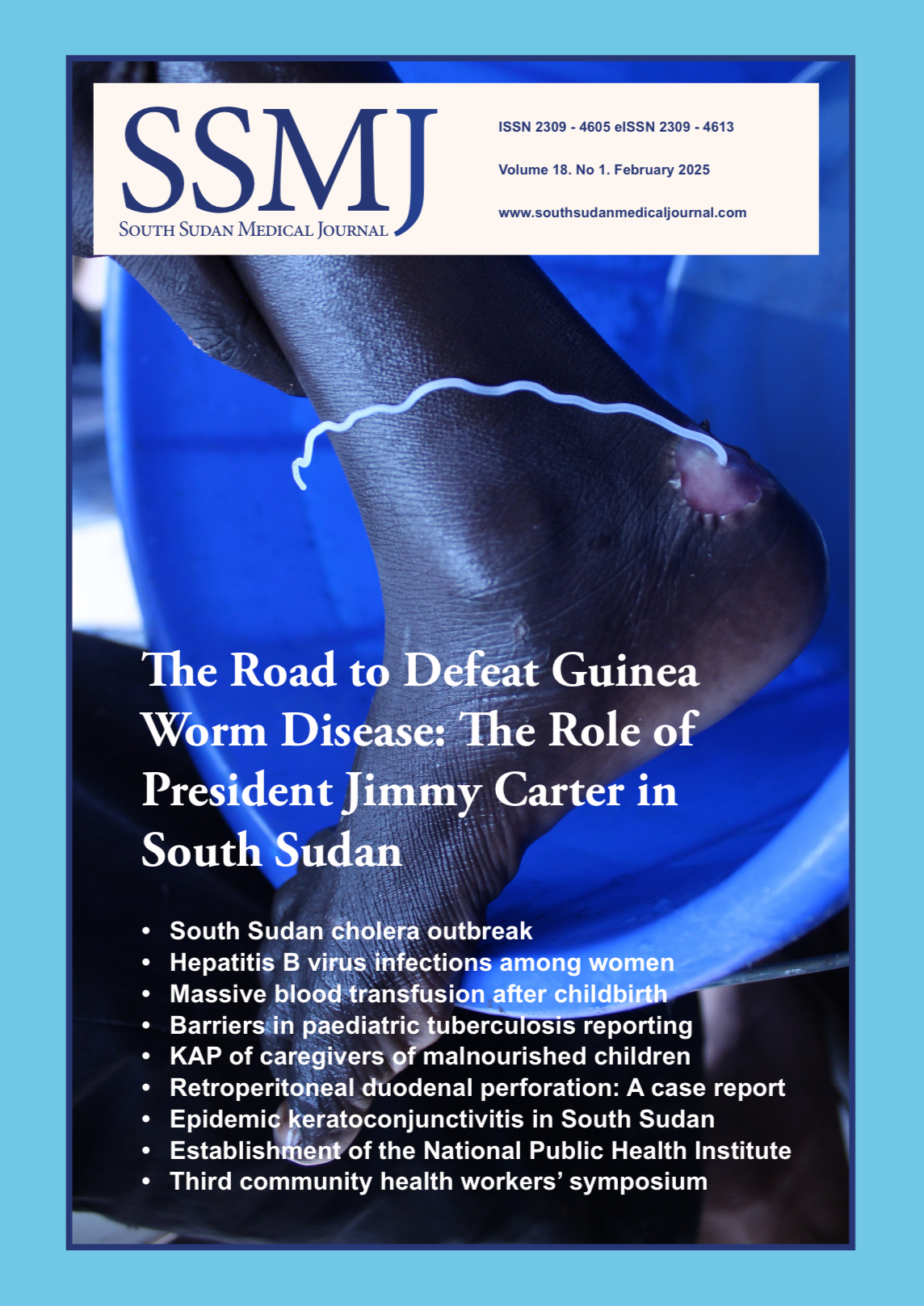
SSMJ February 2025 - South Sudan Medical Journal

Dear Reader,

The full issue of our February 2025 issue is online here; the articles are listed below. 

Editorial 
  • South Sudan cholera outbreak: A call to improve sanitation Ruot Garjiek Teny 
Research Articles 
  • Prevalence and associated risk factors of hepatitis B virus infections among women of reproductive age in Juba, South Sudan Ezbon WApary, Akway M. Cham, Oromo F. Seriano 
  • Management and outcome of women requiring massive blood transfusion after childbirth: A cross-sectional study at Muhimbili National Hospital, Tanzania Wangwe Peter Joseph, Sawe Eshi-Fisha Linda, Meda Elineema Robson 
  • Addressing barriers in paediatric tuberculosis reporting: A qualitative study of private healthcare providers’ perspectives Suryanti Chan, Idris Adewale Ahmed, Hamzah Hamzah 
  • Knowledge, attitudes, and practices of caregivers of malnourished children at the Al Sabbah Children’s Hospital, Juba, South Sudan Francis Beek Akook, Nyok Daniel Ngor 
Case Report 
  • Evaluation and surgical repair of retroperitoneal duodenal perforation following blunt trauma: A case report Rashmi Ranjan Sahoo, Abhinav Voona, Nalini Naik, and Jyotirmay Jena 
Main Articles 
  • Epidemic keratoconjunctivitis (Pink Eye) in South Sudan: A review Wani Mena The Establishment of the National Public Health Institute (NPHI) in South Sudan Nyinypiu Tong, Anthony Garang, Joseph Lako 
  • The third community health workers’ symposium, Liberia, 2023: What are the implications for South Sudan’s Boma Health Initiative? Kon Alier, Solomon Anguei, William Kuon, Christopher Ajumara 
Short Communications 
  • South Sudan’s journey to defeat Guinea Worm Disease: The role of President Jimmy Carter and the Carter Center Makoy Samuel Yibi Logora 
  • Letter to the Editor: President Jimmy Carter deserves a special recognition for his work to eradicate Guinea worm in South Sudan. Victor Vuni Joseph 
  • Letter to the Editor: Simulation-based education amid conflict: The Sudanese American Medical Association experience in Sudan Mohamed Almahal, Mohamed Ahmed, Omer Gomaa, Salaheldin Abusin, Ihab Abdalrahman
  • Obituary: Maj. Dr Santino Kuot Maluil 
  • Obituary: Dr Benjamin Peter Oduk 
See the back page for instructions on how to prepare and submit manuscripts for publishing in SSMJ.

Thanks to everyone who supports SSMJ - authors, editors, and, especially, our peer reviewers.

The SSMJ team
Email: southsudanmedicaljournal AT gmail.com
Website: http://www.southsudanmedicaljournal.com
Follow us on Twitter@SSMedJournal and our Facebook Group,

SSMJ is published by the Health and Social Science Research Institute of South Sudan (HSSRI-SS)

Copyright © 2025 South Sudan Medical Journal, All rights reserved

Previously on W2tQ:

Saturday, July 22, 2023

Migraine: Mind - Body and Art c/o Kustaa Saksi

"A migraine, says Kustaa Saksi, is like an unexpected visit from an irritating old friend. A sudden attack upends your plans; causes havoc; you never know when it will leave. 
The 48-year-old Finnish textile artist has lived with these repetitive, immobilising headaches and their accompanying visual disturbances — ranging from partial blind spots to borderline hallucinations — since childhood. 
'It usually happens on the side of my eye, then it’s like a sun, travelling from east to west,' he says. 'At one point it will take over my whole vision, then it vanishes.'" 

https://www.ft.com/content/f85c900b-9547-44a5-bbc1-ba65d44331d9


INDIVIDUAL
|
INTERPERSONAL    :     SCIENCES               
HUMANISTIC --------------------------------------  MECHANISTIC      
SOCIOLOGY  :   POLITICAL 
|
GROUP
'Aftermath' 2019 Jacquard Weave
172 x 236cm (67" x 93") 
'Attack' 2019 Jacquard Weave
166 x 238 cm (66" x 94") 


My source:
Barrett, H. (2023) Interiors: A migraine's many colours. FTWeekend, House&Home. 8-9 July. p.6.

Wednesday, November 23, 2022

Communication - "See what I mean?"

"Lasswell (1948) claimed that an act of communication was adequately explained only when every aspect of his famous question had been answered:

who - says what - in which channel - to whom - with what effect?"

Lasswell, H.D. (1948) The Structure and Function of Communication in Society. In Bryson, (ed.), The Communication of Ideas, Harper & Brs.


 INDIVIDUAL
|

INTERPERSONAL
   :     SCIENCES             

HUMANISTIC --------------------------------------  MECHANISTIC     

SOCIOLOGY
  :   POLITICAL
|
GROUP


who

says what
in which channel

to whom

with what effect?


My source: 

Morgan, John. & Welton, Peter.  (1992).  See what I mean? An introduction to visual communication. London :  Edward Arnold. pp.2-3.  http://www.loc.gov/catdir/enhancements/fy0638/92229403-t.html


See also - the concept of information remains an interest here:

Jones, P. (1996) Humans, Information, and Science, Journal of Advanced Nursing, 24(3),591-598.

Jones, P. (1996) An overarching theory of health communication? Health Informatics Journal,2,1,28-34.

Saturday, September 03, 2022

"NHS to pilot smart goggles to free up time for community nurses"

c/o Digital Health:


"The NHS is to trial the use of smart goggles that will be worn by community nurses on home visits in order to free up time with patients.

Providing that the patient consents, the virtual reality style headset can transcribe the appointment directly to electronic records, reducing time-consuming admin for nurses.

Staff will have the ability to share live footage directly with hospital colleagues to get a second opinion, avoiding the need for further appointments or hospital admission."

Read more at Digital Health ...


My source:

Eleanor Hayward, Smart goggles give nurses advice during home visits, The Times, 20th August 2022, p.16.

Thursday, July 07, 2022

ERCIM News No. 130 Special Theme: "Assistive Technologies for a More Accessible and Inclusive Society"

Dear ERCIM News reader, 

Assistive Technologies for a More Accessible and Inclusive Society is the special theme of ERCIM News No.130, just published at https://ercim-news.ercim.eu/ 

ERCIM NEWS 130
This issue's Special Theme presents numerous contributions with studies in the field of assistive technology with different and complementary approaches. This special theme has been coordinated by our guest editors Christine Azevedo Coste (Inria) and Barbara Leporini (ISTI-CNR). 

 Thank you for your interest in ERCIM News. 

Feel free to forward this message to anyone who might be interested.

We are also happy if you follow us and talk about us on twitter @ercim_news and other social media. 

Next issue: No. 131, October 2022 Special Theme: "Ethical Software Engineering and Ethically Aligned Design". 

Submissions are welcome! See call for contributions. 

ERCIM News is published quarterly by ERCIM, the European Research Consortium for Informatics and Mathematics. With the printed and online edition, ERCIM News reaches more than 10000 readers. 

All 130 issues published published to date are available online. 

The last four issues have focused on Fighting Cybercrime, Quantum Computing, Smart and Circular Cities, and Privacy Preserving Computation. 

About ERCIM 

ERCIM - the European Research Consortium for Informatics and Mathematics - aims to foster collaborative work within the European research community and to increase co-operation with European industry. Leading European research institutes are members of ERCIM. ERCIM is the European host of W3C.

Join the ERCIM Linkedin Group https://www.linkedin.com/groups/81390/

Peter Kunz*            	
ERCIM Office
2004, Route des Lucioles
BP93
F-06902 Sophia Antipolis Cedex

https://www.ercim.eu
https://ercim-news.ercim.eu 
*My source. 

Monday, May 09, 2022

'Supplication In Alabaster' by Wangari Mathenge

 INDIVIDUAL
|

 INTERPERSONAL    :     SCIENCES               
HUMANISTIC --------------------------------------  MECHANISTIC      
SOCIOLOGY  :   POLITICAL 
|
GROUP


Ack. Wangari Mathenge (and sources for a means to illustrate the 'self' and 'other' in h2cm)

My source and image: @tanita_tikaram

https://twitter.com/tanita_tikaram/status/1364293961184075781?s=20&t=Zn0-jlIRF_n_yyUVkW-f-g

Caption: "'Supplication In Alabaster' - detail, 2019 Oil on canvas 52” x 72.5” All works have been copyright protected, Wangari Mathenge © 2019"

Saturday, May 07, 2022

"The Ascendants XIV (She Is Here Too But Why Are You?)" 2021, by Wangari Mathenge

 INDIVIDUAL
|

 INTERPERSONAL    :     SCIENCES               
HUMANISTIC --------------------------------------  MECHANISTIC      
SOCIOLOGY  :   POLITICAL 
|
GROUP


Ack. Wangari Mathenge

My source: FT.COM/HTSI "HOME is where the ART is".

https://www.ft.com/content/c02b4cec-005b-4fed-9fa2-bfaa648f10c6

Original image: https://www.houldsworth.co.uk/artists/44-wangari-mathenge/works/ 

Caption: The Ascendants XIV (She Is Here Too But Why Are You?), 2021, by Wangari Mathenge © Brian Griffin. Courtesy the artist and Pippy Houldsworth Gallery, London. © Wangari Mathenge 2021


Thursday, April 28, 2022

Review i - "Brainscapes: The Warped, Wondrous Maps Written in Your Brain―And How They Guide You"

Brainscapes


A marvellous cover (US too), a fascinating, clearly written and hence readable book. As expected today the layout, print size and design add enjoyment to the time invested.

As a nurse with an interest in science you are aware of much of the content in broad terms but 'Brainscapes' provides more detail and made me wonder about the prospects to follow from improvements in brain imaging, The Connectome, new technologies and techniques. Rebecca maintains the focus throughout.

I'm pleased to add this to my CPD reading list.

Nature and science are humbling. It is still quite recent that we realised the milky way is one of billions of galaxies. Now we can appreciate not only the complexity of the brain, but how it is embodied in mind, body and our experience of reality.

There is history here to begin. Russia and Japan were at war in 1904. Russia had a new high-velocity rifle with smaller bullets, 7.6mm reaching speeds of 620 meters per second. Whether co-incidence, and/or ironic, there are of course many brains trying to make sense of the current conflict in Eastern Europe. A change in injuries followed with these bullets capable of passing straight through the skull, sparing the life of the soldier and yet with life altering injuries. 

As triage was founded on the battle-ground. So aftercare is grounded in the journey back 'home' for those who can make it and the extent to which 'veterans' and their families are recognised.* This lead to investigations (Inouye, see below) as soldiers experienced localised damage to the brain. Soldiers suffered scotomas affecting their vision, stimulating research and new approaches, devices 'cranio-coordinometer'. There are illustrations and some photographs throughout, the illustrator Paul Kim, adding to the text.

In 'Maps of You' maps are everywhere especially on screens, and yet as Schwarzlose notes the map's materials matter little. On p.17 "All I need is a pen and a scrap paper" I smiled - given the 'map' that Hodges' model provides, on paper, sand, black/whiteboard and mind's eye. Mental imagery is there too. Salience, figures early p.19 and with brain maps, visual maps and where we direct our gaze prompts more detailed consideration of context. The explanations of the sensory brain maps is fascinating, especially how the brain has evolved to deal with constraints of space, energy, distance and organisation. At the fovea in the eye, the map is magnified. 

Perhaps in Hodges' model there are two fovea? One is the center of the model, the person-centred nexus an assurance function/correction as the fovea that is context shifts and jumps in response to the dynamics of the situation. Reading about the audio map, p.73 I thought about the 'timbre of care' (Yes, I've a bad case of h2cm-meme-mapitis). As a further sign of the times, chapter 5 (A Body Under Siege) on taste and smell and the protective function of what we do or don't ingest, I travelled from the individual to the national and the binary choices (yes or no) being exercised right now.

More to follow ...

Alexander P. Leff (2015) Tatsuji Inouye (1881–1976), Discovery UCL.
https://discovery.ucl.ac.uk/id/eprint/1491645/1/Leff_tatsuji_inouye_1881-1976.pdf

Many thanks to Rebecca Schwarzlose and Profile Books for my review copy.

*Apologies for digression...