Hodges' Model: Welcome to the QUAD: simulation

Hodges' model is a conceptual framework to support reflection and critical thinking. Situated, the model can help integrate all disciplines (academic and professional). Amid news items, are posts that illustrate the scope and application of the model. A bibliography and A4 template are provided in the sidebar. Welcome to the QUAD ...

Showing posts with label simulation. Show all posts

Wednesday, January 07, 2026

Healthcare Evolution through AI and Digital twins - HEAD 2026

Dear colleagues,

We do hope this Call for Papers may be of your interest.
We do apologize if this CfP reaches you more than once.

Yours sincerely
HEAD Organizers

=========================================================

Healthcare Evolution through AI and Digital twins - HEAD 2026

18 - 21 May, 2026 - Sydney, Australia

https://www.head.icar.cnr.it/

- in conjunction with the 26th IEEE International Symposium on Cluster, Cloud and Internet Computing (CCGrid 2026) and in-cooperation with ACM SIGHPC

Submit your paper by using the link:

https://easychair.org/conferences/submission_new?a=35863199

=======================================================

MISSION:
------------

All over the world, the number of investments in Information and Communication Technology (ICT) for healthcare and wellbeing (eHealth) is rapidly increasing. GLOBE NEWSWIRE has predicted that the Global eHealth market is expected to reach $123.78 billion by 2030. This means that digital health is of considerable interest worldwide, as it has the potential to improve both the quality of services and users’ access to health information, while also saving time and reducing the workload and associated costs for health service providers in the long term.

In this context, an increasing interest is growing around eHealth and ICT technologies, such as Artificial Intelligence (AI), Digital Twins, Cloud computing, Edge and Fog computing, and Internet of Things (IoT),

which are at the basis of revolutionising healthcare by bringing innovative network applications and services. In fact, modern healthcare applications are becoming increasingly dependent on heterogeneous infrastructures, including IoT and edge medical devices, as well as High-Performance Computing (HPC) backends, to support the execution of AI-driven models and patient-specific Digital Twins.

The HEAD workshop would explore the open challenges and current issues surrounding the application of these technologies, while bridging the gap between healthcare innovation and the hardware and software systems that support scalable and reliable computing. HEAD aims to encourage interdisciplinary discussion about how technologies such as HPC, distributed systems and performance optimisation can facilitate the deployment of reliable and scalable Digital Twins for healthcare. The workshop will highlight the role of computing infrastructures as key enablers of future digital medicine by linking algorithmic advances with architectural and systems-level innovations.


TOPICS:
----------

■ AI Algorithms and Learning Frameworks for Healthcare
■ Modeling and Simulation Methodologies for Healthcare
■ Programming Techniques and Architectures for Healthcare
■ Data Management, Analytics, and Knowledge Extraction
■ ICT Infrastructure and Tools for Healthcare Digital Twins
■ Cloud Computing, Edge and Fog Computing for Healthcare
■ Internet of Things (IoT), Big Data, and Wearable Devices for Healthcare
■ Ethical, Legal, and Societal Implications of ICT for Healthcare
■ Accelerator-based architectures (GPUs, NPUs, FPGAs and DPUs) for Healthcare
■ Parallel and Distributed Training and Multi-GPU/Multi-Node Execution for Healthcare Applications
■ Energy-Efficient, Sustainable, and Optimization-Oriented Computing for AI in Healthcare


IMPORTANT DATES:
--------------------------

• Submission deadline: February 01, 2026
• Notification of paper acceptance: February 28, 2026
• Submission of camera-ready papers: March 15, 2026
• Registration: March 15, 2026


PAPER SUBMISSION:
---------------------------

Manuscripts should describe original work and should be formatted according to the IEEE conference proceedings format. 

Papers will be submitted through the CCGrid 2026 submission system.

Submit your paper here:

https://easychair.org/conferences/submission_new?a=35863199

All submissions will undergo a rigorous peer-review process. Each paper will be reviewed by at least three members of the Technical Program Committee. Reviews will be double-blind.

Accepted papers will be published in the CCGrid 2026 workshop proceedings and will be submitted for inclusion in IEEE Xplore.


BEST PAPER AWARD:
---------------------------

A Best Paper Award certificate will be conferred on the author(s) of a paper presented at the workshop, selected by the Chairs based on scientific significance, originality, and technical quality, as evaluated by the Program Committee.

Please visit https://www.head.icar.cnr.it/  for more information and if you have any questions kindly get back to us by sending an email

Kind regards,
HEAD 2026 Organizers

My source: Dr. Giovanna Sannino
Sunday, November 16, 2025

'Realization' in Training and Simulation

'Some time in the late 1800s, the body of a young woman was pulled from the River Seine. Lacking any signs of struggle or foul play, her death was ruled a suicide. She was displayed on a slab of marble in the window of the Paris morgue - standard procedure for corpses awaiting identification. At the time, the morgue was a popular, albeit gruesome, attraction which drew more daily visitors than the Louvre. ... Apparently, the forensic scientist assigned to the drowned girl's cadaver became so captivated by her that he paid a moulder to make a plaster cast of her face.' p.16.
individual
|
INTERPERSONAL : SCIENCES
humanistic -------------------------------------------  mechanistic
SOCIOLOGY : POLITICAL
|
group-population


'The face is important. The face: pleasant, delicate features, all languid curves, a relaxed, even blissful expression. Her long, matted eyelashes stuck, as if still wet, to plump cheeks. Her mouth curved into an enigmatic smile. The face, gone unclaimed, triggered an intense, cultish frenzy across Europe. She was dubbed the L'Inconnue de la Seine (the Unknown Woman of the Seine). 
...

The advent of mechanical reproduction allowed the mask to be copied and sold on a massive scale. ... Widely replicated in plaster, wax and then plastic, L'Inconnue's dead face was used as a model for artists at the Ecole des Beaux-Arts, and apprentices at beautician training schools.' p.16.


'You may have seen her face yourself. In fact, odds are you've kissed it - indeed, 300 million people have. In 1955, tasked with the job of creating a life-size doll for teaching mouth-to-mouth resuscitation, Norwegian toymaker Åsmund Lærdal thought back to a death mask he'd noticed years ago, hung in his wife's family home. Lærdal wanted the face to be inviting, not dead-looking. It had to be female, of course, the kind of face men undergoing CPR training would be inclined to kiss. L`Inconnue was, perhaps, the obvious choice for Resuscì Anne, the doll that is still used in schools and swimming pools across the UK and US. Lærdal's website nods to the mask's origins, writing that "the face of death became the face of life".' p.16.


Ack. Sarah Haque, https://www.sarahhaque.co.uk/ 

The strange allure of L'Inconnue de la Seine, FT Magazine, 1,149, November 1, 2025. p.16-17. https://www.ft.com/content/64c930ac-b2b7-4314-b915-eb93c87a451f

See also: Wikipedia - L'Inconnue de la Seine

Sunday, September 07, 2025

Editorial: Persistent Positive Change in Challenging Times - IJPCLHSC

'What then is the common theme for this issue? It is the persistence of these authors, practitioners and academics to be curious about what could be better and engage with scholarly enquiry to advance practice-based learning.' 

The editorial introduces the content of -

International Journal of Practice-based Learning in Health and Social Care Vol. 13 No 1 August 2025
https://publications.coventry.ac.uk/index.php/pblh/issue/view/96

Howden,  S.  (2025).  Editorial:  Persistent  Positive  Change  in  Challenging  Times.  International  Journal  of  Practice-based Learning in Health and Social Care, 13(1), ii-iii.

- which I have mapped to Hodges' model (with some additions):

Individual
|
      INTERPERSONAL    :     SCIENCES               
HUMANISTIC  --------------------------------------  MECHANISTIC      
 SOCIOLOGY  :    POLITICAL 
|
Group

restlessness (- in mind)
(curiosity)

patient's lived experiences*

intra- inter-personal

pastoral support

engagement - enjoyment

workshop, case study ...

psycho-

restless legs syndrome

remote, rural, urban
community-based :: clinical settings

(infra-) structures

processes - procedures

simulation, major incident

forensic, podcasts

-social factors

interdisciplinary (integrated?) working

social structures
(This is how we 'do it' here)

'Institutional? “positive restlessness"'

*clinical subjective exposure 
(determinants of health)

organisational (Inst.) structures


<>

The final paper is on workshops and continuing professional development:

Kenny, B., Bourne, E., & Li, J. (2025). Knowledge Translation from Clinical Education Workshop to Workplace. International Journal of Practice-based Learning in Health and Social Care, 13(1), 56-76. https://doi.org/10.18552/ijpblhsc.v13i1.1084 

The editorial notes:

'The authors integrate goal setting as part of a development session on supervision skills and follow up survey, to ask what happened next in relation to their goals and practice. When resources are scarce and CPD is so critical, these ideas about enhancing workshop effectiveness and feeding participants’ experiences back into sessions has never been more important.'

When presenting Hodges' model at events I will often tick for a workshop. This reflects former work experience with student nurses, OTs, social workers and other learners: when a workshop could cover the some 2 hours with a break in the middle. Hodges model is flexible, adaptable and in a workshop can be applied on an individual basis, or small group work - breakout sessions [this does not necessarily mean the participants are bored :-)]. A wide range of learning and teaching approaches can be considered. 

Kenny, Bourne & Li utilise role play, case studies for example, their approach and paper framed by the KTA Framework:

'Workshop design was underpinned by the Knowledge to Action (KTA) Framework. KTA acknowledges the importance of social interaction in the adaptation of research evidence, taking account of local context and culture (Graham & Tetroe, 2011).' p.58. ...

'The KTA framework comprises two major components: knowledge creation and an action cycle. During the workshop, knowledge creation was supported by CEs identifying factors that contribute to challenging clinical education situations and reflecting upon the impact of these factors in their workplace contexts. During Part 1 of the workshop, attendees focussed on understanding challenging situations. Each group was assigned a case study that included a complex mix of student, educator and workplace factors thatinteracted to create a challenging learning situation.' p.58. ...

'A focus on active learning within the workshop prepared CEs for translation of their knowledge of supervisory practices when they returned to their workplaces. In Part 2 of the workshop, CEs worked through a structured process for managing placement challenges by engaging in peer learning role play activities. The process was adapted to address challenges that included mental health issues in workplace learning, developing professionalism, providing inclusive learning environments, and facilitating clinicalreasoning and reflection.' p.58.

  clinical educators (CEs)

Reading KB&L: I wonder if Hodges' model provides a more 'accessible' map - as an output / summary, evidence of learning and teaching activity? 'Filtering' would be essential of course, as to what exactly is mapped. While I've no evidence (in theory), Hodges' model in being (imho) accessible, might also be primed for transferability (after all what does transferable mean?^); by being recognised more consistently across larger groups, and (as per the conclusion) other individuals, and broader educational contexts.

Currently, working with three co-authors on a draft paper revision (dental health and policy frameworks) for a journal, I noticed our leading author refers to 'translational'. In the paper below, (cited by KB&I): 

Graham, Ian D. PhD1; Logan, Jo RN, PhD2; Harrison, Margaret B. RN, PhD3; Straus, Sharon E. MD, MSc4; Tetroe, Jacqueline MA5; Caswell, Wenda RN, MEd2; Robinson, Nicole6. Lost in knowledge translation: Time for a map?. Journal of Continuing Education in the Health Professions 26(1):p 13-24, Winter 2006. | DOI: 10.1002/chp.47

Graham et al's, Table 1 Definitions of Terms, is (still) really helpful.

See also on W2tQ: 'reflect' : 'holistic' : 'map' : 'situation'

^Translation; transfer - dual, two-way, inversion?

Monday, February 24, 2025

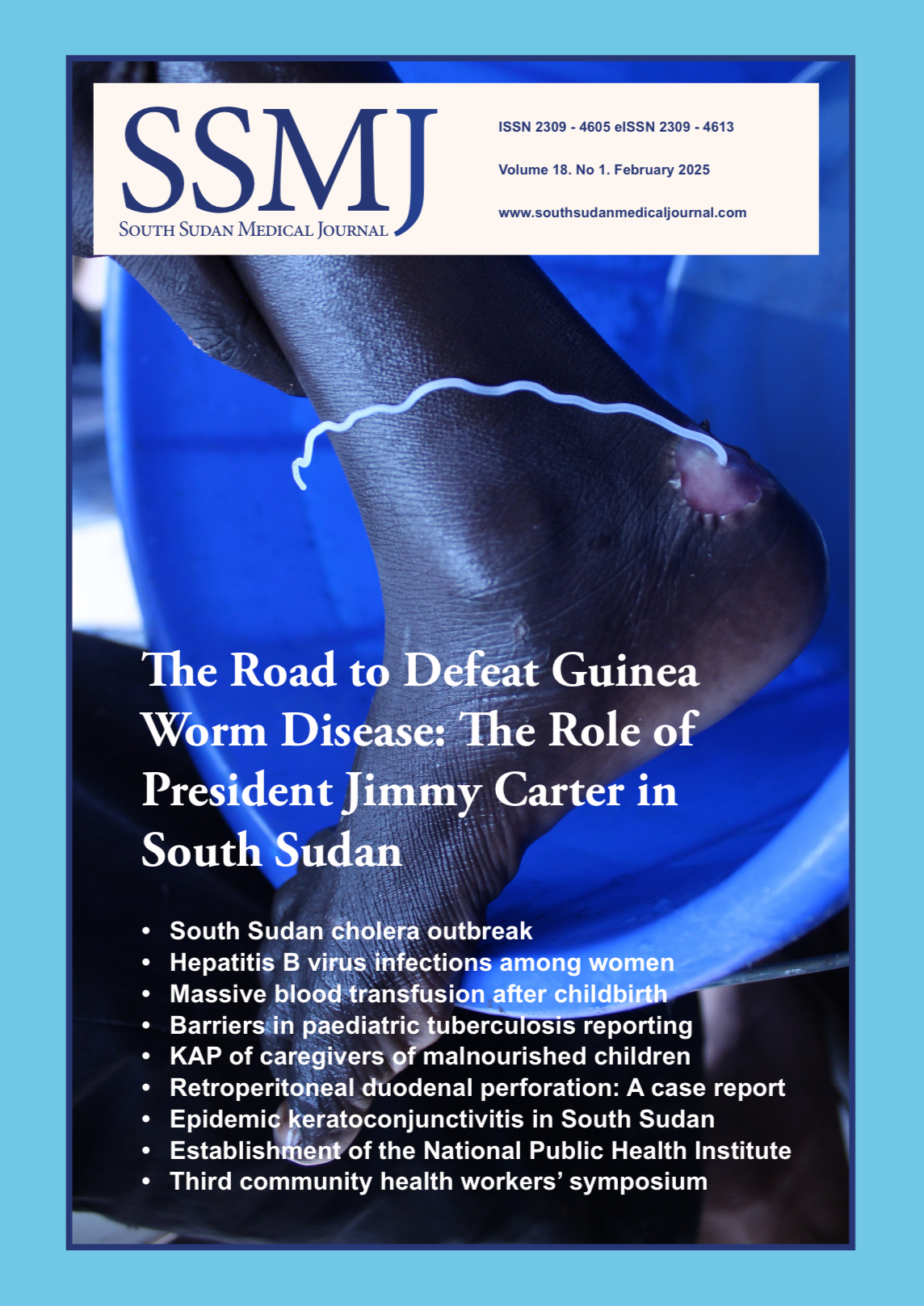
SSMJ February 2025 - South Sudan Medical Journal

Dear Reader,

The full issue of our February 2025 issue is online here; the articles are listed below. 

Editorial 
  • South Sudan cholera outbreak: A call to improve sanitation Ruot Garjiek Teny 
Research Articles 
  • Prevalence and associated risk factors of hepatitis B virus infections among women of reproductive age in Juba, South Sudan Ezbon WApary, Akway M. Cham, Oromo F. Seriano 
  • Management and outcome of women requiring massive blood transfusion after childbirth: A cross-sectional study at Muhimbili National Hospital, Tanzania Wangwe Peter Joseph, Sawe Eshi-Fisha Linda, Meda Elineema Robson 
  • Addressing barriers in paediatric tuberculosis reporting: A qualitative study of private healthcare providers’ perspectives Suryanti Chan, Idris Adewale Ahmed, Hamzah Hamzah 
  • Knowledge, attitudes, and practices of caregivers of malnourished children at the Al Sabbah Children’s Hospital, Juba, South Sudan Francis Beek Akook, Nyok Daniel Ngor 
Case Report 
  • Evaluation and surgical repair of retroperitoneal duodenal perforation following blunt trauma: A case report Rashmi Ranjan Sahoo, Abhinav Voona, Nalini Naik, and Jyotirmay Jena 
Main Articles 
  • Epidemic keratoconjunctivitis (Pink Eye) in South Sudan: A review Wani Mena The Establishment of the National Public Health Institute (NPHI) in South Sudan Nyinypiu Tong, Anthony Garang, Joseph Lako 
  • The third community health workers’ symposium, Liberia, 2023: What are the implications for South Sudan’s Boma Health Initiative? Kon Alier, Solomon Anguei, William Kuon, Christopher Ajumara 
Short Communications 
  • South Sudan’s journey to defeat Guinea Worm Disease: The role of President Jimmy Carter and the Carter Center Makoy Samuel Yibi Logora 
  • Letter to the Editor: President Jimmy Carter deserves a special recognition for his work to eradicate Guinea worm in South Sudan. Victor Vuni Joseph 
  • Letter to the Editor: Simulation-based education amid conflict: The Sudanese American Medical Association experience in Sudan Mohamed Almahal, Mohamed Ahmed, Omer Gomaa, Salaheldin Abusin, Ihab Abdalrahman
  • Obituary: Maj. Dr Santino Kuot Maluil 
  • Obituary: Dr Benjamin Peter Oduk 
See the back page for instructions on how to prepare and submit manuscripts for publishing in SSMJ.

Thanks to everyone who supports SSMJ - authors, editors, and, especially, our peer reviewers.

The SSMJ team
Email: southsudanmedicaljournal AT gmail.com
Website: http://www.southsudanmedicaljournal.com
Follow us on Twitter@SSMedJournal and our Facebook Group,

SSMJ is published by the Health and Social Science Research Institute of South Sudan (HSSRI-SS)

Copyright © 2025 South Sudan Medical Journal, All rights reserved

Previously on W2tQ:

Wednesday, December 27, 2023

The conjunction of reality and simulation?


 "Models are approximations of reality, constructed by scientists to address specific questions of natural phenomena using the language of mathematics. Mathematical equations allow the practitioner to decide the level of abstraction needed to tackle a given problem, thus transcending the 'billiard ball' approach." p.198.


INDIVIDUAL
  |
     INTERPERSONAL    :     SCIENCES               
HUMANISTIC --------------------------------------  MECHANISTIC      
SOCIOLOGY  :   POLITICAL 
|
GROUP


"In practice, simulations are often limited by a dynamic range problem, meaning that one runs out of computing power to simulate behavior at all scales. The discretization of mathematical equations in order to program them into a computer introduces subtleties such as numerical dissipation - an artificial side effect of differential equation calculations that does not arise from physics. It is also likely that one needs different numerical methods to simulate behavior on different scales, and a single method may be insufficient for all spatial scales. Perhaps the advent of AI will allow us to overcome some of these limitations, but for now emulations remain an aspiration." p.199.
 " 

"Generally, examining the microscopic components of a complex system in order to understand how macroscopic behaviour emerges falls short - think biology and economics. Implicitly, this brute-force approach suggests that one may study complex systems without having a scientific question in mind, and if enough computing power is deployed then insight naturally emerges. The billion-euro Human Brain Project is a spectacular example of the limitations of such an approach. Essentially, their  simulations have failed to replace laboratory experiments.
As has been noted by climate scientist Isaac Held, there is a tension between simulation and understanding.  We simulate in order to mimic as much of an observed phenomenon as possible. But we achieve understanding by using idealized models to capture the essence of the phenomenon. By design, idealized models necessarily employ assumptions." p.198.


Heng, K., Approximating Reality, American Scientist - Special Issue: Scientific Modelling, July-August 2023. 111:4,198-199.

Friday, September 22, 2023

"Why models go wrong" BYTE, 1985

Why models go wrong
BYTE


"A model can be a physical object: a scale-model of an ancient settlement inferred from archeological evidence, or a physical anthropologist's reconstruction of a skeleton from a few bones and fragments. Most social models, however, are mathematical isomorphisms that specify one-to-one relationships between elements of the model and observable processes or entities. This abstractness gives models great versatility, but it also opens doors to potential problems. You don't need to be a naval architect to see that a model battleship has no bottom, but flaws in an equally defective sociometric model that repeatedly factors a large covariance matrix might escape casual scrutiny." p.151.


My source:
Houston, T.R. 1985. Why models go wrong. BYTE 10(10) : 151-164.


Wednesday, February 08, 2023

Automation by Design: Politics, Culture, and Landscape in an Age of Machines That Learn

The virtual one and a half-day symposium will be held Friday, February 17 & Saturday, February 18, 2023.

Wednesday, April 13, 2022

c/o Gärdenfors: "Events and Causal Mappings Modeled in Conceptual Spaces"

Personal circumstances mean that over the past decade I've given up on several memberships and hence the benefits that were to be had. The British Computer Society was invaluable, and I'm sure still is even at the 'Associate' level. In addition to the Nursing Specialist Group, the Expert Systems Group, Medical Informatics, SocioTechnical and a Methods group have proved an engrossing distraction and a more remote source of ongoing interest. I'm not sure if this is persistence, or stubbornness, but it surely qualifies as sustainable - as I hope this blog demonstrates.

Following the workshops in 2012, and 2016 on Conceptual Spaces I checked online for developments. Amongst the results a paper (added to Zotero):

"Another field of learning that is required for robotic reasoning
about causation and for communicating, for example in a
planning situation, is action categorization. Representations of
actions in terms of conceptual spaces, such as those proposed
by, for example, Chella et al. (2001), Gärdenfors (2014), and
Gharaee et al. (2017a,b), provide a potentially fruitful method for
implementations. Simulating an action and then using the event
mapping that has been learned to predict a result vector, can then
be used to generate plans and to reason about complex situations.
In this way, simulations can provide the robotic system the power
to imagine events that is needed to understand the physical, social
and, eventually, the emotional world we live in.

The event structure has not yet been implemented in any
concrete system. However, a cognitively motivated architecture
for holistic AI systems, including robotic ones, that integrates
machine learning and knowledge representation has been
proposed in Gärdenfors et al. (2019). The central idea of the
proposal is to use ‘event boards’ representing components of
events as an analogy to blackboards that formed the backbone
in some earlier AI systems." p.8. [with my emphasis].


For years - ever since learning and applying Hodges' model I've been carrying a requirement - a project. As Prof. Gärdenfors notes blackboards were an approach artificial intelligence systems, plus frames, cases, neural networks and others. The Health Career Model can be viewed as a series of boards, frames, conceptual spaces and compound threshold concepts. With so many purported forms of informatics and literacy, h2cm can ultimately represent the general state of affairs. It is situated (previously):

h2cm = 'GI - General Intelligence'?

'general problem'

Englemore, Robert; Morgan, Tony (1988). Blackboard Systems.
Addison-Wesley. ISBN 978-0-201-17431-1.
McCord Nelson, Marilyn / W.T. Illingworth
(1990) A Practical Guide to Neural Nets.
Addison-Wesley, ISBN 10: 0201523760.

Over the years, I've been asked about the number of books on shelves and boxed. This week on BBC Radio 4 or Times Radio(?), I caught a snippet of how we hold on to books and why. Your library: can be part of your identity. 

Knowing the life story of a resident in a nursing home, they may be comforted carrying a book; if staff can manage their anxiety about its potential use as a weapon in the event of an altercation. Having several books on a window sill [they do have a window?], can help. The light damage to the book pales in contrast to the reduced anxiety.

I realise what books mean to me - on 'display' even though nobody else sees them and even as I try to reduce the count. I still hold on to some cherished titles, and will return to those above. Originally, I picked up the Health Career Model and created the now archived website, so it would not gather dust on the shelf. Without action now though - there isn't much difference.

Gärdenfors P (2020) Events and Causal Mappings Modeled in Conceptual Spaces. Front. Psychol. 11:630. doi: 10.3389/fpsyg.2020.00630


Friday, March 05, 2021

gameChange VR therapy

individual
|
INTERPERSONAL : SCIENCES
humanistic ----------------------------------------------- mechanistic
SOCIOLOGY : POLITICAL
|
group


"The issue is an urgent one: all too often, individuals with psychosis find day-to-day life so anxiety-provoking that they simply withdraw. Everyday tasks — getting on a bus, doing the shopping, speaking to other people — become very challenging. Work and home life suffer. And mental and physical health deteriorate.

Psychological therapy can be very beneficial here. But it needs to be the right kind of therapy. What works best is active coaching in the situations that trouble people, helping patients move beyond their fears. However, this is difficult without a skilled therapist who has the time to get out and about with patients. And patients often find the idea frightening. The result is that a potentially powerful treatment is seldom actually delivered."


VIRTUAL REALITY


Source: Flyer from Salford - Early Intervention Team, Sept-Dec 2020 (Great team too!).

VR on archived site 1998-2015:

https://web.archive.org/web/20110903071731/http://www.p-jones.demon.co.uk/linksTwo.htm 

https://web.archive.org/web/20110727043926/http://www.p-jones.demon.co.uk/Introvrn.htm

Wednesday, December 23, 2020

ERCIM News No. 124 Special Theme: "PANDEMIC - Modelling & Simulation"

Dear ERCIM News reader,

ERCIM NEWS

ERCIM News No. 124 has just been published at https://ercim-news.ercim.eu/ The Special Theme of this issue focuses on research surrounding the current epidemic emergency. The contributions address actions to understand and counteract the spread of the virus. This special theme has been coordinated by our guest editors Salvatore Rinzivillo (ISTI-CNR), Joakim Sundnes (SIMULA) and Karin Rainer (AGES).

In the section "Research and Society" some of our institutes describe how they are meeting the challenges of COVID-19.

Thank you for your interest in ERCIM News. Feel free to forward this message to anyone who might be interested.

Next issue:
No. 125,  April 2021
Special Theme: "Brain-Inspired Computing"

Announcements in this issue:


Call for Proposals: Dagstuhl Seminars and Perspectives Workshops
Schloss Dagstuhl – Leibniz-Zentrum für Informatik is accepting proposals for scientific seminars/workshops in all areas of computer science, in particular also in connection with other fields. https://www.dagstuhl.de/dsproposal

SAFECOMP 2021
York, UK, 7-10 September 2021
Call for Papers and Workshop Proposals

The GATEKEEPER 1st Open Call
600,000€ available for AI and Big Data Applications, tools or components


-- 
Peter Kunz                      	
ERCIM Office

Sunday, November 15, 2020

Radiating mechismo...

soul - self - person - individual - person - body - systems - organs - tissues - cells - atp ...
|
INTERPERSONAL : SCIENCES
humanistic ----------------------------------------------- mechanistic
SOCIOLOGY : POLITICAL
|
dyad ... family - group - community - population - Gaia::Earth - Cosmos


Blush


"Blush is a radiator by Icelandic designer Thorunn Arnadottir that is covered in thermochromatic paint and both looks like and simulates capillaries. She says, 'Blush is a very important organ of the house. Regulates the temperature and keeps it warm and alive. Blue when cold, but blushes with red when warm.'"

https://laughingsquid.com/blush-a-radiator-that-simulates-capillaries-blushes-red-when-warm/

 My Source:

IDN, 2012. Volume 19, NO. 3. 080.

See  also:

Book: The Vital Question


Tuesday, September 15, 2020

Chaotic Modeling & Simulation Web Conference 22-24 October 2020

Dear Colleague,

Please see the announcement for the October CMSIM2020 International Web-Conference, 22-24 October 2020. You are invited to contribute by a presentation, a special session or workshop and suggest a keynote talk.

We already have done the appropriate provisions for an important meeting following the successful previous Virtual events.

The deadline for Abstract submissions and Special and Invited session and Workshop proposals is set to September 18, 2020, see at http://www.cmsim.org/cmsim2020webconference.html

We already invite papers for the Conference Proceedings where accepted papers will be included along with Book and Journal publications (submit following the conference paper guidelines to Secretariat AT cmsim1.org ).

On behalf of the Conference Committee,

Prof. Christos H Skiadas,

Conference Chair

________________

Over the years several Books from leading publishers emerged from the CMSIM and CHAOS Conferences and events.

Please see the last years Books published by Springer

11th Chaotic Modeling and Simulation International Conference, 2019,

https://www.springer.com/gp/book/9783030152963  and

12th Chaotic Modeling and Simulation International Conference, 2020,

https://www.springer.com/gp/book/9783030395148

13th Chaotic Modeling and Simulation International Conference, Springer (in preparation)

Friday, January 03, 2020

ERCIM News No. 120 Special theme "Educational Technology"

Dear ERCIM News Reader,

ERCIM News No. 120 has just been published at https://ercim-news.ercim.eu/

ERCIM News 120

This special theme addresses the state of the art in educational technologies, “EdTech”, illustrating the range of scientific fields and challenges faced by the research community when it comes to integrating tools and systems that apply to real-life learning situations.


Guest editors: Vassilis Katsouros (Athena Research and Innovation Centre) and Martin Hachet (Inria)


This issue is also available for download in pdf and ePub.

Thank you for your interest in ERCIM News. Feel free to forward this message to anyone who might be interested.

Next issue:
No. 121, April 2020
Special Theme: The Climate Action: Mathematics, Informatics and Socio-Economics Accelerating the Sustainability Transition
Announcements in this issue:

Follow us on twitter @ercim_news
https://twitter.com/ercim_news
and join the open ERCIM LinkedIn Group http://www.linkedin.com/groups/ERCIM-81390
---------------
Peter Kunz                       
ERCIM Office
2004, Route des Lucioles
BP93
F-06902 Sophia Antipolis Cedex

https://www.ercim.eu  
-----------------------------
@ercim_news
http://twitter.com/ercim_news

join the ERCIM Linkedin Group
http://www.linkedin.com/groups/ERCIM-81390

Saturday, October 27, 2018

ERCIM News No. 115 Special theme "Digital Twins"

Dear ERCIM News Reader,

ERCIM News No. 115 has just been published at https://ercim-news.ercim.eu/

https://ercim-news.ercim.eu/en115/special
The Special Theme "Digital Twins", coordinated by the guest editors Benjamin Sanderse (CWI) and Edgar Weippl (SBA), features 23 articles illustrating the many facets of this growing scientific field. The special theme contributions give insight in ongoing projects and allow for a glimpse into the future of digital twin technology.

The section Research and Innovation reports on news about research activities and innovative developments from European research institutes.


This issue is also available for download in pdf and ePUB


Thank you for your interest in ERCIM News. Feel free to forward this message to anyone who might be interested.

Next issue:
No. 116  January 2019
Special Theme: "Transparency in Algorithmic Decision Making"

My source:
Peter Kunz
ERCIM Office
2004, Route des Lucioles
BP93
F-06902 Sophia Antipolis Cedex

Of particular interest in this issue:

How will your Digital Twin be born?

In-silico models of human physiology and pathology are aimed at progressing and complementing medicine in several ways. These models can reproduce physiological processes and events on multiple scale levels. The goal of the individual models is to help predict the outcome of a specific disease or to support the decision-making process during treatment. p.18.
[ Plus DSLs, pp. 10-12; SpeechXRays, pp. 49-50. ]

Thursday, April 14, 2016

Book: LEARNING IN VIRTUAL WORLDS: RESEARCH AND APPLICATIONS

Announcing the release of:

LEARNING IN VIRTUAL WORLDS: RESEARCH AND APPLICATIONS

Edited by:
Sue Gregory, University of New England, Australia,
Mark J.W. Lee, Charles Sturt University, Australia,
Barney Dalgarno, Charles Sturt University, Australia, and
Belinda Tynan, The Open University, UK

With a Foreword by Chris Dede, Harvard University, USA

Part of the "Issues in Distance Education" series
(Series Editor: Terry Anderson, Athabasca University, Canada)

Published by Athabasca University Press as an open-access publication—
Free PDF download available at: http://www.aupress.ca/index.php/books/120254
Also available for purchase in Paperback and ePub formats

*** Description ***

Three-dimensional (3D) immersive virtual worlds have been touted as being capable of facilitating highly interactive, engaging, multimodal learning experiences. Much of the evidence gathered to support these claims has been anecdotal but the potential that these environments hold to solve traditional problems in online and technology-mediated education—primarily learner isolation and student disengagement—has resulted in considerable investments in virtual world platforms like Second Life, OpenSimulator, and Open Wonderland by both professors and institutions. To justify this ongoing and sustained investment, institutions and proponents of simulated learning environments must assemble a robust body of evidence that illustrates the most effective use of this powerful learning tool.

In this authoritative collection, a team of international experts outline the emerging trends and developments in the use of 3D virtual worlds for teaching and learning. They explore aspects of learner interaction with virtual worlds, such as user wayfinding in Second Life, communication modes and perceived presence, and accessibility issues for elderly or disabled learners. They also examine advanced technologies that hold potential for the enhancement of learner immersion and discuss best practices in the design and implementation of virtual world-based learning interventions and tasks. By evaluating and documenting different methods, approaches, and strategies, the contributors to Learning in Virtual Worlds offer important information and insight to both scholars and practitioners in the field.

*** For More Information ***

A flyer containing further details about the book, including a copy of the Table of Contents, is attached. The full text of the entire book and of individual chapters can be downloaded for free in PDF format at http://www.aupress.ca/index.php/books/120254 . The PDF and ePub versions can also be purchased from this site.
_______________________________________________
My source:
open-education mailing list [closed?]

Thursday, January 14, 2016

Editorial: "Living dolls and nurses without empathy" mapped to Hodges' model

The example of Hodges' model displayed below is based upon selected concepts and themes taken from the following editorial:

Dean, S., Williams, C. and Balnaves, M. (2016), Living dolls and nurses without empathy. Journal of Advanced Nursing. doi: 10.1111/jan.12891

individual
|
INTERPERSONAL : SCIENCES
humanistic ---------------------------------------  mechanistic
SOCIOLOGY : POLITICAL
|
group

'nursing'

empathy - individual ability/quality

'the patient'

patient anxiety:
 emotional - psychological state

reflection
interpersonal skills

compassion - PURPOSE
individual values
hearing the person

artificial intelligence
'nursing'

PROCESS
(nurse-based observation skills)

simulation technology - 'living doll'

'the patient' in bed

(simulated) physiological data

cardiac event - crushing chest pain

voice-over technology

-TECHNICAL (machine)

objectivity


'nursing'

communication skills

experience
PRACTICE
public perception

SOCIO-

subjectivity


'nursing'

nursing programmes - education

litigation

cost of placements

professional values

safety
POLICY


Some further questions:
Where would you place holistic care?
Where does atomism lie?
In the above model where is situational awareness and how do we recognise an integrated approach?

My source: Trisha Greenhalgh
@trishgreenhalgh

There is no endorsement intended with this post. 

Wednesday, September 30, 2015

ERCIM News No. 103 Special Theme: "Augmented Reality"

Dear ERCIM News Reader,

ERCIM News No. 103 has just been published at

Special Theme: "Augmented Reality"
http://ercim-news.ercim.eu/en103/special

Guest editors:
- Constantine Stephanidis, ICS-FORTH, Greece
- Eija Kaasinen, VTT Technical Research Centre of Finland Ltd

This issue is also available for download in pdf and ebpub

Thank you for your interest in ERCIM News. Feel free to forward this message to others who might be interested.

Next issue: No. 104, January 2016 - Special Theme: "Life Science"

Best regards,
Peter Kunz
ERCIM News central editor

Wednesday, April 21, 2010

ERCIM News No. 81 Special theme: "Computational Science/Scientific Computing - Simulation & Modelling for Research and Industry"

Dear ERCIM News Reader,
ERCIM News No. 81 has just been published at http://ercim-news.ercim.eu/

Special Theme:
"Computational Science/Scientific Computing -
Simulation & Modelling for Research and Industry

- coordinated by: Ulrich Trottenberg, Fraunhofer Institute for Algorithms and Scientific Computing (SCAI), Germany, and Han La Poutré, CWI, The Netherlands
- featuring a keynote by Kostas Glinos, European Commission, DG Information Society and Media, Head of GEANT and e- Infrastructure Unit.

Next issue: July 2010
Special Theme: "Computational Biology" (see call for articles)

Thank you for your interest in ERCIM News.
Feel free to forward this message to others who might be interested.

Best regards,
Peter Kunz

<->
[PJ] This issue includes:
p. 44 A Computational Approach to Patient Flow Logistics in Hospitals by Anke Hutzschenreuter, Peter Bosman and Han La Poutré
p.48 Accurate Reconstruction of Single Individual Haplotypes for Personalized Medicine by Filippo Geraci and Marco Pellegrini
p.56 EXTRA Helps SMEs Assess their Knowledge Management Practices by Sanae Saadaoui and Frederic F. Monfils
p.57 The ACM Digital Library at the forefront of Semantic Technology by Stephanie Parker

Monday, February 25, 2008

Lupina Award in Health System Dynamics

The Health Policy Special Interest Group (HPSIG) of the System Dynamics Society is proud to announce the -

Lupina Young Researchers Award in Health System Dynamics

- which will be presented for the first time at this summer's 2008 International System Dynamics Conference in Athens, Greece. The award is sponsored by the Lupina Foundation of Toronto, Canada, and will be accompanied by a check in the amount of CAN$5000. The award will be presented to the recipient (or recipients) during the HPSIG meeting on the Sunday afternoon meeting just preceding the conference (July 20th this year), and a brief announcement will also be made to all conference attendees at a plenary session.

This award will be given to people at early stages of their careers to encourage them to do further work in health system dynamics. In the event that the winning paper represents the equal work of two young researchers, or if there is a tie among papers, the cash prize may be subdivided. The work considered for this award must be accepted as a paper for presentation at the International System Dynamics Conference. Papers are self-nominated, and to be eligible, the author(s) must either be in graduate school or have completed their educational training no more than five years prior to paper submission.

Authors need not be members of the System Dynamics Society and may, in fact, specialize in other methodologies and use them in their submitted papers. But their work must:

  • Focus on dynamic phenomena in health systems and problems,
  • Demonstrate technical quality and clear presentation, and
  • Provide original insights derived from a dynamic analysis.
The winner(s) must be present at the Sunday HPSIG meeting to receive their prize, and be willing to discuss their winning work at that meeting.
For (latest ...) Conference details please see -

http://www.systemdynamics.org

[Ever since watching an Open University programme on Catastrophe Theory in Prisons (+New Scientist article?), running early microcomputer fractal graphic programs for hours and reading Gleick's book on Chaos and others; I've been fascinated by dynamic systems. This is a marvellous field for young researchers to explore:
asking new questions of old answers ...]