Hodges' Model: Welcome to the QUAD: distance

Hodges' model is a conceptual framework to support reflection and critical thinking. Situated, the model can help integrate all disciplines (academic and professional). Amid news items, are posts that illustrate the scope and application of the model. A bibliography and A4 template are provided in the sidebar. Welcome to the QUAD ...

Showing posts with label distance. Show all posts

Thursday, October 01, 2026

Paper - 'Women's voices in rural Malawi: antenatal care research and community learning'

Dear HIFA colleagues,

My friend, Ted Lankester, suggested I share my recently published research with this community.

The paper, published in PLOS Global Public Health, explores women’s perceptions of pregnancy and antenatal care in Chizenga village, Chikwawa, Malawi. It arose from my MSc dissertation at the Liverpool School of Tropical Medicine, with co-authors Deborah Nyirenda and Terry Kana.

Through interviews with 14 pregnant women, we explored how understanding of antenatal care interacts with transport costs, distance, nutritional constraints, gender dynamics and experiences of respectful and disrespectful care. Women also expressed a desire for more community-based education and outreach.

The full open-access paper is available here: https://doi.org/10.1371/journal.pgph.0005515

Layton H, Nyirenda D, Kana T (2026) A qualitative study to explore women’s perceptions of pregnancy and antenatal care in Chizenga village, Chikwawa, Malawi. PLOS Glob Public Health 6(9): e0005515. https://doi.org/10.1371/journal.pgph.0005515

Their accounts inspired me to develop the Sangalala Maternal Health Partnership Programme with local partners, through The Reach Foundation UK. Our first cohort (39 women and 1 man) has recently completed the programme in Uganda, and we are now learning from participants’ experiences to strengthen it.

I would welcome members’ experiences of making maternal health information accessible and useful in rural communities, particularly where information needs sit alongside practical barriers to accessing care.

I promised the women who participated that I would help raise their voices. Sharing their perspectives and learning from this community is one way I hope to honour that promise.

Best Wishes,

Helen

HIFA profile [and my source]: Helen Layton is a Nurse and Global Health Consultant; Founder & Clinical Director, The Marula Institute; Co-founder & Executive Director, The Reach Foundation UK/Spain. My professional interests include maternal and child health, global health equity, respectful maternity care, community-led health education, and translating research into practice. As Co-founder and Executive Director of The Reach Foundation UK and Founder and Clinical Director of The Marula Institute, I am particularly interested in strengthening health systems, workforce education, safe care for children with complex needs, and ensuring women’s and families’ voices inform care. 
Helen AT cathcom.org

Friday, September 04, 2026

Call for Submissions: Fall-Winter 2026 Intima Journal of Narrative Medicine


OUR CALL FOR SUBMISSIONS  FOR OUR FALL-WINTER 2026
JOURNAL IS OPEN. SUBMIT YOUR WORK TODAY.


Intima: A Journal of Narrative Medicine
is a literary journal dedicated to promoting the theory and practice of narrative medicine, an interdisciplinary field that enhances healthcare through the effective communication, empathy and understanding between clinicians, caregivers and patients. Our name Intima has a specific resonance in the field: For us, narrative involves the intimate interface between people, who yield and gain from the experience of stories involving the clinical encounter.

 The word itself has an anatomical reality: intima is  the thin layer lining a blood vessel, speeding blood to the heart and brain, an apt analogy for the kind of narratives we publish that speak to the emotions and the intellect, the feelings and facts that engage the senses in stories with meaning and impact..


individual
|
INTERPERSONAL
: SCIENCES             
humanistic ------------------------------- mechanistic
SOCIOLOGY : POLITICAL   
|
group


©The Art of Anatomy by Khalil Harbie.
Intima, Fall 2013


Art - https://www.theintima.org/missionandvison also reminded of Escher and Byte Magazine.

My source: Intima list

Previously: 'creativity' : 'crossroads' : 'narrative'

Wednesday, August 12, 2026

Total eclipse: The terminator moves faster than you think

individual
|
INTERPERSONAL
: SCIENCES             
humanistic ------------------------------- mechanistic
SOCIOLOGY : POLITICAL   
|
group

Between the new and full moon the terminator - the line demarcating what is lit from what is dark changes all the time. This is imperceptible with the naked eye.

A telescope at low magnification reveals the moon in all its glory. At a higher power with manual control you have to keep moving to keep up, as the moon other-worldly slides out of view.

What of the terminator between poverty and wealth; ultrapoverty and ultrawealthy?

It is plain to see and so - easy to deny; but their instruments are hopeless, they watch indoors, fixed on their screens.


Total Solar Eclipse – August 12, 2026

See also: https://en.wikipedia.org/wiki/Terminator_(solar) 

Previously: 'terminator' 

Tuesday, May 26, 2026

By Helen Frankenthaler - 'A Green thought in a Green Shade'

individual
|
INTERPERSONAL : SCIENCES
humanistic ------------------------------- mechanistic
SOCIOLOGY : POLITICAL
|
group
 
Helen Frankenthaler: A Green Thought in a Green Shade, 1981
119 × 156 1/2 in. (302.3 × 397.5 cm). Acrylic on canvas


© 2026 Helen Frankenthaler Foundation, Inc. / Artists Rights Society (ARS), New York

Image used with kind permission of The Helen Frankenthaler Foundation - and with thanks.
My source: Phoebe Evans. Opening Shot, FT.com/HTSI FTWeekend. 23rd April, 2026, p.13.
 
Gagosian. Helen Frankenthaler: The Moment and the Distance
April 30–July 2, 2026 West 21st Street, New York 
 

Tuesday, March 31, 2026

Global health is ... c/o King & Koski (2020)

Use of the word 'global' in health care is common: from global assessment; global as in a pandemic, as per Covid which for a time closed down most human activity across the world; the global health workforce; and global health crises, that must include the climate crisis and pollution. Universal health coverage, allied with universal healthcare access, refers to (national and aspirational ...) global access to quality health services. 

Above, 'global health' has itself already occurred several times. I've posted about global health on a great many occasions on behalf of other parties.

Defining global health in the context of public health, King and Koski (2020) write:

'We propose the following definition:
global health is public health somewhere else.'

More specifically, they add: 

'Global health as a field is not distinguished by its aspirations, methods of research and practice, intervention strategies or even geographical area per se, but rather by a particular relationship between its practitioners and its recipients: a person engages in global health when they practise public health somewhere—a community, a political entity, a geographical space—that they do not call home.'


To apply Hodges' model to global health, there must be another definition.

King NB, Koski A. Defining global health as public health somewhere else. BMJ Global Health
2020;5:e002172. doi:10.1136/bmjgh-2019-002172

Sunday, December 21, 2025

Disciplinary bridges ... how's your sense of direction?

As an advocate for Hodges' model, I've acquired an affinity for inter- multi- transdisciplinary bridges, especially medical sociology, those leading towards the mathematical, and human geography. An old but significant influence is:

Chapman, K. (1979). People, pattern, and process: an introduction to human geography. London: Edward Arnold.

Chapman begins with the concept of distance, speed of movement and the consequence of the shrinking world. Our ability to move faster has radically altered the total travel time: from what was a 50 mile walking-day. In chapter 2, 'A Conceptual Framework' refers to:

  • Decision making - the basic mechanism
    • The Spatial Context
    • The Content of Space
  • Dimensions of Space
  • Spatial Process - Causality in Time and Space

Overall, the book also takes me back to a paper I cited in 2007: Bell jars and bell curves

I'm sure the 'School of Geography' at Leeds is unrecognisable today from that of the 1980s. But the referenced paper in the 'Bell jars..' post:

Macgill, S.M. (1984). Structural Analysis of Social Data, A Guide to Ho's Galois Lattice Approach and A Partial Re-Specification of QAnalysis, Working Paper 416, School of Geography, University of Leeds. Abstract 1985

- still gives me an itch I can't scratch. 

 I could not fully understand, or follow, the print quality doesn't help, but it captured my imagination (perhaps that is enough?).

Chapter 9 stands out with 'Spatial Pattern' pp.203-234, 9.1.1 Topologic Structures, pp.205-209. Here, Chapman explains and has examples of connectivity matrices, with three indices to calculate the connectivity in a graph. All grist for the mill.

Happy Solstice too!

Sunday, November 02, 2025

The poetry of presence c/o Kenner's 'Mechanic Muse'

'... Eliot's poetry responds to yet another of the new century's pervasive experiences, that of being talked to by people we cannot see. This happens whenever we pick up a telephone, a thing we do so many times a day we quite overlook the strangeness of what lappens next. A character in The Cocktail Party remarks that you can't tell the truth on the telephone, meaning probably that you lose three quarters of your communicative power when you cannot be seen and your breathing body is absent, and you must fabricate mere semantic sequences. Your words are only a fraction of what you say, and the telephone throws you back on nothing but words. It is in Sweeney Agonistes, the play that gives the telephone bell a wholly metrical speaking part, that we hear the famous phrase, "I gotta use words vhen I talk to you."
    When the phone rings in that play - 
    Ting a ling ling 
    Ting a ling ling

Dusty snatches it up and says,

Hello Hello are you there?' 


Kenner, H. (1987) The Mechanic Muse, Oxford: OUP. pp.34-35.

Wednesday, October 01, 2025

Julian Tudor-Hart 'The Inverse Care Law' - c/o The Lancet

On the bottom of my notes re. Giarchi and 'distance decay' I'd written:

'Inverse Care law - p.60. - Giarchi. "those who suffer more ill health are less likely to be assisted."

It made me wonder about the origin of this law having posted about it in 2020.

The Lancet has an editorial and an associated podcast:

50 years of the inverse care law. The Lancet, Volume 397, Issue 10276, 767. February 27, 2021.

'“The availability of good medical care tends to vary with the need for it in the population served. This inverse care law operates more completely where medical care is most exposed to market forces, and less so where such exposure is reduced.”

These understated opening lines of Julian Tudor Hart's paper, The Inverse Care Law, are as relevant now (50 years to the day since publication) as in 1971. The paper is one of the landmark publications in The Lancet's near 200-year history, and the resonance of Tudor Hart's definition of the inverse care law has global and timeless importance. Simply expressed, Tudor Hart observed that disadvantaged populations need more health care than advantaged populations, but receive less.
Tudor Hart's life and career took him from highly privileged beginnings in London and Cambridge to decades spent in the deprived and deeply socialist Welsh valleys. His experience and work has inspired a generation of influential health-care leaders including Andrew Haines, Allyson Pollock, Cesar Victora, and Graham Watt. Today's anniversary issue of The Lancet explores both the global reach of the inverse care law and primary care initiatives in deprived areas around the UK.
Although inequality in health and its many causes are widely understood, inequity in health-care service provision is enduring and fundamental: an intractable concept that lies at the heart of the inverse care law. The inverse care law is primarily about inequity (injustice) in health care that results in unfair social inequalities (imbalances) in health. Since the inverse care law was published, the UK's National Health Service (NHS) has strived to reduce inequity with mixed success. Notably, long-lasting progress was achieved through the 1970s resource allocation formula, which reduced geographical inequality in hospital and institutional expenditure. In the early 2000s, the NHS strengthened primary care provision in disadvantaged areas, leading to a temporary reduction in social inequality, although this progress has reversed following shifts in funding, a slowing of spending, and years of living with austerity.'

See also: 

https://en.wikipedia.org/wiki/Julian_Tudor-Hart

https://www.chpi.org.uk/blog/julian-tudor-hart-and-the-essence-of-primary-care/

Saturday, September 13, 2025

On Care, Papers, Distance, Pressure, Academia and Falls

In my student nursing days late 1970s there was a big-stick of motivation. It wasn't management, and yet it was. There was a stigma attached to a patient developing a pressure sore - decubitus ulcers. The NHS then had many psychogeriatric wards, but that care is now with nursing homes. Despite the best efforts some patients did, especially on the mental health infirmary, which was staffed by 'general'  trained nurses too. Using aseptic technique wounds had to be packed (stage 3-4?). Some of the treatments, were not exactly 'evidence-based'. There is a historical account of previous treatments provided on 'Asylum Years'.

In the 1990s I was working on a 'book' about health, nursing and informatics (it was simpler then?). Submitting the project as a book proposal, a letter from one publisher reads: 'thanks but no thanks'. Although unsuccessful, that exercise accounts for the range of interests I still maintain today, and the scope of posts here on W2tQ. Continuing to clear and sort notes, one is for the 'book':

Abbott, P., & Payne, G. (Eds.). (1990). New Directions in the Sociology of Health (1st ed.). Routledge. https://doi.org/10.4324/9781351141727

From the above book, I've a page of notes headed "For chapter 2" drawing on a brilliant chapter 4:

Distance Decay and Information Deprivation: Health Implications for People in Rural Isolation

By George G. Giarchi

Abstract

Deprivation is frequently associated with the lives of inner city dwellers in old densely packed terraced housing, or with the residents in high-rise city slums and concrete council houses. In substantive socio-economic terms the deprivation of both the urban and the rural setting are the effects of the same structural dysfunctions, as aptly demonstrated by Townsend's 1968 classic study of poverty. On the basis of empirical studies rural deprivation affects the standards of health of many people in the countrysides of the UK particularly the most vulnerable dependent populations, such as younger children and older adults at the lower end of the social scale. The houses which are 'unfit' are damp, poorly lit, badly ventilated or lack healthy sanitation: clothes are rotten with mildew. Leschinsky's nationwide survey of rural health services indicates that centralization of health provision is a major reason for health disparities in rural areas.


I looked up the author, guessing that they were possibly still in academia, emeritus, or more likely (then, a decade or more in their career) retired by now. The search did not take long, but filled me with sadness and anger:

'A coroner has said there were "missed opportunities" to prevent the death of a hospital patient who died after developing a bedsore.

George Giacinto Giarchi, 86, died in November 2017 at Plymouth's Mount Gould Hospital after being treated for weeks at Derriford Hospital after a fall.

At Plymouth Crown Court coroner Ian Arrow said Mr Giarchi died of multi-organ failure from the pressure ulcer.

His family urged ministers to ensure hospitals had adequate staffing levels.

The former Plymouth University professor was admitted to Derriford Hospital after falling and fracturing his arm at home on 25 September 2017.

He was later transferred to Mount Gould where the lesion was first noticed.'

Pressure ulcers, known as bed sores, are injuries caused by pressure on the skin often seen in bedridden patients.'

https://www.bbc.co.uk/news/uk-england-devon-48798285

 Thank you and bless you Prof. George G. Giarchi RIP.

Jones, P. (2012). Exploring several dimensions of local, global and glocal using the generic conceptual framework Hodges's model. The Journal Of Community Informatics. 8(3). Retrieved from https://www.academia.edu/3794699/Reflecting_on_the_glocal_through_the_conceptual_framework_of_Hodges_s_model

Tuesday, January 21, 2025

A Voyage in Cosmic Health ... loneliness

Individual
|
     INTERPERSONAL    :     SCIENCES               
HUMANISTIC --------------------------------------  MECHANISTIC      
SOCIOLOGY  :   POLITICAL 
|
Group
[2] 'Most pressingly, Voyager 1 has severe memory loss It stopped speaking clearly on November 14. All they received at JPL was a carrier signal. This was described to me in many ways: flatlining, an interstellar dial tone, useless ones and zeros, gibberish, no data. Imagine your friend is on a long journey and sends you a detailed letter every day, then, one day, empty envelopes start arriving. What happened to your friend? How do you help?' p.21.
[1] 'VOYAGER 1 SUFFERS MANY AILMENTS OF AGE. It has arthritis. During its planetary encounters, the team excitedly swung the camera and other instruments this way and that; this squeezed the lubricant out of the bearings of its articulated platform. Only painstakingly slow movements could loosen its joints. It also has heart disease, as Todd Barber, its propulsion engineer, explained. The arteries that deliver its propellant, which keeps it perfectly pointed at Earth, are partially clogged. Barber calls himself a space plumber and wore a shirt with flying saucers on it as we spoke in the Voyager office. He had considered all the usual cardiological remedies. 
Diet: unfortunately, Voyager eats only the propellant hydrazine, total junk food. 
Exercise: they haven't thought of a way to fire the thrusters to clear the blockage. 
Medication: so they've relaxed its alignment a bit and fire its thrusters less often; in other words, Voyager is on beta blockers.' p.21.

The Sounds of Earth Record Cover - GPN-2000-001978


My source - with thanks - brilliant writing! 

Roeder O. TERMINATION SHOCK. Last Days of a Lonely Interstellar Spacecraft. FT Magazine, August 3/4 2024. pp.18-27. https://www.ft.com/content/0f2dce04-ec78-4aeb-808c-cff5b5135699

https://www.ft.com/content/90b6aaaa-b192-48d9-bd43-e6f41978ad1c

Wednesday, November 20, 2024

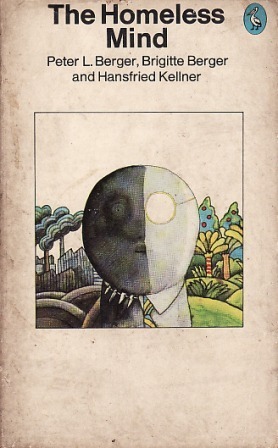
Hello? Is anyone there? 'The Homeless Mind'

individuality
|
INTERPERSONAL : SCIENCES              
humanistic ------------------------------- mechanistic
SOCIOLOGY : POLITICAL   
|
group

'Put differently, the componentiality of the cognitive style pertaining to technological production extends to identity. Again, a specific kind of double consciousness develops. In this case the dichotomy is between concrete identity and anonymous identity. The individual now becomes capable of experiencing himself in a double way: as a unique individual rich in concrete qualities and as an anonymous functionary. This dichotomization in the subjective experience of identity makes it possible for the individual to establish subjective distance vis-à-vis certain features of this identity.9 

For example, the individual will now experience that portion of his identity that contains his anonymization as a 'worker' as being 'less real' than his identity as a private person or family man. Since each portion of identity relates to specific roles, it now becomes possible for the individual to perform some of these roles 'tongue in cheek'. The componentiality of identity, as the componentiality of social relations, makes possible an 'engineering' practice. This time what is involved is the 'engineering' of one's own self. Those aspects of identity that a defined as 'more real' must be protected against threats coming from the 'less real' components of identity.' p.37-38.


Helpful reference to ideas of multi-relational synchronization and institutional vectors and how our mind's became homeless.

Also encouraging, even though 'historic', discussion on life plans and life planning.

'A basic presupposition is that life careers are not firmly fixed but are at least relatively open. Put simply the individual is faced with a number of alternative careers, especially in his " younger years, and therefore must make decisions about these available options. It is possible for the individual to imagine, himself as having different biographies. This possibility has both positive and negative consequences for the emotional economy of the individual. Positively, it may give him a feeling of frees dom to shape at least certain parts of his life. Negatively, it increases the likelihood of frustration regarding specific careers One is, after all, less likely to resign oneself to a particular situation if one believes that other situations are, in principle, possible.' p.67.
'Implicit in this scale of probabilities is a general 'sociology', on whatever level of theoretical sophistication. The individual has a `map of society' within which he can locate and project himself in terms of both past biographical recollection and future projects. The individual's life is perceived as a trajectory across this 'map'. There is also a large body of factual knowledge, most of which is 'weighted' in terms of the individual's life plans. Thus if a particular career appears to the individual as a realistically plausible project, he will have more factual knowledge about it than about a career in which he can participate only in pragmatically irrelevant fantasy. In other words, a good deal of background knowledge is related to 'anticipatory socialization'. p.68.
'However vaguely this may be defined, there is the underlying concept of life plan, both for the individuals and for the a family unit. This life plan is the totalization of all the relevant timetables, their grand sum and their integrative meaning In modern society, such life planning has become a value in itself. Its absence is commonly an occasion for reproach. The family unit thus operates as a life-planning workshop.' p.69.

'There is a general expectation of justice. It is expected that everyone in the relevant category - as, for example, those en-titled by law to a passport - will receive equal treatment. It is, of course, understood that certain persons may be excluded from this relevant category - for example, resident aliens or convicted criminals. It is also understood that the bureaucratic procedures may codify certain preferences, for example, in favour of diplomats or other people travelling on urgent government business. Once the categorial system has been established, however, the presumption of equality holds within each category. In the most general way, bureaucracy is expected to conform to the Roman principle suum cuique. An implication of this is that there will be no favouritism or any other intrusion of personal bias in the bureaucrat's handling of each client's case. The bureaucrat is expected to handle every case sine ira et studio. In other words, there is the general expectation that bureaucracy will operate impersonally and with 'affective neutrality'.2 These considerations bring us to an important point: unlike anything discussed in the preceding chapter, the cognitive style of bureaucracy contains a moral quality, not just as a limiting factor (after all, there are also moral assumptions about technological production - for example, that no one will be killed in the course of it), but as an intrinsic part of its own structure of consciousness. The source for this moral element is probably to be sought in the primary social location of bureaucracy in the political sphere.' pp.52-53.


Berger, P. L., Berger, B., & Kellner, H. (1973). The homeless mind: Modernization and consciousness. Penguin. 

Cover image: https://www.goodreads.com/book/show/3368465-the-homeless-mind

9 This is an amplification, by way of phenomenological description, of what Erving Goffman has called 'role distance'.

2 This term was coined by Talcott Parsons.

See also: 'homeless'

Wednesday, May 29, 2024

Point Nemo: 48°52.6′S 123°23.6′W

The oceanic pole of inaccessibility

Individual
|
      INTERPERSONAL    :     SCIENCES               
HUMANISTIC  --------------------------------------  MECHANISTIC      
 SOCIOLOGY  :    POLITICAL 
|
Group


Point Nemo: 48°52.6′S 123°23.6′W
                 
Social care


Al-Othman, H. Notes from the remotest place on Earth: father and son voyage to Point Nemo. The Sunday Times, 31 March 2024. p.11.

https://brown.co.uk/expeditions/point-nemo

Image: https://oceanservice.noaa.gov/facts/nemo.html

Sunday, June 26, 2022

Reflecting on the 'distances' between us

INDIVIDUAL
|
 INTERPERSONAL    :     SCIENCES               
HUMANISTIC --------------------------------------  MECHANISTIC      
SOCIOLOGY  :   POLITICAL 
|
GROUP

'DISTANCE'

a metric ...

qualitative and quantitative

conceptual - semantic distance

The Social Distance Between Us ...
... How Modern Capitalism Created our Mental Health Crisis

... Drug development $$$
 Access to healthcare / therapy
'Evidence'
Parity of Esteem
 Self-advocacy / Advocacy
 Employment, Poverty, Deprivation
Policy - Health Policy
Land
Property, Housing- Homelessness
 Mental Health Law
 'Public Spaces'
 Social Determinants of Health
Sustainable Development Goals

Life Chances
 Health Career
 Geo-Politics (Local 'politics') ...
 
.... How Remote Politics Wrecked Britain


See also: 'distance'

My source: FT Weekend and Times, BBC Radio 4 and 

https://twitter.com/Keirwales/status/1541093078102048770

Wednesday, May 04, 2022

Triangulation: When is a light an axis?


...when there are two lights ...

32c St. Joseph single
https://postalmuseum.si.edu/object/npm_1996.2066.165

See also:

https://en.wikipedia.org/wiki/St._Joseph_North_Pier_Inner_and_Outer_Lights


Wednesday, April 14, 2021

Webinar: ‘Global Remote and Rural Healthcare – how can we do it better?’

Following a successful online event last November Ms Jackie Aldridge got in touch, seeking speakers and attendees for a further webinar next month.

If you can suggest a speaker, present yourself, or are interested in attending please contact Jackie as per her [edited] message below.

Many thanks

Peter J.

-----------------------

Hello Mr Jones

We were so pleased that you agreed to be a speaker at our conference last November on the subject of ‘Global Remote and Rural Healthcare – how can we do it better?’.

As part of our follow up after the conference we decided it would be a good idea to try and run a short webinar a few times a year to keep this important subject under discussion. We are planning to run our first one on Tuesday 18 May.

I am hoping you may be able to help us by suggesting another contact who works in the field of remote and rural healthcare, who you think may be interested in giving a short presentation (no more than 20 minutes) about their specific field of expertise.

All I would need is their name, contact details and a short indication of what their specialism is.

I hope you can help and I look forward to hearing from you with your suggestions.

Best wishes

   Jackie 

 Jackie Aldridge

Programme Delivery Coordinator 

jackie.aldridge AT bridge2aid.org

Working part time, usually on Tuesdays, Wednesdays & Fridays

signature_1749479179

signature_460645455

UK office: Bridge2Aid, The Keepers, Symn Lane, Wotton-Under-Edge, GL12 7BD

Tel: 01453 546776.   Registered Charity No: 1170578

Friday, January 01, 2021

Mesmerized by the promise of 2021 ...

https://www.archimedes-lab.com/wp/2019/05/04/pascals-theorem/

 ... while listening to the New Year's Day Concert ...

HAPPY NEW YEAR TO ALL! 

BE SAFE, WELL

WISHES FOR HEALTH, PEACE & LOVE


Wednesday, December 23, 2020

ERCIM News No. 124 Special Theme: "PANDEMIC - Modelling & Simulation"

Dear ERCIM News reader,

ERCIM NEWS

ERCIM News No. 124 has just been published at https://ercim-news.ercim.eu/ The Special Theme of this issue focuses on research surrounding the current epidemic emergency. The contributions address actions to understand and counteract the spread of the virus. This special theme has been coordinated by our guest editors Salvatore Rinzivillo (ISTI-CNR), Joakim Sundnes (SIMULA) and Karin Rainer (AGES).

In the section "Research and Society" some of our institutes describe how they are meeting the challenges of COVID-19.

Thank you for your interest in ERCIM News. Feel free to forward this message to anyone who might be interested.

Next issue:
No. 125,  April 2021
Special Theme: "Brain-Inspired Computing"

Announcements in this issue:


Call for Proposals: Dagstuhl Seminars and Perspectives Workshops
Schloss Dagstuhl – Leibniz-Zentrum für Informatik is accepting proposals for scientific seminars/workshops in all areas of computer science, in particular also in connection with other fields. https://www.dagstuhl.de/dsproposal

SAFECOMP 2021
York, UK, 7-10 September 2021
Call for Papers and Workshop Proposals

The GATEKEEPER 1st Open Call
600,000€ available for AI and Big Data Applications, tools or components


-- 
Peter Kunz                      	
ERCIM Office

Saturday, July 13, 2019

Motivating the Gut to Walk, to Run

individual - self
|
INTERPERSONAL : SCIENCES
humanistic ----------------------------------------------- mechanistic
SOCIOLOGY : POLITICAL
|
group- population

motivation:
"I must go for run again
 - regularly - 
build up the distance to long ..."


*Walk, run, do something ...

On long distance runs:
the body produces lactate -
 a by-product of muscles working
in reduced oxygen.

Guts of marathon runners nurture
colonies of bacteria that
can consume lactate.

The bacteria transform lactate into propionate.
Propionate "has been shown to
increase the heart rate and maximise
 the rate of oxygen consumption,
making it essentially a natural
performance-enhancing drug."
Whipple, p.13.


Scheiman, J. et al. (2019) Meta-omics analysis of elite athletes identifies a performance-enhancing microbe that function, via lactate metabolism, Nature Medicine.
https://doi.org/10.1038/s41591-019-0485-4
Fitbiomics
https://www.fitbiomics.com/
*I'm sure I recall reading in Bortz's 'Next Medicine' stressing the importance of movement to independence.

My source:
Whipple, T. (2019) Gutsiest endurance atheletes have the running bug, The Times, 25 June, p.13.


Sunday, July 29, 2018

Relatedness and Similarity - in The Health Career Model

How can we demonstrate the basis for the axes, 'found' conceptual structures and conceptual clustering in Hodges' model?

UMLS::Similarity Web Interface (measuring pairwise similarity and relatedness of medical concepts)

Some results and definitions obtained from the above.

Results:

The similarity of person (C0027361 ) and patient (C0030705 ) using Lin (lin) is 0.85.
Using:    SAB :: include MSH
    REL :: include PAR/CHD

The similarity of person (C0027361 ) and patient (C0030705 ) using Conceptual Distance (cdist) is 0.5.
Using:    SAB :: include MSH
    REL :: include PAR/CHD

The similarity of person (C0027361 ) and patient (C0030705 ) using Resnik (res) is 1.6384.
Using:    SAB :: include MSH
    REL :: include PAR/CHD

The similarity of person (C0027361 ) and patient (C0030705 ) using Jiang & Conrath (jcn) is 1.7295.
Using:    SAB :: include MSH
    REL :: include PAR/CHD

The similarity of person (C0027361 ) and patient (C0030705 ) using Path Length (path) is 0.5.
Using:    SAB :: include MSH
    REL :: include PAR/CHD

The similarity of person (C0027361 ) and patient (C0030705 ) using Wu & Palmer (wup) is 0.8.
Using:    SAB :: include MSH
    REL :: include PAR/CHD

The similarity of person (C0027361 ) and patient (C0030705 ) using Nguyen & Al-Mubaid (nam) is 0.2038.
Using:    SAB :: include MSH
    REL :: include PAR/CHD

The similarity of person (C0027361 ) and patient (C0030705 ) using Random Measure (random) is 0.5703.
Using:    SAB :: include MSH
    REL :: include PAR/CHD

The similarity of person (C0027361 ) and patient (C0030705 ) using Leacock & Chodorow (lch) is 2.9957.
Using:    SAB :: include MSH
    REL :: include PAR/CHD

--
The relatedness of individual (C0027361 ) and group (C1257890 ) using Vector Measure (vector) is 0.7869.
Using:    SABDEF :: include UMLS_ALL
    RELDEF :: include CUI/PAR/CHD/RB/RN

The relatedness of individual (C0027361 ) and group (C1257890 ) using Adapted Lesk (lesk) is 9584.
Using:    SABDEF :: include UMLS_ALL
    RELDEF :: include CUI/PAR/CHD/RB/RN

--
The relatedness of self (C0036588 ) and group (C1257890 ) using Adapted Lesk (lesk) is 263.
Using:    SABDEF :: include UMLS_ALL
    RELDEF :: include CUI/PAR/CHD/RB/RN

The relatedness of self (C0036588 ) and group (C1561557 ) using Vector Measure (vector) is 0.4054.
Using:    SABDEF :: include UMLS_ALL
    RELDEF :: include CUI/PAR/CHD/RB/RN

Definitions:

individual (C0027361)
HL7V3.0 : A living subject of the species homo sapiens.
NCI : Human beings in general.
NCI : A human being.
NCI_BRIDG : A human being.
MSH : Persons as individuals (e.g., ABORTION APPLICANTS) or as members of a group (e.g., HISPANIC AMERICANS). It is not used for members of the various professions (e.g., PHYSICIANS) or occupations (e.g., LIBRARIANS) for which OCCUPATIONAL GROUPS is available.
individual (C0237401)
individual (C3245468)
HL7V3.0 : Description:Person as specified by coverage policy or program.
HL7V3.0 : Description:The level of coverage under the policy or program is available to an individual.
HL7V3.0 : Description: A role played by a party covered under a policy as the policy holder. An individual may be either a person or an organization.
Note: The party playing the role of an individual insured is not a claimant in the sense conveyed by the RoleClassCoveredParty CLAIM (claimant). However, a named insured may make a claim under a policy, e.g., a party that is the named insured and policy holder under a comprehensive automobile insurance policy may become the claimant for coverage under that policy if injured in an automobile accident and there is no liable third party. In the case of an individual insured making a claim, a role type code INSCLM (insured claimant) subtypes the class to indicate that an individual insured has filed a claim for a loss.
Example: The individual insured under a comprehensive automobile, disability, or property and casualty policy that is the policy holder.
HL7V3.0 :
self (C0036588)
HL7V3.0 : The "same" roleclass asserts an identity between playing and scoping entities: that they are in fact instances of the same entity and, in the case of discrepancies (e.g different DOB, gender), that one or both are in error.
Usage:
playing and scoping entities must have same classcode, but need not have identical attributes or values.
Example:
a provider registry maintains sets of conflicting demographic data for what is reported to be the same individual.
NCI : The individual as the object of his own reflective consciousness.
HL7V3.0 : The relationship that a person has with his or her self.
self (C1551994)
HL7V3.0 : Covered party is the policy holder. Also known as the subscriber.

See also:

WordNet::Similarity

This is a Perl module that implements a variety of semantic similarity and relatedness measures based on information found in the lexical database WordNet. In particular, it supports the measures of Resnik, Lin, Jiang-Conrath, Leacock-Chodorow, Hirst-St.Onge, Wu-Palmer, Banerjee-Pedersen, and Patwardhan-Pedersen. 

n.b. While Hodges' model was created for application in health and social care contexts it can be applied generally.


Sunday, March 25, 2018

Somewhere in Between: c/o Wellcome Collection

individual
& INBETWEEN
|
INTERPERSONAL : SCIENCES
humanistic & INBETWEEN ---------------------- mechanistic & INBETWEEN
SOCIOLOGY : POLITICAL
|
group
& INBETWEEN 
thoughts

feelings


wellbeing

Somewhere in Between c/o Wellcome Collection
Somewhere in Between


society
collaboration scientists & artists

art as:
genetic engineering;
HIV medicine;
 free diving;
mirror-touch synaesthenia.


My source: Moulton, N. (2018) We are all scientists now, FT Weekend, Life&Arts, 3-4 March. p.4.