Hodges' Model: Welcome to the QUAD: semantics

Hodges' model is a conceptual framework to support reflection and critical thinking. Situated, the model can help integrate all disciplines (academic and professional). Amid news items, are posts that illustrate the scope and application of the model. A bibliography and A4 template are provided in the sidebar. Welcome to the QUAD ...

Showing posts with label semantics. Show all posts

Wednesday, May 06, 2026

'Anthropological Theory of the Didactic' ATD - in learning mathematics

INTRODUCTION

Several studies have discussed the specific knowledge taught and learned in precalculus, calculus, and analysis courses, from different perspectives: for example, concept image and concept definition (e.g., O’Shea, 2016), APOS theory (e.g., Martínez-Planell, Trigueros Gaisman, & Mcgee, 2016), and the Anthropological Theory of the Didactic (ATD; e.g., Bergé, 2016). Our starting point is the general and relatively vague question of when in an undergraduate degree in mathematics does a student need (need in the sense of to succeed in the course) to engage in mathematical activities that may substantially, or meaningfully, lead to developing mathematical practices. We consider and frame this question within the ATD (Chevallard, 1999), which provides theoretical tools for modelling any human activity or practice. The semantic distinction between these two words is essential to us. Our hypothesis is that the kinds of didactic constructs to which professors and students are exposed are decisive in fostering the emergence of practices out of collections of local, particular, and relatively short-lived activities. From the theoretical stance we take, this means the development of mathematical knowledge out of local, particular, and relatively short-lived mathematical activities.' p.487.

THEORETICAL FRAMEWORK 

“Activity and practice”

'As mentioned above, we have come to see the semantic difference between activity and practice as pertinent to our work. The ATD’s notion of praxeology provides a fundamental model for defining mathematical practice, which, in the context of the theory, is equated to mathematical knowledge. According to the model, any practice (or piece of knowledge) can be represented by a quadruplet [T, τ, θ, Θ] involving four interconnected components: a type of tasks T, which generates the practice, the corresponding collection of techniques τ developed to accomplish T, the discourse used to describe, justify, explain, and produce the techniques (i.e., their technologies θ), and the underlying theories Θ that serve as a foundation of the technological discourse. As students progress in their studies of mathematics, they engage in numerous activities, which progressively determine the practices they develop'. p.489.

Laura Broley and Nadia Hardy. (2018). A study of transitions in an undergraduate mathematics program. In PROCEEDINGS of INDRUM 2018 Second conference of the International Network for Didactic Research in University Mathematics. pp.487-496. ERME topic conference.
https://indrum2018.sciencesconf.org/data/Indrum2018Proceedings.pdf


THEORETICAL CONSTRUCTS 

'ATD “postulates that any activity related to the production, diffusion or acquisition of knowledge should be interpreted as an ordinary human activity, and thus proposes a general model of human activity built on the key notion of praxeology” (Bosch & Gascon, 2014). The praxeology 𝛱 is represented by a quadruple [𝑇/𝜏 /𝜃/𝛩]: its praxis part (or know-how) consists of a type of tasks 𝑇 together with a corresponding technique 𝜏 (useful to carry out the tasks 𝑡 ∈ 𝑇 in the scope of 𝜏). The logos part (or know-why) includes two levels of description and justification: the technology 𝜃, i.e. a discourse on the technique, and the theory 𝛩, which often unifies several technologies. 

The elaboration of a reference epistemological model (Florensa, Bosch, & Gascon, 2015) as sequences of praxeologies, for a given body of knowledge, is an important step in any research carried out in the ATD framework. It is the tool that will be used by the researcher to describe, analyse, put in question or design the specific contents that are at the core of a teaching and learning process. In order to build such a model, “mathematical praxeologies are described using data from the different institutions participating in the didactic transposition process, thus including historical, semiotic and sociological research, assuming the institutionalized and socially articulated nature of praxeologies” (loc. cit. p. 2637).' pp.498-499.

Charlotte Derouet, Gaetan Planchon, Thomas Hausberger, and Reinhard Hochmuth. (2018). Bridging probability and calculus: the case of continuous distributions and integrals at the secondary-tertiary transition. In PROCEEDINGS of INDRUM 2018 Second conference of the International Network for Didactic Research in University Mathematics. pp.497-506. ERME topic conference.
https://indrum2018.sciencesconf.org/data/Indrum2018Proceedings.pdf

I came across this source as I'd read about the way chemistry as a discipline co-opted some mathematical symbols, but adapted them for their own use.

Previously: 'math' : 'threshold concept' : 'liminal' : 'learning'

Wednesday, December 25, 2024

Praying ... for PEACE

INDIVIDUAL
|
INTERPERSONAL : SCIENCES              
humanistic ------------------------------- mechanistic
SOCIOLOGY : POLITICAL   
|
GROUP

PRAY


PREY

PRAY

PREY


Thursday, October 05, 2023

"Diagrammatic Immanence"


Diagrammatic Immanence


"There is thus a naturally 'pragmatic' epistemology intrinsic to categories: from the standpoint of category theory objects are investigated and known only via their interactions with other objects, not 'in themselves''. The space of possible maps from one object to another determines what can be known of those objects as such. Over the past several decades, category theory has proven extraordinarily successful in unifying diverse fields of mathematics and providing a less arbitrary and more productive foundation for mathematics than set theory. Because of its intrinsic orientation towards relations, it connects more readily and with fewer idealist assumptions than set theory to the real world and its component structures." p.10. 


"A meaning of whatever sort is necessarily determined by its position in a space of various intersecting structures, each with its own rich tangle of relations. Each of the 'single' topics being discussed opens up internally into a complex arrangement of mappings between, words, sentences, semantics, phonemes - all the systematic orders of differential relations that structuralism has taught us to recognise. And these orders are themselves embedded in actual material and historical processes.

The seemingly intractable complexity of actual language (parole and not only langue) is one of the reasons linguistic semantics have tended to resist mathematical and logical formalisation so stubbornly. Meaning is enacted in singular events and in this way resists abstract treatment. Yet at the same time, meaning presupposes translatability.  All the singular grain of the interlocking systems of some actual conversational exchange connects potentially to the systems of innumerable others. Any adequate categorical representation of linguistic events and, more generally, semiotic processes must be both rigorous and and flexible enough to track the logical and structural underpinnings of meaning and at the same time facilitate the blurring and affordances of translation." p.141.

Gangle, R. (2016). Diagrammatic Immanence: Category Theory and Philosophy. Edinburgh University Press. http://www.jstor.org/stable/10.3366/j.ctt1bgzc38

Sunday, January 08, 2023

Special Issue - Theorytellings: Epistemic Narratives in the Digital Humanities

Photo by Marcus Urbenz on Unsplash

Journal of Cultural Analytics

Vol. 7, Issue 4, 2022
Theorytellings: Epistemic Narratives in the Digital Humanities

"This special issue deals with existing theory narratives and conceptions in DH scholarship. Introducing the neologism “theorytellings”, this special issue invites DH scholars to narrate and discuss their own theoretical contributions to the field."
 
Kleymann, Rabea, et al. “Foreword to the Special Issue ‘Theorytellings: Epistemic Narratives in the Digital Humanities.’” Journal of Cultural Analytics, vol. 7, no. 4, Nov. 2022, doi:10.22148/001c.55593.
 
Includes:

Abstract

The status of theory in the Digital Humanities (DH) has been the subject of much debate. As a result, we find different theory narratives competing and entangled with each other. If at all, these narratives can only be grasped and examined from a somewhat detached perspective. Here, we attempt to investigate these elusive narratives by means of a conceptual history approach. In doing so, we define different theory dimensions, ranging from specific cultural and literary theory frameworks to more generic uses of the concept of theory. We examine the use and semantic changes of these theory notions in a large corpus of DH journals. Using a mixture of heuristic methods and approaches from the field of distributional semantics, we aim to create tellable conceptual stories of DH theory.

Kleymann, Rabea, et al. “Conceptual Forays: A Corpus-Based Study of ‘Theory’ in Digital Humanities Journals.” Journal of Cultural Analytics, vol. 7, no. 4, Dec. 2022, doi:10.22148/001c.55507.


 INDIVIDUAL
|
 INTERPERSONAL    :     SCIENCES               
HUMANISTIC --------------------------------------  MECHANISTIC   
SOCIOLOGY  :   POLITICAL 
|
GROUP


'theorytellings'
storytelling


Abstract

Instead of looking for new paradigms for Digital Humanities (DH), we present Grounded Theory Methodology (GTM) as a methodological approach to frame digital research practices more reflectively. By turning to the epistemological and practical implications of digital tools like Topic Modeling and digital data sources like YouTube comments, we highlight the theoretical assumptions that are already in the game—and call for more explicitness and methodical monitoring. To explain the procedures of GTM and the proposed worth for DH, we present an example of a qualitative research project using machine learning techniques to narrow down a large scale of data to human interpretable resample. The methodically monitored resampling process provided valuable means to validly minimize the amount of data without losing a qualitative trajectory of the process itself. Defining and tracing relevant content in our original data set enabled us to find related comments and textual conversations to be analyzed further. We discuss the example iteration in two ways: Our prototype and procedure show on the one hand, how qualitative research and computational methods can be better intertwined without compromising their epistemological foundations. On the other hand, we argue for an understanding of DH as research practice, that should follow an abductive research agenda in order to ground its theories in data.

Bischof, Andreas, and Konstantin Freybe. “Grounding Theory in Digital Data: A Methodological Approach for a Reflective Procedural Framework.” Journal of Cultural Analytics, vol. 7, no. 4, Dec. 2022, doi:10.22148/001c.57197.

Friday, October 28, 2022

Concept analysis - Rodgers

"The method of concept analysis has not been well understood in nursing. Most significant is the observation that nurse scholars who describe or employ the method have rarely explored the philosophical foundations and implications of conducting an analysis of a concept. As a result, it is not clear precisely how the method functions or how analysis of a concept actually contributes to further intellectual progression. While the availability of a clear conceptual definition has much appeal, the actual value of a such a definition cannot be taken as self-evident." Rodgers (1989). p.330-331.


"The method entails an initial phase, a core analysis phase, and a further analysis phase (Tofthagen & Fagerström, 2010), which according to Rodgers (2000, p. 85) includes the following overlapping activities:

1. Identifying the name and concept of interest and associated expressions.
2. Identifying and selecting the appropriate setting.
3. Collecting the data to identify:
    a. The attributes of the concept.
    b. The contextual basis of the concept.
4. Analyzing the data.
5. If appropriate, identifying an exemplar of the concept.
6. Identifying hypotheses and implications for the further development of the concept."
Näsman, Nyqvist, & Nygård (2022). p.3104.


Rodgers, B.L., Concepts, analysis and the development of nursing knowledge: the evolutionary cycle. J. Adv. Nurs. 1989:14,4,330-335.

Näsman, M., Nyqvist, F. & Nygård, M. Disentangling the Concept of Well-Being in Very Old Age Using Rodgers’ Evolutionary Concept Analysis. J Happiness Stud 23, 3101–3126 (2022). https://doi.org/10.1007/s10902-022-00496-4

Saturday, September 10, 2022

Is there an implicit theory in Hodges' model?

 INDIVIDUAL
|
 INTERPERSONAL    :     SCIENCES               
HUMANISTIC -------------------------------------  MECHANISTIC    
SOCIOLOGY  :   POLITICAL 
|
GROUP


From early on I've thought that there is a theory in Hodges' model. Maybe not in the structure - the axes, or the (potential and eventual) content - the care (knowledge) domains, but in combination is there an implicit theory?

"Models in the philosophy of science are usually distinguished from theories. However, the distinction is not always clear cut and some authors slip from one to the other. Three examples of philosophers who use the terms differently are: Apostel [16] who allows a theory to be a model, Hesse [216] who argues that a theory is meaningless if it does not include a model and van Frassen who says “To present a theory is to specify a family of structures, its models...” [161] p. 64). On the whole the use of the term ‘model’ implies something relatively concrete, possibly visualisable, approximate, specific and tractable whereas a ‘theory’ implies a more general, abstract and reliable construction. In the social sciences it is more common to use the term ‘model’ for things that would be called theories in the physical sciences (according to Braithwaite, 1962, who deplores the practice)."


Edmonds, B. (1999). Syntactic Measures of Complexity. Doctoral Thesis, University of Manchester, Manchester, UK. http://bruce.edmonds.name/thesis/

[16] APOSTEL, L. Towards the Formal Study of Models in the Non-Formal Sciences. Synthese, 1960, 12, 125-161.

[216] HESSE, MB. Models and Analogies in Science. London: Sheed and Ward, 1963.

[161] VAN FRASSEN, BC. The Scientific Image. Oxford: Clarendon, 1980.

[73] BRAITHWAITE, R. B. Models in the Empirical Sciences. In NAGEL, E; SUPPES, P; TARSKI, A (eds.). Logic Methodology and the Philosophy of Science: Proceedings of the 1960 International Congress. Stanford, CA: Stanford University Press, 1962, 224-239.

Wednesday, March 31, 2021

'Clean tools' - fit for Conceptual Engineering?

Posting previously news of a conference on 'Conceptual Engineering' I was drawn and try to follow the following series:

Conceptual Engineering Seminar | Simon Blackburn (Cambridge): TBA 

March 30 @ 3:00 pm - 5:00 pm 

ABSTRACT. — When I hit upon the term ‘conceptual engineering’ in the Introduction to my book Think, I suppose I thought of it as simply a cute way of introducing what philosophers do. I had no idea that the term had already been used, although I have subsequently learned that it was. I have therefore been surprised that books and seminars have subsequently been devoted to the idea: it is as if books and seminars were simply entitled ‘Philosophy’ rather than directed at particular problems within philosophy. In my talk I hope to go further into that and try to understand why it happened. 

Yesterday, Simon Blackburn cited Austin (1956) and the need for 'clean tools', which led me to the following source*:

"First, words are our tools, and, as a minimum, we should use clean tools: we should know what we mean and what we do not, and we must forearm ourselves against the traps that language sets us. Secondly, words are not (except in their own little corner*) facts or things: we need therefore to prise them off the world, to hold them apart from and against it, so that we can realise their inadequacies and arbitrarinesses, and can re-look at the world without blinkers. Thirdly, and more hopefully, our common stock of words embodies all the distinctions men have found worth drawing, and the connexions they have found worth marking, in the lifetimes of many generations: these surely are likely to be more numerous, more sound, since they have stood up to the long test of the survival of the fittest, and more subtle, at least in all ordinary and reasonably practical matters, than any that you or I are likely to think up in our armchairs of an afternoon - the most favoured alternative method."

*my emphasis

Simon's talk of 'clean tools' prompted me to reflect:

The assumed neutrality of Hodges' model. As noted on W2tQ previously, Hodges' model is an invitation to start with a new slate. To leave behind bias and prejudice, to assure unconditional positive regard and a non-judgmental approach and attitude.

'Engineering' is usually conducted within a dedicated physical space. Apprentices will soon be familiar with the discipline of leaving the work environment clean and prepared for the next day. They will learn that tools have their place (even on the screen). Tools themselves also need care; so don't be care-less.

If Occam's razor is a preparatory rule for conceptual hygiene, perhaps we can take this further, or at least propose an addition? There is a 'rule of forceps' (which, it might be argued, is person-centred, or clearly patient-centred?) but not only are forceps a tool, we can utilise a divider too.

In use, Hodges' model suggests and facilitates dichotomous thinking. The forceps may help grasp the the key parts - the polarities of a situation. The divider may serve to help us to weigh and measure the 'distance' of two concepts, especially if they seem to be grounded across two of the model's care (knowledge) domains.

So Hodges' model may have a role in 'conceptual engineering', variously as a dialectic divider or dialectical forceps?

Austin, J. (1956). A Plea for Excuses: The Presidential Address. Proceedings of the Aristotelian Society, 57, new series, 1-30. Retrieved March 30, 2021, from http://www.jstor.org/stable/4544570Austin, J. (1956). A Plea for Excuses: The Presidential Address. Proceedings of the Aristotelian Society, 57, new series, 1-30. Retrieved March 30, 2021, from http://www.jstor.org/stable/4544570

There is a legal case of historic interest also described in the Austin's paper.

Tuesday, October 06, 2020

ERCIM News No. 123 Special Theme: "Blue Growth"

Dear ERCIM News Reader,

ERCIM News No. 123 has just been published at https://ercim-news.ercim.eu/

This special theme is devoted to the application of ICT technologies to the "blue growth" field, which includes machine learning and artificial intelligence, cyber-physical systems of systems, IoT/M2M communications, space communications and observations, big data infrastructures, unmanned and autonomous systems.

Guest editors: Alberto Gotta (ISTI-CNR) and John Mardikis (EPLO - Circular Clima Institute)

This issue is also available for download in pdf and ePub.

Thank you for your interest in ERCIM News. Feel free to forward this message to anyone who might be interested.

Next issue:
No. 124,  January 2021
Special Theme: "Epidemic Modelling"

Announcements in this issue:


Call for Proposals: Dagstuhl Seminars and Perspectives Workshops
Schloss Dagstuhl – Leibniz-Zentrum für Informatik is accepting proposals for scientific seminars/workshops in all areas of computer science, in particular also in connection with other fields. https://www.dagstuhl.de/dsproposal

Seven open positions from PhD students to research scientists at the the SIMULA HPC department
https://www.simula.no/about/job-openings/simula-research-laboratory

Positions available at Inria
Throughout the year, Inria welcomes new employees to its research teams and departments, whether through competitions, mobility within the public service, contractual agreements or internship proposals
https://jobs.inria.fr/public/classic/en/offres


Special Issue on “Test Automation: Trends, Benefits, and Costs”
Call for papers and submission information:
https://www.journals.elsevier.com/journal-of-systems-and-software/call-for-papers/special-issue-on-test-automation-trends-benefits-and-costs

ERCIM News
is published quarterly by ERCIM, the European Research Consortium for Informatics and Mathematics.
The printed edition reaches about 10000 readers.
This email alert reaches more than 8000 subscribers.
Advertise in ERCIM News

About ERCIM
ERCIM - the European Research Consortium for Informatics and Mathematics - aims to foster collaborative work within the European research community and to increase co-operation with European industry. Leading European research institutes are members of ERCIM. ERCIM is the European host of W3C.

https://www.ercim.eu/
@ercim_news
ERCIM LinkedIn Group
------------------------------------------------------------------------
You can unsubscribe from this quarterly alert at
https://lists.ercim.eu/wws/signoff/ercim-news

-- 
Peter Kunz                      	
ERCIM Office
2004, Route des Lucioles
BP93
F-06902 Sophia Antipolis Cedex

https://www.ercim.eu
https://ercim-news.ercim.eu 
--------------------------------
@ercim_news
http://twitter.com/ercim_news

join the ERCIM Linkedin Group
https://www.linkedin.com/groups/81390/

Ack. Thanks to Peter Kunz.

Saturday, July 11, 2020

A Universal Language needs a Universal Framework ...


and so does ...

Integrated Care

Psychotherapy 

Universal Health Coverage

Global Health

Planetary Health ...


individual
|
INTERPERSONAL : SCIENCES
humanistic ----------------------------------------------- mechanistic
SOCIOLOGY : POLITICAL
|
group - population
Journal of Universal Language

Journal of Universal Language

Tuesday, April 21, 2020

We are all bound variables ...

individual
|
INTERPERSONAL : SCIENCES
humanistic ----------------------------------------------- mechanistic
SOCIOLOGY : POLITICAL
|
group - population


"To be is to be the value
of a bound variable."
- W.V. Quine,
"On What There Is," 1961 


.


Lynn Gamwell (2016) Mathematics and Art: A Cultural History. Princeton, New Jersey: Princeton University Press. ISBN: 9780691165288. p.162.

Saturday, April 04, 2020

VerbAtlas 1.0 - Semantic Role Labeling and beyond! c/o Roberto Navigli

VerbAtlas 1.0 - Semantic Role Labeling and beyond!

We are proud to announce that VerbAtlas 1.0 (http://verbatlas.org) is finally available for download at http://verbatlas.org/download. Developed in the Sapienza NLP group (http://nlp.uniroma1.it), the multilingual Natural Language Processing research team at the Sapienza University of Rome, VerbAtlas is a novel large-scale manually-crafted semantic resource for wide-coverage, intelligible and scalable Semantic Role Labeling. The goal of VerbAtlas is to manually cluster WordNet synsets that share similar semantics into sets of semantically-coherent frames. The main features are:
  • 466 semantically-coherent frames using 26 cross-frame VerbNet-inspired semantic roles for their argument structure.
  • Available both for download and via RESTful API.
  • Full coverage of WordNet 3.0 verb synsets (13,000+).
  • Complete linkage to BabelNet 4.0, which supports 280+ languages (new version to come later this year!).
  • Manual mapping to PropBank of all CoNLL-2009 and CoNLL-2012 dataset occurrences (5000+ mappings).
  • Selectional preferences: the superconcept most probably associated with a semantic role in a frame (e.g. food for the patient role of the EAT frame).
  • Default/shadow arguments: arguments logically implied or already incorporated into a verb.
  • Implicit arguments: arguments that are implicit in the argument structure of a verb.
And much more! Please check out our EMNLP 2019 paper:

A. Di Fabio, S. Conia, R. Navigli “VerbAtlas: a Novel Large-Scale Verbal Semantic Resource and Its Application to Semantic Role Labeling”, EMNLP-IJCNLP 2019, pp. 627-637

and http://verbatlas.org for more details!

A state-of-the-art span-based SRL system which uses VerbAtlas and PropBank jointly is also available from the same website (just type a sentence!).

VerbAtlas is an output of the MOUSSE ERC Consolidator Grant n. 726487 and the ELEXIS project no.731015. Babelscape proudly developed the online interface and API, provides the infrastructure for maintaining the service and works on the improvement of the resource. 

Enjoy!
The Sapienza NLP group
=====================================
Roberto Navigli
Dipartimento di Informatica
Sapienza University of Rome
Viale Regina Elena 295b (building G, second floor)
00161 Roma Italy
Home Page: http://wwwusers.di.uniroma1.it/~navigli
Sapienza NLP Group: http://nlp.uniroma1.it
My Source:
The Semantic-web list @w3.org


What are / should be the current core verbs allocated to each of the care (knowledge) domains of Hodges' model?


individual
|
INTERPERSONAL : SCIENCES
humanistic ----------------------------------------------- mechanistic
SOCIOLOGY : POLITICAL
|
group - population

*personalise


scientify


socialise

 politicise
*(intra- inter-)personalise?


From above introduction to VerbAtlas:

"A state-of-the-art span-based SRL system which uses VerbAtlas and PropBank jointly is also available from the same website (just type a sentence!)."

Sentence: "Nurses wear certified personal protective equipment to care for patients with Coronavirus." in VerbAtlas 1.0


See also:


Saturday, March 09, 2019

ii) A map as well as an app...? - c/o John Kulvicki

"Maps are picture-language hybrids." p.149.

"The features covering maps are like lexemes of a language that play a predicative role." p.149.

"Maps are pictorial in their use of space." p.149.

"Maps, pictures, and diagrams differ from language not in whether
they make use of predication, but in the way they organize predicates.
In maps, predicates are introduced holistically, in groups, as degrees of
freedom to which any location on a map must commit.
This proposal constitutes a different way of understanding the
coarse-grained distinction between maps, pictures, and diagrams
on the one hand, and linguistic representations on the other." p.150.


"In maps, failing to indicate the presence of something—a town, a river, a road, or an island—is tantamount to indicating its absence." p.150.

Kulvicki, John, Maps, Pictures, and Predication, Ergo, Volume 2, No. 07, 2015

Sunday, July 29, 2018

Relatedness and Similarity - in The Health Career Model

How can we demonstrate the basis for the axes, 'found' conceptual structures and conceptual clustering in Hodges' model?

UMLS::Similarity Web Interface (measuring pairwise similarity and relatedness of medical concepts)

Some results and definitions obtained from the above.

Results:

The similarity of person (C0027361 ) and patient (C0030705 ) using Lin (lin) is 0.85.
Using:    SAB :: include MSH
    REL :: include PAR/CHD

The similarity of person (C0027361 ) and patient (C0030705 ) using Conceptual Distance (cdist) is 0.5.
Using:    SAB :: include MSH
    REL :: include PAR/CHD

The similarity of person (C0027361 ) and patient (C0030705 ) using Resnik (res) is 1.6384.
Using:    SAB :: include MSH
    REL :: include PAR/CHD

The similarity of person (C0027361 ) and patient (C0030705 ) using Jiang & Conrath (jcn) is 1.7295.
Using:    SAB :: include MSH
    REL :: include PAR/CHD

The similarity of person (C0027361 ) and patient (C0030705 ) using Path Length (path) is 0.5.
Using:    SAB :: include MSH
    REL :: include PAR/CHD

The similarity of person (C0027361 ) and patient (C0030705 ) using Wu & Palmer (wup) is 0.8.
Using:    SAB :: include MSH
    REL :: include PAR/CHD

The similarity of person (C0027361 ) and patient (C0030705 ) using Nguyen & Al-Mubaid (nam) is 0.2038.
Using:    SAB :: include MSH
    REL :: include PAR/CHD

The similarity of person (C0027361 ) and patient (C0030705 ) using Random Measure (random) is 0.5703.
Using:    SAB :: include MSH
    REL :: include PAR/CHD

The similarity of person (C0027361 ) and patient (C0030705 ) using Leacock & Chodorow (lch) is 2.9957.
Using:    SAB :: include MSH
    REL :: include PAR/CHD

--
The relatedness of individual (C0027361 ) and group (C1257890 ) using Vector Measure (vector) is 0.7869.
Using:    SABDEF :: include UMLS_ALL
    RELDEF :: include CUI/PAR/CHD/RB/RN

The relatedness of individual (C0027361 ) and group (C1257890 ) using Adapted Lesk (lesk) is 9584.
Using:    SABDEF :: include UMLS_ALL
    RELDEF :: include CUI/PAR/CHD/RB/RN

--
The relatedness of self (C0036588 ) and group (C1257890 ) using Adapted Lesk (lesk) is 263.
Using:    SABDEF :: include UMLS_ALL
    RELDEF :: include CUI/PAR/CHD/RB/RN

The relatedness of self (C0036588 ) and group (C1561557 ) using Vector Measure (vector) is 0.4054.
Using:    SABDEF :: include UMLS_ALL
    RELDEF :: include CUI/PAR/CHD/RB/RN

Definitions:

individual (C0027361)
HL7V3.0 : A living subject of the species homo sapiens.
NCI : Human beings in general.
NCI : A human being.
NCI_BRIDG : A human being.
MSH : Persons as individuals (e.g., ABORTION APPLICANTS) or as members of a group (e.g., HISPANIC AMERICANS). It is not used for members of the various professions (e.g., PHYSICIANS) or occupations (e.g., LIBRARIANS) for which OCCUPATIONAL GROUPS is available.
individual (C0237401)
individual (C3245468)
HL7V3.0 : Description:Person as specified by coverage policy or program.
HL7V3.0 : Description:The level of coverage under the policy or program is available to an individual.
HL7V3.0 : Description: A role played by a party covered under a policy as the policy holder. An individual may be either a person or an organization.
Note: The party playing the role of an individual insured is not a claimant in the sense conveyed by the RoleClassCoveredParty CLAIM (claimant). However, a named insured may make a claim under a policy, e.g., a party that is the named insured and policy holder under a comprehensive automobile insurance policy may become the claimant for coverage under that policy if injured in an automobile accident and there is no liable third party. In the case of an individual insured making a claim, a role type code INSCLM (insured claimant) subtypes the class to indicate that an individual insured has filed a claim for a loss.
Example: The individual insured under a comprehensive automobile, disability, or property and casualty policy that is the policy holder.
HL7V3.0 :
self (C0036588)
HL7V3.0 : The "same" roleclass asserts an identity between playing and scoping entities: that they are in fact instances of the same entity and, in the case of discrepancies (e.g different DOB, gender), that one or both are in error.
Usage:
playing and scoping entities must have same classcode, but need not have identical attributes or values.
Example:
a provider registry maintains sets of conflicting demographic data for what is reported to be the same individual.
NCI : The individual as the object of his own reflective consciousness.
HL7V3.0 : The relationship that a person has with his or her self.
self (C1551994)
HL7V3.0 : Covered party is the policy holder. Also known as the subscriber.

See also:

WordNet::Similarity

This is a Perl module that implements a variety of semantic similarity and relatedness measures based on information found in the lexical database WordNet. In particular, it supports the measures of Resnik, Lin, Jiang-Conrath, Leacock-Chodorow, Hirst-St.Onge, Wu-Palmer, Banerjee-Pedersen, and Patwardhan-Pedersen. 

n.b. While Hodges' model was created for application in health and social care contexts it can be applied generally.


Friday, November 06, 2015

RDF in the Political Domain: c/o Narayana, S., Varma, G.P.S. & Govardhan, A. (2013)

individual
|
INTERPERSONAL : SCIENCES
humanistic --------------------------------------- mechanistic
SOCIOLOGY : POLITICAL
|
group


"Consider the scenario where user wishes to find semantic associations between two persons in the domain of ‘Politics’. Then concepts such as ‘Politician’, ‘Political Organization’, ‘Government Organization’ and ‘Legislation’ are considered to be more relevant whereas the concepts such as ‘Financial Organization’ and ‘Terrorist Organization’ are considered to be less relevant. So, user is provided facilities to define his context by selecting his interested regions from the ontology, and based on this context the associations are ranked. As an example consider the RDF graph shown in Figure 2. It shows that, the user has selected three regions belonging to ‘Political Organization’, ‘Politician’, and ‘Legislation’" (p.97).


Figure 2 is copied below.

Reference and Acknowledgement:
Narayana, S., Varma, G.P.S. & Govardhan, A. (2013) An Improved Technique for Ranking Semantic Associations. International Journal of Web & Semantic Technology. 4, 93–106. doi:10.5121/ijwest.2013.4407


Part of RDF graph: DOI : 10.5121/ijwest.2013.4407


Friday, June 12, 2015

Sharing of Knowledge: Culture, Community, Conceptual Spaces and Economics (Gärdenfors)

"Culture, in the form of interaction between people, may in itself generate constraints on conceptual spaces. For example, Freyd (1983) puts forward the intriguing proposal that conceptual spaces may evolve as a representational form in a community just because people have to share knowledge (Freyd 1983, pp. 193–194):

There have been a number of different approaches towards analyzing the structures in semantic domains, but what these approaches have in common is the goal of discovering constraints on knowledge representation. I argue that the structures the different semantic analyses uncover may stem from shareability constraints on knowledge representation. [. . . ] So, if a set of terms can be shown to behave as if they are represented in a three-dimensional space, one inference that is often made is that there is both some psychological reality to the spatial reality (or some formally equivalent formulation) and some innate necessity to it. But it might be that the structural properties of the knowledge domain came about because such structural properties provide for the most efficient sharing of concepts. That is, we cannot be sure that the regularities tell us anything about how the brain can represent things, or even “prefer” to, if it didn’t have to share concepts with other brains.
Here Freyd hints at an economic explanation of why we have conceptual spaces: they facilitate the sharing of knowledge." p.17.

From: Gärdenfors, P. (2004) Conceptual Spaces as a Framework for Knowledge Representation. Mind and Matter. Vol. 2(2), pp. 9–27.


Saturday, June 14, 2014

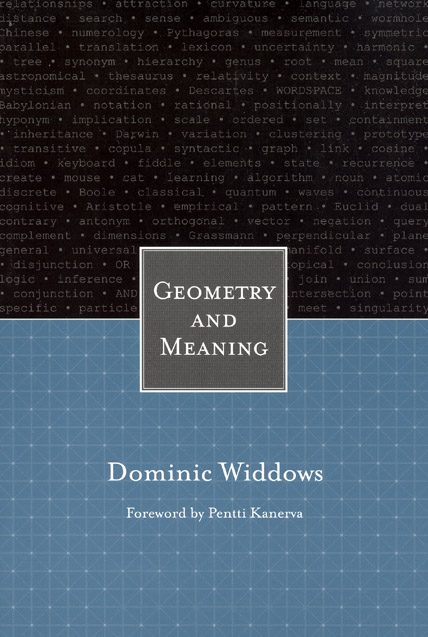
Books: The Geometry of Meaning, Gärdenfors & Geometry and Meaning, Widdows


http://www.mitpressjournals.org/doi/pdf/10.1162/coli.2006.32.1.155
There are two additions to my library. They are technical in parts and beyond my math and technical abilities, but as background this is essential reading.


Widdow's Geometry and Meaning includes details of the software used in the text. See the companion website below. While Gärdenfors' book The Geometry of Meaning is new, Widdow's text is a decade old and so demands some checking of software. I notice there are broken links on the companion site. The book, both in fact are great resources even as they increase the permanence of the geometry upon my furrowed brow...


Dominic Widdows, Geometry and Meaning - Companion website

Monday, January 20, 2014

ERCIM News No. 96 Special theme: "Linked Open Data"

Dear ERCIM News Reader,

ERCIM News No. 96 has just been published at
http://ercim-news.ercim.eu/en96

Special Theme: "Linked Open Data"
http://ercim-news.ercim.eu/en96/special/
Guest editors
: Irini Fundulaki (Institute of Computer Science, FORTH) and Sören Auer (University of Bonn and Fraunhofer IAIS)

http://ercim-news.ercim.eu/en96
Keynote: "Linked Data: The Quiet Revolution" by Wendy Hall

This issue for download
pdf
: http://ercim-news.ercim.eu/images/stories/EN96/EN96-web.pdf
epub: http://ercim-news.ercim.eu/images/stories/EN96/EN96.epub

Next issue: No. 97, April 2014 - Special Theme: "Cyber-Physical Systems"
(see the call at http://ercim-news.ercim.eu/call)

Thank you for your interest in ERCIM News.
Feel free to forward this message to others who might be interested.

Best regards,
Peter Kunz
ERCIM News central editor

--------------------------------------------------
An initiative for the ERCIM members: Call for Participation - identifying the emerging grand challenges in ICST http://kwz.me/74

Friday, November 01, 2013

A book chapter: Spatial semantics - definitions...

This book would appear to be an essential reference in respect of h2cm, the following is from chapter 13:

Spatial semantics is the study of the meaning of spatial language, but what is to be regarded as ‘spatial language’? A moment’s reflection suffices to show that the answer to this question is anything but trivial, since SPACE is not a self-contained ‘semantic field’, but rather constitutes an important part of the background for all conceptualization and meaning (Kant [1787] 1964). Furthermore, the term ‘space’ has been used all too often in an extended, metaphorical sense in Cognitive Linguistics and Cognitive Science, e.g., ‘Space Grammar’ (Langacker 1982), ‘Mental Spaces’ (Fauconnier 1985), ‘Conceptual Spaces’ (Gärdenfors 2000). Hence, an unrestricted interpretation of the term ‘space’ might lead us to think that ‘all semantics is spatial semantics’, a conclusion that not even cognitive linguists would find too attractive. Therefore, the scope of spatial semantics needs to be restricted, and this can and has been done in at least three different ways: by form class, by semantic category, and by communicative function. The three definitions based on these restrictions do not coincide, however, and each leaves something to be desired.

Jordan Zlatev (2007) Spatial Semantics, Chapter 13. In. Hubert Cuyckens and Dirk Geeraerts (eds.) Handbook in Cognitive Linguistics. Oxford, Oxford University Press.

Wednesday, January 16, 2013

Peter Gärdenfors - "Actions and events modelled in conceptual spaces"

The Barcelona Cognition, Brain and Technology summer school. Barcelona, Spain

Friday, 14 September, 2012 - 09:30 to 11:00


Recording of the speaker's talk at the Barcelona Brain and Technology Summer School, September 2012.
"Actions and events are central to a semantics of natural language. I present a cognitively based model of these notions. After giving a general presentation of the theory of conceptual spaces, I suggest how the analysis of perceptual concepts can be extended to actions and events. First, I argue that action space can be analyzed in the same way as e.g. color space or shape space. The hypothesis is that the categorization of actions depends, to a large extent, on the perception of forces. In line with this, I describe an action as a pattern of forces. An action category is identified as a convex region of action space. I review some indirect evidence for this representation. Second, I represent an event as an interaction between a force vector and a result vector. Typically an agent performs an action – i.e., exerts a force – that changes the properties of the patient. Such a model of events is suitable for an analysis of the semantics of verbs. I compare the model to other related attempts from cognitive semantics."

Additional links:
http://www.ht.lu.se/o.o.i.s?id=21232&p=PeterGardenfors


Related posts on W2tQ

Monday, June 21, 2010

Philosophy of information empowers philosophy of care

The moral and ethical dimensions of nursing quickly become apparent to individual practitioners and professional associations. Philosophy in nursing boasts specific courses, journals and groups, for example:

International Philosophy of Nursing Society (IPONS)

Here on W2tQ, in papers and on the (former) website I have stressed the importance of the health career model as a framework that can utilise information as a fundamental and potentially unifying concept.

Expanding on the post last week about the philosophers' magazine [tpm50] let's look at Floridi's piece on the philosophy of information (PI). The 50 ideas featured are each only granted two pages, but this has a definite philosophical equivalent twitter-styled appeal. On page 42 (- 43) Floridi notes that:

... PI possesses one of the most powerful conceptual vocabularies ever devised in philosophy. This is because one can rely on informational concepts whenever a complete understanding of some series of events is unavailable or unnecessary for providing an explanation. Virtually any issue can be rephrased informationally. Such semantic power is a great advantage of PI, understood as a methodology. ...

It shows that we a dealing with an influential paradigm. But it may also be a disadvantage, because a metaphorically pan informational approach can lead to a dangerous equivocation, namely, thinking that since any x can be described in (more or less metaphorically) informational terms, then the nature of any x is genuinely informational. (Luciano Floridi, 2010).
Admittedly Floridi's context is the position and status of PI as an emerging discipline within philosophy. As he notes the vocabulary while powerful lies in the discipline of philosophy.

Given my preoccupation with information, Floridi's observation above is a timely warning for me and the many nurses who in the past saw a concomitant risk that in adopting the nursing process, patients (and carers) would be processed. Ironically, this processing concerned information. The workflow - form and layout of the documentation - was prescribed. This is an old tale, with the nursing process being subsumed within the routine work of nursing. Perhaps though this also demonstrates a need for a new debate?

My interest in information is as a trope to explain the significance of the care (knowledge) domains that underpin Hodges' model. Crucially, though these can stand on their own as nursing philosophy issues. Joining the efforts of the nursing philosophers above, this can bring information and philosophy out of the academic realm to include a more practical and grounded variety of topics:

FROM: personal identity,
definitions and ownership of computer based records,
utility versus security of information (summary care record ...),
definitions of information (data, knowledge) - through
TO: patient information and patient informatics, ...
where is collective informatics# heading?

Taking Floridi's lead - which of the above .... are core nursing (health) information concepts (and not just freeloading info-masqueraders along for the ride)? Well, that is a question for a new community of scholars to decide?

Philosophy resources: Interpersonal care domain

#Collective informatics = all the claimed informatics disciplines combined?