Hodges' Model: Welcome to the QUAD: spaces

Hodges' model is a conceptual framework to support reflection and critical thinking. Situated, the model can help integrate all disciplines (academic and professional). Amid news items, are posts that illustrate the scope and application of the model. A bibliography and A4 template are provided in the sidebar. Welcome to the QUAD ...

Showing posts with label spaces. Show all posts

Tuesday, October 06, 2026

ERCIM News 146 Special Theme: "Quantum Technology"

ERCIM News 146 Cover

Dear ERCIM News reader,

Quantum technology is increasingly becoming part of real-world systems. 

This issue looks at quantum algorithms, secure communication, hybrid computing, software and sensing, highlighting recent advances and the challenges of putting them into practice. The Special Theme was guest edited by Miroslav Dobsicek (RISE), Sebastian Raubitzek (SBA Research) and Filippo Vella (CNR-ICAR).

Introduction

by Miroslav Dobsicek (RISE),  Sebastian Raubitzek (SBA Research) and Filippo Vella (CNR-ICAR)

In recent years, major advances in quantum hardware, algorithms and software have created great  opportunities for scientific discovery and industrial innovation. What can be observed is that quantum technology is entering a new phase where systems are becoming the central focus. Progress is no longer defined only by better qubits, individual algorithms or isolated demonstrations, but increasingly by whether quantum components can be integrated with classical computing, software, networks, sensing platforms and real applications. This transition, from quantum components to quantum systems, is changing both the research questions and the criteria by which progress should be judged
Read more ...

Includes:

Quantum Retina: A Quantum Eye on the Brain and Other Things, pp.43-44. (brain imaging, Parkinson's disease)

Read the October 2026 Issue

This issue in PDF

Next Issue

No. 147 — January 2027
Special Theme: Data Spaces
Call for Contributions

See also:

https://www.ercim.eu/events (AI - ethics, ...)

My source with thanks: peter.kunz AT ercim.eu

Saturday, September 12, 2026

TED - Talks & Listenings

THOUGHT

EDUCATION

DESIGN

  
individual
|
INTERPERSONAL
: SCIENCES             
humanistic ------------------------------- mechanistic
SOCIOLOGY : POLITICAL   
|
group
 
THOUGHT
 
Cognitive maps

Your -
Sense of direction?

Maps

DESIGN

'True South'


Ancient maps - periplus

EDUCATION for All


Maps - Power
 

Our -
Sense of direction?


Previously: 'thought' : 'education' : 'design' : 'cognitive map'

My source:  https://x.com/NobelPrize/status/2098073718371262921?s=20 and @TED_ED

Sunday, September 06, 2026

Socialism & Adult Education - Historical perspectives for a revived lifelong learning

Call for Papers

How important has socialism been to adult education? For most of history, adult education – structured learning, involving organised study and usually teaching – was restricted largely to social and religious elites. During the nineteenth century, however, as the industrial revolution tore apart the bonds of ‘traditional’ economies and societies, propelled migrants to towns and foreign lands, and demanded mastery of new skills, new popular democratic movements arose – most profoundly, the socialist movement.

In Britain, prior to the Elementary Education Act 1870, few working-class people had any formal education; even after that opportunities were limited. In response, a diverse range of non-statutory voluntary adult education organisations emerged. These included the Mutual Improvement Societies, the Young Adult Schools, the Education Settlements, the Mechanics’ Institutes, the Working Men’s College, University Extension, Co-operative Education, the Workers’ Educational Association (WEA), and Independent Working Class Education and the Labour College Movement. Some were deeply linked with socialism – others more tenuously, if at all – but together they made adult education in literacy, technical skills and knowledge, the liberals arts and politics accessible to many adults.

Through the twentieth century, at least until the neo-liberal era, the influence of socialist ideas and movements on adult education was deep. In the 21st century, however, the forces of global capitalism have systematically sought to marginalise socialist (and democratic) thought. As jobs, and much work that rewards the human spirit, are threatened by the advance of Artificial Intelligence, adult education is more and more expected to meet the objectives of “the economy” and the labour market. Wider educational purpose is ignored.

How have we come to this? The marginalisation of socialist perspectives is by no means confined to adult education. Yet so central was adult education to the emergence and growth of socialism – and the reverse is also true – as to pose essential and urgent questions. In what ways did adult education contribute to the development of socialism? Why did socialist perspectives play so central a role in the practice of adult education – and did they enrich or constrain it? What can we learn from examining the part that socialism, and socialists, played in adult education’s rich history?

We aim to revisit the topic of adult education and socialism in Britain in the 21st century through a special issue of the journal Socialist History. It seeks to revive the field of study, and to explore the idea to meet the diverse needs of a multi-cultural society more – rather than less – adult education is needed – and that the adult education needed should be broad rather than narrowly job-related. This is especially relevant to consider in connection with the new Lifelong Learning Entitlement which has the potential to transform how post-18 students fund and approach their studies throughout the course of their lifetimes.

What new research perspectives can academics – and scholar-practitioners and activists – from all disciplines bring to the history of adult education, and to the understanding of socialist approaches to improving economic, social and cultural welfare?

We invite submission of abstracts of approx. 300 words. They may explore any aspect of the interlinked history of adult education and socialism. We welcome contributions relating not only to Britain, but to Europe (western, central and eastern) and other locations around the world. Topics may include (but are not limited to):

  • The experience of tutors and students of different forms of adult education
  • The politics of adult education
  • Organisations that provided adult education
  • The impact of adult education on socialist ideology and movements
  • Key figures in the adult education movement – tutors, students and organisers
  • Gendered perspectives of adult education
  • The buildings and spaces of adult education
  • The organisation and delivery of adult education
  • The content and curriculum of different forms of adult education
  • Biographical and autobiographical accounts of adult education
  • Local and regional case studies of adult education
  • The consuming of adult education
  • The role of socialism in colonial adult education
  • The financing of adult education initiatives
  • State support for adult education
  • Local government and adult education provision

Please email abstracts with your affiliation, a short biography and contact information to:
john.holford AT nottingham.ac.uk and p.kumbhat AT staff.newman.ac.uk. 

The deadline for submission of abstracts is Friday 30th October 2026.

We hope to convene a symposium on this theme on Wednesday 7th April 2027 at Birmingham Newman University, where contributors can discuss their draft papers and ideas. The symposium will provide an opportunity to share work in progress, receive feedback, and develop papers to be considered for publication in the Socialist History special issue in autumn 2027. The April symposium will be an in-person event, although authors based outside the UK will have the option of presenting remotely via Microsoft Teams.

My source: Bob Foster, Admin: https://www.raymondwilliamsfoundation.org.uk/

Friday, December 19, 2025

ii Learn your lines and the hyperplanes will follow

With these lines, partitions, axes and domains in mind, when a clinical practitioner is presented with a new person, whether as a patient, client, or carer ... they can, using Hodges' model (and other tools!) approach their assessment in an open and receptive manner.

This means that the information provided by the 'patient' can be readily fielded, captured whatever the context and situation.

As noted previously, my study of Hodges' model began in the late 1980s. Application in my work as a community mental health nurse, with an interest in informatics followed quite naturally(?). Primed as I was, for various reasons to carry this forward, I also carried a mathematical learning disability. At the risk of getting bogged down in my thought, use and approach to Hodges' model I need a challenge.

Mathematics is the challenge for me. It's fascinating how we have in-built 'calculators' that can help us catch a ball, and judge fairly well where to throw a ball for interception. There seems then to be an informal or naïve  mathematics, at work unconsciously. Does the same apply to Hodges' model? If so, how can I isolate, and identify it?

  • Is it represented somewhere, implicit in Hodges' model itself?
  • Is it (once again) to be found in the user of the model?
  • Is it (more likely, and obviously) a combination of these two?
  • Or, is it a product of the system, or a series of systems? 

I was reminded of what is a Sober toy, several years ago:

Is Hodges' model a selection machine?

All four original purposes of Hodges' model:

  1. Person-centred, integrated and holistic care;
  2. To bridge the theory - practice gap;
  3. To facilitate reflection and reflective practice;
  4. To support curriculum development;

- are concerned with conjunction and choice, selection. So is life itself through distinction, difference, and differentiation.

Hodges' model is a selection machine, that is both fhuman and machine driven.

A clinician may obtain the referral information through an email, a history of previous contacts can be retrieved from a clinical information system; the context and purpose supporting access to the information.   

A whole series of blog posts describe the role of Hodges' model to help assure parity of esteem across mental and physical health. What does this mean in practice?

For the practitioner, they take selected data from the referral, a history - if available, an initial telephone contact, a conversation with a colleague who remembers the person re-referred and starts to populate Hodges' model. What are the psychological concepts that arise? What are the physical?

If a referral in whatever form, or a database record can be viewed as a bag-of-words, then Hodges' model is a collection of care concepts. Four bags then. Sets or classes. An experienced user of Hodges' model may position care concepts that throws attention on the INDIVIDUAL↔GROUP axis. Lying between the INTRA- INTERPERSONAL and SCIENCES domains, this axis (like all the others) earns its keep. There is work to be done that is also of interest in machine learning:

'A support vector machine (SVM) is a supervised machine learning algorithm that classifies data by finding an optimal line or hyperplane that maximizes the distance between each class in an N-dimensional space.

SVMs were developed in the 1990s by Vladimir N. Vapnik and his colleagues, and they published this work in a paper titled "Support Vector Method for Function Approximation, Regression Estimation, and Signal Processing"1 in 1995.' 

https://www.ibm.com/think/topics/support-vector-machine

Strange to think that perhaps the VERTICAL axis and others in Hodges' model are not precisely S-N-E-W in their bearing? There may also be several vectors at work in fact?

Image: c/o https://www.ibm.com/think/topics/support-vector-machine

The word 'naïve' has been bubbling away for a good-many years. A close colleague Silvana Bettiol, Univ. of Tasmania kindly read my draft on Hodges' model as a mathematical object, and mentioned the introduction points to Bayes theorem even if informally. Even in those initial 'clinical' encounters (and social meetings, that attend to empathy, rapport and engagement...) complex judgements are being made, beliefs tested, from what is often partial and disparate sources of information.

Checking other leads led to Frequentist and Bayesian Approaches

'Statistical inference is a series of methods used to make decisions and draw conclusions based on available data. There are two primary approaches for inference: Frequentist and Bayesian. Each framework relies on a different philosophical perspective on probability and modeling, leading to different techniques and interpretations. Each has its own strengths and drawbacks, so understanding the distinctions between them is vital for researchers, data scientists, and statisticians who aim to choose the most suitable approach for their specific analysis.'
https://www.statology.org/comparing-frequentist-and-bayesian-approaches/

More reading required and threads to run.

Earlier this week I posted re. Cromer's book -

Cromer, A. (1997) Connected Knowledge: Science, Philosophy, and Education, Oxford: Oxford University Press

Before passing the book on, p.198, Chapter 8 notes, #4:

'"Understanding" is a commonly used English word which has no precise meaning. It's sometimes taken to mean the ability to apply knowledge to new situations. In this sense, it is a very high-level skill. Benchmarks for Science Literacy says, "Learning to solve problems in a variety of subject-matter contexts, if supplemented on occasion by explicit reflection on that experience, may result in the development of a generalized problem-solving ability that can be applied in new contexts' (American Association for the Advancement of Science, 1993)." The key word here is "may." 'We really don't know how to help students develop a generalized problem-solving ability, or whether there is such an ability apart from mere knowledge of many different problem-solving strategies. Whatever the case, since we do know how to teach students to solve specific, problems. this should be the primary focus of science education' p.198.

Ack. IBM.

Thursday, December 18, 2025

Learn your lines and the hyperplane will follow i

Take an empty [rectangular] space (A4 paper in landscape)

Blank! Isn't it?

Take a line. Yes, call it that.

Divide the space vertically, and equally, in two. 

Do this again but horizontally.

You can call these lines, partitions if you wish?

Or, as per adopted convention here, axes.

Now, there are four empty spaces.

These spaces can be called quadrants, planes, or domains. The latter term usually adopted here.

Labels can be decided, and assigned to the axes and the resulting domains.

Given a purpose, in practice (initially) the 'empty' spaces have the ability to assign significance to what may be placed within them.

Such decisions are non-trivial, in the sense that context and situation determine what follows, influenced by objective and subjective considerations.

The domains can contain concepts, or keywords with decisions driven by categorical reasoning.

The content of the domains can also be viewed as classes and sub-classes.

ii to follow (with revision here?)

Sunday, November 30, 2025

Interesting ... 'Incidence structure(s)'

Unsurprising, in studying 'Hodges' model, I've been aware of Wilfrid Hodges and model theory for many years.


Now, trying to look at (Brian) Hodges' model using maths, I've wondered about possible connections with Wilfred Hodges' work.

Dr W. Hodges was listed in searches on lines, axes, and structure:
'Algebraists and geometers like to classify structures by the laws which they obey. A typical law for incidence structures reads:

"For any two different lines L and M, there is exactly one point which lies on both L and M."'
My imagination may be getting the better of me, but there seems something profound in the intersection of the model's two axes and the care - knowledge domains that are created (proposed - adopted..)?

So, is Hodges' model a form of 'incidence structure', or does it contain several incidence structures? 

Hodges, W. (1985). Truth in a Structure. Proceedings of the Aristotelian Society, 86, 135–151. http://www.jstor.org/stable/4545041

Tuesday, December 31, 2024

Call for Abstracts (for Publication): "Visual Narratives, Aesthetics, and Decoloniality: Imagery and the Construction of the Other"

Mappæmundi is pleased to announce a call for papers for a collective publication on 

"Visual Narratives, Aesthetics, and Decoloniality: Imagery and the Construction of the Other"

Please find all the details below.

We invite contribution proposals for the edited volume Visual Narratives, Aesthetics, and Decoloniality: Imagery and the Construction of the Other. The book aims to critically examine the persistent influence of colonialism in shaping modern subjectivities, tracing its historical roots in the formation of Western modernity and interrogating its continued implications in contemporary contexts. It positions media and visual narratives as central discursive spaces where colonial legacies are both perpetuated and, potentially, contested. This volume conceptualizes and critically interrogates aesthetics as a foundational condition that establishes a visual lexicon integral to Western modernity. The aesthetic framework not only shapes the development of visual narratives but also plays a crucial role in the construction and perpetuation of varied subjectivities.

In particular, we focus on the critical analysis of the role of visual narratives within the framework of epistemological colonialism. Visual narratives have been central in defining, reinforcing, and legitimizing colonial ideologies by shaping perceptions and controlling representations of colonized peoples and cultures. These visual narratives have played a fundamental role in constructing colonial time and space, which were systematically controlled by Western epistemologies. This volume positions itself as a counterpoint to this colonial legacy, offering critical perspectives that challenge and re/deconstruct the visual lexicon of Western modernity. Through this lens, the book seeks to uncover pathways for alternative visual expressions that resist colonial frameworks and promote inclusive, decolonized understandings of identity and, more broadly, cultural production.

The arts, the media, and communication are powerful forces that can either perpetuate or challenge colonial legacies. Addressing and dismantling these legacies is essential for the creation of just, inclusive, and equitable societies - i.e., societies that value, embrace and benefit from the diversity of reason. From a decolonial lens, the book seeks not only to question the validity of established forms of knowledge but also to question the very criteria by which knowledge is defined. The objective is to contribute to critical discourses on potential pathways forward by amplifying cultural voices marginalized within the colonial matrix of power.  To this aim, we invite contributions that engage with scholarship in diaspora studies, subaltern and postcolonial studies, critical race studies, decolonial aesthetics, visual culture, and visual practices, with a particular emphasis on non-hegemonic epistemologies.

When bringing together these critical issues and perspectives, the book shall offer a comprehensive and interconnected framework for understanding postcolonial experiences in the 21st century. It will explore the role of aesthetics in shaping modern subjectivities, tracing the roots of domination in multiple paths toward modernity. This book intends to serve as an essential resource for scholars, researchers, activists, and the general public, encouraging deeper engagement with colonial histories that continue to shape contemporary life.

We especially encourage contributions from scholars, artists, and practitioners from the Global South that:

  • Engage in theoretical discussions on aesthetics and visual narratives from a decolonial perspective.
  • Combine theoretical frameworks with analyses that directly engage with visual arts, such as photography and other forms of artistic expression.
  • Discuss case studies that examine individual works of art, archives, photojournalistic projects, or other forms of visual narratives.
  • Explore media as a space for resisting and challenging colonial legacies.
  • Offer comprehensive analyses of how media and art contribute to the perpetuation or disruption of colonial ideologies.
  • Provide practical strategies and share lived experiences that contest colonial-rooted narratives.
  • Critique prevailing ideologies within the discursive spaces of media and art production and consumption.

Submission Details

The volume Visual Narratives, Aesthetics, and Decoloniality: Imagery and the Construction of the Other will be part of the Mappæmundi series published by Ventura Edizioni. It will be edited by Dr. Tomás Cajueiro (Universitat Autònoma de Barcelona) and Dr. Estevão Bosco (American College of the Mediterranean and the Latin American Social Science Faculty). The final publication will be exclusively in English. However, abstracts may be submitted in Portuguese, English, Spanish, or Italian. Once a proposal is accepted, authors will be responsible for translating their final chapters into English. Chapters should range from 20,000 to 40,000 characters, including spaces, and must incorporate visual materials to support the analysis of visual works. 

Proposals must be submitted to tomaskju AT gmail.com by April 4, 2025.

Theoretical and Textual Articles

Chapters may integrate theoretical insights with practical interventions or focus solely on theoretical exploration. Contributions can draw on real experiences from individuals, communities, and organizations. Potential research methods include literature reviews, case studies, comparative analyses, discourse analyses, and analyses of photographs and visual works. Abstracts should have a maximum of 5,000 characters, including references. Chapters should fall between 35,000 and 40,000 characters.

Visual narratives

For contributions focusing on the analysis of visual content, the textual component must range from 10,000 to 15,000 characters. The abstract, while limited to a maximum of 5.000 words, should also include an overview of the visual material being analyzed.

Important Dates 

Abstract Submission Deadline: April 4, 2025
Notification of Proposal Acceptance: May 11, 2025
Full Chapter Submission Deadline: September 11, 2025 
For more info: tomaskju AT gmail.com
--
Departamento de Filosofia, Comunicação e Informação
Faculdade de Letras da Universidade de Coimbra
3004-530 Coimbra, Portugal ... (and my source).

Friday, November 15, 2024

Podcast: Local green spaces and mental health

Dear CHAIN member,

We would like to draw your attention to the following NIHR alert. Please pass on as appropriate. Thank you.

NIHR

Local green spaces are linked with better mental health

Podcast: Local green spaces and mental health

In this podcast, Helen Saul, Editor in Chief of NIHR Evidence, and study author Sarah Rodgers, Professor of Health Informatics, University of  Liverpool, discuss the impact of local green spaces on people's mental health.

Researchers analysed data on more than 2 million people in Wales over 10 years to explore the impact of green spaces on mental health. They linked information about people’s mental health with information about the greenness of their home’s immediate surroundings and how close they lived to green or blue spaces (such as parks, lakes, and beaches). They found that people had a lower risk of anxiety and depression if:

· their home’s immediate surroundings (within 200-300 metres) were greener
· they could access green and blue spaces nearby.

The researchers say that local authorities could improve the mental health of their community by increasing the greenery in their towns and cities and improving access to green and blue spaces.

Read more at: https://evidence.nihr.ac.uk/alert/local-green-spaces-are-linked-with-better-mental-health/?source=chainmail

Regards,

Irina Johnston
CHAIN Administrative Assistant

(and my source.)

Previously: 

Wednesday, April 26, 2023

Life, Literacy, Oppositions, Complexity and Information

Literacy in Traditional Societies


"Durkheim's work on primitive classification is being applied to societies within the orbit of major civilizations. The polarities and oppositions of la pensée sauvage turn up in ancient Greece, and tools developed in the study of the narratives of American societies are applied to the Oedipus story, the Book of Genesis and even contemporary literature, with little sense of the basic incongruity involved.

Polarities of some sort are of course present in all societies; their significance, however, varies widely. Aristotle describes one Pythagorean theory in the following terms:


Others of this same school say that there are ten principles, which they arrange in ten columns, namely:

limit unlimited
odd even
one plurality
right left
male female
at rest moving
straight crooked
light darkness
good bad
square oblong

. . . How these principles maybe brought into line with the causes we have mentioned is not clearly explained to them [quoted Guthrie 1962: 1, 245]."


Goody, J. (1968) Literacy in Traditional Societies, Cambridge: CUP. pp.10-11.


Taking each of these in-turn as may relate to Hodges' model (I may update/edit these):

limit  unlimited

As a template the model invites both a limit (boundaries) and some-thing unlimited.

odd  even

There is a symmetry - evenness to the model, but the invitation noted above is also a prospect for odd-ness. This may extend to the frustration experienced when a phenomena, account (patient's narrative . . .) defies explanation and classification.

one  plurality

This polarity is key in Hodges' model. 'One' refers to the person, patient, carer, any - individual who the model is applied to. In respect of plurality this can include the dyad of patient - nurse, couple, family, team, community, national or global population (and Biosphere).
 
right  left
 
The horizontal axis is not the last word in Hodges' model, as intra-domain we also find right and left. Of course, the vertical axis (indeed, the whole model if required?) can also be repeated in a domain.
 
male  female
 
You quickly recognise the potential for disagreement* which is fundamental in dichotomous situations, a point further reinforced below.

at rest  moving
 
The model is 'at rest' as a snap-shot, but as a frame it can represent the change over time and so has its own dynamic potential.
 
straight  crooked
 
The axes as continua are 'straight' but this distinction (as noted above) has distinct psycho-socio-political connotations. In the model, line-of-sight is acknowledged, while 'crooked' might suggest what is uncertain, and unseen?
 
light  darkness & good  bad
 
Again, these two oppositions seem 'loaded': especially socially - politically.

Tread carefully. If you have light, that's good, but if lost: bad.
 
square  oblong
 
Viewed as containers, or sets the model's domains can be represented as several shapes, as long as the axes are retained as part of the structure. The adopted rectilinear form is an affordance of the (underlying) HTML, and the traditional (paper-based) tabular format. From the domains being of equal area, the point where the axes intersect could be shifted, such that a single domain is enlarged (prioritised?), at the expense of another.

*Incredible harmony too!

Then prior to an anticipated move, and sorting through books and papers:

Complexity:
Life on the edge of chaos
“The discovery that universal computation is poised between order and chaos in dynamical systems was important in itself, with its analogies to phase transitions in the physical world. It would be interesting enough if adaptive complex systems inescapably were located at the edge of chaos, the place of maximum capacity for information computation. The world could then be seen to be exploiting the creative dynamics of complex systems, but with no choice in the matter. But what if such systems actually got themselves to the edge of chaos, moved in parameter space to the place of maximum information processing?” p.54.


Lewin, R. (1993) Complexity: Life on the edge of chaos. London: Phoenix.

The conclusion? 

Perhaps, the ubiquity of polarity, opposition and dichotomy is that they anticipate and presage an increase in information processing (for good or ill: there we go again!). 

This is also a ( the ) function of Hodges' model.

Previously:

Opposition  . . . See also - Polarity , Dichotomy , Literacy . . .

Thursday, December 01, 2022

Threshold Concepts 2023: "Roads Less Travelled"

Call for Papers 2023

Date 4-6th July 2023

Location: Charles Sturt University, Port Macquarie Campus, NSW, Australia (google map link)

Theme: Threshold Concepts: Roads Less Travelled

The 2023 Threshold Concepts Biannual International Conference is a special one. It marks twenty years since the original 2003 Threshold Concepts paper by Eric Meyer and Ray Land. In the intervening time, Threshold Concepts have become an accessible way of conceptualising learning, and the barriers to mastery that learners encounter. We are taking inspiration from Julie Timmerman’s (2023) provocative question, “Do thresholds always propel us outward, forward, and towards an identified threshold, or might they reveal alternative and unanticipated landscapes for transformation?” 

We propose an exploration of movement “outward, forward, and towards” threshold concepts, and the journeys we undertake as learners and researchers. These pathways may be known or unknown, familiar or alien, hidden or exposed. We have identified a number of subthemes, which you may interpret according to your context.

  • Inter(tidal)disciplinary Zones
  • Learning Spaces and Places 
  • Cultures of Engagement and Connectivity
  • UnOthering 
  • Liminality 

We invite you to submit proposals under one of the subthemes and we look forward to seeing you in Port Macquarie in July 2023 to celebrate twenty years of Threshold Concepts. #9BiTCC2023

.... https://thresholdconcepts.home.blog/

Sunday, July 11, 2021

Measuring physical, mental and social space: A Political record

Since I was a child and my father used a metallic tape measure and my mission was to get it from the garage; I remember the sound as it was rolled out and uttered an occasional click. I took for granted its ability to hold its temporary span, filling a void perhaps and then its signature crack as it collapses. I was reminded of this yesterday.

The span now 3.5 metres.

What a measure of resilience this is.


individual
|
INTERPERSONAL : SCIENCES
humanistic ----------------------------------------------- mechanistic
SOCIOLOGY : POLITICAL
|
group
mental RESILIENCE

PHYSICAL resilience

Ability to 'span' ?
'health career' = life chances
education, work, relationships, housing, the literacies (lifelong learning) ...


Policy

POLICY resilience:

Strategic, planned, long-term, funded, integrated ...


 Previously: Caution! spanning the Theory - Practice Gap


Wednesday, March 31, 2021

'Clean tools' - fit for Conceptual Engineering?

Posting previously news of a conference on 'Conceptual Engineering' I was drawn and try to follow the following series:

Conceptual Engineering Seminar | Simon Blackburn (Cambridge): TBA 

March 30 @ 3:00 pm - 5:00 pm 

ABSTRACT. — When I hit upon the term ‘conceptual engineering’ in the Introduction to my book Think, I suppose I thought of it as simply a cute way of introducing what philosophers do. I had no idea that the term had already been used, although I have subsequently learned that it was. I have therefore been surprised that books and seminars have subsequently been devoted to the idea: it is as if books and seminars were simply entitled ‘Philosophy’ rather than directed at particular problems within philosophy. In my talk I hope to go further into that and try to understand why it happened. 

Yesterday, Simon Blackburn cited Austin (1956) and the need for 'clean tools', which led me to the following source*:

"First, words are our tools, and, as a minimum, we should use clean tools: we should know what we mean and what we do not, and we must forearm ourselves against the traps that language sets us. Secondly, words are not (except in their own little corner*) facts or things: we need therefore to prise them off the world, to hold them apart from and against it, so that we can realise their inadequacies and arbitrarinesses, and can re-look at the world without blinkers. Thirdly, and more hopefully, our common stock of words embodies all the distinctions men have found worth drawing, and the connexions they have found worth marking, in the lifetimes of many generations: these surely are likely to be more numerous, more sound, since they have stood up to the long test of the survival of the fittest, and more subtle, at least in all ordinary and reasonably practical matters, than any that you or I are likely to think up in our armchairs of an afternoon - the most favoured alternative method."

*my emphasis

Simon's talk of 'clean tools' prompted me to reflect:

The assumed neutrality of Hodges' model. As noted on W2tQ previously, Hodges' model is an invitation to start with a new slate. To leave behind bias and prejudice, to assure unconditional positive regard and a non-judgmental approach and attitude.

'Engineering' is usually conducted within a dedicated physical space. Apprentices will soon be familiar with the discipline of leaving the work environment clean and prepared for the next day. They will learn that tools have their place (even on the screen). Tools themselves also need care; so don't be care-less.

If Occam's razor is a preparatory rule for conceptual hygiene, perhaps we can take this further, or at least propose an addition? There is a 'rule of forceps' (which, it might be argued, is person-centred, or clearly patient-centred?) but not only are forceps a tool, we can utilise a divider too.

In use, Hodges' model suggests and facilitates dichotomous thinking. The forceps may help grasp the the key parts - the polarities of a situation. The divider may serve to help us to weigh and measure the 'distance' of two concepts, especially if they seem to be grounded across two of the model's care (knowledge) domains.

So Hodges' model may have a role in 'conceptual engineering', variously as a dialectic divider or dialectical forceps?

Austin, J. (1956). A Plea for Excuses: The Presidential Address. Proceedings of the Aristotelian Society, 57, new series, 1-30. Retrieved March 30, 2021, from http://www.jstor.org/stable/4544570Austin, J. (1956). A Plea for Excuses: The Presidential Address. Proceedings of the Aristotelian Society, 57, new series, 1-30. Retrieved March 30, 2021, from http://www.jstor.org/stable/4544570

There is a legal case of historic interest also described in the Austin's paper.

Thursday, March 11, 2021

PhD position on "Analyzing the Interactions Between Spaces of Argumentation in Different Contexts"

We are seeking applicants for a PhD position on «Analyzing the Interactions Between Spaces of Argumentation in Different Contexts» at LAMSADE (University Paris-Dauphine).

The Covid19 crisis shows us that arguments can circulate between different social worlds, as they have done between scientific and academic worlds, media, and social media, in different directions. However, the way people discuss in these different environments is very different and rely on different standards to recognize proofs.

How can different groups advance in a debate when sharing information, evidence on a complex issue, refer to different notions of arguments and proof standards?

For example, in recent months we could observe some ideal-typic description of the shape of the argumentation:

  1. in the mediatic world: repeat, follow, approve/disprove, exaggerate, attack ad hominem;
  2. in the scientific world: decide paradigm, decide hypothesis, test, revise, purify, consolidate, invalidate, give examples, give counter-example.

The literature on argumentation theory has elaborated several defeasible argumentation schemes, which are abstract argument forms that do not necessarily fall into the classical deductive or inductive argument structures, and that capture also what traditionally is classified as a fallacy.

For a detailed description see:

https://www.lamsade.dauphine.fr/fileadmin/mediatheque/lamsade/documents/propositions_theses_2020/pigozzi.pdf

*Required Profile*

- Master degree in Computer Science (or equivalent) with good GPA
- Knowledge in Computer Science, Mathematics, Economics and Logic
- Minimal programming skills
- Strong interest for multidisciplinary research
- Autonomy and ability to work in a team
- Good writing skills in English

*Application procedure and deadline*

Interested candidates should send the following PDF documents to Juliette Rouchier (juliette.rouchier AT dauphine.fr) and Gabriella Pigozzi (gabriella.pigozzi AT dauphine.fr) before 11 April 2021:

- CV
- Scan of transcripts of marks with their ranking
- A letter of motivation
- One letter or recommendation

A first selection will be performed amongst eligible applications, and selected candidates will be interviewed.

PS: Please forward this email to potential candidates.

My source: 

Philos-L "The Liverpool List" is run by the Department of Philosophy, University of Liverpool https://www.liverpool.ac.uk/philosophy/philos-l/

Saturday, October 17, 2020

Infinite space: Where do you 'read' the model?

individual
|
INTERPERSONAL : SCIENCES
humanistic ----------------------------------------------- mechanistic
SOCIOLOGY : POLITICAL
|
group - population
"The mind is king of infinite space, Hamlet said,

"A book is better to read in the spot of choice..."
... and no better spaceship has yet been found than a book."

"... 4.38 million books -

"But if one is banged up by lockdown, a book is a rope of knotted sheets."

- were bought in the first week of this month."

"Escape is not the same as escapism."

My source:

Editorial, Infinite shelf space, The Daily Telegraph, 8 October, 2020, p.15.

Saturday, June 14, 2014

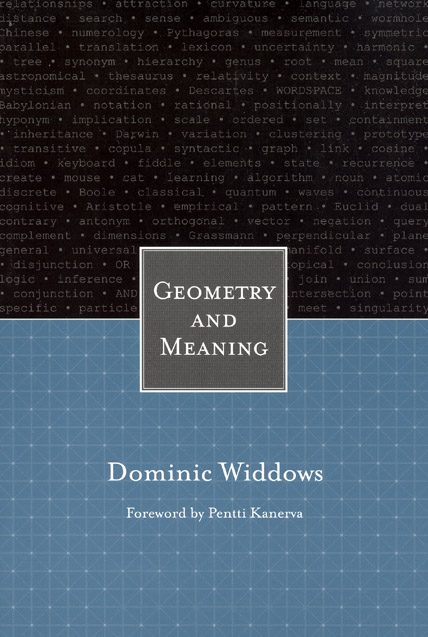
Books: The Geometry of Meaning, Gärdenfors & Geometry and Meaning, Widdows


http://www.mitpressjournals.org/doi/pdf/10.1162/coli.2006.32.1.155
There are two additions to my library. They are technical in parts and beyond my math and technical abilities, but as background this is essential reading.


Widdow's Geometry and Meaning includes details of the software used in the text. See the companion website below. While Gärdenfors' book The Geometry of Meaning is new, Widdow's text is a decade old and so demands some checking of software. I notice there are broken links on the companion site. The book, both in fact are great resources even as they increase the permanence of the geometry upon my furrowed brow...


Dominic Widdows, Geometry and Meaning - Companion website

Sunday, November 25, 2012

CASA - Centre for Advanced Spatial Analysis: Working Papers

Date: Sat, 24 Nov 2012 10:24:30 +0000
From: Willard McCarty
Subject: CASA Working Papers


Many here will find something of interest, I suspect, in the Working Papers series of the Bartlett Centre for Advanced Spatial Analysis, University College London,
http://www.bartlett.ucl.ac.uk/casa/latest/publications/working-papers. 


[updated]
 https://www.ucl.ac.uk/bartlett/casa/about-us/publications

In particular my eye was caught by Martin Dodge and Rob Kitchin, "The ethics of forgetting in an age of pervasive computing", CASA Working Paper 92.

Undoubtedly those with GIS-related concerns will find much more than that.
Yours,
WM
--
Willard McCarty, FRAI / Professor of Humanities Computing & Director of the Doctoral Programme, Department of Digital Humanities, King's College London; Professor, School of Computing, Engineering and Mathematics, University of Western Sydney; Editor, Interdisciplinary Science Reviews
(www.isr-journal.org); Editor, Humanist
(www.digitalhumanities.org/humanist/); www.mccarty.org.uk/


My source:  Humanist Discussion Group, Vol. 26, No. 520. www.dhhumanist.org/
With CASA logo added here. 
                

Thursday, January 06, 2011

2011... looking ahead: Line of sight - Lines of insight

LINE OF SIGHT:


LINES OF INSIGHT:

Fractal Drum


Image sources:

Wilkinson, F.J., Monkhouse, H. R. (1967). Maps and Diagrams; Their Compilation and Construction [Paperback], Methuen & Co Ltd. Intervisibility, Line of sight. p. 125 [scanned].
(Book purchased in Mevagissey, Cornwall, Hurley Books July 2010)

Fractal drum. Lines of INsight: http://classes.yale.edu/fractals/panorama/ManuFractals/FractalDrums/FractalDrums.html

Health and social care - listen!

Thursday, July 01, 2010

earth, wind, fire, water AND the birth of physics

To begin - the health career model is concerned with space, structures and knowledge (care domains) built around two axes, plus the 'subjects' and 'activities' of health.

How we define and (so) divide space and accord that space salience amid changing contexts is critical to theory, practice and management and the models we subsequently derive:

... The dichotomy does not cut, it defines, it surrounds the closure of a limit, it delineates a boundary. Within the space thus enclosed like meets like. Or rather, conversely, the specific convergance [convenance] or identity, the assembly of the analogous, delimits zones in the disorder which are distinguished from each other. The earth is separated from the waters, air divides from fire. ... p.28.

Michel Serres, (2000) The Birth of Physics, Return of the Model, Turba, Turbo. Clinamen Press.

waterearth
airfire

Wednesday, June 25, 2008

Gardenfors' book - a quote and can that be, surely not ...h2cm?

The title of Peter Gardenfors' book Conceptual Spaces is enough to switch the four lights on in this house. In chapter 1 the conclusion includes -

So what kind of theory is the theory of conceptual spaces? Is it an empirical, normative, computational, psychological, neuroscientific, or linguistic theory? The answer is that the theory of conceptual spaces is used in two ways in this book. On a general level, it is a framework for cognitive representations. .... On a more specific level, the framework of conceptual spaces can then be turned into empirically testable theories or constructive models by filling in specific dimensions with certain geometrical structures, specific measurement, specific connections to other empirical phenomena, and so forth. p.30.
Chapter 5: Semantics gives us figure 5.9 (p.173):

Spatial relations between some abstract lexemes

EXISTENCE LOCATION POSSESSION OWNERSHIP

Here below is h2cm. I'll leave the explanatory connections to you:

intrapersonal sciences sociology politics

Since 1986 or thereabouts I've been teased by quadtrees, Voronoi tesselations, facet analytic theory, clustering methods et al. and set to believe there's something here that we can use....

On the website I started to explore some of the assumptions that underpin the structure and (what might contribute to) a theory of Hodges' model. The next 'paper' will assume that the reader is familiar with Hodges' model. The focus will be h2cm as a candidate conceptual space with Gardenfors' text as a key and initial source.

The domains, distances, dimensions, data# it's all there: bar the door....

Many thanks everyone for passing this way - we are now at 10,000+ visitors
#P.S. I'm actually not sure about the data - that is a real challenge.

Gärdenfors, P. (2000). Conceptual Spaces, Cambridge: CUP.