Hodges' Model: Welcome to the QUAD: purposes

Hodges' model is a conceptual framework to support reflection and critical thinking. Situated, the model can help integrate all disciplines (academic and professional). Amid news items, are posts that illustrate the scope and application of the model. A bibliography and A4 template are provided in the sidebar. Welcome to the QUAD ...

Showing posts with label purposes. Show all posts

Sunday, September 06, 2026

Socialism & Adult Education - Historical perspectives for a revived lifelong learning

Call for Papers

How important has socialism been to adult education? For most of history, adult education – structured learning, involving organised study and usually teaching – was restricted largely to social and religious elites. During the nineteenth century, however, as the industrial revolution tore apart the bonds of ‘traditional’ economies and societies, propelled migrants to towns and foreign lands, and demanded mastery of new skills, new popular democratic movements arose – most profoundly, the socialist movement.

In Britain, prior to the Elementary Education Act 1870, few working-class people had any formal education; even after that opportunities were limited. In response, a diverse range of non-statutory voluntary adult education organisations emerged. These included the Mutual Improvement Societies, the Young Adult Schools, the Education Settlements, the Mechanics’ Institutes, the Working Men’s College, University Extension, Co-operative Education, the Workers’ Educational Association (WEA), and Independent Working Class Education and the Labour College Movement. Some were deeply linked with socialism – others more tenuously, if at all – but together they made adult education in literacy, technical skills and knowledge, the liberals arts and politics accessible to many adults.

Through the twentieth century, at least until the neo-liberal era, the influence of socialist ideas and movements on adult education was deep. In the 21st century, however, the forces of global capitalism have systematically sought to marginalise socialist (and democratic) thought. As jobs, and much work that rewards the human spirit, are threatened by the advance of Artificial Intelligence, adult education is more and more expected to meet the objectives of “the economy” and the labour market. Wider educational purpose is ignored.

How have we come to this? The marginalisation of socialist perspectives is by no means confined to adult education. Yet so central was adult education to the emergence and growth of socialism – and the reverse is also true – as to pose essential and urgent questions. In what ways did adult education contribute to the development of socialism? Why did socialist perspectives play so central a role in the practice of adult education – and did they enrich or constrain it? What can we learn from examining the part that socialism, and socialists, played in adult education’s rich history?

We aim to revisit the topic of adult education and socialism in Britain in the 21st century through a special issue of the journal Socialist History. It seeks to revive the field of study, and to explore the idea to meet the diverse needs of a multi-cultural society more – rather than less – adult education is needed – and that the adult education needed should be broad rather than narrowly job-related. This is especially relevant to consider in connection with the new Lifelong Learning Entitlement which has the potential to transform how post-18 students fund and approach their studies throughout the course of their lifetimes.

What new research perspectives can academics – and scholar-practitioners and activists – from all disciplines bring to the history of adult education, and to the understanding of socialist approaches to improving economic, social and cultural welfare?

We invite submission of abstracts of approx. 300 words. They may explore any aspect of the interlinked history of adult education and socialism. We welcome contributions relating not only to Britain, but to Europe (western, central and eastern) and other locations around the world. Topics may include (but are not limited to):

  • The experience of tutors and students of different forms of adult education
  • The politics of adult education
  • Organisations that provided adult education
  • The impact of adult education on socialist ideology and movements
  • Key figures in the adult education movement – tutors, students and organisers
  • Gendered perspectives of adult education
  • The buildings and spaces of adult education
  • The organisation and delivery of adult education
  • The content and curriculum of different forms of adult education
  • Biographical and autobiographical accounts of adult education
  • Local and regional case studies of adult education
  • The consuming of adult education
  • The role of socialism in colonial adult education
  • The financing of adult education initiatives
  • State support for adult education
  • Local government and adult education provision

Please email abstracts with your affiliation, a short biography and contact information to:
john.holford AT nottingham.ac.uk and p.kumbhat AT staff.newman.ac.uk. 

The deadline for submission of abstracts is Friday 30th October 2026.

We hope to convene a symposium on this theme on Wednesday 7th April 2027 at Birmingham Newman University, where contributors can discuss their draft papers and ideas. The symposium will provide an opportunity to share work in progress, receive feedback, and develop papers to be considered for publication in the Socialist History special issue in autumn 2027. The April symposium will be an in-person event, although authors based outside the UK will have the option of presenting remotely via Microsoft Teams.

My source: Bob Foster, Admin: https://www.raymondwilliamsfoundation.org.uk/
Tuesday, December 09, 2025

In search of socio-political logics

'The logic of appropriateness refers to actions which members of an institution take to conform to its norms. For example, a head of state will perform ceremonial duties because it is an official obligation. By contrast, the logic of consequences denotes behaviour directed at achieving an individual goal such as promotion or re-election.' p.87.

individual
|
INTERPERSONAL : SCIENCES
humanistic -------------------------------------------  mechanistic
SOCIOLOGY : POLITICAL
|
group-population


'Institutions are far more than the theatre within which the political drama unfolds; they also shape the script (Peters, 1999). This emphasis within the institutional framework on the symbolic or ritual aspect of political behaviour contrasts with the view of politicians and bureaucrats as rational, instrumental actors who define their own goals independently of the organization they represent.' p.87.


'Further, institutions bring forth activity which takes place simply because it is expected, not because it has any deeper political motive. When a legislative committee holds hearings on a topic, it may be more concerned to be seen to be doing its job than to probe the topic itself. Much political action is best understood by reference to this 
logic of appropriateness rather than a logic of consequences. For instance, when a president visits an area devastated by floods, he is not necessarily seeking to direct relief operations or to achieve any purpose other than to be seen to be performing his duty of showing concern. In itself, the tour achieves the goal of meeting expectations arising from the actor's institutional position. "Don't just do something, stand there", said Ronald Reagan, a president with a fine grasp of the logic of appropriateness.' pp.86-87.


See also: 'drama' : 'bridges'

Hague, R., & Harrop, M. (2007). Comparative Government and Politics (7th ed.). New York, NY: Palgrave Macmillan.

Peters, B. Guy. (1999). Institutional theory in political science: the new institutionalism. London: Pinter.

Thursday, October 02, 2025

Will it? Won't it? Artificial general intelligence - AGI

In the media - notably the financial press (radio, TV, Times, FT here) there have been recent questions raised about whether the generative AI bubble is about to burst. The latest releases of GAI are not the step-change that might have been expected. Artificial General Intelligence may not be quite in-sight. As a result I've been reminded of Prof. Peter Gärdenfors work on 'Conceptual Spaces':

'Within cognitive science, two approaches currently dominate the problem of modeling representations. 

1. The symbolic approach views cognition as computation involving symbolic manipulation. 

2. Connectionism, a special case of associationism, models associations using artificial neuron networks. 

Peter Gärdenfors offers his theory of conceptual representations as a bridge between the symbolic and connectionist approaches.' MIT Press.


Hodges'model facilitates a hybrid response to situations, as needed.

A further prompt is the programme for November's AI Health 2025:

https://www.bcs-sgai.org/health2025/?u=programme

Peter Gärdenfors. (2000) Conceptual Spaces: The Geometry of Thought. MIT Press.
DOI: https://doi.org/10.7551/mitpress/2076.001.0001

https://direct.mit.edu/books/monograph/2532/Conceptual-SpacesThe-Geometry-of-Thought

Saturday, January 11, 2025

Are you planning a health* study in 2025?

New Year - new project perhaps?

*nursing, mental health, theory, practice, management, workforce, medicine, allied health professions, social work, psychology, labs, diagnosis, palliative, end of life, diseases, public health, public MENTAL health, -isms, prevention, protection, education, learning disability, parity in care, informatics, information, literacIES, AI, arts, policy, leadership, migration, history, future, women, children, men, LGBTQ+, ethics, rights, health economics, social care, systems, services, climate change, refugees, conflict, law, leadership, resources, commerce, fraud, self-care, UN, WHO, UNESCO, regional, national, global, or planetary ..., ...

Is there a 'space' for Hodges' model in your study?

IF NOT, IMHO YOUR STUDY MAY BE INCOMPLETE!

Is this statement ...?

INDIVIDUAL
|
   INTERPERSONAL : SCIENCES              
humanistic ------------------------------- mechanistic
 SOCIOLOGY : POLITICAL   
|
GROUP

utter nonsense and arrogance

a psychological threat^

it's either a great joke, or a grand delusion

look - get real, we can't cover all the bases

calling attention to the high-degree of subjectivism in academia and health research

no, actually it is blatant evidence of bias and a lack of objectivity! Who is Hodges?

shamefully egotistical

our project does not need to consider:
reflection - reflective practice
critical thinking
holistic - integrated care: parity of esteem
person-centredness
the curricula (however 'expressed')

methods - methodology - philosophy

a sign we've found the true 'meta-' tool
(Yes, this is interesting!)

to the Nth degree!

a physical threat^

a fact - when critiqued using Hodges' model

limited apprehension of 'HEALTH'..

sheer ignorance

proof of an incomplete (grey) literature search

proof that 'not invented here' prevails

identification of relations and relationships is catered for, as are ...

safety, situational awareness, scoping, mapping, evaluation, analysis, synthesis, diagrams - graphical approaches, project mangement

potentially supporting inter- multi- transdisciplinarity

a sign that ('fashion') science, evidence have moved on: get over it!


a soul in search of a community of practice?

demonstrating much effort is falling on deaf ears?

time to listen, with all that's going in the world

Hodges, did you say? Sorry not here!

not commissioned/funded by a 'us'. 

what? No Doctorate? Go away: please!

who does that person think they are!

   fao project/research management group/committee?


^No threat is implied, on the contrary frustration ... If Hodges' model may be of use, please do get in touch. Thanks to all for your visits and best wishes with your respective projects, studies and careers.

Thursday, January 02, 2025

"Hi! I'm new to Hodges' model - and this blog - what's it about?"

INDIVIDUAL
|
   INTERPERSONAL : SCIENCES              
humanistic ------------------------------- mechanistic
 SOCIOLOGY : POLITICAL   
|
GROUP

The model was created in the early - mid 1980's with four purposes in mind - to facilitate:

1. reflection & develop reflective practitioners;
2. person-centred, integrated (holistic) care;
3. help bridge the theory-practice gap;
4. curriculum design, planning and development.

This was prompted by the change in the UK to university-based nurse education, which was to commence in (Project) 2000.

Learning and applying Hodges' model in 1987-88, and creating a website 1998-2015, I am clearly invested in Hodges' model and biased, questions and debate are welcome.

Created by Brian E.

Hodges' model is a generic framework - 
a conceptual framework.

This model is situated, as 'generic' suggests
which means of course it is universal.

If you've a problem, scenario forthcoming project, or one that is nearing completion Hodges' model can assist in reflection and critical thinking to plan, scope, or evaluate as per your purpose.

This blog has posts about papers, events that interest me (PJ), plus many posts using this two-by-two table approach that suggests how the model can be applied in a variety of contexts.

This blog also has a bibliography
and template in the sidebar.

Hodges^

As noted previously (and last month!), it is marvellous to hear news of a paper citing Hodges' model. If you are planning a piece of writing, research and believe that Hodges' model may be of help please get in touch.

If you don't and can see merit in Hodges' model asit is presented, that is fine also. In fact, although I mention collaboration unique - untainted perspectives are probably much needed. Learning of a citation after publication is great news and encouragement.

This could and should be an amazing community:
Welcome to the QUAD

Thank you for your visit and interest.
Any questions pleased to try to help:
h2cmng AT yahoo.co.uk

As a nurse who trained in learning disability, Brian Hodges was acutely aware of the political in health care, the role of the institutions and the aspiration of community-based and person-centred care.

Yes, you can use the model. It is open source. 
All we* ask is that you cite and credit the source.

With the 'politics of health' much in mind there are many papers to write on the model that includes: reflection; person-centredness; integration of care; self care TO planetary health FROM ?; Inter- multi- transdisciplinary in Hodges' model; A model of healthcare viewed mathematically: Surely you're joking Mr Hodges?

This blog started in 2006, the template is dated, comments are disabled. A new site - repository is needed.

*In Brian's memory too : Brian E. Hodges (1942-2022) RIP^

Monday, December 09, 2024

Baseball: One of the games people play ... Fisher (2001) ii

Returning to Fisher's excellent book I mentioned an analogy from basket ball in discussion about Richard Paul's definition of critical thinking and 'thinking about your thinking'.
'Critical thinking is that mode of thinking - about any subject, content or problem - in which the thinker improves the quality of his or her thinking by skilfully taking charge of the structures inherent in thinking and imposing intellectual standards upon them. (Paul, Fisher and Nosich,1993, p. 4).' pp.4-5.
Fisher's daughter aged eleven wanted to learn how to play basket ball and attended coaching sessions. At the first the raw recruits were divided into two teams and with simplified rules set to play. Initially, getting the ball and in a position to score: shoot.

After the chaos, the coach had them practice shooting after he demonstrated how they had been playing. He explained and pointed out the basics of technique and 'drew attention to how he held the ball, where he looked, how he stood and so on.' p.5. Acknowledging their efforts, they subsequently moved on to passing, then guarding, or marking - practising each skill. 

This is a great analogy and can be applied to health, social care, medicine, nursing and other novices. Hodges' model is the basket ball, tennis, squash court, football, hockey pitch. You might move to a position to obtain an advantageous point of view. In reflective, critical thinking terms, additional data to support or negate a line of thought.

The axes of Hodges' model, serve as a scaffold to help structure our 'game player', and possibly better co-ordinate a group or team's efforts. The domains of Hodges' model cover the knowledge or subject bases that will relate to any context. Hodges' model is situated. If there is need to consider spiritual matters - experiences, then a conceptual journey ... at least, as befits an individual's or group's beliefs and purpose can be made. So forms if intelligence (emotional, cultural, spiritual ...) can also be factored in, as necessary.
 
Are there relational, logical, even mathematical standards that can be applied (formally, in theory) to our thinking? Does 'subject, content or problem' equate with 'situated'? Another book to pass on.

Fisher, A. (2001) Critical Thinking: An Introduction. Cambridge University Press, Cambridge, England. PB. 


Post: ... 'anyone for tennis'.

Sunday, December 08, 2024

Critical thinking: several definitions

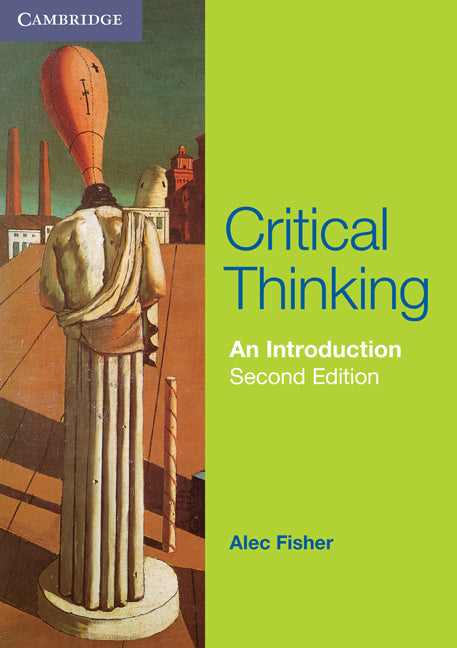
Critical Thinking 
2nd Ed. Cover


An original purpose of Hodges' model was to facilitate reflection, and so help to develop practitioners who were also competent reflective practitioners, and critical thinkers.

Continuing to clear books, I've arrived at:

Fisher, A. (2001) Critical Thinking: An Introduction. Cambridge University Press, Cambridge, England. PB. 

Now in a 2nd edition (2011), my copy has several definitions of 'critical thinking' quoted below, with my emphasis.

There is a pdf of this 1st edition online which may be useful. The reward of the book, however, is in the discussion about each definition and how more recent work has built upon Dewey's legacy.  There is also a baseball analogy, which I will return to soon, or append here. I have omitted a definition by Richard Paul, which is nonetheless important to me, as it draws on meta-cognitive qualities:
"1.1.1 John Dewey and 'reflective thinking' ...

In fact, people have been thinking about critical thinking and have been researching how to teach it for about a hundred years In a way, Socrates began this approach to learning over 2,000 years ago, but John Dewey, the American philosopher, psychologist and educator, is widely regarded as the 'father' of the modern critical thinking tradition. He called it 'reflective thinking' and defined it as: 
"Active, persistent, and careful consideration of a belief or supposed form of knowledge in the light of the grounds which support it and the further conclusions to which it tends. (Dewey, 1909, p. 9)."' p.2.
 'Glaser defined critical thinking as:
(1) an attitude of being disposed to consider in a thoughtful way problems and subjects that come within range of one's experience; (2) knowledge of the methods of logical enquiry and reasoning; and (3) some skill in applying those methods. Critical thinking calls for a persistent effort to examine any belief or supposed form of knowledge in the light of the evidence that supports it and the further conclusions to which it tends. (Glaser, 1941, p.5).' p.3.
1.1.3 Robert Ennis - a widely used definition ...
'Critical thinking is reasonable, reflective thinking that is focused on deciding what to believe or do. (Cf. Norris and Ennis, 1989).' p.4.
Notice the emphasis on being 'reasonable' and 'reflective', which picks up on earlier definitions, but notice also that Ennis speaks of 'deciding what to do', which was not explicitly mentioned earlier; so decision making is part of critical thinking in Ennis's conception. Unlike Dewey's definition, this definition needs no further explanation

A final definition of critical thinking 
One last definition is worth reviewing. Michael Scriven has recently argued that critical thinking is 'an academic competency akin to defines it thus: reading and writing' and is of similarly fundamental importance. He defines it thus:
'Critical thinking is skilled and active interpretation and evaluation of observations and communications, information and argumentation. (Fisher and Scriven, 1997, p. 21).' p.10."

Sunday, December 03, 2023

Four* care domains - revisited ...

 INDIVIDUAL
  |
     INTERPERSONAL    :     SCIENCES               
HUMANISTIC --------------------------------------  MECHANISTIC      
SOCIOLOGY  :   POLITICAL 
|
GROUP

My source: https://x.com/LeanneHPatrick/status/1731311359554371938?s=20

*Hodges' model can be embedded within the spiritual as per the situation - context.

Sunday, July 23, 2023

Book: The Future of Social Care [open access]

"This is an open access title available under the terms of a CC BY-NC-ND 4.0 License. It is free to read, download and share on Elgaronline.com. Foreword by David Brindle In the face of major global demographic change, social care policy and practice are in urgent need of radical reform and reassessment. Rising poverty, inequality and pressure on local communities internationally, are also increasing the urgent need for reform. Drawing on the crisis-ridden UK experience as a case-study, this highly original book identifies the limits of the traditional welfare state in taking forward policy for the twenty-first century. The proposals amount to a renewed approach to social care, based on the philosophy of independent living as originally developed by the international disabled people’s movement and subsequently embodied in a United Nations treaty applicable to all in need of care and support. Despite wide international sign up since adoption in 2008 there is little evidence of any nation successfully delivering. For the first time, this book offers both a blueprint for an environmentally sustainable, rights-based approach to social care and a practical route to achieving it."

INDIVIDUAL
|
INTERPERSONAL    :     SCIENCES               
HUMANISTIC --------------------------------------  MECHANISTIC      
SOCIOLOGY  :   POLITICAL 
|
GROUP


Beresford, P., & Slasberg, C. (2023). The Future of Social Care. Cheltenham, UK: Edward Elgar Publishing. Retrieved Jul 22, 2023, from https://doi.org/10.4337/9781803923017

Wednesday, June 28, 2023

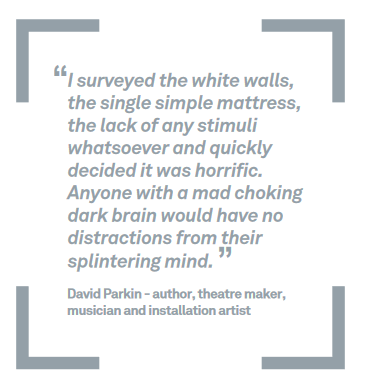
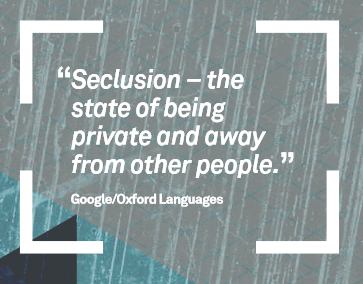
ii Design with People in Mind: Seclusion Issue related to Hodges' model

The Seclusion Issue


INDIVIDUAL
|
     INTERPERSONAL    :     SCIENCES               
HUMANISTIC --------------------------------------  MECHANISTIC      
SOCIOLOGY  :   POLITICAL 
|
GROUP

psychological harm / safety / seclusion

privacy, dignity and respect

Sensory stimuli, calm, distraction

Parity of Esteem

psychological restraint/control

Reaching for the person amid complexity

Staff / Service User attitudes to x,y,z

Lived/Patient experience
sensory -

NATURE - outdoors 'Green'

Design: (sterile?) space, colour, temperature, walls, light, warmth, cold, fresh air, homely/clinical, doors - locks, alarms, noise, violence resistant spaces ...

physical agression / harm / safety / seclusion

'built' environment / 'sensory room'

physical restraint/control, clothing, toilet, access to outdoors

Ecological and Integrative Physiology

- modulation

Social spaces

supportive spaces

scope for therapy

social autonomy

community

music / arts

experience in isolation - stigma in-situ?

trauma-informed services

in-patient services, funding

risk reduction; policies

use of technology/observation

length of stay, reporting

impact of restraint on staff


Hodges' model is situated and can be used in all health, educational and policy contexts.

Hodges' model can assist to initially scope, plan and evaluate research studies not only across all the care (knowledge) domains above (including the spiritual) but the model's structure incorporates such dichotomies as subjective-objective; qualitative-quantitative; person-services; patient-staff; therapy-control/restraint; person-centred--service-centred; private/personal-public; care-custodial; psycho-political; socio-technical and others.


There is of course much more that could be added above, and relationships considered between concepts and perspectives: the patient's, nurse's, doctor's, the multidisciplinary team, manager's, policy makers, architect,s anthropologists, public, professional and regulatory bodies and commissioners?


Please keep 'me' safe safely - yes, and the team!


Even though and especially because I may not currently know exactly who - how ...  I am?


My source: https://twitter.com/DIMHN

Related post i

Sunday, June 25, 2023

Design with People in Mind Books - The Seclusion Issue

Design with People in Mind
The Seclusion Issue


Design with People in Mind is the Design in Mental Health Network’s annual round up of the latest research evidence on therapeutic outcomes and the evidence for them relating to the built environment in mental health. In partnership with London Southbank University and Nottingham Trent, so far we’ve looked at a variety of issues, from nature to sound design to boundaries and borders. The latest issue is Seclusion, launched at this years conference and focusing on the evidence for and impact of the practice of seclusion units, how to use them if at all, and best practice in the field to maintain psychological as well as physical safety for service users and staff.


The link to the publication is: 

https://dimhn.org/wp-content/uploads/2023/06/1DWPIM_I8_250x210_24PP_AW_V02_HI_RES.pdf

It’s a member only resource, so you will need to register (free for individuals) before viewing.

Very best,

Hannah

Hannah Chamberlain
CEO
Design in Mental Health Network
m: 07811169609
www.dimhn.org


My source: https://twitter.com/DIMHN

See also:
ii Design with People in Mind