Hodges' Model: Welcome to the QUAD: evaluation

Hodges' model is a conceptual framework to support reflection and critical thinking. Situated, the model can help integrate all disciplines (academic and professional). Amid news items, are posts that illustrate the scope and application of the model. A bibliography and A4 template are provided in the sidebar. Welcome to the QUAD ...

Showing posts with label evaluation. Show all posts

Thursday, August 13, 2026

Call for Papers: Bioethics and Philosophical Health - JECP

Submission Deadline: Thursday, 31 December 2026

Contemporary bioethics has developed sophisticated tools for ethical decision-making. Yet it often operates within assumptions that reduce life to physiological viability. Ethical questions are frequently treated as matters of procedure and consent. Meanwhile, patients and clinicians face questions that exceed these frameworks. What makes a life worth living? How does illness disrupt or reveal meaning? What forms of care support not just survival but existential coherence? These questions call for a deeper engagement between bioethics and the philosophy of existence.

Despite growing interest in person-centred care, conceptual tools for clinical evaluation remain limited. Frameworks for assessing philosophical sense-making and existential orientation are underdeveloped. The Philosophical Health perspective addresses this gap by going beyond physical and psychological health. It asks how we cultivate meaningful lives through bodily experience, self-understanding, relational belonging, engagement with possibility, purposeful action, and philosophical reflection. The concept draws on the ancient tradition of bios philosophikos. It proposes that healthcare should attend not only to pathology but to the philosophical dimensions of human existence.

This special issue creates space for exploring how philosophical health can deepen bioethical inquiry as an embodied ethics of the good life. It challenges reductive assumptions and fosters practices that support purpose and meaning in lives, even when disrupted by health challenges. We welcome transdisciplinary contributions from philosophers, bioethicists, clinicians, medical humanists, and social scientists. Topics include how philosophical frameworks enrich clinical practice, how healthcare shapes existential experience, how the 4E cognitive approach may inform bioethical theory, and how dialogical methodologies can be integrated into institutional contexts. The issue aims to rediscover bioethics as a genuinely philosophical and existential enterprise, that is as bios ethikos.

Topics of interest for this call for papers include but are not restricted to:

  • Philosophical frameworks for enriching or transforming bioethical practice and clinical evaluation;
  • Philosophical dimensions of clinical encounters: embodiment, selfhood, temporality, and meaning-making;
  • Critiques of the reduction of ethical deliberation to procedure, regulation, or risk management;
  • How healthcare practices shape or constrain the philosophical dimensions of human existence;
  • The 4E cognitive approach (embodied, extended, enactive, embedded) applied to bioethical theory and practice;
  • Integration of philosophical inquiry and dialogical methods into clinical or institutional contexts;
  • Empirical and conceptual engagement with the Philosophical Health methodology, including SMILE_PH;
  • Cross-cultural and planetary perspectives on philosophical health and the good life;
  • Methodological innovations in clinical philosophy, philosophical counselling, and reflective practice.
More details here: https://onlinelibrary.wiley.com/page/journal/13652753/call-for-papers/si-2026-000772


_______

Dr Luis de Miranda
Associate Professor (Docent) in Bioethics, Uppsala University
Marie Skłodowska-Curie Fellow, Turku Institute for Advanced Studies
Associated Researcher, Centre for Research Ethics and Bioethics,
Department of Public Health and Caring Sciences, Uppsala University
https://www.luisdemiranda.com/

My source: Philos-L "The Liverpool List" is run by the Department of Philosophy, University of Liverpool https://www.liverpool.ac.uk/philosophy/philos-l/ Messages to the list are archived at http://listserv.liv.ac.uk/archives/philos-l.html. Follow the list on Twitter @PhilosL. Follow the Department of Philosophy @LiverpoolPhilos


Tuesday, August 04, 2026

Brief introduction to Hodges' model

Hodges’ model is a conceptual framework of universal value in theoretical work, practice, policy and care management. While this model is a product of the health-education sector, it is global in scope, taking in the current situation, history and future as complicated by scientific, socio-political, technology and climate change. Practice-based, Hodges’ model is a tool simple in form and yet powerful in terms of how it can help users frame the problems and opportunities of the 21st century. The model was originally taught in studies for the post-registration certificate of care of the mentally ill in the community and other courses. Student assessment included the completion of a case study (vignette), demonstrating competence in application of the model and its embedded (implicit) values.

Access to education, especially early years, is emphasised as foundational for personal and community growth and development. For individuals this can set the course for lifelong learning and an ability to contribute to society and the economy. Given this primary challenge, global institutions and policy makers point to the need for curricula that are relevant. In turn employers and industry leaders need a (global) workforce who are: 

  • reflective practitioners;
  • critical thinkers;
  • able to see the ‘big-picture’; and focus on detail and priorities when needed (risk and triage);
  • decompose a problem, but also integrate (care);
  • work as team-members;
  • and extend across several literacies.
These challenges are ongoing for education (being health literate, so as to address personal, social, health and economic education, and the sustainable development goals), and increasingly climate impacts.

Tuesday, May 05, 2026

iii Picking up sticks: when axes matter

It is one thing for us to break the stick, but quite another from a concept's perspective. They are accustomed to the dynamics at work, when as search terms they are exploded, or not. And, not just any concept but one that can be unique. Consider the concept, and how or where it finds itself [ in Hodges' or another model ]? Let us use the intra-INTERPERSONAL domain, as an example, and ask:

  1. Is 'mood' fixed by the I-axis alone?
  2. Does the humanistic axis have a role in where in the doomain the user of Hodges' model places 'mood'?
  3. Acknowledging person-centredness, if the patient/client had a view, to what extent would this agree (with annonymity assured) with the professional's judgement, or a relatives / guardian?
  4. What is as a result, 'mood' has become 'very low mood'? (To continue in this vein , invites complication, but we will continue.)
  5. Introducing the 'Other' whatever their role and relationship, pushes us to the humanistic, but whether this is achieved in a person-centred manner (triage excluded) is a matter of opinion and judgement (evaluation).

If mood is fixed by the I-axis then if we determine the issue is 'low mood' are we introducing a combined quantitative and qualitative dimension, a continuum, at the selected point in the interpersonal domain? Writing previously about threshold concepts, I wondered, and proposed compound threshold concepts. There is a progression from the patient's subjective self-assessment, to in all likelihood of an objective measure being introduced, so spanning two domains. Definition of 'compound' aside; there is a compound structure at work.

What points 1-5 above reveal is triangulation. When it is argued that Hodges' model facilitates navigation as per my presentation on 21st April, this is a strategy from mixed-methods research in practice. Many years ago, Hodges' model was described as a 'cognitive periplus', reflecting the way ancient mariners initially charted the coastlines creating the first map, as per their culture and dispora. In the west more recently the value of social approaches and activities, especially in mental health. Care navigation is a role. Literally sign-posting to individually suited (which must be stressed) activities, resources, and agencies. So, in Hodges' model what are our three triangulation points? They are:

  1. Axial;
  2. Intra- InterDomain; 
  3. Person-centred. 

Perhaps, we can describe 1-2 as conceptual anchors at least when dealing with a concept, while #3 is more about approach, values and philosophy. So, there is something of a 'cheat' going on, because each one is compound:

1. Axial: The axial is comprised of four points. The axes create a Cartesian plane (figure). And, as far as a patient is concerned, they mark off a point on the respective Individual and Humanistic-Sciences parts of the axes. This form of triangulation point can claim a general conceptual precision (language) in the applied terminal labels; but what happens in-between can be patently fuzzy. A mix of what may be objective and subjective.

2. Intra- Interdomain: This may be the most imprecise triangulation point. It appears the axes of Hodges' model are composite (figure). They have two-sides as a boundary. To be pedantic, in our example, one plays to the interpersonal domain, the other the sciences.

[The relationship between the axis and the domains in Hodges' model, is far from unique; but I wonder if there is something else here?]

2. Person-Centred: There is a paradoxical nature to person-centred(ness). It is also nebulous in nature, and yet in care it is definitive in practice (safety, purposes, values, professionalism, competency, ...).  It forms locus which can also be classed as a traingulation point, at the centre of the model. This is the point around which Hodges' model is built. This captures the individual's (life, care) context and situation, all influenced by their life chances as consequent health - and other - careers. Salience and our attention^ is key. Is it possible to frame our purpose(s)?

^A focus for [N] autumn.

Marrakech, Le Jardin Secret. 24th April. 1000-1830.

Monday, March 23, 2026

Good - Bad AI? c/o FT Magazine et al.

My source: Tim Harford, How can we tell good AI from bad? FT Magazine. 21 March 2026. #1168: pp.9-10.

    'Two new working papers address the tricky issue of verifying quality. In "Some Simple Economics of AGI", Christian Catalini, xiang Hui and Jane Wu (assisted, sometimes gratingly, by generative AI) propose the inevitable 2x2 matrix in which economic activity can be easy to automate, easy to verify, both or neither. Automatable, verifiable output is the stuff that computers do for us. The non-automatable stuff remains reassuringly artisanal.
    The difficult quadrant is where tasks seem easy to complete but are hard to check. Catalini, Hui and Wu call this the "runaway risk zone". It is not a reassuring label and it is not meant to be.
...
    In the second paper, "A model of Artificial Jagged Intelligence", Joshua Gans offers an analogy in which asking AI to perform task is like trying to cross a river over a network of planks supported by occasional pylons. The jagged frontier is represented by the fact that some planks are long and wobbly, while others are short and sturdy. Problem one: even if the planks are typically sturdy, the wobbly planks will require most of your time and attention. Problem two: if you can't predict in advance which planks will let you down, you may quite sensibly prefer to eschew the AI entirely and row yourself across the old-fashioned way.'

Catalini, C., Hui, X., & Wu, J. (2026). Some Simple Economics of AGI. arXiv preprint arXiv:2602.20946.

Joshua S. Gans, 2026. "A Model of Artificial Jagged Intelligence," NBER Working Papers 34712, National Bureau of Economic Research, Inc.


Previously: 'safety' : 'ai' : 'domain' : 'matrix'

Monday, March 16, 2026

Kantian Justice: A Desert-sensitive Responsibility-enhancing Theory

On Nov 3rd & 4th last year, I was able to attend a launch event in Liverpool, UK - which I intended to post:

KantianDESERT* is designed to formulate a new model of distributive justice in response to growing economic disparities globally, by offering a distinctive position within dominant egalitarianisms in current political theory/philosophy. Through several original contributions, the project builds an innovative case for a theory sensitive to individual just deserts.

This 5-year, €2 million Advanced Research Project, selected by the European Research Council and funded by the UK Research and Innovation, is led by Professor Sorin Baiasu (Liverpool). With this conference, the project will be officially launched.

The launch has been followed  by a reading group working through (now chapter 4) of Shelly Kagan's -

Chapter 3 on Desert Graphs - seemed somehow familar, at least in the structures first presented:

Abstract

This chapter is concerned with desert graphs, which help clarify and demonstrate the complexity of the topic of desert. The first section includes graphs that explain the fault forfeits first view and its two extensions. It then studies varying slopes, graphs that depict the desert line of two different individuals, and rotation. The next section discusses the concept of peak, which represents the exact level of suffering or happiness a person actually deserves. It also includes a comparison of the eastern and western slopes of one and two individuals, as well as a section on the Sym Mountain. This chapter also introduces the mountain as the characteristic shape of an individual desert line.

Kagan, Shelly, The Geometry of Desert (New York, 2012; online edn, Oxford Academic, 24 Jan. 2013), https://doi.org/10.1093/acprof:oso/9780199895595.001.0001, accessed 16 Mar. 2026. 

The main launch programme is copied below for reference:

Day 1

9.00-9.15: Coffee/tea. Welcome addresses from Professor Peter Buse (Liverpool, Dean of the School of the Arts) and Professor Michael Hauskeller (Liverpool, Head of the Philosophy Department)

9:15-10:15 Introduction; about the project. Sorin Baiasu (Liverpool): Kantian Justice: A Desert-sensitive Responsibility-enhancing Theory; Tom Bunyard (Liverpool): 'Is Desert a Viable Concept?'; Tom Whyman (Liverpool): 'Food Justice and Desert'

10.20-11.20: Sebastian Orlander (Independent): ‘Kant, Freedom, Desert and Practical Faith’
...
11.30-12.30: Tommaso Mauri (Perugia): ‘Desert and Inequality in Kant: A Theologico-Political Approach’
...
1.15-2.15: Elisabeth Widmer (LSE): ‘What’s the point of Kantian Inequality?’
2.20-3.20: Huub Brouwer (Tillburg): ‘Defending Asymmetries of Desert’
...
3.30-4.30: Tom Mulligan (Georgetown): ‘Who deserves what AI produces?

4.35-5.20: Roundtable

7.00: conference dinner ...

Day 2

9:30-9.45: Welcome; coffee

9.45-10.45: Seniye Tilev (Kadir Has University): ‘Kant on Well-Being and Virtue: A Framework for Desert Without Consequentialism’

10.50-11.50: Krishna Pathak (Delhi): ‘Institutional Desert, Injustice, and Adaptive Preference for Suicide: A Kantian Perspective’
...
12:10-1.10: Jochen Bojanowski (Illionois): ‘Luck Egalitarianism and the Limits of Desert’
...
2.10-3.10: Gabriel Maruchi (Campinas): ‘Denotational Revisionism Cannot Escape Basic Desert’

3.15-4.15: Marius Baumann (LMU): ‘Desert, Responsibility and Skepticism’
..
4.30-5.15: Roundtable & close

Commentators: Tom Whyman (Liverpool), Sorin Baiasu (Liverpool), Bertjan Wolthuis (VU Amsterdam), Christian Españo (University of the Philippines Diliman), Sung-Yeop Jo (LMU), Tom Bunyard (Liverpool), Robin Eliath Joy (Calicut), Beşir Özgür Nayır (Boğaziçi).

https://www.liverpool.ac.uk/philosophy/research/research-projects/kantian-justice/

My source: *Philos-L https://www.liverpool.ac.uk/philosophy/philos-l/ 

Tuesday, March 10, 2026

Did Mr Hodges ever say "Welcome to my World?" (i)

The source for the post:

'Move Over LLMS! AI Legends Yann LeCun and Alex LeBrun
Debut AMI Labs' Bold Ambitions for World Models in Healthcare
' 

- reminds me that Hodges' model provides a potential 'World Model'. Not just one world, but (seriously and non-trivially) several, in the form of the  ...

  • Nurse's
  • Student's*
  • Patient's
  • Carer's
  • Team Leader's / Managers
  • and yes the team's too - the sum total of all that effort. ...

 Hodges' model is applicable in assessment, planning, interventions, evaluation and review. The key of course, is as was as computers first arrived on wards and clinics: the human users of Hodges' model.

Of course, each comes with their own, hard won (see what I did there!) model, that needs extending by several intensive years of study. 

Situated and person-centred, Hodges' model can assist all its users, to 'incorporate the learned dynamics of the environment', however it presents: medicine anyone? What about surgical, psychiatry, paediatrics, orthopaedics, or gynaecology? You get my drift?


Wenninghoff, N., Schwammberger, M. (2026). Interpretable World Model Imaginations as Deep Reinforcement Learning Explanation. In: Guidotti, R., Schmid, U., Longo, L. (eds) Explainable Artificial Intelligence. xAI 2025. Communications in Computer and Information Science, vol 2578. Springer, Cham. https://doi.org/10.1007/978-3-032-08327-2_7  

 *And not necessarily a student nurse, but possibly medical, social work, psychology, probation, ... ai!

Mr Brian E. Hodges (RIP)

Thursday, January 22, 2026

NANDA-I Newsletter - theme of clinical reasoning


'This month at NANDA-I, we have been exploring the theme of clinical reasoning.


Clinical reasoning is at the heart of nursing; it’s how nurses make sense of complex patient information and choose the best path forward. While many nurses think of diagnosis as the centerpiece, it’s really the thinking that leads up to it, gathering cues, interpreting what matters most, and then safely determining goals and actions, that makes all the difference in outcomes. Strong reasoning helps nurses notice subtle changes and act with confidence.


As healthcare grows more complex, understanding how nurses think, not just what tools they use, helps elevate care for every patient. We’ll be sharing insights throughout the year to help you stay connected to nursing knowledge and its impact on care delivery and education.'


Teaching Tip: Clinical Reasoning in Practice

Start With Assessment to Improve Reasoning

When nurses work with standardized languages and clinical judgment tools, it’s tempting to dive right into diagnosis. But the most accurate and useful nursing judgments always come from strong, systematic assessment first. Quality assessment supports better interpretation of patient needs and more precise identification of nursing responses.


Quick Tip: Use a flexible assessment framework, whether it’s a conceptual model or a tool like functional health patterns, to make sure you’re capturing the data that matters most first. When you build a solid foundation with assessment, everything that follows (including diagnostic thinking) becomes clearer and more grounded.  


My source: 'Friends of NANDA®-I Newsletter' subscription (with my emphasis).

See also:
https://nanda.org/2025/12/nanda-360-for-educators-and-researchers-strengthening-nursing-knowledge-through-diagnosis-centered-reasoning/

Assessment, plus planning, implementation - action, evaluation (plus, formulation).

Functional and cognitive [Health, Illness, Climate, Poverty, Political, Security, Prevention, Self-care, ...] patterns.

'... make sure you’re capturing the data that matters most first' - Situated, Context, Salience.

For a competent practitioner an assessment can also be 'therapeutic' for the patient.

Previously: 'classification' : 'diagnosis' : 'NANDA' : 'ICD'

Saturday, January 17, 2026

European Character and Virtue Association (ECVA) Conference 2026

Theme: Bridging the Knowledge – Action Gap in Character Development

Re: invitation to the ECVA 2026 conference: reminder ...

Established in 2022, the European Character and Virtue Association offers a forum for promoting research, training and networking in the field of character education. We bring together educational institutions in Europe and scholars from around the world, providing unrivalled opportunities for members to share best practices and shape European policies affecting higher education and research. 

The 2026 conference of ECVA will take place in Trnava University, Slovakia, in cooperation with the Jubilee Centre for Character and Virtues, University of Birmingham, the Private University College of Teacher Education of Christian Churches, and the Virtues and Values Education Center of Francisco de Vitoria University. 

The Executive Board of the European Character and Virtue Association (ECVA) cordially invites you to attend the 2026 ECVA Conference in Trnava, Slovakia. 

  • President: Prof. Dr. James Arthur (Harvard University)
  • Vice President: Prof. Dr. Verónica (Francisco de Vitoria University Madrid)
  • Secretary: Prof. Dr. Tom Harrison (Jubilee Centre for Character and Virtues, University of Birmingham)
  • Treasurer: Prof. Dr. Roland Bernhard (University of Teacher Education of Christian Churches Austria)

Conference Information Trnava, Slovakia, 2026, 24th to 26th of June 

We expect more than: 📍100+ researchers 🏫 40+ universities 🌍 20+ countries 🎤 60+ presentations & keynote addresses 

📝 Submit your abstract and find all conference details at the link below:

👉 https://ecva-character.org/ecva-conference-2026

Deadline for Abstract Submission: 31st of January, 2026.

All abstracts will undergo a review process over the course of the following month. Once your proposal has been accepted, you will receive detailed information about registration, conference fee (275,- EUR) processing, accommodation options, and other necessary information.

Notification of Acceptance: 1st of March 2026.

Contributions that demonstrate high quality and close relevance to the main theme of the conference will be accepted for review in preparation for the next scientific monograph produced by the ECVA.

Warm regards,

Dr. Martin Brestovanský
(Trnava University, Slovakia)

on behalf of the ECVA Steering Group

Prof. James Arthur (Harvard University)
Prof. Verónica Fernández (Universidad Francisco de Vitoria, Madrid)
Prof. Tom Harrison (Jubilee Centre for Character and Virtue, University of Birmingham)
Prof. Roland Bernhard (University of Teacher Education of Christian Churches, Vienna)
Prof. Claudia Navarini (Università degli Studi Europea di Roma)
Prof. Ines Weber (Paris Lodron Universität Salzburg)

Conference description 

Bridging the Knowledge – Action Gap in Character Development 

Moral education often assumes that ethical knowledge or cognitive competence alone will result in moral behaviour. Yet lived experience, philosophical reflection, and empirical research consistently show otherwise. A persistent gap exists between what individuals know is right and what they actually do—a phenomenon recognized since antiquity. 

Aristotle observed that “we reason here not to know what virtue is, but to become good” (Nicomachean Ethics, 1103b), highlighting that moral reasoning is directed toward formation, not just information. Immanuel Kant similarly acknowledged that a person may clearly understand moral duty and yet lack the will to act accordingly, pointing to the human struggle between reason and inclination. 

David Hume went further, arguing that “reason is, and ought only to be the slave of the passions,” insisting that moral knowledge without rightly ordered desires lacks the power to move us to action. And Martin Buber wittily adds: “The worst notorious liar in the classroom will write a brilliant treatise on the destructive power of falsehood”. 

This enduring challenge – now referred to as the knowledge–action gap – remains a pressing concern across education, psychology, and the social sciences. Scholars have described related phenomena in various conceptualizations, such as the reason–action gap, attitude–behaviour gap, intention–behaviour gap, or the knowledge–attitudes–practice (KAP) gap. Each term reflects a common concern: knowing what is right does not reliably lead to doing what is right. 

Bridging this divide is a complex task, compounded by the dynamic, deeply personal, and context-sensitive nature of character formation. Educational and behavioural sciences are increasingly turning to integrative approaches that go beyond cognitive instruction. Interventions such as moral sensitization, dramatization, habit training, and reflective practice are being explored to enhance the coherence between values and actions. 

There is growing consensus that this so-called “gappiness problem” cannot be resolved through one-size-fits-all solutions (e.g., moral emotions alone or identity-based interventions). Instead, promising “multi-component” models are emerging that draw on diverse disciplines and methodologies to address the challenge. 

Conference Goals 

By bringing together interdisciplinary perspectives and diverse methodologies, the ECVA 2026 conference aims to deepen our understanding of the knowledge–action gap and to promote innovative, research-informed strategies for strengthening moral coherence and character development in real-world settings. 

We look forward to welcoming those committed to advancing theory-informed practice and practice-informed theory in the service of ethical integrity and flourishing lives.

Previously: 'character' 

Saturday, December 06, 2025

The critical pathway leads to ...?

I missed the most salient information on this book's cover - at least for me. My copy is secondhand, but I picked the copy up recalling Dr Walsh's many publications on models of nursing.

The critical pathway for me is plural. It would include, the CPN(Cert.) course when I first encountered Hodges' model in 1987-8. Plus the fact that the pathway is not unidirectional, with some backward steps and reviews, but is multifold. Running the axes of Hodges' model to - pre-op, surgery, post-op, rehab ... we can add the whole corpus of nursing, social, self, and global health care.

The cover is of course illustrative, intended to support the title and suggest an explicit critical pathway. Apart from possibly pointing to collaboration "Mr Jones ... Let us discuss your critical pathway!" what has changed? Since the book's publication in 1997, we need health care services and systems to be sustainable. We are bit late here. Mr Jones is already a 'patient', bedecked in dressing gown and slippers.


This critical pathway needs to be replaced by one informed and oriented towards Mr Jones as self-caring citizen. This is of course easier said than done in policy terms. While governments globally and institutions stress the need for health literacy, informed life style choices, self-care, health promotion and prevention how much progress is being made? Nutrition remains a profound issue.*

The environmental challenges of climate change, pollution and waste disposal are seemingly contested even as the effects and cost of non-action are increasingly obvious.

The policy of 'care in the community' even while incomplete in the community, has provided me with a stimulating, challenging and rewarding career 1985 ... In the 21st century though, we have to ask of the assessment of mobility to follow and effort of the up-hill walk to 'home' begs the critical pathway that is now Planetary Health.

<>

Several points from Walsh (1997):
'Introducing a model to a clinical area is not an easy task to be undertaken lightly, as it involves fundamental changes in the way staff think and work. Luker (1988) has suggested that each nurse carries around their own informal model of nursing which guides their practice. It is probable that a formal model will be significantly different, although these differences can be minimized by full consultation and involvement with staff to ensure that the model chosen reflects their views of nursing as far as possible.' p.36.
Hodges' model can be 'carried around'. In truth it not strictly a model of nursing. Its scope extends beyond nursing and yet the model can incorporate thought about the patient, nurse, environment and what health, illness, recovery and self-care entail. Hodges' model is meta-cognitive and meta-conceptual, and (very) capable of mapping the terrain (p.26) of nursing from these and other perspectives. A nurse's 'views of nursing' will be dictated by the situation presented to them. Hodges' model can be retrospective, prospective and operate in the here-and-now: situated.
'There is a further point, however, that follows on from Luker's observation for expert nurses have an internalized model of care which is unique to them, it is possible that they may have internalized some practices which are outdated, taken for granted or inappropriate (Paley, 1996) but which are never made explicit as their care is not based upon a commonly understood model of nursing. This notion of every nurse having their own model therefore can lead to the situation where outdated rituals can be propagated under the guise of expert practice. Having a series of explicit models whose aims and ideas are common knowledge, shared by all, opens up care to critical scrutiny in a way that is not possible if each nurse has their own private internal model.' p.37.

Hodges' model can be used with other models, conceptual frameworks and systems across disiplines. Hodges' model is not intended to be prescriptive or prospective. It can be utilised for learning and unlearning. As a registered General Nurse who studied in the 1980s this does not mean I would be competent and safe to practice now. Continuing professional development, mandatory training and revalidation of nursing registration are all geared to support professional practice that has currency, validity, and is safe.

If nursing ever needed a commonly understood model ...?

'It will be apparent from the previous sections that use of a model will lead nursing into some new and unfamiliar territory that will involve seeing the patient in a more holistic fashion'. p.63.

'The nurse may find that models start to identify environmental problems whose solutions lie beyond the boundaries of nursing at present. This is particularly true of the community nurse.' p.63.
Walsh's concern here is the immediate community, but we can recognise the prescience of environmental problems here. Plus the need for the POLITICAL domain in Hodges' model:
'On a larger scale still, perhaps some patient's problems have their origins in political decisions made by national govemment or perhaps it is the factory down the road producing unacceptable levels of pollution. If nursing models make us recognize the political and environmental causes of some patient problems, there should ee no logical reason why nursing should not go forward into theee arenas as a legitimate part of nursing intervention.' p.63.
'There are senior NHS managers and health academics in so-called 'policy thínk tanks' who simply do not recognize the value of nursing and see only a collection of simpie tasks which anybody with an NVQ level 2 can perform. Nursing therefore has to demonstrate its worth; it has to evaluate what it is doing for patients.
Here it is important to remember that the care given may be very different from what is written down. Consequently, how a nurse evaluates care mentally may be very different from how this care is recorded in nursing process documentation. ...' p.64.
Hodges' model can (imho) have a role in argumentation for the quality and scope of healthcare, for nursing as a profession, evaluating and assuring nursing's values in the constant that are the demands of complexity and change. The (several) determinants of health are the other constant.

Mike Walsh (1997) Models and Critical Pathways in Clinical Nursing. London: Bailliere Tindall.

Luker K. (1988) Do Models Work? Nursing Times, 84 (5), 27-29.

Paley, J. (1996), Intuition and expertise: comments on the Benner debate. Journal of Advanced Nursing, 23: 665-671. https://doi.org/10.1111/j.1365-2648.1996.tb00035.x

*Jones P, Wirnitzer K. Hodges’ model: the Sustainable Development Goals and public health – universal health coverage demands a universal framework. BMJ Nutrition, Prevention & Health 2022;5: doi:10.1136/bmjnph-2021-000254

Wirnitzer KC, Motevalli M, Tanous DR, Drenowatz C, Moser M, Cramer H, Rosemann T, Wagner K-H, Michalsen A, Knechtle B, Fras Z, Ritskes-Hoitinga M, Marques A, Mis NF, Stanford FC, Schubert C, Goswami N, Leitzmann C, Fredriksen PM, Ruedl G, Wilflingseder D, Lima RA, Kessler C, Jeitler M, Khan NA, Joulaei H, Fatemi M, Knight A, Kratky KW, Palmer KK, Haditsch B, Jakse B, Kofler W, Pfeiffer T, Cordova-Pozo K, Tortella P, Straub S, Lynch H, Schätzer M, Krishnan A, Fathima A. S, Gatterer L, Kriwan F, Abhishek M, Nandgaonkar H, Nandgaonkar S, Adedara AO, Haro JM, Gericke C, Neumann G, Akhtar A, Rashidlamir A, Thangavelu M, Ngoumou GB, Perpék É, Klaper M, Bhattacharya B, Kirschner W, Bessems KMHH, Jones P, Peoples G, Bescos R, Duftner C, Seifert G (2025). Toward a roadmap for addressing today's health dilemma–The 101-statement consensus report., 
Frontiers in Nutrition, Volume 12:1676080. doi: 10.3389/fnut.2025.1676080. https://doi.org/10.3389/fnut.2025.1676080

Saturday, October 18, 2025

Just imagine ... caseloads, payloads and careloads

Just imagine ... no, not like that - really imagine!

You are in a situation. Unsurprisingly, let's say it's in health, or social care. We find ourselves in a care or nursing home, on a ward, or in the individual's home, even if the patient does not currently recognise it as such.

The patient is mobile. That is, and isn't a problem.

Physically, apart from thoughts about a chest, or urine infection, yes they are mobile, but they're also confused - disoriented.

We are concerned about their safety. 

Noisy, increasingly agitated, they are making it clear they want to leave.

Their carer, family, or staff are trying to limit the patient / resident's access to the exits, be that the front, or back door, the spare room, their room, or main entrance. They are not in agreement about where they need to be. Persuasion and distraction aren't working either. They appear to lack the level of mental capacity required to decide for themselves what needs to happen.

It is one thing to have this assessment of the situation running through one's mind; but quite another to 'pick up' a care concept mentally and carry it over the care (knowledge) domains of Hodges' model.

Hodges' Health Career - Care Domains - Model
Try it for yourself ...

Have a think about the following care concepts: mobility, capacity, consent, confusion, mobility, liberty, a locked-door while spouse/partner goes shopping, and safeguarding? 

As we engage in critical thinking, these concepts have a literal payload. They carry varying degrees of informational value, salience that helps us prioritise, what else do we need to factor in, what help is needed, and when; how do we  decide what to do?

As a concept is evaluated against Hodges' model, it changes. It is as if it morphs subtely, or starkly as other concepts, by association, are brought into play.

This process is influenced in so many ways; our training to date, our prior experience, biases and cultural baggage we might also carry, who else is present (this is of course potentially both a positive and negative), past and current role-models, our (team's) preparedness - what to do if .., teamwork, access to leadership (who is 'duty'?), and our confidence in them (Oh no!). And, them in us.*

Vitally, there is the small matter of our understanding, attititude and response to the person in-front of us. 

The delivery of healthcare is often stressed as emotional labour. Whether we use Hodges' model or not, perhaps the labour, the physical and psychological work involved, is experienced through carrying and feeling the careload. A reason too for supervision.

*Do seek help - advice if needed.

Further reading [ please contact me if needed - h2cmng AT yahoo.co.uk ]:

Jones, P. (2025), A Generic Model and Conceptual Framework to Prime Curiosity Across Health and Social Care Disciplines to Facilitate Lifelong Learning. Journal of Evaluation in Clinical Practice, 31: e70252. https://doi.org/10.1111/jep.70252

Jones, P. (2025). A Conceptual Mapping Exercise of Deprivation of Liberty Safeguards in Residential & Community Care Using Hodges' Model and Threshold Concepts. Journal of Evaluation in Clinical Practice, 31: e70085. https://doi.org/10.1111/jep.70085

Saturday, September 06, 2025

Scholarship in Arnold Wesker's 'The Friends'

... n'just t'lethee know that's, scholrship up int North ...

'MANFRED. Our trouble, Crispin, us lot, the once-upon-a-time bright lads from up north, is that we've no scholarship. Bits and pieces of information, a charming earthiness intelligence and cheek, but-not scholarship. Look at these books here. (He picks up a pile and throws them round him.) Renan, Taine, Kirkegaarde, Wittgenstein, Spengler, Plato, Jung, Homer, Vico, Adorno, Lukacs, Heine, Bloch-you've not heard of half of them, have you? And half of them, two-thirds, I'll never read. Do you know, new knowledge disrupts me. Because there's no solid rock of learning in this thin, undernourished brain of mine, so each fresh discovery of a fact or an idea doesn't replace, it undermines the last; it's got no measurement by which to judge itself, no perspective by which to evaluate its truth or its worth; it can take no proper place in that lovely long view of history scalloped out by bloody scholarship, because each new concern renders the last one unimportant. No bloody scholarship, us. And when I sometimes get a feeling that two people in love or one man afraid of death might be a supreme consideration, along comes this man with his 'we are moving into phases of creative disorder' and his 'everywhere the lines are blurred' and I've no defence. He sounds so right, I think, and besides-he's got scholarship. What's 'silly loving' and 'banal dying' in all that? Evil? You want me to confess to the knowledge of evil? I confess it. I say it-evil! So? And what  shall I do with that bit of knowledge?' p.18.

 WESKER, Arnold. The Friends. London: Jonathan Cape, (1970). Hardcover. First edition.

Wednesday, May 14, 2025

c/o Ridgway - assimilation & accommodation

An approach to testing and teaching

'Consider the problems of acquiring new knowledge; two ideas are particularly important. The first is that existing knowledge and conceptual structures affect the way that new materials are perceived and learned; the second is that new experiences bring about changes in our knowledge and conceptual structures. These two processes are referred to as assimilation (analogous to the way in which the stomach digests food, whose later structure cannot be recognized as being similar to its earlier structure) and accommodation (analogous to the way that the pupil of the eye adjusts itself different light levels). Biological analogies make it easier to understand these concepts but leave unresolved the question of when one accommodates and when one assimilates. In general, one accommodates (i.e. changes one's conceptual structures) when fresh knowledge provides strong challenges to what is in mind; so dramatic counter-examples to currently held beliefs, or coherent patterns in the world, which cannot be explained by existing beliefs are both likely to bring about accommodation. Assimilation (interpreting new events in terms of old ideas) can be made to work when the number of counter-examples to predictions made from old beliefs are rather low. It follows, therefore, that if misconceptions are to be remedied (i.e. the mechanism of assimilation is overcome and the mechanism of accommodation stimulated) a representative sample of questions in the domain of interest is unlikely to have the desired effect because the number of cases which violate pupils' misconceptions and which therefore  might cause accommodation, will be relatively small. To foster accommodation it is necessary to provide dramatic examples which violate current conceptions and to provide these examples in quantity. Examples which are most likely to be dramatic are those in which it is obvious to pupils that the results they are obtaining using particular misconceptions are at variance with what they 'know to be true' from everyday experience.' pp.46-47.

Jim Ridgway (1988). Assessing Mathematical Attainment. Chapter 3, Using Test Results.Windsor Berkshire. NFER-NELSON. pp.40-52. [Ack. length of quote - See also: https://www.nfer.ac.uk/ ]

Thanks to Lancaster Univ. Library.

Previously 'assimilation' : 'accommodation' : 'math'

Sunday, April 20, 2025

Safety testing time - evaluations - for users of Hodges' model to be extended

The time to test Hodges' model* is to be extended (in my dreams...).

Or. Do not underestimate 'simple' models.

The time to evaluate Hodges' model:

  • for individual users
  • cross-curricula
  • professional groups (e.g. registered mental health; and general nurses)
  • within multidisciplinary / skilled teams / venues (Nursing home, Community Mental Health Team)
Given the universal, multicontextual scope of the model for public and patient safety it was decided to extend the time for testing by a further month to two quarters [ 😉] - six whole calendar months.

When applied it is important that checkpoints are agreed:

  • Data gathering - initial interview
  • initial formulation / care plan
  • care review / evaluation
  • discharge - staying well 
There is no agreed standard for testing a generic model in healthcare. Is there?
  • Not for the medical / bio-medical model
  • Nor, for the biopsychosocial model?
What chance then for a biopsychosociopolitical model?

*Per user and group of users of course.

My source: 
Christina Criddle, Concerns raised after OpenAI slashes time taken to test potential risks of latest models, FTWeekend, 12-13 April, 2025, p.14. (italicised terms discussed).

See also:
Radhika Rajkumar, Editor. OpenAI used to test its AI models for months - now it's days. Why that matters, ZDNET.

https://www.zdnet.com/article/openai-used-to-test-its-ai-models-for-months-now-its-days-why-that-matters/

Wednesday, March 19, 2025

News on two papers: Deprivation of Liberty Safeguards & Threshold Concepts

 - plus of course Hodges' model


While I could find out (here on W2tQ!?), I can't remember exactly when I started a writing project about threshold concepts, deprivation of liberty safeguards in the context of residential care and nursing homes. It was at least 2013, and may date back to 2011. Well, whenever it was: what a palaver! 

One paper, rejected, the advice was to split the work and create two. The two papers were then also rejected. My writing is always off-piste as it were, on-off too; and then ironically COVID-19 may have helped too? Afterwards, I started to pick it up again - the same title but parts 1 & 2. I never heard from one journal, so quickly moved on. Each time, the work improved thanks to two reviewers and their feedback. All the time my thought about Hodges' model has itself changed: I like to think progressed. With further revision, I finally had two standalone papers.


The important thing is the news received this week: Re. ...
'"A Conceptual Mapping Exercise of Deprivation of Liberty Safeguards in Residential & Community Care using Hodges’ Model and Threshold Concepts". I am pleased to be able to tell you that has been accepted for publication in Journal of Evaluation in Clinical Practice.'
A further paper (part 1 originally) same journal, to be referenced in the above, needs some minor revisions.

I am worried about another paper, with a similar history, that I can now turn my attention to (this itself speaks volumes!). I can see I need to alter the emphasis, balance of Hodges' model, diagrams, psychological therapies and case formulation. A co-author would help, but of course everyone's busy.

So if you're writing and struggling: do keep going!

Saturday, January 11, 2025

Are you planning a health* study in 2025?

New Year - new project perhaps?

*nursing, mental health, theory, practice, management, workforce, medicine, allied health professions, social work, psychology, labs, diagnosis, palliative, end of life, diseases, public health, public MENTAL health, -isms, prevention, protection, education, learning disability, parity in care, informatics, information, literacIES, AI, arts, policy, leadership, migration, history, future, women, children, men, LGBTQ+, ethics, rights, health economics, social care, systems, services, climate change, refugees, conflict, law, leadership, resources, commerce, fraud, self-care, UN, WHO, UNESCO, regional, national, global, or planetary ..., ...

Is there a 'space' for Hodges' model in your study?

IF NOT, IMHO YOUR STUDY MAY BE INCOMPLETE!

Is this statement ...?

INDIVIDUAL
|
   INTERPERSONAL : SCIENCES              
humanistic ------------------------------- mechanistic
 SOCIOLOGY : POLITICAL   
|
GROUP

utter nonsense and arrogance

a psychological threat^

it's either a great joke, or a grand delusion

look - get real, we can't cover all the bases

calling attention to the high-degree of subjectivism in academia and health research

no, actually it is blatant evidence of bias and a lack of objectivity! Who is Hodges?

shamefully egotistical

our project does not need to consider:
reflection - reflective practice
critical thinking
holistic - integrated care: parity of esteem
person-centredness
the curricula (however 'expressed')

methods - methodology - philosophy

a sign we've found the true 'meta-' tool
(Yes, this is interesting!)

to the Nth degree!

a physical threat^

a fact - when critiqued using Hodges' model

limited apprehension of 'HEALTH'..

sheer ignorance

proof of an incomplete (grey) literature search

proof that 'not invented here' prevails

identification of relations and relationships is catered for, as are ...

safety, situational awareness, scoping, mapping, evaluation, analysis, synthesis, diagrams - graphical approaches, project mangement

potentially supporting inter- multi- transdisciplinarity

a sign that ('fashion') science, evidence have moved on: get over it!


a soul in search of a community of practice?

demonstrating much effort is falling on deaf ears?

time to listen, with all that's going in the world

Hodges, did you say? Sorry not here!

not commissioned/funded by a 'us'. 

what? No Doctorate? Go away: please!

who does that person think they are!

   fao project/research management group/committee?


^No threat is implied, on the contrary frustration ... If Hodges' model may be of use, please do get in touch. Thanks to all for your visits and best wishes with your respective projects, studies and careers.

Thursday, November 28, 2024

Invitation for User Evaluation of OntoChat

Dear W3C Semantic Web Community,^

(Sending the below on behalf of one of our PhD students-your help would be very much appreciated!) 

We are a research team at King's College London conducting a study on the user experience of OntoChat, a tool built on large language models and designed to assist ontology engineers in creating user stories for ontology development. If you are currently or have previously been involved in ontology engineering projects, performing tasks such as ontology development, refinement, alignment, extension, or evaluation, we invite you to participate in this study to help improve OntoChat's design.

Participation Details:
  • Duration: Approximately 35 - 40 minutes
  • Activities:
    • Use OntoChat to create an ontology user story relevant to your project while sharing your thoughts
    • Answer open-ended questions about your experience
    • Complete a brief questionnaire evaluating OntoChat's usefulness
We are flexible and can accommodate your availability within 19th November and 10th December 2024. If you are interested in participating in this study, please indicate your preferred time and agree to the user consent form by completing the registration form at:

https://forms.office.com/e/2wkmugH9v1

Your feedback is invaluable for refining OntoChat to better support ontology engineering processes. Please be assured that all personal data will be kept confidential and anonymised.

Thank you for considering this opportunity to contribute.

Kind regards,
Yihang Zhao
PhD Researcher, King's College London
Contact: yihang.zhao AT kcl.ac.uk

^Via semantic-web mail list.

Monday, September 16, 2024

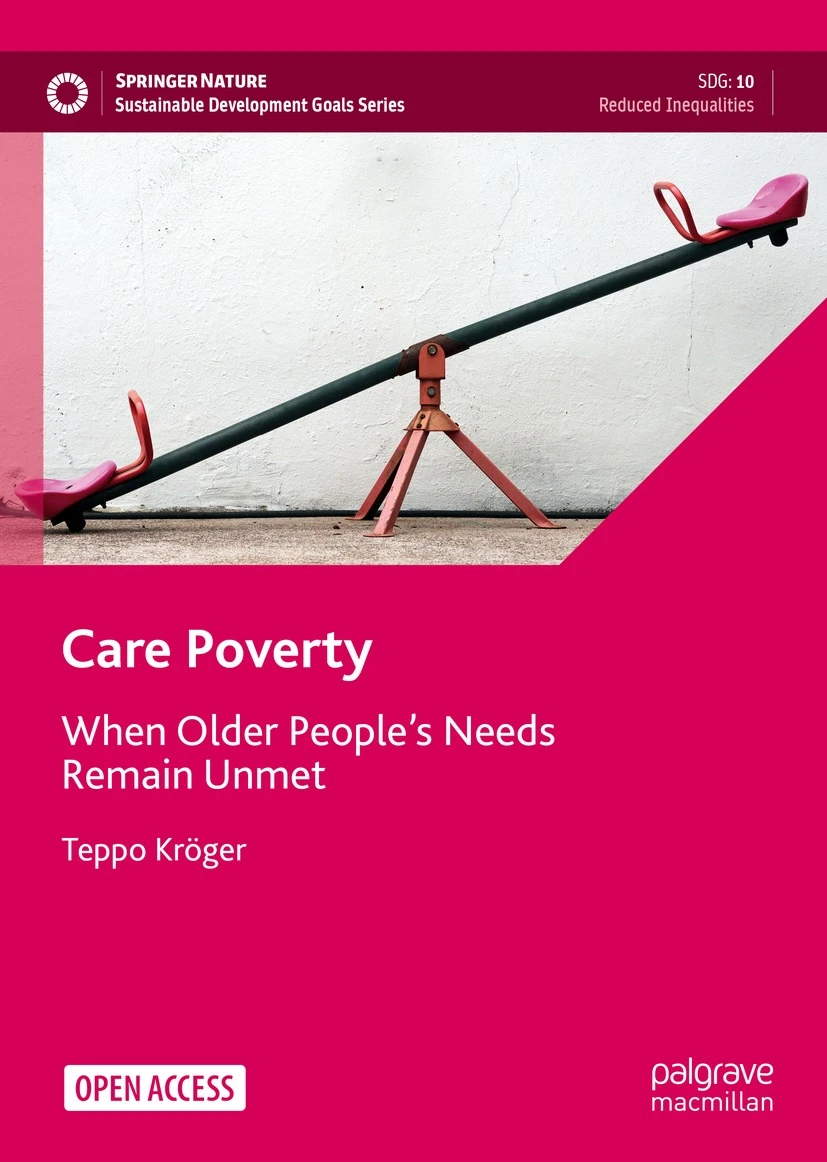
Book: Care Poverty - When Older People’s Needs Remain Unmet

CARE POVERTY
'This open access book turns the research attention of social policy scholars and long-term care researchers from comparative descriptions of care systems, focusing mostly on expenditures and volumes of long-term care services, to outcomes, and in particular to the question whether older people really receive the support that they need. Without knowledge about which needs and which social groups are currently inadequately covered, it is impossible to guide policy development.

The book puts forward a novel theoretical framework to guide future research work and public discussion on the issue of unmet long-term care needs, by broadening the current discussion so that inadequate care is seen in its societal and policy contexts, taking structural issues and policy designs into account. Kröger outlines three different domains of care poverty (personal care poverty, practical care poverty and socio-emotional care poverty) and differentiates between main methods how unmet needs are measured.' [my emphasis]

In psychiatry and psychiatric nursing, a person may be assessed to display poverty of thought, ideas or speech. As an exercise it may be useful to invert the rendering below in Hodges' model, and  consider Kröger's forms of poverty and possibly others that arise from your critique, reflections and life experience to date. Clearly, another book to add to the list!
 
individual
|
INTERPERSONAL : SCIENCES
humanistic ------------------------------- mechanistic
SOCIOLOGY : POLITICAL
|
group

CARE


CARE

CARE

POVERTY


Previously on W2tQ - (unmet) 'needs'

Kröger, T. (2022) Care Poverty - When Older People’s Needs Remain Unmet. Cham: Palgrave Macmillan. https://link.springer.com/book/10.1007/978-3-030-97243-1#about-this-book

Will check on a related title too.

Sunday, November 19, 2023

Attending: Active listening c/o Baggini & TPM

Reading through more past issues of The Philosopher's Magazine, I came across Baggini's short contribution of Attending one of "50 New Ideas".

That Hodges' model has a role in attention must follow from its main purpose as an aide-mémoire. To 'know', to recognise that your memory has been jogged is surely to attend.

I realise that Hodges' model represents a philosophical smörgåsbord, rather like the 50 ideas in this issue.^

Baggini draws on a film for inspiration on empathy, feelings for other, humanity and moral philosophy. For Hodges' model our context can encompass media, but the focus remains empathy, ability to relate in the clinical, social care context. Attention and interpersonal skills come the fore here.

If you are not hungry, the model (smörgåsbord) can be considered as empty. This is a precondition for 'attending' - having unconditional positive regard. Apart from information that relates to the patient's, student's, and your safety the domains of Hodges' model are vacant spaces. How they are populated depends on how we attend. There are important lessons for students here. The first is their phone. Its being on their person, may impact their ability to attend to the other (person). The window to outside isn't a screen either.

 Individual
  |
     INTERPERSONAL    :     SCIENCES               
HUMANISTIC --------------------------------------  MECHANISTIC      
SOCIOLOGY  :   POLITICAL 
|
GROUP

previous experience
cognitive furniture -
elephants in the room (for all?)

attend/attending
attention
active listening
authenticity
observation

empathy - rapport
therapeutic relationship

unconditional +ve regard

I see, I hear you ...

physical space
physical environment measurements
furniture - layout
position / posture
observation


Attending needs to be active listening. This includes all the senses, although sniffing the air is probably  best avoided - body odour may announce itself. Attention, then is synonymous with observation and in this context must span an individual's physical and their psychological presentation. You may draw social, political and spiritual assumptions, it is human to do so. Intuition has a role in healthcare but initial conclusions must be recognised as potentially premature and be verified. 

To initiate, be-in, partake-in such situations is to attend to the verbal, and non-communication; the data you already have and information communicated, including in a referral. Is this confirmed, challenged, what is your opinion? What about your colleagues? Most importantly, what does the person (patient, client... say)? What is unspoken? Do you understand? Did you seek clarification? 'Where' have you been / not been in Hodges' model? What picture is emerging at this stage?

It is gratifying that this is the first of the 50 'new' (2016) ideas in TPM #72. 

More to follow - drawing on TPM and (I think, Hodges' model as a 'philosophy? Surely not!)

Baggini, J., Attending, The Philosopher's Magazine, 1st Quarter 2016. Issue 72. pp.21-22.

TPM #72 cover image: https://ericthomasweber.org/correcting-political-correctness/

Tuesday, July 25, 2023

'Sophisticated cultural relativism: Bernard Williams' c/o Bond (1996)

INDIVIDUAL
|
     INTERPERSONAL    :     SCIENCES               
HUMANISTIC --------------------------------------  MECHANISTIC      
SOCIOLOGY  :   POLITICAL 
|
GROUP

"Transcendental standpoint

The perspective of the person who evaluates or questions or reflects upon a moral issue by consciously examining the issue from an objective perspective

Uses "thin" concepts such as "good" or "ought" in the process 
Take the question
"Is it really true that I ought not to tell lies?" In order to answer this question some moral authority or standard must be referred to. No answer can be found because there is no universal moral standard to appeal to.

SUBJECTIVE


OBJECTIVE

A culture

Moral truths exist                These are:


1. Non-objectivist truths (belong to and are valid within this particular culture)
2. Non-reflective (use the "thick" concepts of the culture, e.g. "liar", "bully." These carry within them their moral meaning. For this reason, no conscious reflection is needed in identifying a truth)" p.28.
"The evaluative perspective

The perspective of the person living in the culture who is stating and thinking about moral truths."


Based on Figure 2.1 Sophisticated cultural relativism: Bernard Williams. In
Bond, E.J. (1996). Ethics and Human Well-Being: An Introduction to Moral Philosophy. Cambridge, Mass.: Wiley-Blackwell. p.28.