Hodges' Model: Welcome to the QUAD: planning

Hodges' model is a conceptual framework to support reflection and critical thinking. Situated, the model can help integrate all disciplines (academic and professional). Amid news items, are posts that illustrate the scope and application of the model. A bibliography and A4 template are provided in the sidebar. Welcome to the QUAD ...

Showing posts with label planning. Show all posts

Thursday, January 22, 2026

NANDA-I Newsletter - theme of clinical reasoning


'This month at NANDA-I, we have been exploring the theme of clinical reasoning.


Clinical reasoning is at the heart of nursing; it’s how nurses make sense of complex patient information and choose the best path forward. While many nurses think of diagnosis as the centerpiece, it’s really the thinking that leads up to it, gathering cues, interpreting what matters most, and then safely determining goals and actions, that makes all the difference in outcomes. Strong reasoning helps nurses notice subtle changes and act with confidence.


As healthcare grows more complex, understanding how nurses think, not just what tools they use, helps elevate care for every patient. We’ll be sharing insights throughout the year to help you stay connected to nursing knowledge and its impact on care delivery and education.'


Teaching Tip: Clinical Reasoning in Practice

Start With Assessment to Improve Reasoning

When nurses work with standardized languages and clinical judgment tools, it’s tempting to dive right into diagnosis. But the most accurate and useful nursing judgments always come from strong, systematic assessment first. Quality assessment supports better interpretation of patient needs and more precise identification of nursing responses.


Quick Tip: Use a flexible assessment framework, whether it’s a conceptual model or a tool like functional health patterns, to make sure you’re capturing the data that matters most first. When you build a solid foundation with assessment, everything that follows (including diagnostic thinking) becomes clearer and more grounded.  


My source: 'Friends of NANDA®-I Newsletter' subscription (with my emphasis).

See also:
https://nanda.org/2025/12/nanda-360-for-educators-and-researchers-strengthening-nursing-knowledge-through-diagnosis-centered-reasoning/

Assessment, plus planning, implementation - action, evaluation (plus, formulation).

Functional and cognitive [Health, Illness, Climate, Poverty, Political, Security, Prevention, Self-care, ...] patterns.

'... make sure you’re capturing the data that matters most first' - Situated, Context, Salience.

For a competent practitioner an assessment can also be 'therapeutic' for the patient.

Previously: 'classification' : 'diagnosis' : 'NANDA' : 'ICD'

Friday, January 02, 2026

Nothing new under the Sun ...

 ... unless you're a 'health' service, or gathering dust on a shelf

January. Is the time of Janus: we look forward and back.

In April, this blog 'Hodges' model: Welcome to the QUAD - W2tQ' will be twenty years young. A blog post will follow with some metrics and statistics, although the 'analytics' that accompany many websites is not the main objective here. Preceding W2tQ and that first post, was the now archived website:

https://web.archive.org/web/20150316193042/http://www.p-jones.demon.co.uk/index.htm

Running from 1998-2015, the site's emergence ran as per:

Taught and applied Hodges' model on
 Community Psychiatric Nursing Certificate course 1987-1988.
Using the model in my practice and sharing with colleagues.
Gaining online access 1997.

Finding the Nursing Theory Development Site - NTDS 
(no longer available)
which was at https://www.ualberta.ca/en/index.html 
Meeting Brian Hodges at Manchester Met. University in May 1997.
Publishing the website in 1998.

Listed at the NTDS was a broad range of models of nursing and nursing theories. Brian's model, as anticipated was missing. I asked about Brian Hodges's model being added as a resource. Back then I thought, and still do, that Brian's work deserves recognition and more importantly, actually being used by practitioners and learners. It was a shame I thought, that such a person-centered and integrative model should be sat on a shelf (like other great ideas) gathering dust?

Still limping along in theme, functionality and accessibility, at least W2tQ has outlived the original website.

Academia and professional bodies across healthcare disciplines stress the need for research in practice. As a consequence, I've wondered about the pool of research questions that a healthcare, nursing, community nurse might have in mind? Ready and waiting, for those instances when specific funding materialises for a project. How many of these questions might feature as recurring characters? Once articulated, there for a new team member, are several starter-questions, a primer, to encourage exploration and critical thought. (Of course, a researcher needs to frame the question themselves; even if they do not 'own' them - public, patient engagement in research?).

With sustainability still on the political agenda (whatever the media suggests), is there a plan gathering dust, for the redesign, no less, of the National Health Service? Having squandered the demographic dividend of the 1950-1980s, how do we create concurrent health caring and preventive/educational services and systems?

Now, there is a project that Hodges' model could assist with! Better check the shelves (floppy disks!) and blow the dust-off real quick!

Wednesday, October 22, 2025

Single, dual aspect in architecture. What of care?

'The challenge of overheating in Britain is our buildings are built to retain heat in our temperate climate. Energy efficiency regulations for new dwellings now require high insulation and few drafts to reduce the need for heating in winter, but broadly make it harder to cool homes in summer. Residents of cities are particularly vulnerable to overheating due to urban heat island effects.

There are two ways buildings can be cooled – mechanical methods (primarily air conditioning) and passive cooling methods that use the design of the building to limit heat gain and retain cooler air inside the dwelling.

Passive cooling is much easier in dual-aspect dwellings with windows on multiple external facades, which as shown in Figure 1, are contrasted to single-aspect flats that face out on to only one external facade. Dual aspect allows breezes to blow through dwellings and easily exchange stuffy indoors air for cooler air from the outdoors. Even if outside temperatures are high, cross-ventilation or overnight air exchange and limits to solar gain (daylight indoors) can keep indoor environments cooler than the outdoors.'

https://www.centreforcities.org/reader/breaking-the-bottlenecks/overheating-and-dual-aspect/


individual
|
INTERPERSONAL : SCIENCES
humanistic -------------------------------------------  mechanistic
SOCIOLOGY : POLITICAL
|
group-population
In Hodges' model at least, we seem to have dual aspect covered. 

That's why we say the model is situated.


Image source: https://www.centreforcities.org/reader/breaking-the-bottlenecks/overheating-and-dual-aspect/

My source:  Plimmer, G., Pickard, J., Steinberg, J., London planning rules face tweak in bid to build more homes. FTWeekend. 18/19 October 2025, p.2.

Previously on W2tQ: 'architecture' : 'situated' : 'housing'

Thursday, July 10, 2025

ii 'Thinking outside the box ...' by Amber Javis

Second reply to a blog post by Amber Jarvis on The Mental Elf:

Thinking outside the box: alternatives to standard inpatient mental health care

Amber's post considers a study by:

Griffiths, J. L., Baldwin, H., Vasikaran, J., Jarvis, R., Pillutla, R., Saunders, K. R., … & Johnson, S. (2025). Alternative approaches to standard inpatient mental health care: development of a typology of service models. International Journal of Mental Health Systems, 19(1), 1-13: https://pubmed.ncbi.nlm.nih.gov/40247283/

Jarvis highlights concern within inpatient services of:
'use of coercive practices ... (Nyttingnes et al., 2018; Belayneh et al., 2024). These include physical restraint (physically holding a person), seclusion (holding a person in a locked room) and chemical restraint (the use of sedating medication to manage distress or behaviour, sometimes administered “as needed” rather than as part of any planned treatment). Poor relationships between staff and service users have also been noted, ...'
Reflecting since the previous post, I realise that I encountered efforts to prevent admission and treat in the community prior to going part-time. A short stay unit at a general hospital. Being a member of Intermediate Support for older adults; shifts ran 0800-2000 - early or late. Then working part-time, there were short-stay placements in the community that the recovery team would visit providing support.

Mental distress is distressing (a truism of course), both as lived experience (with or without self-awareness in-situ/crisis) and for others in the vicinity. Family, friends - who see a person they thought they knew, perhaps even thought they were a friend, a person who loved them; but now!? They present as distant, aggressive, subdued, agitated, unpredictable, inconsolable and possibly expressing thoughts of self-harm, threats to harm others, or totally bizarre, 'psychotic' ideas. This is not the person they thought they knew. For the person affected, familiars are strangers. A relational breakdown. We forget the severely mentally ill at our peril. A pervasive sense of helplessness is readily transferred: the reflex conclusion that help is needed - and fast.

To say we are creatures of habit, is to also acknowledge that change our environment results in a change in our behaviour. When relatives did arrive on the psychogeriatric ward I mentioned previously, they cried. Apologising for the environment, yes; efforts to reassure ensued and eventually family, friends were won over. They shouldn't have been. Unless we're in a game, play, or movie, who wants to find themselves in a Victorian era institution?

I've posted previously (or is it in draft?) on the importance of design in the design of care environments. It was a relative's visit to a care home, that resulted in a nursing home design business (Sunday Times). 
A person who is severely mentally ill needs service-centred care, not purely person-centred care. Person-centredness is key, but safety of self, and the public soon makes itself known. We also forget this at our peril. The problem is that control, and law literally take over. Plus, it's our place not yours. Loss of power the person struggling, ill, in crisis then follows. Amber continues:
'The concerns described above chime uncomfortably with modern mental health agendas of prioritising autonomy, compassion, trauma-informed and person-centred care. In light of these tensions, and the growing number of crisis alternatives – ranging from crisis cafes to intensive home treatment services – researchers  at the NIHR Policy Research Unit in Mental Health set out to map current alternatives to traditional inpatient care, both nationally and internationally. Griffiths and Baldwin’s findings raise important questions about how mental health services could evolve to better suit people’s needs, providing a valuable starting point for service planners considering developments in care.'
Hodges' model is ideal to help reflect and critique the relation-ship between 'a person' and 'the service'. I passed two gentlemen in London over the weekend. Clearly unkempt, standing but gesticulating, freely verbalising, incoherent on passing. Neither appeared intoxicated ( but I wasn't that close) or 'stoned'. That's the other question; passing-by what was I going to do? Does the 'community' care? On 'X' you encounter the extremes of debate. Anti-psychiatry, resort to and risks of dependence on medication - anti-depressants, anxiolytics; the damage from anti-psychotic drugs and atypical antipsychotics. The continuous debate about ECT. A dizzying stream of texts about mental health, over-diagnosis and wellbeing:


Medical prescribing has a partner. Social prescribing is well established, with organisations, events, publications and research emerging. People, have scoffed at the suggestion that gardening can help; or going for a run. Especially when you can't get out of bed. Chronic fatigue syndrome, long-COVID are seemingly monolithic in their resistance to change. A real challenge and so counter to the person's 'pre-morbid' personality and lifestyle.

For several years the state of mental health nursing as a specialty has been questioned. Is the mental health nursing curriculum being genericised? Enrollment of students nurses in learning disability has also dropped.

Medical prescribing has a partner. Social prescribing is well established, with organisations, events, publications and research emerging. People, have scoffed at the suggestion that gardening can help; or going for a run. Especially when they can't get out of bed. Chronic fatigue syndrome, long-COVID are seemingly monolithic in their resistance to change. A real challenge and so counter to the person's 'pre-morbid' personality and lifestyle. As a conceptual framework Hodges' model is ideal as a semantic net, to reflect and critique concepts that stretch and so disrupt (for a time) out norms. Concepts with a dual character. If social prescribing is one example, take crisis cafe mentioned by Jarvis above. If you think in physical - environmental terms where do you envisage a crisis occuring or playing out? What about a cafe? What is the ambience of these places?

I noticed a little visual game, an animation of characters running, jumping, climbing over an obstacle course. You focus on one figure and follow them for a time. This makes a difference, called distraction. In psychosocial intervention and managment of psychosis and anxiety audio - music, poetry, repetition has also bee used. The essence here must be when the intervention begins. Recognising relapse triggers, requires preparatory work. The Griffith reference is provided, but Jarvis begins to describe the results:
'Researchers identified 65 alternative service models to standard inpatient care. These were organised broadly organised according to the setting (e.g., community-based, hospital-based, or cross-setting) and the target population (e.g., adults versus children). Across these categories, ‘community-based alternatives’ were the most common category of alternative service models, followed by hospital-based and cross-setting approaches. We’ll explore each of these in more detail below.'
In post (i) and here I suppose I am advocating for mental health nursing as a distinct programme of study, practice and proven competence. For several years the state of mental health nursing as a specialty has been questioned. Is the mental health nursing curriculum being genericised? Enrollment of students nurses in learning disability has also dropped. 


There is a saying: 'You get what you pay for'. There is a sense that there are people who would like to ignore, deny, erase 'mental health'. After all, the truth really is that you can 'see' a broken leg. This isn't an issue if you can afford a private psychotherapist, or a psychoanalyst.

The elephant here (well, there always is one) is education and the literacies. For prevention: the ultimate change - this is where we must focus. But of course for the problem at hand - and mind it is too late.

(Post iii likely to follow.)

Individual
|
      INTERPERSONAL    :     SCIENCES               
HUMANISTIC  --------------------------------------  MECHANISTIC      
 SOCIOLOGY  :    POLITICAL 
|
Group
subjectivity         
mental state - crisis - mind
quality
objectivity
hand - physical state - crisis
quantity
Social prescribing
Cafe

Housing - crisis
Cost of living - crisis

See also: 'literacy' : 'prevention' : 'service' : 'severe' : 'change'


Tuesday, April 15, 2025

The 'animal' in Hodges' model ii

The two pairs of eyes in Hodges' model are provided through the model's two axes

HORIZONTALLY: the humanistic and mechanistic.

VERTICALLY: the individual and the group.

Hodges' model: Axes & Domains
Structure AND Content :: Fight OR Flight

Before delving into this though, let's revisit the model as a template.

Structure aside, Hodges' model acts as a conceptual blank sheet. Overall, the model is also an aide-mémoire. It can prompt us to 'where' we've been, where we need to go in our data gathering, assessment, planning, interventions, evaluations: personal history, family, work and leisure. In an interview how does the patient, client, carer, student ... negotiate the domains of Hodges' model? The model can guide us in what is said, what is omitted - for whatever reason, what is significant within all this; AI-assisted or not.

These two 'horizontal' eyes prompt us to attend to safety, your own, the patient / client and other people in the vicinity. In terms of responding to 'fight', obviously this does not mean you are looking for a fight, but of course you have to be able to defend yourself. Metaphorically, Hodges' model can represent the sword and shield. We are in a fight for justice to secure health services for individuals, families, and the population.

On the side - vision for flight, what is humanistic and mechanistic.

Then, in the vertical axis, there is vision for fighting, for the individual, and the group - population.

In this interplay of person and collective, I'm reminded of Odysseus and the shout "Nobody did it!" (with other sources). It never ceases to amaze, the frequency of this conclusion throughout local, national and global politics?

The individual nightmare of Cyclops; and collective nightmare of the Panopticon.

In mental health nursing you quickly learn about the anatomy^, physiology and psychology of anxiety. Not necessarily simultaneously, but the jig-saw is there to be completed, at least as far as you can as a 1st year student - whatever your health discipline. The pieces that matter (literal keys to action) are provided by the patient, client, carer. ...

In a way it is too late when people are referred to mental health services. Too late for prevention, but given the incoherence between:

  • health systems (as usually found & founded)
  • government policy -
    • state of nutrition - food
    • advertising of foods, beverages
    • life style choices
    • education - health literacy
      • individual
      • family
      • community
      • national (curricula)
  • NHS? National Health Illness/Disease Service
- this isn't a surprise.

Whatever an individual's sensory capacities and abilities we need to do better. With tools to facilitate situational awareness, and realise an individual's and community's potential to learn and prosper.

^Anatomy? How many of us take for granted our limbs are 'there': ready to react?

Previously: The 'animal' in Hodges' model i

Original source - prompt:
Doniger, Wendy. The Rise and Fall of Warhorses. The New York Review of Books. April 10, 2025. Volume LXXII, Number 6. pp.17-19.

Saturday, January 11, 2025

Are you planning a health* study in 2025?

New Year - new project perhaps?

*nursing, mental health, theory, practice, management, workforce, medicine, allied health professions, social work, psychology, labs, diagnosis, palliative, end of life, diseases, public health, public MENTAL health, -isms, prevention, protection, education, learning disability, parity in care, informatics, information, literacIES, AI, arts, policy, leadership, migration, history, future, women, children, men, LGBTQ+, ethics, rights, health economics, social care, systems, services, climate change, refugees, conflict, law, leadership, resources, commerce, fraud, self-care, UN, WHO, UNESCO, regional, national, global, or planetary ..., ...

Is there a 'space' for Hodges' model in your study?

IF NOT, IMHO YOUR STUDY MAY BE INCOMPLETE!

Is this statement ...?

INDIVIDUAL
|
   INTERPERSONAL : SCIENCES              
humanistic ------------------------------- mechanistic
 SOCIOLOGY : POLITICAL   
|
GROUP

utter nonsense and arrogance

a psychological threat^

it's either a great joke, or a grand delusion

look - get real, we can't cover all the bases

calling attention to the high-degree of subjectivism in academia and health research

no, actually it is blatant evidence of bias and a lack of objectivity! Who is Hodges?

shamefully egotistical

our project does not need to consider:
reflection - reflective practice
critical thinking
holistic - integrated care: parity of esteem
person-centredness
the curricula (however 'expressed')

methods - methodology - philosophy

a sign we've found the true 'meta-' tool
(Yes, this is interesting!)

to the Nth degree!

a physical threat^

a fact - when critiqued using Hodges' model

limited apprehension of 'HEALTH'..

sheer ignorance

proof of an incomplete (grey) literature search

proof that 'not invented here' prevails

identification of relations and relationships is catered for, as are ...

safety, situational awareness, scoping, mapping, evaluation, analysis, synthesis, diagrams - graphical approaches, project mangement

potentially supporting inter- multi- transdisciplinarity

a sign that ('fashion') science, evidence have moved on: get over it!


a soul in search of a community of practice?

demonstrating much effort is falling on deaf ears?

time to listen, with all that's going in the world

Hodges, did you say? Sorry not here!

not commissioned/funded by a 'us'. 

what? No Doctorate? Go away: please!

who does that person think they are!

   fao project/research management group/committee?


^No threat is implied, on the contrary frustration ... If Hodges' model may be of use, please do get in touch. Thanks to all for your visits and best wishes with your respective projects, studies and careers.

Tuesday, October 22, 2024

Consultation: CHANGE NHS


Our NHS is broken, but not beaten. Together we can fix it.    
[ c/o https://change.nhs.uk/en-GB/ ]

The NHS has been there for us for over 76 years. But to make sure the NHS is here for the next 76 years, doing all it can to support the health of everyone, we need your help.

We want to have the biggest ever conversation about the future of the NHS.

It doesn’t matter whether you have a lot or a little to say. Your views, experiences and ideas will shape a new 10 Year Health Plan for England. 

This is open to everyone. If you are a member of the public or someone who works in health and care in England, 'Start Here', to tell us how the NHS needs to change.

If you are contributing as a representative of an organisation, complete the organisation questionnaire. This is an early opportunity to share your insights as we begin an extensive programme of engagement to develop the 10 Year Health Plan. 

If you register your email address, we will stay in touch to seek your views as the 10 Year Health Plan develops.

[video no longer available]

'change' in Hodges' model

The NHS and people's health is more than 
a machine, more than a mechanistic thing 
that if broken can be fixed.

By definition you cannot be 'inclusive'
if you do not achieve balance
with the humanistic; and the
values of humanity and
 the spiritual as per context.


individual
|
INTERPERSONAL : SCIENCES
humanistic ------------------------------- mechanistic
SOCIOLOGY : POLITICAL
|
group

purposes

person-centredness

personalised care experiences

continuity

mental state; mental health

attitudes - mindset

expectations (public education)

my health literacy (all of them: education)


processes
(care inc. 'writing' records, 'gates' access)
demographically-driven care 

define 'success' - metrics - data

utilise evidence

peak CO2
peak obesity

physical health:
chronological age - pathological age

encourage self-care to support sustainability

social care

social attitudes

child support - support for families

proven practices that delivers

community as resource

community: homes for living in -
not profiting from

Public involvement: 
#NHSCHANGE #CHANGENHS

Protect / Create green spaces for outdoor play


funding, finance, budgets, economics

POLICY:
FROM: National ill-Health Service
TO: National Health Service 

long-termism

E3^ for all the literacies

address: food quality, 
air, water, noise, litter

SOCIO-tech approach to applied technology

Teach Hodges' model to teens, and prisoners
as part of PSHE and rehab programmes


E3^ education, education, education - by literacies we include: information, emotional, media, finance, spiritual, cultural, scientific, religious, climate...

'delivers' includes: improved care experiences, integrated care (related to all the domains), patient, carer, public safety, cost effectiveness, research questions, accurate - valid reporting.

All health disciplines / professionals, social care, and APPGs ... share a common model - a conceptual framework for critical thinking and reflective practice.

Thursday, July 18, 2024

A Workforce Strategy for Adult Social Care in England

"For the first time ever, the adult social care sector has come together, led by Skills for Care, to develop the Workforce Strategy it needs. Adult social care needs a workforce strategy to ensure we have enough of the right people with the right skills to provide the best possible care and support for the people who draw on it. 
Development of this vital Strategy has been truly collaborative and it could not have been developed without the expertise, time and commitment of many stakeholders."
Individual
|
      INTERPERSONAL    :     SCIENCES                   
HUMANISTIC  --------------------------------------  MECHANISTIC      
 SOCIOLOGY  :    POLITICAL 
|
Group
Job satisfaction

Personalisation - Belongings

Motivation

Attitudes, Opportunities, Incentives

Access to Training


Activities, Reablement

Arts, Dance, Music

Dental and other services

Systems view - Demographics

Collaboration / Liaison


Social Care: At home & residential care

Job status

Local community, schools

Funding of Social Care

Integrated & Person-centred Care

Workforce strategy

Pay - terms and conditions

Government policy

Workforce recruitment & retention:

National - International


Source: Email - Skills for Care and BBC Radio 4 Today.

Wednesday, November 01, 2023

ERCIM News No. 135 Special Theme "Climate-Resilient Society"


Dear ERCIM News reader,

A new ERCIM News issue (135) is online with a special theme on Climate-Resilient Society! This special theme aims to put a spotlight on recent research, innovation and Implementation activities that could be taken up by the EU Mission on Adaptation to climate change, focusing on actionable knowledge, tools and solutions for planning, implementation, and progress monitoring. We encourage you to read the full issue to learn more about the latest advances in climate change adaptation research and practice. You can access the issue at the following link: https://ercim-news.ercim.eu/


This special theme was coordinated by our guest editors Athina Lykos (AIT Austrian Institute of Technology) and Sobah Abbas Peterson (NTNU).

Thank you for reading ERCIM News! Please share this issue with anyone who might find it interesting. You can also support us on Twitter (@ercim_news) and LinkedIn (https://www.linkedin.com/company/ercim). 
Let's keep the conversation going and share the latest updates together!

Next issue:
No. 136, January 2024
Special Theme: "Large Language Models". Submissions are welcome! See call for contributions.


Announcements in this issue:

Call for Proposals: Dagstuhl Seminars and Perspectives Workshops Schloss Dagstuhl – Leibniz-Zentrum für Informatik is accepting proposals for scientific seminars/workshops in all areas of computer science.

Social Robotics, Artificial Intelligence & Multimedia Winter School, Grenoble, France, 19-23 February 2024

ERCIM "Alain Bensoussan" Fellowship Programme - postdoctoral fellowships available at leading European research institutions. Simple application procedure. Next application deadline: 30 April 2024.

ERCIM News is published quarterly by ERCIM, the European Research Consortium for Informatics and Mathematics. With the printed and online edition, ERCIM News reaches more than 10000 readers.
All issues published to date are available online.


About ERCIM

ERCIM - the European Research Consortium for Informatics and Mathematics - aims to foster collaborative work within the European research community and to increase co-operation with European industry. Leading European research institutes are members of ERCIM. ERCIM is the European host of W3C.

Peter Kunz                      	
ERCIM Office
2004, Route des Lucioles
BP93
F-06902 Sophia Antipolis Cedex

Includes:
Clean air
20 Improving Urban Air Quality and Climate-resilience in Cities with Inclusive, Policy-relevant Citizen Science
by Pavel Kogut (21c Consultancy), Lieven Raes (Digital Flanders) and Susie McAleer (21c
Consultancy) 
Energy
21 LoCEL-H2 - Low-cost, Circular, Plug and Play, Off-grid Energy for Remote Locations including Hydrogen
by Athanasia-Maria Tompolidi (Consortium for Battery Innovation, CBI), Jonathan Wilson (Loughborough University) and Hassan A Khan (Lahore University of Management Sciences)
Transferable mitigation pathways
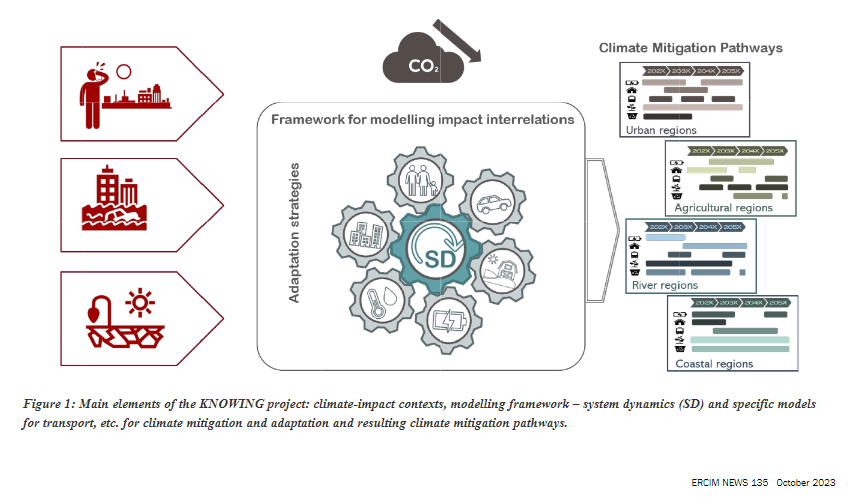
28 KNOWING How to Deal with Climate Change 
by Alexandra Millonig and Marianne Bügelmayer-Blaschek (AIT Austrian Institute of Technology) - with image:
Figure 1: Main elements of the KNOWING project: ... p.28.

Wednesday, October 11, 2023

'System 1 and 2 Modes of Thinking' in Hodges' model

 System 1 - 

"operates automatically and quickly,
with little or no effort and no sense of voluntary control. 

 System 2 - 

allocates attention to the effortful mental activities that demand it, including complex computations. The operations of System 2 are often associated with the subjective experience of agency, choice, and concentration." pp. 20-21.

"When we think of ourselves, we identify with System 2, the conscious, reasoning self that has beliefs, makes choices, and decides what to think about and what to do. Although System 2 believes itself to be where the action is, the automatic System 1 is the hero of the book. I describe System 1 as effortlessly originating impressions and feelings that are the main sources of the explicit beliefs and deliberate choices of System 2. The automatic operations of System 1 generate surprisingly complex patterns of ideas, but only the slower System 2 can construct thoughts in an orderly series of steps. I also describe circumstances in which System 2 takes over, overruling the freewheeling impulses and associations of System 1. You will be invited to think of the two systems as agents with their individual abilities, limitations and functions." p.21.


INDIVIDUAL
|
     INTERPERSONAL    :     SCIENCES               
HUMANISTIC --------------------------------------  MECHANISTIC      
SOCIOLOGY  :   POLITICAL 
|
GROUP

System 2:
  • Brace for the starter gun in a race.
  • Focus attention on the clowns in the circus.
  • Focus on the voice of a particular person in a crowded and noisy room.
  • Look for a woman with white hair.
  • Search memory to identify a surprising sound.
  • Maintain a faster walking speed than is natural for you.
  • Monitor the appropriateness of your behavior in a social situation.
  • Count the occurrences of the letter a in a page of text.
  • Tell someone your phone number.
  • Park in a narrow space (for most people except garage attendants).
  • Compare two washing machines for overall value.
  • Fill out a tax form.
  • Check the validity of a complex logical argument. p.22.

System 1:
  • Detect that one object is more distant than another.
  • Orientate to the source of a sudden sound.
  • Complete the phrase "bread and . . .".
  • Make a "disgust face" when shown a horrible picture.
  • Detect hostility in a voice.
  • Answer to 2 + 2 = ?
  • Read words on large billboards.
  • Drive a car on an empty road.
  • Find a strong move in chess (if you are a chess master).
  • Understand simple sentences.
  • Recognize that a "meek and tidy soul with a passion for detail" resembles an occupational stereotype. p.21.


Kahneman, D. (2011). Thinking, fast and slow. London: Penguin Books.

See also:
https://thedecisionlab.com/reference-guide/philosophy/system-1-and-system-2-thinking

Friday, July 21, 2023

Cognitive and Affective Empathy c/o Simon Baron-Cohen

   New Scientist 3311
"At the bottom, Nicholas Conard, archaeologist and director of the nearby museum in Blaubeuren, Germany, pointed to a layer of rock. 'Right here is 20,000 years ago,' he said. Then he pointed about a metre lower. 'Here, we are at 40,000 years ago.' 
I was in awe, suddenly aware that I was standing where our early human ancestors lived and breathed so long ago. But it was what they invented that inspired my trip. Hohle Fels is where, in 2008, Conard and his colleagues discovered the earliest known musical instrument, a flute carved from a vulture bone that is thought to be about 40,000 years old.

It is the product of what I argue are parallel revolutions in human cognition. In my career studying the human brain through the lens of understanding autism, I have devoted a lot of time to understanding empathy, its role in our evolution and how it still underpins human interaction today. But around the same time that the brain changes arose that enabled us to use empathy, another equally critical set of changes took place: the evolution of a pattern-seeking brain network, what I refer to as the systemising mechanism, that provides the foundation for human invention - including that of musical instruments." p.34.
INDIVIDUAL
|
     INTERPERSONAL    :     SCIENCES               
HUMANISTIC --------------------------------------  MECHANISTIC      
SOCIOLOGY  :   POLITICAL 
|
GROUP

"One of these circuits, the empathy circuit, enabled a raft of new behaviours, including the ability to deceive others, teaching, self-reflection, social "chess" and flexible communication that relied on shared reference, including storytelling. These explain why modern humans could make stealth weapons and jewellery: we were keeping track of what others might think, know, intend, feel, want and believe." p.36.

COGNITIVE EMPATHY
theory of mind

AFFECTIVE EMPATHY

"- the drive to respond to another person's mental state with an appropriate emotion." p.36.


Baron-Cohen, S. (2020) Our Restless Minds, New Scientist, 248: 3311, pp.34-39.

Autism Research Centre, Cambridge University

The Pattern Seekers, Simon Baron-Cohen.

Saturday, April 22, 2023

Nursing care of the patient - 1976 and Earth Day . . .

Moidel, H.C., Giblin, E.C., Wagner, B.M. (Eds) (1976) Nursing care of the patient with medical-surgical disorders. New York: McGraw-Hill,  ISBN 10: 0070426554 / ISBN 13: 9780070426559

"The process of nursing assessment is a deliberate and systematic analysis of the patient and his environment with the purpose of gathering data about the patient's health-illness status and resources. A systematic and recorded assessment also provides (1) a baseline measure for identifying change over a period of time; (2) a foundation for the nursing-care plan, giving direction to nursing interventions; (3) a means for evaluating the effectiveness of nursing care." p.8.

"The nurse's major tools for obtaining data regarding a patient's health-illness status and resources include communication (with the patient, his family, health team, and nursing-team members), direct observation and examination (through the use of all sensory channels and technological adjuncts), consultation, and review of the literature. The use of these tools, which is amplified in chap. 7, should be in accordance with some organized, systematic, valid, and reliable framework." p.9.

The need for systematic and deliberative approach remains, despite the passing decades. Whatever 'system' is adopted it needs, as per 1-3 to be dynamic, act as a substrate; that is also neutral - non-prescriptive (apart from); facilitating the flow of assessment, planning, interventions and evaluations, and what used to measure effectiveness, outcomes, quality and safety. As an American text, chapter 7 is also concerned with 'nursing diagnosis' and Orem is referenced.

Nursing care of the patient
with medical-surgical disorders


Nursing Management

"Nursing management is based upon and follows assessment. It is the process of determining and initiating goal-directed nursing action in relation to the patient problems diagnosed during assessment. Without assessment, nursing management becomes mechanical, dependent on physician's orders, and detached from the ultimate goal of wholeness for the patient." p.9.


We still need balance in humanistic-mechanistic care delivery. Paying attention and due regard to the interpersonal detail and needs, while also seeing the whole.


"Delong studied the impact of preoperative information on recovery from surgery. In general, individuals who were given specific detailed information regarding the surgery and postoperative care had a less complicated recovery and were discharged earlier than those who received general nonspecific information. When coping styles were considered, it was found that those who exhibited flexible patterns of coping with general stress in their lives recovered well regardless of the type of information they received. Copers, who were defined as individuals who seek out information regarding potential threat, recovered better if they were given specific information before surgery. Avoiders typically showed slow, complicated recoveries, regardless of specific or nonspecific information; however, those who received specific information had more postoperative complications than those who heard only the general information." pp.38-39.

Now in healthcare, we are concerned with Health Information for All, and Health Literacy. I wonder what the informational nuances are in 2023 bio-psycho-socio-politically: and of course spiritually?


"All the disease and illness concepts cited above have reshaped society's thinking and practices about health, maintenance of health, and treatment of disease when it appears. But each emphasizes specific aspects of the totality of interwoven dynamics that constitute disease and illness, leaving us with cumbersome vocabularies and classifications that are partial and imprecise. Theoreticians, endowed as they are with a sense of order and logic, will most assuredly seek to bring the various viewpoints together into new conceptual frameworks." p.51.

Now our 'new' conceptual frameworks must incorporate nursing, patient-nurse relationship, the 'team', society, research and evidence-based care, policy - local, national, and global, plus technical and climate change all amid the politics of health and the informational milieu - or melee?

Also of note (Chap. 1):

Section headings: Care as a Nursing Function, with Cure, and Coordination as Nursing Functions.

Ecologic Orientation, Part 2.


Individual differences in patterns of anxiety arousal, stress-relevant information and recovery from surgery. Delong, R. D., University of California, Los Angeles ProQuest Dissertations Publishing, 1970. 7116307. https://www.proquest.com/openview/0d64def524b9e5845b7e168aa4cc5876

<>


As I continue to sort through 'old' books and papers, on Earth Day we are (duty) bound to reflect on the future. As my grandson was on the post-school play ground this week, I noticed the infants and those at risk of walking into the merry-go-round. I wondered whether in their senior years, will the ice be returning, the sea-levels stabilise, and will the CO2 in the atmosphere be reducing? 

What of - Nursing care in 2076? We need a conceptual framework that can project the care of the past and now, into the future. For those who are not yet here.

Previously:

'Planetary Health'

Gaia

'climate change', 'ecology' . . .

Thursday, November 10, 2022

New York – Livable Cities: A Conference on Issues Affecting Life in Cities

NEW YORK Conference: Abstract Deadline

New York / Virtual
14-16, June 2023
Abstracts: Nov 20th, 2022 (Round One)


A cross-departmental conference held at City Tech (CUNY) with the Departments of Architectural Technology, Construction Management, Civil Engineering and Environmental Technology

LIVABLE CITIES - NEW YORK is a conference covering architecture, design, planning, health, technology, urban economics and social policy. It is calling for contributions to specific strands of sustainability, resilience, design, planning and construction.

These strands seek to explore issues related to net-zero energy buildings, sea defenses and strategic retreat, life cycle analysis in the construction industry, Building Environmental Assessment methods, EcoHomes, BREEAM, alternative energy generation in cities, material science and much more. 

The conference is organized across departments at City Tech (City University of New York) with Amps and publication support from Routledge and UCL Press.

CALL SUMMARY

What makes a city livable? Transport, housing, health and environment. Matters of culture, entrepreneurship, crime and safety. Affordability and education. Depending on whose ‘livability index’ you look at, it may include design quality, sustainability and the digital infrastructures of the smart city. Other criteria applied may encompass food access, job opportunities or walkability. Inclusivity and the politics of participation also come into play.

The past two decades have seen an exponential rise of livability measures. Reflecting increased urbanity globally, they risk making the notion of the city ever more contested. The two cities that host this event are cases in point. The Mercer Livability Ranking takes New York as the datum by which all other cities globally are graded – as better or worse. London, by contrast, measures itself: the London Assembly scoring everything from air quality to indices of deprivation. When we consider the livability of cities then, it is clear we are dealing with a plethora of issues – both isolated and, inevitably, interconnected.

Within this broad livability framework, we seek to develop strands and publications around themes of the design and construction sectors – particularly as they relate to sustainability and resilience.

https://amps-research.com/conference/livable-cities-new-york/

My source: http://www.cosmobilities.net/ list

n.b. A suggestion: consider the conference themes and the structure and domains of Hodges' model; what relationships, dichotomies, synergies, and opportunities can you glean?