Hodges' Model: Welcome to the QUAD: models

Hodges' model is a conceptual framework to support reflection and critical thinking. Situated, the model can help integrate all disciplines (academic and professional). Amid news items, are posts that illustrate the scope and application of the model. A bibliography and A4 template are provided in the sidebar. Welcome to the QUAD ...

Showing posts with label models. Show all posts

Wednesday, October 07, 2026

Hodges' model: Is it a virus: or a universal vaccine?

The arrival of 'imposter syndrome' well-over a decade ago(?), from the speaker's podium was an interesting surprise. A case of lived experience, as I'd felt this in trying (and failing) to grapple with the ever-growing, morphing development stack of a software program. Long gone are the days of Sinclair and BBC BASIC. The mountain and learning cliff, was CMS content management system: Drupal. 

What contributed to that feeling back then? Well there was the people I was sat by and sharing time at various European DrupalCons. It was I who was the 'con'. A hobbyist, from pre-PC days. Seeing and hearing what they were creating and the great community. Fascinating also, to see web design fashions come-and-go.

I've written before about Hodges' model being an over-valued idea to me. As a mind-mapping meme it infected me decades ago. Is it a virus? If it is I clearly had no resistance, no immunity. I've always tried to acknowledge, reminded myself that the model is not the be-all-and-end-all.

While the specific mathematical is complex, it is worth trying to grasp some of the intent and meaning (even at the risk of exacerbating imposter reactions). Hestenes provides a paper (and several others):

'ABSTRACT. The discovery of Mathematical Viruses is announced here for the first
time. Such viruses are a serious threat to the general mental health of the mathematical
community. Several viruses inimical to the unity of mathematics are identified, and their
deleterious characteristics are described. A strong dose of geometric algebra and calculus
is the best medicine for both prevention and cure.'

Hestenes, D. (1992). Mathematical Viruses. In: Micali, A., Boudet, R., Helmstetter, J. (eds) Clifford Algebras and their Applications in Mathematical Physics. Fundamental Theories of Physics, vol 47. Springer, Dordrecht. https://doi.org/10.1007/978-94-015-8090-8_1

'The computer virus (CV) owes its name and perhaps its genesis to the biological virus
(BV). Like a BV, a CV cannot function by itself, but when attached to a host it replicates
repeatedly until it impairs the functioning of the host, sometimes to the point of disabling
the host altogether. ...

My purpose here is to call your attention to another kind of virus - one which can
infect the mind - the mind of anyone doing mathematics, from young student to professional
mathematician. As I believe this is the first published paper to explicitly identify
such viruses, I take the liberty of naming and describing them as follows: A mathematical
virus (MV) is a preconception about the structure, function or method of mathematics
which impairs one's ability to do mathematics. Just as a CV is program which impairs the
operating system of a computer, an MV is an idea which impairs the conceptualization of
mathematics in the mind. Indeed, as one definition of "virus," Webster gives "something that
corrupts the mind or soul." Since the identification and classification of MVs has only
just begun, it would be premature to attempt a more precise definition. The better course
is to examine some specific viruses to form a form empirical base for further study.
My first example is an easily recognized MV which is extremely virulent and as common
as the common cold. I call it the coordinate virus, designating it by MV/C to denote genesis
and type, and characterizing it as follows:' pp.1-2. (online copy)

Hestenes' biohistory is an interesting conceptual and interdisciplinary bridge. Another construct to add to our  collection. Is there a virus in the models deployed within medicine and healthcare to date? You know, the bed-round of the medical, biomedical, bio-psycho-social? The round were you don't need to count the number of beds, except in the event of a pandemic. Is the omission of the political, even as the socio-economic reality is now a constant point of reference a symptom of a centuries-long infection? 

For a long time now* the legacies that successive cohorts of students, and newly qualified professionals encounter have stood out. Another question is, just how far back in time do we need to travel to find can the origin of this situation? Was there an initial crisis involving the overt expression of 'power'? Can this be found the as the Hippocratic oath butted up - literally - against triage on the battlefield?

Now: Time won't tell (or will it?). Now that - is some virus.

Friday, August 14, 2026

Sometimes it can take an old model ...


'Sometimes it can take an old model, 
to build a new one, 
that makes the existing model obsolete.'

To borrow from Buckminster Fuller.                         

 
Resurgence & Ecologist, Sept/Oct 2020, Issue 322, p.33.

Saturday, July 18, 2026

Hodges' conceptual framework: A model for Narrative Medicine ...

Abstract

The effective practice of medicine requires narrative competence, that is, the ability to acknowledge, absorb, interpret, and act on the stories and plights of others. Medicine practiced with narrative competence, called narrative medicine, is proposed as a model for humane and effective medical practice. Adopting methods such as close reading of literature and reflective writing allows narrative medicine to examine and illuminate 4 of medicine's central narrative situations: physician and patient, physician and self, physician and colleagues, and physicians and society. With narrative competence, physicians can reach and join their patients in illness, recognize their own personal journeys through medicine, acknowledge kinship with and duties toward other health care professionals, and inaugurate consequential discourse with the public about health care. By bridging the divides that separate physicians from patients, themselves, colleagues, and society, narrative medicine offers fresh opportunities for respectful, empathic, and nourishing medical care. ...


Charon R. Narrative Medicine: A Model for Empathy, Reflection, Profession, and Trust. JAMA. 2001;286(15):1897–1902. doi:10.1001/jama.286.15.1897 

With my emphasis.

#Identity #Group #Individual #Collective #Mind #Body #TheOdysseyHasBegun

Tuesday, June 16, 2026

vi Book: 'Complexity in Health Care - A Paradigm Shift for Clinical Practice'

The rest of the book is practice-based which is a strength. Chapter 18 has three clinical illustrations, were reflection and self-reflection is brought to fore. Especially so, as it pointed out that the 'clinical situation/encounter' introduces its own 'vagaries', or noise which can impact the 'quality of the bond between clinician and patient'. Rapport is the key. 

I was still missing 'complexity' and its dynamics, but I'm sure of the following:

If this was discussed - could be represented then the book would be theory-laden and I and other would-be readers would not be able to understand.

I still think Hodges' model can help, and in chapter 19 picked out 'manifold' (p.113), as if doing so, manifests something more esoteric. There is something here, the author noting the need to shift from individual to group perspectives. So, yes I think we can do more than embrace 'complexity' (p.114).

On page 116 there is discussion of the sometimes sudden path to recovery, 'probably common but often not comprehended'. Please pardon the naivety, but I scribbled 'hidden in complexity, what would (say) the three(?) equations be?'. For a book published in 2023 'artificial intelligence' is not indexed. This might be one area that AI could assist, given the progress in formal mathematics (but see below p.183!)? Algorithm is mentioned throughout the book. Further reading here, informed me that engaging with a reading group on 'Philosophical Counselling' is worthwhile. It is!

Part IX had me wondering if the debate about typical and complex cases, there is a slight of perspective going on? You can end up with paradoxes in terms of an individual's needs, criteria, risk, 'need for admission'. Which I must think about! Chapter 20 has three further reading texts on abductive reasoning. There's an appeal(?) on page 129 for an appropriate treatment model, well that is my take. Collaborative care and stepped care models are suggested. But with acknowledgement that:

'In truth, all models currently available may involve a defect in continuity within or between systems'. p.129.

I beg to differ. A role of Hodges' model is to help frame aspects of care through time, to facilitate and assure continuity.

Part X tackles the required precision in assessment, hence recourse to mathematics and statistics. The next two chapters may be useful for early career researchers and yet looking over our shoulders what is ai offering here? In Case 1 I was impressed by the suggestion of a health record that is over 70 years old. Not impossible of course, but I thought of the Lloyd George envelopes, their hospital equivalents, other paper sources and inevitable scanning this would entail here in the UK? Of interest to research is the creation and validation of complexity profiling inventories (tools) not just that, but their self-assessment form of delivery. And, yes in summary chapter 24:

'We are still left with the challenge of rating the patients' severely compromised health situations where "health" includes social, emotional, and financial well-being.' p.143.

'How do you factor this interpersonal situation into your complexity equation?' p.144.

Yes, how indeed? 

The realities of research of dealt with - funding for the development of tools a problem universally. The references here concern biopsychosocial complexity. Chapter 25 describes abstraction, and hiding detail, which is of great interest here. DSM-5 criteria for major depressive disorder are listed (DSM-6 may be released in 2029?). 

In chapter 25 the authors are once stymied by 'how to include (integrate? PJ) four dimensions, three time periods,and assorted assessment items in a single assessment.' 

As noted the four domains are here again (p.151): medical, psychological, social and care delivery and on page 153, introducing chapter 26, limitations of complexity assessment tools. Parity as in 'parity of esteem' is not indexed and I don't recall having read this, but this is well represented in later deliberations on variables #2. You will find psychosis, but not in depth or severity.

 In 'Creation of a New Model for Clinical Practice' (Chapter 31) identity is stressed, as a prompt to encompass those variables that contribute to preserving the person - what is humanistic. Allied with manifold, identity is a 'coi' for me, concept of interest - for this same reason. On page 172: the authors observe they 'are left with the question of whether there are acceptably accurate clinical models that are simpler and more straightforward than ours? We believe the answer is no!'. I believe there is a way, and a model to help 'keep the life in clinical work' - not take it out. There is a sense that Chapter 32 seeks what I was looking for above: as they explore random variable and 'sample spaces' descriptively - over a page.

Ah! 'Artificial intelligence' is found in text p.183. I'm surprised an editor, proofreader aloud the following sentence to go unchallenged?

'But, as will be discussed, these computer techniques have their limitations based on their lack of flexibility.' 

I was genuinely surprised to read this. Plus, again on ai on page 185: 'Making inferences is not reliably their domain.' I think I would look more at the human-ai interface. And the status of ai within psychiatry as opposed to medicine, but that is also another (parity - divide) debate. Things really are complex now on so many fronts: ethics especially.

Perhaps I am looking for the cookbook formula as introduced for chapter 35 clinical judgement. The further reading is combined with critical thinking. More detail on the empirical-collaborative method is welcome. When I read 'illustrated' I take this literally. Again I can disagree twice on page 220. I know Hodges' model is not validated, but it can - with practice(?) - do this light (simple) or heavy (complex) lifting. 

The warning about dogma needs to be repeated regularly. It is rather like the need for nurses to revisit their profession, role and work as relates to the law. Is Hodges' model an over-valued idea? Am I guilty of thinking I'm an expert? A problem with that view is that any assumed expertise is stretched across the whole model. So if anything there is a shallowness, but this means that I see my particular scope of practice, as other colleagues / professions see theirs. Here in the UK of late, this seems to have become rather blurred. 

In closing with this and achieving a "real-life" understanding of a case, with synthesis - path analysis diagram, the author's underline the value of their book which I have enjoyed and informed my preparation for WCCS26 (more to follow there). The authors can perhaps be reassured that all practitioners have a means to achieve their paradigm shift as described here - with added value and values.

There is a missed word: "of the situation ['with'?] him" on page 114. And revision needed re. text beginning with 'his boyish Paul McCartney "mop-top" ... on page 214. Spelling error on 216 'retu(r)ning'. 

Thanks again to Daniela and colleagues at SpringerNature for the review copy.

Steven A. Frankel, Steven D. Thurber, James A. Bourgeois (2023) Complexity in Health Care: A Paradigm Shift for Clinical Practice. Cham. Switzerland: Springer. ISBN: 978303114948.

Thursday, June 04, 2026

Individual and shared mental models c/o Proctor, & Vu, (2023).

The first day of the conference on 'Ecologies of Care' 4th-5th June is complete. It was helpful to contribute early and then focus on the programme. The questions and acknowledgement have made the (personal) effort worthwhile. Tomorrow also looks promising. There was an emphasis on attention which I tried to reflect and featured in a fascinating keynote by Professor Yves Citton. I will check the sources highlighted; and tomorrow, inquire about a point made re. use of socio in contrast to social.

Regards ongoing reading, perhaps, the evidence to support Hodges' model in practice is already out there? There might be a caveat, that the literature may suggest (if does not yet confirm) that if taught cross-curricula and professional groups then Hodges' model can function as a meta-model? 

What do you think of the following from a chapter on 'Social attention and team performance' (with my emphasis)? :

'... Other two-person team examples include doubles tennis partners and pairings of an airline pilot and copilot. Larger teams can be found in the numerous team sports surgical teams, busineses, and research teams of many scientific laboratories. For teams, coordinated performance is crucial, which becomes more difficult when teams extend to three or more people. As such, teams need to have shared mental models representing the team knowledge (Gardner et al., 2017), which support team situation awareness (Demir et al. 2017).
 
The concept of individual mental model refers to understanding a particular event on the basis of the activation of relevant schemas from long-term memory and, sometimes, simulation of possible scenarios (see also Chapter 10). Bower and Morrow (1990) pointed out that a crucial role in mental models is to shift and focus attention. ...
 
Shared mental models refer to collective understanding among team members of the task to be performed and how it can be accomplished. This understanding includes the responsibilities of the individual team members and dependencies between teammates on other members progress. The term team mental models is sometimes used when the context is teamwork that needs to be coordinated and executed (Jonker et al., 2010). The idea is that teams will perform better if they share mental models. ...
 
The surgery intern study illustrates that shared mental models are learned, leading to the question of how this learning can be facilitated.' p.368. ...
 
'Team leadership can be effective at getting members to be engaged in activities that will promote shared mental models. Boies and Fiset (2018) found evidence that leaders can facilitate the development of shared mental models by involving team members in the consideration of the to-be-accomplished task and their roles in its accomplishment. This involvement, again, likely directs members' attention to information relevant for achieving team goals and enables more domain-specific group discussion, which then furthers the emergence of a shared mental model. ...
 
Situation awareness is a broader concept than mental models, focusing on an explicit understanding of events and contexts. Shared situation awareness differs from individual situation awareness discussed in Chapter 9, in the information required for operators to have effective coordination (Chiappe et al., 2016). For example, paramedics delivering a patient to an emergency room need to coordinate with the hospital and its staff members to ensure that the hospital has the capacity and that the doctors receiving the patient have the vital information they need to treat the patient. Once the patient is in the emergency room, nurses, doctors and technicians need to coordinate with each other to make sure that the patient is being properly cared for.' p.369. 

Proctor, R. W., & Vu, K.-P. L. (2023). Social attention and team performance. In R. W. Proctor & K.-P. L. Vu, Attention: Selection and control in human information processing (pp. 343–374). American Psychological Association. https://doi.org/10.1037/0000317-012

Saturday, May 23, 2026

The alchemy of terminology, symbols, and signs ...

Or, 'What is a nurse doing … in a chemistry class?' [Ack. See Estrada]

In reading, I was reminded that chemistry adopted mathematical symbols for its own use. Not only that, but as a core science (with physics and biology, emerging from natural philosophy) there is a historical development from the time of alchemy:

Please see (with a graphical abstract):

C.Wentrup, The Transition from Alchemical to Modern Chemical Symbolism: from Bergman and Guiton de Morveau to Hassenfratz and Adet, Higgins, Richter, Dalton, and Berzelius. ChemPlusChem. 2024, 89, e202400033. https://doi.org/10.1002/cplu.202400033

This journey matters today as the use of symbols, in mathematics or other fields can be a barrier to learning and hence personal and disciplinary progress:

Ollie Hunter. Lost in translation: Demystify scientific symbolic language to help your chemistry students overcome any potential learning barriers. Royal Society of Chemistry, 23 May 2022.

As acknowledged many times, it is easy to take a word, or concept from one discipline and 'fit' it to - or in another. Or is it? Estrada concludes:

“The complexities of modern science and modern society have created a need for scientific generalists, for men trained in many fields of science.” This is a paradigm of science in the XXI century, where the advent of such fields like the study of complex systems requires multidisciplinary approaches. But the previous phrase was not written in the XXI century. It is the starting sentence in The education of a scientific generalist” published in Science in 1949 (Bode et al. 1949).' p.161. 

'Mathematics has been defined as the science of patterns. Thus, mathematicians search for “numerical patterns, patterns of shape, patterns of motion, patterns of behavior, voting patterns in a population, patterns of repeating chance events, and so on” (Byers 2010). Once a pattern is identified either in chemistry or in mathematics, the researcher can proceed to the clarification of the systematic rule which is behind that pattern. This is evident in the analogy used here between code-breaking and structure elucidation. This attachment to patterns makes both chemists and mathematicians very prone to the use of pictures. An organic chemist hardly can say anything about the chemical reactivity (or any physical or chemical property) of a molecule from its exact quantum-mechanical Hamiltonian. However, she will construct a complete narrative about the physical and chemical properties of a molecular structure drawn in a piece of paper, even if such a molecule is completely imagined. The power of pictures in mathematics is discussed in the book Mathematics and the Unexpected by Ivar Ekeland (1990) where its value is recognized as fundamental in the early stages of the development of mathematical ideas. This also introduces a very important analogy among chemists and mathematicians. Namely, that they use a proper language in their respective fields. While physicists use the mathematical language in their investigations, chemists use the sophisticated language of chemical formulas and specific symbols to represent charges, rearrangements, partial equilibria, etc. These “invented” languages mainly appear only in Chemistry and in Mathematics, making them unique intellectual activities.' p.162.

With thanks to the author, Ernesto Estrada IFISC for additional thoughts and insights:

Estrada, E. What is a mathematician doing…in a chemistry class?. Found Chem 26, 141–166 (2024). https://doi.org/10.1007/s10698-023-09497-4

Saturday, April 18, 2026

'Our broken sticks' c/o Roger Lewin "Complexity: life at the edge of chaos"

Chapter 4 Explosions and Extinctions

  'Is Stu being led astray? I asked. "There's something called the broken stick model in statistics," said Dave. In this trick, a random number generator "breaks'' a stick a hundred inches long at twenty-five points, and produces twenty-six short sticks. Measure them, count the number that are one inch long, the number two inches long, and so on, and draw a histogram. You get a skewed distribution, toward the short end, just like many natural phenomena, including the distribution of sizes of U.S. cities, for instance. "One thing you have to remember about extinctions is that some species are more likely than others to die out, just because they exist as small, isolated populations,'' explained Dave. "This sort of statistical quirk can skew your results, easily." So, you would be suspicious of anything that looks like a power law? "I would, because it's common, just in the nature of statistics. It may tell you that a system is poised at a critical point, whatever that means, but it may not. In any case, when Stu says that the curve he gets from my data is close to a power law, he knows that there are many other mathematical models that could fit equally well."
  Clearly, there were many reasons to be cautious about drawing the conclusion that global ecosystems are poised at the edge of chaos, using just the extinction data.' p.80.
 
Hodges' model: Axes (structure) and Domains (content)

If we take the axes of Hodges' model, and break them at twenty-five points, I wonder what we end-up (or start) with?
 
Lewin, Roger. (1993) Complexity: life at the edge of chaos. London : Phoenix [Dent, 1993] ISBN: 1857990285.

Previously: 'complexity' : 'system'

Sunday, April 05, 2026

Complexity science as a frame; or, a frame for complexity science?

In reading for WCCS later this month, I wonder if Braithwaite et al. (open access) may have found Hodges' model useful in addressing both the learning objectives and questions they raise in their chapter; and as a response to the recommendations?

Braithwaite J, Ellis LA, Churruca K, et al. Complexity Science as a Frame for Understanding the Management and Delivery of High Quality and Safer Care. 2020 Dec 15. In: Donaldson L, Ricciardi W, Sheridan S, et al., editors. Textbook of Patient Safety and Clinical Risk Management [Internet]. Cham (CH): Springer; 2021. Chapter 27. Available from: https://www.ncbi.nlm.nih.gov/books/NBK585611/ doi: 10.1007/978-3-030-59403-9_27

' Learning Objectives and Questions Covered in the Chapter

  • How does a linear view of improvement contrast with a complexity science approach? 
  • The complexity frame makes it harder to manage and deliver high quality and safer care — does it therefore need to be rejected in favour of simpler improvement models?
  • What examples can be brought to bear to show how studies in the complexity frame can lead to good outcomes and positive change?'

'In addition, in homing in on any part of a CAS, we can discern elements of both selfsimilarity and local nuances. Self-similarity can manifest fractally, at different scales (e.g., features of the culture of the organisation at the team level approximate to that of the culture of the department, and then division, and then the whole organisation) or laterally (e.g., one department looks comparable structurally to another). It might seem paradoxical, but healthcare levels or departments, despite being self-similar in some respects, also each operate as unique entities. There are always localised contextual, cultural and structural distinctions. Such local nuances occur as the result of the particular configurations of agents (e.g., nurses, doctors, quality managers, patients) following their internalised rules and shared mental models (e.g., put the patients first, project a good reputation to the outside world, prioritise safety) in that unique setting.' pp.378-379.

'Bringing clinicians from different departments together with the patient as the focus, provided a deeper understanding of other’s roles and barriers, helped create a shared mental model, and fostered a whole-of-system approach to the care for patients with this condition.' p.382.

[CAS - Complex Adaptive System]
 

'Recommendations

1. Sensitise those with responsibility for leading, managing, improving or researching care settings to a systems view. 
2. Train sufficient staff in the tools of complexity: FRAM, network analyses, system dynamics modelling, process mapping, and the like. 
3. Approach quality and safety and risk management activities with a knowledge of complexity science, sense-making, and non-linearity rather than as a set of linear problems amenable to simplistic causal change logic. 
4. Consider how our studies, borrowing from complexity theory, have resisted simplifying the challenges, but have nevertheless made progress in understanding care systems and their improvement.' p.389.

 [FRAM - Functional Resonance Analysis Method]

 I will include this in my presentation, duly cited:

 'Complexity science as a frame: or, frame for complexity science?'

Wednesday, March 25, 2026

Call for Submissions: Reimagining the Frontline - The Evolving Roles of Community Health Workers (CHWs) in a Changing World

Dear HIFA Colleagues,

Are you a researcher operating in the community health space?

Sage Health Service Insight Journal, a JCR-ranked, peer-reviewed, fully Open Access journal with an Impact Factor of 2.5. launched a Special Collection focused titled:

Reimagining the Frontline:

The Evolving Roles of Community Health Workers (CHWs) in a Changing World
 https://journals.sagepub.com/topic/collections-his/002164/hisa

Your perspective would be invaluable to this collection, especially at a time when CHWs are at a pivotal crossroad. From navigating funding pressures and the health impacts of climate change to harnessing AI and digital tools, their roles are evolving faster than ever. This collection seeks to capture that transformation through rigorous, forward-looking research.

We welcome research articles and review articles on these topics: 
  • Sustainable financing and economic models in a constrained landscape 
  • Digital transformation: AI, mHealth, and data equity
  • Adapting to emerging health threats and new health conditions 
  • CHW resilience and wellbeing
Submission deadline: 13 July 2026

Additionally, authors may be eligible for APC discount through: Please note that only the highest applicable discount would apply to the standard publication fee, as authors would be unable to stack the discounts.

We deeply appreciate your consideration and would be delighted to feature your work in this Special Collection. Please feel free to reach out if you have any further questions.

Should you have any questions about the Special Collection, please do not hesitate to reach out to the Guest Editors directly: Abimbola.Olaniran AT outlook.com and Roosa.Sofia.Tikkanen AT fhi.no. For journal-related queries, please contact: Katalin.Orosz AT sagepub.co.uk

Thank you so much for considering this invitation. I truly look forward to the possibility of featuring your work.

Best regards,

Drs Abimbola Olaniran & Roosa Sofia Tikkanen Guest Editors, Health Services Insights Special Collection

HIFA profile: Abimbola A. Olaniran (MB;BS, PhD, EMBA) is a physician, researcher, and digital health entrepreneur with over twenty years of experience at the intersection of clinical care, health systems research, and policy in Africa. He continues to collaborate with local and international partners as well as national governments across Africa on health policy, workforce planning, and implementation research. His mission is to ensure that the AI revolution serves the most underserved, building from the continent, for the continent. Abimbola.Olaniran AT outlook.com
 
🔷 

Just to add: In addition, if I can support any CHW's and team colleagues and managers in a contribution using Hodges' model, I would be pleased to do so.

My source: HIFA list

Sunday, March 22, 2026

Slingshot AI? Meet the Earthshot (Prize ...!)

Slingshot AI

Ash
"the first AI designed for therapy"
 

'In January 2024, we set out to build a 
foundation model for psychology. 

The mental health crisis sweeping across 
our communities isn’t going anywhere, 
and what we’re doing clearly isn’t enough. 
Therapists have one of the hardest jobs in the world,
and there just aren't enough people 
or resources to help everyone in need.
And we all know in our hearts that everyone 
could use some help with their mental health. ...'

'We need a foundation model for psychology.'
 
🔷 
 
Plus a bit more ...? 
 
INDIVIDUAL
|
    INTERPERSONAL    :     SCIENCES               
HUMANISTIC --------------------------------------  MECHANISTIC      
SOCIOLOGY  :   POLITICAL 
|
GROUP

The four primary therapeutic approaches used by Ash are:
  1. Cognitive Behavioral Therapy (CBT): Focuses on identifying and modifying dysfunctional thoughts, emotions, and behaviors.
  2. Dialectical Behavior Therapy (DBT): Teaches skills for emotion regulation, distress tolerance, and interpersonal effectiveness.
  3. Acceptance and Commitment Therapy (ACT): Focuses on accepting difficult emotions while committing to actions that align with personal values.
  4. Psychodynamic Therapy: Explores unconscious patterns and early life experiences to understand current behaviors. [ Google AI Overview* ]
?

?

?


Our 'Intelligence' is embodied.
The whole of Hodges' model is / can be 
embodied - embedded within the SPIRITUAL.

My source: Electronic therapy - Machines of loving grace, The Economist, November 15th-21st, 2025. Vol. 457: #9474. pp.72-73.

 *"slingshot ai - what are the four therapeutic approaches used by ash?"

 
Previously: 'health' : 'ai' : 'parity of esteem' : 'foundation' : 'language' : 'embodied'

Tuesday, March 17, 2026

Be careful - the laws you wish for ...

INDIVIDUAL
|
    INTERPERSONAL    :     SCIENCES               
HUMANISTIC --------------------------------------  MECHANISTIC      
SOCIOLOGY  :   POLITICAL 
|
GROUP


LETHAL AUTONOMOUS 
WEAPON SYSTEMS


laws


Reminder: The FT View, Iran and the rising perils of AI in warfare, FTWeekend, 14-15 March, 2026, p.10.

Tuesday, March 10, 2026

Did Mr Hodges ever say "Welcome to my World?" (i)

The source for the post:

'Move Over LLMS! AI Legends Yann LeCun and Alex LeBrun
Debut AMI Labs' Bold Ambitions for World Models in Healthcare
' 

- reminds me that Hodges' model provides a potential 'World Model'. Not just one world, but (seriously and non-trivially) several, in the form of the  ...

  • Nurse's
  • Student's*
  • Patient's
  • Carer's
  • Team Leader's / Managers
  • and yes the team's too - the sum total of all that effort. ...

 Hodges' model is applicable in assessment, planning, interventions, evaluation and review. The key of course, is as was as computers first arrived on wards and clinics: the human users of Hodges' model.

Of course, each comes with their own, hard won (see what I did there!) model, that needs extending by several intensive years of study. 

Situated and person-centred, Hodges' model can assist all its users, to 'incorporate the learned dynamics of the environment', however it presents: medicine anyone? What about surgical, psychiatry, paediatrics, orthopaedics, or gynaecology? You get my drift?


Wenninghoff, N., Schwammberger, M. (2026). Interpretable World Model Imaginations as Deep Reinforcement Learning Explanation. In: Guidotti, R., Schmid, U., Longo, L. (eds) Explainable Artificial Intelligence. xAI 2025. Communications in Computer and Information Science, vol 2578. Springer, Cham. https://doi.org/10.1007/978-3-032-08327-2_7  

 *And not necessarily a student nurse, but possibly medical, social work, psychology, probation, ... ai!

Mr Brian E. Hodges (RIP)

Sunday, February 22, 2026

BCS SPECIALIST GROUP ON ARTIFICIAL INTELLIGENCE: Virtual seminar 'Generative AI'

BCS SPECIALIST GROUP ON ARTIFICIAL INTELLIGENCE (SGAI)

The next in our series of free evening virtual seminars will be on Wednesday March 11th from 6 p.m. to 7.30 p.m. (UK time). The topic will be Generative AI.

Synopsis
Generative AI is rapidly reshaping the landscape of intelligent systems. This virtual seminar covers cutting-edge research and visionary perspectives on the design, deployment, and governance of generative models. It explores how generative models are enabling adaptive control, task planning, and embodied intelligence in dynamic environments. It also addresses GenAI robustness, interpretability, and alignment which are critical pillars for deploying generative systems in high-stakes domains.

The speakers will be Dr Mark Post (University of York) on 'Safety, Trust, and Perception of Generative AI: Is it deceiving us, or are we deceiving ourselves?' and Dr Erfu Yang (University of Strathclyde) on 'Generative AI in Robotics and Automation: Applications, Advancements and Challenges'.
The virtual seminar series is free and open to all. For further details and for the zoom link to use go to http://https://bcs-sgai.org/seminars/2026-03-11/.

Details of future SGAI events will be placed on the website at https://bcs-sgai.org as they become available. To register to be sent information about future SGAI events by email go to https://www.bcs-sgai.org/register/.

Max Bramer
Chair, BCS SGAI
----------------------------------------------------
Chair, British Computer Society Specialist Group on Artificial Intelligence
Emeritus Professor, School of Computing, University of Portsmouth, UK
http://www.maxbramer.org

My source: BCS-AI mail list.

Friday, February 20, 2026

Presentation: 'An example of open research sharing Hodges’ Health Career Model'

From: Ulster University Open Research Conference 2026 

Simms, V., Jacobs, N., Magee, J., De Ornellas, K., Mollik, E., Kernohan, W. G., Leacock, J., Akter, J., Sempey, C., Beech, S. E., Naz Asif, R., Yap, L. K., & Miller, K. (2026, Jan 16). Ulster University Open Research Conference 2026: Conference Speaker Abstracts. Ulster University. Advance online publication. https://doi.org/10.21251/0d7780ce-ce97-468f-b5d5-69201ca90b20

Speaker: Professor George Kernohan 

School or Department: School of Nursing and Paramedic Science Ulster University 

Email: wg.kernohan AT ulster.ac.uk 

The area(s) of open research talk relates to: 
  Practice as research; Open data/ Open code 

Talk Title: An example of open research sharing Hodges’ Health Career Model 

Abstract: 

This paper examines a blog post [see below, pj], “Thinking about a comprehensive framework for dementia,” as a case study illustrating the integration of open research practices within dementia palliative care research. The post introduces the Hodges’ Health Career Model— a four-domain conceptual framework encompassing biomedical, psychological, social, and policy perspectives— to articulate the multidimensional nature of dementia and inform care planning. As an openly accessible research communication, the blog contributes to transparent and inclusive knowledge exchange beyond traditional academic channels. 

The blog exemplifies practice-as-research, translating conceptual development from theory into a form of scholarly exposition that invites engagement from practitioners, policymakers, carers, and people living with dementia. It forms part of a wider programme of work in which the research team openly documents methods, emerging findings, and reflections across scoping reviews, surveys, and service case studies hosted on the same platform. These materials complement peer-reviewed open access outputs, including open publications. 

The project demonstrates alignment with open research principles through prospective protocol registration: the scoping review protocol is publicly available on PROSPERO. The team’s prior work on blogging as a mechanism for knowledge mobilisation strengthens the methodological coherence of using this medium to disseminate conceptual frameworks and preliminary insights.

Although the blog does not itself provide underlying datasets or analytic code, it outlines methodological approaches that could facilitate future open data practices, particularly in qualitative and mixed-methods research. Overall, the case illustrates a pragmatic and pluralistic adoption of open research methods across dissemination, protocol transparency, and public engagement, offering a model for enhancing accessibility and reproducibility in dementia palliative care research.

.

Title: “Thinking about a comprehensive framework for dementia”

Author: Professor George Kernohan

Date: 7 November 2019

Link: https://pallcare4dementia.com/thinking-about-a-comprehensive-framework-for-dementia/

Friday, January 30, 2026

ERCIM News No. 143 Special theme: "AI for Science"

 
Dear ERCIM News reader,

ERCIM News 143 is now online! The articles in this special theme show that AI is no longer a peripheral tool in science, but a central part of research practice across disciplines. AI for Science is reshaping how research is organised, understood, and conducted, while also raising important questions about trust, transparency, energy use, and the evolving role of human expertise.

Read the January 2026 Issue


This issue in PDF


This special theme was coordinated by our guest editors Edina Nemeth (SZTAKI) and Alexandre Termier (University of Rennes – Inria/IRISA).


My source:
Peter Kunz ERCIM https://www.ercim.eu https://ercim-news.ercim.eu

Saturday, January 17, 2026

European Character and Virtue Association (ECVA) Conference 2026

Theme: Bridging the Knowledge – Action Gap in Character Development

Re: invitation to the ECVA 2026 conference: reminder ...

Established in 2022, the European Character and Virtue Association offers a forum for promoting research, training and networking in the field of character education. We bring together educational institutions in Europe and scholars from around the world, providing unrivalled opportunities for members to share best practices and shape European policies affecting higher education and research. 

The 2026 conference of ECVA will take place in Trnava University, Slovakia, in cooperation with the Jubilee Centre for Character and Virtues, University of Birmingham, the Private University College of Teacher Education of Christian Churches, and the Virtues and Values Education Center of Francisco de Vitoria University. 

The Executive Board of the European Character and Virtue Association (ECVA) cordially invites you to attend the 2026 ECVA Conference in Trnava, Slovakia. 

  • President: Prof. Dr. James Arthur (Harvard University)
  • Vice President: Prof. Dr. Verónica (Francisco de Vitoria University Madrid)
  • Secretary: Prof. Dr. Tom Harrison (Jubilee Centre for Character and Virtues, University of Birmingham)
  • Treasurer: Prof. Dr. Roland Bernhard (University of Teacher Education of Christian Churches Austria)

Conference Information Trnava, Slovakia, 2026, 24th to 26th of June 

We expect more than: 📍100+ researchers 🏫 40+ universities 🌍 20+ countries 🎤 60+ presentations & keynote addresses 

📝 Submit your abstract and find all conference details at the link below:

👉 https://ecva-character.org/ecva-conference-2026

Deadline for Abstract Submission: 31st of January, 2026.

All abstracts will undergo a review process over the course of the following month. Once your proposal has been accepted, you will receive detailed information about registration, conference fee (275,- EUR) processing, accommodation options, and other necessary information.

Notification of Acceptance: 1st of March 2026.

Contributions that demonstrate high quality and close relevance to the main theme of the conference will be accepted for review in preparation for the next scientific monograph produced by the ECVA.

Warm regards,

Dr. Martin Brestovanský
(Trnava University, Slovakia)

on behalf of the ECVA Steering Group

Prof. James Arthur (Harvard University)
Prof. Verónica Fernández (Universidad Francisco de Vitoria, Madrid)
Prof. Tom Harrison (Jubilee Centre for Character and Virtue, University of Birmingham)
Prof. Roland Bernhard (University of Teacher Education of Christian Churches, Vienna)
Prof. Claudia Navarini (Università degli Studi Europea di Roma)
Prof. Ines Weber (Paris Lodron Universität Salzburg)

Conference description 

Bridging the Knowledge – Action Gap in Character Development 

Moral education often assumes that ethical knowledge or cognitive competence alone will result in moral behaviour. Yet lived experience, philosophical reflection, and empirical research consistently show otherwise. A persistent gap exists between what individuals know is right and what they actually do—a phenomenon recognized since antiquity. 

Aristotle observed that “we reason here not to know what virtue is, but to become good” (Nicomachean Ethics, 1103b), highlighting that moral reasoning is directed toward formation, not just information. Immanuel Kant similarly acknowledged that a person may clearly understand moral duty and yet lack the will to act accordingly, pointing to the human struggle between reason and inclination. 

David Hume went further, arguing that “reason is, and ought only to be the slave of the passions,” insisting that moral knowledge without rightly ordered desires lacks the power to move us to action. And Martin Buber wittily adds: “The worst notorious liar in the classroom will write a brilliant treatise on the destructive power of falsehood”. 

This enduring challenge – now referred to as the knowledge–action gap – remains a pressing concern across education, psychology, and the social sciences. Scholars have described related phenomena in various conceptualizations, such as the reason–action gap, attitude–behaviour gap, intention–behaviour gap, or the knowledge–attitudes–practice (KAP) gap. Each term reflects a common concern: knowing what is right does not reliably lead to doing what is right. 

Bridging this divide is a complex task, compounded by the dynamic, deeply personal, and context-sensitive nature of character formation. Educational and behavioural sciences are increasingly turning to integrative approaches that go beyond cognitive instruction. Interventions such as moral sensitization, dramatization, habit training, and reflective practice are being explored to enhance the coherence between values and actions. 

There is growing consensus that this so-called “gappiness problem” cannot be resolved through one-size-fits-all solutions (e.g., moral emotions alone or identity-based interventions). Instead, promising “multi-component” models are emerging that draw on diverse disciplines and methodologies to address the challenge. 

Conference Goals 

By bringing together interdisciplinary perspectives and diverse methodologies, the ECVA 2026 conference aims to deepen our understanding of the knowledge–action gap and to promote innovative, research-informed strategies for strengthening moral coherence and character development in real-world settings. 

We look forward to welcoming those committed to advancing theory-informed practice and practice-informed theory in the service of ethical integrity and flourishing lives.

Previously: 'character' 

Wednesday, December 17, 2025

'Connected Knowledge' - 4MAT

'Very different is the 4MAT system, which classifies students along two axes according to their answers to a multiple-choice questionaire. One axis measures the student's preference for acquiring knowledge concretely versus abstractly, and the other measures his preference for applying knowledge concretely versus abstractly (McCarthy, 1980). His scores on these axes places the student into one of the four quadrants: 

1. Innovative Learners (acquire concretely, apply abstractly); 
2. Analvtic Learners (acquire abstractly, apply abstractly; 
3. Common Sense Learners (acquire abstractly, apply concretely);
4. Dynamic Learners (acquire concretely, apply concretely). 

Each of these quadrants is divided again, according to whether the student prefers processing information analytically (left-brain mode) or holistically (right-brain mode). The 4MAT System trains teachers to write lesson plans that cycle through all eight learning styles and brain modes.

Such more-or-less arbitrary classification schemes abound in the social sciences. They are easy to dream up, and virtually impossible to validate (Wilkerson and White, 1988). This doesn't mean that they're totally useless. ...' pp.63-64. 
(Edited 1-4 for readability.)

Individual
|
      INTERPERSONAL    :     SCIENCES               
HUMANISTIC  --------------------------------------  MECHANISTIC      
 SOCIOLOGY  :    POLITICAL 
|
Group
Abstract
 
Personhood

Concrete

Objecthood


The notion of 'learning styles' is sticky: especially when you look back several decades to the literature?

Cromer, A. (1997) Connected Knowledge: Science, Philosophy, and Education, Oxford: Oxford University Press.

McCarthy, B. (2000). About Teaching: 4MAT® in the Classroom. Wauconda, IL: About Learning, Inc.

McCarthy, B. (1980). The 4MAT® System: Teaching to Learning Styles with Right/Left Mode Techniques. Barrington, IL: EXCEL, Inc.

Wilkerson, R. and White, K. (1988). Effects of the 4MAT system of instruction on students' achievement, retention, and attitudes. Elementary School Journal 88, pp.257 - 368.

Sunday, December 14, 2025

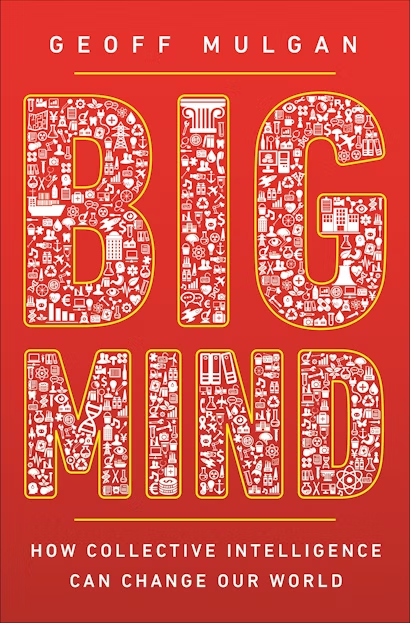
ii Big Mind: How Collective Intelligence Can Change Our World

'Everything we know is knowledge from the past, which may not apply in the future - the problem repeatedly stumbled on by models, algorithms, economic theories, and geopolitical dispositions, which made sense in one era, but then become dysfunctional in another. As social science has repeatedly discovered, the more you use a model, the less likely you are to question it. What starts as a pragmatic tool to answer a question becomes a truth in itself.

And so the models we use to think can also become traps. A model is held on to because it provides meaning and reassurance. Police forces notoriously cling to evidence they collect early in a case in the face of powerful contrary evidence that emerges later, and thus extraordinary miscarriages of justice result. The middle-aged cling to the theories they learned as undergraduates. Organizations become attached to models that become comfortable through use. I remember once meeting the planning team of a government that admitted that their forecasts had been no better than random guesses, but argued that the detailed forecasts were still needed to help with planning. The model became a comfort, even though it had no real use. 

Familiarity also breeds blindness. ...

Expertise can equally entrap. ...
 
The implication, as the Buddha pointed out, is that intelligence has to be at war with and suspicious of itself to be truly intelligent.' pp.120-121.

FIVE FUNDAMENTAL PRINCIPLES FOR EFFECTIVE COLLECTIVE INTELLIGENCE

'The first is the extent of what I call (1) autonomous commons of the intelligence in the system. By this I mean how much the elements of intelligence are allowed free rein, and not subordinated too easily to ego, hierachy, assumption, or ownership.' p.66. Chap. 5. Organizing Principles.
2. Balanced use of the capabilities of intelligence
3. Focus and the right granularity
4. Reflexivity and learning
5. Integration for action
 
'So a group is a we, but it is not just a scaling up of an I. How, then, should we think about the character of this we?' p.102. Chap. 9. The Collective.
 
Individual
|
      INTERPERSONAL    :     SCIENCES               
HUMANISTIC  --------------------------------------  MECHANISTIC      
 SOCIOLOGY  :    POLITICAL 
|
Group
 
EGO
 

 HIERARCHY


ASSUMPTION
 

OWNERSHIP


n.b. With my emphasis.

 
Geoff Mulgan (2017) Big Mind: How Collective Intelligence Can Change Our World, Princeton University Press.

Image: Princeton University Press.

See also: 'AI' : 'group' : 'axes' : 'individual'

 Previously:
Big Mind: How Collective Intelligence Can Change Our World


Saturday, December 13, 2025

WCCS26: Abstract 'Presenting a Universal and Simple Conceptual Workbench to Situate and Encompass Complexity'

ABSTRACT

Background

In health and social care there is, as yet, no universally recognised model, or framework applied and taught across all academia, fields of practice, professional disciplines and apprenticeships. At a time when ‘truth’ is challenged by information disorder, AI, and curricula are overload, this is both a stark and hidden problem. Medicine was quick to embrace complexity as an additional scientific tool. Complexity extends our understanding of epidemiology, demographic trends, the birth of modern bio-genomics, pharmacokinetics, public health, workflows, patient safety and more. The medical and bio-medical models are subject to critique, especially in psychiatry in terms of their conceptual scope and holistic bandwidth. Consider for example, the representation of patient and public engagement, human rights, climate change, poverty, refugees and natural disasters? The field of psychiatry extended these models to the bio-psycho-social model.

Methods

Despite this ‘progress-ion’, profound legacy issues remain: 
  • The dualities of INDIVIDUAL-GROUP and HUMANISTIC-MECHANISTIC
  • Sustainable services and systems, change to emphasize prevention and education (not just cure)
  • A lack of parity of esteem between mental illness and physical illness
  • A complicated relationship between psychiatry and psychology
The 21st century demands we also factor in economics, technology, social media - especially AI, education and literacies, geopolitics, security and more. This paper argues that we need a bio-psycho-socio-political model stat! This paper introduces and demonstrate the generic conceptual framework known as Hodges’ model.

To date, Hodges’ model has been explained and studied by guided discovery through lectures, workshops, posters, show and tell, and discussion groups; plus descriptive means of case study, and in practice patient care assessments and case formulation. Journal papers include conceptual analysis and synthesis, concept mapping of issues, e.g. nutrition and the sustainable development goals, plus oral health and policy frameworks (in-process). This paper ‘workbench’ encourages and facilitates reflective practice and critical thinking on an individual and collective basis. The derivation of the structure and content of Hodges’ model through guided discovery will be shared.

Results & Discussion

The background to Hodges’ model and its creation is introduced. In health care delivery, evidence-based interventions are of course paramount to patient, and public safety. Work to ‘see’ Hodges’ model as a mathematical object has begun. Help and collaboration is welcome; especially with supervisors of early career researchers and scholars in LMICs. Examples of complexity will be mapped to the knowledge (care) domains of Hodges’ model, which can itself be embedded within the spiritual. This paper responds directly to WCCS26’s main theme; and the need to listen to the lessons of history and isolate, weigh, refine and seek to preserve the often hard-won values that sustain humanity, humanistic care and qualities at a time when these are under assault, e.g. assisted dying – a right to die, or a duty? A small but growing bibliography, a template, plus illustrations of Hodges’ model are provided. Background on Hodges’ model can be found in the blog ‘Welcome to the QUAD’ - https://hodges-model.blogspot.com

Keywords: Healthcare, Nursing, Hodges’ model, Humanities, Global health

Topic: Complexity in Health and Medicine

🔷

News of acceptance was received on 29th November: brilliant! The deadline for submission of full-papers is 25th December. Try as I might, I can't meet this date. 

Helpfully, a presentation based on abstract alone is acceptable. I am hoping to network and learn too. The draft notes on Hodges'model as a mathematical object (6k words) are helpful in framing thoughts about the presentation and a future paper as a writing project. All in, a marvellous end to 2025 and prospect for 2026.

Sunday, December 07, 2025

AI - World Models

'What Is a World Model?

World models are neural networks that understand the dynamics of the real world, including physics and spatial properties. They can use input data, including text, image, video, and movement, to generate videos that simulate realistic physical environments. Physical AI developers use world models to generate custom synthetic data or downstream AI models for training robots and autonomous vehicles.'

https://www.nvidia.com/en-us/glossary/world-models/

In healthcare a 'world model' is slightly more expansive, hence the importance of experienced humans. We call these - nurses, doctors, physiotherapists, occupational therapists, social workers and many other professions, support workers and disciplines. They learn and train for many years and must continue to learn and unlearn throughout their careers. Their work and engagement is shaped and directed by human values, which are in turn informed by social change, evidence-based research, professional guidance, policy and law.

individual
|
INTERPERSONAL : SCIENCES
humanistic -------------------------------------------  mechanistic
SOCIOLOGY : POLITICAL
|
group-population


WORLD MODEL