Hodges' Model: Welcome to the QUAD: disciplines

Hodges' model is a conceptual framework to support reflection and critical thinking. Situated, the model can help integrate all disciplines (academic and professional). Amid news items, are posts that illustrate the scope and application of the model. A bibliography and A4 template are provided in the sidebar. Welcome to the QUAD ...

Showing posts with label disciplines. Show all posts

Friday, October 02, 2026

Gaps and Legacy Issues in Health and Education

 ... and across the Professions and Disciplines

I've just revised what may be table 1 of an exploratory paper. The table's role is to inform the motivation, scope and overall purpose within the introduction. The aim is to outline the gaps and legacies in health and education. Is this the combined inheritance of life chances, health and work career: gaps?

  1. Theory-Practice gap

    A. Research in Practice – Translational Research;
     B. Education/Training: University – Apprenticeship (see 4.B);

  1. There is no research-based conceptual framework taught and applied across health and social care systems and services.

  2. Individual – Collective (Population) Health

  3. Legacies of:
      A. Integrated care (global: funding / philosophy / location / disciplines / academic …);
      B. Parity of Esteem
           i   Mind - Body – Cartesian dualism;
           ii  Funding of Health Services [mental health - general];
           iii Research funding; Policy & Education);

C. Person-Centred Care – Service-Centred Care;

D. NHS - Social care;

  1. (Ill-Health-Disease, see 4.B.ii) Treatment versus Prevention first 

  2. Long-term policy Vs Short-termism

  3. Personal, Local, Global: Developed – Developing Health Systems & Services 

  4. Determinants of Health (Schrecker and Bambra, 2025)

Any thoughts, key sources ... are most welcome, e.g. should there be a place for sustainability, self-care, the literacies and the basis of funding public, private, or charitable (mixed)? h2cmng AT yahoo.co.uk
 

Schrecker, T., Bambra, C. (2025). ‘Lethal But Legal’: The Corporate Connections (Commercial Determinants of Health). In: How Politics Makes Us Sick. Palgrave Macmillan, London. 
https://doi.org/10.1057/978-1-349-96127-6_7

Sunday, September 27, 2026

Book review: 'Categories: A Study of a Concept in Western Philosophy and Political Thought'

Categories


To - Edinburgh University Press. 

Many thanks for this book -

O’Sullivan L. Categories: A Study of a Concept in Western Philosophy and Political Thought. Edinburgh University Press; 2024.

Requested in May, your response was quick. So, my apologies for the delay in picking this up. In mitigation, what I have been learning since, will help my reading of O'Sullivan's text.

As readers of W2tQ will have realised, there is a built in bias to my reading of any text. In short: It's all about the model. 

Categories was spotted in Foyles on a visit to London. It recommended itself instantly: title, Venn diagrams, sets and all.

A larger format paperback of 335 pages, the print quality, font and design match the values and usual care of the publisher. 

Given the subject, there are appropriately distinct indices of subjects and proper names.

At pages 2-3, I have already succumbed (my emphasis):

'As a result, there is widespread contemporary recognition that categories are both important and problematic. A non-exhaustive list of academic fields and disciplines in which issues to do with categories arise includes anthropology, critical theory, cultural studies, feminist studies, history, linguistics, philosophy, political science, political theory, post-colonial studies, post-modernism, post-humanism, psychoanalysis, psychology, rhetoric and sociology. It is clear, moreover, that this recognition reflects the situation in society at large. Popular authors articulate a pervasive feeling that "Things are in the wrong place. Religion is in the box where science used to be. Politics is on the shelf where you thought you left science the previous afternoon." Categorical worries have penetrated public as well as academic discourse.' pp.2-3.

But how did Luke O'Sullivan know? On page 3 having given us the informal uses of the word 'category':

'These, moreover, are only the informal uses; there are also formal, logical and mathematical, senses which we shall largely have to pass over.'13

For me it is a disappointment that the formal aspects will be passed over. It is also a relief. 

For a model that is situated, as far as nursing theory, and models of nursing/care were concerned in 1997-8; Hodges' model had been left on the shelf - gathering dust.

I recognised a slide from a Youtube video this past week, care of Cheng I think? I'll share soon.

More to follow.

13 Eugenia Cheng, Cakes, Custard, and Category Theory Easy Recipes for Understanding Complex Mathematics (London: Profile Books, 2015) provides an introduction to mathematical category theory.

Sunday, August 30, 2026

Dear Editorial Office,

Dear Dr. Jones,

My name is Editorial Office, and I am writing on behalf of the selected journal. I came across your article, "A Conceptual Mapping Exercise of Deprivation of Liberty Safeguards in Residential & Community Care Using Hodges' Model and Threshold Concepts". Its focus on deprivation of liberty safeguards, Hodges' model, older adults caught our attention. I would like to invite you to consider a new and unpublished contribution to the selected journal.

For this invited contribution, we are pleased to offer a Full APC Waiver. Invited manuscripts receive priority editorial handling, and we aim to provide an initial editorial decision within one week. This invitation does not imply acceptance, and editorial standards remain unchanged.

If you are interested, a working title or short abstract is enough for an initial discussion. If your current work is not closely aligned with this journal, you are also welcome to share your present research topic and we can check whether another journal in our portfolio may be more suitable.

I would be glad to answer any questions and look forward to hearing from you.

Best regards,
Editorial Office
the selected journal


Dear Editorial Office,

Re. 'the selected journal: Invited Contribution – Full APC Waiver'

Thank you for your communication and recognition of my recent paper.

Unfortunately you have not specified the 'selected journal'. Without this detail it is difficult to proceed at all, or ascertain what benefit is provided by the 'full APC waiver'. 

I am more troubled, however by your name. Is it really 'Editorial Office'?

Again the specific journal matters here. If it is materials science, chemistry, or quantum physics or related this is (slightly?) less of a problem. Otherwise, I do worry that with Hodges' model being person-centred your being de-personalised does not sit very well with the purposes and values of Hodges' model.

It is however reassuring to learn that I should not take your invitation to suggest acceptance, and that accordingly your editorial standards remain intact - especially in these times.

Again, even if I were interested, I am at a loss to provide either a working title, or abstract.

I do hope you understand my difficulty? 

Although perhaps I ask too much.

Can it be - this IS in fact the journal?

'The Selected Journal'?

Yours Faithfully,

Mr^ P Jones

^'Conceptual Surgeon' 4th class

(and not sent.) 

Tuesday, August 11, 2026

Philosophical Counselling - Reading group: Taylor 2002 'Central Value of Philosophical Counseling'

In addition to Kantian Desert (this p.m.) it is proving helpful to join a reading group on Philosophical Counselling. Being able to combine clinical and therapy experience* with philosophy is a welcome and rather overdue development. The reading for tomorrow (online for me I hope) is: 

Taylor J.S. (2002) The Central Value of Philosophical Counseling. International Journal of Philosophical Practice. 1 (2):1-9.

ABSTRACT: The title of this paper is deliberately ambiguous. It could refer either to the central value that philosophical counseling has for philosophy in general, or else it could refer to something (such as personal autonomy, or personal well-being) that philosophical counselors believe to be of value, and that they are able to help their clients pursue. In fact, this paper will be addressing both of these topics in order to demonstrate
the links that hold between them, and, in so doing, will attempt to further elucidate the nature of philosophical counseling itself.

Taylor (and related papers) also joins the dot (object?) that is Hodges' model, for example (with my emphasis):

'In this vein philosophical counseling is viewed as a Socratic drawing out of the knowledge that the client already possess, and that may be revealed through the careful questioning of a well-trained practitioner of the elenchic method.' pp.1-2.

I've long used guided discovery, by which the students (usually)/audience co-produce the model through a discussion.

'However, the difference between Socrates as a seeker after truth and the philosophical counselor as a professional who helps his or her client map out his or her own world-view in order to address particular problems that he or she is concerned with should not be overstated.' p.2.

'Furthermore—and perhaps most galling of all to philosophical counselors—academic philosophers often seem to view philosophical counseling as not being “real” philosophy at all, but more perhaps a species of social work, or an unsophisticated variant ofpsychotherapy.' p.4.

'Again, this information may be used by the counselor to help the client reflect more acutely upon her own views concerning the morality of abortion.' p.6.

'Given these two senses of “autonomy” it appears that the philosophical counselor is most concerned with enhancing autonomy in the second, Millian, sense of this concept. This is because philosophical counselors often try to aid persons in making decisions (or discoveries) about what it is that they really want to do, what their personal value-system or world-view really consists of.' p.11. 
(A contribution to person-centredness? Critical thinking is also noted by Taylor.)

 See also: https://www.igpp.org/english

 *Including, counselling, family, cognitive and behavioral therapies, plus psychosocial intervention.

Saturday, June 06, 2026

"step inside" TO "think outside"

  
individual
|
INTERPERSONAL
: SCIENCES             
humanistic ------------------------------- mechanistic
SOCIOLOGY : POLITICAL   
|
group


             c/o Somerset House, 6th June 2016.

Saturday, May 23, 2026

The alchemy of terminology, symbols, and signs ...

Or, 'What is a nurse doing … in a chemistry class?' [Ack. See Estrada]

In reading, I was reminded that chemistry adopted mathematical symbols for its own use. Not only that, but as a core science (with physics and biology, emerging from natural philosophy) there is a historical development from the time of alchemy:

Please see (with a graphical abstract):

C.Wentrup, The Transition from Alchemical to Modern Chemical Symbolism: from Bergman and Guiton de Morveau to Hassenfratz and Adet, Higgins, Richter, Dalton, and Berzelius. ChemPlusChem. 2024, 89, e202400033. https://doi.org/10.1002/cplu.202400033

This journey matters today as the use of symbols, in mathematics or other fields can be a barrier to learning and hence personal and disciplinary progress:

Ollie Hunter. Lost in translation: Demystify scientific symbolic language to help your chemistry students overcome any potential learning barriers. Royal Society of Chemistry, 23 May 2022.

As acknowledged many times, it is easy to take a word, or concept from one discipline and 'fit' it to - or in another. Or is it? Estrada concludes:

“The complexities of modern science and modern society have created a need for scientific generalists, for men trained in many fields of science.” This is a paradigm of science in the XXI century, where the advent of such fields like the study of complex systems requires multidisciplinary approaches. But the previous phrase was not written in the XXI century. It is the starting sentence in The education of a scientific generalist” published in Science in 1949 (Bode et al. 1949).' p.161. 

'Mathematics has been defined as the science of patterns. Thus, mathematicians search for “numerical patterns, patterns of shape, patterns of motion, patterns of behavior, voting patterns in a population, patterns of repeating chance events, and so on” (Byers 2010). Once a pattern is identified either in chemistry or in mathematics, the researcher can proceed to the clarification of the systematic rule which is behind that pattern. This is evident in the analogy used here between code-breaking and structure elucidation. This attachment to patterns makes both chemists and mathematicians very prone to the use of pictures. An organic chemist hardly can say anything about the chemical reactivity (or any physical or chemical property) of a molecule from its exact quantum-mechanical Hamiltonian. However, she will construct a complete narrative about the physical and chemical properties of a molecular structure drawn in a piece of paper, even if such a molecule is completely imagined. The power of pictures in mathematics is discussed in the book Mathematics and the Unexpected by Ivar Ekeland (1990) where its value is recognized as fundamental in the early stages of the development of mathematical ideas. This also introduces a very important analogy among chemists and mathematicians. Namely, that they use a proper language in their respective fields. While physicists use the mathematical language in their investigations, chemists use the sophisticated language of chemical formulas and specific symbols to represent charges, rearrangements, partial equilibria, etc. These “invented” languages mainly appear only in Chemistry and in Mathematics, making them unique intellectual activities.' p.162.

With thanks to the author, Ernesto Estrada IFISC for additional thoughts and insights:

Estrada, E. What is a mathematician doing…in a chemistry class?. Found Chem 26, 141–166 (2024). https://doi.org/10.1007/s10698-023-09497-4

Monday, November 24, 2025

Working title: 'Can Hodges’ model provide a foundation for a mathematically informed ...

... epistemology and relational ontology? Part 1'

Abstract

Aims: To begin a process of examining a ‘model of care’ and conceptual framework known as Hodges’ model as a mathematical object. This paper examines the structural elements of this model, its axes and domains through a formal, logical and mathematical lens. To establish the extent to which a combined relational understanding and mathematical approaches can provide avenues for further research.

Design: This study adopts the design of a two-part exploratory and descriptive paper, using an inquiry-based approach throughout.

Methods: The method is interdisciplinary, descriptive, and involves conceptual analysis. Rather than Hodges’ Model acting as a model of, and for care, here the model is used to investigate how health and social care can be better conceptualised. The question is: What is the result when Hodges’ Model is treated as a mathematical object? Here, Hodges’ model is used as an inquiry-based model with reflection and critique.

Results: Readers will see the development of ideas, driven by the structure of a model of care, existing taxonomy defined by nursing theory, associated with foundational mathematical concepts.

Conclusion: The questions introduced and deliberated here will identify avenues for further study. And highlight Hodges’ model to other researchers; less familiar with Hodges’ model, and yet more skilled – adept mathematically.

What does this paper contribute to the wider global clinical community?

Re-assert the importance of theory development in nursing and health disciplines.

Draw attention to the relational (and reflexive) potential of Hodges’ model and in healthcare to abstract the collective dimensions of healthcare, especially those that are political.

Given the problems faced in the century to follow, e
ncourage researchers within and without healthcare to further develop these ideas.

Impact:

Extend the relevance and scope of mathematical abstraction, in healthcare disciplines and the humanities, beyond statistical analysis.

This paper confirms: the conceptual utility of Hodges’ model; the challenge of requisite mathematical skills; the need for interdisciplinary cooperation.

Theorists in health and social care, policy makers and researchers seeking to apply mathematical techniques, especially category theory in the social science may find this work helpful and encouraging.

Reporting Method: N/A

Patient or Public Involvement: This study did not include patient or public involvement in its design, conduct, or reporting.

Keywords: nursing, theory, relational ontology, health, Hodges’ model, 
mathematics

Saturday, October 04, 2025

Argumentation - Journal: Informal Logic

Early evening (UK) yesterday, I joined a further webinar on argumentation. Through the speaker, and discussion, I was led to a journal

INFORMAL LOGIC

It is in informal logic that I see a role for Hodges' model. The model's structure providing a universal foundation of knowledge domains to be applied in practice. The bonus of this journal, is its being open access, a search revealed the following paper:

Mark Weinstein. Towards a Research Agenda for Informal Logic and Critical Thinking. XII.3, Fall 1990.
https://ojs.uwindsor.ca/index.php/informal_logic/article/view/2609

'This paper recommends that the recent concern with informal logic and critical thinking be redirected from its general philosophical focus and towards a greater appreciation of the particulars of practice in the various domains of human understanding. The redirection recommended is prompted by the central role that critical thinking and informal logic can be seen to play in meaningful educational reform, especially at the undergraduate level.' 

'Critical thinking, similarly, should be redirected from concerns typical of philosophers and towards issues and approaches more representative of critical thinking both within and across the wide range of disciplines represented by the course of undergraduate studies.' p.121.

'The sense that there is an internal relationship between arguments, argumentation and domains of knowledge persists despite attempts to show relevant and useful notions of critical thinking that are generally available for instruction and neutral in respect of the disciplines. The resolution of the issues generated by these competing views, requires that reflective practitioners of the disciplines, students of the history of ideas, methodologists and specialists in teaching increasingly engage in the task of generating and organizing the data upon which an informed and adequate notion of critical thinking across the disciplines must be based.' p.125.

I believe that the structure of Hodges' model provides a basis for Weinstein's ordinary argumentation and stylized argumentation.

For me (at present) ordinary argumentation, is 'open' argumentation. That is, without differentiation in (using) Hodges' model. I might (well, I would) have Hodges' model in mind, but choose not to apply it. As per the paper, stylized argumentation is using Hodges' model and doing so in a multidisciplinary manner - within my discipline. 

The problem and challenge for nurses and other health professionals is the need, if:

  • person/patient-centred;
  • integrated;
  • and holistic - having regard for parity of esteem (mind - body)

- not to stray, extend the disciplinary scope, while working within one's professional scope.

In highly effective multidiscioplinary teams that touch on being transdisciplinary (hybrid?), can experienced team members have insight into the stylized argumentation of their colleagues?

Ack. ​Argumentation network of the AMERICAS - https://www.argnet.org/ethics-of-arg.html

Previously: 'critical thinking'

Friday, August 22, 2025

Paper - (finally!) "A generic model and conceptual framework to prime curiosity across health and social care ..."

 It has been over a decade but at last the second* paper has been published in Journal of Evaluation in Clinical Practice:

Jones, P. (2025), A Generic Model and Conceptual Framework to Prime Curiosity Across Health and Social Care Disciplines to Facilitate Lifelong Learning. Journal of Evaluation in Clinical Practice, 31: e70252. https://doi.org/10.1111/jep.70252

ABSTRACT 

Rationale: The Corona virus pandemic highlighted the importance in continuity of the physical and emotional labour across all care sectors. Synergy between healthcare in hospitals, and community services must be allied with social care; and be central to integrated and efficient policy and service delivery. Services were found wanting in the pandemic and in recurring winter crises. The politics of funding for care delivered in rest and nursing homes remains contested, awaiting long‐promised governmental action. The workforce is recognised as dedicated, skilled, compassionate and yet under‐valued and under‐paid; managers face ongoing recruitment challenges, with a national shortage of staff, and high turnover of personnel. A National Care Service is awaited in England and Wales. 

Aims and Objectives: This study explores the ongoing care crisis, using the educational lens of threshold concepts, projected, analysed and synthesised of a generic conceptual framework, known as Hodges' model. Readers will understand Hodges' model and threshold concepts being equipped to explain both. 

Methods: The study is descriptive and uses a conceptual mapping approach supported by discussion and literature. Additional resources and avenues for ongoing study are also provided. 

Conclusion: In conclusion, Hodges' model is a pragmatic, practice‐based tool, that can support and sustain curiosity for workforce learning and development. 

Acknowledgements I would like to thank Messrs Mark Bird and Matthew Graham and the journal's reviewers for comments on drafts of this study; and acknowledge the effort of Dr Michael T. Flanagan in creating the informative threshold concepts resource (referred to above). 


https://onlinelibrary.wiley.com/share/author/IRPNBR2KHJNYJK8XUAW6?target=10.1111/jep.70252

*This paper was originally the first of a two-part work. Feedback from reviewers suggested the papers be standalone. United now, in one journal.

Many thanks to the reviewers, editor, editorial and publications team at JECP.

This paper has been added to bibliography in the blog's sidebar.

Thursday, July 31, 2025

'Nurse as Engineer' by Josefson

'Engineering' and 'architecture' have both been co-opted by cross-disciplinary explorers to help traverse what are usually cravasses between disparate fields. Or, if not a serious journey - more a day-trip than an expedition, it's an effort to create the impression of progress being (rapidly) made. Fields of knowledge being pulled - fused-together. These are transdisciplinary times:

'Individualization is best achieved in the engineering model, in which cach patient is seen as a unique case. The nurse collects and analyses the patients' data to arriye at a diagnosis, which includes, but is not limited to, issues that concern medical diagnosis and treatment. "The nurse sets obiectives based on knowledge and experience of what is desirable and achievable and designs an individualized care plan by selecting from a known repertoire of nursing interventions those most likely to lead to achievement of the objectives. After implementing the interventions, the nurse evaluates their effectiveness by comparing the client's subsequent condition with previous diagnoses and objectives."

In the last model - the non-routine model, which is a research model - the patient is still seen as unique. The problem is that the search procedures cannot be analysed because more judgement and intuition is required in making decisions.' p.25.

n.b. Two other models are described: the nurse acting as a craftsman; and the routine.

Josefson asks in a section (pp.28-29):

Who draws the boundary between Man and Machine?

Who - indeed!

Ingela Josefson. The nurse as engineer—the theory of knowledge in research in the care sector. In.  Knowledge, Skill and Artificial Intelligence. Bo Göranzon & Ingela Josefson (Eds). (1988), ISBN038719519X. pp.19–30. Berlin, Heidelberg: Springer-Verlag.

In the above paper/chapter Josefson draws upon the work of Katie Eriksson and Judy Ozbolt.

Previously: 'engineer' : 'architecture'

Saturday, July 05, 2025

'Axiomatic' - according to Simondon

Glossary:

Fifty Key Terms in the Works of Gilbert Simondon, pp.203-231.
Jean-Hugues Barthélémy, translated by Arne De Boever. 
In. De Boever A, Murray A, Roffe J, eds. Gilbert Simondon: Being and Technology. Edinburgh University Press; 2012.
'Axiomatic
In Simondon, this notion does not designate a formal system as in the case of logico-mathematical axiomatics, but simply a set of principles, or first propositions, that enable the linking fundamental concepts. It is in this sense that Simondon, in IPC in general and more specifically in FIP, struggles to work out a 'common axiomatic' (FIP, in IPC 35 or ILFI 533) for the human sciences - which enables the unification of psychology and sociology.' p.208.


Simondon holds hope for me (I think) in terms of the extent of formality I (and others) might seek for Hodges' model. Is there a set of principles - and simple at that? The structure of Hodges' model 'places' the knowledge (care) domains of psychology (intrapersonal & interpersonal) and sociology next to each other, as if to encourage unification. The bridge: psycho-social and a great many others, are there, to take walk and reflect on what we find there. If we choose to. ...

I'll check on the abbreviations. 

FIP : « Forme, information, potentiel » (conférence datant de 1960, ajoutée par l’éditeur), in Simondon, ILFI et IPC (voir ci-dessous).

ILFI : L’individuation à la lumière des notions de forme et d’information, Grenoble, Éditions Jérôme Millon, 2005 (Thèse principale de Simondon pour le Doctorat d’État, écrite de 1954 à 1958). 

IPC : L’individuation psychique et collective, Paris, Aubier, 1989 et 2007 (cet ouvrage contient le dernier tiers d’ILFI, ainsi que son Introduction et sa Conclusion).

https://journals.openedition.org/appareil/2253

Tuesday, March 11, 2025

Joint-carving - 'The First Cut is the Deepest' c/o Traldi

Last Friday I joined in another online session of the Argumentation network c/o Andrew Aberdein and Kat Stevens. 

The subject was “The Epistemology and Politics of Redefinition” by Oliver Traldi.

As ever, it was interesting, technical, relevant and a prompt to concepts new, briefly encountered previously. I can't remember if in the talk, or Q&A, but mention was made of 'joint-carving' but I checked some sources:
'Because properties are so abundant, they are undiscriminating. Any two things share infinitely many properties, and fail to share infinitely many others. That is so whether the two things are perfect duplicates or utterly dissimilar. Thus properties do nothing to capture facts of resemblance. That is work more suited to the sparse universals. Likewise, properties do nothing to capture the causal powers of things. Almost all properties are causally irrelevant, and there is nothing to make the relevant ones stand out from the crowd. Properties carve reality at the joints -- and everywhere else as well. If it's distinctions we want, too much structure is no better than none.' p.346.
Lewis, D. 1983. New Work for a Theory of Universals, Australasian Journal of Philosophy, 61(4): 343–377. doi:10.1080/00048408312341131

'Though the facts or truths that the realist judges mind-independent are most commonly put in terms of a kind’s ‘naturalness’ (or lack thereof), they may be formulated in alternative locutions, such as the ‘reality,’ ‘non-reality,’ or ‘artificiality’ of a kind or kinds. For example, that human races are not real, or that protons form a natural kind, both express such facts. Equivalently, Plato’s famous carving metaphor may be used to do so, as when it is asserted that the classifications of the DSM-5 do not carve nature at the joints. For the sake of expository simplicity I will exclusively use the language of ‘naturalness’ here, but translations into alternative terminology are straightforward.'
Franklin-Hall, L. 2015. Natural kinds as categorical bottlenecks. Philosophical Studies 172 (4):925-948.


Further, Sass writes:
'The goal is to have a consistent and informative test for what counts
as a realist versus an anti-realist view about natural kinds. Bird’s(2018) taxonomy,
building on Hawley and Bird(2011), focuses on the questions of whether natural
kinds exist, and if so, what sort of entity kinds are. Franklin-Hall’s (2015) taxonomy
focuses instead on whether kinds are individuated by a mind-independent principle,
or whether kinds “carve at the joints”.1 This paper focuses mainly on the issues raised
by Bird’s (2018) taxonomy.' p.11862.
Sass, R. 2021. An ontology of weak entity realism for HPC kinds. Synthese, 198(12), 11861–11880. https://www.jstor.org/stable/48692794 [ homeostatic property cluster (HPC) theories of kinds ].

In the past, I've written about the (nursing, IT, psychological...) models muddle. At the risk of adding to my muddle, Traldi's presentation is a timely prompt. Timely, because trying to looking at Hodges' model as a mathematical object, it needs to be stripped down to its bare components (and purposes?). Is redefinition the order of the day? I will leave defining the components to one-side at present (in drafted notes). But even from Hodges' model as a template, with its (two) axes and (four) domains we can (must) consider:

1. The two axes taken as a whole - do they intersect, or not?*

Relationally, the axis between:

INTERPERSONAL | SCIENCES
SOCIOLOGY | POLITICAL
INTERPERSONAL - SOCIOLOGY
SCIENCES - POLITICAL

2. Each axis (treated independently) to the centre of Hodges' model. (See 1.)

The conjoining of axes (do they?):

The INDIVIDUAL - HUMANISTIC and INDIVIDUAL - MECHANISTIC.

The HUMANISTIC - GROUP and GROUP - MECHANISTIC.
                                
Hodges' model
I won't continue now, but I have wondered if one axis is primary? Which one comes first? Faced with a blank piece of paper, or flipchart ... which axis gets drawn first?

In guided discovery workshops, teaching sessions I have been directed by the context and duty of care. Given that this is clinical then the I-G is where I start, or lead the discussion.

Perhaps, (as per the previous post) there is a safety dividend in having to consider this question more formally (forcibly)?


I remember Rod Stewart's rendition of  'The First Cut is the Deepest' - even as governments work to make this cut as shallow as possible.

The INDIVIDUAL - GROUP cut: has it every time.

Previously: 'argumentation'

Friday, August 30, 2024

Still sorting books: "The holographic paradigm and other paradoxes"

There has been overlap in my subscription to the Laws of Form mail list and a (David) Bohm list. With the difference, I unsubscribed from the latter, in an effort to focus. The work of Bohm is still very much on the radar and book shelves (well, boxes currently). Continuing to clear books, I've been reading through some relevant sections and quote here at length from:

Wilber, K. (Ed.), (1982) The holographic paradigm and other paradoxes. Boulder, CO: Shambhala.

The Enfolding-Unfolding Universe: A conversation with David Bohm (pp.44-104)

"WEBER: You've spoken of clarity often today and in the past: therefore, isn't it necessary at this point to consider consciousness and the knower, the one who is or isn't clear?

BOHM: Yes, we could come to that. The point is that consciousness is confused. Confusion is nonclarity. And if you say, a person is not clear, you mean he's confused, although it is more polite to say he's not clear. And confusion means "melting together." Things that are different are seen as one and things that are one are seen as broken up into many. So confusion clearly causes chaos." p.61.

"BOHM: Well, yes, we can consider that maybe that is what is, but, at the same time we have to be very  careful to say that thought cannot grasp it, so at some stage thought has to put this question aside as to what is, you see. Thought cannot grasp that which is. And any attempt to grasp that which is engages us in serious self-deception which confuses everything. So that thought has to learn or somehow come to a state of discipline, or whatever you want to call it, spontaneous discipline, its own discipline. 

WEBER: Order?  

BOHM: Yes, order, in which it does not attempt to grasp the questions which are beyond it, such as the question of that which is. It can grasp any relative question which is conditioned, or in some way, conditional. So even the nonmanifest consciousness of the  nonmanifest matter, which is highly subtle, is still within the possible area of thought."  p.64.


"WEBER: Deeply. So you're saying that prior to this current awareness of the centrality of consciousness, what we've been trying to do is hopeless because we've addressed small social problems all in the wrong domain, so to speak. 

BOHM: Yes. Well, really not going to their source at all." p.80.


"WEBER: Which was the old Cartesian or dualistic model.  

BOHM: Right. It also leads to infinite regress, unless you end it by  God or somewhere.
Now I think we come to a point where we're raising a question which was similar to what was raised in  yesterday's discussion.  How long can we go on trying to talk about what is beyond thought by making an intellectual construction? You see, because when we  make such an intellectual construction we  have a content and we have implied that the one who is constructing it is also supposed to be beyond that content. So he evades the very thing we attempt to include him in and in that very attempt he gets out. And so it seems that there is some limit to how far you can go in that  process, in that approach. Therefore it's best to say that in this approach in which we attempt to make a map, or a sketch of some  kind of what reality is, that we are really dealing with something limited. Korzybski used to say: "Whatever we say it is, it isn't."

WEBER: The map is not the territory. . . .

BOHM: That's right. Yes. And therefore what we are doing is making maps, making sketches, making concepts. And see, that's why I said the other night that science, for example, theoretical  science, is not primarily concerned with observing things but with observing ideas. ..."  p.84


The Tao of Physics Revisited  (pp.215-248)

"CAPRA: Yes, they would look at genetics, individual parts and so on. 

WEBER: They have the Cartesian view, whereas you're saying that this is the new vision, emphasizing interdependence, interconnectedness, the dynamics of the whole. 

CAPRA: But I should say that both reductionism and holism are necessary. 

WEBER: I understand. You are not suggesting that we abolish the other. You are saying we should supplement one with the other. 

CAPRA: If you want to get the full story, then you need both views. Because either one gives you only half of the story. This is what I see as the future of science, and I see a future science as no longer distinguishing between disciplines. 

WEBER: That's a very radical view. 

CAPRA: Yes, and by the way Heinsenberg already said that years ago. In one of his books, The Part and the Whole, he ends with his view of future science, and I agree very much with that. I have come to believe that in the future we will apply a network of models, and we will use different languages to describe different phenomena at different levels. We will not worry any longer whether we are doing biology or psychology or physics or anthropology or whatever; we won't be worried about these classifications." p.241.

Reading of The Systems View of Life - A Unifying Vision is also ongoing (p.240 ... and a joy) with posts to follow.

See also:
https://kfoundation.org/krishnamurti-and-david-bohm/

Thursday, April 11, 2024

Peter Higgs - Boson and Field

"Higgs theorised that particles would acquire mass by interacting with a new type of field. That field had a very special excitation of its own, another particle called the Higgs boson. The Higgs field solved a huge question in theoretical particle physics, and the Higgs boson was a tantalising target that experimentalists could hunt for in order to tie theory to reality.


“If you remove everything from the vacuum, all matter or quantum fluctuations, all electromagnetic stuff, all gravity, you will be left with the Higgs field,” says Frank Close at the University of Oxford. “And we need that just like a goldfish needs water. It stabilises empty space.”

Working independently from Higgs, Belgian physicists Francois Englert and Robert Brout reached the same conclusion, also in 1964."
On BBC Radio 4 11th April 1500 UT, Frank Close extended the goldfish analogy: "as if some clever goldfish have proved that they are immersed in something because they have found a molecule of H2O."

BBC Inside Science

The following is from a previous post:

UK Higher Education Research Excellence Framework - Disciplines
https://hodges-model.blogspot.com/2023/07/ref-uk-higher-ed-h2cm.html


INDIVIDUAL
|
     INTERPERSONAL    :     SCIENCES               
HUMANISTIC --------------------------------------  MECHANISTIC      
SOCIOLOGY  :   POLITICAL 
|
GROUP

Psychology, Psychiatry and Neuroscience

Archaeology

Theology and Religious Studies

Philosophy

[Mathematics & Logic]

^Communication 
as Intra- Interpersonal (Skills) Neurodiversity
hence an individual's
sense-making

Clinical Medicine (Neuroscience)
Public Health, Health Services and Primary Care
Allied Health Professions, Dentistry, Nursing and Pharmacy
Biological sciences 
Agriculture, Food and Veterinary Sciences

Earth Systems and Environmental Sciences
Chemistry
Physics
Mathematical Sciences
Computer Science and Informatics
Engineering
Architecture, Built Environment and Planning
Geography and Environmental Studies
Archaeology
Area Studies
Sport and Exercise Sciences, 
Archaeology
Social Work and Social Policy
Sociology
Anthropology and Development Studies
area studies
Education
Modern Languages and Linguistics
English Language and Literature
History
Classics
Communication^, Cultural and Media Studies, Library and Information Management
Art and Design: History, Practice and Theory
Music, Drama, Dance, Performing Arts, Film and Screen Studies
Leisure and Tourism


Archaeology

Economics and Econometrics

Business and Management Studies

Law

area studies

Politics and International Studies

34 subject-based Units of Assessment (UOAs)


1st April 2030 From Person to Planet:

First Call for the First Transdisciplinary Health 
and Social Care Conference -
Everyone is Invited!


Open to all health and social care professions and disciplines:

https://en.wikipedia.org/wiki/List_of_healthcare_occupations

A celebration of the Hodges' field.😉

RIP Peter Higgs

Thursday, April 04, 2024

Can a whole discipline act as an interface?

Abstract

"In this article, we consider how certain types of contemporary biosocial psychiatric research conceptualise and explicate biology-social relations. We compare the historic biopsychosocial model to recent examples of social defeat research on schizophrenia and cultural neuroscience work on affective disorders. This comparison reveals how the contemporary turn towards the ‘biosocial’ within psychiatric research relies upon ideas of the psychological as an interface. This is problematic because psychological notions of ‘experience’ are used as the central mechanics of biosocial processes, but lack any meaningful engagement with considerable debates within psychology and cognitive science about what the mind, and indeed the psychological, actually is, its relationship to social life, and how we should study it. The psychological interface is therefore vital to these biosocial hypotheses but is remarkably underdeveloped in comparison to its biological and sociological components. We argue that biosocial psychiatric research could gain a great deal from engaging with contemporary theorisations of experience and being more critical of vague appeals to psychological phenomena." p.317. [my emphasis]

Fletcher, J. R., & Birk, R. H. (2022). The conundrum of the psychological interface: On the problems of bridging the biological and the social. History of the Human Sciences, 35(3-4), 317-339. https://doi.org/10.1177/09526951211070503 

Individual
|
      INTERPERSONAL    :     SCIENCES               
HUMANISTIC  --------------------------------------  MECHANISTIC      
 SOCIOLOGY  :    POLITICAL 
|
Group

PSYCHOLOGY
- as interface?

Intrapersonal - Interpersonal
Individual psychology
BIOLOGICAL
Group psychology

SOCIAL


Does each of the disciplines in Hodges' model act as an interface in certain contexts/situations?

If there is a primary discipline (domain), that determines the context, is this also the interface (interstitial)? Discuss.

If care is integrated, holistic, with parity of esteem demonstrably assured should each discipline have its turn as interface?

My source/prompt:
Preparation for a conference video: 5 ppt slides, Samsung Notes drawing of Hodges' model, 7 slides.
If I can't put this together, it is still worth the effort.

Wednesday, February 14, 2024

Distance: Shoulders and ships that pass ...

James Lovelock, 2005 (cropped).jpg
Lovelock in 2005: Wikipedia

Over the past 10-20 years I've become more aware of the distance from scholars and people whose work is relevant to Hodges' model. Distance in the sense of their concomitant 'celebrity', hence the issue of how to make contact; and the stage of their career and my discovery of their relevance. Three people come to mind ... 

I've long admired the work of James Lovelock, and when writing on ecological themes in -

Jones, P. (2008) Exploring Serres’ Atlas, Hodges’ Knowledge Domains and the Fusion of Informatics and Cultural Horizons, IN Kidd, T., Chen, I. (Eds.) Social Information Technology Connecting Society and Cultural Issues, Idea Group Publishing, Inc. Chap. 7, pp.96-109.
- I wondered about trying to contact Dr Lovelock. As the majority of people are aware his thought and books, especially the Gaia hypothesis with Lynn Margulis caught the public's imagination from first publication and through the 1970s. Was there a Horizon TV programme? James Lovelock's influence was not just in ecology, but also earth (planetary) sciences through work for NASA. In early 2021 I thought I would reach out, through his most recent book and publisher/agent. I passed a message, which was forwarded but I never heard anything more.

As a nurse - with experience in older adult community mental health, I was acutely aware that this senior gentleman - in every sense of the word - may not want to be mithered by a scouser*, now living near Wigan Pier. I stressed not wanting to disturb the Dr. I also thought, given Dr Lovelock being of independent mind - a maverick, he might on the contrary love to be disturbed. 

Sadly, I was too late, hearing the news of Dr Lovelock's death in 2022. Of course, I was seeking validation (and still am) for the project here. I can't help thinking though, that Dr Lovelock really would have 'got' Hodges' model.

James Lovelock: BBC Radio 4 The Life Scientific

<>

Philosophy has long been an interest B.A.(Joint Hons.) Comp./Phil.. In a way you have no choice as a nurse, especially trained in mental health and general nursing: the theory and practice invariably touch reality, consciousness, perception, subjectivity, objectivity, knowledge, being, perception, data, information, time and so on.

Once acquainted with Hodges' model, scale is the dimension that asserts itself. I wrote about this and referenced Mario Bunge in about 1998, on the old, now archived website:

https://web.archive.org/web/20100329050839/http://www.p-jones.demon.co.uk/infintro.htm

Scale is a constant and multicontextual focus, but interest was piqued once again as I try to look at Hodges' model mathematically (yes, who am I trying to kid!) - as an object and relationally. I was reminded of Prof. Bunge's work noting a paper that included 'isomorphic-ism':

Bunge, M. (1969). Corrections to “Foundations of Physics”: Correct and Incorrect. Synthese, 19(3/4), 443–452. http://www.jstor.org/stable/20114653

https://link.springer.com/article/10.1007/s10838-021-09553-7

Mahner, M. Mario Bunge (1919–2020): Conjoining Philosophy of Science and Scientific Philosophy. J Gen Philos Sci 52, 3–23 (2021). https://doi.org/10.1007/s10838-021-09553-7

There may be a brief email exchange with Prof. Bunge, a request for a paper or two. Any emails are now stored (CD-ROM and portable drive) in a Turnpike folder, an old email client. Last year I was disappointed again, to learn of Dr Bunge's passing in 2020. His focus on science, philosophy, and systems - hard / soft is also very informative.

<>

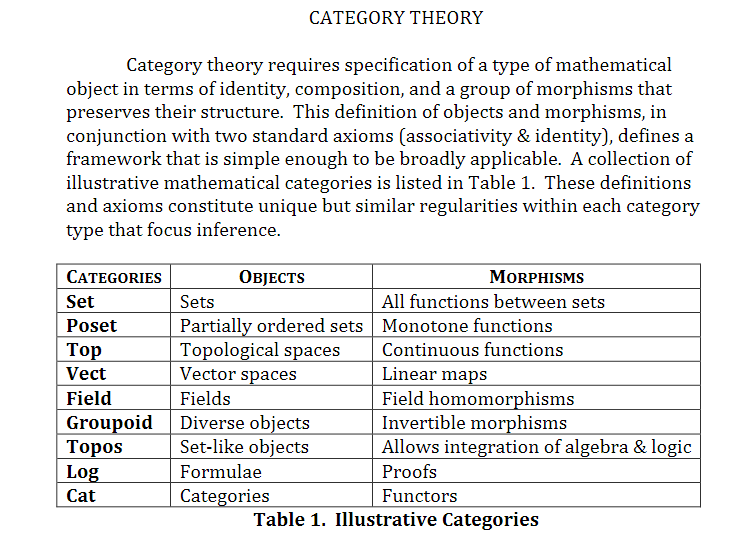
More recently, I came across the fascinating work of David Sallach, one paper (a conference from 2012) includes:


Sallach, D.L. Categorical Social Science: Theory, Methodology and Design. September 2012
Conference: Fourth World Congress on Social Simulation. Taipei, Taiwan.
https://www2.econ.iastate.edu/tesfatsi/Sallach2012CategoricalSoSci4.WCSS-SS.pdf

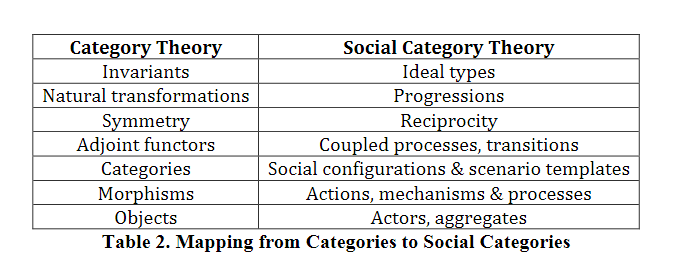
Plus, developed further in table 2:

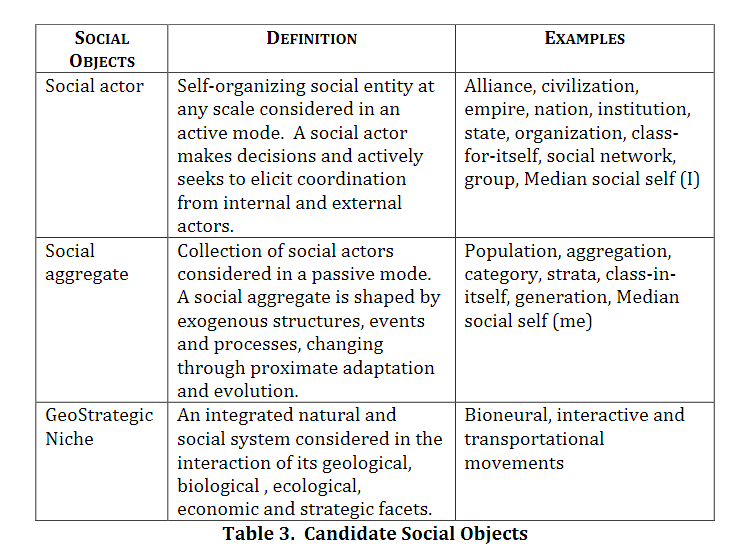
If time permits as an exercise, please consider Sallach's table 3 below. It may be interesting to map this to the domains of Hodges' model(?) [template]:
:

If you can see the potential utility of Hodges' model, you may also appreciate why Sallach's paper  resonates. Having emailed Dr Sallach, without reply, I did some checking. More sad news followed.

I, and no doubt many people will continue to discover and appreciate the legacy left behind by the above and many other pioneers. 

<>

I must acknowledge - Enid Mumford - whose work on socio-technical systems continues to inform my study and application of Hodges' model. This includes recognition of the many x-disciplinary bridges (or, barricades?) that can be found within Hodges' model. 

Clearly, much reading still to do.
<>

Returning to Hodges' model as a mathematical object, the 'distance' above is suddenly interstellar (and yes, sudden, as in faster than light!). I'm following videos, papers, and specific work-streams by  universities (I won't mention presently...) seeking to apply category theory to the social sciences. This suggests, at least, I'm not (completely!) wasting my time. If you have thoughts yourself on Hodges' model, the journey from Sallach's tables 1 - 2 not just 3, I'd be delighted to hear from you. 

There is another approach I will share this (N) spring. This author - researcher I have been able to contact.

*Scouser - https://en.wikipedia.org/wiki/Scouse
(Re. Liverpool - further post to follow).

James Lovelock image:  Bruno Comby, CC BY-SA 1.0, via Wikimedia Commons.

Wednesday, January 24, 2024

Psycho-Philosophical Creativity - Csikszentmihalyi (1934-2021)

"Hungarian-American psychologist Mihaly Csikszentmihalyi (1934-2021) identified a type of highly focused mental state conducive to productivity and creativity. He called it the 'flow'. He described flow as "being completely involved in an activity for its own sake. The ego falls away. Time flies. Every action, movement, and thought follows inevitably from the previous one, like playing jazz. Your whole being is involved, and you're using your skills to the utmost." Csikszentmihalyi advanced a model odf creativity that stresses the importance of a 'specific domain' to make meaningful contributions within a culture - a time and place in history where many variables come together to form a situation where creativity can bloom. . . .

Csikszentmihalyi work focuses on creativity as a cultural phenomenon. It is useful, he says, to think about culture as systems of interrelated domains. He puts forward a model of creativity consisting of a domain, a field, and a person. The domain is the wider area of cultural application, whether that be sculpture, mathematics, reason or science. Inside the domain is the specific field; and inside the field is the person. Csikszentmihalyi outlines the creative person as having "a sense that one's skills are adequate to cope with the challenges at hand, in a goal directed, rule-bound action system" (Flow: The Psychology of Optimal Experience, 1990)." p.10.

 Individual
   |
      INTERPERSONAL    :     SCIENCES               
HUMANISTIC  --------------------------------------  MECHANISTIC      
 SOCIOLOGY  :   POLITICAL 
|
Group
person

domain

field

creativity

person

domain

field

creativity


domain

field

culture

creativity

domain

field

culture

creativity


Culture also extends to the psychological (mental life) and physical (sciences); person(s) are supported, it is hoped, by their society, and political structures and services.

'Domain(s) can be organised, designated and structured in other ways. This would include, the center of Hodges' model not necessarily being fixed.

There is a paper to be written on Hodges' model related to inter- multi- transdisciplinarity.

Jones, L., Plaiting Gravy, Philosophy Now. Creativity. December 2022 / January 2023: Issue 153. pp.9-11.

Tuesday, November 14, 2023

'Humanistic geography' - goes full circle

INDIVIDUAL
|
     INTERPERSONAL    :     SCIENCES               
HUMANISTIC --------------------------------------  MECHANISTIC      
SOCIOLOGY  :   POLITICAL 
|
GROUP

"Alongside Euclidean geometry non-Euclidean geometries were invented. Alongside the old Aristotelian logic and the law of the excluded middle, new forms of logic with, for example, multiple values were developed. This type of work, far from remaining purely speculative, proved indispensable to the progress of physical theories. Consequently epistemological research was no longer seen as fundamentally inductive. It was no longer content to follow the movement of science: it undertook to precede science by indicating which tools should be used to make the best progress. This was the atmosphere which characterised neo-positivism: some concern was already apparent, therefore, but epistemology was still only partially critical. Its role was still more prescriptive." p.227.


"Tuan states that 'humanistic geography' is 'not an earth science' and that with its purpose as the better understanding of man and his condition, humanistic geography properly belongs to the humanities. (Tuan, 1976, 266). For Tuan humanistic geography is 'event-centred'; it is the study of articulated geographical ideas such as 'place', 'territory', 'crowding', 'privacy' and religion and it is particularly concerned with describing the quality of the emotion experienced in specific settings, e.g. the study of place as a centre of meaning for an individual rather than place as described by its geographical coordinates." pp.116-7.


Now we need to think of 'biospheric geography' within which humanity plays a pivotal and critical part.

https://science.nasa.gov/resource/the-story-behind-apollo-8s-famous-earthrise-photo/

https://www.nasa.gov/news-release/nasa-administrator-honors-life-of-apollo-astronaut-frank-borman/

Rose, C., Wilhelm Dilthey's Philosophy of Historical Understanding: a Neglected Heritage of Contemporary Humanistic Geography, p.99-131; Claval, P., Epistemology and the History of Geographical Thought, p.227-239. In. Stoddart, D.R., editor (1981) Geography, Ideology & Social Concern. Oxford: Basil Blackwell Publisher Ltd.

More books - gone; btw I'm not finding a post in each one - honest!

Monday, October 02, 2023

Citation of Hodges' model IN "Application of the Threshold Concept Framework in Nursing: An Integrative Review"

This morning ResearchGate informed me of a further citation for Hodges' model:

Kistler KB, Tyndall DE. Application of the Threshold Concept Framework in Nursing: An Integrative Review. Nurse Educ. 2022 Mar-Apr 01;47(2):91-95. doi: 10.1097/NNE.0000000000001041. PMID: 34033613.
I have requested a copy and added Kistler and Tyndall to the bibliography listing in the blog's sidebar.

Here, I am still sitting on the two-part draft paper on threshold concepts, liberty protection safeguards, residential forms of care and Hodges' model.

Last week, during a break I received news of acceptance for another online conference. Details to follow, as I complete two abstracts this month.

Saturday, August 19, 2023

Evidence-based care: The original Gordian Knot

or - Choose your audience carefully.

Within health and social care (and other - safety-critical - academic and professional fields) evidence-based care is pivotal as proof of safety, reproducibility, effectiveness, efficacy, professionalism, and benefits for the subjects of care and public. How best then to prove the scope, scale, relevance and safety of Hodges' model? How to demonstrate in theory and practice the utility and increasing relevance of Hodges' model? There are times I have to temper my belief, passion and enthusiasm for h2cm; am I too ardent, and at risk of coming across as preaching? There is a further tension. The one that is constant: language.

As a nurse, attention to language and terminology is vital to effective communication, establishing and sustaining rapport and empathy. This concern applies across situations, contexts and encounters; with patients, patient and carer (family), and colleagues. We are encouraged to avoid jargon, abbreviations  and technical terms. I use Hodges' model implicitly (aide-mémoire, assess, plan, evaluation, prioritise) and explicitly - sharing the model on some occasions but not all.

In the role of researcher / author, the audience, especially - editors, reviewers, and readers have expectations in how concepts, ideas, theories are expressed and explained. To a degree, the very title of a publication, preempts the language to follow. As I present, or write, sources must be declared and  referenced. Again, resort to jargon is discouraged. Clarity and brevity are strengths. And yet how likely is it that at least 1/3 reviewers will demand more technical rigour and explanation? If terms are used from other disciplines, the expectation follows that their cross-disciplinary application is explained and argued for, and meanings differentiated.

With potential theoretical underpinnings for Hodges' model to be found in Gärdenfors's Conceptual Spaces, and Meyer & Lands's Threshold Concepts and others (nursing and healthcare no-less); John D. Cook provides additional pause for thought - as I look even further afield:

"When I was in college, I sat in on a communication workshop for Latin American preachers. ...

Another lesson from that workshop, the one I want to focus on here, is that you don’t always need to convey how you arrived at an idea. Specifically, the leader of the workshop said that if you discover something interesting from reading the New Testament in Greek, you can usually present your point persuasively using the text in your audience’s language without appealing to Greek. This isn’t always possible—you may need to explore the meaning of a Greek word or two—but you can use Greek for your personal study without necessarily sharing it publicly. The point isn’t to hide anything, only to consider your audience. In a room full of Greek scholars, bring out the Greek.

This story came up in a recent conversation with Brent Yorgey about category theory. You might discover something via category theory but then share it without discussing category theory. If your audience is well velrsed in category theory, then go ahead and bring out your categories. But otherwise your audience might be bored or intimidated, as many people would be listening to an argument based on the finer points of Koine Greek grammar. ...

Some things may sound profound when expressed in esoteric language, such as category theory or Koine Greek, that don’t seem so profound in more down-to-earth language. Expressing yourself in a different language helps filter out pedantry from useful ideas. (On the other hand, some things that looked like pure pedantry have turned out to be very useful. Some hairs are worth splitting.) 

Sometimes you have to introduce a new terms because there isn’t a colloquial counterpart." ...

 Category theory and Koine Greek: John D. Cook. 

Category theory and Koine Greek: John D. Cook. 
https://www.johndcook.com/blog/2016/06/27/category-theory-and-homiletics/

See also: Applied category theory: John D. Cook

https://www.johndcook.com/blog/applied-category-theory/