Hodges' Model: Welcome to the QUAD: formalism

Hodges' model is a conceptual framework to support reflection and critical thinking. Situated, the model can help integrate all disciplines (academic and professional). Amid news items, are posts that illustrate the scope and application of the model. A bibliography and A4 template are provided in the sidebar. Welcome to the QUAD ...

Showing posts with label formalism. Show all posts

Friday, April 17, 2026

Ann Hutchinson Guest (Obit.), 'Authority on dance notation ... '

'Although there are many forms of dance notation going back to Pierre Beauchamp's system for Baroque dance in the 1680s, Nijinsky had developed his own cryptic version. Ann Hutchinson Guest first tried to reconstruct his work in 1956 after the choreogapher's widow, Romola, gave her his notes. "I spent years trying to work it out," she said, adding with a laugh: And I'm supposed to be the leading authority on dance notation in the world. She told how Nijinsky had revised his notes many times, often contradicting himself. 'We couldn't get anywhere. Romolo was furious. She said it was taking much too long."
    Hutchinson Guest studied dozens of different dance notation systems, translating many of them into Labanotation, a system developed in the 1920s by Rudolf von Laban who was a central figure in European modern dance. According to a  press report in 1954: "The printed Labanotation page looks like a combination of hieroglyphs, pictographs, Morse dots-and-dashes, đoodles, and a musie score turned on edge" 
    It was not until 1980 that she and Claudia Jeschke, a dance historian, succeeded in cracking Nijinsky's code after finding a copy of his annotated score in the British Library.'
Register, The Times.

My source: Ann Hutchinson Guest (Obit.), 'Authority on dance notation known for reconstructing Vaslav Nijinsky's scandalous ballet, L'Après-midi d'un faune'. Register, The Times. 20 April, 2022, p.48.
https://www.thetimes.com/uk/obituaries/article/ann-hutchinson-guest-obituary-hkw8z88ns


INDIVIDUAL
|
     INTERPERSONAL    :     SCIENCES               
HUMANISTIC --------------------------------------  MECHANISTIC      
SOCIOLOGY  :   POLITICAL 
|
GROUP
abstraction
representation
interpretation
observation - translation
code - formalism

body (bodies)
symbols - forms
dance
choreography
movement - 4D - time

group
ensemble
'anthropological composition?'
'diagnostic grouping'?
social - cultural category . . .

'collective power & attention 
evinced as time'
'The stage: the space for health'^

Hutchinson Guest in 1956
 Source: The Times.


'Dance has been called moving architecture, a truth which the complexities of contemporary choreography may mask. Not only does the dancer's body form shapes and groups of dancers form moving or static designs, but also group arrangements carve up the stage space, establishing areas of open as well as enclosed space which are significant in their changes and contrasting effects.

While the rccording of movement on paper-dance notation-does not look like movement (disregarding primitive stick figure drawings), there is an "architecture" in the sequence of graphic symbols used to record dance patterns. Over the centuries many different devices have been used to capture dance steps on paper. What are the elements that have to be represented?

The process of dance notation requires reducing four-dimensional movement (time being the fourth dimension) to a two-dimensional surface. The parts of the body in action have to be defined, as does the form of movement involved (flexion, extension, rotation, directional placement) and the duration of each in relation to the overall time structure. In group dances the relationship of dancers to one another must be determined and recorded, as well as their location on stage and their paths of travel. In a dance score each performer is like a small orchestra-arms, legs, head, torso, etc. in motion-this is then multiplied by the number of dancers who are performing individual sequences.'


Guest, A. H. (1990). Dance Notation. Perspecta, 26, 203–214. https://doi.org/10.2307/1567163

^Health is always performed in the political domain, make no mistake (excuses, or exceptions). It is not:
  1. Acknowledged, masked - covered by the 'set design' (see #2 below);
  2. Implied in the medical, biomedical, bio-psycho-social model;
  3. The intermission is neither the time, or place, to reflect upon and critique the political in health :: health in politics.

Previously: 'dance' : 'architecture' : 'movement' 
 : 'notation'

Saturday, July 05, 2025

'Axiomatic' - according to Simondon

Glossary:

Fifty Key Terms in the Works of Gilbert Simondon, pp.203-231.
Jean-Hugues Barthélémy, translated by Arne De Boever. 
In. De Boever A, Murray A, Roffe J, eds. Gilbert Simondon: Being and Technology. Edinburgh University Press; 2012.
'Axiomatic
In Simondon, this notion does not designate a formal system as in the case of logico-mathematical axiomatics, but simply a set of principles, or first propositions, that enable the linking fundamental concepts. It is in this sense that Simondon, in IPC in general and more specifically in FIP, struggles to work out a 'common axiomatic' (FIP, in IPC 35 or ILFI 533) for the human sciences - which enables the unification of psychology and sociology.' p.208.


Simondon holds hope for me (I think) in terms of the extent of formality I (and others) might seek for Hodges' model. Is there a set of principles - and simple at that? The structure of Hodges' model 'places' the knowledge (care) domains of psychology (intrapersonal & interpersonal) and sociology next to each other, as if to encourage unification. The bridge: psycho-social and a great many others, are there, to take walk and reflect on what we find there. If we choose to. ...

I'll check on the abbreviations. 

FIP : « Forme, information, potentiel » (conférence datant de 1960, ajoutée par l’éditeur), in Simondon, ILFI et IPC (voir ci-dessous).

ILFI : L’individuation à la lumière des notions de forme et d’information, Grenoble, Éditions Jérôme Millon, 2005 (Thèse principale de Simondon pour le Doctorat d’État, écrite de 1954 à 1958). 

IPC : L’individuation psychique et collective, Paris, Aubier, 1989 et 2007 (cet ouvrage contient le dernier tiers d’ILFI, ainsi que son Introduction et sa Conclusion).

https://journals.openedition.org/appareil/2253

Tuesday, August 27, 2024

(ii) Hodges' model? Ah! You mean the naïve conceptual framework that ...

... thinks it's a theory!

Apparently, the support of computers, through computer proof assistants, to help test and generate proofs in mathematics is creating confusion for mathematicians. 

"When you see “2 + 2 = 4”, what does “=” mean? It turns out that’s a complicated question, because mathematicians can’t agree on the definition of what makes two things equal. ... 

It was the late 19th century when things began to change, with the development of set theory, which provides the logical foundations for most modern mathematics.

To understand why, take the sets {1, 2, 3} and {a, b, c}. Clearly, the elements of each set are different, so the sets aren't equal. But there are also ways of mapping between the two sets, by identifying each letter with a number. Mathematicians call this an isomorphism. In this case, there are multiple isomorphisms because you have a choice of which number to assign to each letter, but in many cases, there is only one clear choice, called the canonical isomorphism. ...

Because a canonical isomorphism of two sets is the only possible way to link them, many mathematicians now take this to mean they are equal, even though it isn't technically the same concept of equality that most of us are used to."


Does this create an 'opening' for others? Others, whose commute also falls between the cold-logic of the hard sciences, and the fuzzy fields of the humanities? Others who may find the threshold as daunting, as it is (truly!?) tantalising.

Alex Wilkins, Confusion over what 'equals’ means. New Scientist, 262: 3495: 15 June 2024. pp.10-11.

Many thanks to Alex Wilkins for a pdf copy.

Wednesday, August 14, 2024

There is this thing - 'universal construction'

The problem of bugs in software is an ongoing problem across all IT industries. For application that are safety critical we are still reminded of the risk implications and consequences if bugs are software is not tested and bugs - errors identified and corrected.

Back in the 90s during BA(Joint Hons. Philosophy & Computing) studies, I was introduced to the formal specification language 'Z'. It was designed for definition, and modelling of computer software, working from specification to implementation, as per these images:

https://personalpages.bradley.edu/~young/CS592M120_OLD/handoutZed.pdf

https://personalpages.bradley.edu/~young/CS592M120_OLD/handoutZed.pdf

To be clear I've never worked as part of a software project and my 'tinkering' - Drupal, Pharo, online groups, hosting platform - reveals how the development stack and work processes have developed apace. The challenge is keeping up. Simultaneously, there is the sense of being on the bank of deep water; or, a vertiginous cliff:

A little learning is a dang’rous thing;
Drink deep, or taste not the Pierian spring:
There shallow draughts intoxicate the brain,
And drinking largely sobers us again.
Fir’d at first sight with what the Muse imparts,
In fearless youth we tempt the heights of arts,
While from the bounded level of our mind,
Short views we take, nor see the lengths behind,
But more advanc’d, behold with strange surprise
New, distant scenes of endless science rise! 
Pope. https://interestingliterature.com/2021/09/a-little-learning-is-a-dangerous-thing-meaning-analysis-origin/

 Acknowledging the need for an 'evidence-base' and theoretical underpinning the effort to 'push' Hodges' model forward is ongoing. Maths remains an alien territory to me, but the 'secret garden' is as tantalizing as ever. Over the years I have posted - with much overlap about:

  • maths
  • relation
  • logic
- and more recently:
  • isomorphism
  • category theory
  • and as previously posted - laws of form.
In an effort to get to grips with the above, I'm following various online videos, books and papers. Bartosz Milewski's videos, blog and publications are aimed at programmers, but are very interesting nonetheless. The first video provides an introduction to the motivation and philosophy of category theory. In another, Milewski refers to 'universal construction' on YouTube and in a blog post about 'Function Types'.

The 'universal' figures in healthcare too: universal health access, and universal health coverage appear to over-shadow 'universal health care'. The quality of 'universal' also creeps into assessment. Data gathering is not merely complete, it is comprehensive. It has to be, to contribute not just to a care plan, for one that is (supposedly) person-centred, with risks identified, strengths, weaknesses - needs, history, social network, and much more. The care plan informs and orchestrates the interventions; then evaluation follows. Are we delivering? What is the patient's (client's, carer's) level of satisfaction. Have care stages and actions been completed as per policy (in time!)? (More on this to follow later this year in light of UK mental health/illness news.)

So as I consider (wrestle with...) initial, and terminal objects, sets and categories … I can hopefully, especially with help, extend the number of posts tagged 'universal' here on W2tQ. In this vein, is Hodges' model a universal construction? There may not be a universal truth to reveal, but it will prove a marvellous learning journey.

Wednesday, August 07, 2024

"How did you get that answer? Show your working out!"

As students of - math, maths, mathematics (pick one!) or arithmetic, algebra - know only too well: Learning, no doubt, through a series of prompts, especially if numerically challenged:

The way you derived your answer is an important - the most important part of the exercise. It is the exercise in most cases.

As may be apparent here on W2tQ, in addition to visual methods, mind-mapping, diagrams and computers, the professional basis for the study and the draw of Hodges' model was models of care and nursing theory. I've blogged previously about if we stress the theoretical, this variously invites yawns, and critique (always welcome), if not ridicule from outside.

In practice we seem struggle to do the ideal. This is one aspect of the theory-practice gap; bridging this gap was one reason for the creation of Hodges' model. What the student health professional learns in the  class/lecture theatre/online, may not be reflected and realised 100% in practice. 

On clinical placements the real-world intervenes, upsetting the academic comforts. Suddenly the armchair hypotheses do not sit so comfortably. Reality bites. Are there enough staff, is the skill-mix 'ideal'. Patients present their own variables. Which are also often at least binary (and invariably more), to include carers, family, with prior experiences. There are specific life experiences and situations of the patient; and yes, in plural.

Competence with paperwork, the electronic health record (EHR) is key to a student's progress:

From communication skills, establishing a therapeutic relationship (yes, so 'old school'?), enabling and concurrent with care assessment, care planning, intervention and evaluation. Plus, the 'writing' of the same including all the processes, messages received, clinical team meetings, allocations, supervision. All the while being mindful of ethics, professionalism and accountability.

Regarding theory: I do wonder; are we missing something? Something that artificial intelligence may (will) pick-up eventually (quite quickly in-fact!). With the legacy of largely abandoned nursing theories, models of care, health frameworks … do we need to look at theory in a more literal (yes, idealised) form? To have any chance of success do we need to leave behind what we have thus far? In addition to science, nursing, medicine are often described as an art. Even if this theoretical treatment is impressionistic surely it is worth trying - to be creative, innovative, to hypothesise and speculate on the edge?

Can we use Hodges' model, or another 'tool' you might care to propose even more suited to the purpose? 

Throwing caution to the wind: this is a theoretical exercise. It may be based upon sand? Then so be it! If there is a practical, pragmatic and practice-based application that would be marvellous. Why does this matter? The rationale here is driven by the fact that health has its feet, or draws every-other-breath in the humanities. Yes, evidence is grounded in science, anatomy, physiology, life sciences and the rest. The humanistic care - knowledge domains need, demand their own unique theoretical space. A sandpit to play with a theoretical language. And make no mistake, the sand is already hurting these eyes.

There are malign agents who would deny any practical benefits of such an effort, and yet this should be in prospect. This should be an outcome to follow in the near future (although delayed by COVID). In fact it is a necessity, a requirement even, given attention and prioritisation of the SDGs, and the determinants of health,. Add to this the politics of health, and health in politics and the world🌍🌎🌏🌐today; full implementation, achievement and ongoing development will costs billions (trillions of dollars) and once-and-for-all a long-term perspective. 

There is a now, a holistic need to show your working out. How you have arrived at your answer. 

Monday, January 29, 2024

Identity: Self, person, client, patient ... player

INDIVIDUAL
|

 INTERPERSONAL    :     SCIENCES               
HUMANISTIC --------------------------------------  MECHANISTIC      
SOCIOLOGY  :   POLITICAL 
|
GROUP
Identity morphism


My source: Twitter - X
https://x.com/Ravens/status/1751712286769660409?s=20

Plus:
https://www.cbssports.com/nfl/news/lamar-jackson-makes-unreal-catch-of-his-own-pass-in-chiefs-ravens-afc-title-game-leaving-tony-romo-amazed/
 
Image:
https://krossovochkin.com/posts/2020_04_26_category_theory/

Wednesday, August 30, 2023

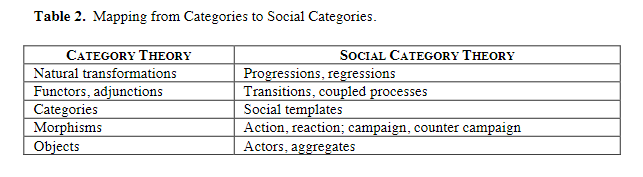
Paper - Categorical Social Science: Theory, Methodology and Design by Sallach (2012)

This conference paper from 2012 - cited at length here - is very encouraging as I try to work on category theory within Hodges' model. This is timely too, as a new (northern) academic year begins - post to follow ...

Sallach, D.L. Categorical Social Science: Theory, Methodology and Design. In: Conference Paper - 4th World Congress on Social Simulation. Taipei, Taiwan (September 2012). https://www.researchgate.net/publication/275584554

"The prospect of representing social processes at multiple scales, at an arbitrary level of detail, is likely to produce rich, interwoven models with the potential to provide a more effective map of historical and policy-oriented dynamics. However, this potential will also raise significant challenges in validating such a model [15].

One approach to managing the complexity (both conceptual and computational) of social models is to move them toward a higher level of abstraction."

"Category theory requires specification of a type of mathematical object in terms of identity, composition, and a group of morphisms that preserves their structure. This definition of objects and morphisms, in conjunction with two standard axioms (associativity & identity), defines a framework that is simple enough to be broadly applicable."

Conclusion:

"The present analysis introduces more analytical potential than can currently be demonstrated. Nonetheless, it makes a case for the relevance of category theory for the representation of social applications, and illustrates a variety of ways in which these conclusions are, or ultimately can become, compelling.

Category theory provides a rigorous yet expressive formalism for representing and integrating challenging modeling domains. It is also a formalism that can support extensive theoretical and modeling syntheses, while still maintaining appropriate levels of exactness. These strengths make CT particularly appropriate for providing a mathematical foundation for computational social science.

Ultimately, it is important to return to the issue of the validation of social models. The practical use of historical and/or policy-oriented models is highly dependent upon their credibility. Category theory provides a formalism that can be precise when applied to theory, explicit during the design stage, and definitive at the assessment stage, while also attending to the consistency of intermediate stages. It deserves serious exploration and investigation."

Wednesday, October 05, 2022

Is there an implicit theory in Hodges' model? ii


More to follow, including what is proving a real yet enjoyable challenge.

Saturday, October 23, 2021

COVID: Logic is the patient - again...

Hodges' model is evidence seeking, what logic might apply? 
 
Logic was once the 'patient':
“Yet, by 1530, formal logic was a dying branch of studies, and by the seventeenth century it had been completely forgotten. Why? No one to my knowledge has provided a satisfactory answer. Prantl, one of the earliest scholars to take notice of medieval logic, merely relied on the prejudice of four hundred years in depicting the universities as nursing; the sick but obstinate patient (dialectics), until 'the healthy spirit of antiquity conquered the scholastic pedantry'. Bochenski is not concerned with the mechanics of historical change. Ong gives the cause of death as an inherent weakness in medieval logic itself: 'Scholastic logic was dying of the frustration attendant upon its failure to develop a symbolic system adequate to its ambition and the promise of its initial development.' Even if medieval logic could not overcome this weakness, it had nevertheless hobbled along for three hundred fifty years with the malady! Even if the universities artificially prolonged its life, how exactly did the 'healthy spirit of antiquity' do away with the old warrior?” (Heath, 1971, p.47).
 
Individual
|

INTERPERSONAL : SCIENCES
humanistic ------------------------------------------ mechanistic
SOCIOLOGY : POLITICAL
|
Group

logic


LOGIC

logic

logic

Heath, Terrence. “Logical Grammar, Grammatical Logic, and Humanism in Three German Universities.” Studies in the Renaissance 18 (1971): 9–64. https://doi.org/10.2307/2857078.

Saturday, July 11, 2020

A Universal Language needs a Universal Framework ...


and so does ...

Integrated Care

Psychotherapy 

Universal Health Coverage

Global Health

Planetary Health ...


individual
|
INTERPERSONAL : SCIENCES
humanistic ----------------------------------------------- mechanistic
SOCIOLOGY : POLITICAL
|
group - population
Journal of Universal Language

Journal of Universal Language

Tuesday, April 21, 2020

We are all bound variables ...

individual
|
INTERPERSONAL : SCIENCES
humanistic ----------------------------------------------- mechanistic
SOCIOLOGY : POLITICAL
|
group - population


"To be is to be the value
of a bound variable."
- W.V. Quine,
"On What There Is," 1961 


.


Lynn Gamwell (2016) Mathematics and Art: A Cultural History. Princeton, New Jersey: Princeton University Press. ISBN: 9780691165288. p.162.