Hodges' Model: Welcome to the QUAD: groups

Hodges' model is a conceptual framework to support reflection and critical thinking. Situated, the model can help integrate all disciplines (academic and professional). Amid news items, are posts that illustrate the scope and application of the model. A bibliography and A4 template are provided in the sidebar. Welcome to the QUAD ...

Showing posts with label groups. Show all posts

Friday, April 17, 2026

Ann Hutchinson Guest (Obit.), 'Authority on dance notation ... '

'Although there are many forms of dance notation going back to Pierre Beauchamp's system for Baroque dance in the 1680s, Nijinsky had developed his own cryptic version. Ann Hutchinson Guest first tried to reconstruct his work in 1956 after the choreogapher's widow, Romola, gave her his notes. "I spent years trying to work it out," she said, adding with a laugh: And I'm supposed to be the leading authority on dance notation in the world. She told how Nijinsky had revised his notes many times, often contradicting himself. 'We couldn't get anywhere. Romolo was furious. She said it was taking much too long."
    Hutchinson Guest studied dozens of different dance notation systems, translating many of them into Labanotation, a system developed in the 1920s by Rudolf von Laban who was a central figure in European modern dance. According to a  press report in 1954: "The printed Labanotation page looks like a combination of hieroglyphs, pictographs, Morse dots-and-dashes, đoodles, and a musie score turned on edge" 
    It was not until 1980 that she and Claudia Jeschke, a dance historian, succeeded in cracking Nijinsky's code after finding a copy of his annotated score in the British Library.'
Register, The Times.

My source: Ann Hutchinson Guest (Obit.), 'Authority on dance notation known for reconstructing Vaslav Nijinsky's scandalous ballet, L'Après-midi d'un faune'. Register, The Times. 20 April, 2022, p.48.
https://www.thetimes.com/uk/obituaries/article/ann-hutchinson-guest-obituary-hkw8z88ns


INDIVIDUAL
|
     INTERPERSONAL    :     SCIENCES               
HUMANISTIC --------------------------------------  MECHANISTIC      
SOCIOLOGY  :   POLITICAL 
|
GROUP
abstraction
representation
interpretation
observation - translation
code - formalism

body (bodies)
symbols - forms
dance
choreography
movement - 4D - time

group
ensemble
'anthropological composition?'
'diagnostic grouping'?
social - cultural category . . .

'collective power & attention 
evinced as time'
'The stage: the space for health'^

Hutchinson Guest in 1956
 Source: The Times.


'Dance has been called moving architecture, a truth which the complexities of contemporary choreography may mask. Not only does the dancer's body form shapes and groups of dancers form moving or static designs, but also group arrangements carve up the stage space, establishing areas of open as well as enclosed space which are significant in their changes and contrasting effects.

While the rccording of movement on paper-dance notation-does not look like movement (disregarding primitive stick figure drawings), there is an "architecture" in the sequence of graphic symbols used to record dance patterns. Over the centuries many different devices have been used to capture dance steps on paper. What are the elements that have to be represented?

The process of dance notation requires reducing four-dimensional movement (time being the fourth dimension) to a two-dimensional surface. The parts of the body in action have to be defined, as does the form of movement involved (flexion, extension, rotation, directional placement) and the duration of each in relation to the overall time structure. In group dances the relationship of dancers to one another must be determined and recorded, as well as their location on stage and their paths of travel. In a dance score each performer is like a small orchestra-arms, legs, head, torso, etc. in motion-this is then multiplied by the number of dancers who are performing individual sequences.'


Guest, A. H. (1990). Dance Notation. Perspecta, 26, 203–214. https://doi.org/10.2307/1567163

^Health is always performed in the political domain, make no mistake (excuses, or exceptions). It is not:
  1. Acknowledged, masked - covered by the 'set design' (see #2 below);
  2. Implied in the medical, biomedical, bio-psycho-social model;
  3. The intermission is neither the time, or place, to reflect upon and critique the political in health :: health in politics.

Previously: 'dance' : 'architecture' : 'movement' 
 : 'notation'
Saturday, November 01, 2025

On Sociology & Becoming a Patient

'The Subject matter of Sociology
& Becoming a Patient'

A primer for my picking up Hodges' model, or being pressed onboard, was early exposure to history and sociology. There was an understandable emphasis in the (then) school of nursing (registered mental nursing) on the role of society, social history, lunacy and the asylums, law, and attitude towards mental illnesses.

Continuing to sort books (inc. secondhand) and papers, there is:

Maclean, Una. (1974) Nursing in contemporary society. London: Routledge & Kegan Paul.
https://wellcomecollection.org/works/qhqc24fv

individual
|
INTERPERSONAL : SCIENCES
humanistic -------------------------------------------  mechanistic
SOCIOLOGY : POLITICAL
|
group-population


'The sociological viewpoint can be taken on many different subjects. Thus, political sociology has to do with people's voting behaviour and their reactions to the processes of government, while the sociology of education takes into account the influence of various social factors upon educational opportunities and achievements. In addition, social psychology, social psychiatry and social medicine are all related to medical sociology. These terms all imply the use of sociological methods and insights in different areas of human behaviour, and the divisions between them are a convenient way of dealing with what is a very wide territory. Such divisions may suggest that events and things in the real world are already separated in themselves, whereas the divisions are actually in the minds of the people who make them.
It is easier to regard sociology generally as being the study of people's behaviour in groups, groups of all kinds, large and small, casual or permanent, groups of which people are very conscious as well as those of which they may scarcely be aware. Thus, much of sociology is concerned with the human family, a group whose form and composition varies from one part of the world to another and from one set of people to another but which does have common features and functions wherever it is studied. The family will be referred to repeatedly in this book, since not only does it affect all our lives but it profoundly influences the way in which people react in relation to illness.' pp.8-9.


Maclean pointed to the 'innumerable other human groupings' (p.9) and how these - family, schools, clubs, professional training, friendships, audiences, tourist crowds, customers, villager, hostel dweller; such groupings, some historic, temporary or transient - also differentiate into populations, that inform epidemiological and demographic studies. 

It is remarkable how societies have changed globally, since Maclean's 1974 text.

As if to presage the one-to-one encounters to follow, chapter 2 'Becoming a patient' after a brief history 'sickness' arrives at the work of the American sociologist Talcott Parsons.

I don't have the date but I remember making a note the four combined conditions at work for an individual to adopt the sick role. What stood out was how something we think is individually determined is social and so often a question of permission.

Maclean's text (with my emphasis) on these factors follows;
 and is then mapped to the domains of Hodges' model:
'In the first place, the illness must be outside the patient's control, in no sense his own fault. Second, the sick role will allow him exemption from his other roles. with their associated obligations and duties. For example, a man can legitimately give up work and leave his usual family 'responsibilities to his wife. But, third, the sick role requires that the patient should positively desire to get well, he should not relish the relinquishment of responsibility and, fourth, he has the obligation to seek competent medical help.' p.25.
individual
|
INTERPERSONAL : SCIENCES
humanistic -------------------------------------------  mechanistic
SOCIOLOGY : POLITICAL
|
group-population
the sick role requires that the patient should positively desire to get well

the illness must be outside the patient's control,
in no sense his own fault.

the sick role will allow him exemption from his other roles. with their associated obligations and duties

he has the obligation to seek
competent medical help


Again as an exercise you might care to reflect on this and our experiences since the millennium?

What is most remarkable is the need to view this as a 'future lesson' in terms of how societies must, will change to meet the challenges of tomorrow, and the day after that ...

Wednesday, April 02, 2025

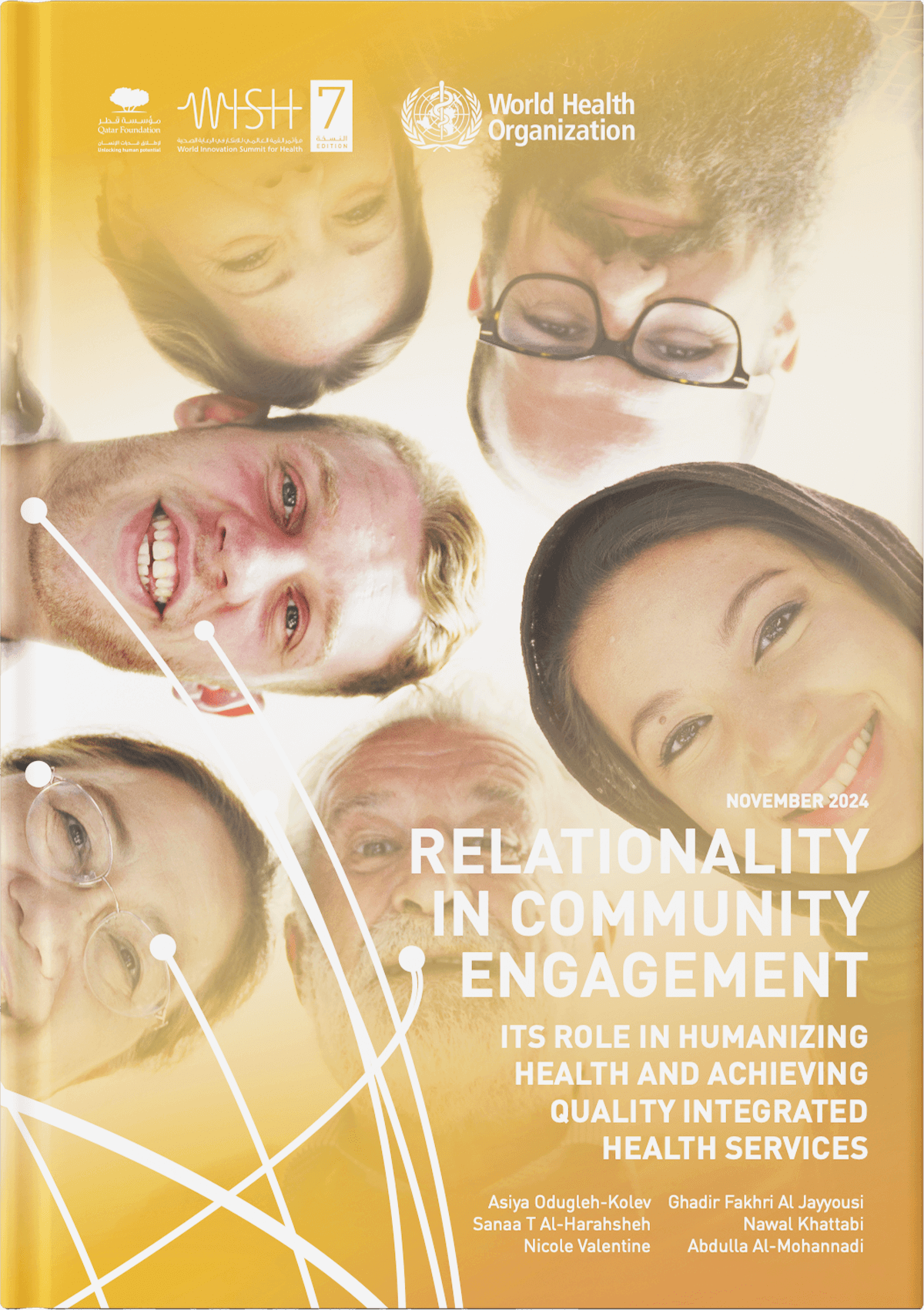
Webinar: 8 April Humanizing Health Care Through Relationality -

Exploring The Science And Practice Of Community Engagement


Join us for the first of four webinars co-hosted by the WHO Department of Integrated Health Services (IHS) and the Global Health Partnerships (GHP) (formerly THET). This webinar series is based on a new policy report launched at the World Innovation Summit for Health (WISH) -

https://wish.org.qa/wp-content/uploads/2024/09/Relationality-in-Community-Engagement.pdf 

The report revisits foundational concepts of community and examines how a deeper understanding of the relational nature of community engagement can contribute to improving quality of health care and transforming health systems. The webinar series hopes to inspire a shared understanding of community engagement’s transformative potential and how it can be leveraged for people-led change.

Continued ...


 Previously: relational :: community :: scale

Monday, November 25, 2024

The naïve approach

Categories, Bundles and
Spacetime Topology 
 

'First steps' are by their nature plagued by uncertainty of intent and direction, ungainliness, missteps, stumbles and ('finally') possibly falls.

Finding a starting point can be difficult.

Where to find a hand-hold, place one's foot, or other anchor?

At Lancaster University library I came across this book, first published in 1980. The cover displayed is from the 1988 edition.

In order of appeal I read:

applications, categories, spacetime and topology.

Section I starts with Preliminaries: Notation and Abbreviations; always useful (reminder).

The next, Section II Naïve Category Theory, had my immediate attention. We often speak of learners as being naïve. As lifelong learners we all meet this descriptor. I keep revisiting this word, concept - 'naïve'.

Naivety is a starting point for practitioners in health and social care too. Hence the need for supervision, mentors, the tokens of probationary (driver) and 'newly qualified'. 

Many posts on W2tQ stress the diagrammatic quality of Hodges' model. It is visibly a 2x2 matrix, (once again..) beloved of management consultants, psychologists and change agents. In Section II Dodson recognizes the London Underground map as a graph. A small example is developed, explained and illustrated on p.6. 

Graph example, drawing on the London Underground. p.6.

Section II may be a small part of the overall book but it is invaluable to me. As the photo above suggests, the book is old, especially as 1st edition. I will try to access the 2nd edition. If this work is a project with which you can (more ably!) assist, I would greatly appreciate your input. The aim is to signpost Hodges' model as a potential focus for all researchers. Especially researchers interested in trying to conjoin the sciences and humanities and develop visualization in the latter. 

C.T.J. Dodson. Categories, Bundles and Spacetime Topology. 1st Edition, Shiva, Kent. 1980.

Previously: 'math'

'Diagram' resources listed on former, now archived website.

Thursday, November 17, 2022

Social Sciences, measurement ... c/o Outhwaite (1991)


"the conceptual aspect of the subject matter of the social sciences circumscribes the possibility of measurement. . . . For meanings cannot be measured, only understood. Hypotheses about them must be expressed in language, and confirmed in dialogue. Language here stands to the conceptual aspect of social sciences as geometry stands to physics. And precision in meaning now assumes the place of accuracy in measurement as the a posteriori arbiter of theory. It should be stressed that in both cases theories may continue to be justified and validly used to explain, even though significant measurement of the phenomena of which they treat has become impossible." Chapter 3, Realism and Social Science. p.60.


William Outhwaite (1991) New Philosophies of Social Science: Realism, Hermeneutics and Critical Theory. London: MacMillan.

 INDIVIDUAL
|

 INTERPERSONAL    :     SCIENCES               
HUMANISTIC --------------------------------------  MECHANISTIC      
SOCIOLOGY  :   POLITICAL 
|
GROUP


quality


subject/subjective
geometry, physics (time)
metric / measurement / magnitude
quantity
*or, automated systems, robots

object/objective

social sciences - humanities

"Society consists of people. Groups consist of people. Institutions consist of people plus rules and roles. Rules are followed (or alternately not followed) by people and roles are filled by people.* Also there are traditions, customs, ideologies, kinship systems, languages: these are ways people act, think, and talk." p.108.
Chapter 7, Conclusion. (Citing Steven Lukes.)

Institutions

"There is thus an important sense in which Marx's explanandum in Capital is a conceptual question (though one whose answer required detailed empirical as well as conceptual investigation): 'why labour is expressed in value and why the measurement of its duration is measured in the magnitude of the product.'
Chapter 6, Critical Hermeneutics ... p.96.


Hodges' model:
The Individual - Group(s) axis: The subjects and agents of health and social care (theory, practice, management, policy, research, history, future studies ...)

Wednesday, February 02, 2022

Carvalho - "The Paths to Narrow Identities" 2021

"The Dasgupta-Goyal Model of Narrow Identities"

Seeking the logic(s) in the 'health career' model


 Self - Individual - Person
|

 INTERPERSONAL    :     SCIENCES               
HUMANISTIC ----------------------------------  MECHANISTIC
SOCIOLOGY  :   POLITICAL 
|
Community - Group - Population


"DG recognize that narrow identities form through social interactions and that groups play an important role in this process. This is a major advance. Because narrow identities are an equilibrium phenomenon they cannot be undone through individual will and right thinking alone. Specifically, DG’s model consists of a finite population of individuals, N, and two groups, A and B. Individuals and groups are ex ante identical. Individuals can choose to join one or both of the groups. Only the extensive margin (membership) is considered, not the time or effort devoted to each group. The payoff from joining group k ∈{A, B} is increasing in the size of group k and is also a function of the size of the other group k′ ≠ k. An individual i is said to have a narrow identity if i joins only one of the groups. Society can be said to have narrow identities when each individual i ∈ N joins exactly one group. Note that narrow identities can exist in a monomorphic equilibrium (where all individuals join one group) or a polymorphic equilibrium (where different individuals join different groups)." p.79.


Jean-Paul Carvalho. The Paths to Narrow Identities. Erasmus Journal for Philosophy and Economics,Volume 14, Issue 2,Winter 2021, pp. 77–86. https://doi.org/10.23941/ejpe.v14i2.615 

The above paper is part of an "ARTICLE SYMPOSIUM on “Narrow Identities”.

'health career' - life chances. 

My source: @PhilosL @LiverpoolPhilos


Sunday, January 16, 2022

SHAME AND MEDICINE PROJECT: 2022

‘PHENOMENOLOGY AND SHAME EXPERIENCES’

SPECIAL PANEL BSP ANNUAL UK CONFERENCE 2022

Call For Papers for special panel for the 2022 British Society for Phenomenology Annual Conference

Location: University of Exeter, UK, in-person and virtual (hybrid)

Date: Tuesday 30 August – Thursday 1 September 2022

CFP deadline: Thursday 31 March 2022 (midnight UK).

The “Phenomenology and Shame Experiences” Call for Papers invites abstracts to be considered for a special panel for the 2022 British Society for Phenomenology Annual Conference on the theme of Engaged Phenomenology II.

This panel is sponsored by the Shame and Medicine Project and the aim of the panel is to encourage an engaged phenomenological approach to considering shame in its various forms, and how it relates to and effects features of lived experience such as embodiment, affective life, consciousness, sociality, intersubjectivity, intercorporeality, health, among others.

Check out the full CfP for ‘Phenomenology and Shame Experiences’.

https://shameandmedicine.org/call-for-papers-phenomenology-and-shame-experiences/


Individual
|

INTERPERSONAL : SCIENCES
humanistic ------------------------------------------ mechanistic
SOCIOLOGY : POLITICAL
|
Group

COGNITION
lived experience
emotions
mental health
interpersonal skills
self-conscious
shame
self-stigma

subjectivity

physical health
dis-ability
place - privacy
medicine
health care

HEALTH STATUS

objectivity

STIGMA
SHAME
SOCIAL COGNITION
communication
meanings
dignity and respect

health status [REAL?]
power
health professionals
(whose parity of esteem,
autonomy, control?)
'Cost' to health systems?


My source:

Philos-L "The Liverpool List" Department of Philosophy, University of Liverpool https://www.liverpool.ac.uk/philosophy/philos-l/

@PhilosL @LiverpoolPhilos


Friday, December 10, 2021

Register for ‘Vulnerabilised Individuals and Opaque Institutions’ Feb 10 2022

Professor Havi Carel


Join us for the Second Annual Joint Center for Knowledge,
Technology and Society Center for Nursing Philosophy lecture,
“Vulnerabilised Individuals and Opaque Institutions”
with University of Bristol Professor Havi Carel.


About the lecture

“In this talk I develop the concept of vulnerabilisation to pick out a large and diverse group of people who suffer vulnerabilities caused or exacerbated by their situations. I outline how individuals can be made vulnerable by interpersonal encounters and interactions with social structures. I then discuss vulnerabilisation in relation to what I call ‘institutional opacity.’

An opaque institution is especially problematic for individuals and groups already rendered vulnerable during their interactions with that institution, and a prime example are ill persons in the context of healthcare institutions, which I discuss. I articulate the features of an encounter between a vulnerabilised individual and an opaque institution and end by tracing two ameliorative strategies that could help repair this interaction.” — Havi Carel

About Havi Carel

Havi Carel is professor of philosophy at the University of Bristol, England. She recently completed a Wellcome Trust Senior Investigator Award, the Life of Breath. She was awarded the Health Humanities’ Inspiration Award 2018 for this work.

Her third monograph, Phenomenology of Illness, was published by Oxford University Press in 2016. She was selected as a Best of Bristol lecturer in 2016.

Havi is the author of Illness (2008, 2013, 2018), shortlisted for the Wellcome Trust Book Prize, and of Life and Death in Freud and Heidegger (2006). She is the co-editor of Health, Illness and Disease (2012), New Takes in Film-Philosophy (2010), and of What Philosophy Is (2004).

Event details

Date and time: Feb. 10, 2022 | 10 a.m. Pacific; 1 p.m. Eastern; 5 p.m. UK
Event location: Zoom

Registration

You will receive a link to join the event upon registration.

My source: 

University of California, Irvine Sue & Bill Gross School of Nursing | 252 Berk Hall, Irvine, CA 92697

Previously on W2tQ:

https://hodges-model.blogspot.com/search?q=illness

Links in original source rationalised to reduce any algorithmic penalties.

Thursday, April 08, 2021

"Public Domain" - The Vaudeville Theatre

individual
|
INTERPERSONAL : SCIENCES
humanistic ----------------------------------------------- mechanistic
SOCIOLOGY : POLITICAL
|
group


Public Domain is a dark, funny, verbatim musical about the internet: Those who own it; those who live in it; and YOU!

Following an acclaimed digital debut at Southwark Playhouse this thrilling, new British musical, composed entirely from the real-life words of YouTube vloggers, Instagram influencers, Facebook’s tech giants, and everyday internet users now has its live world premiere in the West End.

Written and performed by the hugely talented Francesca Forristal (Oddball) and Jordan Paul Clarke (Showstopper! The Improvised Musical), this blackly comic musical follows two teenage influencers; Millie (sporty spice, health guru, buddha bowls – millennial) and Z (GCSEs existential dread, swag – generation Z), as well as featuring exclusive ‘footage’ of inside Mark Zuckerberg and wife Priscilla Chan’s family home…

You’re gonna get their honest, true selves… with some serious bass, obvs. Authentic, right?

Remember, it’s like ‘Black Mirror’ but real and set to music.

The Vaudeville Theatre operates strictly under the government COVID-19 guidelines. For further information check our COVID-19 secure information page. All bookings in a party must only be from the same household or the legally defined support bubble.

Sunday, August 30, 2020

How many APPGs does your Garden Grow?

APPGs - All Party Parliamentary Groups
 
 
individual
|
INTERPERSONAL : SCIENCES
humanistic ----------------------------------------------- mechanistic
SOCIOLOGY : POLITICAL
|
group - population


APPG on Autism
APPG on Learning Disability
APPG on Ageing and Older People
APPG on Carers
APPG on Parkinson's
APPG on Terminal Illness
APPG on Dementia and Adult Social Care
APPG on Dementia
APPG on Multiple Sclerosis
APPG on Disability

How do you integrate their 'outputs'?

I am not disputing the need for APPGs and their number, but highlighting a 'fact of care and governance' and what remain legacy problems of holistic, integrated, person-centred and reflective care.

My source:

Better social care, Letters to the Editor, The Times, Saturday, July 25, 2020, p.28.


Thursday, December 26, 2019

Self to Other: Forms of 'imagination'

Book: "The Sociological Imagination"


INDIVIDUAL
|
INTER-PERSONAL : SCIENCES
HUMANISTIC -------------------------------------------------- MECHANISTIC
SOCIOLOGY : POLITICAL
|
GROUP

Self
Person
Biography
imagination and creativity
individual values

Sociologist C. Wright Mills, who created the concept and wrote the definitive book about it, defined the sociological imagination as “the vivid awareness of the relationship
 between [individual] experience ...

'Thought experiment'

...and the wider society." (Crossman, 2019).

Charles Wright Mills (1916-1962)
The Sociological Imagination, 1959
Political 
imagination ACTION!

growth
climate change
universal health care
antibiotic resistance
pollution
corruption
fake news


My source:
Dillow, C. (2019) The demise of growth stocks, Investors Chronicle, 13-19 December, 210:2680, pp.16-17.

Additional links:

C.Wright Mills: On Intellectual Craftsmanship
https://brettworks.com/2010/11/04/c-wright-mills-on-intellectual-craftsmanship/

Crossman, Ashley. "Definition of the Sociological Imagination and Overview of the Book." ThoughtCo, Oct. 25, 2019, thoughtco.com/sociological-imagination-3026756

Wednesday, July 10, 2019

Ethnicity - Pay Gap: in Hodges' model

individual - self
|
INTERPERSONAL : SCIENCES
humanistic ----------------------------------------------- mechanistic
SOCIOLOGY : POLITICAL
|
group- population


Tuesday, March 26, 2019

Word use & implications for research - 'Population health' by Canales, Drevdahl & Kneipp (2019)

individual
|
INTERPERSONAL : SCIENCES
humanistic ----------------------------------------------- mechanistic
SOCIOLOGY : POLITICAL
|
group - POPULATION
individual health

a. INTERVENTION in Individual behaviour

4Ps - PURPOSE
My word use -
(contribution to and affected by
a community of practice)
  
scale
Begin: Planetary Health End:

 interventions
  Length and quality of life
 academia - evidence-base
b. INTERVENTION in a healthcare sector
Public Health as a discipline - word use
SMALL-scale:
 health promotion and disease prevention
FROM: individual
CLINICAL - sub-groups
TO: group - population
 A data dictionary?
4Ps - PROCESS
language use - 'pop. health' meaning?

Social and Society

Does the community have a role in local health population management?

a. and b. insufficient to address -
social determinants and health inequities
root - societal and structural levels

History

Community activists for Social Determinants of Health
4Ps - PRACTICE

SOCIO-
TOTAL POP. [health systems Pop.]

population health management
4Ps - POLICY

political & economic systems
low-income
LARGE-scale: community initiatives that attempt to reduce inequities by challenging
poverty and racism


SDOH - inc:
food supply, housing, economic and social
relationships, transportation,
education, and health care

-ECONOMIC


Canales, M.K., Drevdahl, D.J., Kneipp, S.M., (2019) Moving Words, Moving Meanings: The Discourse of Population Health, Journal of Professional Nursing, 35, 2, 71-73, ISSN 8755-7223,
https://doi.org/10.1016/j.profnurs.2019.02.007
(http://www.sciencedirect.com/science/article/pii/S8755722319300201)

Wednesday, March 13, 2019

Knife crime: treat as a 'disease'.. (in Hodges' model!)

individual
|
INTERPERSONAL : SCIENCES
humanistic ----------------------------------------------- mechanistic
SOCIOLOGY : POLITICAL
|
group
Individual Human Rights
 Self - IDENTITY
Vulnerability - Influence of others?
 Motivation, Anger, Impulsivity
Schools - bag searches

public MENTAL health
Character; Values
Self-esteem, responsibility, resilience
'Kids with attitude' (great)?
'Kids with attitude' (problem)?

 D   disease models
 A                         
 T                    Public Health
 A             Violence: stabbing, slashing

 T        Access to weapons inc. kitchen knives
 R            Weapon concealment on person
 A                            Metal detectors
 C    of individuals
peer GANGS groups
belonging
social cohesion - social integration
Family structures
'Friends and Family'
'Friends as Family'
Social services: housing, education,
community centers, community workers
'Moral Panics'?
Victim's family - aftermath
COMMUNITY 
 K    and groups
 I                   Youth Services - Funding
 N               'Global' action - All Together
 G                          Chicago - Glasgow
"STOP & SEARCH"
          Public Health approach to policing violence
School (exclusion, impact of)
Knife crime: Policy, Home Secretary
  'Strong ENFORCEMENT'
Strategy - Early Intervention
 POLICING           legal advocates

See also:

BBC Radio 4 - Moral Maze 13 March 'Moral Panics'

My source:

Various including: @rydermc "Not a sticking plaster" on https://www.tortoisemedia.com/

 https://twitter.com/rydermc/status/1104706208630489089

David Gillanders

Saturday, January 12, 2019

Book: Making of Byrne’s Euclid

individual
|
INTERPERSONAL : SCIENCES
humanistic ----------------------------------------------- mechanistic
SOCIOLOGY : POLITICAL
|
group

My source: Twitter @dr_tj @defilippovale @rougeux

https://twitter.com/defilippovale/status/1074436950663278592

Monday, October 15, 2018

Primary Care and the GP crisis: Individual - Group [Consultations]

individual
|
INTERPERSONAL : SCIENCES
humanistic ----------------------------------------------- mechanistic
SOCIOLOGY : POLITICAL
|
group

Mental health (use of groups)

One-to-One
Interpersonal skills
Psychological therapies
PURPOSE
Psychotherapy
Time, Place
Efficiency
Cost-effectiveness
Evidence-based
same conditions
PROCESS

Group Consultations
Group Therapy -
an established therapeutic modality
Group CBT for Older Adults
PRACTICE

POLICY
Treatment
Therapy
Education
Doctor or Nurse led
other disciplines too...


My source:
The Telegraph, GPs to see patients in groups of 15

@weGPNS - text corrected from original.

Thursday, August 09, 2018

The Health Career - Life Chances - Model as Critical Social Theory...?

"... the concept of knowledge that is central to critical social theory takes in all possible forms of knowledge, from implicit knowledge (tacit knowledge, know-how, etc.) to the knowledge that we find methodically sharpened and theoretically developed within science. As a conceptual tool of critical analysis applied to contemporary society, such a notion of knowledge makes it possible to study the way that interrelations between the various forms of knowledge are shaped by the relationships between knowledge carriers and between the social groups that they form (what Znaniecki has dubbed "social circles"). Interpreted as a form of cultural capital, knowledge comes to be seen as a factor in power relations, as a potent force driving social development, and as a fundamental determinant of life chances." p.44.
Invasive Technification

With my emphasis.

Carriers: individuals, groups, populations, knowledge (care) domains?

Information: ???


Gernot Böhme (2012) Invasive Technification: Critical Essays in the Philosophy of Technology, Bloomsbury: London.

My source: Waterstones, Gower Street, London, £6.99.
See also:
https://hodges-model.blogspot.com/search?q=fundamentalism 
https://hodges-model.blogspot.com/search?q=life+chances


Saturday, November 04, 2017

Book: (more than) Skin Deep ...?

individual
|
INTERPERSONAL : SCIENCES
humanistic --------------------------------------- mechanistic
SOCIOLOGY : POLITICAL
|
group


"For decades now tattoos have been potent symbols of the Los Angeles gang-life scene. The black and white tattoos with recognizable gang symbols appear on members’ faces, necks and all over their bodies, making their gang affiliation immediately clear to whomever crosses their path. This can mean the difference between life and death on he streets, and just as often, in prison. ..." 

My source: Sandhu, S. Crime ink: lifting the layers of prejudice, 20 October, i news, pp.30-31.

Photos: http://www.powerhousebooks.com/books/skin-deep-looking-beyond-the-tattoos/

Saturday, October 13, 2007

Drupal, Northern England CHE group

It's been a busy week...

On Wednesday night the turnout for the 1st NW England Drupal user group was excellent. A great springboard for next month. I've ordered another book! The title reflects an aspirational air. Although search inside helps, there's nothing like having chance to open the book for real and scan. Especially, when you've also been shown (thanks Chris!) some basics of installation and must-have modules. So, if this blog suffers through the Solstice well you know why ;-).

Today, the Yorkshire Sculpture Park proved a great find for me; with Criggy and Andy there were just three of us for the Northern England CHE group meet. It was overcast and drizzled occasionally, but the conversation and exhibits ensured it was really warm and sunny. Walking and bike riding in the 90s around Grizedale Forest I remember Andy Goldsworthy's work: brilliant! Hope to go back before this exhibition ends in January. Strange how I'd seen it featured on the Culture Show - BBC 2 and the programme returned for a new series tonight.

Back very soon... CBT and CMHNs: - Anyone for tennis?

Sunday, August 12, 2007

Assen NL + Northern England CHE group Oct 13 Rivington Park Arts, Horwich

Sunday 0500 last week arrived home from Assen, Netherlands with Matt and Lawrence my son's friend having attended the Assen cycle Tour. It really was an international field and they really flew. Some unfortunately more than others.... The first race Matt came off!! - scaphoid # so we got to see the Dutch health service at work and very impressive too. Thanks to the staff at Wilhelmina Hospital - great job (I notice the TT circuit also keeps them busy). Closing my eyes while waiting for the Radiographer (like you do) Wilhelmina did not 'sound' like a hospital. Excellent attention to the 'hospital' environment - the colour, some nice curves, the signage was spot on too.

At the close of the holiday-cycle tour the sunset at Calais was beautiful.

Returning to the human ecology thread, I can confirm that the next Northern England CHE group event will be on Saturday 13th October 11-3pm at Rivington Park Arts. The group would like to thank David Ruaux for providing us with a room and facilities.

The theme for the meeting is well-being and I'll post more details nearer the time. Leave a comment or e-mail me h2cmng AT yahoo.co.uk and we will add you to the mail list.

Well I'm getting to know my ready-made case-load. It really does not feel like I've been away some 2.5 years. This is what Hodges' model was born for and it's great to get the therapeutic juices flowing again. I've not yet stabbed anyone (injections!), but that won't be long. Actually, I think a delay here is positive evidence that injections and medications are used much more carefully now; especially with older adults and they are reviewed regularly. A trend that has been in train for many years.

Speaking of trains - wonder if it will be clear tonight and in the early hours...?