Hodges' Model: Welcome to the QUAD: Search results for scale

Hodges' model is a conceptual framework to support reflection and critical thinking. Situated, the model can help integrate all disciplines (academic and professional). Amid news items, are posts that illustrate the scope and application of the model. A bibliography and A4 template are provided in the sidebar. Welcome to the QUAD ...

Showing posts sorted by relevance for query scale. Sort by date Show all posts

Monday, July 18, 2022

The QUALCARE Scale - in Hodges' model

 Clearing yet another piece of notepaper from the 1990s, when I wrote (from the abstract):

"The QUALCARE Scale is an observational rating scale designed to quantify the quality of family caregiving to home-dwelling elders in six areas: physical, medical management, psychosocial, environmental, human rights and financial."

 (extra note - 53 item Likert scale format.)

INDIVIDUAL
|
 INTERPERSONAL    :     SCIENCES               
HUMANISTIC --------------------------------------  MECHANISTIC      
SOCIOLOGY  :   POLITICAL 
|
GROUP


PSYCHO-


PHYSICAL

ENVIRONMENT

MEDICAL MANAGEMENT
-SOCIAL

ENVIRONMENT


(MANAGEMENT)

HUMAN RIGHTS

FINANCIAL


Phillips LR, Morrison EF, Chae YM. The QUALCARE Scale: testing of a measurement instrument for clinical practice. Int J Nurs Stud. 1990;27(1):77-91. doi: 10.1016/0020-7489(90)90025-e. PMID: 2312237.

I had encountered Hodges' model in 1987-88 [ Manchester Polytechnic College, now Manchester Metropolitan University, CPN(Cert.) course ], but the initial (and thus far only) website appeared in 1998 (-2015):

https://web.archive.org/web/19990501185433/http://www.p-jones.demon.co.uk/index.htm

Friday, May 08, 2026

iv WCCS26: World Conference on Complex Systems 20-22nd April

Day 1: Panel 2 - Rethinking Knowledge in the Age of Complexity

  • Helena Knyazeva - Dancing with Complexity: How the World Thinks Through Us
  • Carlos Gershenson - The Implications of Complexity
  • Leonardo Rodríguez Zoya - Can Statistics Think? Complexity, Future, and Freedom in the Age of Large Language Models
    Panel Chair: Nigel Gilbert 

Courage is one of the 6Cs in nursing, and was on display at WCCS26.

Carlos Gershon began by offering two references, the first:

De Domenico, et al., (2019). Complexity explained: A grassroot collaborative initiative to create a set of essential concepts of complex systems. https://complexityexplained.github.io

This is a brief 20 pages, larger text, and provides a helpful primer to complexity and related concepts covering:

Interactions
Emergence 
Dynamics 
Self-organization
Adaptation
Interdisciplinarity
Methods

For each concept, the authors explain:

Definition/Description
Examples
Relevant Concepts
References

Plus, secondly:

Gershenson, C. The Implications of Interactions for Science and Philosophy. Found Sci 18, 781–790 (2013). https://doi.org/10.1007/s10699-012-9305-8

I liked the practical feel here, the encouragement to think anew, and perhaps taste the "flavors of emergence": synchronic - space; diachronic - time, weak and strong feedback, transversal of scale - upwards and downwards.

There is further conference on complexity later this year (and also online!):

CCS 2026:
The 2026 Conference on Complex Systems
OCTOBER 9 - 16, 2026 BINGHAMTON, NY, USA & ONLINE

In my search I also found:

Carlos Gershenson; Complexity, Artificial Life, and Artificial Intelligence. Artif Life 2025; 31 (3): 289–303. doi:https://doi.org/10.1162/artl_a_00462

Gershenson, C. Self-organizing systems: what, how, and why?. npj Complex 2, 10 (2025). https://doi.org/10.1038/s44260-025-00031-5

Leonardo Rodríguez Zoya's presentation helpfully connected social practice, interdisciplinary bridges, statistical rationality, complex (human) rationality and the future(s): desirable, possible, latent and probable.

individual
|
INTERPERSONAL : SCIENCES
humanistic ------------------------------- mechanistic
SOCIOLOGY : POLITICAL
|
group
COMPLEX (HUMAN) RATIONALITY
 
cognition

STATISTICAL RATIONALITY
Techopraxis
LLMs - technology

socio-
HUMAN PROBLEMS
SOCIAL PRACTICE
PRACTICE (one of the 4Ps)

ELECTION - CAMPAIGN SPENDING
PEACE NEGOTIATIONS
ISLAND ECONOMY
CRYPTOCURRENCY

To answer the prompt - 

"Give me a less likely but more fruitful interpretation of this [concept]*."

*Replace with a significant concept in your practice

Would it might help to have a simple, and yet complexity (and simplicity!) primed conceptual framework to assist reflection, argumentation, and progress?
 
I missed the poster at the afternoon break, and followed track 1. I greatly enjoyed Julian Arevalo's - Adaptive Readiness: an Agent-Based Model of Peace Negotiations. Perhaps this accounts for my having no notes or photos for this track except for one. I realise now we did speak, sitting together for the conference dinner. I'm sure I remember Negotiation Lab 1.0 - 

https://www.comses.net/codebases/1256dc74-9ae4-4f49-a235-1ec129be1930/releases/1.0.0/
 
This past week I heard discussion (BBC Radio 4) of the 'income' Norway obtains from its expertise and engagement in peace negotiations.
 
Nicholas Roxburgh, and colleagues Rachel Creaney, Mindi Premarathne and Ruth Wilson through 
Exploring Interdependencies in an Island Economy, reminded me of public engagement in research. Especially when it involves their community; and that community is somewhat rural, or remote.
 
Remah Dahdoul, with Jan Korbel and Stefan Thurner presented -
Campaign-Spending Driven Polarization Transition in a Double-Random Field Model of Elections. The following paper brings home the mathematics in complex systems. The reference is:
 
Jan Korbel and Remah Dahdoul and Stefan Thurner. (2026) Empirical validation of the polarization transition in a double-random field model of elections. arXiv. https://arxiv.org/abs/2510.00612.  doi.org/10.1103/9gjj-1df6.
 
The paper by Saida Hachimi El Idrissi and Mohamed Nemiche is not open access, but the abstract follows. 
 
S. H. El Idrissi and M. Nemiche, "Formation of Complex Societies: An Agent-Based Model Inspired by Freudian Theory," 2024 World Conference on Complex Systems (WCCS), Mohammedia, Morocco, 2024, pp.1-6, doi: 10.1109/WCCS62745.2024.10765573.
Abstract: The rise and emergence of complex societies in the Old World mark a pivotal chapter in human history, characterized by the transition from small, kin-based communities to large, hierarchical states. This transformation raises fundamental questions: How did human societies progress from small, cohesive groups characterized by face-to-face cooperation to the expansive, anonymous societies of today, often organized as states? What factors account for the significant variation in different human populations' capacity to construct stable and functional state structures? To address these questions, we developed an agent-based model grounded in Freud's hypothesis, which posits that civilization could neither emerge nor evolve without the repression of human desires. In the context of social evolution, this repression of desires can be interpreted as the repression of intra-societal competition, ultimately strengthening the society and facilitating the formation of complex social structures. We implemented this model within a realistic representation of the Afroeurasian landmass, incorporating various geographical factors. To validate our model, we compared our simulated results with historical data. The model-predicted pattern of expansion of complex societies demonstrated remarkable congruence with the observed historical patterns in the Old World. The emergence, growth, and distribution of large-scale societies predicted by our computational model showed remarkable consistency with the archaeological and historical record.

keywords: {Analytical models; Computational modeling; Predictive models; Data models; Agriculture; Rivers; History; Complex systems; component; Agent-based Modeling; Repression of satisfaction; cooperation; competition; Social Simulation},
URL: https://ieeexplore.ieee.org/stamp/stamp.jsp?tp=&arnumber=10765573&isnumber=10765499 
Unless you are a microsurgeon (increasingly with robotic co-workers), is the word practice, more likely to manifest what is larger, the big picture, a sense of space, even at a societal or continental scale? In reading, I came across four forms of attractors. For me, how they fit into the question of scale makes this paper worthy of seeking out. 

M. Nemiche was unable to attend the conference, and was greatly missed.

Friday, January 24, 2025

ERCIM News No. 140 Special theme: "Large-Scale Data Analytics"

Dear ERCIM News reader,

ERCIM NEWS #140
The January 2025 issue of ERCIM News (Number 140) is online with a special theme on Large-Scale Data Analytics. This issue features a Special Theme that highlights the diverse applications of large-scale data analytics across Europe. The advancements are achieved through close collaboration with European data spaces and open science platforms.

You can access the issue at https://ercim-news.ercim.eu/

This special theme was coordinated by our guest editors Andras Benczur (HUN-REN SZTAKI) and Dominik Ślęzak (University of Warsaw).

===
Note PJ: Includes: 
Breaking the Silence: Brain-to-Speech Innovations. p.36
Data Visualisation for Big Data: Digital Epidemiology. p.39.

CWI Research Semester Programme. Truth is in the Eyes of the Machines Amsterdam, 8-9 May 2025.
https://kwz.me/hF1
===

Thank you for reading ERCIM News! Please share this issue with anyone who might find it interesting. You can also support us on LinkedIn. Let's keep the conversation going and share the latest updates together!

Next issue: No. 141, April 2025
Special Theme: "Cultural AI". Submissions are welcome! See preliminary call for contributions.


ERCIM News is published quarterly by ERCIM, the European Research Consortium for Informatics and Mathematics. With the printed and online edition, ERCIM News reaches more than 10000 readers.
All issues published to date are available online.


About ERCIM

ERCIM - the European Research Consortium for Informatics and Mathematics - aims to foster collaborative work within the European research community and to increase cooperation with European industry. Leading European research institutes are members of ERCIM. ERCIM is the European host of W3C.

https://x.com/ercim_news
ERCIM LinkedIn Group
ERCIM LinkedIn Page

Peter Kunz                      	
ERCIM Office
2004, Route des Lucioles
BP93
F-06902 Sophia Antipolis Cedex

Monday, October 08, 2018

Book Review: [ii] Health System Redesign - How to Make Health Care Person-Centered, Equitable, and Sustainable

Part 1 gets straight to the matter of "challenging the orthodoxy" with a two page introduction to complexity and health. Part 1 covers:

  • systems sciences
  • visualization of complex systems (Capra's vortex metaphor)
  • understanding the co-existence of different degrees of complexity and their dynamics within complex adaptive organisations based on Kurtz and Snowden's Cynefin model.
  • health as a "complex adaptive experiential state"
All four points here are very pertinent to where we are in health and healthcare (the book rightly stresses this differentiation) and current and ongoing 21st century issues. The use of Capra helps to distinguish scale and the levels inevitably existent, experienced, and described in health and healthcare systems.

If you are familiar with Hodges' model and the Cynefin model, then the answer is yes - seeing the Cynefin model did make me hoot. (I remember Dave Snowden's work from Plaxo and a presentation he did in Lancaster back in 2007). More importantly, part 1 introduces where the focus needs to be to facilitate change; on the core driver of the system, the system's long-term direction, a specific system view and the need for a solid grounding in theoretical and applied approaches. This is were the visual tools and producing a view - perspective are so important. Chapter 2 contrasts the simple scientific world view and the complex scientific. The reader is asked to consider numerous background points, from the colloquial meaning of complex/complexity to the scientific. How do the words 'complex' and 'complicated' differ? At small scale the result is greater certainty BUT loss of context, while at the large scale we find greater uncertainty AND loss of detail.

https://www.springer.com/us/book/9783319646046
Figure 2.3 shows the key features of complex systems (also indicating the dynamics - '+' '-'):
  • System boundaries
  • Interconnectedness
  • Feedback
  • Impact of starting (initial) condition
Some of the figures point to their means of creation "The essence of systems thinking" (Figure 2.4) produced through Insightmaker. Sturmberg's seeks to ground the discussion too by reference to the everyday. Table 2.1 runs through how systems can be related to the experience of a 'Long day at work'. Addenda are put to immediate effect with a reference to a map of the history of complexity science; the philosophy of complex adaptive systems; and the complexity and difficult questions.

As already suggested Chapter 3 on the visualisation of complex adaptive systems had my attention. The vortex metaphor (Capra) seems trite on first encounter, but it works.* The four different ways to map a system:
  1. Systems map
  2. Influence map
  3. Multiple case diagram
  4. Sign graph diagram
are quite important as if you can take the explanations onboard you really will be on the way to fully understanding and utilising theoretical and applied approaches. The learning here is allied with understanding common system dynamic behaviours which are also illustrated and explained. Figure 3.4 shows the Cynefin framework, which is still in my head. The Cynefin model deals with the continua of:
  • uncertain - certain
  • non-linear - linear
  • Contrasts - Learning and Teaching
  • and four quadrants that combine what is complex, knowable or complicated, chaos, and known or obvious (simple). The three references here span 1996-2003.
At chapter 4 - I was worried - 'Defining Health' (now there's a task) but this is also interesting, rewarding and well placed. Core notions of health are tabled (4.1) from 1911 to 2007. Health is distinguished from dis-ease. I must follow up the footnote on p.59 Marja Jylhä and her framework of self-perception of health. 

The illustrations on pp.60-61 are frustrating.

Very!

Not because they shouldn't be there, but because they are a gift that remain (as far as I am aware) unrealised in respect of those of us working in the humanities. We still lack the visualisation tools that we need.

If I mention Figure 4.1 "The somato-psycho-socio-semiotic model of health" you will get the drift and overlap with Hodges' model. There is more with 4.2 on Attractors in Health and Illness and the system dynamics of health. The political attractor is missing (and its 'gravitational' impact) in this rendering, but the barriers to progress are also raised at the book's end. Given the topic of health, the text is not science light, with the physiology of health and disease also used to explain points, so we have, gene networks, the autonomic nervous system, the hypothalamic-pituitary-adrenal axis and bioenergetics in the mitochondrion. While not in-depth the potential application across external factors-personal experiences and internal mechanisms are demonstrated. The role of the patient, public and carers are central today and realised to various degree in theory, practice, management and policy. Self-rated health is briefly mentioned and with community health and health services utilisation this closes part 1.

More to follow...

Sturmberg JP. Health System Redesign. How to Make Health Care Person-Centered, Equitable, and Sustainable. Cham, Switzerland: Springer; 2018.

See also first part...

Saturday, August 09, 2025

Richardson et al. 'The entities enabling scientific fraud at scale are large, resilient, and growing rapidly'

Abstract

'Science is characterized by collaboration and cooperation, but also by uncertainty, competition, and inequality. While there has always been some concern that these pressures may compel some to defect from the scientific research ethos—i.e., fail to make genuine contributions to the production of knowledge or to the training of an expert workforce—the focus has largely been on the actions of lone individuals. Recently, however, reports of coordinated scientific fraud activities have increased. Some suggest that the ease of communication provided by the internet and open-access publishing have created the conditions for the emergence of entities—paper mills (i.e., sellers of mass-produced low quality and fabricated research), brokers (i.e., conduits between producers and publishers of fraudulent research), predatory journals, who do not conduct any quality controls on submissions—that facilitate systematic scientific fraud. Here, we demonstrate through case studies that i) individuals have cooperated to publish papers that were eventually retracted in a number of journals, ii) brokers have enabled publication in targeted journals at scale, and iii), within a field of science, not all subfields are equally targeted for scientific fraud. Our results reveal some of the strategies that enable the entities promoting scientific fraud to evade interventions. Our final analysis suggests that this ability to evade interventions is enabling the number of fraudulent publications to grow at a rate far outpacing that of legitimate science.'


R.A.K. Richardson, S.S. Hong, J.A. Byrne, T. Stoeger, & L.A.N. Amaral, The entities enabling scientific fraud at scale are large, resilient, and growing rapidly, Proc. Natl. Acad. Sci. U.S.A. 122 (32) e2420092122, https://doi.org/10.1073/pnas.2420092122 (2025).
https://www.pnas.org/doi/10.1073/pnas.2420092122


My source: The Economist, 9th August 2025. 
https://www.economist.com/science-and-technology/2025/08/06/fraudulent-scientific-papers-are-booming

Tuesday, March 26, 2019

Word use & implications for research - 'Population health' by Canales, Drevdahl & Kneipp (2019)

individual
|
INTERPERSONAL : SCIENCES
humanistic ----------------------------------------------- mechanistic
SOCIOLOGY : POLITICAL
|
group - POPULATION
individual health

a. INTERVENTION in Individual behaviour

4Ps - PURPOSE
My word use -
(contribution to and affected by
a community of practice)
  
scale
Begin: Planetary Health End:

 interventions
  Length and quality of life
 academia - evidence-base
b. INTERVENTION in a healthcare sector
Public Health as a discipline - word use
SMALL-scale:
 health promotion and disease prevention
FROM: individual
CLINICAL - sub-groups
TO: group - population
 A data dictionary?
4Ps - PROCESS
language use - 'pop. health' meaning?

Social and Society

Does the community have a role in local health population management?

a. and b. insufficient to address -
social determinants and health inequities
root - societal and structural levels

History

Community activists for Social Determinants of Health
4Ps - PRACTICE

SOCIO-
TOTAL POP. [health systems Pop.]

population health management
4Ps - POLICY

political & economic systems
low-income
LARGE-scale: community initiatives that attempt to reduce inequities by challenging
poverty and racism


SDOH - inc:
food supply, housing, economic and social
relationships, transportation,
education, and health care

-ECONOMIC


Canales, M.K., Drevdahl, D.J., Kneipp, S.M., (2019) Moving Words, Moving Meanings: The Discourse of Population Health, Journal of Professional Nursing, 35, 2, 71-73, ISSN 8755-7223,
https://doi.org/10.1016/j.profnurs.2019.02.007
(http://www.sciencedirect.com/science/article/pii/S8755722319300201)

Sunday, May 29, 2016

Networked Learning Conference 2016 leads to Barcelona which means...?

After the ICIC 2016 in Barcelona this past week I'm still reflecting on Lancaster and the Network Learning Conference. It has been a busy month. I'll write about Barcelona (again) soon, but with the ICIC presentation done (thanks to all 30+ who attended the session and engaged afterwards) I can catch up a little. Despite the stress this implies this is all positive as the challenge lies in the opportunities and tensions between nursing-healthcare, education and technology.

In Lancaster, Fran Tracy (Liverpool John Moores University) and Jesper Jensen (University of Southern Denmark) held a symposium - Designs for learning with the Semantic Web. Three papers were presented followed by discussion on:

1) the emergent nature of semantic web technologies, 2) how participatory research practices like DBR are affected during the development of semantic web technologies and 3) how both of these concepts may find a new place as we move forward into increasingly complex and changeable educational environments.
By means of introduction there were several useful pointers and reminders, including Stahl with a definition of emergence and a definition of design based learning (and DB Research). It was the combination of semantic web, DBR and networked learning which made this an immediate must-go-to session for me. My research proposal is seeking to combine these aspects plus situated learning.

I probably won't be following DBR by-the-letter(s) as defined by some advocates. My application will to some extent be emergent. There will, as I envisage it, be several invitations for users to contribute to DBR but being asynchronous this needs to be factored in. All learners - users could contribute to successive iterations, but this is unlikely and once the numbers get beyond 10-15 it would become complex and difficult to make a sense of. Poll-based reconciliation might work? As per #2 above my plan would be that a number of subjects (web users) would provide views on their experience with the model and the future site. So it is DBR on a scale that befits a small-scale evaluation study. Tracey also mentioned Wang and Hannafin (2005) and their definition of DBR:
a systematic but flexible methodology aimed to improve educational practices through iterative analysis, design, development, and implementation, based on collaboration among researchers and practitioners in real-world settings, and leading to contextually-sensitive design principles and theories. (p. 7)
The context sensitive is were I see a role for situated learning. There are a couple of hierarchies that result. Situated learning brings in the community (- of practice), but Hodges' is firstly about the student, the care situation and their learning with the model, reflection and developing reflective practice. There are few examples of technology mediated group reflection, but the technical challenges of the group form make the individual starting point more realistic?

Simonson also cites the above and notes how DBR is pragmatic. My approach is pragmatic (that's why it's taking so long).

In Hodges' model I've written before how the interpersonal care domain, combines the INTRA (an individual's metacognition - their thinking about thinking) and the INTERpersonal (how they relate to the other). The NL conference and this past week at #ICIC2016 have helped me realise that this project may also possess this property*. As an intraproject and interproject (?) subjects (students) may engage at any of the following levels:
  • Not engage in design questions at all / Read the intro materials on Hodges' model
  • Read the intro materials / use the site for their case study purposes
Drupal can (I believe and have seen demonstrated) provide a great deal of web analytics from logs and reports. There is the prospect of taking this further using web analytics to inform the specific site locations subjects have visited. (For Hodges' model visual tracking would be an excellent measure but that is beyond me). There is a potential escalator of sorts here:
  • Use the site for their case study purposes / comment on the usability of h2cm and the site
  • Comment on the usability of h2cm and the site / See their web analytics data and my conclusions about this 
  • See their web analytics data and my (other student's!) conclusions about this / Use their experience, knowledge and this feedback to respond to design questions
These design questions would then socio-technically span their nursing care learning and TEL. The project as a whole represents at its core the intra, its about the student's reflection and being reflexive. It could be that the project can progress to group and community. As posted previously I have highlighted the functionality of Drupal with respect to the semantic web. I mentioned Drupal in the discussion. The conceptual (and semantic) dimension that can be found within Hodges' model, the curriculum, the learner's vocabulary and development might facilitate that transition from individual to group? Since 2008 I've followed the development of RDF, semantic web in Drupal and the longevity of contributed modules and Drupal projects that have used them. Framing these observations with an emergent lens is fascinating in terms of the challenges, opportunities and tensions in nurse education, TEL and furthering Hodges' model.

I added the asterisk above as what follows from that point seems a long winded description of what is basically an experiment, with the attendant risks... I need to forget about the INTER and concentrate on the INTRA and yet both clamour for attention. Whatever follows must deliver something tangible for subjects# to mitigate the risk and translate experiment into (some resemblance of) workflow? It can't be quod cum fit, however long 'after' may be...

(The terms intra-project and inter-project are not novel, see for example: http://eprints.qut.edu.au/31946/ )

The symposium paper

Simonson, M. (2006). DESIGN-BASED RESEARCH Applications for Distance Education. The Quarterly Review of Distance Education, 7(1), pp. vii–viii.

Wang, F. & Hannafin, M. (2005). Design-based research and technology-enhanced learning environments. Educational Technology Research and Development, 53(4), 5-23.

# students, subjects, users - all these terms may be applicable.

Wednesday, August 02, 2017

Nurses ... console, console, yes; but don't become one ...

individual
|
INTERPERSONAL : SCIENCES
humanistic --------------------------------------- mechanistic
SOCIOLOGY : POLITICAL
|
group


subjective

console
noun
a surface on which you find the controls for a piece of electrical equipment or a machine:

a gaming console


console
verb

to make someone who is sad or disappointed feel better by giving them comfort or sympathy:

He tried to console her, but she kept saying it was all her own fault.
I tried to console her with a box of chocolates.
I was consoling Liz on having broken up with her boyfriend.


objective


[ political objectives? ]


My source:
Whiston Hospital: Accident & Emergency & Resus, Laminated FLACC.
Face, Legs, Activity, Cry and Consolability scale for assessing pain in infants and children

See also:
Crellin D.J., Harrison, D., Santamaria, N, & Babl, F.E. (2015). Systematic review of the Face, Legs, Activity, Cry and Consolability scale for assessing pain in infants and children: is it reliable, valid, and feasible for use? Pain. Nov;156(11):2132-51. doi: 10.1097/j.pain.0000000000000305.

Dictionary entries:
http://dictionary.cambridge.org/dictionary/english/console


Wednesday, February 14, 2024

Distance: Shoulders and ships that pass ...

James Lovelock, 2005 (cropped).jpg
Lovelock in 2005: Wikipedia

Over the past 10-20 years I've become more aware of the distance from scholars and people whose work is relevant to Hodges' model. Distance in the sense of their concomitant 'celebrity', hence the issue of how to make contact; and the stage of their career and my discovery of their relevance. Three people come to mind ... 

I've long admired the work of James Lovelock, and when writing on ecological themes in -

Jones, P. (2008) Exploring Serres’ Atlas, Hodges’ Knowledge Domains and the Fusion of Informatics and Cultural Horizons, IN Kidd, T., Chen, I. (Eds.) Social Information Technology Connecting Society and Cultural Issues, Idea Group Publishing, Inc. Chap. 7, pp.96-109.
- I wondered about trying to contact Dr Lovelock. As the majority of people are aware his thought and books, especially the Gaia hypothesis with Lynn Margulis caught the public's imagination from first publication and through the 1970s. Was there a Horizon TV programme? James Lovelock's influence was not just in ecology, but also earth (planetary) sciences through work for NASA. In early 2021 I thought I would reach out, through his most recent book and publisher/agent. I passed a message, which was forwarded but I never heard anything more.

As a nurse - with experience in older adult community mental health, I was acutely aware that this senior gentleman - in every sense of the word - may not want to be mithered by a scouser*, now living near Wigan Pier. I stressed not wanting to disturb the Dr. I also thought, given Dr Lovelock being of independent mind - a maverick, he might on the contrary love to be disturbed. 

Sadly, I was too late, hearing the news of Dr Lovelock's death in 2022. Of course, I was seeking validation (and still am) for the project here. I can't help thinking though, that Dr Lovelock really would have 'got' Hodges' model.

James Lovelock: BBC Radio 4 The Life Scientific

<>

Philosophy has long been an interest B.A.(Joint Hons.) Comp./Phil.. In a way you have no choice as a nurse, especially trained in mental health and general nursing: the theory and practice invariably touch reality, consciousness, perception, subjectivity, objectivity, knowledge, being, perception, data, information, time and so on.

Once acquainted with Hodges' model, scale is the dimension that asserts itself. I wrote about this and referenced Mario Bunge in about 1998, on the old, now archived website:

https://web.archive.org/web/20100329050839/http://www.p-jones.demon.co.uk/infintro.htm

Scale is a constant and multicontextual focus, but interest was piqued once again as I try to look at Hodges' model mathematically (yes, who am I trying to kid!) - as an object and relationally. I was reminded of Prof. Bunge's work noting a paper that included 'isomorphic-ism':

Bunge, M. (1969). Corrections to “Foundations of Physics”: Correct and Incorrect. Synthese, 19(3/4), 443–452. http://www.jstor.org/stable/20114653

https://link.springer.com/article/10.1007/s10838-021-09553-7

Mahner, M. Mario Bunge (1919–2020): Conjoining Philosophy of Science and Scientific Philosophy. J Gen Philos Sci 52, 3–23 (2021). https://doi.org/10.1007/s10838-021-09553-7

There may be a brief email exchange with Prof. Bunge, a request for a paper or two. Any emails are now stored (CD-ROM and portable drive) in a Turnpike folder, an old email client. Last year I was disappointed again, to learn of Dr Bunge's passing in 2020. His focus on science, philosophy, and systems - hard / soft is also very informative.

<>

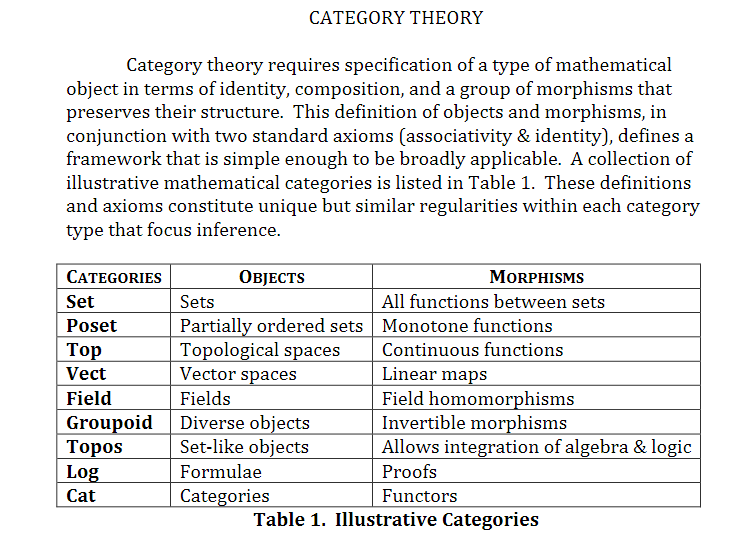
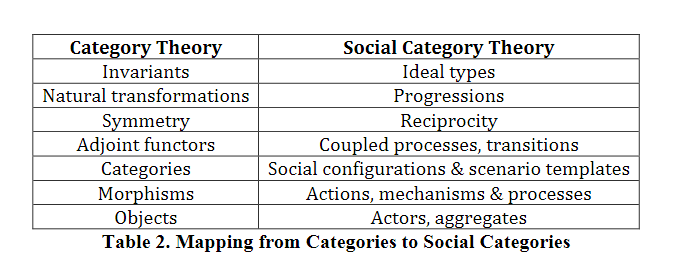
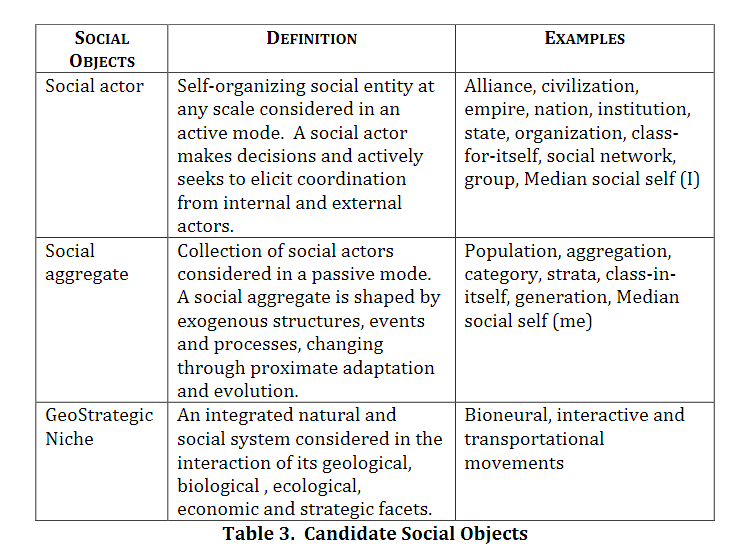
More recently, I came across the fascinating work of David Sallach, one paper (a conference from 2012) includes:


Sallach, D.L. Categorical Social Science: Theory, Methodology and Design. September 2012
Conference: Fourth World Congress on Social Simulation. Taipei, Taiwan.
https://www2.econ.iastate.edu/tesfatsi/Sallach2012CategoricalSoSci4.WCSS-SS.pdf

Plus, developed further in table 2:

If time permits as an exercise, please consider Sallach's table 3 below. It may be interesting to map this to the domains of Hodges' model(?) [template]:
:

If you can see the potential utility of Hodges' model, you may also appreciate why Sallach's paper  resonates. Having emailed Dr Sallach, without reply, I did some checking. More sad news followed.

I, and no doubt many people will continue to discover and appreciate the legacy left behind by the above and many other pioneers. 

<>

I must acknowledge - Enid Mumford - whose work on socio-technical systems continues to inform my study and application of Hodges' model. This includes recognition of the many x-disciplinary bridges (or, barricades?) that can be found within Hodges' model. 

Clearly, much reading still to do.
<>

Returning to Hodges' model as a mathematical object, the 'distance' above is suddenly interstellar (and yes, sudden, as in faster than light!). I'm following videos, papers, and specific work-streams by  universities (I won't mention presently...) seeking to apply category theory to the social sciences. This suggests, at least, I'm not (completely!) wasting my time. If you have thoughts yourself on Hodges' model, the journey from Sallach's tables 1 - 2 not just 3, I'd be delighted to hear from you. 

There is another approach I will share this (N) spring. This author - researcher I have been able to contact.

*Scouser - https://en.wikipedia.org/wiki/Scouse
(Re. Liverpool - further post to follow).

James Lovelock image:  Bruno Comby, CC BY-SA 1.0, via Wikimedia Commons.

Tuesday, September 29, 2020

Objectivity, Sociology and Measurement ... Hodges' model

individual
|
INTERPERSONAL : SCIENCES
humanistic ----------------------------------------------- mechanistic
SOCIOLOGY : POLITICAL
|
group - population


"Big data is all the rage. 

We have become increasingly obsessed in economics and in medicine and in public policy with what can be measured. Evidence-based is always better it would seem, than going with our gut or worse, a wild guess that springs from our biases. This passion for evidence is not new. Carved in stone, on the outside of the social science building where I got my PhD at the University of Chicago is a quote attributed to Lord Kelvin, the physicist who gave us the Kelvin temperature scale and who died in 1907:"

“When you cannot measure, your knowledge is meager and unsatisfactory.”

Russ Roberts


"Like Weber and Dilthey, Mannheim opposes the positivist approach which seeks to render all social facts measureable and 'unambiguously ascertainable'. He invites us:- 'to think what becomes of our psychic and social world when it is restricted to purely externally measureable relationships', and argues that 'There can no longer be any doubt that no real penetration into social reality is possible through this approach . . . It is clear that a human situation is characterizable only when one has also taken into account those conceptions which the participants have of it, how they experience their tensions in this situation, and how they react to the tensions so conceived." p.160-161.
 
THE TASKS OF SOCIOLOGY

"The tasks which are presented to sociology are of a two-fold character. On the one hand there is the need to establish a valid model for the analysis of a particular social system which he is studying. And on the other hand, once such a model is established he may be faced with explaining some partial and particularized form of behaviour in terms of the part it plays in the total system. However, in any particular research situation there will be a choice as to what shall be regarded as a total system, that is what the scale of our interest should be, or what segment of the total system we should study." p.185.
 
Mannaheim's "proposals for a sociology of knowledge". p.165.


Sources:

Adam Smith, Loneliness, and the Limits of Mainstream Economics
Russ Roberts

https://medium.com/@russroberts/adam-smith-loneliness-and-the-limits-of-mainstream-economics-f0be78940e17

Also summarised in MoneyWeek.

Rex, J. (1968) Key Problems of Sociological Theory, 4th Edition. London: Routledge & Kegan Paul Limited.

(... continued sorting through old books... )

Saturday, June 23, 2012

Drupal Education Camp Oxford (School's out)

Well it is over and it was a great experience. So many thanks to the Drupal Oxford Group, Finn @finnlewis and the sponsors. The boxes are all ticked: the sessions, lunches, St Catherines' College surroundings and staff (excellent), and as ever the Drupal Community. Amongst many really good sessions ...

Yesterday, Johan Gant listed the pros and cons of Migrating data into Drupal using the migrate module, when you might care to use it and when not. When not to use it is a definite take home (a take care). There's a potential overlap here with semantizing content in Drupal 7 which Philipp Schaffner explored today. His presentation included not just the relevant modules, but Drupal's core RDF status out of the box and how to extend this. Philipp's English is very good; I wish I could present in another language as well as he did.

Many of the 'take homes' have not changed. They are glaringly obvious: build your site get on with it. That aside in the previous efforts to enter content from the old website into Drupal (4.7, 5.x, 6.x ...) the decisions about style, fonts, colours have been and remain an enjoyable task. In Bring that designer over to the Drupal side of the force Tom Bamford provided a description of styling and a listing of resources. Definitely something to follow and use.

Martin Bush introduced his work as a lecturer Use of Drupal at London South Bank University and the creation of QuizSlides. I have an eye on the existing Quiz module. The QuizSlides' approach utilises Powerpoint as the basis for the quiz. Prior to this Martin outlined his course on Internet Technologies across lectures, labs, MCT and individual assignments. Speaking to him afterwards I mentioned how I would love to take my stuff (re. h2cm) and formalise it in a structured way. How could you link Hodges' model into nursing, informatics, and educational curricula?

Another key session for me was How we built a Virtual Learning Environment with Drupal 7 with Lee Willis. This is way beyond my purposes in the sense of scale but not in terms of - intended - user experience. Lee made some vital points about Drupal's educational potential and the lessons he and his colleagues have gleaned from projects to date. There is still great variation in the user interface of Drupal and this is compounded with the number of contributed modules used. Drupal is powerful in providing related navigable content, but this should not mean forcing an order on the learner. In addition to the need to plan the interface, another point Lee made also draws me to Drupal and reflects a central ethos of some psychological therapies. We learn best through self-discovery. So in addition to structured and unstructured content, there is a case for leveraging Drupal to facilitate discovery. (I've just thought of another post...)

As well as education, the keynote yesterday by Prof. David Upton was informative and entertainingly delivered (a lesson in itself) stressing the complexity of corporate scale IT projects and the problems (disasters) that can and do ensue. I did wonder (and nearly asked) if Prof. Upton had any views on a particular project he didn't mention. Which reminds me: I must cast an eye on the new NHS information strategy.

Wednesday, July 01, 2026

Tricotyledons, systems and social problems

'If scientists and engineers are to be able to attack social problems with the same validity and effectiveness with which physical problems have been attacked, then a much more sophisticated and rigorous system design methodology is needed.

Such methodology, called the tricotyledon theory of system design, has been developed as a synthesis of: empirical and speculative approaches to system design [2], the methodology of operations research [10], classical optimization techniques [18], results in specialized branches of mathematical system theory [1,4,6,7], and the constructs of general mathematical system theory [12,13,14].

Experimental applications of the tricotyledon theory of system design to several problems in widely differing contexts [3,4,8,9,16,17] indicate that the methodology holds great promise for validity and effectiveness in attacking any large-scale, complex, man/machine system design problem with precision and rigor. There are no theoretical limitations (such as differentiability, linearity, finiteness, or discreteness) for the problems that can be attacked within the tricotyledon theory of system design.

In this short abstract the theory is only described in terms of set and system theoretic concepts as presented in Reference [12), [13], or [14]; no exploitation of the theory, either theoretical or practical is attempted here.' ..' p.224-225.

'The task of defining a large-scale, complex, man/machine system design problem P=(S,T,α,β,γ,D) often requires an interdisciplinary team in practice. An interdisciplinary team requires, in turn, that the above definitions be translated into non-mathematical methodology. This has been done in Reference [15].' p.229.
15. Wymore, A.W., Systems Engineering Methodology for Interdisciplinary Teams, unpublished manuscript. (Another loss?)


Wymore, A.W. (1975) The Tricotyledon Theory of  System Design. In. Category Theory Applied to Computation and Control: Proceedings of the First International Symposium, San Francisco, February 25-26, 1974 (Lecture Notes in Computer Science, 25) by E.G. Manes (Editor).

See also: 

https://en.wikipedia.org/wiki/A._Wayne_Wymore

http://sysengr.engr.arizona.edu/wymore/bookreview.html 

https://lockywolf.wordpress.com/2019/02/16/a-mathematical-theory-of-systems-engineering-the-elements-by-a-wayne-wymore/ 

style="font-family: helvetica; font-size: small;"

Wednesday, January 03, 2018

Modelling Scale: Self, Families, Communities, Organisations - a Planet's Health...

Dear HIFA colleagues,

I would like to wish you all a happy new year and to share with you a powerful quote on the front cover of the current print issue of The Lancet:

"Achieving planetary health will require a renaissance in how we define our place in the world. A new narrative will reject the one streaming into our homes — that happiness comes from relentlessly acquiring more things — and embrace what we know: that what truly makes us happy is time spent with those we love, connection to place and community, feeling connected to something greater than ourselves, taking care of each other."
The quote is from a lecture by Samuel Myers, Planetary Health Alliance at Harvard University, USA. The citation is below and the full text is freely available here:
http://www.thelancet.com/journals/lancet/article/PIIS0140-6736(17)32846-5/fulltext

CITATION: Planetary health: protecting human health on a rapidly changing planet
Dr Samuel S Myers
Volume 390, No. 10114, p2860–2868, 23 December 2017
DOI: http://dx.doi.org/10.1016/S0140-6736(17)32846-5

Best wishes, Neil

Let's build a future where people are no longer dying for lack of healthcare information - Join HIFA: www.hifa.org

<->

My additions:

I am always fascinated by the need for such expansive perspectives, the need to simultaneously factor in scale; how for example, do we warn future generations of environmental hazards?

Such questions are also crucial to "how we define our place in the world"?

individual
|
INTERPERSONAL : SCIENCES
humanistic --------------------------------------- mechanistic
SOCIOLOGY : POLITICAL
|
group

The Far Future - BBC Radio 4

The Long Now


Political planning
NHS workforce planning
NHS preparedness for (a?) the (this?) Winter


Source: HIFA Dr Neil Pakenham-Walsh with thanks.

Monday, July 08, 2019

Inaugural Scottish Threshold Concepts Conference: TCs in Action [ii]

After Prof. Land's keynote and the previous post on 'work-as-X' I can see the value of the academically agnostic - neutrality of Hodges' model in terms of the spaces it affords. It can be used to reflect as a safe space or problematic, troublesome or unsafe. As an example, consider the task of reflecting upon the current state of residential and nursing home care?

individual - self
|
INTERPERSONAL : SCIENCES
humanistic ----------------------------------------------- mechanistic
SOCIOLOGY : POLITICAL
|
group- population


Next reflect upon residents and sexuality within these care environments. This could be from any perspective, or even work through several: resident, a new care worker, other team members, staff nurse, home manager, family member, GP, or inspector. ...


#UoDthresholdconcepts2019
Prof. Land raised the matter of extreme vulnerability and experience of Syrian refugees. Individual and Population are forced through a threshold that is catastrophic: that of identity. The scale of this event is being stressed as an urgent issue that must be accorded attention in parallel with physical relief

Perhaps, it is not just individuals who must encounter and pass through a threshold in their learning, their liminal journey. The problems we face demands that disciplines must find the disciplinary bridges that will enable them to solve the interdisciplinary and even transdisciplinary problems we face.

Geopsychiatry is a key bridge here. Research has determined that trauma can be intergenerationally transmitted. Governments, aid organisations and policy makers must take this into account and not just respond with physical relief. Unfortunately, the imbalance that is a lack of parity of esteem in general physical and mental health has its global-scale analogue in humanitarian crises and conflicts, especially those that displace populations.

Prof. Land referred to eduChaos and this is where 'lived experience' is found: not just in 'real time'.

#UoDthresholdconcepts2019

Uncertainty, kept repeating itself Prof. Land describing the work of Ilgen et al. (2018) and the need in (and through) education to find comfort with uncertainty. The challenge of this is acute in medicine and mental health care as Ilgen's work highlights. The previous post's nod to box-ticking and elsewhere the quest that is the 'comprehensive record' stresses at point of initial encounter - the initial assessment, perhaps to the detriment of an outcome oriented approach?

The question posed of "how professionals can manage the uncertainty arising from complex, ill-defined problems with conflicting assumptions, evidence and opinion" [another slide] is not just concept-bound as I tend propose. The terrain of Hodges' model can be used to map wells of uncertainty that help make the more certain, concrete data - information stand out. It helped me to see the situatedness of this discourse repeated. The definitions of 'uncertainty' and 'certainty' attributed to Ilgen et al. (2018) are a helpful adjunct to information science based sources.

In subsequent parallel sessions I switched rooms in  trying follow what was most relevant. First was,
'Where have all the empathetic professionals gone? An exploration of empathy as a threshold concept for the helping professions'. This provided a multidisciplinary insight into social work education, with overlaps that included safeguarding and child protection. Jayne Lewis's format had us engaged, well me clearly as I've no notes or photos. The talk of empathy made me recall twitter and student nurses remarks on their placements (accepting too that 'No news is good news') and student-mentor-placement relationships. If the practice/placement environment is stressed/contested for a variety of reasons, to what extent does this influence empathy role models, student experience and study of TCs? Do researchers need to record the emotional and political 'temperature' as a baseline measure?


#UoDthresholdconcepts2019


Next, on the programme; TCs, medical students and population health learning. From an acute angle (I was late arriving) Hothersall explained a study with a small sample, and yet findings that (as ever) call for more study, with implications for teaching in the lecture theatre, as a whole, in practice and relevance for me.

I'm sure there are many threshold concepts in public health and public mental health (to ensure inclusion). Even if specialty posts in public health are filled 2013-2016 (and amid recruitment pressures) I wonder if there is an issue for students (generally) in the perception of  'public health' and their respective discipline? Is there something in the old debate of pure - applied disciplines? Do medical and other students feel they must focus attention on the 'hard' learning rather than the 'soft' fuzzy concepts that public health encompasses? What has been the impact of the most recent series of re-organisations?


 #UoDthresholdconcepts2019

Of course, given the big themes identified, for me, the first lecture 101 should include a conceptual framework that can readily incorporate the (socio-)technical, (psycho- socio-) political, conceptual and much more.


The presenter also informed us that a paper is in press: 'The Clinical Teacher'. These findings of concepts that were troublesome for students appears to support my '101' role for Hodges' model - but then I would say that ...


Tierney's Exploring threshold concepts in the scholarship of teaching and learning was a rich source on a model of scholarship (Trigwell, et al. 2000) with tables also drawing on Perkins (1999, 2006) that I must try to follow-up as with Visual Art as navigation of affective thresholds: implications for the classroom.


The afternoon keynote discussed The dual development of professional identity as physicians and mentors, with Profs Hokstad and Kvernenes. Using a narrative reading (Reismann, 2008) the content and findings to me call for simultaneous duality in identity, the medical and the non-medical (practitioner - interaction with the patient and their family), clinician and mentor.

Being struck by the thought (on science, knowledge, holism - whole / part distinctions) of Goethe in the past it was a marvellous to attend Jonathan Code's session; Mind the Gap - Ontological discontinuity as threshold concept. I imagined Hodges' model and several leaves in various stages of growth.

It creates an overhead for conference organisers, but video recordings would be a great help. I think there is one more short post on this conference.


Ilgen, J.S., Eva, K.W., de Bruin, A., Cook, D.A., Regehr, G. (2018). Comfort with uncertainty: reframing our conceptions of how clinicians navigate complex clinical situations.
Adv Health Sci Educ Theory Pract. Nov 2. doi: 10.1007/s10459-018-9859-5.


See also:
Inaugural Scottish Threshold Concepts Conference: TCs in Action [i]

Wednesday, September 29, 2010

Global health: Care logistics in-deed

Although the previous post -

Care Logistics: have model will travel ...


- differentiated between what we might term mechanistic and humanistic logistics, there is a great deal of overlap:

communications, time, priorities, purposes, service, quality, processes ....

Global health has featured on W2tQ and it is here that the true dimensions of logistics can be defined. I may be confusing logistics and scale, but if I am then the challenge of logistics presents itself by virtue of scale and in global health the focus upon populations, nations, medical conditions and physical environments, climates and topography.

While the Wikipedia page on global health does not explicitly refer to logistics it is there in the shadows: it contributes to inequality, illiteracy, poverty, public ill-health (and mental too), pandemics ...

Logistics is there in the light too; the torch of disaster relief, the many development organisations, the ethos and values of the Millennium Development Goals. ...

Saturday, September 22, 2018

Book Review: [i] Health System Redesign - How to Make Health Care Person-Centered, Equitable, and Sustainable


https://www.springer.com/us/book/9783319646046
Health System Redesign
The 'summer reading' is almost complete (p.245/290) and described as such due to it being a review and a specific deadline is not helpful. (You may have noticed with Drupal and the new site!). Fortuitously, starting the book coincided with my attending the UKSS conference in Portsmouth. The exposure to systems and complexity - as in complexity science was welcome. I would really like to write a paper on Hodges' model and complexity and this book would be a primary reference.

The foreword is by the President of the Lown Institute, this is a think-tank "advocating a radically better and uniquely American health system that overturns high-cost, low-value care." Sturmberg provides the means for this over-turning whilst beforehand explaining what is happening in the health system and health care systems worldwide. There is a difference, as we must change mindsets and facilitate the health system reducing the impact, dependence and expense of existing health care systems. What we have is no longer sustainable.

Even in Sturmberg's preface I can see why this book through its title had an instant appeal to me and should do so to others in the health, social care, policy and educational communities.

The book addresses three key themes:
  1. Understanding complexity—what are complexity sciences, and how does complexity thinking shape our understanding of health
  2. Envisioning a “best adapted” health system
  3. Achieving a person-centred, equitable and sustainable health system
The promised references follow the chapters (as expected!), but often with addenda that provide more background, insight and further reading if needed. Page 2 provides the first of many figures throughout the book, as with copious footnotes. Some people and publishers find footnotes untidy or contributing noise. I found these informative, pointing in some instance to video resources and copies of diagrams that are too detailed for a book. Inclusion still conveys some meaning given the subject matter of complexity and scale through the levels of nano, micro, meso and macro.

The book is clearly laid out, chapter 1 precedes Part 1 to set the context and agenda. Sturmberg explains this is not a theory book, but the explanations are progressive and a good foundation for further study (that must follow). Some of the challenges in teaching and learning systems thinking and health(care) systems redesign are discussed, as students are bound to encounter them not only in the literature, but in many of the assumptions that they are being socialised into in practice. A good example, is Table 1.1 Disambiguation of systems complexity (p.5). Like the use of figures, tables are liberally but effectively distributed throughout to reinforce the discussion. I like the way that systems thinking tools are set out in Table 1.2 across three pages. The tables and figures are not just page-fillers though, but sources to return to.

The differing sections that apply systems thinking are set with the implications for health care. As already mentioned some of the figures are colour reproductions and suffer due to the print size. To compensate the original source is usually provided (Addendum 2, Obamacare Health System Chart is a prime example that also time places pressure on any text). This works well as the author grapples to illustrate scale from the individual to the organisational level, industrial and processes and policy makers.

I know a review is about the book, but in this case especially I cannot but help see how this topic supports and validates (imho!) my own work and interests. Page 9 confirms how h2cm not only incorporates "design thinking" as it can readily combine the sciences and the arts (as in various blog posts). As I have stated (for 30 years) the POLITICAL domain in Hodges' model is crucial in the 21st century. So, even as I reach Part 1 for this review, the importance of global health; policy, organisations, public engagement are stressed if change is to follow. Many sections have a short introduction that ends with questions for readers to reflect on their own health systems experiences. As a summer reading project through to part 1 I was very pleased to have an 'ice-cream' of my favourite flavour that was going to run and run...

Sturmberg JP. Health System Redesign. How to Make Health Care Person-Centered, Equitable, and Sustainable. Cham, Switzerland: Springer; 2018.

More to follow three - four posts in total?


Thursday, April 30, 2026

ii WCCS26: World Conference on Complex Systems 20-22nd April

Day 1

Plenary Talk: Reda Benkirane - Lost in Complexity: Welcome to the Real World

A first slide considered Abraham Maslow's book The Psychology of Science and his thought on the "law of the instrument". Maslow's hierarchy of needs is a key primer for new students to many disciplines, including nursing, and psychology. The purpose of Benikrane's focus on instruments concerns the emergence of civilisation and roles of agriculture, and war in the rise of community at several scales from village, to cities, states and nations. In terms of flow the slides highlighted the next speaker Peter Turchin's END TIMES, and two books by Johann Chapoutot, LES IRRESPONSABLES, and FREE TO OBEY.

In response to the slide with Einstein's -

"We cannot solve our problems with the same thinking we used when we created them":

- may I please class 'health - care' as a world? The thought that the medical, bio-medical, and bio-psycho-social encourages, sees enacted, and sustained a : is this fit for the problems of the 21st century. I like the slide's heading 'Beyond Complexity'. Such is the pace of change, which is labelled 'progress' that each one of us wakes up momentarily stupified and lost in complexity.

Keynote Speaker: Peter Turchin - The Great Holocene
Transformation: What Complexity Science Tells Us About The Evolution of Complex Societies

Turchin's keynote reminded me of Jared Diamond's book Guns, Germs and Steel. Reading GGS I realised there is more to 'axes' than I thought, especially from the individual to collective scales. It appears that whichever label - academia, research or education - you would like to apply, they all need a conceptual framework. Just as, individually, we all need a model of self, others and the world. This was a marvellous journey, through millennia of humanities' evolution, social, and political development, all realised through complexity. While attractors are to the fore, architecture and archaeology are regular distractors for me. Reading Holocene then had me hooked. 

A fellow delegate and speaker I dined with a few times encouraged me to read 'END TIMES'. I will seek it out later this year, (the next Hay-on-Wye visit?). Turchin is seeking to account for how human societies have reached their current state of organisation. The role of self-protection, seeking food, shelter, co-operation are all factors, with the emergence of religions, and agriculture. Several theories to date were covered [including, cultural multilevel selection, see Wilson et al. (2023)], plus a major project on cultural evolution: The Seshat: Global History Databank. For all the current loss and misery, conflict has paid a major role in cultural and political development. The prefix 'macro' features here. There was a social scale (people): FROM 10s - in foraging bands through TO 100,000,000s large nation-states. Mention of levels of scale, took me back to the work of Mario Bunge. The application of the Hertzsprung-Russell 'main sequence' (H-R) diagram is a great idea. I think Olaf Stapleton, author of Star Maker would have approved. 

This itself, for me, is reason enough to read Turchin. There is evolutionary biochemistry too, which is required in terms of a systems account. Is there a reflection of a main sequence construct between the SOCIOLOGICAL and SCIENCES domain of Hodges' model? 

 It is incredible the way new findings are regularly pushing even further the dates of human milestones stepping-stones. Perhaps we should always view progress in this way, and enjoy the 'moment'. There is still the puzzle of ultrasociality, and how to explain it? Turchin is seeking a mathematical history, with a journal Cliodynamics. There is another SF reference here, in Asimov's psychohistory in the Foundation books, but with less emphasis upon maths. This is encouraging for Hodges' model, and the inevitable transdisciplinary approach these questions demand.

More to follow ...

D.S. Wilson, G. Madhavan, M.J. Gelfand, S.C. Hayes, P.W.B. Atkins, & R.R. Colwell, Multilevel cultural evolution: From new theory to practical applications, Proc. Natl. Acad. Sci. U.S.A. 120 (16) e2218222120, https://doi.org/10.1073/pnas.2218222120 (2023).

Saturday, December 16, 2023

Vera Spencer - Artist versus Machine c.1954


Tate Etc.
"The paper card used to create this collage by the artist Vera Spencer may look unassuming, but the idea behind them is monumental. Around 1800, the French merchant and weaver Joseph Marie Jacquard first developed the automated loom, a machine which used perforated cards to store advanced weaving patterns. These perforations - a series of holes or not-holes - created the world's first large-scale system of binary data storage. Jacquard's loom went on to inspire British mathematician Charles Babbage to design the Analytical Engine, the first punch-card calculator and a precursor to the modern computer - the potential of which was grasped by the mathematician Ada Lovelace, regarded as the first computer programmer. . . . 

By modifying punched cards, Vera Spencer started up a material fight with the very tissue of automation. The same automation that today, with the invention of self-learning image and text-creating algorithms like Dall-E and ChatGPT, has reached the practices of artists and writers, challenging our very concept of creativity and ultimately threatening their work." p.99.


 Individual
  |
     INTERPERSONAL    :     SCIENCES               
HUMANISTIC --------------------------------------  MECHANISTIC      
SOCIOLOGY  :   POLITICAL 
|
GROUP
creativity

automation
material
size-scale:
loom <> punched card computer 
tissue

Vera Spencer Artist versus Machine c.1954


Smith, A., on Vera Spencer Artist versus Machine c.1954, Summer 2023, Tate Etc., Issue 58, p.99.

Previous posts on W2tQ:
Ada Lovelace