Hodges' Model: Welcome to the QUAD: experience

Hodges' model is a conceptual framework to support reflection and critical thinking. Situated, the model can help integrate all disciplines (academic and professional). Amid news items, are posts that illustrate the scope and application of the model. A bibliography and A4 template are provided in the sidebar. Welcome to the QUAD ...

Showing posts with label experience. Show all posts

Thursday, September 10, 2026

Is the Individual-Group axis health's proscenium arch?

Speech: “All the world’s a stage”

By William Shakespeare
(from As You Like It, spoken by Jaques)
          
     All the world’s a stage, 
And all the men and women merely players; 
They have their exits and their entrances; 
And one man in his time plays many parts, 
His acts being seven ages. At first the infant,
Mewling and puking in the nurse’s arms; 
And then the whining school-boy, with his satchel
And shining morning face, creeping like snail
Unwillingly to school. And then the lover,
Sighing like furnace, with a woeful ballad 
Made to his mistress’ eyebrow. Then a soldier,
Full of strange oaths, and bearded like the pard,
Jealous in honour, sudden and quick in quarrel,
Seeking the bubble reputation
Even in the cannon’s mouth. And then the justice,
In fair round belly with good capon lin’d,
With eyes severe and beard of formal cut,
Full of wise saws and modern instances;
And so he plays his part. The sixth age shifts
Into the lean and slipper’d pantaloon,
With spectacles on nose and pouch on side;
His youthful hose, well sav’d, a world too wide
For his shrunk shank; and his big manly voice,
Turning again toward childish treble, pipes
And whistles in his sound. Last scene of all,
That ends this strange eventful history,
Is second childishness and mere oblivion;
Sans teeth, sans eyes, sans taste, sans everything.

Source: https://www.poetryfoundation.org/poems/56966/speech-all-the-worlds-a-stage


TIME FRAMES

'As Shakespeare and his contemporaries wrote for the epic scale, the imaginative commitment and the 360-degree embrace of the Globe so, three hundred years later, generations of playwrights wrote for the velvety darkness, the enclosed acoustic and the picture framing of the proscenium arch.

For a century, the story of the changing world was told inside proscenium theatres, by a series of remarkable playwrights. In over sixty irreverent, illuminating pen portraits – of both famous giants and lesser-known talents – Dominic Dromgoole takes us on a journey from 1865 to 1965, revealing how these writers used the framed stage to reflect the social upheavals of their times.' 

This post began with: 'All the world's a stage', but I realised I'm no Shakespeare. Hodges' model is a frame; and users of the model can put it to work, readily. Be that in the sciences, arts, and across curricula. The 'arch' in Hodges' model appears to be inverted, working from within, rather than out. Similarly to the proscenium arch, however, the model provides a structure, for whatever performance, situated, will surely follow.

Hodges' model: Axes and Domains

Of course, the question posed here might be re-framed as: 

Are the axes of Hodges' model, life and death's proscenium arch?


Dominic Dromgoole (2026) Time Frames: A century of proscenium playwrights. London: Faber. 
https://www.faber.co.uk/product/9780571374113-time-frames/ [Text source].

Previously: 'drama' : 'stage' : 'frame'

Saturday, July 11, 2026

"Train midwives as nurses" - Ockenden

Re. Ockenden Report

Catching up on the newspapers, I noticed in the Times reporting of Ockenden calling for midwives to train as nurses first. Provoking debate about nurse education.

Within maternity services there are problems with continuity of care and skills in dealing with complex cases:

'Maternal Deaths 

60. The Review examined 27 maternal deaths that occurred between 2006-2024. Five cases fell outside of the Terms of Reference of the Review. Of the 22 remaining cases, reviewers identified failures in care that may have or substantially impacted on the outcome in six deaths. 

61. The profile of maternal deaths at NUH over this period broadly aligned with the known demographics and causes as identified by MBRRACE. 11 of the deaths occurred to women living in the most deprived areas of the city and 14 occurred amongst women who were not white British.

62. The common failures reviewers identified that might prevent future maternal deaths included: listening to women and families and acting promptly on concerns; continuity of care particularly for those with additional social/medical complexities; robust clinical governance to ensure timely information sharing across organisations and prompt access to imaging for women presenting with concerning neurological symptoms.' xiv

AI Overview (Ecosia) suggests that although direct entry to midwifery has always been possible(?), the English National Board created the pathway some 39 years ago.

The Ockenden Report describes how in combination health systems, culture, leadership and training can contribute to compassion fatigue (p.313).

When you look at Hodges' model and our languages, a great many challenges for curricula, training and education programmes can be found. The most powerful of what can be progressive, or threats are invariably mechanistic:

  • shorten
  • bypass
  • shortcut
  • cutting corners
  • short-circuit

Nursing must always move forward, continuous professional development is built on this principle. In the late 70s and 1980s post-registered qualifications were held in high esteem. Especially midwifery, paediatrics, health visiting, emergency and intensive care. 

Clearly, decision and policymakers can underestimate the value of basic nurse training. Having an idea since childhood is brilliant, but at interview saying you're compassionate and want to make a difference will soon be tested. Sometimes as a student rather bluntly, as with a first placement in forensic nursing. I wonder how many students have been lost there? I'm sure the majority will cope, manage, enjoy and prosper, but I've seen the student peers who miss these cohort members on subsequent learning experiences. What preparation is employed?

Basic nurse training, is just that. Demonstrating competence in communication, awareness of basic needs and how these are expressed behaviourally. What interpersonal skills and knowledge are needed. As highlighted before, the director of nurse education worried about those of us who worked as nursing assistants risked being trained in poor care. Not recognising 'bad practice', a 'poor attitude', not using observation and most important of all listening: to what is said and unsaid. When I started I remember thinking about not responding - as individually programmed to do so, through a reflex action. That was a worry back then. 

While the news in the Ockenden Report is bleak. The depth of the report (for me) is manifest in identification of not only socioeconomic factors, but sociotechnical too (with five mentions) and the critical interplay of seeing (and hearing!) the individual amid the collective:

'2. Fetal monitoring

Rather than reflecting simple failures of individual interpretation, growing evidence suggests that intrapartum fetal monitoring is best understood as a complex sociotechnical practice, shaped by system design, workload, team dynamics, guideline variability and organisational culture.119 Continuous CTG itself has well-recognised limitations, including poor specificity for predicting long-term neonatal outcomes and substantial inter- and intra-observer variation in interpretation.5 Reviews of intrapartum care are therefore unavoidably influenced by retrospective bias, with greater apparent clarity afforded by knowledge of the outcome than was available to clinicians at the time. 

However, despite this, a sociotechnical understanding does not negate the importance of examining individual cases in which intrapartum monitoring was demonstrably substandard. National inquiries and confidential reviews repeatedly describe cases involving sustained failure to recognise pathological fetal heart-rate patterns, delayed escalation despite repeated triggers, and missed opportunities for timely intervention. 2,3,120,121 These cases cannot be explained solely by the inherent limitations of CTG or by hindsight bias.' p.143.

It is quite shocking to hear this conclusion: the need to train as a nurse first. Counterarguments: where is the evidence(?!) - have followed. But then if you undervalue and miss the fundamentals (see Hodges' model!) then individuals, families, communities, students, practitioners, services and systems suffer.

Previously: 'maternity' : 'report' : 'safety'

Friday, April 10, 2026

'Healing grid' - the penultimate?

Healing grid by Ryota Kanai

Hodges' model is surely a clear winner 'healing grid'? Acting not only in healing, but in recovery, rehabilitation, reablement, palliative, illness and well-being too.

Quite a grid all-in-all (which also fascinate grandchildren).

My source: 

Previously: 'grids' : 'perception' : 'vision' : 'lines' : 'geometry'

#ArtemisSafeReturn #PrecisionGridManoeuvres

Wednesday, February 18, 2026

Move Over LLMS! AI Legends Yann LeCun and Alex LeBrun Debut AMI Labs' Bold Ambitions for World Models in Healthcare


My source: https://x.com/OffCallDotCom/status/2022708074105242035?s=20

Saturday, December 20, 2025

A time for reflection S-N solstice :: equinox

Analemma image: Anthony Ayiomamitis

Ever since we first took note of the passing Seasons, and what is left of them today, we have marvelled and come to recognise the extremes of the calendar in the sky.

For humanity in the North and the South. 

The emergence of culture, societies, and civilization has been  dependent upon the calendar - whether recorded in customs and rites, giant blocks of stone, papyrus, or binary code.

As the solstice fast approaches - Sunday, 21 December 2025 15:03-4 - and the Sun touches its lowest, southernmost point, I think of (former) family and friends 'way down' south, and the distance between the hemispheres, represented in the analemma. Of course then there is the solstitial experience of humanity in the south as the sun crests the highest point in their sky.

It must be amazing to see the nightsky from the far south(?). 

How might we explain this culturally, with the benefit of foresight? This apparent celestial 'opposition' of Earth's path around the Sun, is reflected N-S in who bears the impact of climate change and the need attend to planetary health.

But, then look at the equinox, the north and south are seemingly united? 

Is there a baton passed in March and September?

Perhaps, this can be a celebration of global health, for both hemispheres. With a simultaneous 'nod' to planetary health and the search for social and climate justice.
 

What Complex Threads We Weave

Monday, November 10, 2025

Modelling turbulence in flight: and other situations?

'Thomas Q. Carney, a retired professor of aviation technology at Purdue University in Indiana who has logged more than 11,000 flight hours as a pilot, said, "The better the model, the more it captures of the particular turbulent field, then the better the forecast, which is what the pilot is going to use."'
individual
|
INTERPERSONAL : SCIENCES
humanistic -------------------------------------------  mechanistic
SOCIOLOGY : POLITICAL
|
group-population
complexity
and
turbulence
here ...

Birnir, B., & Angheluta, L. (2025). Scaling of Lagrangian structure functions. Phys. Rev. Res., 7(2), 023225.  https://doi.org/10.1103/PhysRevResearch.7.023225


here

and here ...


'To try to make sense of chaos, Dr. Birnir worked with Luiza Angheluta-Bauer, a theoretical physicist at the University of Oslo, to devise a model that combines two different methods for observing turbulence: what are known as Lagrangian and Eulerian mechanics. Experts say that neither framework can fully explain how turbulence works. 

That's because these two frameworks look at fundamentally different aspects of a turbulent system. In Lagrangian mechanics. researchers observe a simple particle. while in the Eulerian framework they look at a single point in space. Put simply, Lagrangian mechanics is like watching a leaf flow downriver, subject to the whims of eddies in the water. On the other hand, Eulerian mechanics is like watching a rock that protrudes from the river's surface and studying how the turbulence of the water moves around that fixed point.

Lagrangian turbulence is trickier to model because it requires an understanding of how a lone particle will behave. That lone particle will "execute the most complicated motion that you could imagine," Dr. Birnir said.

Knowing how each type of turbulence fits into the bigger picture is akin to selecting the appropriate lens for a microscope, since both are highly dependent on perspective. "Same turbulence, different stories," said Tomek Jaroslawski a postdoctoral fellow at the Center of Turbulence Research at Stanford University.' Nazaryan, p.12.


Nazaryan, A. A new theory of in-flight turbulance lands, Science: The New York Times International Edition, October 15, 2025, p.12.

[Subscription: https://www.nytimes.com/2025/09/24/science/physics-airplanes-turbulence.html ].

See previously: 'care architecture' : 'Serres' : 'complexity' - and, if needed 'spiritual'

Tuesday, October 28, 2025

Careif report: The Health Needs of the Indo-Caribbean Community in the United Kingdom

'The Indo-Caribbean community has played a key part in the life of the United Kingdom, but this has not often been recognised. Little is known about this populations’ physical and mental health needs and its experience of health and social services in the UK.


This report, The Health Needs of the Indo-Caribbean Community in the United Kingdom, examines the history of the Indo-Caribbean community in the UK, the prevalence of mental health conditions among the community, barriers to accessing mental health services, and the existing services available.'


Includes:
"The absence of a unique category designating ‘Indo-Caribbean’ as a unique category in the UK Census was identified as a major barrier to obtaining vital epidemiological data on the UK’s Indo-Caribbean population."

Above text:
https://www.careif.org/news-and-events/2025-10-9-careif-report-the-health-needs-of-the-indo-caribbean-community-in-the-united-kingdom


n.b. 
In my community mental health nursing career in Chorley, Preston, and West Lancashire as services were established, the diversity of the local populations was evident, but there was an assumption that many communities were essentially 'closed': one explanation for lack of referrals from specific racialised communities - was that some communities 'looked-after their own'.

Of course this can be racism (acute or subtle), an excuse for inaction, delayed response, lack of action - outreach and translation services. There were marked examples of intervention. I have seen first-hnad interpreting and translation services in action since full-time retirement and the services offered are amazing for the insights and care delivery they can facilitate. Is this why we also need mental health nurses and the team? To translate in challenging circumstances, even by being there, seeking avenues, giving time - especially in instances of psychoses and doing so safely (for all)?

In addition to the main body of Careif's report and its recommendations, it may be helpful to consider the report's key terms relating them to the domains of Hodges' model? I also note reference to the bio-medical model as an explanatory framework. A conference abstract has been submitted today for April 2026, highlighting the need for bio-psycho-socio-political model / framework (Hodges' model - of course?).

See also:
RCN North West Multicultural Group

Friday, October 24, 2025

Come on Healthcare: catch up will you!

Within philosophy it is recognised that Immanuel Kant provided a means by which the rationalists and empricists can be reconciled. Some background:

In philosophy, rationalism is the epistemological view that "regards reason as the chief source and test of knowledge"[1] or "the position that reason has precedence over other ways of acquiring knowledge",[2] often in contrast to other possible sources of knowledge such as faith, tradition, or sensory experience. More formally, rationalism is defined as a methodology or a theory "in which the criterion of truth is not sensory but intellectual and deductive".[3]  https://en.wikipedia.org/wiki/Rationalism
In philosophy, empiricism is an epistemological view which holds that true knowledge or justification comes only or primarily from sensory experience and empirical evidence.[1] It is one of several competing views within epistemology, along with rationalism and skepticism. Empiricists argue that empiricism is a more reliable method of finding the truth than purely using logical reasoning, because humans have cognitive biases and limitations which lead to errors of judgement.[2] Empiricism emphasizes the central role of empirical evidence in the formation of ideas, rather than innate ideas or traditions.[3] Empiricists may argue that traditions (or customs) arise due to relations of previous sensory experiences.[4]

Historically, empiricism was associated with the "blank slate" concept (tabula rasa), according to which the human mind is "blank" at birth and develops its thoughts only through later experience.[5] https://en.wikipedia.org/wiki/Empiricism

If health and social care, must be evidence-based, then as far as Hodges' model is concerned we are then duty-bound to use the most readily available 'evidence' to us, including (while taking liberties?):

  • The structure of national health and social care organisations (NHS, DHSS ...)
  • Physical infrastructure
  • Human Resources Organisation
  • Unions and Labour relations
  • Texbooks, journal papers, conferences
  • Organisational structures from the regional to the local
  • Professional bodies and governance of licensing/registration
  • Curricula that students follow^
  • Models, frameworks, teaching and learning tools and methods
  • Data, statistics, information and reporting (national, international)
  • Research projects ongoing (whatever scale, methods, methodology)
  • Accounts from lived experience of patients, carers and public (^and students)
  • Policy
  • Funding
  • Law relating to Health and Social Care
  • Public (Mental) Health? Discuss
  • Media (Social) Control, Advertising
  • . . .

Hodges' model: Structure and Content


Using this evidence, we still see the Cartesian divide, the mind-body distinction writ large in health and social care. The continuing impact is evident in theory, practice, (hence) lived experience, policy and managment. Since its creation in the 1980s, Hodges' model mirrors (literally) this philosophical, epistemological and ontological legacy, thereby acknowledging the ancient history of medicine, and 'modern' development of healthcare and nursing. Through this device, Hodges' model can facilitate debate, critique, reflection, and critical thinking; to encourage progress in our thought, motivations, action and subsequent evaluation.


This explains the structure of Hodges' model and predicts the range (contextual signature) of content when the model is applied.

Evidence permitting of course!

See also: BBC The Great Philosophers:

Series 1: 4. Descartes

Series 1: 5. Spinoza and Leibniz

Series 1: 8. Kant

n.b. I video taped this marvellous series when first screened. When studying for my BA(Hons), audio taped, they also provided a great learning resource in the car. The programmes are on BBC 4 (UK) once again, but are readily accessible.

Friday, June 06, 2025

RCN Foundation: Investigating Learning Disability Nurses’ Perceptions of Registration with the Nursing Midwifery Council -

and wider Impact on RNLD Nursing Students
and People living with an Intellectual Disability

From twitter: Dr Lorraine Henshaw RN PD. https://x.com/lor_henshaw

'Are you a Learning Disability Nurse who is no longer registered with the NMC? Would you be happy to discuss your experiences with us for our important research into the RNLD role. See contact details below for further info. Please also share with your networks !' 


'This study ‘Investigating Learning Disability Nurses’ Perceptions of Registration with the Nursing Midwifery Council and wider Impact on RNLD Nursing Students and People living with an Intellectual Disability’ Study Aim and Objectives 1.To investigate RNLD perceptions of registration with the NMC and their thoughts about the impact on RN:D nurses on people living with an intellectual disability and thoughts regarding the future of RNLD nurses a)Obj 1- to ascertain where LD nurses are working and in what capacity/role. b)Obj 2- To explore the impact of this work on their identity as a RNLD 2.To investigate student RNLD nurses’ experiences of practice placements and perception of the role of RNLD nurses a)Obj- to understand the impact of the reduction of RNLD registered nurses (with the NMC) on the future workforce 3.To examine the impact that RNLDs have on people living with an intellectual disability and their families/carers. a)Obj- To explore the perceptions of service users and carers of the value of the RNLD.'


Site: https://salford-repository.worktribe.com/project/3385884/rcn-foundation-investigating-learning-disability-nurses-perceptions-of-registration-with-the-nursing-midwifery-council-and-wider-impact-on-rnld-nursing-students-and-people-living-with-an-intellectual-disability

Wednesday, May 14, 2025

c/o Ridgway - assimilation & accommodation

An approach to testing and teaching

'Consider the problems of acquiring new knowledge; two ideas are particularly important. The first is that existing knowledge and conceptual structures affect the way that new materials are perceived and learned; the second is that new experiences bring about changes in our knowledge and conceptual structures. These two processes are referred to as assimilation (analogous to the way in which the stomach digests food, whose later structure cannot be recognized as being similar to its earlier structure) and accommodation (analogous to the way that the pupil of the eye adjusts itself different light levels). Biological analogies make it easier to understand these concepts but leave unresolved the question of when one accommodates and when one assimilates. In general, one accommodates (i.e. changes one's conceptual structures) when fresh knowledge provides strong challenges to what is in mind; so dramatic counter-examples to currently held beliefs, or coherent patterns in the world, which cannot be explained by existing beliefs are both likely to bring about accommodation. Assimilation (interpreting new events in terms of old ideas) can be made to work when the number of counter-examples to predictions made from old beliefs are rather low. It follows, therefore, that if misconceptions are to be remedied (i.e. the mechanism of assimilation is overcome and the mechanism of accommodation stimulated) a representative sample of questions in the domain of interest is unlikely to have the desired effect because the number of cases which violate pupils' misconceptions and which therefore  might cause accommodation, will be relatively small. To foster accommodation it is necessary to provide dramatic examples which violate current conceptions and to provide these examples in quantity. Examples which are most likely to be dramatic are those in which it is obvious to pupils that the results they are obtaining using particular misconceptions are at variance with what they 'know to be true' from everyday experience.' pp.46-47.

Jim Ridgway (1988). Assessing Mathematical Attainment. Chapter 3, Using Test Results.Windsor Berkshire. NFER-NELSON. pp.40-52. [Ack. length of quote - See also: https://www.nfer.ac.uk/ ]

Thanks to Lancaster Univ. Library.

Previously 'assimilation' : 'accommodation' : 'math'

Sunday, February 23, 2025

Care concept engineering - anyone? [ concepts-maths ii/iii ]

"Concepts are the building blocks for thought, and from Socrates onward one of the goals of philosophers in the Western tradition has been to analyse important philosophical concepts like knowledge, justice, beauty and freedom. For some, the motive was just to get clearer about these fundamental units of thought. For others, the goal was more ambitious. Not content to analyse our concepts, these philosophers hoped to improve them - an old project that has recently acquired a new name: "conceptual engineering". p.98.

"Well, good conceptual engineers, like good engineers in other domains, should start with as much information as possible about which options have already been tried and how well they have worked. If we are going to build a better concept of knowledge, or justice, or moral permissibility, or freedom, we would do well to begin by seeing how these concepts (or their closest analogs) are constructed in cultures around the world, and how well existing varieties work. We would also do well not to restrict ourselves to the millennia old method of cases in studying concepts. Over the last century, linguists, anthropologists, psychologists and neuro-scientists have developed many new methods and technologies for studying concepts. Philosophers who are serious about conceptual engineering should embrace these methods." p.100.


Stich, S., Machery, E., A Possible Future For Philosophy, The Philosopher's Magazine, 1st Quarter 2018. 80: 98-100. 
https://www.stephenstich.com/_files/ugd/0ad9d7_2679b985ce0e43b693d197c775c08e46.pdf

You can call it [conceptual engineering] whatever you wish; in nursing, concept analysis is well established for example. However described, you may find that Hodges' model useful. If you can demonstrate that Hodges' model is not suited to the task, due to its undoubted Cartesian credentials (baggage'), then this would also be progress.

There are no doubt many previous posts this one can be connected to. Most immediately is:

- to follow iii.

This issue of TPM is long gone. In the clear out, I'd drafted these posts.

Monday, January 06, 2025

Variable Hours Tutor: Take II

In September 2019 I was successful in securing a part-time post as a university tutor. This was great news.

While I've always worked in practice, I've enjoyed having students as a (sign-off) mentor and helping colleagues to fill holidays and other gaps; and completing a certificate in education (PGCE). In the past with the help of colleagues, I've organised teaching sessions for students on placement and small conferences. Now, I miss 'mentor updates' and meetings with the university outreach teams - practice education facilitators.

Of course at the end of 2019 a pandemic was brewing. The upshot - sadly for me - the tutoring was a non-event. No teaching (learning) opportunities followed, and the contract was not renewed in August 2020. 

Through nurse revalidation in March 2023, I was helped in Warrington with another academic contact. I attended an open event, but again no openings. In (N) spring last year, I picked up the 2019 thread once again. 

Success again! Another chance. Six months having passed, I do wonder though  - if any hours will follow? 

Fingers still crossed, having chased and looking elsewhere too.

https://hodges-model.blogspot.com/2023/08/brian-e-hodges-r-i-p.html

Wednesday, December 11, 2024

Reith Lectures: Gwen Adshead - 4 Questions about Violence

Individual
   |
      INTERPERSONAL    :     SCIENCES               
HUMANISTIC  --------------------------------------  MECHANISTIC      
 SOCIOLOGY  :   POLITICAL 
|
Group
Is there such a thing as Evil?

What is the relationship between trauma and violence?

Is violence normal^?

Can we change violent minds?


^'normal' -isation.

Thursday, November 28, 2024

Invitation for User Evaluation of OntoChat

Dear W3C Semantic Web Community,^

(Sending the below on behalf of one of our PhD students-your help would be very much appreciated!) 

We are a research team at King's College London conducting a study on the user experience of OntoChat, a tool built on large language models and designed to assist ontology engineers in creating user stories for ontology development. If you are currently or have previously been involved in ontology engineering projects, performing tasks such as ontology development, refinement, alignment, extension, or evaluation, we invite you to participate in this study to help improve OntoChat's design.

Participation Details:
  • Duration: Approximately 35 - 40 minutes
  • Activities:
    • Use OntoChat to create an ontology user story relevant to your project while sharing your thoughts
    • Answer open-ended questions about your experience
    • Complete a brief questionnaire evaluating OntoChat's usefulness
We are flexible and can accommodate your availability within 19th November and 10th December 2024. If you are interested in participating in this study, please indicate your preferred time and agree to the user consent form by completing the registration form at:

https://forms.office.com/e/2wkmugH9v1

Your feedback is invaluable for refining OntoChat to better support ontology engineering processes. Please be assured that all personal data will be kept confidential and anonymised.

Thank you for considering this opportunity to contribute.

Kind regards,
Yihang Zhao
PhD Researcher, King's College London
Contact: yihang.zhao AT kcl.ac.uk

^Via semantic-web mail list.

Friday, November 15, 2024

'Emperor' - Aphasia

individual
|
INTERPERSONAL : SCIENCES              
humanistic ------------------------------- mechanistic
SOCIOLOGY : POLITICAL   
|
group
'Physical
Reality'

Social Reality

'Political
Reality'?!

See also:
Mammary Mountain

Impulse

Faber, T. Lessons in empathy, Life&Arts, FT Weekend, October 5-6, 2024, p.13.

Sunday, October 13, 2024

Dramatherapy 2 - Personal identity

'Dramatherapy helps make sense of the world. Just as Goffman (1971) regards society as dramaturgically constructed, for the social presentation of selves, so Kelly (1955) describes a process in which individuals 'try on for size' various views of themselves as perceived by other people, in order to select the ones which allow them to carry on social relationships with one-another. Understanding of the other person is achieved by the process of construing his or her world, or 'construct system'. Kelly uses the notion of constructs and construct systems to describe cognitive structures. A construct is basically way of registering the degree to which an idea is present in relation to other ideas:

A construct is like a reference axis, a basic dimension of appraisal, often unverbalised, frequently unsymbolised, and occasionally unsignified in any manner except by the elemental processes it governs. Behaviourally it can be regarded as an open channel of movement, and a system of constructs provides each man with his own personal network of action pathways, serving both to limit his movements and to open up to him passages of freedom which otherwise would be psychologically non-existent.
(Kelly, 1955:199)' p.164.

'The multifarious ingredients of dramatherapy, like those of a theatrical event, are not haphazard. They are closely related, either by similarity or difference, to one another. Where there is confusion, this too is distinguished: it is confusion as opposed to order. Structure is employed in a conscious or intentional way, in order to reveal its true identity as the means by which we perform the fundamental action of relating things, in order to plot our movements in the world we live in. By allowing us to distinguish from, structure permits us to relate to. Certainly, the mechanism of perception performs this action without any conscious intention on our part; drama, and dramatherapy, is consciously contrived to assist it in its critical function, helping it to achieve a particular kind of clarity, by providing it with the raw material for involvement with the objects of perception.'
p.167-168.

EVALUATING THE EFFECT OF DRAMATHERAPY ON THOUGHT-DISORDER

Construct Theory rests upon the proposition that ideas hang together in a trustworthy way because people's behaviour is basically consistent. If people behave inconsistently, the thinking which they induce will lose its articulation, because the sense we make of life demands continual validation from the people and events we base it on. Thus, confused experience of relationship is, at its most fundamental level, the same thing as confused thinking; when our ideas begin to lose their coherence this is because, for us, other people have begun to come apart'. When they no longer fit the model we have of reality, the model itself loses its precise definition. At this point, Kelly suggests, we make our model more vague in order to preserve its identity as a model of reality: reality is blurred, so our model is imprecise. Unfortunately, it may become too inexact to function as a means of communication with the world of people and events it is intended to represent. The task of therapy is to provide evidence of the world's conformity to the individual's model, thus validating that individual's constructs. Because a person's disordered thinking is primarily concerned with the way they construe people, it must be done personally; because it is the result of experience over a considerable time, it must be done systematically, or 'serially`.
pp.171- 172.

Note to self: 'It is' :: 'It is - as if ?'. p.166.

individual
|
INTERPERSONAL : SCIENCES
humanistic ------------------------------- mechanistic
SOCIOLOGY : POLITICAL
|
group

I


I


Greek theatre masks

Institutional masking


Grainger, R. Dramatherapy and thought-disorder. Chapter 11. In Jennings, S. (Ed.), (1992) Dramatherapy. Theory and Practice 2. London: Routledge.
(Apologies, punctuation in the above may not be accurate, and I no longer have the text.)

Monday, September 16, 2024

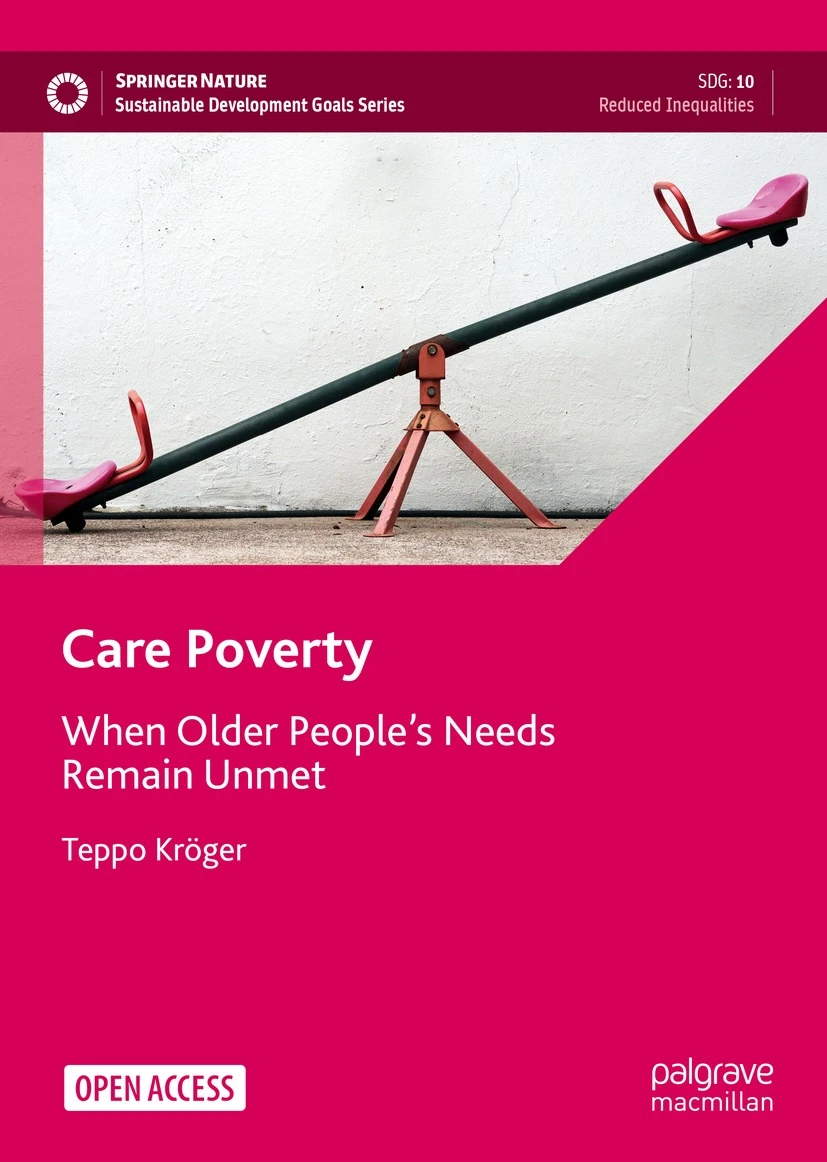
Book: Care Poverty - When Older People’s Needs Remain Unmet

CARE POVERTY
'This open access book turns the research attention of social policy scholars and long-term care researchers from comparative descriptions of care systems, focusing mostly on expenditures and volumes of long-term care services, to outcomes, and in particular to the question whether older people really receive the support that they need. Without knowledge about which needs and which social groups are currently inadequately covered, it is impossible to guide policy development.

The book puts forward a novel theoretical framework to guide future research work and public discussion on the issue of unmet long-term care needs, by broadening the current discussion so that inadequate care is seen in its societal and policy contexts, taking structural issues and policy designs into account. Kröger outlines three different domains of care poverty (personal care poverty, practical care poverty and socio-emotional care poverty) and differentiates between main methods how unmet needs are measured.' [my emphasis]

In psychiatry and psychiatric nursing, a person may be assessed to display poverty of thought, ideas or speech. As an exercise it may be useful to invert the rendering below in Hodges' model, and  consider Kröger's forms of poverty and possibly others that arise from your critique, reflections and life experience to date. Clearly, another book to add to the list!
 
individual
|
INTERPERSONAL : SCIENCES
humanistic ------------------------------- mechanistic
SOCIOLOGY : POLITICAL
|
group

CARE


CARE

CARE

POVERTY


Previously on W2tQ - (unmet) 'needs'

Kröger, T. (2022) Care Poverty - When Older People’s Needs Remain Unmet. Cham: Palgrave Macmillan. https://link.springer.com/book/10.1007/978-3-030-97243-1#about-this-book

Will check on a related title too.

Sunday, September 15, 2024

Interview study: Exploring psychological safety in inpatient mental health settings


Wednesday, April 10, 2024

"David Lynch: A Thinking Room"


Where is the Thinking Room?


Individual
|
      INTERPERSONAL    :     SCIENCES               
HUMANISTIC  --------------------------------------  MECHANISTIC      
 SOCIOLOGY  :    POLITICAL 
|
Group

Ah! Surely this one?

It's deep!


Is it here?
This is deep too!

Please take a chair.


I trust you are comfortable, so
what about this place?


Yes, you can think here -
but you must check first
before you do: Think. 
If you must ...

N.B. Please rate your experience too.


Soraya Roberts. A Room Of His Own, FT Magazine, 30-31 March, 2024, 1067: pp.38-41.

https://www.ft.com/content/bf6a6eaa-30d1-4704-9aea-4ff2d117f407

David Lynch’s dreamlike rooms at the Salone del Mobile.Milano 2024:
https://www.salonemilano.it/en/articles/david-lynchs-dreamlike-rooms-salone-del-mobilemilano-2024

Saturday, March 30, 2024

"Jason and the adventure of 254" c/o Wellcome Collection

"A work by artist Jason Wilsher-Mills is displayed at the Wellcome Collection ahead of the opening of a solo exhibition at the London museum. "Jason and the adventure of 254" reimagines the gallery space as a hospital ward and features huge sculptures, illustrations and interactive dioramas that draw on the artist's experience of becoming disabled at the age of 11.

The exhibition's title alludes to 2.54pm at Pinderfields Hospital, Wakefield, on August 1 1980, when Wilsher-Mills watched from his hospital bed as his parents were told he was suffering from an autoimmune condition brought on by a bout of chicken pox.

The free exhibition opens tomorrow (21st March) and runs until January." p.2.

INDIVIDUAL
|
      INTERPERSONAL    :     SCIENCES               
HUMANISTIC  --------------------------------------  MECHANISTIC      
 SOCIOLOGY  :    POLITICAL 
|
GROUP


'Figure in the bed', 2024, part of Jason and the Adventure of 254, an exhibition by Jason Wilsher-Mills at Wellcome Collection. Gallery Photo: Benjamin Gilbert. Attribution-NonCommercial 4.0 International (CC BY-NC 4.0).


Body of work, Artist relives diagnosis, Financial Times, 20 March 2024, p.2. 

Previously - 'beds'