Hodges' Model: Welcome to the QUAD: personality

Hodges' model is a conceptual framework to support reflection and critical thinking. Situated, the model can help integrate all disciplines (academic and professional). Amid news items, are posts that illustrate the scope and application of the model. A bibliography and A4 template are provided in the sidebar. Welcome to the QUAD ...

Showing posts with label personality. Show all posts

Saturday, May 02, 2026

Martha's Rule revisited ...

Last year in May, I posted about Martha's Rule. A year on, there is an update:

Evidence suggests Martha’s Rule is saving lives

'To support learning and assess the impact the programme is having, we regularly collect data from sites where Martha’s Rule is in place.

Early evidence suggests Martha’s Rule is saving lives and helping thousands of patients benefit from changes to their care.

Data from September 2024 to February 2026 shows 12,301 Martha’s Rule calls were made, with the highest proportion of calls (72%) made via the family/carer escalation process. 4,047 Martha’s Rule escalation calls (33%) related to acute deterioration.

Of those, 2,310 calls required changes in treatment. This includes 524 calls which resulted in transfers of care to high dependency or intensive care units, enhanced levels of care, tertiary centres or referral/transfer to specialists or a specialist ward. Other changes in treatment (1,786) did not require transfer of a patient from a ward in-patient setting. This includes the introduction of a new medication such as an antibiotic to treat infection, investigations including scans and procedural interventions including going to theatre.'

Source:
https://www.england.nhs.uk/patient-safety/marthas-rule/#implementingmarthasrule


individual
|
INTERPERSONAL : SCIENCES
humanistic ------------------------------- mechanistic
SOCIOLOGY : POLITICAL
|
group

"Not herself ..."
 
Listening 

Martha

1,700 NHS staff

Taking action


escalation
Mills

parents, guardians, friends & family
 
Familly input -
Multidisciplinary Team
 
Teamwork


Martha's Rule


My prompt:
Koronka, P. '1,700 NHS staff use Martha's Rule to raise the alarm'. The Times, 1 May, 2026, p.6.

Previously: 'intuition' : 'observation' : 'listen' : 'communication' (Never as an afterthought.)

Wednesday, February 19, 2025

Frayn's - shared 'Home Address'

Frequently I've made the point that 'person-centred' means placing the individual, patient, carer ... whatever the context, at the centre of Hodges' model. At the same time this is of course an idealisation:

individual
|
INTERPERSONAL : SCIENCES
humanistic ------------------------------- mechanistic
SOCIOLOGY : POLITICAL
|
group

What is your
'home' address?


'Science, it turns out, is in this respect simply an extension of all the other means we have found of representing the world. As with pictures and narratives, the world is unimaginable without the focus of a viewpoint. To understand the world in any way whatsoever scientifically, historically, artistically, anecdotally, imaginatively we find ourselves compelled to assume a potential point of convergence from which everything is  viewed, measured, and recounted. About the entity that defines this point we know only that it is by definition invisible to us. And since the instruments of science, of logic and mathematics, and of art, are all products of this invisible entity, they will not serve to represent or explain it to us. Anything in the world, or out of it, can be perceived or thought about, or both, and represented in our various codes. The only thing that systematically eludes us, whichever way we turn, is the something upon which everything else depends. The conscious subject that gives meaning to the objective universe cannot give meaning to itself. Without it nothing can be understood; about it nothing can be said. 
'The point of convergence . . .' And already we've gone wrong. The self isn't a point, in any remotely geometrical sense, but a complex organisation; and the consciousness that it generates, and by which it is animated, is a complex phenomenon.' pp.401-402. (my emphasis)


Frayn, Michael (2006). The human touch: our part in the creation of a universe. 'Home Address', Chapter 5. London: Faber & Faber. 

A final post from my paperback copy, next - off to a good secondhand home. Previously: 'Frayn'.

Sunday, October 13, 2024

Dramatherapy 2 - Personal identity

'Dramatherapy helps make sense of the world. Just as Goffman (1971) regards society as dramaturgically constructed, for the social presentation of selves, so Kelly (1955) describes a process in which individuals 'try on for size' various views of themselves as perceived by other people, in order to select the ones which allow them to carry on social relationships with one-another. Understanding of the other person is achieved by the process of construing his or her world, or 'construct system'. Kelly uses the notion of constructs and construct systems to describe cognitive structures. A construct is basically way of registering the degree to which an idea is present in relation to other ideas:

A construct is like a reference axis, a basic dimension of appraisal, often unverbalised, frequently unsymbolised, and occasionally unsignified in any manner except by the elemental processes it governs. Behaviourally it can be regarded as an open channel of movement, and a system of constructs provides each man with his own personal network of action pathways, serving both to limit his movements and to open up to him passages of freedom which otherwise would be psychologically non-existent.
(Kelly, 1955:199)' p.164.

'The multifarious ingredients of dramatherapy, like those of a theatrical event, are not haphazard. They are closely related, either by similarity or difference, to one another. Where there is confusion, this too is distinguished: it is confusion as opposed to order. Structure is employed in a conscious or intentional way, in order to reveal its true identity as the means by which we perform the fundamental action of relating things, in order to plot our movements in the world we live in. By allowing us to distinguish from, structure permits us to relate to. Certainly, the mechanism of perception performs this action without any conscious intention on our part; drama, and dramatherapy, is consciously contrived to assist it in its critical function, helping it to achieve a particular kind of clarity, by providing it with the raw material for involvement with the objects of perception.'
p.167-168.

EVALUATING THE EFFECT OF DRAMATHERAPY ON THOUGHT-DISORDER

Construct Theory rests upon the proposition that ideas hang together in a trustworthy way because people's behaviour is basically consistent. If people behave inconsistently, the thinking which they induce will lose its articulation, because the sense we make of life demands continual validation from the people and events we base it on. Thus, confused experience of relationship is, at its most fundamental level, the same thing as confused thinking; when our ideas begin to lose their coherence this is because, for us, other people have begun to come apart'. When they no longer fit the model we have of reality, the model itself loses its precise definition. At this point, Kelly suggests, we make our model more vague in order to preserve its identity as a model of reality: reality is blurred, so our model is imprecise. Unfortunately, it may become too inexact to function as a means of communication with the world of people and events it is intended to represent. The task of therapy is to provide evidence of the world's conformity to the individual's model, thus validating that individual's constructs. Because a person's disordered thinking is primarily concerned with the way they construe people, it must be done personally; because it is the result of experience over a considerable time, it must be done systematically, or 'serially`.
pp.171- 172.

Note to self: 'It is' :: 'It is - as if ?'. p.166.

individual
|
INTERPERSONAL : SCIENCES
humanistic ------------------------------- mechanistic
SOCIOLOGY : POLITICAL
|
group

I


I


Greek theatre masks

Institutional masking


Grainger, R. Dramatherapy and thought-disorder. Chapter 11. In Jennings, S. (Ed.), (1992) Dramatherapy. Theory and Practice 2. London: Routledge.
(Apologies, punctuation in the above may not be accurate, and I no longer have the text.)

Wednesday, February 14, 2024

Distance: Shoulders and ships that pass ...

James Lovelock, 2005 (cropped).jpg
Lovelock in 2005: Wikipedia

Over the past 10-20 years I've become more aware of the distance from scholars and people whose work is relevant to Hodges' model. Distance in the sense of their concomitant 'celebrity', hence the issue of how to make contact; and the stage of their career and my discovery of their relevance. Three people come to mind ... 

I've long admired the work of James Lovelock, and when writing on ecological themes in -

Jones, P. (2008) Exploring Serres’ Atlas, Hodges’ Knowledge Domains and the Fusion of Informatics and Cultural Horizons, IN Kidd, T., Chen, I. (Eds.) Social Information Technology Connecting Society and Cultural Issues, Idea Group Publishing, Inc. Chap. 7, pp.96-109.
- I wondered about trying to contact Dr Lovelock. As the majority of people are aware his thought and books, especially the Gaia hypothesis with Lynn Margulis caught the public's imagination from first publication and through the 1970s. Was there a Horizon TV programme? James Lovelock's influence was not just in ecology, but also earth (planetary) sciences through work for NASA. In early 2021 I thought I would reach out, through his most recent book and publisher/agent. I passed a message, which was forwarded but I never heard anything more.

As a nurse - with experience in older adult community mental health, I was acutely aware that this senior gentleman - in every sense of the word - may not want to be mithered by a scouser*, now living near Wigan Pier. I stressed not wanting to disturb the Dr. I also thought, given Dr Lovelock being of independent mind - a maverick, he might on the contrary love to be disturbed. 

Sadly, I was too late, hearing the news of Dr Lovelock's death in 2022. Of course, I was seeking validation (and still am) for the project here. I can't help thinking though, that Dr Lovelock really would have 'got' Hodges' model.

James Lovelock: BBC Radio 4 The Life Scientific

<>

Philosophy has long been an interest B.A.(Joint Hons.) Comp./Phil.. In a way you have no choice as a nurse, especially trained in mental health and general nursing: the theory and practice invariably touch reality, consciousness, perception, subjectivity, objectivity, knowledge, being, perception, data, information, time and so on.

Once acquainted with Hodges' model, scale is the dimension that asserts itself. I wrote about this and referenced Mario Bunge in about 1998, on the old, now archived website:

https://web.archive.org/web/20100329050839/http://www.p-jones.demon.co.uk/infintro.htm

Scale is a constant and multicontextual focus, but interest was piqued once again as I try to look at Hodges' model mathematically (yes, who am I trying to kid!) - as an object and relationally. I was reminded of Prof. Bunge's work noting a paper that included 'isomorphic-ism':

Bunge, M. (1969). Corrections to “Foundations of Physics”: Correct and Incorrect. Synthese, 19(3/4), 443–452. http://www.jstor.org/stable/20114653

https://link.springer.com/article/10.1007/s10838-021-09553-7

Mahner, M. Mario Bunge (1919–2020): Conjoining Philosophy of Science and Scientific Philosophy. J Gen Philos Sci 52, 3–23 (2021). https://doi.org/10.1007/s10838-021-09553-7

There may be a brief email exchange with Prof. Bunge, a request for a paper or two. Any emails are now stored (CD-ROM and portable drive) in a Turnpike folder, an old email client. Last year I was disappointed again, to learn of Dr Bunge's passing in 2020. His focus on science, philosophy, and systems - hard / soft is also very informative.

<>

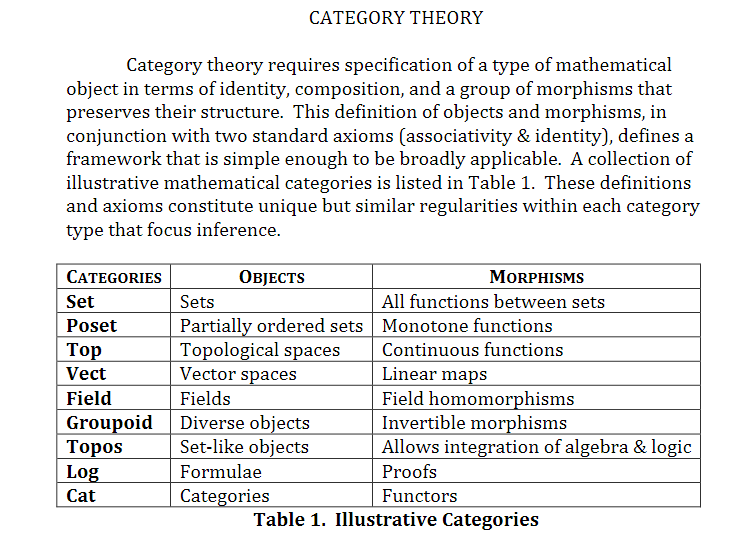
More recently, I came across the fascinating work of David Sallach, one paper (a conference from 2012) includes:


Sallach, D.L. Categorical Social Science: Theory, Methodology and Design. September 2012
Conference: Fourth World Congress on Social Simulation. Taipei, Taiwan.
https://www2.econ.iastate.edu/tesfatsi/Sallach2012CategoricalSoSci4.WCSS-SS.pdf

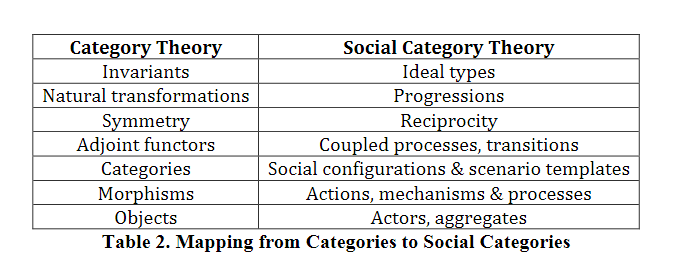
Plus, developed further in table 2:

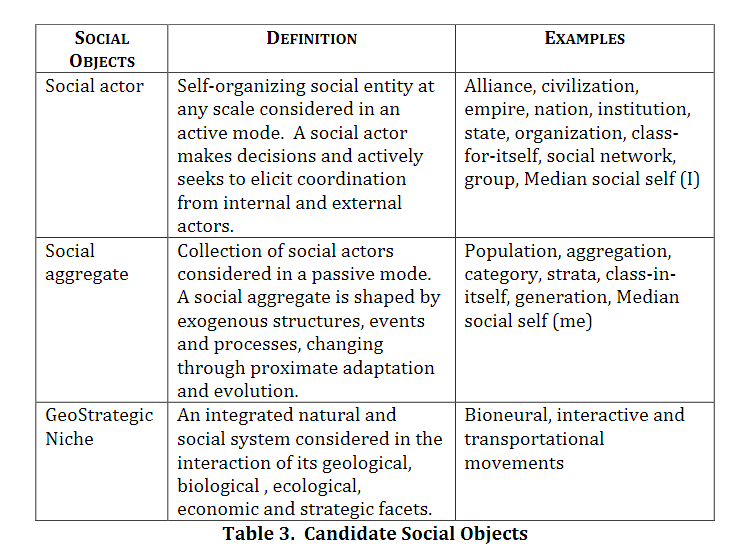
If time permits as an exercise, please consider Sallach's table 3 below. It may be interesting to map this to the domains of Hodges' model(?) [template]:
:

If you can see the potential utility of Hodges' model, you may also appreciate why Sallach's paper  resonates. Having emailed Dr Sallach, without reply, I did some checking. More sad news followed.

I, and no doubt many people will continue to discover and appreciate the legacy left behind by the above and many other pioneers. 

<>

I must acknowledge - Enid Mumford - whose work on socio-technical systems continues to inform my study and application of Hodges' model. This includes recognition of the many x-disciplinary bridges (or, barricades?) that can be found within Hodges' model. 

Clearly, much reading still to do.
<>

Returning to Hodges' model as a mathematical object, the 'distance' above is suddenly interstellar (and yes, sudden, as in faster than light!). I'm following videos, papers, and specific work-streams by  universities (I won't mention presently...) seeking to apply category theory to the social sciences. This suggests, at least, I'm not (completely!) wasting my time. If you have thoughts yourself on Hodges' model, the journey from Sallach's tables 1 - 2 not just 3, I'd be delighted to hear from you. 

There is another approach I will share this (N) spring. This author - researcher I have been able to contact.

*Scouser - https://en.wikipedia.org/wiki/Scouse
(Re. Liverpool - further post to follow).

James Lovelock image:  Bruno Comby, CC BY-SA 1.0, via Wikimedia Commons.

Wednesday, August 04, 2021

Myers-Briggs 'in' Hodges' model (Discuss?)

individual
|
INTERPERSONAL : SCIENCES
humanistic ----------------------------------------------- mechanistic
SOCIOLOGY : POLITICAL
|
group - population
INTUITION

THINKING
 

INTROVERSION

JUDGING


While thinking and thought span the intra- interpersonal and sciences domains, the bias is towards objectivity not subjectivity.

While individual's exercise judgement and the outcome of many decisions may be inconsequential, when situations are misjudged, the consequences can be very political, i.e. professional and legal. The overlaps here are many (as per the function of the MBTI) - in judgements that are adverse socially, for example, shame and embarrassment may also result.

Intuition is usually experienced in a person's 'gut' and yet despite this somatic reference it is a very subjective and humanistic quality. In clinical contexts it is interesting when a colleague or a team try to make sense of this in terms of action to take.

This interplay between subjectivity-objectivity, personal-other, quality-quantity and other dichotomies are inherent in Hodges' model.

My source:
Ahuja, A. (2018) The eternal appeal of Jung (Review of: What's Your Type? The Strange History of Myers-Briggs and the Birth of Personality Testing, Merve Emre, William Collins. Life&Arts, FTWeekend, 15-16 September. p.9.


Wednesday, January 11, 2017

Person & Sense of Place: A River runs through it ...

individual
|
INTERPERSONAL : SCIENCES
humanistic -------------------------------------------  mechanistic
SOCIOLOGY : POLITICAL
|
group-population
Personhood Personality Identity

Philosophy

Ethics

Panpsychism

Whanganui River

Nature

Environment

Human Ecology

History - Heritage

Indigenous Peoples

Legal personhood

Rights of Nature


My source: Moses, K. (2017) New Zealand River Granted Legal Personhood, Resurgence & Ecologist, Jan / Feb 2017. Issue 300: p.5.

NZHerald Agreement entitles Whanganui River to legal identity http://nzh.tw/10830586 via @nzherald

The Rights of Nature

Wednesday, July 20, 2016

A Checklist for Personhood

individual
|
INTERPERSONAL : SCIENCES
humanistic ---------------------------------------  mechanistic
SOCIOLOGY : POLITICAL
|
group

"Philosophers disagree on exactly what it would 
take for an animal to qualify as a person. 
Kristin Andrews at York University in Toronto, Canada, 
suggests searching for the six attributes listed here." p.17


SUBJECTIVITY
(REASONING) --------------

PERSONALITY

NARRATIVE SELF

AUTONOMY

(OBJECTIVITY)
--------------- RATIONALITY


RELATIONSHIPS


HI Peter,

Oh, that's interesting! I'd move Rationality to objectivity/science, though, as it refers to the ability to engage in logical reasoning, solve problems, etc. There's been a lot of interest recently on the logical abilities of babies (Sue Carey's team) and chimpanzees (e.g. Josep Call's team) and they both seem to be able to engage in exclusion reasoning (i.e. disjunctive syllogism).  I discuss animal rationality in my book The Animal Mind. 

Rationality isn't consciousness; I could add consciousness to the list, but it's there already, just subsumed by narrative self and relationships too.

cheers,
Kristin

___________________________________________________________
Kristin Andrews
Associate Professor
Philosophy/Cognitive Science
York University
4700 Keele St.
Toronto, ON M3J 1P3
CANADA

www.yorku.ca/andrewsk

Rutkin, A. (2016). Almost human? New Scientist, 2 July. 231:3080. 16-17.

Additional link:
BBC Future: 'Wisdom of the crowd'; The Myths and Realities