Hodges' Model: Welcome to the QUAD: category theory

Hodges' model is a conceptual framework to support reflection and critical thinking. Situated, the model can help integrate all disciplines (academic and professional). Amid news items, are posts that illustrate the scope and application of the model. A bibliography and A4 template are provided in the sidebar. Welcome to the QUAD ...

Showing posts with label category theory. Show all posts

Sunday, September 27, 2026

Book review: 'Categories: A Study of a Concept in Western Philosophy and Political Thought'

Categories


To - Edinburgh University Press. 

Many thanks for this book -

O’Sullivan L. Categories: A Study of a Concept in Western Philosophy and Political Thought. Edinburgh University Press; 2024.

Requested in May, your response was quick. So, my apologies for the delay in picking this up. In mitigation, what I have been learning since, will help my reading of O'Sullivan's text.

As readers of W2tQ will have realised, there is a built in bias to my reading of any text. In short: It's all about the model. 

Categories was spotted in Foyles on a visit to London. It recommended itself instantly: title, Venn diagrams, sets and all.

A larger format paperback of 335 pages, the print quality, font and design match the values and usual care of the publisher. 

Given the subject, there are appropriately distinct indices of subjects and proper names.

At pages 2-3, I have already succumbed (my emphasis):

'As a result, there is widespread contemporary recognition that categories are both important and problematic. A non-exhaustive list of academic fields and disciplines in which issues to do with categories arise includes anthropology, critical theory, cultural studies, feminist studies, history, linguistics, philosophy, political science, political theory, post-colonial studies, post-modernism, post-humanism, psychoanalysis, psychology, rhetoric and sociology. It is clear, moreover, that this recognition reflects the situation in society at large. Popular authors articulate a pervasive feeling that "Things are in the wrong place. Religion is in the box where science used to be. Politics is on the shelf where you thought you left science the previous afternoon." Categorical worries have penetrated public as well as academic discourse.' pp.2-3.

But how did Luke O'Sullivan know? On page 3 having given us the informal uses of the word 'category':

'These, moreover, are only the informal uses; there are also formal, logical and mathematical, senses which we shall largely have to pass over.'13

For me it is a disappointment that the formal aspects will be passed over. It is also a relief. 

For a model that is situated, as far as nursing theory, and models of nursing/care were concerned in 1997-8; Hodges' model had been left on the shelf - gathering dust.

I recognised a slide from a Youtube video this past week, care of Cheng I think? I'll share soon.

More to follow.

13 Eugenia Cheng, Cakes, Custard, and Category Theory Easy Recipes for Understanding Complex Mathematics (London: Profile Books, 2015) provides an introduction to mathematical category theory.

Wednesday, April 15, 2026

Book: 'Logic on the Track of Social Change'

When I walked into Lancaster Univ. library in February, I had no idea I was being followed.

From the maths shelves, the lights switching on as you progress, I decided to walk across to the more familiar realm of sociology. Looking for something, it was nice to see the parity in lighting, even as my struggle for mathematical enlightenment continues.

Logic on the Track of Social Change    

I do use the e-library, and other e-resources, but sometimes real shelves and varying levels of mustiness (remember the 'new acquisitions' - fewer these days?) invite a bit of serendipity. Suddenly, over my shoulders, the stranger,  pointed (with four arms of course). Was it my shadow? Or, was it my unconscious that 'read': LOGIC and TRACK and SOCIAL CHANGE, on the spine of -

David Braybrooke, Bryson Brown & Peter K. Schotch (eds.), Logic on the Track of Social Change, Oxford University Press. 1995?

In the early decades of health informatics, there was much talk - and still is(?) - of  'languages for health', even languages for nursing. Coding and classification systems were constantly developing, as posted here, but while physical diagnoses were the driver, the psychosocial dimensions of person - patienthood proved more nebulous. DSM is still subject much debate.

 Chapter 8 in Braybrook et al. is brilliant: A Rules-Analysis, Following Foucault, of the Birth of Clinical Medicine.

I've been in situations when surgery is suggested for an older person, and family, friends wonder is this really necessary? This chapter literally brings the history home, and not only that, but the emergence of the hospital system, versus care at home, in the community. The social determinants of health have been ever-present. This is essential reading for students, with the history of ICD, and the history of medicine. There are insights too into public attitudes and expectations to health services and provision here in the UK and in France.

For me, and Hodges' model, the significance of Braybrook, Brown, Schotch and Byrne is that it precedes:

Sallach, D.L. Categorical Social Science: Theory, Methodology and Design. September 2012
Conference: Fourth World Congress on Social Simulation. Taipei, Taiwan.
https://www2.econ.iastate.edu/tesfatsi/Sallach2012CategoricalSoSci4.WCSS-SS.pdf

And so, I do need my own secondhand copy of  Logic on the Track of Social Change. More to follow (indeed)! ... and help still welcome and needed.
 

Wednesday, January 28, 2026

ii Math Without Numbers - final notes & obs

In Math Without Numbers the chapters and topics flow and slot in really well, even for novices. There is no index, the inclusion of which is a first-check usually. The book's appeal was its non-technical title and invitation reading the sleeve notes. The title throws up words and visuals, the latter, to repeat, are ably and simply furnished by M Erazo. Remaining notes to highlight (record here) include (and capture overthinking!):

Math Without Numbers

Reference to 'ideology space', 'conceptual space' and the role of visual analogies, idioms, and how 'the list of spaces to choose from is always the same.' ... pp.28 & 29. On page 30, 'When you say that gender is a spectrum rather than a binary, that's a topological claim: You're  saying gender space is one-dimensional (a line) rather than zero-dimensional (two separate points). 'Questions about which conceptual paradigm to use sometimes boil down to questions of dimensionality.' Discussion of an infinite continuum had me making an axis of Hodges' model warp, this way and that: concave-convex (p.59). Maps and correspondence is already well established, as per a new paper (abstract and thanks to follow 1st Feb):

S. Bettiol, P. Jones, H. A. Onyedikachi, and W. G. Kernohan, “Bridging Gaps in Oral Health Frameworks: Mapping With Hodges' Health Career - Care Domains - Model”, Journal of Public Health Dentistry (2026): 1–14, https://doi.org/10.1111/jphd.70034 

Interesting to read of general map facts, flowing substances inside a rigid container, and vector maps. A pencilled note to share:

'Because when you look at things in the abstract like this, dusting off the specifics of a situation to focus on underlying dynamics, you start to realize there are only so many different patterns and structures out there. These patterns and structures are called mathematical objects, and thinking about them is called math.' p.79

The chapter on (generalised) Algebra, forced me to reconsider the Socratic, guided discovery and arrival at the structure of Hodges' model. (lines & points : nodes & edges). For page 88, I noted 'generic' invites abstraction. Isomorphism is discussed. Again I tested this against Hodges' model. I've always found it helps to immerse oneself in a new vocabulary: so welcome (anew) - structures, fields, rings, groups, loops, graphs, lattices, orderings, semigroups, groupoids, monoids, magmas, modules . . . algebras, p.101. Some are named only, but on graphs raises questions ... p.103.

'How densely interconnected is it? How segregated into different cliques? Does it cut clean into two subgraphs, with no connections between them? Can it be drawn without any lines crossing? Are there any lone dots without any connections?' 

There's the matter of 'friend of a friend' who have broken out of the sociological domain. Other notes to self: Significance of concepts - patient-centred, service-centred? The distance between between (vertical, horizontal, diametric)? There are weighted graphs (p. 104) and acknowledgement of category theory (p.115). A chapter on modelling pp.161-175, and models p.164 & p.169 are just a selection of highlights on a marvellous tour.

A hidden puzzle in the book remains a mystery for me.

Milo Beckman (2021) Math Without Numbers. London, Penguin Books. Illustrated by M. Erazo.

Previously: 'math' : 'diagrams' 
Plus, now archived Science domain links: 
https://web.archive.org/web/20150414125339/http://www.p-jones.demon.co.uk/linksTwo.htm

Believe it or not, this 'diversion' does help my reading of Order and the Virtual. 

Monday, November 24, 2025

Working title: 'Can Hodges’ model provide a foundation for a mathematically informed ...

... epistemology and relational ontology? Part 1'

Abstract

Aims: To begin a process of examining a ‘model of care’ and conceptual framework known as Hodges’ model as a mathematical object. This paper examines the structural elements of this model, its axes and domains through a formal, logical and mathematical lens. To establish the extent to which a combined relational understanding and mathematical approaches can provide avenues for further research.

Design: This study adopts the design of a two-part exploratory and descriptive paper, using an inquiry-based approach throughout.

Methods: The method is interdisciplinary, descriptive, and involves conceptual analysis. Rather than Hodges’ Model acting as a model of, and for care, here the model is used to investigate how health and social care can be better conceptualised. The question is: What is the result when Hodges’ Model is treated as a mathematical object? Here, Hodges’ model is used as an inquiry-based model with reflection and critique.

Results: Readers will see the development of ideas, driven by the structure of a model of care, existing taxonomy defined by nursing theory, associated with foundational mathematical concepts.

Conclusion: The questions introduced and deliberated here will identify avenues for further study. And highlight Hodges’ model to other researchers; less familiar with Hodges’ model, and yet more skilled – adept mathematically.

What does this paper contribute to the wider global clinical community?

Re-assert the importance of theory development in nursing and health disciplines.

Draw attention to the relational (and reflexive) potential of Hodges’ model and in healthcare to abstract the collective dimensions of healthcare, especially those that are political.

Given the problems faced in the century to follow, e
ncourage researchers within and without healthcare to further develop these ideas.

Impact:

Extend the relevance and scope of mathematical abstraction, in healthcare disciplines and the humanities, beyond statistical analysis.

This paper confirms: the conceptual utility of Hodges’ model; the challenge of requisite mathematical skills; the need for interdisciplinary cooperation.

Theorists in health and social care, policy makers and researchers seeking to apply mathematical techniques, especially category theory in the social science may find this work helpful and encouraging.

Reporting Method: N/A

Patient or Public Involvement: This study did not include patient or public involvement in its design, conduct, or reporting.

Keywords: nursing, theory, relational ontology, health, Hodges’ model, 
mathematics

Tuesday, January 28, 2025

Sticky Categories and Their Negative Consequences c/o Mikulak et al.

Category - Theory and Practice

Hodges' model -
A model for care in whatever situation, care environment*.

 
Individual
|
      INTERPERSONAL    :     SCIENCES               
HUMANISTIC  --------------------------------------  MECHANISTIC      
 SOCIOLOGY  :    POLITICAL 
|
Group
'I'
Me
My name is . . .
I am a person.
I am an individual.

Even if I don't thank you,
there may be someone out
there who thanks you for
acknowledging, confirming,
sustaining, preserving and
respecting my identity.

Even if I don't ask you
for your name please share
it with me, when you feel
 the time is right.

Together ...

[Abstract] "‘Behaviours that challenge others’ are attributed to 20% of people with learning disabilities. These behaviours are not a diagnosis, it is something people are labelled with. We conducted qualitative interviews with social care staff in the UK within four models of care: independent supported living, residential nursing home, Shared Lives, and living with family and attending a day opportunities centre*. We examine how the category of ‘behaviours that challenge others’ is produced, applied, and contested in adult social care settings. We demonstrate its stickiness and discuss its stigmatising consequences. How behaviours are understood, felt, and talked about matters for the support people with learning disabilities receive and maps onto their consequent inclusion or exclusion from society. We point out the harms the category carries for people who receive it and argue that it should be abandoned." p.110.


"Labeling theory suggests that labels lead to stigma, through changing how a group is perceived by others and supporting stratification (Haft et al. 2023). According to Link and Phelan (2001: 383), stigma ‘exists when elements of labeling, stereotyping, separating, status loss, and discrimination co-occur in a power situation that allows these processes to unfold’ (emphasis added). The acceptance of categories as valid and important differences is described by the labeling element of stigma (Link and Phelan 2001). Here, we attend to how this ‘labeling’ aspect of stigma interacts with its other mechanisms in the category of ‘behaviours that challenge others’." p.112.


"Emotions are not private, rather, they ‘circulate between bodies and signs’ producing meanings and creating ‘the surfaces or boundaries of bodies and worlds’ (Ahmed 2004b: 117); thus, affect is always distributed (Wetherell 2015). We propose the category—and the labeling process behind it—should be understood within an ableist (Campbell 2009) distribution of affect and politics of emotion; one that subordinates the experiences of people with learning disabilities through establishing the ‘truth’ of the reading as external and mediated through the emotions of people without learning disabilities. ‘Behaviours that challenge others’ (and synonyms of the category) are inherently relational but also reflect and reproduce existing power imbalances. We suggest their stickiness rehearses and reinforces the ableist politics of emotion that positions people with learning disabilities as ‘less human’ (Goodley 2021) and at times as monstrous. The category is a product of this politics, one that repeats its rehearsed, sticky associations, making the reading of the proximity of people with learning disabilities in the present a result of histories marked by dehumanization. The method of categorizing people through labels also makes them more susceptible to what McClimens has described as ‘reauthoring’, with collective histories ‘presented in a way that condones or even justifies their current situation’ (2007: 259)." p.113.


Mikulak, Magdalena, Sara Ryan, Elizabeth Tilley, Susan Ledger, Lisa Davidson, Pam Bebbigton, and Dawn Wiltshire. 2024. “Sticky Categories and Their Negative Consequences: People with Learning Disabilities and ‘Behaviours that Challenge Others’.” Scandinavian Journal of Disability Research 26(1): 110–123.
DOI: https://doi. org/10.16993/sjdr.1069 (with my emphasis)

I have cited Mikulak et al. in 1/2 papers submitted yesterday after revision on: threshold concepts, deprivation of liberty, residential care and Hodges' model.

Sunday, July 07, 2024

Book for review: v "Philosophy of Care - New Approaches to Vulnerability, Otherness and Therapy"

I think this is the final post for Philosophy of Care (think! There is so much more ...). There are other chapters more salient to me personally, but for Hodges' model and the collective human enterprise, I think chapter 5 by Virginia Held is the most important. There's not just a chapter, but three in Part II 'Care and Economy'. I appreciate the reminder of Kate Raworth's Doughnut Economics which challenges;"the dominant assumption of the economy as a machine". I notice on Twi/X Kate Rowarth reflects on the UK's election:
The book 'Doughnut Economics' opens with the story of Yuan Yang who, as a young economics student back in 2008, was challenging the outdated theory she was being taught. Last night she was elected as the first-ever MP for Earley & Woodley. Huge congratulations @YuanfenYang!
    https://x.com/KateRaworth/status/1809216007518507248
I gave Keir Starmer a copy of Doughnut Economics just 10 days before he became Labour Party Leader. So will the book make it onto his bookshelves in Number 10? More importantly: will policies for a regenerative & distributive UK become real under this government?...

     https://x.com/KateRaworth/status/1809235013403136029

While in Philosophy of Care, another three words stood out:
"'Big-picture thinkers'^, Raworth notes, have offered alternative visions, but they have been dismissed by the field of economics." p.102.

continued ... 

Friday, May 10, 2024

Towards isomorphisms in Hodges' model

"The concept that best captures the process of homogenization is isomorphism. In Hawley's (1968) description, isomorphism is a constraining process that forces one unit in a population to resemble other units that face the same set of environmental conditions. At the population level, such an approach suggests that organizational characteristics are modified in the direction of increasing comparability with environmental characteristics; the number of organizations in a population is a function of environmental carrying capacity; and the diversity of organizational forms is isomorphic to environmental diversity." p.149.

"We identify three mechanisms through which institutional isomorphic change occurs, each with its own antecedents: 1) coercive isomorphism that stems from political influence and the problem of legitimacy; 2) mimetic isomorphism resulting from standard responses to uncertainty; and 3) normative isomorphism, associated with professionalization. This typology is an analytic one: the types are not always empirically distinct." p.150.

DiMaggio, P. J., & Powell, W. W. (1983). The Iron Cage Revisited: Institutional Isomorphism and Collective Rationality in Organizational Fields. American Sociological Review, 48(2), 147–160. https://doi.org/10.2307/2095101

"Some of them went further, using approaches based in political economy, world systems theory, and theories of neocolonialism and underdevelopment to show that economic imperatives on a global scale were a major force in shaping education worldwide. Others interpreted such change through an institutional lens, arguing that the convergence toward accepted models of modernity has resulted in a process of educational isomorphism within and across countries." p.1.

Carnoy, M., & Rhoten, D. (2002). What Does Globalization Mean for Educational Change? A Comparative Approach. Comparative Education Review, 46(1), 1–9. https://doi.org/10.1086/324053

"The movement is inspired by Rudolf Virchow (1821-1902), who coined the term zoonosis, arguing that there should be no dividing lines between animal and human medicine. This position has been gathering momentum in the last fifteen years. The One Health Initiative is a rather daring interdisciplinary alliance that unites physicians, osteopaths, veterinarians, dentists, nurses, and other scientific-health and environmentally related disciplines, on the basis of a simple hypothesis, which is the isomorphism of structures between humans and animals in immunology, bacteriology, and vaccine developments. This means that humans are both exposed and vulnerable to new diseases, like bird flu and other epidemics, which they share with animal species." p.16.

Rosi Braidotti. (2015). Yes, There Is No Crisis. Working Towards the Posthumanities. DiGeSt. Journal of Diversity and Gender Studies, 2(1–2), 9–20. https://doi.org/10.11116/jdivegendstud.2.1-2.0009

"The chapter begins by developing the logic of strategic voting in a single- member district system, thus won by whichever party or candidate gets the most votes (first past the post, or FPTP). This represents the simplest and easiest case for the logic of strategic voting, and similarities (and sometimes theoretical isomorphism) exist between strategic voting— sometimes called instrumental voting (or voting as an investment)— and expected- utility maximization." p.3.

Aldrich, J. H., Blais, A., & Stephenson, L. B. (2018). Strategic Voting and Political Institutions. In J. H. Aldrich, A. Blais, & L. B. Stephenson (Eds.), The Many Faces of Strategic Voting: Tactical Behavior in Electoral Systems Around the World (pp. 1–27). University of Michigan Press. http://www.jstor.org/stable/j.ctvh4zhzr.4 

"Let us take a closer look at this important topic: what might be termed the isomorphism between the realm of care and the realm of perception/oikeiôsis-allotriôsis." p.57.

Joaquim Braga & Mário Santiago de Carvalho (eds.) (2021). Philosophy of Care - New Approaches to Vulnerability, Otherness and Therapy. Cham: Springer Verlag.
https://link.springer.com/book/10.1007/978-3-030-75478-5

- will add here ... suggestions welcome h2cmng AT yahoo.co.uk

Wednesday, February 14, 2024

Distance: Shoulders and ships that pass ...

James Lovelock, 2005 (cropped).jpg
Lovelock in 2005: Wikipedia

Over the past 10-20 years I've become more aware of the distance from scholars and people whose work is relevant to Hodges' model. Distance in the sense of their concomitant 'celebrity', hence the issue of how to make contact; and the stage of their career and my discovery of their relevance. Three people come to mind ... 

I've long admired the work of James Lovelock, and when writing on ecological themes in -

Jones, P. (2008) Exploring Serres’ Atlas, Hodges’ Knowledge Domains and the Fusion of Informatics and Cultural Horizons, IN Kidd, T., Chen, I. (Eds.) Social Information Technology Connecting Society and Cultural Issues, Idea Group Publishing, Inc. Chap. 7, pp.96-109.
- I wondered about trying to contact Dr Lovelock. As the majority of people are aware his thought and books, especially the Gaia hypothesis with Lynn Margulis caught the public's imagination from first publication and through the 1970s. Was there a Horizon TV programme? James Lovelock's influence was not just in ecology, but also earth (planetary) sciences through work for NASA. In early 2021 I thought I would reach out, through his most recent book and publisher/agent. I passed a message, which was forwarded but I never heard anything more.

As a nurse - with experience in older adult community mental health, I was acutely aware that this senior gentleman - in every sense of the word - may not want to be mithered by a scouser*, now living near Wigan Pier. I stressed not wanting to disturb the Dr. I also thought, given Dr Lovelock being of independent mind - a maverick, he might on the contrary love to be disturbed. 

Sadly, I was too late, hearing the news of Dr Lovelock's death in 2022. Of course, I was seeking validation (and still am) for the project here. I can't help thinking though, that Dr Lovelock really would have 'got' Hodges' model.

James Lovelock: BBC Radio 4 The Life Scientific

<>

Philosophy has long been an interest B.A.(Joint Hons.) Comp./Phil.. In a way you have no choice as a nurse, especially trained in mental health and general nursing: the theory and practice invariably touch reality, consciousness, perception, subjectivity, objectivity, knowledge, being, perception, data, information, time and so on.

Once acquainted with Hodges' model, scale is the dimension that asserts itself. I wrote about this and referenced Mario Bunge in about 1998, on the old, now archived website:

https://web.archive.org/web/20100329050839/http://www.p-jones.demon.co.uk/infintro.htm

Scale is a constant and multicontextual focus, but interest was piqued once again as I try to look at Hodges' model mathematically (yes, who am I trying to kid!) - as an object and relationally. I was reminded of Prof. Bunge's work noting a paper that included 'isomorphic-ism':

Bunge, M. (1969). Corrections to “Foundations of Physics”: Correct and Incorrect. Synthese, 19(3/4), 443–452. http://www.jstor.org/stable/20114653

https://link.springer.com/article/10.1007/s10838-021-09553-7

Mahner, M. Mario Bunge (1919–2020): Conjoining Philosophy of Science and Scientific Philosophy. J Gen Philos Sci 52, 3–23 (2021). https://doi.org/10.1007/s10838-021-09553-7

There may be a brief email exchange with Prof. Bunge, a request for a paper or two. Any emails are now stored (CD-ROM and portable drive) in a Turnpike folder, an old email client. Last year I was disappointed again, to learn of Dr Bunge's passing in 2020. His focus on science, philosophy, and systems - hard / soft is also very informative.

<>

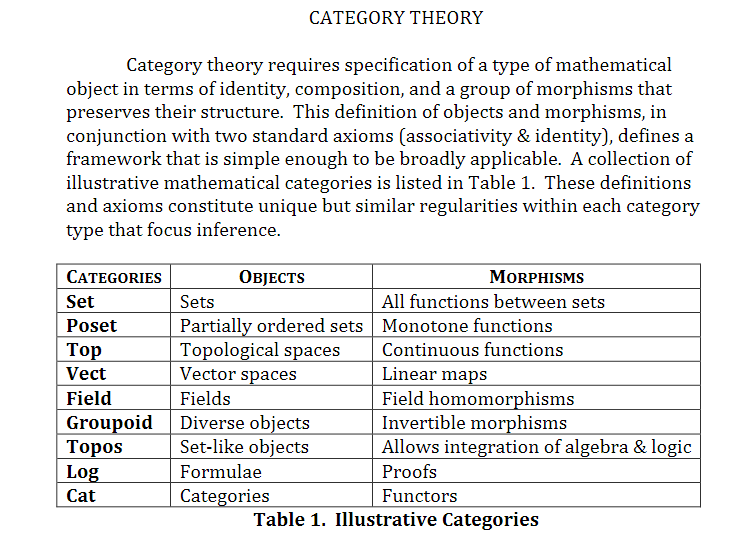
More recently, I came across the fascinating work of David Sallach, one paper (a conference from 2012) includes:


Sallach, D.L. Categorical Social Science: Theory, Methodology and Design. September 2012
Conference: Fourth World Congress on Social Simulation. Taipei, Taiwan.
https://www2.econ.iastate.edu/tesfatsi/Sallach2012CategoricalSoSci4.WCSS-SS.pdf

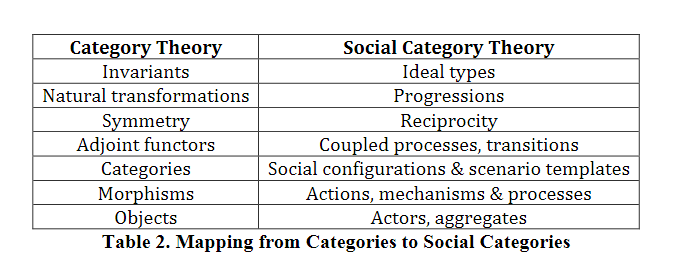
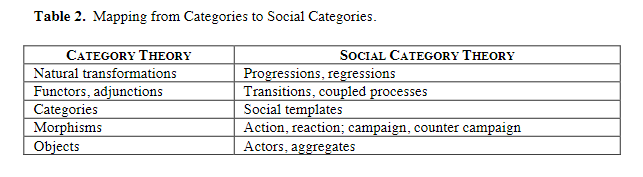
Plus, developed further in table 2:

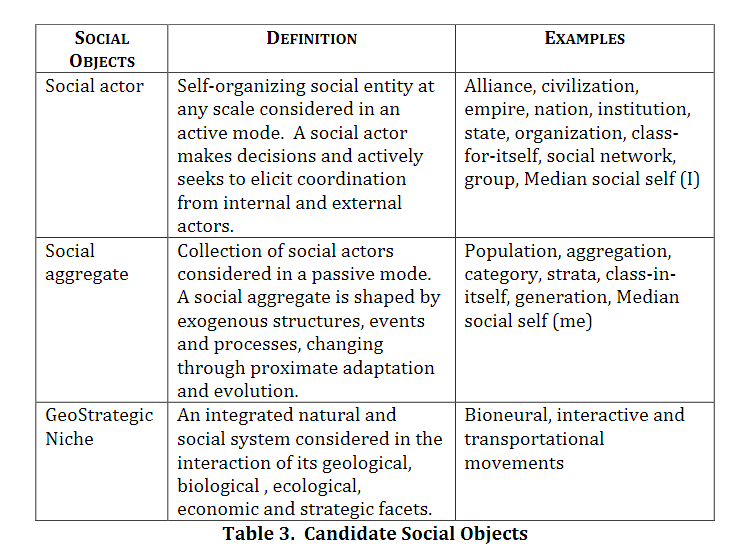
If time permits as an exercise, please consider Sallach's table 3 below. It may be interesting to map this to the domains of Hodges' model(?) [template]:
:

If you can see the potential utility of Hodges' model, you may also appreciate why Sallach's paper  resonates. Having emailed Dr Sallach, without reply, I did some checking. More sad news followed.

I, and no doubt many people will continue to discover and appreciate the legacy left behind by the above and many other pioneers. 

<>

I must acknowledge - Enid Mumford - whose work on socio-technical systems continues to inform my study and application of Hodges' model. This includes recognition of the many x-disciplinary bridges (or, barricades?) that can be found within Hodges' model. 

Clearly, much reading still to do.
<>

Returning to Hodges' model as a mathematical object, the 'distance' above is suddenly interstellar (and yes, sudden, as in faster than light!). I'm following videos, papers, and specific work-streams by  universities (I won't mention presently...) seeking to apply category theory to the social sciences. This suggests, at least, I'm not (completely!) wasting my time. If you have thoughts yourself on Hodges' model, the journey from Sallach's tables 1 - 2 not just 3, I'd be delighted to hear from you. 

There is another approach I will share this (N) spring. This author - researcher I have been able to contact.

*Scouser - https://en.wikipedia.org/wiki/Scouse
(Re. Liverpool - further post to follow).

James Lovelock image:  Bruno Comby, CC BY-SA 1.0, via Wikimedia Commons.

Monday, January 29, 2024

Identity: Self, person, client, patient ... player

INDIVIDUAL
|

 INTERPERSONAL    :     SCIENCES               
HUMANISTIC --------------------------------------  MECHANISTIC      
SOCIOLOGY  :   POLITICAL 
|
GROUP
Identity morphism


My source: Twitter - X
https://x.com/Ravens/status/1751712286769660409?s=20

Plus:
https://www.cbssports.com/nfl/news/lamar-jackson-makes-unreal-catch-of-his-own-pass-in-chiefs-ravens-afc-title-game-leaving-tony-romo-amazed/
 
Image:
https://krossovochkin.com/posts/2020_04_26_category_theory/

Friday, December 15, 2023

Person to object: Surely you're joking* ...!

 INDIVIDUAL
  |
     INTERPERSONAL    :     SCIENCES               
HUMANISTIC --------------------------------------  MECHANISTIC      
SOCIOLOGY  :   POLITICAL 
|
GROUP

identity

person

choice


identity

person, age

integer


people

father - mother

election

voting age


By @Eyesomorphic - https://www.youtube.com/@Eyesomorphic 

"A gentle introduction to the study of Category Theory and Abstract Algebra, done from the ground-up by exploring the mathematical weapon of abstraction. This video aims to give an overview of the fundamental tool at the forefront of pure mathematical research: abstraction. By seeing this tool in various contexts, and how it allows us to encounter Category Theory in a natural and intuitive manner, we'll see how beautiful the abstract can really be."

  ― Timestamps ― 
 0:00 - Intro 
1:49 - Abstraction and Algebra 
7:30 - Examples of Abstraction 
8:49 - Set Theory 
13:25 - Category Theory 
21:16 - Outro 
― Credits ―
All animation and voiceover created by Eyesomorphic. Background music: 'Abstraction', composed by Caleb Peppiatt.

― Further Reading ―
Category Theory for Programmers: The Preface, by Bartosz Milewski: https://bartoszmilewski.com/2014/10/28/category-theory-for-programmers-the-preface/

Category Theory for Computing Science, by Michael Barr & Charles Wells (Book)

 *Person to object - and back again - assuring and preserving the humanistic.

Thursday, October 05, 2023

"Diagrammatic Immanence"


Diagrammatic Immanence


"There is thus a naturally 'pragmatic' epistemology intrinsic to categories: from the standpoint of category theory objects are investigated and known only via their interactions with other objects, not 'in themselves''. The space of possible maps from one object to another determines what can be known of those objects as such. Over the past several decades, category theory has proven extraordinarily successful in unifying diverse fields of mathematics and providing a less arbitrary and more productive foundation for mathematics than set theory. Because of its intrinsic orientation towards relations, it connects more readily and with fewer idealist assumptions than set theory to the real world and its component structures." p.10. 


"A meaning of whatever sort is necessarily determined by its position in a space of various intersecting structures, each with its own rich tangle of relations. Each of the 'single' topics being discussed opens up internally into a complex arrangement of mappings between, words, sentences, semantics, phonemes - all the systematic orders of differential relations that structuralism has taught us to recognise. And these orders are themselves embedded in actual material and historical processes.

The seemingly intractable complexity of actual language (parole and not only langue) is one of the reasons linguistic semantics have tended to resist mathematical and logical formalisation so stubbornly. Meaning is enacted in singular events and in this way resists abstract treatment. Yet at the same time, meaning presupposes translatability.  All the singular grain of the interlocking systems of some actual conversational exchange connects potentially to the systems of innumerable others. Any adequate categorical representation of linguistic events and, more generally, semiotic processes must be both rigorous and and flexible enough to track the logical and structural underpinnings of meaning and at the same time facilitate the blurring and affordances of translation." p.141.

Gangle, R. (2016). Diagrammatic Immanence: Category Theory and Philosophy. Edinburgh University Press. http://www.jstor.org/stable/10.3366/j.ctt1bgzc38

Friday, September 22, 2023

"Why models go wrong" BYTE, 1985

Why models go wrong
BYTE


"A model can be a physical object: a scale-model of an ancient settlement inferred from archeological evidence, or a physical anthropologist's reconstruction of a skeleton from a few bones and fragments. Most social models, however, are mathematical isomorphisms that specify one-to-one relationships between elements of the model and observable processes or entities. This abstractness gives models great versatility, but it also opens doors to potential problems. You don't need to be a naval architect to see that a model battleship has no bottom, but flaws in an equally defective sociometric model that repeatedly factors a large covariance matrix might escape casual scrutiny." p.151.


My source:
Houston, T.R. 1985. Why models go wrong. BYTE 10(10) : 151-164.


Friday, September 15, 2023

Draft papers: The heat is always on ...

Writing is never easy here. My 'pen' runs pell-mell and I invariably follow; dragged and teased from discipline-to-discipline, while trying to pick up any semblance of a coherent thread.

Perhaps that's the cost of being naturally(?) drawn to mind-mapping, Hodges' model specifically and the substrate - structure it affords.

While painful, the papers I've produced show (as listed in bibliography and with others) that I can get there.

In February I posted:


In truth, of course, there was no way I was going to complete a submission by July. I've been intent to throw caution to the wind, even at risk of being blown flat on the my face (and worse?).

Winding back further to October and December 2021 and the 12,000 word draft: "Society, Technology and COVID19 in Hodges' model":

https://hodges-model.blogspot.com/2022/10/draft-papers-iii.html
I approached a journal regards the draft 'Society, Technology and COVID19 in Hodges' model'. Having reduced the original 12000 words to 7700, the paper is of interest, but is (as expected) too long. There is the possibility of reducing the word count to 5000, or splitting the essay.

Duly resubmitted, the feedback from the reviewers, all three, is spot-on. 

Since the (N.) spring, I've tried to re-structure and provide a meaningful discussion. In conclusion. It's  not happening.

One reviewer noted: 

"I still do not have a clear understanding of where the model comes from and what its axioms are."
Repeating myself no doubt, the book chapter on the work of Michel Serres:

Jones, P. (2008) Exploring Serres’ Atlas, Hodges’ Knowledge Domains and the Fusion of Informatics and Cultural Horizons, IN Kidd, T., Chen, I. (Eds.) Social Information Technology Connecting Society and Cultural Issues, Idea Group Publishing, Inc. Chap. 7, pp. 96-109.

- resulted from an earlier draft which was well-shredded by the nurse journal reviewers. They did help - I've a paper to review myself.

Out of flames though that chapter quickly emerged and took flight (well, was 'completed' at least). So if you are writing and struggling - take heart.

Avoiding nursing journals (enough = enough? Nobody is interested): 

I now think I have an improved plan for two papers. The first will consider the axioms of care within Hodges' model; plus (please don't laugh!) what insights might follow if I/we treat Hodges' model as a mathematical object?

Can I claim mitigation by suggesting this (folly) is not entirely my fault . . ?

"Thus, the author can take a different approach and with a structured discussion of ideas, the author can generate testable hypotheses to move forward with a research paper. A more structured theoretical approach would also help to pique the interest of more advanced readers, especially academic audiences such as faculty who want to learn about something outside of their own research areas."

STRANGER IN
A STRANGE LAND

I feel I've no choice but to respond to the reviewer quite literally. As a non-mathematician, perhaps I can pique the interest of more advanced readers and faculty? The aim of the former archived website and this blog is to pass-on this baton2 😉to others; people who can understand it anew and apply it to the problems (solutions ...) of the century.

So in part two, the 'Society, Technology and COVID-19 in Hodges' model' piece will be structured (re-written) using hypothetical examples that ask questions of Hodges' model, the audience, and most definitely - me! It might, if not too grandiose, even ask questions of mathematics too and the humanities(?) - hence reading to follow. A real trick would be if these two papers could also stand alone.


n.b. After attending the UKSS Conference today, I must consider systems too (but don't panic - it's OK!) - to inform a title: re. humanistic & mechanistic systems? Yesterday, I really enjoyed 3 hours chatting to two fellow systems enthusiasts, who work in public health; and business / management respectively. We met in Oxford, at the Ashmolean cafe. 


UKSS Conference is bound for Oxford next year and when I have details I will post here.

Book cover:
https://www.hachette.com.au/robert-a-heinlein/stranger-in-a-strange-land
div>

Wednesday, August 30, 2023

Paper - Categorical Social Science: Theory, Methodology and Design by Sallach (2012)

This conference paper from 2012 - cited at length here - is very encouraging as I try to work on category theory within Hodges' model. This is timely too, as a new (northern) academic year begins - post to follow ...

Sallach, D.L. Categorical Social Science: Theory, Methodology and Design. In: Conference Paper - 4th World Congress on Social Simulation. Taipei, Taiwan (September 2012). https://www.researchgate.net/publication/275584554

"The prospect of representing social processes at multiple scales, at an arbitrary level of detail, is likely to produce rich, interwoven models with the potential to provide a more effective map of historical and policy-oriented dynamics. However, this potential will also raise significant challenges in validating such a model [15].

One approach to managing the complexity (both conceptual and computational) of social models is to move them toward a higher level of abstraction."

"Category theory requires specification of a type of mathematical object in terms of identity, composition, and a group of morphisms that preserves their structure. This definition of objects and morphisms, in conjunction with two standard axioms (associativity & identity), defines a framework that is simple enough to be broadly applicable."

Conclusion:

"The present analysis introduces more analytical potential than can currently be demonstrated. Nonetheless, it makes a case for the relevance of category theory for the representation of social applications, and illustrates a variety of ways in which these conclusions are, or ultimately can become, compelling.

Category theory provides a rigorous yet expressive formalism for representing and integrating challenging modeling domains. It is also a formalism that can support extensive theoretical and modeling syntheses, while still maintaining appropriate levels of exactness. These strengths make CT particularly appropriate for providing a mathematical foundation for computational social science.

Ultimately, it is important to return to the issue of the validation of social models. The practical use of historical and/or policy-oriented models is highly dependent upon their credibility. Category theory provides a formalism that can be precise when applied to theory, explicit during the design stage, and definitive at the assessment stage, while also attending to the consistency of intermediate stages. It deserves serious exploration and investigation."

Saturday, August 19, 2023

Evidence-based care: The original Gordian Knot

or - Choose your audience carefully.

Within health and social care (and other - safety-critical - academic and professional fields) evidence-based care is pivotal as proof of safety, reproducibility, effectiveness, efficacy, professionalism, and benefits for the subjects of care and public. How best then to prove the scope, scale, relevance and safety of Hodges' model? How to demonstrate in theory and practice the utility and increasing relevance of Hodges' model? There are times I have to temper my belief, passion and enthusiasm for h2cm; am I too ardent, and at risk of coming across as preaching? There is a further tension. The one that is constant: language.

As a nurse, attention to language and terminology is vital to effective communication, establishing and sustaining rapport and empathy. This concern applies across situations, contexts and encounters; with patients, patient and carer (family), and colleagues. We are encouraged to avoid jargon, abbreviations  and technical terms. I use Hodges' model implicitly (aide-mémoire, assess, plan, evaluation, prioritise) and explicitly - sharing the model on some occasions but not all.

In the role of researcher / author, the audience, especially - editors, reviewers, and readers have expectations in how concepts, ideas, theories are expressed and explained. To a degree, the very title of a publication, preempts the language to follow. As I present, or write, sources must be declared and  referenced. Again, resort to jargon is discouraged. Clarity and brevity are strengths. And yet how likely is it that at least 1/3 reviewers will demand more technical rigour and explanation? If terms are used from other disciplines, the expectation follows that their cross-disciplinary application is explained and argued for, and meanings differentiated.

With potential theoretical underpinnings for Hodges' model to be found in Gärdenfors's Conceptual Spaces, and Meyer & Lands's Threshold Concepts and others (nursing and healthcare no-less); John D. Cook provides additional pause for thought - as I look even further afield:

"When I was in college, I sat in on a communication workshop for Latin American preachers. ...

Another lesson from that workshop, the one I want to focus on here, is that you don’t always need to convey how you arrived at an idea. Specifically, the leader of the workshop said that if you discover something interesting from reading the New Testament in Greek, you can usually present your point persuasively using the text in your audience’s language without appealing to Greek. This isn’t always possible—you may need to explore the meaning of a Greek word or two—but you can use Greek for your personal study without necessarily sharing it publicly. The point isn’t to hide anything, only to consider your audience. In a room full of Greek scholars, bring out the Greek.

This story came up in a recent conversation with Brent Yorgey about category theory. You might discover something via category theory but then share it without discussing category theory. If your audience is well velrsed in category theory, then go ahead and bring out your categories. But otherwise your audience might be bored or intimidated, as many people would be listening to an argument based on the finer points of Koine Greek grammar. ...

Some things may sound profound when expressed in esoteric language, such as category theory or Koine Greek, that don’t seem so profound in more down-to-earth language. Expressing yourself in a different language helps filter out pedantry from useful ideas. (On the other hand, some things that looked like pure pedantry have turned out to be very useful. Some hairs are worth splitting.) 

Sometimes you have to introduce a new terms because there isn’t a colloquial counterpart." ...

 Category theory and Koine Greek: John D. Cook. 

Category theory and Koine Greek: John D. Cook. 
https://www.johndcook.com/blog/2016/06/27/category-theory-and-homiletics/

See also: Applied category theory: John D. Cook

https://www.johndcook.com/blog/applied-category-theory/

Friday, May 05, 2023

"There are no tools stored in this van overnight"

. . . but there is a tool
with great potential
available here 24/7/365 . . .


INDIVIDUAL
|

 INTERPERSONAL    :     SCIENCES               
HUMANISTIC --------------------------------------  MECHANISTIC      
SOCIOLOGY  :   POLITICAL 
|
GROUP
Identity morphism


Images: 
 
https://krossovochkin.com/posts/2020_04_26_category_theory/
 
https://cdn.shopify.com/s/files/1/0044/4701/0919/products/no-tools-stored-in-this-vehicle-overnight-sign-646188.png?v=1680276776

Tuesday, April 04, 2023

ii SNAP! Abstract [working] Hodges’ model as a mathematical object, a lens for social care and inclusion: category theory or category mistake?

Snap! 

As suspected the elasticity in the holistic bandwidth of the working abstract just failed.

The abstract rejected, I'm not surprised.

[ Prev. https://hodges-model.blogspot.com/2023/03/category-theory-or-category-mistake.html ]

I hoped 'no news' ... might fuel progress for a little longer.

Clearly (again), holistic bandwidth is never enough - focus, focus.

I'm grateful to learn from the call however, that there is a need to address:

How can prevention in social care be better conceptualised?

So I've a start at least ...

Grateful too, in the call, for Wright Mills sociological imagination:

“Know that the human meaning of public issues must be revealed by relating them to personal troubles—and to the problems of the individual life. Know that the problems of social science, when adequately formulated, must include both troubles and issues, both biography and history, and the range of their intricate relations. Within that range the life of the individual and the making of societies occur; and within that range the sociological imagination has its chance to make a difference in the quality of human life in our time.” Wright Mills (1959:226). [My emphasis.]

Clearly the current and previous governments have not got a clue!


Thursday, March 16, 2023

Abstract [working] Hodges’ model as a mathematical object, a lens for social care and inclusion: category theory or category mistake?

There's a clearer idea now - an abstract - something to aim for in July:

Call for Papers - Community Development and Preventative Care With Older People:
New Values and Approaches

Not yet fully fledged, but then Spring [N] still beckons ...

Hodges’ model as a mathematical object, a lens for social care and inclusion:
category theory or category mistake?

Abstract

The health and social care sectors include disciplines that inevitably fall under the combined aegis of the sciences and humanities. This paper examines social inclusion across Snow’s ‘Two Cultures’. The method is interdisciplinary and descriptive utilising a generic conceptual framework known as Hodges’ model. Rather than Hodges’ model acting as a model of, and for care, here the model is used to investigate how social care can be better conceptualised. While mathematics is a mandated competency in healthcare, the subject, as for the general population, is one preferably left at school. The question posed is: What happens when Hodges’ model is treated as a mathematical object? A challenge for reader and author alike, the purpose is to seek new insights into social inclusion, value, values and development through a relational and dialectic strategy with diagrammatic support, also signposting future avenues of study.

Given ongoing demographic pressures for many nations, is there an additional danger of two intergenerational cultures? Is prevention enough; and can we improve understanding of what can be termed ‘legacy issues’ in health and social care? Can we simultaneously reduce the focus to Simmel’s ‘dyad’, and yet open new avenues for discourse and description? Can we expose the epistemological and ontological dimensions of social inclusion and the life (and death) experience of older adults? Inclusion and exclusion are implicit parameters within the model, its original purposes being person-centredness and recognition of health as political. References and resources, in the form of a template and bibliography are provided.

<>

Still much more to do ... heaven knows what the result will be - and do? Even as I keep the call 'in mind', it may not 'fit' the intended journal at all. Non-predatory, and no article processing charges is essential. Brevity, conciseness ... the order of the day. I can't even hide behind "A little knowledge is a ...": I know nothing - but I'm sure there is some-thing here and in #h2cm.

If anyone is interested in writing something quite different and challenging, then please get in touch. There may (realistically imho) be two-three papers here?

From the call:

"As Rapoport highlighted in the 1960s, however, translating the unified view of prevention associated with public health into social welfare is inherently problematic. This remains the case. Preventative social care and support necessarily operate in complex and dynamic systems, generally where knowledge of causation and the consequences are unclear, and an imaginative application of care needs and contexts is required.

Though current policy direction across many countries suggests opportunities for re-imagining how prevention may be best conceptualised, numerous studies have highlighted that there remains considerable confusion and disparity in how this plays out in practice."

I have held on to the following article from Computing, March 19th 1987 and still learning from Durham and colleagues' journalism:

 "Sometimes a highly abstract, unifying mathematical theory underlies a whole set of scientific or engineering subjects. ...

Category theory is one such subject. Sometimes described as an algebra of algebras, it plays a unifying role in discrete mathematics. Discrete mathematics is a general heading for all the mathematical subjects which deal with jumpy, lumpy entities. Most of the mathematics used in the theory of digital computing is of this kind.

Another unifying subject, homology theory or differential topology, is less well known to computer scientists ... Homology theory is a unifying theory in continuous mathematics, which is the name given to everything that deals with smooth and stretchy entities.

Durham, T. (1987) Over the Horizon.
Working out the algebra of algebras, Computing, 19 March. pp.28-29.

[According to Bowden,] 'category theory and homology theory are fairly close things. The big difference is that homology theory includes information about the topology of the space that it describes.

Category theory is just about information. Homology theory is about information and structure, the structure of something.'

Space itself is not something we usually think of as possessing structure. But space does impose limitations on the kinds of behaviour that can be exhibited by things like electric fields and currents, or electromagnetic waves." p.28.


Durham, T. (1987) Over the Horizon. Working out the algebra of algebras, Computing, 19 March. pp.28-29. (Sorry no issue / volume nos.).


See also:

Call for Papers (i) Community Development and Preventative Care With Older People: New Values and Approaches

Call for Papers (ii) Community Development and Preventative Care With Older People: New Values and Approaches

Monday, January 02, 2023

Out of hand ...

This blog is a pain, as is twitter.

I've known for ages -

H2CM new website - A short-form project brief

Twitter on hold: Blog a trickle ... 

Dries! I promise ...  (Sorry!)

I've known since the start of W2tQ back in April 2006. The web - software is change.
 
Blogging and twitter are a distraction.
 
The blog has helped to frame ideas. I can see now though (hindsight eh!), how unprepared I was in 2014 for a PhD, not just financially (self-funded), but having a question. I've had a project since 1988, but what's the Question?
 
People get in touch (SPAM reaches the inbox) with web design, SEO service offers. They point to how 'ill' my website / blog is. No website/blog are specified, no business address, details, there's a personal/business name that doesn't reflect the email signature.

I know that 'analysis' of the blog reveals a pile of errors, missed opportunities. And, yes; there is a much better online solution to drive income ...?

So, after the past year and especially last month, 2023 will be much much quieter on W2tQ. What will be posted?
  • Book 'reviews'
  • Quotes, insights from books I'm clearing as relates to Hodges' model
  • Occasional timely insights from press / media*
  • Conferences, Calls for papers, Journal news
  • Q&A with other people about h2cm; critique of the model (well you never know!)
  • Update on draft papers, and new citations

So, yes similar threads but the volume must be much, much less.

Twitter will likewise be less, but that doesn't mean - like many - I'm running elsewhere.

I'll be reading, writing, drawing 👍, following webinars and specific YouTube sessions ... studying and will pick up Drupal, github and Pharo. There's a hosting account to put to work, or at least experiment with. Over the past year my thinking about Hodges' model has (imho) progressed. I'm quite excited about what might follow. I'm also daunted, by the dual challenges of the 'development stack' (Drupal is at version 10 and counting...) on the one hand, and logic - relational analysis on the other.

Many thanks for your interest thus far.

HAPPY NEW YEAR TO ALL.
 
*Oh gee! I replied to a thread on #HIFA yesterday and tweeted this a.m.. It would be remiss of me not to pick this up, so post to follow soon.

Sunday, November 13, 2022

Head-Smashed-In ... Maths

In 1979, with a friend and still one of four (yes - I know!) we went to Calgary, Alberta for three weeks.

This was a key holiday, one to remember. I was able to return in 1989, with my then wife, eldest son and the (very) youngest - at the time - as we learned. With a new edition of the same tourist map, it was amazing to see the change in the cities footprint across a decade.

Our travels supported by the love and hospitality of two Brits who emigrated to Canada, sadly no longer with us. We talked of migrating for a time: Canada, or New Zealand.

In Alberta, one trip took us past:

Head-Smashed-In Buffalo Jump (and photo source)

Ever since school, it is maths that has head-smashed-in mine. The (personal) history here revolves around the Eleven-plus exam [ https://en.wikipedia.org/wiki/Eleven-plus ] which I failed.

Yes, that's -'11+' - I'm sure you can see the irony?

Perhaps, in the near future the future will resolve around the diagrammatic form of Hodges' model and the model's acting as a baton to pass to others with the knowledge and skills to apply mathematics and logic to Hodges' model.

Here is some of the history of this geophysical feature:

https://www.audleytravel.com/canada/places-to-go/alberta/head-smashed-in-buffalo-jump

"The buffalo jump was used for 5,500 years by the indigenous peoples of the plains to kill bison by driving them off the 11 metre (36 foot) high cliff. Before the late introduction of horses, the Blackfoot drove the bison from a grazing area in the Porcupine Hills about 3 kilometres (1.9 mi) west of the site to the "drive lanes", lined by hundreds of cairns, by dressing up as coyotes and wolves. These specialized "buffalo runners" were young men trained in animal behavior to guide the bison into the drive lanes. Then, at full gallop, the bison would fall from the weight of the herd pressing behind them, breaking their legs and rendering them immobile. The cliff itself is about 300 metres (1000 feet) long, and at its highest point drops 10 metres (33 ft) into the valley below. The site was in use at least 6,000 years ago, and the bone deposits are 12 metres (39 feet) deep. ... The importance of the site goes beyond just providing food and supplies. After a successful hunt, the wealth of food allowed the people to enjoy leisure time and pursue artistic and spiritual interests. This increased the cultural complexity of the society.

In Blackfoot, the name for the site is Estipah-skikikini-kots. According to legend, a young Blackfoot wanted to watch the bison plunge off the cliff from below, but was buried underneath the falling animals. He was later found dead under the pile of carcasses, where he had his head smashed in."
https://en.wikipedia.org/wiki/Head-Smashed-In_Buffalo_Jump

With COP27 on-going we are all participants in a 'drive' ...