Hodges' Model: Welcome to the QUAD: tools

Hodges' model is a conceptual framework to support reflection and critical thinking. Situated, the model can help integrate all disciplines (academic and professional). Amid news items, are posts that illustrate the scope and application of the model. A bibliography and A4 template are provided in the sidebar. Welcome to the QUAD ...

Showing posts with label tools. Show all posts

Sunday, August 16, 2026

Well-being of Future Generations (Wales) Act 2015

I do remember reading about the Well-being of Future Generations (Wales) Act 2015 in Resurgence & Ecology, Russell Warfield, Acting for the future. Issue 322. 2020. pp.20-24 [with another gem to follow]. Belatedly, here it is:

The Well-being of Future Generations Act

There are 7 connected well-being goals for Wales. They are:

  • A prosperous Wales
  • A resilient Wales
  • A healthier Wales
  • A more equal Wales
  • A Wales of more cohesive communities
  • A Wales of vibrant culture and thriving Welsh language
  • A globally responsible Wales

 ...

This is about ensuring that future generations have at least the same quality of life as we do now. The act provides for better decision-making by ensuring that public bodies:

  • take account of the long term
  • help to prevent problems occurring or getting worse
  • take an integrated approach
  • take a collaborative approach, and
  • consider and involve people of all ages and diversity.

Text source, video below with a 10th Anniversary video also:
 https://www.gov.wales/well-being-of-future-generations-wales


I wonder what tools they use to help the integration?

Saturday, July 11, 2026

Leapspace iii - References ii

Regards the two other references listed by Leapspace in the previous post:

Jones, P. (2009) Socio-technical structures, 4Ps and hodges' model. Nursing and Clinical Informatics: Socio-Technical Approaches. https://doi.org/10.4018/978-1-60566-234-3.ch011 

Jones, P. (2011) Socio-technical structures, 4Ps and hodges' model. Clinical Technologies: Concepts, Methodologies, Tools and Applications. https://doi.org/10.4018/978-1-60960-561-2.ch215 

The doi links above lead to a page where to read the 'View Full Text HTML', or 'PDF' you need a login. This suggests a paywall(?), but the paper can be found here:

https://papers.ssrn.com/sol3/papers.cfm?abstract_id=1842543&rec=1&srcabs=886584&alg=7&pos=3

These are not the original reference or title:

Jones, P. (2009) Socio-Technical Structures, the Scope of Informatics and Hodges’ model, IN, Staudinger, R., Ostermann, H., Bettina Staudinger, B. (Eds.), Handbook of Research in Nursing Informatics and Socio-Technical Structures, Idea Group Publishing, Inc. Chap. 11, pp. 160-174.

I am unable to check fully, but it appears in 2011, the paper was republished in another collection. It is nice to have a 'bovine' experience, with a lesson about copyright, open access, and predatory publishing. Alteration of titles is bound to result in repetition, confounding the accuracy of publication metrics and indices?

I am not going to add the second reference to the blog's bibliography.

Wednesday, May 06, 2026

'Anthropological Theory of the Didactic' ATD - in learning mathematics

INTRODUCTION

Several studies have discussed the specific knowledge taught and learned in precalculus, calculus, and analysis courses, from different perspectives: for example, concept image and concept definition (e.g., O’Shea, 2016), APOS theory (e.g., Martínez-Planell, Trigueros Gaisman, & Mcgee, 2016), and the Anthropological Theory of the Didactic (ATD; e.g., Bergé, 2016). Our starting point is the general and relatively vague question of when in an undergraduate degree in mathematics does a student need (need in the sense of to succeed in the course) to engage in mathematical activities that may substantially, or meaningfully, lead to developing mathematical practices. We consider and frame this question within the ATD (Chevallard, 1999), which provides theoretical tools for modelling any human activity or practice. The semantic distinction between these two words is essential to us. Our hypothesis is that the kinds of didactic constructs to which professors and students are exposed are decisive in fostering the emergence of practices out of collections of local, particular, and relatively short-lived activities. From the theoretical stance we take, this means the development of mathematical knowledge out of local, particular, and relatively short-lived mathematical activities.' p.487.

THEORETICAL FRAMEWORK 

“Activity and practice”

'As mentioned above, we have come to see the semantic difference between activity and practice as pertinent to our work. The ATD’s notion of praxeology provides a fundamental model for defining mathematical practice, which, in the context of the theory, is equated to mathematical knowledge. According to the model, any practice (or piece of knowledge) can be represented by a quadruplet [T, τ, θ, Θ] involving four interconnected components: a type of tasks T, which generates the practice, the corresponding collection of techniques τ developed to accomplish T, the discourse used to describe, justify, explain, and produce the techniques (i.e., their technologies θ), and the underlying theories Θ that serve as a foundation of the technological discourse. As students progress in their studies of mathematics, they engage in numerous activities, which progressively determine the practices they develop'. p.489.

Laura Broley and Nadia Hardy. (2018). A study of transitions in an undergraduate mathematics program. In PROCEEDINGS of INDRUM 2018 Second conference of the International Network for Didactic Research in University Mathematics. pp.487-496. ERME topic conference.
https://indrum2018.sciencesconf.org/data/Indrum2018Proceedings.pdf


THEORETICAL CONSTRUCTS 

'ATD “postulates that any activity related to the production, diffusion or acquisition of knowledge should be interpreted as an ordinary human activity, and thus proposes a general model of human activity built on the key notion of praxeology” (Bosch & Gascon, 2014). The praxeology 𝛱 is represented by a quadruple [𝑇/𝜏 /𝜃/𝛩]: its praxis part (or know-how) consists of a type of tasks 𝑇 together with a corresponding technique 𝜏 (useful to carry out the tasks 𝑡 ∈ 𝑇 in the scope of 𝜏). The logos part (or know-why) includes two levels of description and justification: the technology 𝜃, i.e. a discourse on the technique, and the theory 𝛩, which often unifies several technologies. 

The elaboration of a reference epistemological model (Florensa, Bosch, & Gascon, 2015) as sequences of praxeologies, for a given body of knowledge, is an important step in any research carried out in the ATD framework. It is the tool that will be used by the researcher to describe, analyse, put in question or design the specific contents that are at the core of a teaching and learning process. In order to build such a model, “mathematical praxeologies are described using data from the different institutions participating in the didactic transposition process, thus including historical, semiotic and sociological research, assuming the institutionalized and socially articulated nature of praxeologies” (loc. cit. p. 2637).' pp.498-499.

Charlotte Derouet, Gaetan Planchon, Thomas Hausberger, and Reinhard Hochmuth. (2018). Bridging probability and calculus: the case of continuous distributions and integrals at the secondary-tertiary transition. In PROCEEDINGS of INDRUM 2018 Second conference of the International Network for Didactic Research in University Mathematics. pp.497-506. ERME topic conference.
https://indrum2018.sciencesconf.org/data/Indrum2018Proceedings.pdf

I came across this source as I'd read about the way chemistry as a discipline co-opted some mathematical symbols, but adapted them for their own use.

Previously: 'math' : 'threshold concept' : 'liminal' : 'learning'

Monday, February 02, 2026

Bridging Gaps in Oral Health Frameworks: Mapping With Hodges' Health Career - Care Domains - Model

 ABSTRACT

Objectives

Despite decades of national and global strategies, persistent inequities in oral health outcomes, access, and service provision remain. Existing frameworks often fail to integrate clinical and behavioral factors with social, cultural, and political determinants. This study aimed to map and evaluate oral health frameworks using Hodges' Health Career—Care Domains-Model (HCM), a meta-framework that spans clinical, behavioral, sociological, and political domains. The goal was to identify conceptual gaps and opportunities for greater integration.

Methods

A structured scoping review was conducted using MEDLINE, CINAHL, EBSCO, and search engine Google Scholar (1995–2025) to identify oral health-related conceptual frameworks. Frameworks were eligible if they addressed oral health determinants, behaviors, policies, or interventions. Two reviewers independently screened records and analyzed full-text articles. Frameworks were categorized by theoretical orientation and mapped against the four HCM domains to identify patterns of emphasis or omission.

Results

Of 226 identified records, 21 frameworks met inclusion criteria. These were classified into three thematic groups: balanced (addressing all domains), clinically led (focused on clinical/behavioral aspects), and policy/public health-focused (emphasizing sociological/political factors). Seven cross cutting themes emerged, including health promotion, systems integration, social justice, and cultural safety. While many frameworks promoted equity and policy reform, few offered implementation guidance or had been empirically validated.

Conclusions

HCM proved useful for systematically comparing frameworks and revealed consistent underrepresentation of political and structural domains. It offers a practical tool for oral health professionals, educators, and policymakers developing integrated oral health models that align with equity, sustainability, and universal health coverage goals.

S. Bettiol, P. Jones, H. A. Onyedikachi, and W. G. Kernohan, “ Bridging Gaps in Oral Health Frameworks: Mapping With Hodges' Health Career - Care Domains - Model,” Journal of Public Health Dentistry (2026): 1–14, 
https://doi.org/10.1111/jphd.70034

Thursday, December 11, 2025

Bourdieu: systems, axes, maps, practical logics

I have checked these quotes and am fairly sure they are accurate. The first, I feel, improves with re-reading, and presents a clearing at the end? 

The clearing could be a template, and as per the second it may be old; but retains its practical function.

'Intellectualism is inscribed in the fact of introducing into the object the intellectual relation to the object, of substituting the observer's relation to practice for the practical relation to practice. Anthropologists would be able to escape from all their metaphysical questioning about the ontological status or even the 'site' of culture only if they were to objectify their relation to the object, that of the outsider who has to procure a substitute for practical mastery in the form of an objectified model. Genealogies and other models are to the social orientation which makes possible the relation of immediate immanence to the familiar world, as a map, an abstract mode of all possible routes, is to the practical sense of space, a "system of axes linked unalterably to our bodies, which we carry about with us wherever we go", as Poincaré put it.' p.34.
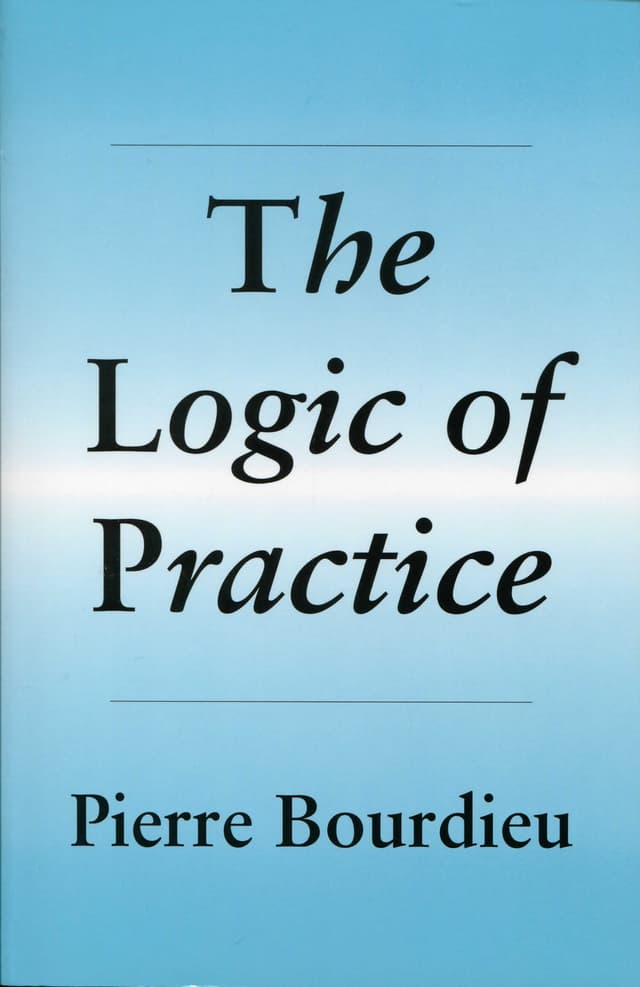
The Logic of Practice
'The logical [kinship] relations he constructs are to 'practical' relations - practical because continuously practised, kept up and cultivated - as the geometrical space of a map, a representation of all possible routes for all possible subjects, is to the network of pathways that are really maintained and used, 'beaten tracks' that are really practicable for a particular agent. The family tree, a spatial diagram that can be taken in at a glance, uno intuitu and scanned indifferently in any direction from any point, causes the complete network of kinship relations over several generations to exist in the mode of temporal existence which is that of theoretical objects, that is, tota simul, as a totality in simultaneity. It puts on the same footing official relationships, which, for lack of regular maintenance, tend to become what they are for the genealogist, that is, theoretical relationships, like abandoned roads on an old map; and practical relationships which really function because they fulfil practical functions.' p.35.


My source:
Bourdieu, P. (1990). The Logic of Practice. Stanford University Press. https://doi.org/10.1515/9781503621749 [and image source].

Bourdieu, Pierre, "The Logic of Practice (1990)" (1990). eTextbooks for Students. 875.
https://stars.library.ucf.edu/etextbooks/875

See also: https://hodges-model.blogspot.com/search?q=bourdieu

Thursday, November 13, 2025

Friday, July 18, 2025

Narketpally syndrome: A different approach to medical education and research

From: Marc Jamoulle
MD (UCL 1974), PhD (ULg 2017)
Family physician, Belgium (INAMI 15324119004)
marc.jamoulle AT uliege.be
Associate researcher at HEC-Liège, BAS-SCM, University of Liège, University of Rouen, D2IM & CAMG-UCL, Brussels


hi friends,

in an unknown syndrome, another way to deal with the patient, to learn from the patient, to develop a partnership with the patient, caring while waiting for the cure,

Jamoulle, M., & Soylu, S. (2025). Phenotyping Long COVID in Children in Primary Care: A Case-Based Study Using the Human Phenotype Ontology. ORBi-University of Liège. https://orbi.uliege.be/handle/2268/334447

From: Rakesh Biswas
rakesh7biswas AT gmail.com


This paper illustrates a global patient-centered learning ecosystem, anchored in Narketpally, that adopts a syndromic approach to medical education and research. Rooted in the etymological origins of 'syndrome' ("together we flow"), this approach reframes medical research as a collective, contextual response to individual patient needs.

https://pubmed.ncbi.nlm.nih.gov/40674544/

Methods: The structure of the paper is intentionally modeled as a team-based learning exercise, grounded in our prior Web 2.0-based cognitive tools: CBBLE (Case-Based Blended Learning Ecosystem) https://pmc.ncbi.nlm.nih.gov/articles/PMC6163835/ and PaJR (Patient Journey Record) https://pajr.in/. These are framed against the conceptual scaffolding provided by three key publications: a framework by Sturmberg et al. and two contrasting commentaries by Greenhalgh and Ioannidis.

Results: Through our ongoing CBBLE-PaJR workflow, thematic learning outcomes emerged in response to these frameworks. Sturmberg's stratified realism helped us recognize how individual patient connections, recorded in our daily practice and online learning portfolios, can drive both contextual learning and meaningful changes in patient outcomes. Greenhalgh's commentary inspired our conceptualization of a 'wildebeest river crossing value model,' contrasting population-based efficiency with individual-centered compassion. Ioannidis's critique of methodological rigor highlighted the potential for expanding low-resource, high-impact research through patient-centered designs, particularly in phases 1 and 4 of the clinical trial hierarchy.


Podder, V., Kulkarni, R., Samitinjay, A., Salam, A., Gade, S., Agrawal, M., Surendran, A. K., & Biswas, R. (2025). Narketpally Syndrome and the Embedding of Contextual Values in Real-Life Patient Pathways. Journal of evaluation in clinical practice, 31(5), e70186. https://doi.org/10.1111/jep.70186
[Citation added PJ].
--

My source:
You received this message because you are subscribed to the Google Groups "Unnecessary Services in Clinical Medicine & Public Health" group.

Tuesday, July 01, 2025

Exhibition: V&A Design and Disability - to 15th Feb 2026

There is a lot of informative, creative and surprising insights through this V&A exhibition website, and related (well executed web designs), by Conor Foran for example. 


Individual
|
      INTERPERSONAL    :     SCIENCES               
HUMANISTIC  --------------------------------------  MECHANISTIC      
 SOCIOLOGY  :    POLITICAL 
|

I will look to post again at the year's end and try to visit the V&A in September, or November.

Image: https://www.vam.ac.uk/exhibitions/design-and-disability

Ack. and thanks to Conor Foran & V&A.

See also: 'clinical' in -

My source:
Emily Cronin. 'You have to be your own inspiration', Life&Arts, FTWeekend, 7-8 June 2025, p.4.

Tuesday, April 01, 2025

c/o A.Word.A.Day: Hodges' model - Walk the (dual!) chalk line

A.Word.A.Day

with Anu Garg

'Having a tool is like having a superpower in your pocket. With the right gadget, you can do much more than what arms and legs alone allow -- build a magnificent pyramid, lift water from deep below, or even predict whether you’ll need an umbrella tomorrow.


And not all tools need wires, batteries, or instruction manuals. Sometimes, a simple device can save labor -- a lever, a pulley, a piece of string dusted with chalk -- can save hours of sweat and toil.'

chalk line


Friday, November 29, 2024

'Domain-specific is wider than specific domain knowledge' Kalyuga (2013)

 'Developing learner ability to apply knowledge in relatively new situations is an important aim of learning and instruction, and many instructional programs and materials explicitly state this goal. However, not many of them demonstrate a consistency in achieving this goal using sufficiently well-specified instructional procedures and techniques. According to a popular view, transferable knowledge and skills in complex domains result from problem solving experiences (e.g. Inagaki and Miyake 2007). At the same time, there is evidence indicating the importance and effectiveness of explicit learning generalized theoretical frameworks and abstract conceptual knowledge for deep understanding of tasks and en hancing transfer capabilities (Karpov and Bransford 1995; Hinds et al. 2001). Gick and Holyoak (1983) convincingly demonstrated the value of the acquisition of abstract schémas as mediators of analogical transfer between very different task areas.'

'Many studies in expert problem solving have demonstrated that relying on highly contextualized domain-specific knowledge associated with concrete situations is the most effective way to solve problems in familiar task areas and that expert performance is largely based on the acquisition of organized domain-specific knowledge structures (schémas; Chi et al. 1982). ... For example, the game of chess has traditionally represented a classical example of expertise based on the acquisition of a huge amount of highly specific knowledge structures (chunks) corresponding to various concrete game situations (De Groot 1965; Chase and Simon 1973). However, more recent studies have indicated that experts use not only concrete chunks but also more general patterns, such as "templates" (Gobet and Simon 1998) or generalized chunks (Walczak and Fishwick 1997) representing typical classes of chess positions with substantial variations in concrete board locations. Based on his observations of the behaviour of rats in maze situations, Tolman (1948) was one of the first to discuss the role of broad vs. narrow cognitive constructs (cognitive maps) in both animal and human learning. 

Domain-specific knowledge that is applicable only to a limited range of tasks represents the most powerful tool for dealing with these tasks in terms of efficiency of achieving immediate results. On the other hand, knowledge that can be applied more broadly is likely to be less efficient for solving specific problems since it would require additional searching, reasoning, and elaborating activities, whilst specific knowledge directly leads to a definite solutions.' pp.1478-1479.

Kalyuga, S. (2013). Enhancing transfer by learning generalized domain knowledge structures. European Journal of Psychology of Education, 28(4), 1477–1493. http://www.jstor.org/stable/23580919

Sunday, March 17, 2024

Geneva Health Forum and AXA Launch €50,000 Grand Jet d’Or de Genève Award to Address Pollution's Impact on Human Health

Since 2006, the Geneva Health Forum (GHF) has been uniting stakeholders to address critical global health issues every two years. By amplifying the voices of field experts and facilitating connections with influential policymakers, the forum provides a platform for showcasing innovative, accessible, and sustainable practices, as well as significant initiatives. Through its editions, the GHF has emerged as a pivotal event in addressing global health challenges.

For its 10th edition, from May 27 – 29, 2024, the GHF will address crucial issues for our future under the theme “Health, A Common Good!” The GHF transcends the boundaries of the healthcare system, considering the social and environmental determinants of health, with a specific focus on how environmental degradation is profoundly impacting human health.

As part of its mission to advance academic research on key societal challenges and contribute to human progress, the AXA Research Fund (https://axa-research.org/) AXA Group’s global science philanthropy launched in 2008, is teaming up with the GHF in this endeavor.

In light of this collaboration, the Geneva Health Forum (GHF) is introducing a new call for the Grand Jet d’Or de Genève Award, in partnership with the AXA Research Fund: Health & medical solutions to address the adverse effects of pollution on humans.

The World Health Organization estimates that exposure to air pollution is responsible for about 7 million premature deaths worldwide each year. Addressing pollution-related health issues is crucial, as underscored on May 24, 2023, by the World Health Assembly's resolution “WHA76.17 - The impacts of chemicals, waste, and pollution on human health.” The resolution calls upon Member States to work on human health impacts associated with plastics, act on linkages between chemicals, waste, pollution and other health priorities, as well as to prepare a proposal for a science-policy panel to contribute to the sound management of chemicals and waste.

Pollution is a major global health issue, affecting human health by causing respiratory diseases, heart problems, and cancer due to exposure to pollutants in the air, water, and soil. Specific attention has been given to pollutants such as per- and polyfluoroalkyl substances (PFAS), which are linked to cancer, thyroid disease, and developmental issues. Other pollutants such as heavy metals, volatile organic compounds (VOCs), particulate matter, persistent organic pollutants (POPs), and indoor air pollutants, present serious health risks, including neurological damage, reproductive disorders, and respiratory illnesses, highlighting the broad impact of pollution on human wellbeing.

Building on this international momentum, the Grand Jet d’Or de Genève 2024 will focus on the nexus of pollution and its health impacts.

The objective of the Grand Jet d’Or de Genève Award is to support an research team engaged in researching or implementing research-based projects with a focus on health treatment, measurements, use of data, and community involvement in addressing pollution-related health issues. The proposed projects must demonstrate their potential to change health practices and improve health outcomes in relation to pollution of air, water and soil, including but not limited to PFAS. Multidisciplinary teams exploring innovative practices or tools will be favoured.

The projects should not only focus on preventive measures to reduce pollution in the environment, but also encompass a broader scope, including assessing existing pollution, removing pollutants from the body and environment, developing medical solutions for pollution-related diseases, and finding ways to enhance health despite existing pollution.

The call will be open from March 11 to April 21, 2024, midnight (CET). Applications must be submitted online in English.

The Scientific Committee will select the top seven applications, which will then be submitted to the Programme Committee for the final selection of the winner. The award- winning research group will be announced on Tuesday, May 27, 2024, after the first day of the Geneva Health Forum, in the presence of the winning team.

The Grand Jet d’Or de Genève Award carries a prize of €50,000, awarded by the AXA Research Fund.

To prepare your proposal, you can view the complete proposal form:
https://grandjetdor2024form.genevahealthforum.com

If you need more information: contact AT genevahealthforum.com

HIFA* Profile: Eric Comte is Executive Director, Geneva Health Forum, External Affairs Directorate, Geneva University Hospitals. Email: eric.comte AT unige.ch

*My source.

Friday, December 08, 2023

The Digital Collective (DC) a Symposium: Digitalisation, Subjectivities, and Care

Dear colleagues, 

We recognise that many people who wanted to join our symposium on Digitalisation, subjectivities, and care were unable to join in person. For this and other reasons we have moved our symposium to be fully online. Our intention is for the symposium to be accessible to all of our colleagues including those who are outside the NL. 

If this is you, we hope you will now consider submitting an abstract, and as such we have extended the deadline to 31 January 2024.

Decisions will be made by 14 February 2024.

Please find the amended call below.

CFP: Digitalisation, subjectivities, and care
7 March 2024, 9.30am – 6pm, online
Deadline abstract submission: 27 November

The Digital Collective (DC) at the University of Twente in the Netherlands is planning a symposium on digitalisation in care. More information below. Please consider submitting an abstract for a talk or poster presentation, deadline: 31 January 2024. 

Any questions to: dc-bms AT utwente.nl 

Introduction

Digitalisation is more than a technological phenomenon. It concerns an ever shifting relation between digital technologies and societal developments. Digital tools are increasingly common in care contexts, reshaping practices, institutions, relations, and social structures. Understanding digitalisation of care therefore requires a multidisciplinary approach to distinct yet related issues that cover the scale of technology innovation, societal impacts (benefits and drawbacks), as well as the pace of development and its ubiquitous nature. In this interdisciplinary symposium we will therefore explore the relation between digital tools and those who use them, willingly or otherwise. 

Topics of interest:

Possible topics related to digitalisation include, but are not limited to: 

  • Digital users and digital tools
  • Care institutions
  • Data development / use in digital care contexts
  • Epistemic injustice in digital care contexts 
  • Perspectives on ‘users’ of digital care content
  • Realities and subjectivities of ‘digital users’ 
  • (Multi-)methodological approaches to digital care
  • Care labour economies
  • Global justice perspectives on care
  • Human-technology relations
  • Health economics 
  • Health Technology Assessment of digital health technologies

The DC is a multidisciplinary platform and we welcome submissions from a broad range of disciplinary and interdisciplinary perspectives, including from outside academia.

Overview of the symposium:

Schedule and further information about the day to follow.

Submission deadlines:

  • Extended abstract submission: Wednesday, 31 January 2024
  • Notification of decisions: Wednesday, 14 February 2024

Please note:

  • Extended abstracts should be between 500 and 1000 words. 
  • Submissions should be sent by email to dc-bms AT utwente.nl 
  • Poster proposals should be sent to the same email, and clearly labelled as such. 
  • If you want your work to be considered for both a presentation and a poster, please make this clear in your submission. Abstracts not accepted for presentation may be invited to present a poster instead.
  • Each submission will receive at least two reviews. 

Additional information:

The Digital Collective (DC) is an interdisciplinary research platform on digitalisation at the University of Twente in the Netherlands. DC consists of social scientists and philosophers specialised in digitalisation and with domain expertise in health, higher education, artificial intelligence, and related technologies. 

After the symposium the DC intends to build a consortium with a view to developing collaborative work, including for a Horizon Europe funding proposal.


Event and venue information:


The event will be free for all participants. It will be fully online. Further details to follow.


Symposium organisers and programme Committee:

Please send questions to: dc-bms AT utwente.nl 

Dr Y. J. Erden

Associate Professor in Philosophy
University of Twente
AISB Vice Chair 

My source:

Philos-L "The Liverpool List" is run by the Department of Philosophy, University of Liverpool https://www.liverpool.ac.uk/philosophy/philos-l/ 

Follow the list on Twitter @PhilosL. Follow the Department of Philosophy @LiverpoolPhilos 

n.b. With the event now including provision for online presentations I am submitting an abstract.

Friday, May 05, 2023

"There are no tools stored in this van overnight"

. . . but there is a tool
with great potential
available here 24/7/365 . . .


INDIVIDUAL
|

 INTERPERSONAL    :     SCIENCES               
HUMANISTIC --------------------------------------  MECHANISTIC      
SOCIOLOGY  :   POLITICAL 
|
GROUP
Identity morphism


Images: 
 
https://krossovochkin.com/posts/2020_04_26_category_theory/
 
https://cdn.shopify.com/s/files/1/0044/4701/0919/products/no-tools-stored-in-this-vehicle-overnight-sign-646188.png?v=1680276776

Saturday, July 17, 2021

"Whipala Chango"

individual
|
INTERPERSONAL : SCIENCES
humanistic ----------------------------------------------- mechanistic
SOCIOLOGY : POLITICAL
|
group


A new flag of the indigenous people of Northern Chile
"Whipala Chango"

"The Chango - a colonial-era term which has stuck - are descended from nomads who inhabited South America's west coast over 10,000 years ago. Despite their culture having supposedly vanished, 4,725 Chileans defined themselves as Chango in a 2017 census, in the "other" category. Many still work as hardscrabble, nautical types, as their ancestors did (they were known for sea-lion skin rafts). Some still use ancient tools such as the chinguillo, a net fibre bag to carry fish, and the chope, an iron file to scrape molluscs off rocks." p.41.

The Chango people, A sea change, The Economist, March 6th, 2021, 438: 9235, pp.41-42.


Wednesday, March 31, 2021

'Clean tools' - fit for Conceptual Engineering?

Posting previously news of a conference on 'Conceptual Engineering' I was drawn and try to follow the following series:

Conceptual Engineering Seminar | Simon Blackburn (Cambridge): TBA 

March 30 @ 3:00 pm - 5:00 pm 

ABSTRACT. — When I hit upon the term ‘conceptual engineering’ in the Introduction to my book Think, I suppose I thought of it as simply a cute way of introducing what philosophers do. I had no idea that the term had already been used, although I have subsequently learned that it was. I have therefore been surprised that books and seminars have subsequently been devoted to the idea: it is as if books and seminars were simply entitled ‘Philosophy’ rather than directed at particular problems within philosophy. In my talk I hope to go further into that and try to understand why it happened. 

Yesterday, Simon Blackburn cited Austin (1956) and the need for 'clean tools', which led me to the following source*:

"First, words are our tools, and, as a minimum, we should use clean tools: we should know what we mean and what we do not, and we must forearm ourselves against the traps that language sets us. Secondly, words are not (except in their own little corner*) facts or things: we need therefore to prise them off the world, to hold them apart from and against it, so that we can realise their inadequacies and arbitrarinesses, and can re-look at the world without blinkers. Thirdly, and more hopefully, our common stock of words embodies all the distinctions men have found worth drawing, and the connexions they have found worth marking, in the lifetimes of many generations: these surely are likely to be more numerous, more sound, since they have stood up to the long test of the survival of the fittest, and more subtle, at least in all ordinary and reasonably practical matters, than any that you or I are likely to think up in our armchairs of an afternoon - the most favoured alternative method."

*my emphasis

Simon's talk of 'clean tools' prompted me to reflect:

The assumed neutrality of Hodges' model. As noted on W2tQ previously, Hodges' model is an invitation to start with a new slate. To leave behind bias and prejudice, to assure unconditional positive regard and a non-judgmental approach and attitude.

'Engineering' is usually conducted within a dedicated physical space. Apprentices will soon be familiar with the discipline of leaving the work environment clean and prepared for the next day. They will learn that tools have their place (even on the screen). Tools themselves also need care; so don't be care-less.

If Occam's razor is a preparatory rule for conceptual hygiene, perhaps we can take this further, or at least propose an addition? There is a 'rule of forceps' (which, it might be argued, is person-centred, or clearly patient-centred?) but not only are forceps a tool, we can utilise a divider too.

In use, Hodges' model suggests and facilitates dichotomous thinking. The forceps may help grasp the the key parts - the polarities of a situation. The divider may serve to help us to weigh and measure the 'distance' of two concepts, especially if they seem to be grounded across two of the model's care (knowledge) domains.

So Hodges' model may have a role in 'conceptual engineering', variously as a dialectic divider or dialectical forceps?

Austin, J. (1956). A Plea for Excuses: The Presidential Address. Proceedings of the Aristotelian Society, 57, new series, 1-30. Retrieved March 30, 2021, from http://www.jstor.org/stable/4544570Austin, J. (1956). A Plea for Excuses: The Presidential Address. Proceedings of the Aristotelian Society, 57, new series, 1-30. Retrieved March 30, 2021, from http://www.jstor.org/stable/4544570

There is a legal case of historic interest also described in the Austin's paper.

Wednesday, November 25, 2020

Book launch: Foundations of Global Health & Human Rights (OUP, 2020)

 On Tuesday, 24 November 2020, 14:05:39 GMT, Benjamin Meier <benjaminmasonmeier AT gmail.com> wrote:


We hope that you will join us on Human Rights Day for the launch of:

Foundations of Global Health & Human Rights (Oxford University Press 2020)

Thursday, December 10th

9:00 - 10:30 EST

Register on Zoom (https://zoom.us/webinar/register/WN_Ti7k95HbTl2qPbvWBWdzRw)

This foundational text seeks to provide a systematic understanding of the evolving relationship between global health and human rights, laying a human rights foundation for the advancement of transformative health policies, programs, and practices.

Bringing together the WHO Director-General and leading academics in the field of health & human rights, this book launch will:

(1) explain the norms and principles that define the field,
(2) examine the methods and tools for implementing human rights to promote health,
(3) apply essential human rights to leading public health threats, and
(4) analyze rising human rights challenges in a rapidly globalizing world.

We look to this textbook in providing a foundation for public health students, and as we respond to the COVID-19 pandemic, we see this book as more necessary than ever before — preparing the next generation for the global health and human rights challenges ahead. This foundational text shows why interdisciplinary scholarship and action are essential for advancing health-related human rights, placing human rights at the center of public health and securing a future of global health with justice. We hope you will join us for this book launch, drawing on this foundational text in your teaching, research, and advocacy in the years to come.

Human Rights in Global Health: Rights-Based Governance for a Globalizing World (2018)
available from Oxford University Press

Foundations of Global Health & Human Rights (2020)
available from Oxford University Press

Benjamin Mason Meier, JD, LLM, PhD
Associate Professor of Global Health Policy
Department of Public Policy
University of North Carolina at Chapel Hill
bmeier AT unc.edu
https://www.benjaminmasonmeier.com/
Twitter @BenjaminMMeier
 
<>
 
My review will follow 2021 ...
 individual 
|
INTERPERSONAL : SCIENCES
humanistic ----------------------------------------------- mechanistic
SOCIOLOGY : POLITICAL
|
group


Foundations of Global Health & Human Rights


My source:

The Spirit of 1848 - A Network Linking Politics, Passion, & Public Health 


Thursday, October 22, 2020

Erasmus+ Survey - Invite

Dear INHWE Members,

We need your help with a research proposal we are submitting soon. If you teach elements of leadership or IPE in your role then we would be delighted if you could spare 3 minutes of your time to complete the following survey: https://inhwe.org/erasmus-survey (Deadline: end of play Tuesday 27th October)

Also, you might be interested to know that we are now producing results (with more to come later this week) for our StoryAidEU project which you can view and download here: https://storyaid.eu/results/

If you would like to know more about our research projects or how to partner with us, feel free to get in touch.

Best wishes,

David

David Smith

Director | www.inhwe.org International Network for Health Workforce Education


Friday, October 16, 2020

Persistent or Global navigation: Hodges' model

Interfaces are hardly novel these days, even our acknowledging them is a moot point. An interface that is effective will be transparent to the 'user' who is able to get on with the task, the process that is their purpose. For web design, medical devices and

There are many posts on 'interfaces' here on 'Welcome to the QUAD' from 2007 to 2020:

Hodges model: What is it? [2] It’s an interface... 

(Contrast this view, perhaps, with recent posts on Hodges' model as a matrix.)

VerbAtlas 1.0 - Semantic Role Labeling and beyond! c/o Roberto Navigli 

Don't Make Me Think (2006)
- and the tag 'interfaces' (59).
 
Hodges' model remains an interface to me.
 
The homepage for the website 1998-2015 presents Hodges' model - as the interface - to the user (visitor).

In revisiting (before it visits the charity shop) Steve Krug's Don't Make Me Think (2006) reference to persistent navigation or global navigation (p.62) reinforces the fact that humanity needs an interface for health and care. Two qualities that such an interface needs include:
  1. Persistence in being Cognitive (isn't everything?) but in the sense here of being simple and so ready-to-mind.
  2. Being Global as in Global Health, plus Universal Health Coverage, generic, applicable to all persons, contexts and situations.

Thursday, May 07, 2020

Antimicrobial Resistance - an AMR TOOLBOX

Dear All,

AMR (antimicrobial resistance) is an increasing threat to global public health worldwide that requires cross-sectional and cross-disciplinary action. It is present in every country and is spurred by several human made factors including over- and/or inadequate use of antibiotics, poor hygiene and infection prevention control, excessive usage of antibiotics outside the health care sector e.g. in life stock production. And there are reasonable assumptions that the current COVID-19 pandemic might fuel AMR in the hospital.

The AMR TOOLBOX (www.amrbox.org) is a comprehensive knowledge repository designed to provide its users with practical, up-to-date information on antimicrobial resistance. It collates documents, guidelines, posters, training tools as well as information sources for various disciplines and backgrounds including among others health care sector, veterinary and agriculture sector, but also the general public. Thereby, it contributes to the fight against AMR by providing high quality information for all stakeholders involved.

The AMR TOOLBOX is part of MEDBOX http://www.medbox.org and was jointly created by Apotheker Helfen e.V. and the MEDBOX team.

We hope you find this new toolbox useful! If you have any feedback regarding the content, please feel free to contact us under info AT medbox.org.

Best regards,

the MEDBOX team & Andreas Wiegand Apotheker helfen e.V.


Sieglinde Mauder
Project Manager MEDBOX
Karin Geffert
Project Assistant MEDBOX
www.medbox.org


HIFA profile: Sieglinde Mauder is Librarian at the Medical Mission Institute, Würzburg, Germany. She collects and distributes resources on HIV/AIDS, tropical diseases, humanitarian aid, health service management, e-learning for partners in developing countries.

sieglinde.mauder AT medmissio.de


My source: HIFA

Friday, January 03, 2020

ERCIM News No. 120 Special theme "Educational Technology"

Dear ERCIM News Reader,

ERCIM News No. 120 has just been published at https://ercim-news.ercim.eu/

ERCIM News 120

This special theme addresses the state of the art in educational technologies, “EdTech”, illustrating the range of scientific fields and challenges faced by the research community when it comes to integrating tools and systems that apply to real-life learning situations.


Guest editors: Vassilis Katsouros (Athena Research and Innovation Centre) and Martin Hachet (Inria)


This issue is also available for download in pdf and ePub.

Thank you for your interest in ERCIM News. Feel free to forward this message to anyone who might be interested.

Next issue:
No. 121, April 2020
Special Theme: The Climate Action: Mathematics, Informatics and Socio-Economics Accelerating the Sustainability Transition
Announcements in this issue:

Follow us on twitter @ercim_news
https://twitter.com/ercim_news
and join the open ERCIM LinkedIn Group http://www.linkedin.com/groups/ERCIM-81390
---------------
Peter Kunz                       
ERCIM Office
2004, Route des Lucioles
BP93
F-06902 Sophia Antipolis Cedex

https://www.ercim.eu  
-----------------------------
@ercim_news
http://twitter.com/ercim_news

join the ERCIM Linkedin Group
http://www.linkedin.com/groups/ERCIM-81390