Hodges' Model: Welcome to the QUAD: map

Hodges' model is a conceptual framework to support reflection and critical thinking. Situated, the model can help integrate all disciplines (academic and professional). Amid news items, are posts that illustrate the scope and application of the model. A bibliography and A4 template are provided in the sidebar. Welcome to the QUAD ...

Showing posts with label map. Show all posts

Wednesday, September 16, 2026

Philosophical Counselling Reading Group [and Hodges' model]

The discovery of a reading group on philosophical counselling (PC), through University of Liverpool, continues to prove helpful; to utilise professional experience, that included counselling, family therapy, cognitive therapy in psychoses, and practical experience as a mental health nurse (in-patient and community). There is overlap with Hodges' model, but it's fascinating and rewarding to listen and learn from practitioners of PC. As noted before, I was aware of PC through two popular philosophy magazines. This time around we read:

Ran Lahav, “Philosophical Counseling and Self-Transformation,” in Philosophy, Counseling, and Psychotherapy, eds. Elliot D. Cohen & S. Samuel Zinaich, Jr. (Newcastle upon Tyne: Cambridge Scholars Publishing, 2013), 82.

Abstract

This paper presents my approach to philosophical counseling, which is geared towards self-transformation, and is inspired by important thinkers throughout the history of Western philosophy whom I call transformational thinkers. I take from these thinkers the realization that our daily life is normally confined to rigid and superficial attitudes towards ourselves and our world. This is because individuals’ everyday attitudes are based on limited understandings of life, which form what I call the person’s perimeter, or perimetral worldview. The goal of philosophical counseling, as I see it, is to help counselees transcend their constricted perimetral worldview, or in the language of Plato – to realize that they are imprisoned in a “cave,” and then to step out of it towards a fuller reality. A case study is presented to illustrate the two main stages of the counseling process. 

I know there is the (biblical) phrase 'Seek and you will find'; but there is also the notion of seeing only what you seek, and missing other content - contexts. This is marked in beliefs and the development of delusional ideas. 

Of interest to me, Lahav discusses (as indicated above) a person’s perimeter, or perimetral worldview. 

We still hear how difficult it is for people to access help. I wondered (again) about referral pathways for PC? The nature of the person's problems that prompts them to seek help? Lahav acknowledges the complexity here. Speaking of 'prompt', of course now there is AI in the mix. Lahav points out how PC does not quite have the foundation and hence theoretical impetus (and rigour?) that Freud provided to psychoanalysis and psychotherapy. 

PC is, however, to some extent a broad field: '... philosophical practice has come to include several different formats in which it is practiced: one-time workshops for the general public, philosophical retreats, long-term self-reflection groups, the philosophical café, and of course philosophical counseling'. 

I wonder if philosophical counsellor's could have a role, post AI / agentic ai interventions. This could provide a step-down assurance, and be rolled into 'treatment / intervention programmes'. This could help retain the humanistic element of duty of care, underscore the person_al in care architectures/systems and provide a step-down - just in-case AI has missed, or upset something? The acknowledged strength of AI in not being subjective is balanced. Although evidence also points to misogynistic responses derived through what can be biased, and prejudiced learning sources: thus a reflection of 'society'.

In the introduction, more encouragement with reference to situated, a general map, and basic - fundamental aspects. There are (at least) two domains: 'the domain of philosophical discourse and the domain of everyday life and predicaments'. 

Hodges' model was created to facilitate the FIRST approach in PC, the Critical Thinking Approach, with an associated subtype of Problem-Solving Approach. 

It was also designed to help with the theory-practice gap. Lahav describes this in the how and what of philosophy and PC itself. I wondered to what extent if the approach of PC 'leave out the more important “what” of great philosophies.' then would a counselee be denied avenues to learning, as we may be drawn to specific philosophical schools of thought, and crucially reasoning?

The SECOND approach to PC is the Edification Approach. The author has adopted this second approach in practice.

Guess what? Yes, you've got it. Hodges' model can actually close a circle here. Or, more accurately help sustain the reflective, reflexive, recursive ... reasoning loop as needed. Another objective of Hodges' model is to produce reflective practitioners, critical thinkers and lifelong learners.

A take-away for me is the 'perimeter and the perimetral worldview'. A search for 'perimeter' here on W2tQ is null.^ I'm also wondering about transformation (in the title) and throughout the paper.

There may be an example here were a domain of Hodges' model can itself reflect the model, as in the Intra- Interpersonal domain below.

Lahav employs a case study to illustrate his thought and practice. The discussion really helped improve my reading and understanding of this.

individual
|
INTERPERSONAL
: SCIENCES             
humanistic ------------------------------- mechanistic
SOCIOLOGY : POLITICAL   
|
group

Psychology   | Philosophy(-isms)
________________________________
Psycho-Social|  Psychotherapies 

basic - fundamental

general map


case study

referral pathways

^'Peripheral' does feature in posts.

Monday, September 14, 2026

Paper: What factors influence evidence use in policy? An updated systematic map

 Abstract  [ REVIEW | Article in Press ]

In 2014, a large systematic map found that relational factors were amongst the most frequently reported facilitators of evidence use in policy. Since then, there has been a growth in evidence-use initiatives and research, many of which have attempted to address relational factors. In this timely updated map, we describe the current state of research about which factors influence evidence use in policy. A search strategy combining ‘evidence’, ‘barriers and facilitators’ and ‘policy/policymakers’ was used to identify studies across 15 electronic databases between 2012 and 2022. Studies were screened for those that include empirical data about evidence use in policy. Data extraction enabled descriptive analyses characterising studies in terms of focus, topic area, setting, and types of factors influencing use. Two thousand, one hundred and ninety-nine studies were included, a 20-fold increase over 10 years. The most commonly reported factors influencing use were the relevance of evidence, and then organisational (resources, skills, personnel and managerial support). A large number of studies reported on evidence-use interventions (n = 877) of which 379 were evaluations. Findings may indicate a shift towards relational and systemic thinking about evidence use. There appears to be a growing recognition of the resourcing, work, time, and workforce required to embed evidence use within and between organisations. With this huge growth in the literature, particularly in new evidence use interventions being tested across policy sectors, continued review and mobilisation is necessary to effectively inform the design and implementation of evidence use interventions and research.


Oliver, K., Malin, J., Akerlof, K.L. 
et al. What factors influence evidence use in policy? An updated systematic map. Humanities and Social Sciences Communications. (2026). 
https://doi.org/10.1057/s41599-026-08391-6

Not a citation for Hodges' model, but I am grateful to Prof. Oliver and co-authors for being able to assist with data extraction using EPPI-Reviewer Screening Wizard. The preceding patience and guidance to complete the coding tasks was also invaluable in being transferable. I learned a great deal and it has been perversely reassuring (disheartening!) to see that the path to final publication is also 'circuitous' for academics.^  An additional lesson is building on existing work and publication (Oliver, 2014) to revisit a method and research question. (Updates to follow).

Previously: 'map' : 'systematic' : 'policy'

^A conclusion, much shared I believe: academic publishing is systematically dysfunctional.

Monday, June 22, 2026

Maker-field: More than just a point* on a map

Ashton-in-Makerfield has been in the news of late. With Andy Burnham MP championing the communities of the north; local issues, socio-economic gaps, needs and everyday lived experience up North.

But Makerfield holds much more as a veritable rabbit-hole supporting lifelong learning, character development, reflective practice and critical thought:

 'maker' - 'field'

* - a political constituency.

Previously: 'map'

Thursday, December 11, 2025

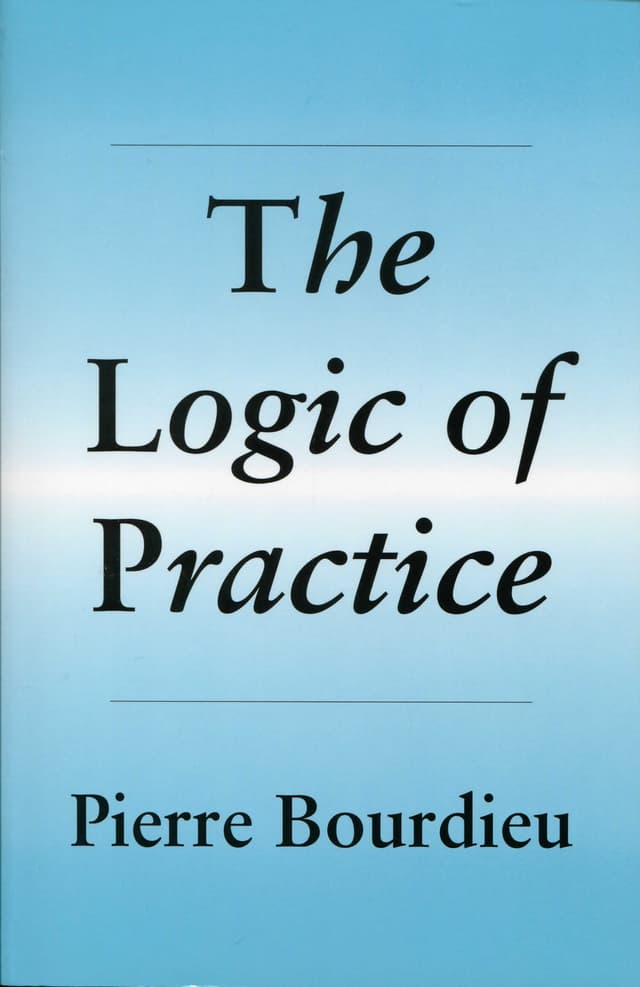
Bourdieu: systems, axes, maps, practical logics

I have checked these quotes and am fairly sure they are accurate. The first, I feel, improves with re-reading, and presents a clearing at the end? 

The clearing could be a template, and as per the second it may be old; but retains its practical function.

'Intellectualism is inscribed in the fact of introducing into the object the intellectual relation to the object, of substituting the observer's relation to practice for the practical relation to practice. Anthropologists would be able to escape from all their metaphysical questioning about the ontological status or even the 'site' of culture only if they were to objectify their relation to the object, that of the outsider who has to procure a substitute for practical mastery in the form of an objectified model. Genealogies and other models are to the social orientation which makes possible the relation of immediate immanence to the familiar world, as a map, an abstract mode of all possible routes, is to the practical sense of space, a "system of axes linked unalterably to our bodies, which we carry about with us wherever we go", as Poincaré put it.' p.34.
The Logic of Practice
'The logical [kinship] relations he constructs are to 'practical' relations - practical because continuously practised, kept up and cultivated - as the geometrical space of a map, a representation of all possible routes for all possible subjects, is to the network of pathways that are really maintained and used, 'beaten tracks' that are really practicable for a particular agent. The family tree, a spatial diagram that can be taken in at a glance, uno intuitu and scanned indifferently in any direction from any point, causes the complete network of kinship relations over several generations to exist in the mode of temporal existence which is that of theoretical objects, that is, tota simul, as a totality in simultaneity. It puts on the same footing official relationships, which, for lack of regular maintenance, tend to become what they are for the genealogist, that is, theoretical relationships, like abandoned roads on an old map; and practical relationships which really function because they fulfil practical functions.' p.35.


My source:
Bourdieu, P. (1990). The Logic of Practice. Stanford University Press. https://doi.org/10.1515/9781503621749 [and image source].

Bourdieu, Pierre, "The Logic of Practice (1990)" (1990). eTextbooks for Students. 875.
https://stars.library.ucf.edu/etextbooks/875

See also: https://hodges-model.blogspot.com/search?q=bourdieu

Sunday, September 07, 2025

Editorial: Persistent Positive Change in Challenging Times - IJPCLHSC

'What then is the common theme for this issue? It is the persistence of these authors, practitioners and academics to be curious about what could be better and engage with scholarly enquiry to advance practice-based learning.' 

The editorial introduces the content of -

International Journal of Practice-based Learning in Health and Social Care Vol. 13 No 1 August 2025
https://publications.coventry.ac.uk/index.php/pblh/issue/view/96

Howden,  S.  (2025).  Editorial:  Persistent  Positive  Change  in  Challenging  Times.  International  Journal  of  Practice-based Learning in Health and Social Care, 13(1), ii-iii.

- which I have mapped to Hodges' model (with some additions):

Individual
|
      INTERPERSONAL    :     SCIENCES               
HUMANISTIC  --------------------------------------  MECHANISTIC      
 SOCIOLOGY  :    POLITICAL 
|
Group

restlessness (- in mind)
(curiosity)

patient's lived experiences*

intra- inter-personal

pastoral support

engagement - enjoyment

workshop, case study ...

psycho-

restless legs syndrome

remote, rural, urban
community-based :: clinical settings

(infra-) structures

processes - procedures

simulation, major incident

forensic, podcasts

-social factors

interdisciplinary (integrated?) working

social structures
(This is how we 'do it' here)

'Institutional? “positive restlessness"'

*clinical subjective exposure 
(determinants of health)

organisational (Inst.) structures


<>

The final paper is on workshops and continuing professional development:

Kenny, B., Bourne, E., & Li, J. (2025). Knowledge Translation from Clinical Education Workshop to Workplace. International Journal of Practice-based Learning in Health and Social Care, 13(1), 56-76. https://doi.org/10.18552/ijpblhsc.v13i1.1084 

The editorial notes:

'The authors integrate goal setting as part of a development session on supervision skills and follow up survey, to ask what happened next in relation to their goals and practice. When resources are scarce and CPD is so critical, these ideas about enhancing workshop effectiveness and feeding participants’ experiences back into sessions has never been more important.'

When presenting Hodges' model at events I will often tick for a workshop. This reflects former work experience with student nurses, OTs, social workers and other learners: when a workshop could cover the some 2 hours with a break in the middle. Hodges model is flexible, adaptable and in a workshop can be applied on an individual basis, or small group work - breakout sessions [this does not necessarily mean the participants are bored :-)]. A wide range of learning and teaching approaches can be considered. 

Kenny, Bourne & Li utilise role play, case studies for example, their approach and paper framed by the KTA Framework:

'Workshop design was underpinned by the Knowledge to Action (KTA) Framework. KTA acknowledges the importance of social interaction in the adaptation of research evidence, taking account of local context and culture (Graham & Tetroe, 2011).' p.58. ...

'The KTA framework comprises two major components: knowledge creation and an action cycle. During the workshop, knowledge creation was supported by CEs identifying factors that contribute to challenging clinical education situations and reflecting upon the impact of these factors in their workplace contexts. During Part 1 of the workshop, attendees focussed on understanding challenging situations. Each group was assigned a case study that included a complex mix of student, educator and workplace factors thatinteracted to create a challenging learning situation.' p.58. ...

'A focus on active learning within the workshop prepared CEs for translation of their knowledge of supervisory practices when they returned to their workplaces. In Part 2 of the workshop, CEs worked through a structured process for managing placement challenges by engaging in peer learning role play activities. The process was adapted to address challenges that included mental health issues in workplace learning, developing professionalism, providing inclusive learning environments, and facilitating clinicalreasoning and reflection.' p.58.

  clinical educators (CEs)

Reading KB&L: I wonder if Hodges' model provides a more 'accessible' map - as an output / summary, evidence of learning and teaching activity? 'Filtering' would be essential of course, as to what exactly is mapped. While I've no evidence (in theory), Hodges' model in being (imho) accessible, might also be primed for transferability (after all what does transferable mean?^); by being recognised more consistently across larger groups, and (as per the conclusion) other individuals, and broader educational contexts.

Currently, working with three co-authors on a draft paper revision (dental health and policy frameworks) for a journal, I noticed our leading author refers to 'translational'. In the paper below, (cited by KB&I): 

Graham, Ian D. PhD1; Logan, Jo RN, PhD2; Harrison, Margaret B. RN, PhD3; Straus, Sharon E. MD, MSc4; Tetroe, Jacqueline MA5; Caswell, Wenda RN, MEd2; Robinson, Nicole6. Lost in knowledge translation: Time for a map?. Journal of Continuing Education in the Health Professions 26(1):p 13-24, Winter 2006. | DOI: 10.1002/chp.47

Graham et al's, Table 1 Definitions of Terms, is (still) really helpful.

See also on W2tQ: 'reflect' : 'holistic' : 'map' : 'situation'

^Translation; transfer - dual, two-way, inversion?

Thursday, June 26, 2025

You say Hodges' model is a map. What's the scale?

"That's another thing we've learned from your Nation," said Mein Herr, "map-making. But we've carried it much further than you. What do you consider the largest map that would be really useful?"

"About six inches to the mile."

""Only six inches!"exclaimed Mein Herr. "We very soon got to six yards to the mile. Then we tried a hundred yards to the mile. And then came the grandest idea of all! We actually made a map of the country, on the scale of a mile to the mile!"

"Have you used it much?" I enquired.

"It has never been spread out, yet," said Mein Herr: "the farmers objected: they said it would cover the whole country, and shut out the sunlight! So we now use the country itself, as its own map, and I assure you it does nearly as well."
        Lewis Carroll - The Complete Illustrated Works. Gramercy Books, New York (1982). Page 727.


My source
Text: https://people.duke.edu/~ng46/topics/lewis-carroll.htm

Plus a letter in FTWeekend: by Prof. R.T. Harrison. 'Country as its own map served as well' https://www.ft.com/content/2ad8ea16-d27d-11e1-abe7-00144feabdc0 1 Sept. 2012.

Friday, January 03, 2025

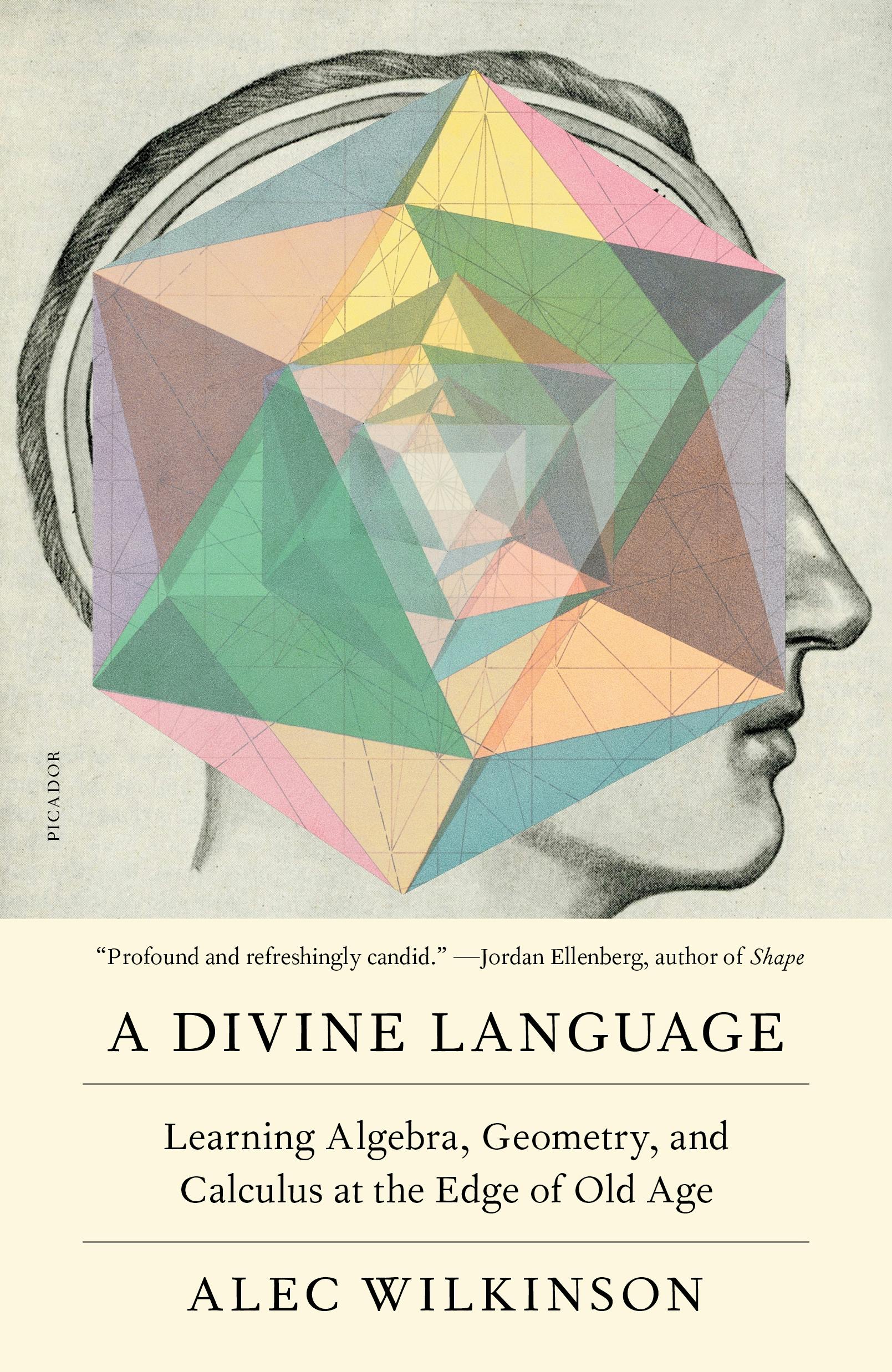
How 'divine' is the language of care?

'My impression was that algebra was less a subject than a practice into which one was inducted by the algebra priests after a series of mortifications. The letters and equations that the teacher drew on the board did not seem related to the numbers I had handled in other classrooms. For one thing, a problem in arithmetic was vertical, one number beneath another, and a problem in algebra, an equation, was horizontal. I felt as if in a permanent present, unable to see how the past and the future were joined. In Ulysses James Joyce writes that the present is the drain that the future goes down on its way to becoming the past.' p.12.
'The mathematician Alonzo Church, who taught Alan Turing, told another of his students, David Berlinski, "Any idiot can learn anything in mathematics. It requires only patience." I would sit with a pencil and paper trying to solve an algebra problem and sometimes go only so far before my mind would halt, because I had could used up what little I knew that might apply. It hadn't occurred to me to think of algebra as the bright boys and girls I had been among had thought of it, as a series of related procedures. They were constructing a map. I was collecting postcards from places where anxiety or incuriousness had kept me from leaving my hotel.' p.31.
(my emphasis)


Alec Wilkinson. (2022) A Divine Language. Learning Algebra, Geometry, and Calculus at the Edge of Old Age. New York: Farrar, Straus and Giroux. https://us.macmillan.com/books/9781250168580/adivinelanguage/

Previously: math :: logic

Friday, August 30, 2024

Still sorting books: "The holographic paradigm and other paradoxes"

There has been overlap in my subscription to the Laws of Form mail list and a (David) Bohm list. With the difference, I unsubscribed from the latter, in an effort to focus. The work of Bohm is still very much on the radar and book shelves (well, boxes currently). Continuing to clear books, I've been reading through some relevant sections and quote here at length from:

Wilber, K. (Ed.), (1982) The holographic paradigm and other paradoxes. Boulder, CO: Shambhala.

The Enfolding-Unfolding Universe: A conversation with David Bohm (pp.44-104)

"WEBER: You've spoken of clarity often today and in the past: therefore, isn't it necessary at this point to consider consciousness and the knower, the one who is or isn't clear?

BOHM: Yes, we could come to that. The point is that consciousness is confused. Confusion is nonclarity. And if you say, a person is not clear, you mean he's confused, although it is more polite to say he's not clear. And confusion means "melting together." Things that are different are seen as one and things that are one are seen as broken up into many. So confusion clearly causes chaos." p.61.

"BOHM: Well, yes, we can consider that maybe that is what is, but, at the same time we have to be very  careful to say that thought cannot grasp it, so at some stage thought has to put this question aside as to what is, you see. Thought cannot grasp that which is. And any attempt to grasp that which is engages us in serious self-deception which confuses everything. So that thought has to learn or somehow come to a state of discipline, or whatever you want to call it, spontaneous discipline, its own discipline. 

WEBER: Order?  

BOHM: Yes, order, in which it does not attempt to grasp the questions which are beyond it, such as the question of that which is. It can grasp any relative question which is conditioned, or in some way, conditional. So even the nonmanifest consciousness of the  nonmanifest matter, which is highly subtle, is still within the possible area of thought."  p.64.


"WEBER: Deeply. So you're saying that prior to this current awareness of the centrality of consciousness, what we've been trying to do is hopeless because we've addressed small social problems all in the wrong domain, so to speak. 

BOHM: Yes. Well, really not going to their source at all." p.80.


"WEBER: Which was the old Cartesian or dualistic model.  

BOHM: Right. It also leads to infinite regress, unless you end it by  God or somewhere.
Now I think we come to a point where we're raising a question which was similar to what was raised in  yesterday's discussion.  How long can we go on trying to talk about what is beyond thought by making an intellectual construction? You see, because when we  make such an intellectual construction we  have a content and we have implied that the one who is constructing it is also supposed to be beyond that content. So he evades the very thing we attempt to include him in and in that very attempt he gets out. And so it seems that there is some limit to how far you can go in that  process, in that approach. Therefore it's best to say that in this approach in which we attempt to make a map, or a sketch of some  kind of what reality is, that we are really dealing with something limited. Korzybski used to say: "Whatever we say it is, it isn't."

WEBER: The map is not the territory. . . .

BOHM: That's right. Yes. And therefore what we are doing is making maps, making sketches, making concepts. And see, that's why I said the other night that science, for example, theoretical  science, is not primarily concerned with observing things but with observing ideas. ..."  p.84


The Tao of Physics Revisited  (pp.215-248)

"CAPRA: Yes, they would look at genetics, individual parts and so on. 

WEBER: They have the Cartesian view, whereas you're saying that this is the new vision, emphasizing interdependence, interconnectedness, the dynamics of the whole. 

CAPRA: But I should say that both reductionism and holism are necessary. 

WEBER: I understand. You are not suggesting that we abolish the other. You are saying we should supplement one with the other. 

CAPRA: If you want to get the full story, then you need both views. Because either one gives you only half of the story. This is what I see as the future of science, and I see a future science as no longer distinguishing between disciplines. 

WEBER: That's a very radical view. 

CAPRA: Yes, and by the way Heinsenberg already said that years ago. In one of his books, The Part and the Whole, he ends with his view of future science, and I agree very much with that. I have come to believe that in the future we will apply a network of models, and we will use different languages to describe different phenomena at different levels. We will not worry any longer whether we are doing biology or psychology or physics or anthropology or whatever; we won't be worried about these classifications." p.241.

Reading of The Systems View of Life - A Unifying Vision is also ongoing (p.240 ... and a joy) with posts to follow.

See also:
https://kfoundation.org/krishnamurti-and-david-bohm/

Saturday, March 16, 2024

Hodges' model: An architectonic sense-making tool

"Translation by architectonic map is a sense-making tool inspired by Peirce's use of the term, architectonic, to describe the systematic form of a body of knowledge. Theorists create a structure around which their approach to understanding human conduct is built. Familiarity with the overall structure facilitates generalized discourse among those interested in the framework. An architectonic map identifies all the major components of a scientific text or canon, including its assumptions, concepts, propositions, and theories, and the paths connecting these components. Mapping architectonics is an intersemiotic (across two different types of sign systems) translation process when the translation product is a diagram, and an intralingual process when the product is a narrative." p.111. (My emphasis)

"Models employ symbols (terms and their meanings), but also have an iconic function (a design meant to represent a object or process in important ways) and an indexical function (notation indicating and pointing to persons, processes, relationships, organizations)." p.112. 


Individual
|
      INTERPERSONAL    :     SCIENCES               
HUMANISTIC  --------------------------------------  MECHANISTIC      
 SOCIOLOGY  :    POLITICAL 
|
Group
person

concepts

critical thinking

person

maps

framework


languages

dialogue - narrative

shared understanding

social worlds*

anthropology

organisations

communities of practice

professions, scope of practice

*translation here too:

policy, power, status ...


Forte, J. A. (2009). Interactionist Practice: A Signs, Symbols, and Social Worlds Approach. Humboldt Journal of Social Relations, 32(1), 86–122. http://www.jstor.org/stable/23263237