Hodges' Model: Welcome to the QUAD: translation

Hodges' model is a conceptual framework to support reflection and critical thinking. Situated, the model can help integrate all disciplines (academic and professional). Amid news items, are posts that illustrate the scope and application of the model. A bibliography and A4 template are provided in the sidebar. Welcome to the QUAD ...

Showing posts with label translation. Show all posts

Monday, May 18, 2026

Call for Abstracts: Prototypes for Humanity - Submission Deadline 22 May 2026

Dear Colleagues, 

I am pleased to invite the submission of abstracts to the Prototypes for Humanity 2026 Short Papers Platform. 

Abstract Submission Deadline: 22nd May 2026
Invitations to Successful Authors: 8th July 2026
Conference Dates: 15th - 19th November, Dubai, UAE 

** Description **

The Short Papers Platform provides a forum for professors to share their research and engage in interdisciplinary dialogue, fostering global collaboration and knowledge exchange, with a focus on driving real-world impact through academic research.

For 2026, Prototypes for Humanity is delighted to announce the launch of a strategic partnership with the Investment Corporation of Dubai (ICD), for the Short Papers Platform. This joint effort reinforces the programme’s commitment to advancing impactful innovation through collaboration between academia and industry, focusing on the key sectors and themes that reflect international research priorities and that are relevant to the city and to the fund. 

Themes 
  • Wellbeing and Human Performance
  • Infrastructures and Cities
  • Autonomous Systems and Advanced Manufacturing
  • Environment, Sustainability and Energy
  • Mobility and Logistics
  • Socio-Economic Empowerment, Digital Economies and Future Markets
  • Open and Speculative
Awards

As part of the programme’s ongoing commitment to research translation, ICD will award a $50,000 prize to one of the short papers presented at the conference. The award recognises academic work with strong potential for practical application, identified through engagement with ICD industry experts, and will support the winning project’s next stage of development towards implementation.

Submissions

Full details can be found at: https://www.prototypesforhumanity.com/press-releases/stories/Call_For_Abstracts_2026

Apply here: https://form.jotform.com/260705028532451?source=https://www.jisc.ac.uk

Deadline for abstract submission: 22 May, 2026

We strongly encourage you to apply where your interests and research aligns with the programme’s thematic areas.

If you have any questions, please contact us at professors AT prototypesforhumanity.com

Sarah Ward
University Relations Manager
Prototypes for Humanity

E: sarah.ward AT prototypesforhumanity.com

My source: Email - https://www.bcs-sgai.org/
Tuesday, December 16, 2025

Tongues: The Edinburgh Companion to the Global Medical Humanities

Editors: Benjamin Dalton (Lancaster University), Steven Wilson (Queen’s University Belfast), Alex Wragge-Morley (Lancaster) and Stephanie Wright (Lancaster)

NEW Deadline for abstracts: 30 January 2026

The deadline for proposals to participate in a new Edinburgh Companion to the Global Medical Humanities has been extended. Following on from the landmark Edinburgh Companion to the Critical Medical Humanities, this handbook aims to catalyse the emerging field of global, multilingual work in the medical humanities. In its earliest form, the medical humanities sought to recognize the importance of literature and the arts to medical education and communication. In the following decades, scholars have recognized the entanglements that have existed between mind, body and environment – entanglements that call into question still prevalent distinctions between the sciences and the humanities, or between biology and culture (Whitehead et. al., 2016). Now, scholars and practitioners are increasingly bringing global cultures, epistemologies, and languages to bear on the medical humanities. At the same time, new approaches that both challenge and extend the concerns of the medical humanities are emerging in non-Anglophone and non-Western contexts.

This volume will give students and scholars a comprehensive guide to the dynamic and emerging field of global medical humanities – identified as such in recent editorials in Medical Humanities, The Polyphony and The Routledge Handbook of the Medical Humanities. This is a field that engages critically with the notion of global studies, recognizing that some of its iterations simply perpetuate the cultural, epistemic, and cultural hierarchies that have so long dominated the fields of health and the humanities. At once synthesizing and developing the insights of the field, this Edinburgh Companion will deploy the metaphor of the tongue to bring together, without homogenizing, a globally diverse range of contexts and interconnections. The tongue is at once an instrument of speech and a bodily organ that connects people to their cultures and environments. Indeed, through its communicative function and the pleasures and pains of taste, the tongue relates people to the language and foodways frequently taken to define cultures and societies. Moreover, the tongue is an interface for pleasure, intimacy and connection between bodies. And, of course, the tongue quite literally brings the world into the body through acts of taste and eating (Mol, 2021).

On the one hand, therefore, this Companion will deal with language, exploring the manifold ways in which translation between cultural and linguistic contexts can change our understandings and experiences of health. But at the same time, taking its cue from the corporeality of the tongue, it will explore how thought, perception and bodily reality may alter or be altered by movement in and between cultural and linguistic settings. This new handbook will thus serve as a crucial resource for anybody engaging with the trans-cultural and trans-linguistic aspects of health and wellbeing, from scholars and students to medical practitioners and carers.

The handbook will include a foreword by Angela Woods (Durham University), and the editors invite proposals for chapters on any topic relating to the global medical humanities, including but not restricted to:
  • Translating the medical humanities across cultures (broadly conceived)
  • Vernaculars of healthcare
  • Non-verbal languages
  • Global conceptions or expressions of pleasure, sexuality, taste, and/or pain
  • Bodies, senses and environments
  • Failures of language to communicate pain and/or bodily resistance to translation
Abstracts of between 200-300 words should be sent along with a short (50-word max) bio to a.wragge-morley AT lancaster.ac.uk, b.dalton AT lancaster.ac.uk, s.wright9 AT lancaster.ac.uk and steven.wilson AT qub.ac.uk by 30 January 2026. Informal enquiries can be directed the same addresses.

My source: NNMHR list www.jiscmail.ac.uk/NNMHR

Monday, November 03, 2025

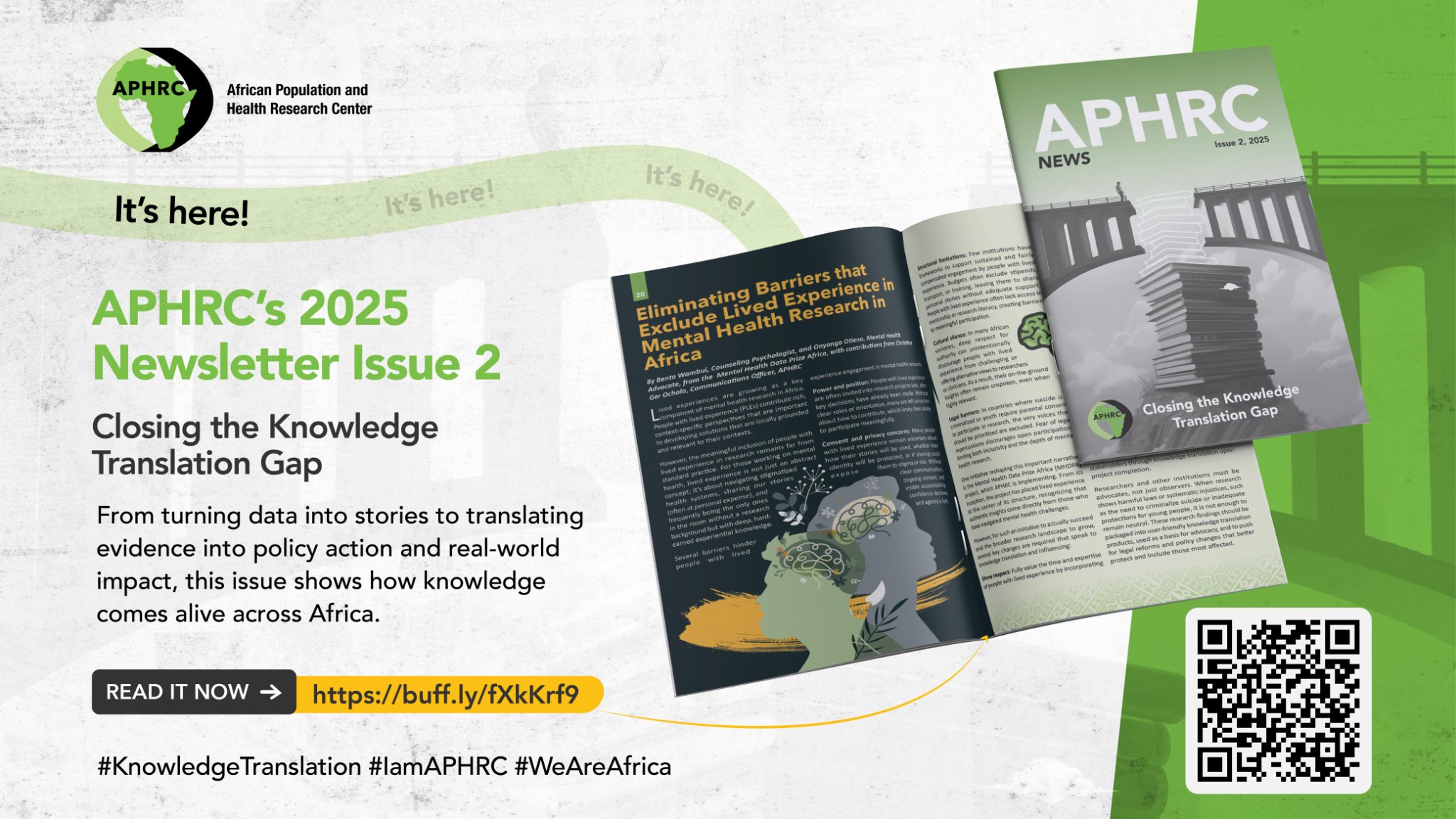
Newsletter: African Population and Health Research Center

APHRC News – Issue 2, 2025

  •  31/10/2025
Welcome to APHRC’s second 2025 newsletter issue! This edition explores how the Center is closing the Knowledge Translation Gap, making research accessible, relatable, and transformative. Dive in to discover stories of change, from climate and health innovations to inclusive education and mental health breakthroughs across Africa.


Monday, September 08, 2025

ii Editorial: Persistent Positive Change in Challenging Times ...

To Howden's editorial it's worth highlighting that Hodges' model is situated. So, whether the 'challenge' that is faced is individual, or collective Hodges' model can help to identify the issues, problems, strengths, opportunities, threats, where we are, where we would like to be and more. Surely, reflection, critical thinking is about confiming, or regaining our perspective, correcting our orientation or improving alignment and synchronisation with others? The time this entails, whether exercised on paper, or cognitively (yes, humans thinking is still an option) this is equivalent to a time-out even if momentary. This can be critical in clinical encounters, were emotions are raised, or there is risk of escalation.

So whether the challenge is personal, lived experience, bullying, finance, physical, or mental health, simulation (fidelity, testing), ethical ...; or collective (a team) - service and organisational change, major incident, policy, clinical or management supervision, whistleblowing, public / patient engagement, complaints and challenging relationships; Hodges' model is a tool (one of many) to call upon.

It could be the context causes you to focus on one or two care (knowledge) domains. Or, there is a need to step back in order to 'see' the big picture (integrated care, risk assessment, holistic care, psychosocial view ...) - the spiritual too.

While Hodges' model is simple, please consider this: there aren't many tools that can facilitate articulation and dissemination of the 'big picture' in a form that is (imho) readily transferable and translatable.

Howden, S. (2025). Editorial: Persistent Positive Change in Challenging Times. International Journal of Practice-based Learning in Health and Social Care, 13(1), ii-iii.

Sunday, September 07, 2025

Editorial: Persistent Positive Change in Challenging Times - IJPCLHSC

'What then is the common theme for this issue? It is the persistence of these authors, practitioners and academics to be curious about what could be better and engage with scholarly enquiry to advance practice-based learning.' 

The editorial introduces the content of -

International Journal of Practice-based Learning in Health and Social Care Vol. 13 No 1 August 2025
https://publications.coventry.ac.uk/index.php/pblh/issue/view/96

Howden,  S.  (2025).  Editorial:  Persistent  Positive  Change  in  Challenging  Times.  International  Journal  of  Practice-based Learning in Health and Social Care, 13(1), ii-iii.

- which I have mapped to Hodges' model (with some additions):

Individual
|
      INTERPERSONAL    :     SCIENCES               
HUMANISTIC  --------------------------------------  MECHANISTIC      
 SOCIOLOGY  :    POLITICAL 
|
Group

restlessness (- in mind)
(curiosity)

patient's lived experiences*

intra- inter-personal

pastoral support

engagement - enjoyment

workshop, case study ...

psycho-

restless legs syndrome

remote, rural, urban
community-based :: clinical settings

(infra-) structures

processes - procedures

simulation, major incident

forensic, podcasts

-social factors

interdisciplinary (integrated?) working

social structures
(This is how we 'do it' here)

'Institutional? “positive restlessness"'

*clinical subjective exposure 
(determinants of health)

organisational (Inst.) structures


<>

The final paper is on workshops and continuing professional development:

Kenny, B., Bourne, E., & Li, J. (2025). Knowledge Translation from Clinical Education Workshop to Workplace. International Journal of Practice-based Learning in Health and Social Care, 13(1), 56-76. https://doi.org/10.18552/ijpblhsc.v13i1.1084 

The editorial notes:

'The authors integrate goal setting as part of a development session on supervision skills and follow up survey, to ask what happened next in relation to their goals and practice. When resources are scarce and CPD is so critical, these ideas about enhancing workshop effectiveness and feeding participants’ experiences back into sessions has never been more important.'

When presenting Hodges' model at events I will often tick for a workshop. This reflects former work experience with student nurses, OTs, social workers and other learners: when a workshop could cover the some 2 hours with a break in the middle. Hodges model is flexible, adaptable and in a workshop can be applied on an individual basis, or small group work - breakout sessions [this does not necessarily mean the participants are bored :-)]. A wide range of learning and teaching approaches can be considered. 

Kenny, Bourne & Li utilise role play, case studies for example, their approach and paper framed by the KTA Framework:

'Workshop design was underpinned by the Knowledge to Action (KTA) Framework. KTA acknowledges the importance of social interaction in the adaptation of research evidence, taking account of local context and culture (Graham & Tetroe, 2011).' p.58. ...

'The KTA framework comprises two major components: knowledge creation and an action cycle. During the workshop, knowledge creation was supported by CEs identifying factors that contribute to challenging clinical education situations and reflecting upon the impact of these factors in their workplace contexts. During Part 1 of the workshop, attendees focussed on understanding challenging situations. Each group was assigned a case study that included a complex mix of student, educator and workplace factors thatinteracted to create a challenging learning situation.' p.58. ...

'A focus on active learning within the workshop prepared CEs for translation of their knowledge of supervisory practices when they returned to their workplaces. In Part 2 of the workshop, CEs worked through a structured process for managing placement challenges by engaging in peer learning role play activities. The process was adapted to address challenges that included mental health issues in workplace learning, developing professionalism, providing inclusive learning environments, and facilitating clinicalreasoning and reflection.' p.58.

  clinical educators (CEs)

Reading KB&L: I wonder if Hodges' model provides a more 'accessible' map - as an output / summary, evidence of learning and teaching activity? 'Filtering' would be essential of course, as to what exactly is mapped. While I've no evidence (in theory), Hodges' model in being (imho) accessible, might also be primed for transferability (after all what does transferable mean?^); by being recognised more consistently across larger groups, and (as per the conclusion) other individuals, and broader educational contexts.

Currently, working with three co-authors on a draft paper revision (dental health and policy frameworks) for a journal, I noticed our leading author refers to 'translational'. In the paper below, (cited by KB&I): 

Graham, Ian D. PhD1; Logan, Jo RN, PhD2; Harrison, Margaret B. RN, PhD3; Straus, Sharon E. MD, MSc4; Tetroe, Jacqueline MA5; Caswell, Wenda RN, MEd2; Robinson, Nicole6. Lost in knowledge translation: Time for a map?. Journal of Continuing Education in the Health Professions 26(1):p 13-24, Winter 2006. | DOI: 10.1002/chp.47

Graham et al's, Table 1 Definitions of Terms, is (still) really helpful.

See also on W2tQ: 'reflect' : 'holistic' : 'map' : 'situation'

^Translation; transfer - dual, two-way, inversion?

Thursday, October 05, 2023

"Diagrammatic Immanence"


Diagrammatic Immanence


"There is thus a naturally 'pragmatic' epistemology intrinsic to categories: from the standpoint of category theory objects are investigated and known only via their interactions with other objects, not 'in themselves''. The space of possible maps from one object to another determines what can be known of those objects as such. Over the past several decades, category theory has proven extraordinarily successful in unifying diverse fields of mathematics and providing a less arbitrary and more productive foundation for mathematics than set theory. Because of its intrinsic orientation towards relations, it connects more readily and with fewer idealist assumptions than set theory to the real world and its component structures." p.10. 


"A meaning of whatever sort is necessarily determined by its position in a space of various intersecting structures, each with its own rich tangle of relations. Each of the 'single' topics being discussed opens up internally into a complex arrangement of mappings between, words, sentences, semantics, phonemes - all the systematic orders of differential relations that structuralism has taught us to recognise. And these orders are themselves embedded in actual material and historical processes.

The seemingly intractable complexity of actual language (parole and not only langue) is one of the reasons linguistic semantics have tended to resist mathematical and logical formalisation so stubbornly. Meaning is enacted in singular events and in this way resists abstract treatment. Yet at the same time, meaning presupposes translatability.  All the singular grain of the interlocking systems of some actual conversational exchange connects potentially to the systems of innumerable others. Any adequate categorical representation of linguistic events and, more generally, semiotic processes must be both rigorous and and flexible enough to track the logical and structural underpinnings of meaning and at the same time facilitate the blurring and affordances of translation." p.141.

Gangle, R. (2016). Diagrammatic Immanence: Category Theory and Philosophy. Edinburgh University Press. http://www.jstor.org/stable/10.3366/j.ctt1bgzc38

Thursday, August 12, 2021

Post Tokyo Olympics 2021: Yes 'Shun' fits, Gaia knows ...

MOST individual
   patient / client  PERSON student / practitioner
|

INTERPERSONAL : SCIENCES
MOST humanistic ------------------------------------- MOST mechanistic  
SOCIOLOGY : POLITICAL
|
society - community of practice - profession
 MOST group


"There's this wonderful Japanese word shun, which is when something is full of its life force," says Pearson. "In that peak, when the meadows are flourishing, everything is reaching for the solstice, and you can feel the energy pouring from it. It's quite overwhelming - you're aware of this special time slipping through your fingers and you can't take it all in because it's so alive."p.36.

On second reading, maybe not? And, not for the fact that the next solstice is mid-winter here in the Northern hemisphere.

'Glances'

Visiting McDonalds for a coffee (only) at the end of 2020, I noticed one of the merchandising screens was displaying an error message. The message referred to glances, which I read as the content that changes after several seconds in succession. I meant to take a photo for a post such as this, and back in the area, I'll take my chance if spied again. [Success!]  I did speak to a member of staff but they couldn't help. The take away (you could say!) is of a 'glance' as the content of a single care domain. This isn't very accessible, emphasizing the visual nature of Hodges' model, but I'm kicking ideas around...

Media - marketing screen

Reading the above I thought of 'holistic bandwidth' in Hodges' model. If the model was fully populated with care concepts and, no doubt, some annotations, key relationships then I thought shun might be appropriate. By holistic bandwidth I mean the semantic distance between care concepts. This is what 'MOST' suggests above. Beyond these concepts we are in the realm of the spiritual: do they join up in some way? Obviously, 'complete' in fulfilling the purpose of assessment, care planning, intervention, evaluation whether clinical or learning activity. But then shun as a celebration of nature seems inappropriate in many clinical contexts, especially palliative and end-of-life care. Yes, time for second thoughts here too.

The role of nature in healthcare, the value of green spaces, for recovery or a peaceful ending is well documented. Then again, the shun as experienced in 2021 by a person, do they really see how it is diminished, how it has changed, is changing? The point was made recently, of the different experiences of the Seasons, the weather, now across generations: diminishing 'norms' birds, bees ...?

Perhaps, after all, shun can signify a complete care matrix. If we carry on as we are then Nature will act, is acting now. Gaia knows.

Coulson, C. Double Act, Work, rest and weed: Dan Pearson and his partner Huw Morgan share their garden vision, HTSI, FTWeekend, April 2021,  pp.36-39. 

https://www.ft.com/content/74061538-d1ef-4922-a821-09ed5484e7ec

Photos added 8/9/21.


Saturday, February 08, 2014

[hifa2015] Wikipedia, Medicine and a Language of Your Choice

Wikipedians and Translators Without Borders have been collaborating for more than two years in an effort to improve access to medical information. [1] Over this time we have improved more than 30 key medical articles in English and are working on translating them into around 60 languages. This effort has resulted in more than 3 million words of translated text. [2]

The work is having an impact. Wikipedia’s medical content is the single most read medical resource globally, [3] receiving about 5 billion page views in 2013 for around 180,000 articles across 286 languages. It is also often re-used by other sources including university textbooks by Boundless.com which reaches more than 3 million students, [4] Google, and many others. Additionally the Wikimedia Foundation through partnerships with cellphone companies has secured Wikipedia browsing without data charges for more than 500 million people in the developing world (currently rolling out in many regions with more carriers being added). [5]

Most of these efforts are accomplished entirely by volunteers. Volunteers who believe that all people deserve free and easy access to high quality health care information in the language of their choosing. The number of people currently working on these efforts are however small. To expand our work we need more people to join us who share our dream. For many aspects of the project there is no formal registration required. One can simply begin editing on Wikipedia.

If one is interested in translating from English to their native language they can contact enrique at proz dot com. Currently we are primarily looking for people to help in non European languages as in major languages much content already exists. Additionally we need people who can help add already translated article to Wikipedia. It requires a bit of time to figure out the Media Wiki markup but not too much. We are specifically looking for help adding articles in Arabic, Polish and Dutch right now.

Please let us know if you would be interested or wish to learn more.

James Heilman & Lori Thicke

MD, CCFP(EM), Wikipedian Founder and 
President of Wiki Project Med Foundation Translators without Borders

References

[1] https://en.wikipedia.org/wiki/Wikipedia:WikiProject_Medicine/Translation_task_force
[2] https://en.wikipedia.org/wiki/Wikipedia:WikiProject_Medicine/Translation_task_force/RTT
[3] http://www.imshealth.com/portal/site/imshealth/menuitem.c76283e8bf81e98f53c753c71ad8c22a/?vgnextoid=ebc072cc270b3410VgnVCM10000076192ca2RCRD&vgnextchannel=ba11e590cb4dc310VgnVCM100000a48d2ca2RCRD&vgnextfmt=default
[4] http://blog.boundless.com/2013/12/marching-forward-boundless-settles-lawsuit-traditional-publishers-continues-change-education/
[5] http://wikimediafoundation.org/wiki/Wikipedia_Zero
 
James Heilman
MD, CCFP-EM, Wikipedian

The Wikipedia Open Textbook of Medicine
www.opentextbookofmedicine.com
__________

From December 2013 to March 2014, mPowering Frontline Health Workers is supporting an in-depth exploration here on the HIFA forum around the information and learning needs of Community health workers (CHWs), and how we can meet those needs more effectively and efficiently over the coming years. Further information: http://tinyurl.com/hifa97

Monday, June 24, 2013

Nursing Informatics 2014 - Call for Submissions


Please forward this message via to your own networks and contacts.

We are pleased to announce that NI 2014, the 12th International Congress on Nursing Informatics, will be held in Taipei, Taiwan, June 21-25, 2014.

The theme of the conference is “eSmart + ” where “e” stands for eHealth, “S” implies simplicity, “m” represents mobility and meaningful use, “a” denotes advanced leadership, “r” indicates revolution, “t” means translational technologies, and “+” symbolizes People Leading uCare Safely. The acronym is also used to convey the idea of adopting smart technology to help health providers deliver higher quality care.

The online submissions system is now open and will remain open until mid-September 2013. Decisions on manuscripts will be made by mid-December 2013.

You can find more information at the conference website: ...

We very much look forward to seeing your submissions and to meeting you in Taiwan next year.

With best wishes

Nick Hardiker & Heimar Marin

Co-Chairs, Scientific Programme Committee, NI2014


Monday, August 27, 2012

Drupalcon Munich 2012 [i]

Drupalcon Munich 2012 Group Photo
Well another European Drupalcon has been and gone. It was an awesome event in Munich; the venue, sessions, organisation and the community. It all proved a brilliant experience even without the night time thunder and lightening.

I'm not sure if this particular sponge is saturated to its limited capacity, but compared with previous years I took fewer notes and haven't posted as yet. The (glaring) take home lesson for me remains the same. Write less: do!

The notes I do have started after the first keynote by Dries Buytaert on the State and future of Drupal. Personally, I prefer a presentation rather than the interview format. A change in format must be a relief for Dries and for circuit regulars, but despite a visual interlude the social negotiation seemed for me to get in the way of the show and tell. Given that though Drupal is a year aware from the next release, so this reduces the 'news'. Portland 2013 will no doubt be literally more telling.

I did scribble some ..., on Entities and Properties and attending How to Dominate the Theme Layer. Useful to consider that the visual hierarchy may not match the outline of your site in terms of information architecture. The idea of styling now and injecting classes later has much appeal. I am enthralled by the prospect of font selection, colour and other site design aspects.

There were several sessions on Multilingual sites in D7 & D8. The pros and cons of node level translation vs. field level translation were explained, the latter being considered the best model for most use cases and set to be the likely default in D8. Given the cons of translation and the need to keep it simple I would set about limiting translation to Brian Hodges' original course notes and a new introduction to h2cm. Another key question referred to the type of experience you are building - is it totally symmetrical or asymmetric?

More to follow.  
Photo source:
https://www.flickr.com/photos/drupalassoc/7893709730/

Saturday, October 29, 2011

Abstract translation (100 words): Exploring several dimensions of local, global and glocal using the generic conceptual framework Hodges's model

I need to produce translations of an abstract into French, Spanish and Russian with a 100 word limit. At present I'm relying on Google translate; any suggestions to improve what follows (the English too!) greatly appreciated. 'Glocal' should prove a bit of a test. (h2cmng at yahoo.co.uk):

Exploring several dimensions of local, global and glocal using the generic conceptual framework Hodges's model

Abstract
This paper introduces Hodges’s model a conceptual framework as a means to explore the  concept glocal and the more familiar terms local and global. Actual and speculative definitions of glocal are offered. Discussion will also deliberate on the compound meanings of these terms. The model's four knowledge (care) domains facilitate discussion of the physical, social, political and individual dimensions of local, global and glocal. The paper draws upon health, anthropology, history, science, informatics and geopolitics – especially the themes of globalization, literacy,  information technology and communication (voice). The purpose is exploratory with additional resort to philosophical reflection.

Explorar varias dimensiones de locales, globales y glocales utilizando el modelo conceptual genérico Hodges marco de

abstracto
Este trabajo presenta un nuevo modelo Hodges es un marco conceptual como un medio para explorar el concepto glocal y los términos más familiares locales y globales. Definiciones reales y especulativos de glocal se ofrecen. El debate también se tratará sobre el significado de estos términos compuestos. El modelo de cuatro conocimiento (atención) dominios de facilitar la discusión de las dimensiones físicas, sociales, políticos e individuales de los locales, globales y glocales. El documento se basa en la salud, la antropología, la historia, la ciencia, la informática y la geopolítica - especialmente los temas de la globalización, la alfabetización de tecnología de la información y la comunicación (voz). El objetivo es exploratorio con recurso adicional para la reflexión filosófica.


Exploration des dimensions de plusieurs locaux, mondiaux et glocal utilisant le modèle générique de cadre conceptuel Hodges

Résumé
Cet article présente le modèle Hodges un cadre conceptuel comme un moyen d'explorer le concept et le glocal termes plus familiers local et mondial. Définitions réelles et spéculative de glocal sont offerts. La discussion portera également délibérer sur les significations composé de ces termes. Les quatre modèle de connaissances (soins) domaines de faciliter la discussion de la physique, les dimensions sociales, politiques et individuels des locaux, mondiaux et glocal. Le document s'appuie sur la santé, anthropologie, histoire, sciences, informatique et de la géopolitique - notamment les thèmes de la mondialisation, de l'alphabétisation technologies de l'information et de communication (voix). Le but est exploratoires avec station supplémentaire à la réflexion philosophique.


Изучение нескольких размеров локальных, глобальных и глокальные использованием модели общих концептуальных рамках Ходжеса

абстрактный
В данной статье рассматривается модель Ходжеса концептуальную основу в качестве средства для изучения концепции и глокальные Наиболее известные термины локальные и глобальные. Фактические и спекулятивных определений глокальные предлагаются. Обсуждения будут также обсуждать соединения смысл этих терминов. Четыре модели знаний (ухода) области содействия обсуждению физических, социальных, политических и индивидуальных размеров локальных, глобальных и глокальные.Статья основана на здоровье, антропологии, истории, науки, информатики и геополитика - особенно темы глобализации, распространения грамотности, информационных и коммуникационных технологий (голос).Цель поисковой дополнительные прибегать к философской рефлексии.


Sunday, November 08, 2009

The art and science of nursing: the poetry of caring

http://alikaragoz.net/index.php?showimage=234
Another quote:

... The best translators seem to have an extra ear, indeed, have to have an extra ear, for the literary dimensions and possibilities of their own language. Translation can draw the poet out of someone who may not have realised the poet in himself. The response to poetry is in us all but it takes an extra talent to turn response to invention, to hear and speak echo in a fresh voice. ...


George Szirtes, The Times, Words with a fresh voice, 7 November 2009, p.8.


Original image source with thanks: Alikaragoz.net
