Hodges' Model: Welcome to the QUAD: Japan

Hodges' model is a conceptual framework to support reflection and critical thinking. Situated, the model can help integrate all disciplines (academic and professional). Amid news items, are posts that illustrate the scope and application of the model. A bibliography and A4 template are provided in the sidebar. Welcome to the QUAD ...

Showing posts with label Japan. Show all posts

Tuesday, February 17, 2026

CFP - 2026 International Conference on Artificial Intelligence for Health and Education (ICAIHE2026)

July 8-10, 2026, Tokyo, Japan
Dear Colleagues,

We are writing to invite you to submit your papers for publication and presentation at 2026 International Conference on Artificial Intelligence for Health and Education (ICAIHE 2026) scheduled on July 8-10, 2026 in Tokyo, Japan.

https://icaihe.org

Also, we invite you to submit a workshop/special session proposal to participate in ICAIHE 2026.

The workshop/special session proposal submission deadline has been extended to: February 28, 2026.
The regular paper submission deadline is: March 1, 2026.

----------------------------------------

INTRODUCTION
---------------
With the spread of digital technology in healthcare and education, there is a growing interest in using artificial intelligence (AI) to promote human well-being in the extensive areas of health and learning. As more data becomes available from IoT, wearable devices, sensors, social media and many other online platforms, new possibilities emerge for understanding and revolutionizing digital health and learning.

ICAIHE 2026 focuses on AI-enhanced and data-driven approaches to health and education. It aims to leverage advanced AI technology to provide new opportunities in the healthcare and education sectors. This conference is committed to bringing together researchers to explore how these cutting-edge AI technologies can optimize personal health and learning environments, and to demonstrate how these emerging technologies can drive transformative practices that promote human well-being.

IMPORTANT DATES
---------------
Workshop/SS Proposal Due: February 28, 2026 (Extended)
Regular Paper Due: March 1, 2026

Workshop/SS Paper Due: March 8, 2026
Author Notification: May 1, 2026
Paper Registration Due: May 15, 2026
Camera-ready Submission Due: May 22, 2026

SCOPE AND TRACKS
---------------
Prospective authors are invited to submit papers on topics including, but not limited to:
Track 1: Emerging AI Technologies for Health and Education
  • Generative AI and LLM
  • Agentic AI and AI Agents
  • Explainable AI
  • Multimodal AI Models
  • Small Smart AI Models
  • Knowledge Graphs
  • Privacy Protection, Security, and Ethics in Emerging AI Applications
Track 2: AI-Enhanced Healthcare and Medical Services
  • AI-Enhanced Big Data Analytics in Healthcare and Medical Services
  • Multimodal Data Fusion in Digital Health
  • AI-Enhanced Biometric Analysis in Digital Health
  • Machine Learning and Deep Learning for Healthcare and Medical Services
  • AI-Enhanced Precision Healthcare
  • Metaverse and Digital Twin for Healthcare and Medical Services
  • Human-AI Interaction in Digital Health and Well-being Promotion
Track 3: AI-Enhanced Education and Learning
  • LLM-Enhanced Educational Content Generation
  • LLM-Enhanced Personalized Learning
  • LLM-Enhanced Automated Learning Feedback and Assessment
  • AI-Enhanced Collaborative Learning
  • AI-Enhanced Learning Analytics
  • AI-Enhanced VR/AR/Metaverse for Immersive Learning
  • AI Agents for Learning Management Systems
ICAIHE 2026 CALLS
---------------
Prospective authors are invited to submit original papers. Formats for the submissions are either
- Full Paper: 12-15 pages
- Short Paper: 6-11 pages
- Work-in-Progress Paper: 6-7 pages
SUBMISSIONS AND PUBLICATIONS
---------------
All accepted papers will be published in Springer CCIS series. Selected high quality papers will be recommended for possible publications on journal special issues.

For further details, please refer to https://icaihe.org/sub.html

Submission Link: https://cmt3.research.microsoft.com/ICAIHE2026
 
-------------
Hosted by
Waseda University, Japan 
 
My source: AI-SGES list - https://www.bcs-sgai.org/?section=server

Wednesday, August 06, 2025

'The Bells of Nagasaki' by Takashi Nagai

Individual
|
      INTERPERSONAL    :     SCIENCES               
HUMANISTIC  --------------------------------------  MECHANISTIC      
 SOCIOLOGY  :    POLITICAL 
|


Takashi Nagai, William Johnston (Translator), Richard Lloyd Parry (Introducer). The Bells of Nagasaki. London: Penguin.
https://www.penguin.co.uk/books/469083/the-bells-of-nagasaki-by-nagai-takashi/9781529952605

My source:
Olivia Ward-Jackson. What one man saw in the ruins of Nagasaki, Review, The Daily Telegraph. 26 July 2025. pp.6-7.

See also:


Jones, P. (1994) An Enthusiast's View of CAL. (Problems in production of CAL - Simulation effects of Nuclear Weapons - conversion of GWBASIC to BBC BASIC from BYTE - with original author's permission - J Fanchi). IT in Nursing. 6,2.

Tuesday, August 05, 2025

Collective loneliness

Individual
|
      INTERPERSONAL    :     SCIENCES               
HUMANISTIC  --------------------------------------  MECHANISTIC      
 SOCIOLOGY  :    POLITICAL 
|
Group
loneliness

depopulation
demographics

Japan

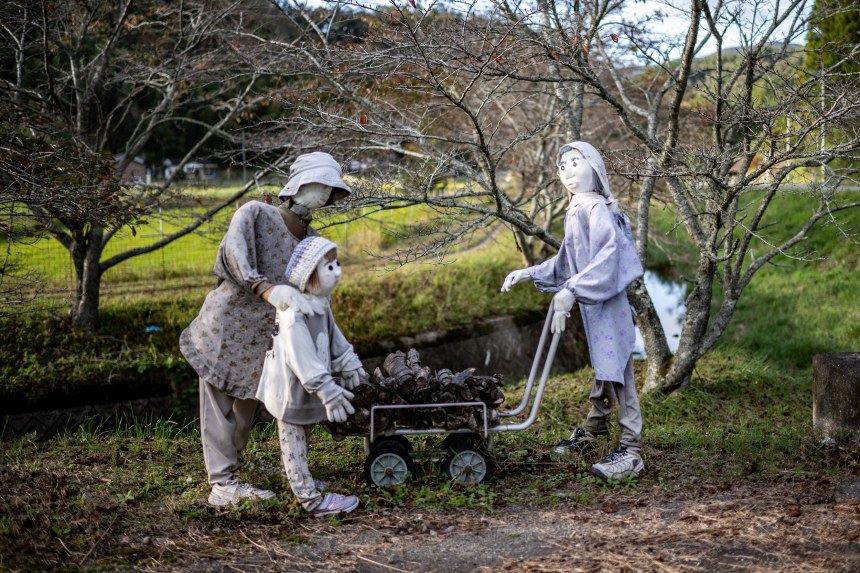
 A family of puppets collects wood in 
 the Japanese village of Ichinono.
 Philip Fong / AFP - Getty Images 
'Stop the boats'

'global trends'


My source: Sam Freedman. The truth about migrant workers: demonised but in demand, and few of us can live without them. The Observer, 03.08.25. pp.12-13.
https://observer.co.uk/news/national/article/sam-freedman-demonising-migrants-wont-fill-jobs-or-boost-falling-populations

Image and context:
'Outnumbered by puppets': Depopulated village in Japan crafts dolls for sense of life
https://www.nbcnews.com/news/world/outnumbered-puppets-depopulated-village-japan-crafts-dolls-sense-life-rcna177216

Thursday, August 12, 2021

Post Tokyo Olympics 2021: Yes 'Shun' fits, Gaia knows ...

MOST individual
   patient / client  PERSON student / practitioner
|

INTERPERSONAL : SCIENCES
MOST humanistic ------------------------------------- MOST mechanistic  
SOCIOLOGY : POLITICAL
|
society - community of practice - profession
 MOST group


"There's this wonderful Japanese word shun, which is when something is full of its life force," says Pearson. "In that peak, when the meadows are flourishing, everything is reaching for the solstice, and you can feel the energy pouring from it. It's quite overwhelming - you're aware of this special time slipping through your fingers and you can't take it all in because it's so alive."p.36.

On second reading, maybe not? And, not for the fact that the next solstice is mid-winter here in the Northern hemisphere.

'Glances'

Visiting McDonalds for a coffee (only) at the end of 2020, I noticed one of the merchandising screens was displaying an error message. The message referred to glances, which I read as the content that changes after several seconds in succession. I meant to take a photo for a post such as this, and back in the area, I'll take my chance if spied again. [Success!]  I did speak to a member of staff but they couldn't help. The take away (you could say!) is of a 'glance' as the content of a single care domain. This isn't very accessible, emphasizing the visual nature of Hodges' model, but I'm kicking ideas around...

Media - marketing screen

Reading the above I thought of 'holistic bandwidth' in Hodges' model. If the model was fully populated with care concepts and, no doubt, some annotations, key relationships then I thought shun might be appropriate. By holistic bandwidth I mean the semantic distance between care concepts. This is what 'MOST' suggests above. Beyond these concepts we are in the realm of the spiritual: do they join up in some way? Obviously, 'complete' in fulfilling the purpose of assessment, care planning, intervention, evaluation whether clinical or learning activity. But then shun as a celebration of nature seems inappropriate in many clinical contexts, especially palliative and end-of-life care. Yes, time for second thoughts here too.

The role of nature in healthcare, the value of green spaces, for recovery or a peaceful ending is well documented. Then again, the shun as experienced in 2021 by a person, do they really see how it is diminished, how it has changed, is changing? The point was made recently, of the different experiences of the Seasons, the weather, now across generations: diminishing 'norms' birds, bees ...?

Perhaps, after all, shun can signify a complete care matrix. If we carry on as we are then Nature will act, is acting now. Gaia knows.

Coulson, C. Double Act, Work, rest and weed: Dan Pearson and his partner Huw Morgan share their garden vision, HTSI, FTWeekend, April 2021,  pp.36-39. 

https://www.ft.com/content/74061538-d1ef-4922-a821-09ed5484e7ec

Photos added 8/9/21.


Thursday, September 25, 2014

1 in 3 will be older adults by 2025 in Japan

In June Dr Mayumi Hayashi described Japan's vision of 'total care' for its older population in HSJ. The article that prompts this post follows another with lessons for England.

Referring to a "2025 vision" this forward thinking has its roots in established systems of healthcare set up in 1961 and social care established in 2000 (p.25).

Care integration is not new as a fundamental issue in health and social care. It is for me a career legacy issue. As a student nurse it was discussed and debated, closely allied with multidisciplinary and holistic (joined up physical and mental health) care. Even now 37 years later it will drive many arguments and policy deliberations in the run up to the next election here.

Many nations are faced with stark demographics. As the population ages and works its way through wooden blocks, Rubik cubes, it is the population pyramid that takes on increasing significance.


Dr Hayashi lists the need for inclusion, integration and continuation of four components that are essential to the realisation of this vision:
  • maximising the integration of healthcare and social care;
  • promoting policies for prevention and outreach together with safeguarding;
  • embedding supported living programmes and dementia friendly community initiatives; and
  • addressing “late life specific” housing needs.
I have mapped these to Hodges' model below:

individual
INTERPERSONAL : SCIENCES
humanistic ------------------------------------------- mechanistic
SOCIOLOGY : POLITICAL
group
embedding supported living programmes and dementia friendly community initiatives integration of health and social care
"late life specific" housing needs
(integration of health and social care)
promoting policies for prevention and outreach, together with safeguarding


It becomes clear to see in Japan, China and other nations how telecare and smart homes have a role to play. Getting the basics of integrated care resolved firstly is the prerequisite whatever the culture.

Where achieved the integration of health and social care can act as a diagonal brace as it straddles two care domains. Perhaps the model also reflects the ongoing challenges of parity in esteem in mental health care and physical care; and the funding ambiguity for people living with dementia as opposed to other medical conditions?

In January 2014 the FT Weekend magazine also featured an article on ageing in Japan.

Hayashi, M. (2014) Japan's vision of a 'total care' future looks bright, Health Service Journal, 124, 6404, 25-27. 

FT magazine cover image:
https://www.facebook.com/financialtimes/photos/a.10150157857040750.297340.8860325749/10152119294570750/?type=1

Friday, September 14, 2007

SpacePort and Moon

There are a series of images on TechRepublic including:


The view from above is reminiscent of crop circles. Officials hope Spaceport America will be operational in late 2009 or early 2010.
Apart from the little matter of punching of a big hole in the atmosphere, it is great to see another return to the moon - this time SELENE from Japan.

Working on the socio-technical structures paper, I need to summarise existing socio-technical approaches in the literature. The moon will figure in this paper too - an ideal light to help explain why s-t perspectives are essential.

I visited a nursing home this week (not much choice there as a Community Mental Health Nurse for Older Adults): the surprise though - no PCs.

More this weekend...