Hodges' Model: Welcome to the QUAD: devices

Hodges' model is a conceptual framework to support reflection and critical thinking. Situated, the model can help integrate all disciplines (academic and professional). Amid news items, are posts that illustrate the scope and application of the model. A bibliography and A4 template are provided in the sidebar. Welcome to the QUAD ...

Showing posts with label devices. Show all posts

Tuesday, February 17, 2026

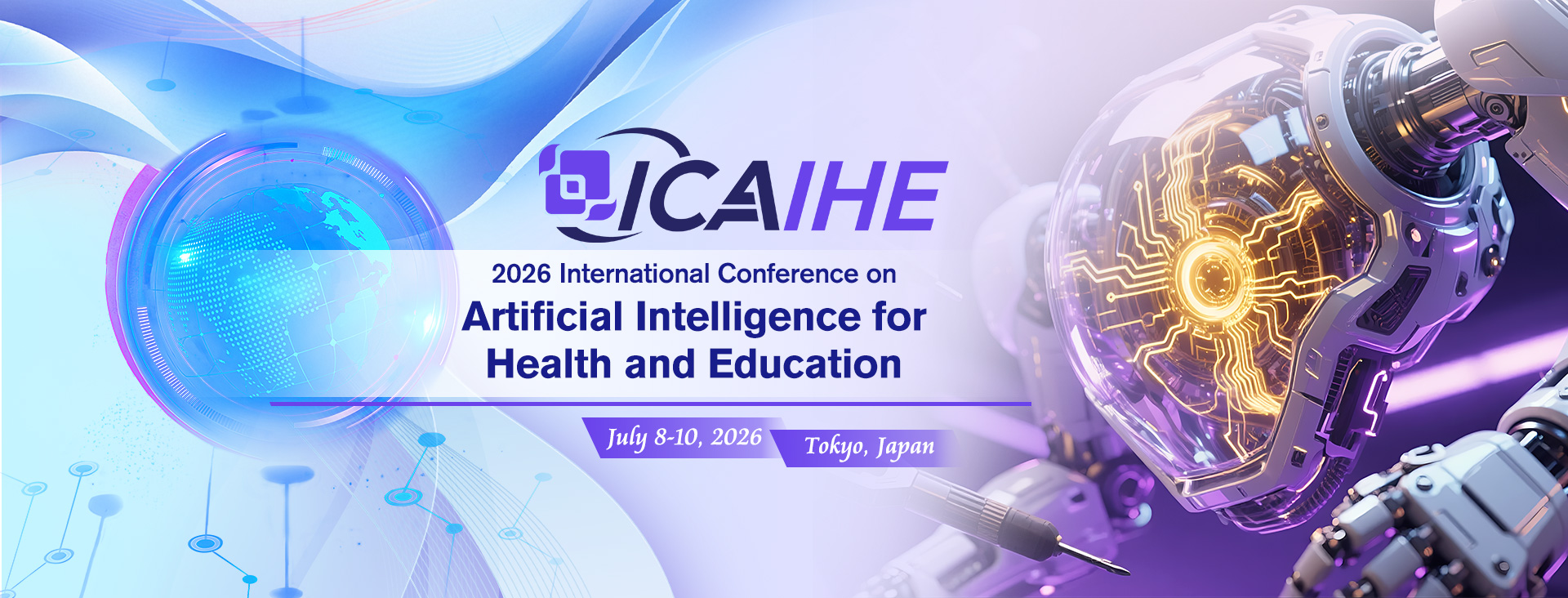
CFP - 2026 International Conference on Artificial Intelligence for Health and Education (ICAIHE2026)

July 8-10, 2026, Tokyo, Japan
Dear Colleagues,

We are writing to invite you to submit your papers for publication and presentation at 2026 International Conference on Artificial Intelligence for Health and Education (ICAIHE 2026) scheduled on July 8-10, 2026 in Tokyo, Japan.

https://icaihe.org

Also, we invite you to submit a workshop/special session proposal to participate in ICAIHE 2026.

The workshop/special session proposal submission deadline has been extended to: February 28, 2026.
The regular paper submission deadline is: March 1, 2026.

----------------------------------------

INTRODUCTION
---------------
With the spread of digital technology in healthcare and education, there is a growing interest in using artificial intelligence (AI) to promote human well-being in the extensive areas of health and learning. As more data becomes available from IoT, wearable devices, sensors, social media and many other online platforms, new possibilities emerge for understanding and revolutionizing digital health and learning.

ICAIHE 2026 focuses on AI-enhanced and data-driven approaches to health and education. It aims to leverage advanced AI technology to provide new opportunities in the healthcare and education sectors. This conference is committed to bringing together researchers to explore how these cutting-edge AI technologies can optimize personal health and learning environments, and to demonstrate how these emerging technologies can drive transformative practices that promote human well-being.

IMPORTANT DATES
---------------
Workshop/SS Proposal Due: February 28, 2026 (Extended)
Regular Paper Due: March 1, 2026

Workshop/SS Paper Due: March 8, 2026
Author Notification: May 1, 2026
Paper Registration Due: May 15, 2026
Camera-ready Submission Due: May 22, 2026

SCOPE AND TRACKS
---------------
Prospective authors are invited to submit papers on topics including, but not limited to:
Track 1: Emerging AI Technologies for Health and Education
  • Generative AI and LLM
  • Agentic AI and AI Agents
  • Explainable AI
  • Multimodal AI Models
  • Small Smart AI Models
  • Knowledge Graphs
  • Privacy Protection, Security, and Ethics in Emerging AI Applications
Track 2: AI-Enhanced Healthcare and Medical Services
  • AI-Enhanced Big Data Analytics in Healthcare and Medical Services
  • Multimodal Data Fusion in Digital Health
  • AI-Enhanced Biometric Analysis in Digital Health
  • Machine Learning and Deep Learning for Healthcare and Medical Services
  • AI-Enhanced Precision Healthcare
  • Metaverse and Digital Twin for Healthcare and Medical Services
  • Human-AI Interaction in Digital Health and Well-being Promotion
Track 3: AI-Enhanced Education and Learning
  • LLM-Enhanced Educational Content Generation
  • LLM-Enhanced Personalized Learning
  • LLM-Enhanced Automated Learning Feedback and Assessment
  • AI-Enhanced Collaborative Learning
  • AI-Enhanced Learning Analytics
  • AI-Enhanced VR/AR/Metaverse for Immersive Learning
  • AI Agents for Learning Management Systems
ICAIHE 2026 CALLS
---------------
Prospective authors are invited to submit original papers. Formats for the submissions are either
- Full Paper: 12-15 pages
- Short Paper: 6-11 pages
- Work-in-Progress Paper: 6-7 pages
SUBMISSIONS AND PUBLICATIONS
---------------
All accepted papers will be published in Springer CCIS series. Selected high quality papers will be recommended for possible publications on journal special issues.

For further details, please refer to https://icaihe.org/sub.html

Submission Link: https://cmt3.research.microsoft.com/ICAIHE2026
 
-------------
Hosted by
Waseda University, Japan 
 
My source: AI-SGES list - https://www.bcs-sgai.org/?section=server

Wednesday, January 07, 2026

Healthcare Evolution through AI and Digital twins - HEAD 2026

Dear colleagues,

We do hope this Call for Papers may be of your interest.
We do apologize if this CfP reaches you more than once.

Yours sincerely
HEAD Organizers

=========================================================

Healthcare Evolution through AI and Digital twins - HEAD 2026

18 - 21 May, 2026 - Sydney, Australia

https://www.head.icar.cnr.it/

- in conjunction with the 26th IEEE International Symposium on Cluster, Cloud and Internet Computing (CCGrid 2026) and in-cooperation with ACM SIGHPC

Submit your paper by using the link:

https://easychair.org/conferences/submission_new?a=35863199

=======================================================

MISSION:
------------

All over the world, the number of investments in Information and Communication Technology (ICT) for healthcare and wellbeing (eHealth) is rapidly increasing. GLOBE NEWSWIRE has predicted that the Global eHealth market is expected to reach $123.78 billion by 2030. This means that digital health is of considerable interest worldwide, as it has the potential to improve both the quality of services and users’ access to health information, while also saving time and reducing the workload and associated costs for health service providers in the long term.

In this context, an increasing interest is growing around eHealth and ICT technologies, such as Artificial Intelligence (AI), Digital Twins, Cloud computing, Edge and Fog computing, and Internet of Things (IoT),

which are at the basis of revolutionising healthcare by bringing innovative network applications and services. In fact, modern healthcare applications are becoming increasingly dependent on heterogeneous infrastructures, including IoT and edge medical devices, as well as High-Performance Computing (HPC) backends, to support the execution of AI-driven models and patient-specific Digital Twins.

The HEAD workshop would explore the open challenges and current issues surrounding the application of these technologies, while bridging the gap between healthcare innovation and the hardware and software systems that support scalable and reliable computing. HEAD aims to encourage interdisciplinary discussion about how technologies such as HPC, distributed systems and performance optimisation can facilitate the deployment of reliable and scalable Digital Twins for healthcare. The workshop will highlight the role of computing infrastructures as key enablers of future digital medicine by linking algorithmic advances with architectural and systems-level innovations.


TOPICS:
----------

■ AI Algorithms and Learning Frameworks for Healthcare
■ Modeling and Simulation Methodologies for Healthcare
■ Programming Techniques and Architectures for Healthcare
■ Data Management, Analytics, and Knowledge Extraction
■ ICT Infrastructure and Tools for Healthcare Digital Twins
■ Cloud Computing, Edge and Fog Computing for Healthcare
■ Internet of Things (IoT), Big Data, and Wearable Devices for Healthcare
■ Ethical, Legal, and Societal Implications of ICT for Healthcare
■ Accelerator-based architectures (GPUs, NPUs, FPGAs and DPUs) for Healthcare
■ Parallel and Distributed Training and Multi-GPU/Multi-Node Execution for Healthcare Applications
■ Energy-Efficient, Sustainable, and Optimization-Oriented Computing for AI in Healthcare


IMPORTANT DATES:
--------------------------

• Submission deadline: February 01, 2026
• Notification of paper acceptance: February 28, 2026
• Submission of camera-ready papers: March 15, 2026
• Registration: March 15, 2026


PAPER SUBMISSION:
---------------------------

Manuscripts should describe original work and should be formatted according to the IEEE conference proceedings format. 

Papers will be submitted through the CCGrid 2026 submission system.

Submit your paper here:

https://easychair.org/conferences/submission_new?a=35863199

All submissions will undergo a rigorous peer-review process. Each paper will be reviewed by at least three members of the Technical Program Committee. Reviews will be double-blind.

Accepted papers will be published in the CCGrid 2026 workshop proceedings and will be submitted for inclusion in IEEE Xplore.


BEST PAPER AWARD:
---------------------------

A Best Paper Award certificate will be conferred on the author(s) of a paper presented at the workshop, selected by the Chairs based on scientific significance, originality, and technical quality, as evaluated by the Program Committee.

Please visit https://www.head.icar.cnr.it/  for more information and if you have any questions kindly get back to us by sending an email

Kind regards,
HEAD 2026 Organizers

My source: Dr. Giovanna Sannino

Monday, June 02, 2025

Online: Hodges' model in Safety presentation

Later this week I've an online presentation to deliver. The brief is to introduce Hodges' model and relate the model to the matter of safety - some thoughts ...

individual
|
INTERPERSONAL : SCIENCES
humanistic ------------------------------- mechanistic
SOCIOLOGY : POLITICAL
|
group
PATIENT safety

Task: Attention - Concentration
Rest - Sleep

psychological environment - safety

to ERR is human
HUMAN as weakest link

risk to SELF

Cognitive support - lists, names,
informational analysis of environment

Critical thinking
Situational awareness

Therapeutic - OBSERVATIONS
ethics- video surveillance
PATIENT - PROCESS safety
 - e.g. diagnosis, handover
physical safety: 1st law 1st aid.
SELF-harm : SELF-neglect
Assessments, Plan, Evaluation
environment:safety, construction, buildings
occupational/disciplinary safety
Comms - Information theory
 safety as security: lone working
signals - alarms, protocols

medical safety: medicines, devices
risk reduction - management

Human factors
Human- Computer/Tech/AI Interaction
Research - Records
Interfaces

Public Health Safety: Food, Pollution

risk to others
stereotypes - assumptions

risk from others - bullying

social media

teamwork: simulation

PRACTICE safety
Law - Health & Safety
Reporting - Statistics
Transparency
Mandatory Training / Learning
Whistleblowing
safety standards ISO
safety organisations

The Learning Organisation
Other sectors e.g. Aviation, Formula 1 ...
Risk of 'groupthink'

 Is it a risk to assume parity of estem in patient safety? What of 'a' patient's safety?

safety
https://hodges-model.blogspot.com/search?q=safety

Sunday, February 11, 2024

Nursing a dinosaur: Or, "Computer on your face? Still not cool" c/o Chen, NYT

A gifted copy of the NYT has already paid a dividend providing a post. There's another reporting the launch of Apple's $3,500 Vision Pro. 

Through Chen's tech report we learn, or are reminded that "Google, Meta, Snap, Samsung and Sony" and other companies, have been trying to create VR headsets as an experience for over the past 12 years. Familiar barriers to entry (for all) still make themselves known: physical - weight, energy - battery, purpose - getting tasks done, the graphics - 'tech', hence the market key - of cost. It is integrating these that might also be termed 'maturity' - the time is, finally right. The term has always been somewhat unfortunate but where is the killer-app?

Jurassic World: Aftermath. Credit: Coatsink

Chen's trials of VR headsets old and new includes what seems the ubiquitous dinosaur app.

I can relate to the 'dinosaur' moniker, given the veritable dinosaur represented by models of care and nursing theory; and yes that one, the dinosaur riding the bike to a new (health) career in 1977.

Apple bills this launch as the start of:

"'spatial computing,' which blends data with the physical world to make our lives better."

In a way, this oft-repeated situation can be summed up as socio-technical reality, travelling through various iterations until capability and maturity of technology come of age. 

Now it's not just hi-res graphics, it is video quality imagery. Recalling an interface in my first HTML editor, I wonder if there is an opportunity being missed?

Unpicking Apples' 'spatial computing' which in short = data + physical world + lives better (purposes) tech is persistently predictable in going for the commercial jugular. Perhaps there is an intermediate step which software developers have sought to leverage over many years. 

'Data' here, means care concepts, or as the context dictates. Hodges' model as a data, information, knowledge, educational (e.g., case study) portal. 

Given a specific context what concepts might we 'find' at a,b,c and d below; and elsewhere in the model? How do we characterise the 'individual', the group? While in a virtual (and conceptual / threshold space: Hodges' model!) this might, encountered as text be a less virtiginous and tiring  experience*? Hodges' model is an ideal fit in fact - well a candidate space at least.

Consider how far, since the early 2000s and 2012 (not to mention 1991) technology (hard and soft)  has come in terms of language understanding and AI - ChatGPT. Hodges' model can leverage this in the first instance. As a template Hodges' model is a proverbial virtual lab - a potential situated corpus - also awaiting its dinosaur.

Individual
   |
      INTERPERSONAL    :     SCIENCES               
HUMANISTIC  --------------------------------------  MECHANISTIC      
 SOCIOLOGY  :   POLITICAL 
|
Group
a)

user (sector) purposes

concepts

critical thinking

reflection

model, modelling

b)

space

3D - graphics

representation

health / nurse theory

models  of care

patient/carer engagement

metric for: self care

integrated care

person-centred care

integrated care

c)
open source/commercial apps

outcomes

prevention

sustainable health care

determinants of health

d)


Brian X. Chen, Computer on your face? Still not cool. Tech, The New York Times International Edition, January 30, 2024, p.14.
https://nytimes-en.com/2024/01/25/why-making-face-computers-cool-isnt-easy/

*https://www.msn.com/en-us/news/technology/the-vision-pros-scary-side-effect/ar-BB1i6Hln
(The tech giants will battle it out.)

Images: 
Jurassic World: Aftermath - https://www.nme.com/news/gaming-news/jurassic-world-aftermath-brings-vr-horror-to-the-oculus-quest-this-week-2840584

Fossilized evidence of the dinosaur - as expected from the archive:
https://web.archive.org/web/20091205090804/http://www.p-jones.demon.co.uk/Introvrn.htm

The above is included in the fourth row of the SCIENCES collection of links at:

https://web.archive.org/web/20100327172004/http://www.p-jones.demon.co.uk/linksTwo.htm

Tuesday, December 20, 2022

Additional citation: IRMS Bulletin - November 2022

 Last May I presented Hodges' model at the IRMS Conference in Glasgow.

When I walked in to set up I had the room to myself. I was able to attend on the final day, that of my talk - travelling and staying at my own expense.

The concurrent - streamed format for the conference means you are competing for hearts, minds and existing conceptual frameworks, how well they are populated, what are the 'gaps' and delegate's curiosity and desire for lifelong learning. Next year's event is in Manchester, I'd encourage you to submit, attend if you can.

Five minutes before the start of my session, I counted 8-10 people. The Chair had arrived and suggested we wait a bit longer. 4-5 minutes later I was really pleased - all the seats were occupied and people still arrived by the door. Altogether there were over 30 people.

I'm probably better 1-1 - perhaps that's the 'nurse inside', but the session went well, as the Chair acknowledged and some questions afterwards.

At the end, I was also approached by Jonathan Fryer, in response to a slide showing how Hodges' model can conceptually encompass the various forms of literacy and schools and informatics (posted previously on W2tQ).

Jon immediately saw the relevance of the model, as at The British Library (Head of Corporate Information Management Corporate Information Management Unit) he was currently thinking about literacy.

IRMS Bulletin is a member-based publication, so not open access. I'm grateful that Hodges' model has some exposure and that Mr Fryer found it helpful:

"Information Literacies - Learning, to thrive in a digital age"

IRMS bulletin 230

"I am indebted to Peter Jones, who shared Hodges’ Health Career Model1 with the 2022 IRMS conference in Glasgow. Although originally used in a healthcare setting, this simple, two-axis intellectual model can be readily used to analyse any complex interaction between the individual and their environment – in this case, information literacies.

The diagram2 shows a number of distinct yet overlapping literacies that were potentially in play in our problem example, although there are likely to be many more – even emotional literacy played a part, with the frustrations of the young people in question causing them to dismiss potential solutions before they had been tried or even considered. Likewise, socio-political and socio-economic literacies may have been a factor – if you are unaware that something exists in the world due to blind-spots in your own cultural background then you cannot even begin to look for it."


Jon Fryer, "Information Literacies - Learning, to thrive in a digital age". IRMS Bulletin, Issue 230, November 2022.

[ I will add a detailed citation when obtained and add to the blog's bibliography. Apparently some details referring to Hodges' model were omitted from the published article, I understand IRMS editors are addressing this is a future issue. ]


See also:
https://hodges-model.blogspot.com/search?q=blind-spot

I am planning a submission to the bulletin myself in 2023.

Wednesday, November 09, 2022

Books: Psychiatry and Technology - Phillips, ed. (2008)

Despite the necessity of new (inc. secondhand when possible) titles, the overall push is to reduce the shelf and box count. This means that:

Phillips, James (ed.) (2008). Philosophical Perspectives on Technology and Psychiatry. Oxford University Press.

- will soon have a new home. Before that another look to support the effort here:

"It hardly needs stating that treatment algorithms, the evidence-based approach, and treatment manuals are useful tools in psychiatric practice. What issue is then being addressed in referring to them as examples of technical reason? The issue is that they, and other examples of the technical approach, can at their worst turn psychiatric treatment (or medical treatment for that matter) into a mechanical procedure. The patient becomes an instance of a diagnostic category, and the treater becomes a generic treater. Follow the technicized approach too literally, and one schizophrenic becomes interchangeable with the next, and one psychiatrist with another. In this situation of the fungible patient and the fungible treater, the individuality of both is lost, and the need for individual judgement on the part of the psychiatrist is rendered obsolete." p.9. Introduction.

Hodges' Health Career - Care Domains - Model
Axes and Care (knowledge) Domains

"Qualified users [of technology] have a professional responsibility to be reflective users. They should be 'thinkers'. Reflective use means being able to step back and become more conscious of one's professional activity." p.46. Chapter 2 Examples from Psychiatry.


"A concern for objective truth is at the heart of the scientific enterprise. An unfortunate consequence of the rigid dichotomies associated with a scientistic epistemology is that objective truth is defined in opposition to subjective values. The result is the 'Either/Or' thinking characteristic of the 'science wars' where science is either reduced to a relativistic exercise of political power or characterized as a value-neutral exercise progressing in an inevitable fashion determined solely by the facts." p.120. Chapter 6 Rational Argumentation.

Saturday, September 03, 2022

"NHS to pilot smart goggles to free up time for community nurses"

c/o Digital Health:


"The NHS is to trial the use of smart goggles that will be worn by community nurses on home visits in order to free up time with patients.

Providing that the patient consents, the virtual reality style headset can transcribe the appointment directly to electronic records, reducing time-consuming admin for nurses.

Staff will have the ability to share live footage directly with hospital colleagues to get a second opinion, avoiding the need for further appointments or hospital admission."

Read more at Digital Health ...


My source:

Eleanor Hayward, Smart goggles give nurses advice during home visits, The Times, 20th August 2022, p.16.

Tuesday, February 23, 2021

Button Batteries: Power ... in its place

INDIVIDUAL
|
INTERPERSONAL : SCIENCES
HUMANISTIC----------------------------------------------- MECHANISTIC
SOCIOLOGY : POLITICAL
|
  COMMUNITY
INFANTS - TODDLERS
BUTTON BATTERIES

“It turns out this is one of the most damaging and dangerous things that my beautiful boy could have ever swallowed. It does not get much worse than this.” - Mother of an 8 month-old baby boy

Credit: Child Accident Prevention Trust

Thursday, September 17, 2020

When what is political turns Yellow ...

individual
|
INTERPERSONAL : SCIENCES
humanistic ----------------------------------------------- mechanistic
SOCIOLOGY : POLITICAL
|
group - population


My source:

https://twitter.com/MHRAgovuk/status/1306201325903007745?s=20

Saturday, May 23, 2020

People Fixing the World: c/o BBC World Service

The breath of life

"A clever invention is saving the lives of hundreds of children.

Pneumonia kills about 1.4 million children under five every year. Treatment with concentrated oxygen could save many of them, but the machines that make it need a reliable source of electricity. Some hospitals have frequent power cuts, though, which can be fatal.

So scientists in Australia and Uganda came up with an innovative way to produce oxygen by separating it from the rest of the air, using a vacuum created by running water.

Then they designed special bags that can store and deliver oxygen – even when the electricity cuts out. Their systems have provided oxygen for hundreds of sick children in Uganda.

People Fixing the World hears the story of these remarkable inventions."

individual
|
INTERPERSONAL : SCIENCES
humanistic ----------------------------------------------- mechanistic
SOCIOLOGY : POLITICAL
|
group - population
Creativity
Innovation
Problem solving
Pneumonia
Concentrated Oxygen
Storage
Devices - Maintenance
Life cycle management
Repair in the field 
Sustainability


iFixit Medical Device Repair Database

Please forward this to anyone you think might be interested.


The iFixit Medical Device database, a new resource for Biomedical Technicians and Equipment Maintenance workers to access user manuals and repair documentation for the medical equipment in hospital and healthcare facilities has just been released.

https://www.ifixit.com/Device/Medical_Device

Please help distribute this announcement to Biomedical Technicians, Equipment Maintenance workers or anyone you think would be interested.


More information can be found at https://www.ifixit.com/News/41440/introducing-the-worlds-largest-medical-repair-database-free-for-everyone
and
https://www.theverge.com/2020/5/19/21263762/ifixit-medical-device-repair-database-launch


HIFA profile: Arlene G Cohen is a retired Associate Professor of Library Science, based in the USA, having worked at the University of Guam Library for 18 years. She has a particular interest in the information needs of medical and allied health professionals in the Pacific region. She runs the "Pacific Islands Regional Medical Distribution List," a current awareness service open to anyone in the world. arlenegcohen AT gmail.com

My source:

HIFA: Healthcare Information For All: www.hifa.org


individual
|
INTERPERSONAL : SCIENCES
humanistic ----------------------------------------------- mechanistic
SOCIOLOGY : POLITICAL
|
group - population

Repairs Database
Devices - Maintenance
Sustainability

imaging
clinical equipment 
laboratory
surgery
medical support
imaging
medical furniture ...


Saturday, April 18, 2020

the What, When, Where, Why of online healthcare information exclusion

individual
|
INTERPERSONAL : SCIENCES
humanistic ----------------------------------------------- mechanistic
SOCIOLOGY : POLITICAL
|
group - population

Mental Health factors

Lack of confidence in device usage

Self-exclusion due to lack of motivation (sense of information overload, trust); or multiple illiteracies: 3Rs, health, IT, information.

Articulation of MY 
health information needs

Health literacy (and others) still 
emerging as a discipline

Lack of time to focus on 'my' health due to other constraints 
and social pressures: duties / work

Ethics: Primacy of message?
My health or forest logging, 
over-fishing, selling x,y,z ?
Physical health factors
 (mobility, senses, ableness ...
Inverse Care Law)

Geographic issues - 
terrain remoteness
 
Non-existent or 
poor broadband services

No access to energy supply

Quality and safety concerns

Need for more research 
- change studies, innovation.
Media modalities: paper->digital, speech (theatre?)->digital ...
Design, Usability
Grammatical/reading age checks

Individual's understanding 
of the benefits of
 online healthcare information.

No spare - individual - income 
for online services due to
 family welfare - food ...

Languages not available

Cultural factors, negative attitudes

Personal space in group settings
(privacy, concentration, engagement)

Articulation of MY 
family's health information needs
 
Availability of Community initiatives
shared access schemes?

Policies / Funding 
of telecoms infrastructure:
community - industry - gov 
collaboration & partnership*

'Market' conditions - governance

Being 'permitted' to have access, 
use of devices - girls/women.

Being voluntarily displaced
from local community by work (continuity)

Government control of access to services - 
political fire-walls ('noise'?)
Use of pay-walls

Incarceration

Loss/Dispossession:
Refugees - Disasters

Deliberate publication of
 fake-(health) news.
Gov & Corp. 
control of this and advertising.


Open to suggestions for any additions ...?


Prompt: HIFA message.

*See also previous post:
https://hodges-model.blogspot.com/2020/04/book-third-pillar.html

Friday, January 03, 2020

ERCIM News No. 120 Special theme "Educational Technology"

Dear ERCIM News Reader,

ERCIM News No. 120 has just been published at https://ercim-news.ercim.eu/

ERCIM News 120

This special theme addresses the state of the art in educational technologies, “EdTech”, illustrating the range of scientific fields and challenges faced by the research community when it comes to integrating tools and systems that apply to real-life learning situations.


Guest editors: Vassilis Katsouros (Athena Research and Innovation Centre) and Martin Hachet (Inria)


This issue is also available for download in pdf and ePub.

Thank you for your interest in ERCIM News. Feel free to forward this message to anyone who might be interested.

Next issue:
No. 121, April 2020
Special Theme: The Climate Action: Mathematics, Informatics and Socio-Economics Accelerating the Sustainability Transition
Announcements in this issue:

Follow us on twitter @ercim_news
https://twitter.com/ercim_news
and join the open ERCIM LinkedIn Group http://www.linkedin.com/groups/ERCIM-81390
---------------
Peter Kunz                       
ERCIM Office
2004, Route des Lucioles
BP93
F-06902 Sophia Antipolis Cedex

https://www.ercim.eu  
-----------------------------
@ercim_news
http://twitter.com/ercim_news

join the ERCIM Linkedin Group
http://www.linkedin.com/groups/ERCIM-81390

Wednesday, May 08, 2019

AffecTech Workshop: Lancaster Tuesday May 14th 2019, 9-1pm

Presented by Lancaster University

Help shape the future of innovative technologies for mental health

We hope you will join us as a guest of Lancaster University, for a special workshop and networking opportunity exploring interactive mental health technologies being developed here in Lancaster. This is a first of a kind opportunity for professionals and public to engage with new prototypes being developed as part of the AffecTech network – a major international research project developing personal technologies for affective health.

Where: Reading and Writing Room, Storey Arts Centre, in Lancaster City Centre
(Next to Lancaster Railway Station)

When: Tuesday May 14th 2019, 9.00 am to 13.30 pm

Why: Learn about personal technologies for affective health, and help shape a major initiative dedicated to delivering self-help technologies to help sufferers of affective health conditions such as depression, anxiety and bipolar disorder.

More information and registration (free). 


[Hope to see you there!]

Wednesday, April 03, 2019

Navigating Health and Social Care: We are on a mission - aren't we ...?*


"Before the introduction of instrument navigation, an aircraft pilot had to give up his mission whenever weather conditions worsened to a degree where visual orientation did not allow for secure landing at his destination airfield. This is situation of today's surgery." p.43.

Adams L, Krybus W, Meyer-Ebrecht D, Rüger D, Gilsbach JM, Mösges R, Schlöndorff G (1990)
Computer assisted surgery. IEEE Computer Graphics and Applications. 10:43–51.

*All together.

Tuesday, February 12, 2019

Friday, April 20, 2018

Digital health interventions: How might we measure “meaningful engagement”?


I admit I am struggling to stop blogging, even as the pull of Drupal and a new site will (must) win-out. The above tweet prompts these thoughts ...

A key point from Kathleen Ryan's blog post reads:

"The design process* needs to be reflective..."

I wholeheartedly agree - it is the way that we reflect to achieve a socio-technical synergy that counts. Even with the socio-technical bases covered there are other factors too:

individual
|
INTERPERSONAL : SCIENCES
humanistic ----------------------------------- mechanistic
SOCIOLOGY : POLITICAL
|
group
Person-related issues
(e.g. their beliefs, cognitions and values).

What 'x' means to me.
"... attention, interest and how the person feels and thinks about the intervention (where more attention / affect / enjoyment = more engagement)."

Patient (Person?) Activation measures?

Yes - 'person-centredness' is 'up-here' according to the axes of the model, BUT we must take into account the social and political milieu of the individual concerned.

*design purposes
subjective
diseases
Technology-related issues

"No matter how well-crafted and evidence-based the intervention, active ingredients proven to effect health behaviour change simply cannot work if the technological components that house them are not accessed by participants. As such, lack of adequate engagement with DHIs poses a barrier to evaluating the effectiveness of these interventions."
*design process
‘Law of Attrition’
Usage metrics:
statistics, logs, frequency, totals

e-health and m-health
objective
prevention & treatment of -
'lifestyle diseases'

social incentives
socialisation
'health seeking behaviour'
Health literacy

 "human contacts can allow for “supportive accountability” via remotely delivered prompts, social support and encouragement."

*design practices

National use of 'Patient activation'?
(Forms of profiling)
Incentives - health policy
Nudge - behaviour change?
Health insurance/credits

HEALTH meaning within? SYSTEMS
 paternalistic--'degrees of freedom'?--autonomy
ADVERTISING
'The Market'

*design policy


Perhaps, future measures need to simultaneously combine analysis AND synthesis - the subjective AND objective... a job for AI ..?

Thanks to Kathleen Ryan
https://twitter.com/kathleen_ryan33

Ack. This week learned of 'Patient activation' attending a Best Practice Meeting.

 *The 4Ps within Hodges' model. 

What is meant by 'universal' design?

Yes, there is an ironic element to this post and recent others in respect of 'meaningful engagement' and 'the meaning of evidence'? Do people recognise 'evidence'?

Friday, February 23, 2018

Depression Worskhop: c/o and with thanks to AffecTech

As posted last September I enjoyed an evening at the launch of AffecTech at Lancaster. This post is prompted by a tweet:

I should add that this post is not intended to represent an endorsement by AffecTech but there is an opportunity to reflect and show how Hodges' model can be used.  I contacted the researchers who - in the spirit just mentioned - kindly forwarded higher resolution images. Of course, not being present at the workshop a lot of information is lost. The reference to art is interesting in itself. It is difficult to capture the context of the whole workshop but - as per the tweet - a short article sets the scene:

AffecTech Design Workshop: Discussion on Cross-disciplinary Methods for Depression Treatment

I have provided two examples of Hodges' model mapping the contents of the workshop. The first,  covers Figure 1: Concept maps of depression causes and symptoms. I don't have a key so there may be the thoughts of several individuals - as per the colours and codes on the flipcharts. Some terms are immediately not only cross-disciplinary but multicontextual in terms of their everyday meaning, for example, darkness, falling, stuck-ness, negative spiral (thoughts, actions), imprisonment mentally, physically, and politically due to dependency, financial constraints.

individual
|
INTERPERSONAL : SCIENCES
humanistic --------------------------------------- mechanistic
SOCIOLOGY : POLITICAL
|
group
Unreachable hope                                     Pain
                                          Weight - burdened
       Immobility - motivation
                  DEPRESSION    Anxiety
DESPERATION                                          Stuck
                Darkness    Grief             Falling
Insomnia
      Negative filter         No hope
Nowhere
  Negative spiral                             Lack of
interest and motivation
Internalising rage   Suppressed emotions
Anger Not being listened to                  Darkness
Pain
Im-mobility 
Physical decline Weight

Stuck
Chained/Locked


to go
energy

imprisonment
Darkness
Imprisonment – Social Isolation

No support

Hiding

Loneliness
Imprisonment – Powerlessness?

Loss of control

Next, I have examined the text immediately following and mapped this [my emphasis] to the model.

individual
|
INTERPERSONAL : SCIENCES
humanistic ----------------- THE SYSTEM --------------- mechanistic
SOCIOLOGY : POLITICAL
|
group
Identified, general state of lack of interest as a main symptom of depression (lack of energy, negative spiral), and as one of the obstacles for technology-based treatment of it.

Therapist input: the emotion regulation component of the system should be suggestion-based (promoting novelty in the patient daily routine). system should be able to continuously monitor* (and predict) the user mood

should have an appealing and trust-worthy interface from which it can communicate with the user and modifying his/her immediate context.

If depressed - the agent engages the user in a discussion in which a range of emotion regulation techniques is proposed to him/her.
Includes: (i) modifying environment (light changes, playing music); (ii) recommending activities; (iii) proposing mindfulness exercises; (iv) engaging the user in a discussion; or (v) recommending the user to look for the support of a friend.

Further, at the end of each day the user and the agent discuss progress made over recent days, and define small steps that could be taken in the near future.

Requirement for a pro-active intervention system, and engage the user as soon as (or better just a bit before) a critical situation is detected.

System should: *real time - 'always on'? provide daily feed-back to the user (giving a sense of incrementally overcoming problems).

Low-fidelity prototype of a system that meet these requirements. Composed of two components: (i) wrist-band device worn by the user that monitors the user mood; and (ii) an assistive agent that is responsible for the emotion regulation system component.


Working principle of system - wrist-band devices communicates to the agent when the user is in a depressed mood (- use of biosensors)


Should strive to connect the user with his/her close friends. 

Emotion regulation techniques - (v) recommending the user to look for the support of a friend (see above).


The above is provided as a 'pause for thought'. I'm no expert on NLP, but I am acutely aware of the power of the words we use. And how what is said to patients, carers can be returned as a sizzling hot potato that may reveal: great foresight in what you have missed; a major lack of understanding of a situation and treatment plan; and (then) as follows a need for urgent educational intervention. In applications such as this - care needs to be taken in when and were particular words are used. 'Treatment' is in the title, but can be a loaded term as understood by the patient, client, carer, or user. People will say, "No it isn't - this is a 'balanced' approach." but herein risks lie.

Services should be non-ageist and yet culturally if you survey treatment and related terms - from a decennial perspective I wonder what you would find? I have patients who refer to Dr Google and will challenge and ask about their care and if not satified seek further opinions - a fresh pair of eyes; and others who are quite institutionalized in respect of passively accepting what is 'prescribed'. This may be reflected in the length of their mental 'health career' and their previous mental health history.

Please note the inclusion of THE SYSTEM above in the axes and domains of Hodges' model. This is non-trivial. 

At the end of the day (and the start of the night - for someone with depression?) what is the system? I'm not being awkward, but the 'system' in research can become a lay-by. As a compound term it is shorthand, but obviously we need to focus on the elements, constituents and what glues the system together: coherence. As an example, how often in IT project are 'Requirements' the sought after token that signifies "We are on the right track!"? The focus from the above is laudable being clearly person- patient-centred. Is there more that can be said about the system and requirements in the social and political domains? Is there a way also for the agent to figure higher up the design ecosystem (hierarchy)? This is no doubt were the hard work matters - theory, practice - the thesis!

Given the complexity of the (design, care, technical, global...) problems we face I do believe that Hodges' model may serve a purpose in helping to sustain, or ‘recover’ the context – of a situation. This is the purpose of stories of course. The aim of AffecTech's project here is no less than detecting a critical situation. Perhaps this is the truth of 'integrated health records' from wrist device, to agent, patient's record and health services'? It is brilliant to see such initiatives getting underway they are the future....

 (I may add to this post in coming days - weeks.)

With thanks to Alan Cole and Andrea Patane of AffecTech at Lancaster University.

Monday, September 26, 2016

Ponencia "La revolución de la emoción" | The Revolution of Emotion & Hodges' model


Below I have mapped some of the concepts discussed in the video to Hodges' model plus the 4Ps.

individual
|
INTERPERSONAL : SCIENCES
HUMANISTIC-------------------------------  mechanistic
SOCIOLOGY : POLITICAL
|
group-population
emotion  uncertainty  identity
individual skills (inner tech)
emotional intelligence
fear-----terror
sadness    stress    anxiety
loneliness
person centered
communication    
love
PURPOSE
"HUMAN 

disease
technology      devices
experience - expertise
life  death
'an object' - 'meat'
anonomised - aggregated
waiting rooms
working / caring space
PROCESS - PROCEDURE(S)
TECHNOLOGY"
love
relationships    goodbyes
'life' : the way you/we live
patient-family
people centered
stories - narrative
PRACTICE
professionals
rules permissions
'restricted' spaces
accessibility
service centered
power
Hierarchy
(obstructive) 'distance' (protective)
POLICY

Wednesday, September 30, 2015

ERCIM News No. 103 Special Theme: "Augmented Reality"

Dear ERCIM News Reader,

ERCIM News No. 103 has just been published at

Special Theme: "Augmented Reality"
http://ercim-news.ercim.eu/en103/special

Guest editors:
- Constantine Stephanidis, ICS-FORTH, Greece
- Eija Kaasinen, VTT Technical Research Centre of Finland Ltd

This issue is also available for download in pdf and ebpub

Thank you for your interest in ERCIM News. Feel free to forward this message to others who might be interested.

Next issue: No. 104, January 2016 - Special Theme: "Life Science"

Best regards,
Peter Kunz
ERCIM News central editor