Hodges' Model: Welcome to the QUAD: life

Hodges' model is a conceptual framework to support reflection and critical thinking. Situated, the model can help integrate all disciplines (academic and professional). Amid news items, are posts that illustrate the scope and application of the model. A bibliography and A4 template are provided in the sidebar. Welcome to the QUAD ...

Showing posts with label life. Show all posts

Sunday, October 04, 2026

Living and Loving Dangerously

individual
|
INTERPERSONAL
: SCIENCES             
humanistic ------------------------------- mechanistic
SOCIOLOGY : POLITICAL   
|
group

identity - choices
 
Memory - Cognition
DEMENTIA - Early onset

Inability to consent
 
inhibition-disinhibition 

mental capacity


My liberty, my choices

"What! I'm married to you? Oh!"

Treatment - medication 

'Secure (safe)' environment

'Holistic assessment'?


Marital/Initimate Relationships
Social (our) identity

Existing relational behaviours

Interrelational needs
Interpersonal grief

Social identity/expectations

Yes, but we're married ... had 40 years together ...

Family bias, prejudices..
A 'new' step-parent ...

Access to support: 
relational - mutual vulnerability


Informed consent
Assumed consent

Rape, Sexual abuse, crime

Capacity to give consent

Consistency in decisions

Lasting power of attorney -
finance; health

External safeguards

Human rights

Access to supervision -
clinical & management


Prompts:

Previously post: Living and Caring Dangerously

Danny Leigh. Critic's choice - Films on release: Queen at Sea. Life&Arts, FTWeekend, 19/20 September, 2026, p.18.

https://depijp.rialtofilm.nl/en/films/queen-at-sea

So many difficult conversations. All on their own unique continuum in terms of sense-making for all concerned. 

A 'new' diagnosis at age 60; versus one at 44. Families seeking to control disclosure of the diagnosis from the patient. Clinical and family debate about this.

Finding a person locked-in the house, while their partner 'nips' to the shops. A person having their freedom to go out, on their regular walk  -despite acknowledged risks. (When they are known by people on their route - community care in action. Receiving a call from a neighbour; or the neighbour who knows where you park and can intercept you, on arrival or departure to express concerns. Or, even as you venture out for a walk with their neighbour of many a year. Categorise them as you will: [nosey, caring, concerned, public spirited, neighbourly, or (healthily) curious]?

Other discussions of grief at the loss of a person they have loved - in every way. A grief that presents new dark dimensions to what has gone before. Complicated by a state of early onset of memory loss. An ongoing disintegration of personhood and identity. An inability to consistently express thoughts, wishes, and choices. An inability to give informed consent. A loss taunted by retained physical desirability. What does love, sex, compassion mean now? What is the sum now, of love expressed over 'x' years? Hearts hollowed out, of what can be so important to a couple. Not vital to all. But for others, a source of conjoined affirmation, joy, warmth, companionship, a celebration of life and being human.

How to share that grief even amid close friends and family, who cannot cope themselves and withdraw? What of the preparedness of professions to manage such situations? What structures are in-place for team meetings, clinical supervision and inclusion in training, especially safeguarding?

From the bibliography (lower sidebar):

Hodges, B.E. (1989) The Health Career Model, IN, Hinchcliffe, S.M. (et al.) 1989 Nursing Practice and Health Care, 1st Edition only, London, Edward Arnold.

Adams, T. (1987) Dementia is a family affair. Community Outlook, Feb, 7-8.

Merritt MK, Procter N. Conceptualising the functional role of mental health consultation-liaison nurse in multi-morbidity, using Peplau's nursing theory. Contemp Nurse. 2010 Feb-Mar;34(2):158-66. doi: 10.5172/conu.2010.34.2.158. PMID: 20509800.

Murphy, K., Welford C. (2012) Agenda for the future: enhancing autonomy for older people in residential care.International Journal of Older People Nursing. 7, 75–80.

Kernohan, W. G., & Jones, P. (2023). Hodges’ Health Care Model as a Framework for Quality. Paper presented at Interprofessional work: developing oral care and the health workforce for the future, Brescia, Italy.
https://pure.ulster.ac.uk/en/publications/hodges-health-care-model-as-a-framework-for-quality

Jones, P. (2025). A Conceptual Mapping Exercise of Deprivation of Liberty Safeguards in Residential & Community Care Using Hodges' Model and Threshold Concepts. Journal of Evaluation in Clinical Practice, 31: e70085. https://doi.org/10.1111/jep.70085

Jones, P. (2025), A Generic Model and Conceptual Framework to Prime Curiosity Across Health and Social Care Disciplines to Facilitate Lifelong Learning. Journal of Evaluation in Clinical Practice, 31: e70252. https://doi.org/10.1111/jep.70252

Previously: 'capacity' : 'consent' : 'law' : 'safeguarding'


Wednesday, September 30, 2026

Prof. George William Brown OBE, FBA (1930–2026)

"George Brown was a huge figure in sociology and social psychiatry. At a time when social science and psychiatry were so riven with conceptual differences they could not work constructively, George’s approach was collaborative, courageous and imaginative. His work addressed real-world problems and in so doing greatly enriched mental health research."

Professor Matthew Hotopf, Executive Dean, Institute of Psychiatry, Psychology & Neuroscience:
https://www.kcl.ac.uk/news/professor-george-william-brown-obe-fba-19302026

Starting in Warrington School of Nursing (Winwick Hospital) as a student mental health nurse in October 1977 you can how that curriculum and programme of study came about; and influences on Brian Hodges' early career.
 
Hodges' Health Career - Care Domains - Model
 
 An individual's 'health career' is impacted by their life chances and life events.
 
 
individual
|
INTERPERSONAL
: SCIENCES             
humanistic ------------------------------- mechanistic
SOCIOLOGY : POLITICAL   
|
group

Individual Psychology

Life events

PSYCHIATRY

psycho-

Life events

EVOLUTIONARY
PSYCHIATRY

social

Group Psychology

Life events

SOCIAL & CULTURAL 
PSYCHIATRY


LIFE EVENTS

 PSYCHO-POLITICAL
PSYCHIATRY


See also:

Wing, J.K., & Brown, G.W. (1970). Institutionalism and Schizophrenia: A Comparative Study of Three Mental Hospitals 1960–1968. Cambridge; Cambridge University Press. 

Brown, G. & Harris, T. (1978) Social Origins of Depression. A Study of Psychiatric Disorder in Women. London: Tavistock.Google Scholar 

Brown G.W. & Harris, T. (1979) Social origins of depression: a study of psychiatric disorder in women, London: Tavistock Publications.

Brown, G. W., & Harris, T. O. (Eds.). (1989). Life events and illness. The Guilford Press.

My source: Patrick Kidd. Forum, Obituary, The Observer. 20th September, 2026, p.42.
https://observer.co.uk/profile/obituary/article/george-brown-the-former-post-office-boy-who-unlocked-the-mystery-of-depression

Previously: 'social sciences' : 'psychiatry' : 'determinants'

Wednesday, September 02, 2026

Celebrating Black History Month with the RCN NW Multicultural Group

From Allyship to Action: Building an Inclusive, Anti-Racist Future for Nursing


22 Oct 2026, 10:00 - 16:00
6 Mount Street, , Manchester, M2 5NS

Free

Book onto our celebration for Black History Month.

Join us for a full day at the Friend's Meeting House in Manchester to celebrate Black History Month!

North west members are invite to join us in celebration alongside the RCN President, who is making a special trip to Manchester to join us for part of the day.  This year we will be exploring the theme: From Allyship to Action: Building an Inclusive, Anti-Racist Future for Nursing.

The event, organised by the member-led North West Multicultural Group, will hear from speakers including:

Estephanie Dunn: Non-Executive Director of the Caribbean and African Health Network (CAHN)

Estephanie will discuss exceptionalism and how intentional and unintentional actions can negatively impact equity, inclusion and belonging in healthcare. Her session will encourage reflection on bias, challenge inequitable practices, and promote more inclusive workplaces for all.

Temitope Babajide: General Practice Nurse

Creator of both the General Practice Nurse Starter Manual and a separate nursing-themed colouring book, will share her inspiring journey in primary care. Her session will recognise and celebrate the historic and ongoing contributions of Black nurses, while showcasing the achievements, leadership and influence of Black nursing professionals in the North West and beyond.

Patricia Hughes: Associate Director RCN : Nursing Practice Nursing

Patricia will focus on equality, leadership and career progression, encouraging greater representation of Black nurses in senior and decision-making roles.

Bejoy Sebastian: RCN President

The President, will discuss the importance of allyship and the role nursing professionals play in creating anti-racist, inclusive workplaces. He will recognise and celebrate the significant contributions of Black nurses to the NHS and wider health and social care sector. The session will explore how inclusive leadership, workforce equality standards and fair career progression can help create a culture of belonging. Attendees will be encouraged to take practical action to challenge discrimination, support equality and inspire the next generation of nursing leaders.

Anandi Ramamurthy: Professor of Media and Culture, Sheffield Hallam University; Principal Investigator, Nursing Narratives: Racism and the Pandemic; Co-Editor, Anti-Racist Nursing and Midwifery: A Resource for Students, Practitioners and Activists.

The Anti-Racist Nursing and Midwifery book, the Nursing Narratives research project, and the film 'Exposed'.

There will also be a panel discussion and a poetry workshop and 'Allyship in Action' challenge workshop in the afternoon. 

Book now to avoid missing out. This event will take place in person and is open to all North West members. A sandwich lunch is provided. 

For further information regarding the aims and objectives of the NW Multicultural Group, please visit our webpage. 

Olanike Babalola

Olanike.Babalola AT reps.rcn.org.uk

Saturday, August 08, 2026

Mathematical terms: domain, plane, 'field' ...

individual
|
INTERPERSONAL
: SCIENCES             
humanistic ------------------------------- mechanistic
SOCIOLOGY : POLITICAL   
|
group


Such is the innocence of youth, of all children, that should they be ensnared by the new-age 'scrolls' ...


... they will miss out on the life-affirming experience of the playing field.


This is a great shame, a tragedy no less, of missed opportunities to learn social and life-skills, to know joy, and make friends, who might just be lifelong ...

... as they prepare to make their way in the [un-] level playing field.


Thursday, March 19, 2026

'Loud' noises and silences - Martin Luther King

INDIVIDUAL
|
    INTERPERSONAL    :     SCIENCES               
HUMANISTIC --------------------------------------  MECHANISTIC      
SOCIOLOGY  :   POLITICAL 
|
GROUP


... We are confronted with the fierce urgency of now. In this unfolding conundrum of life and history, there is such a thing as being too late. Procrastination is still the thief of time. Life often leaves us standing bare, naked, and dejected with a lost opportunity. ... We may cry out desperately for time to pause in her passage, but time is adamant to every plea and rushes on. Over the bleached bones and jumbled residues of numerous civilizations are written the words, "Too late." There is an invisible book of life that faithfully records our vigilance or our neglect. Omar Khayyam is right: "The moving finger writes, and having writ moves on."
    -DR. MARTIN LUTHER KING, J.,
    Beyond Vietnam - A Time to Break Silence


Thursday, February 05, 2026

c/o Jayne Wilton: Reflex-ive :: Reflection - Breathe : DO - REPEAT - WHILE

INDIVIDUAL
|
    INTERPERSONAL    :     SCIENCES               
HUMANISTIC --------------------------------------  MECHANISTIC      
SOCIOLOGY  :   POLITICAL 
|
GROUP

'Many of us will have experienced playing with the interaction of our breath on shiny surfaces such as windows and mirrors, allowing us temporary fields of condensation in which to doodle thoughts or messages. In emergency situations a mirror or shiny surface is held in front of the mouth of a subject to confirm whether or not they are breathing. The Breathe series makes use of these dynamics.

The breath of a series of  individuals was captured on a shiny copper surface and then etched to create a negative of the breath where it sat on the copper plate. The result is a series of evocative landscapes. This work employs and yet subverts traditional printing processes. The inscription of spent breath onto precious metal immortalises a discharge and presents an alternative to portraiture.'

Jayne
Reflection - Reflexive
 
Resuscitation 

 
mirror
Wilton

- is a visual artist who explores the breath as a unit of exchange between people and their environments. Her practice uses darkroom processes with drawing, photography, video and sound to capture the usually invisible trace of breath as it moves across a surface. www.jaynewilton.com


My source and thanks to Jayne Wilton: 

Jayne Wilton. Breathe, Artist's Statement. Resurgence & Ecologist, July/August2023: 339: p.47 & (p.49 image).

Previously: 'breathing' : 'reflex' : 'reflection' : 'art'

Sunday, February 01, 2026

'First came the landscape' c/o Eden project & Resurgence & Ecologist

Ingela Ihrman - First Came the Landscape

Beech wood

'First Came the Landscape is a giant stick skeleton made from the trunk, limbs and branches of a single beech tree that was blown down during Storm Eunice in 2022. . . .'

https://www.edenproject.com/visit/things-to-do/first-came-the-landscape

◇

INDIVIDUAL
|
    INTERPERSONAL    :     SCIENCES               
HUMANISTIC --------------------------------------  MECHANISTIC      
SOCIOLOGY  :   POLITICAL 
|
GROUP


My source: Anna Souter & Ingela Ihrman. 'First came the landscape'. Resurgence & Ecologist, May/June 2023. 338: pp.44-46. 

See also: https://www.edenproject.com/visit/things-to-do/first-came-the-landscape

Previously: 'landscape' : 'ecology'

Saturday, January 31, 2026

International Conference: the Concept of Attention - IEF

Filosofia na Agenda

international conference
the concept of attention

Theme and Objectives

Attention constitutes one of the most fundamental yet under-theorized dimensions of human experience. Despite its centrality to perception, cognition, action, and intersubjectivity, the philosophical investigation of attention as a concept in its own right remains surprisingly underdeveloped. This international conference represents the first major initiative of a four-year research program (2025-2029) dedicated to establishing the philosophy of attention as a major field of contemporary philosophical inquiry.

The philosophical engagement with attention has deep historical roots. Already in ancient Greek thought, we find attention implicitly at stake in the Socratic contrast between an 'examined' and an 'unexamined' life and in the dialectical reform of ordinary reason pursued throughout Plato's dialogues. Medieval philosophy anticipates later developments through its emphasis on representation and intentionality (intentio), particularly in the works of Augustin, Aquinas and Duns Scotus. Yet it is only with Descartes's Meditations that attention receives explicit philosophical treatment, emerging as the crucial mediating link between radical doubt and epistemic certainty. This Cartesian innovation opens a rich trajectory of reflection, pursued by thinkers as diverse as Malebranche, Berkeley, Locke, and Wolff.

The scope of philosophical inquiry into attention expands dramatically from the late 18th century onwards. No longer confined to epistemological questions, attention becomes central to investigating the fundamental structures of subjectivity itself. French spiritualism, phenomenology, and philosophies of existence explore how attention relates to apperception, sensation, emotion, and volition—a trajectory that runs from Maine de Biran and Bergson through the phenomenological movement, encompassing figures from Paul Ricoeur to Michel Henry. Meanwhile, William James's psychological and philosophical investigations, along with later thinkers like Merleau-Ponty, Simone Weil, and Iris Murdoch, demonstrate attention's significance across multiple philosophical domains.

Indeed, contemporary philosophy recognizes attention as fundamental to a remarkable range of inquiries. In ethics, attention emerges as an essential vehicle for exercising personal and collective virtues. Aesthetics invokes attention in debates about the nature of beauty and our engagement with works of art—their creation, appreciation, and critique. Social and political philosophy identifies attention as a central component of the modern media landscape, where it functions as a valuable and increasingly contested economic resource. Environmental philosophy calls upon attention to help conceptualize our evolving and often precarious relationship with the natural world. Across these diverse contexts, attention appears as a fundamental human capacity whose nature and quality largely determine the kinds of bonds we can establish with each other and our surrounding world.

This conference seeks to bring these rich historical engagements into systematic dialogue with contemporary philosophy. We welcome contributions from all philosophical traditions and approaches, including but not limited to: the reflexive tradition, hermeneutics, phenomenology, empiricist and analytic philosophy, philosophy of mind, cognitive science, pragmatism, and non-Western philosophical traditions. We aim to explore how different philosophical frameworks have conceptualized attention's structure, dynamics, and normative dimensions, and how these varied perspectives can illuminate both historical debates and current research.

Full details: international conference: the concept of attention

Image: https://www.wikiart.org/en/theo-van-doesburg/heroic-movement-1916

Sunday, January 04, 2026

Biology, axioms, teleology and knowledge c/o Cox & Forshaw (2012)

'Teleological ideas generally have a rather bad reputation in science, and it's easy to see why. In biology, a teleological explanation for the emergence of complex creatures would be tantamount to an argument for the existence of a designer, whereas Darwin's theory of evolution by natural selection provides a simpler explanation that fits the available data beautifully. There is no teleological component to Darwin's theory - random mutations produce variations in organisms, and external pressures from the environment and other living thing determine which of these variations are passed on to the next generation. This process alone can account for the complexity we see in life on Earth today. In other words, there is no need for a grand plan and no gradual ascent of life towards some sort of perfection. Instead, the evolution of life is a random walk, generated by the imperfect copying of genes in a constantly shifting external environment. The Nobel-Prize-winning French biologist Jacques Monod went so far as to define a cornerstone of modern biology as "the systematic or axiomatic denial that scientific knowledge can be obtained on the basis of theories that involve, explicitly or not, a teleological principle".
As far as physics is concerned, there is no debate as to whether or not the least action principle actually works, for it allows calculations to be performed that correctly describe Nature and it is a cornerstone of physics. It can be argued that the least action principle is not teleological at all, but the debate is in any case neutralized once we have a grasp of Feynman's approach to quantum mechanics. The ball flying through the air 'knows' which path to choose because it actually, secretly, explores every possible path.' pp.52-53.


Cox, Brian, and Jeff Forshaw. (2012) Quantum Universe, the: Everything That Can Happen Does Happen. London: Penguin Books Ltd.

See also: 

Jacques Monod - https://www.informationphilosopher.com/solutions/scientists/monod/

Harrison, Peter. 2022. 'The History of Science and Theology', St Andrews Encyclopaedia of Theology. Edited by Brendan N. Wolfe et al. https://www.saet.ac.uk/Christianity/TheHistoryofScienceandTheology

Greslehner GP. "Molecular Biology"- Pleonasm or Denotation for a Discipline of Its Own? Reflections on the Origins of Molecular Biology and Its Situation Today. Biomolecules. 2023 Oct 12;13(10):1511. doi: 10.3390/biom13101511. PMID: 37892193; PMCID: PMC10605324.

Previously: 'axiom' : 'biology' : 'corner'

Sunday, November 16, 2025

'Realization' in Training and Simulation

'Some time in the late 1800s, the body of a young woman was pulled from the River Seine. Lacking any signs of struggle or foul play, her death was ruled a suicide. She was displayed on a slab of marble in the window of the Paris morgue - standard procedure for corpses awaiting identification. At the time, the morgue was a popular, albeit gruesome, attraction which drew more daily visitors than the Louvre. ... Apparently, the forensic scientist assigned to the drowned girl's cadaver became so captivated by her that he paid a moulder to make a plaster cast of her face.' p.16.
individual
|
INTERPERSONAL : SCIENCES
humanistic -------------------------------------------  mechanistic
SOCIOLOGY : POLITICAL
|
group-population


'The face is important. The face: pleasant, delicate features, all languid curves, a relaxed, even blissful expression. Her long, matted eyelashes stuck, as if still wet, to plump cheeks. Her mouth curved into an enigmatic smile. The face, gone unclaimed, triggered an intense, cultish frenzy across Europe. She was dubbed the L'Inconnue de la Seine (the Unknown Woman of the Seine). 
...

The advent of mechanical reproduction allowed the mask to be copied and sold on a massive scale. ... Widely replicated in plaster, wax and then plastic, L'Inconnue's dead face was used as a model for artists at the Ecole des Beaux-Arts, and apprentices at beautician training schools.' p.16.


'You may have seen her face yourself. In fact, odds are you've kissed it - indeed, 300 million people have. In 1955, tasked with the job of creating a life-size doll for teaching mouth-to-mouth resuscitation, Norwegian toymaker Åsmund Lærdal thought back to a death mask he'd noticed years ago, hung in his wife's family home. Lærdal wanted the face to be inviting, not dead-looking. It had to be female, of course, the kind of face men undergoing CPR training would be inclined to kiss. L`Inconnue was, perhaps, the obvious choice for Resuscì Anne, the doll that is still used in schools and swimming pools across the UK and US. Lærdal's website nods to the mask's origins, writing that "the face of death became the face of life".' p.16.


Ack. Sarah Haque, https://www.sarahhaque.co.uk/ 

The strange allure of L'Inconnue de la Seine, FT Magazine, 1,149, November 1, 2025. p.16-17. https://www.ft.com/content/64c930ac-b2b7-4314-b915-eb93c87a451f

See also: Wikipedia - L'Inconnue de la Seine

Saturday, September 06, 2025

Scholarship in Arnold Wesker's 'The Friends'

... n'just t'lethee know that's, scholrship up int North ...

'MANFRED. Our trouble, Crispin, us lot, the once-upon-a-time bright lads from up north, is that we've no scholarship. Bits and pieces of information, a charming earthiness intelligence and cheek, but-not scholarship. Look at these books here. (He picks up a pile and throws them round him.) Renan, Taine, Kirkegaarde, Wittgenstein, Spengler, Plato, Jung, Homer, Vico, Adorno, Lukacs, Heine, Bloch-you've not heard of half of them, have you? And half of them, two-thirds, I'll never read. Do you know, new knowledge disrupts me. Because there's no solid rock of learning in this thin, undernourished brain of mine, so each fresh discovery of a fact or an idea doesn't replace, it undermines the last; it's got no measurement by which to judge itself, no perspective by which to evaluate its truth or its worth; it can take no proper place in that lovely long view of history scalloped out by bloody scholarship, because each new concern renders the last one unimportant. No bloody scholarship, us. And when I sometimes get a feeling that two people in love or one man afraid of death might be a supreme consideration, along comes this man with his 'we are moving into phases of creative disorder' and his 'everywhere the lines are blurred' and I've no defence. He sounds so right, I think, and besides-he's got scholarship. What's 'silly loving' and 'banal dying' in all that? Evil? You want me to confess to the knowledge of evil? I confess it. I say it-evil! So? And what  shall I do with that bit of knowledge?' p.18.

 WESKER, Arnold. The Friends. London: Jonathan Cape, (1970). Hardcover. First edition.

Thursday, September 04, 2025

Parity of Esteem: It's all smoke and mirrors ...

Having just visited the National Gallery and an exhibition on Millet:

https://www.nationalgallery.org.uk/exhibitions/millet-life-on-the-land

Dr Sanil Rege on twitter provided:


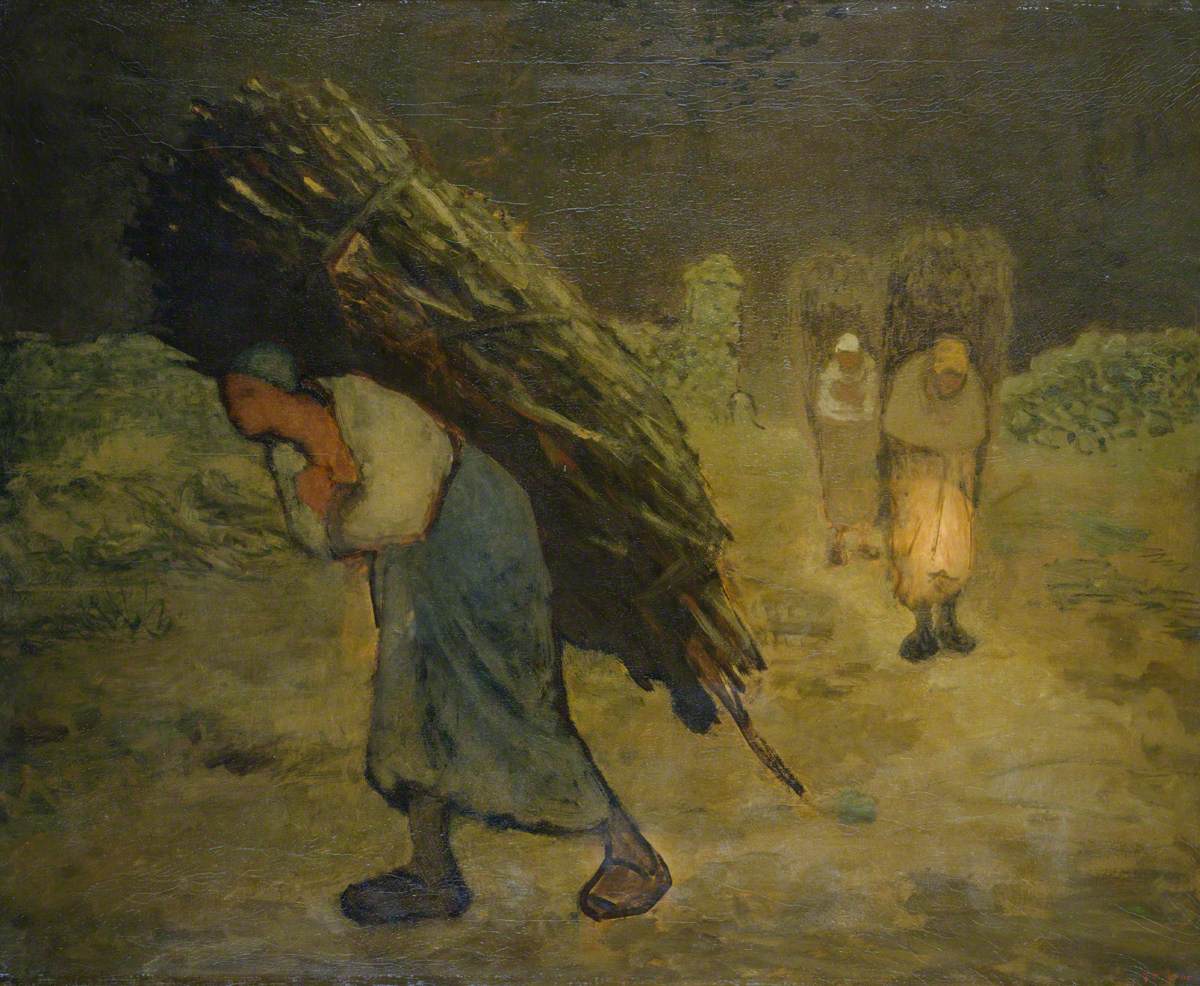
Seeing, and reading (again?) about 'The Faggot Gatherers' I couldn't help but see socio-economic history enacted:

'Two women are taking a short rest from gathering tree branches for sale as firewood. The older woman’s hunched back and clawed hands betray a lifetime of physical toil. The setting is the forest of Fontainebleau, south of Paris, close to the village of Barbizon. Millet was an exponent of Realism, a movement that rejected historical art and idealisation in favour of a truthful view of contemporary reality.'

Text: https://www.nationalgalleries.org/art-and-artists/232271
Winter, The Faggot Gatherers Jean-François Millet (1814–1875) National Museum Cardiff

The National Gallery's accompanying text reads:

'Three women are on their way home trom the forest of Fontainebleau. One of its entrances, the Porte aux Vaches, is visible at the back right. The staggering scale of their loads threatens to overwhelm them in their stumble homewards. The scene evokes Millet's 1851 letter to his biographer Alfred Sensier, in which he described how seeing 'a poor figure laden with a faggot reminded him of the constant fatigue of people's lives.
While the painting is unfinished, the elemental figures are typical of Millet's vork. The extreme simplification of their forms results in austere silhouettes.'

Mental illness has always been a facet of humanity, evidence of trephination from prehistoric times and across cultures and geographies bears testimony to the mind - body divide. Life was brutish physically too. What chance did the weakest stand? If, that is a broken bone: you could be left behind? But perhaps we underestimate the knowledge and experience of our ancient ancestors. Knowledge gained and passed orally, culturally, even before written history. Perhaps too, we struggle to understand how early humanity expressed itself beyond the big-stick of nature and the struggle for survival as the hominids that led to 'us' were winnowed down?

Even as recent as the 19th century life was hard. As the notes above attest, Millet's work seeks to record the sheer physicality of labour, even as the industrial age emerged. The advent of the industrial revolution brought its own pressures and privations, as pastoral life is replaced with change work at home (spinning cotton) to urban and factory growth. 

Severe mental illness would have been institutionalised in poor houses, religious and charitable organisations. Parity of esteem is grounded, to some extent in the questions: "What happened to you?", or "How are you feeling today?" In Millet's work the physical cost and strain stands out. While in the L'Angelus there is debate about prayer, or grief. What is visible usually speaks first, and stands for itself. This is why self-awareness, reflection, critical thinking, observational and interpersonal skills are important; and why mental health nursing calls for specific knowledge and skills. And, in psychiatry too, even when the same is contested.

Image source: Oil on carvas Lent by Amgueddfa Cymry - Museum Wales. Bequeathed by Gwendoline Davies in 1952.

Friday, August 29, 2025

Winner of Wrecsam National Eisteddfod crown - 4th Aug.

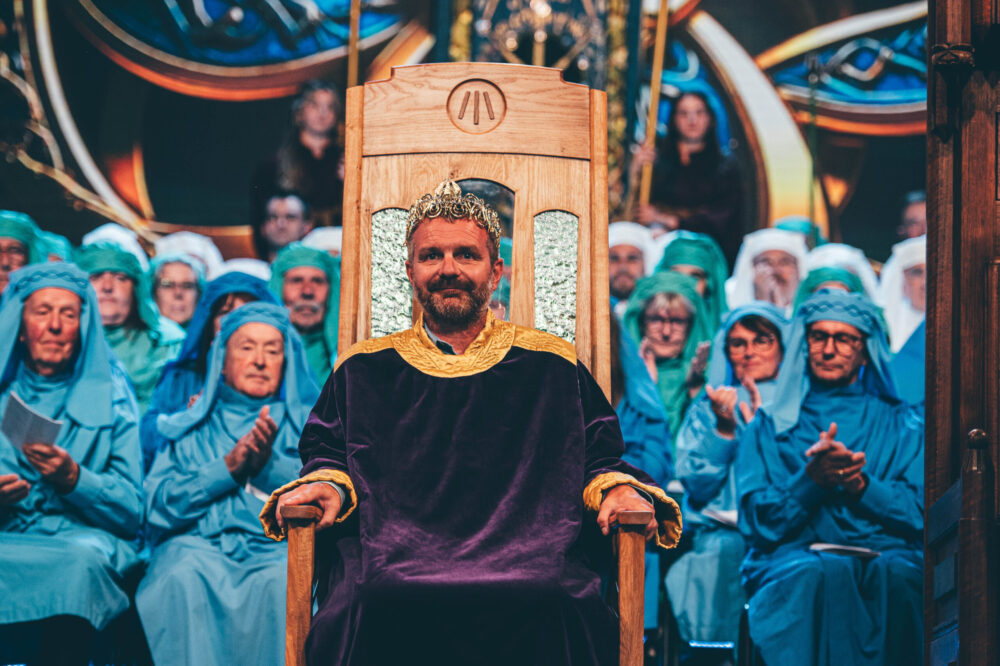
Crown winner Owain Rhys
Image: 
https://nation.cymru/culture/winner-of-wrecsam-national-eisteddfod-crown-announced/

Owain Rhys is the winner of the Wrecsam National Eisteddfod crown for his poems about living with a loved one who is suffering with dementia.

The crown – sponsored by Elin Haf Davies – and a cash prize of £750 was presented to Owain in north Wales on Monday (August 4) by Prydwen Elfed Owens.

The prize was awarded for a “pryddest” or collection of poems not in the traditional Welsh style cynghanedd, of no more than 250 lines, on the theme of “Adfeilion” or ruins.

The adjudicators were Ifor ap Glyn, Gwyneth Lewis and Siôn Aled.

The crown was designed and produced by Neil Rayment and Elan Rowlands.

The pair previously created the impressive crown for the Rhondda Cynon Taf Eisteddfod in 2024 – won by Gwynfor Dafydd for his series of poems on “Atgof” – or remembrance.

Head judge Ifor ap Glyn said: “Llif 2 opens with the simple couplet ‘When you forget / every day as you wake’ – and it discusses living with someone suffering from dementia, namely the poet’s mother.

“It’s a quiet and sensitive treatment of what must be done to help the mother continue to live with dignity as her memory deteriorates.

“The collection presents a tender picture of a difficult situation faced by so many families today, and we sense the depth of the poet’s feelings toward his mother and her former strength.”

Text: https://nation.cymru/culture/winner-of-wrecsam-national-eisteddfod-crown-announced/

See also: https://eisteddfod.wales

My Source: BBC Four Episode 1 - 15mins
https://www.bbc.co.uk/iplayer/episode/m002gwyq/eisteddfod-eisteddfod-2025-with-huw-stephens-episode-1

Saturday, August 16, 2025

Women, human rights after 4 years ...

. . . in Afghanistan


Individual
|
      INTERPERSONAL    :     SCIENCES               
HUMANISTIC  --------------------------------------  MECHANISTIC      
 SOCIOLOGY  :    POLITICAL 
|
Group

A woman
A girl

Personhood
Personal identity
Dehumanisation
Self-expression


objectification
defined


A girl
A women

Cultural life
Psycho-Social
Community life
- denied


Gender crimes against girls & women
Human Rights denial
Law?

National identity
Nationhood?

Previously: 'women' : 'girls' : 'boys' : 'gender'

Monday, June 30, 2025

Assisted Dying Bill - UK

Individual
|
      INTERPERSONAL    :     SCIENCES               
HUMANISTIC  --------------------------------------  MECHANISTIC      
 SOCIOLOGY  :    POLITICAL 
|
Group


Choice by dying person of how they die

Anticipation of role of AI

Where does mental illness 'lie'?

Decision needs approval by two doctors

Change in relationship between:
INDIVIDUAL -
Prognosis of < 6 months

Terminal diagnosis

Anticipation of role of AI

Seek assistance to end their life

Decision needs approval by two doctors

What of patients who are comatose?^
Profound Societal Change

Quality of Life

Quality of Death

Impact of 'poor' death on others - friends and family

Vulnerabiity of certain groups

Lest we forget what happened to the nursing and care home sector during COVID*

and the STATE

UK - House of Lords

Oversight Panel: 
Legal figure e.g., King's Counsel; and a Psychiatrist

Doctors and care workers not compelled to take part in assisted dying

What about the psycho-POLITICS of anorexia, severe depression?


^Brian M. Rosenthal. They woke as doctors prepared to remove their organs. The New York Times International Edition, 11 June 2025, p.6. 
https://www.nytimes.com/2025/06/06/us/kentucky-organ-donations.html

Monday, June 23, 2025

Entry to the Theatre of Nursing & Space

I do understand that reading theatre related texts, joining a theatre group, my writing a play is still pi in the sky. It's the journey, that's all. In Hodges' model I've differentiated between structure and content. This is the center of the stage about which Hodges' model turns. In the guided discovery by which students and audiences can discover the model,  these are the bases to touch in turn.


Sir Alan's focus on construction in writing: is narrative, time, location, characters (p.12). The overall message for me is, the frequently uttered - less is more. I must take heed and listen. During Ayckbourn's career, he has encountered the full retinue of writers and directors young and 'experienced'. Reading this, it is nice to be both 'new old-er' -
'Then there is the new old playwright. Far more difficult to deal with. They have probably nursed this script for twenty-five years and they're damned if you're going to mess it up for them when they've waited so long. Especially someone your age who wasn't even born when their harrowing play about World War Two was still raging, dammit.' p.110. (My emphasis in bold.)
Thinking about 1959 and the start of Sir Alan's career, his reference to WWII, made me recall nursing assistant and student nurse studies and placements at Winwick Hospital in 1977. On the geriatric wards for entertainment it was WWI songs were often sung, or records played. Long players, indeed.

In health we are usually accustomed to stopping before the 'true' end, with the exception of palliative care, although even then the ending should be 'better' than what it would otherwise have been.

If I am nursing Hodges' model, I've been doing so ever since 1987-88. As Sir Alan also observes of writers, while passionate about the utility of the model - my project - not my model; I am filled with self-doubt. Is this an over-valued idea - in my hands (and mind!)?

In other reading - Stagecraft. The Complete Guide To Theatrical Practice, by Griffiths Trevor R. 1982, I came across the word 'proscenium'.

'Incidentally, when we came to stage [the play in question is 'Woman in Mind' PJ] the London proscenium version this was far more difficult to achieve. Proscenium theatres generally make scenic statements whether they want to or not; the round makes none unless called upon to do so.' p.32. 

There are many insights into sets, design, and the various pros and cons. In May and earlier this month, with three other cast members I performed a role 8-9mins in a Living Newspaper (40-50 mins in total). It was fascinating to watch the various aspects developing from the initial reading in January. With Hodges' model an idea, the question of set design is not straight forward. But as with over-valued ideas, I am probably over-thinking (as usual) making things more complicated than necessary.

One golden nugget of advice, is if you are the writer and write well, well you don't have to think the set design. That is a problem for someone else to solve. Hopefully you will be impressed by the interpretation and realisation (often in film credits) of your work.

That is, unless you're unlucky and find yourself on the receiving end of Obvious Rule No. 13:

Beware of competitive set designers, particularly those with a 'concept'.

The name Ayckbourn is synonomous with The Stephen Joseph Theatre, which is in the round:

'The Round provides a truly unique experience as the audience is seated all around the stage. Not only does the audience see the performance from every angle, it also brings the actor into the same space as the audience.'

"Let’s have the actors in the same room as the audience, let’s have four front rows, let’s get really excited about this acting business!"

Stephen Joseph, 1959 - https://sjt.uk.com/about-us

From the mid-1980s and 90s I used to visit Bolton's Octagon quite regularly. Performances were frequently in the round. Last month, Abigail's Party was too (the last night).

Whatever, the staging, set, I'd be interested to see the 'concept'. On directing:

'As regards interpretation. you may need to tread more warily. As I said earlier, many playwrights are not naturally theatre creatures - certainly they are rarely visual theatre creatures, I have seen them sit there and watch their play physically anfold with a look of total amazement. pordering sometimes on delight, sometimes on dismay. What was in their head has been made three-dimensional flesh.' p.111.

Space has been and remains fundamental to my thinking about Hodges' model. Even pushing the envelope to topology, this is well beyond my ken. But not other gifted researchers. Hodges' model provides inter- multi- transdisciplinary bridges: we need to Before the time of schools becoming fenced and patrolled sites, we used to play cricket, tennis and football. There was a large wall at front of a former school, great for tennis, but not return of serve. Now a projection shared in the round - so everyone sees the same thing (yes, another rule!) might hold potential. There's acknowledgement that technology moves on too (p.123). And room for comedy, Ayckbourn's starting point. 

'Designers, it has been said, even the best of them, sometimes get hold of the wrong end of the stick. ... Always get to look at drawings, ground plans and, most helpfully, scale models of what they intend.' p.120.

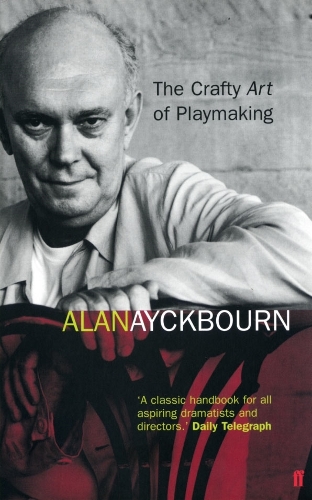
The Crafty Art of Playmaking by Alan Ayckbourn. Faber, 2004, softcover, ISBN 0571215106.

https://www.concordtheatricals.co.uk/s/45898/the-crafty-art-of-playmaking

Friday, June 20, 2025

Theatre in TI:ME

The Crafty Art of Playmaking
In health we're dealing with time in all its forms: cardinal; birth and death and all that happens in-between. Aka, 'life', illness, and palliative care. And, even if not recognised, chronological and pathological time, which policymakers should pay more attention to. The art of theatre, has its time (p.20): stage time, and real (theatre foyer) time. 

'At its most successful, theatre views things from a human standabout.' (p.9). 

I'd second that, especially allied with the notions (ideas!) of health career, and life chances. 

Since the publication of TCAoP in 2004 people seem to quite ready to dispense, disregard, downplay, demote the humanistic with the rise of AI and assisted dying for the terminally ill (of course).

Time recurs - as a frame. (p.25) with a touch of elective surgery. 'Think of your story as a piece of thread. Where you cut in is the point at which the lights come on in Act One. Where you cut out will be your final curtain. (There may be a knot or two in the middle to denote the intervals, too.)' p.25.

In the first post re. TCAoP I stressed the complexity, plethora of ideas that Hodges' model can create. Sir Alan provides a potential 'get of jail free card' (or as near as?) in his original rule no. 9. 

'If a play can be too simple, it can also be too complicated. If one element is particularly complicated, keep the rest of it simple.' (p.25).

Very useful advice! But achieving it when having and applying an idea is another matter.

What's this though? Step back to original rule no. 6:

'There is no hard and fast rule as to which constructional element comes first.' (p.20).

Butrint National Park Albania   

In the guided discovery exercise in students (audiences..) creating the model, there are two constructional elements, that also contribute to the one big idea.

It gets better! Original rule no. 14:

At least fifty per cent of your play is going to be visual. (p.33).

I must make sure I don't confuse concept/ual with visual/imagery.

More to follow.

The Crafty Art of Playmaking by Alan Ayckbourn. Faber, 2004, softcover, ISBN 0571215106.

https://www.concordtheatricals.co.uk/s/45898/the-crafty-art-of-playmaking

Tuesday, June 03, 2025

Self, ego, life and death

The INDIVIDUAL - GROUP axis continues to fascinate:


individual
|
INTERPERSONAL : SCIENCES
humanistic ------------------------------- mechanistic
SOCIOLOGY : POLITICAL
|
group

SELF - IDENTITY - PERSONHOOD

ego superego id

mood - depression - mania

psychoactive substances

ego death - reset, reconstitition, re-birth?

NATURE

 personhood -
rivers, mountains, trees, land

medicine(s)

psychedelics

cultural identity, knowledge

social history, practices

corporate personhood

law 'person'


See also:

Pahnke, Walter N. “The Psychedelic Mystical Experience in the Human Encounter with Death.” The Harvard Theological Review 62, no. 1 (1969): 1–21. http://www.jstor.org/stable/1509131.

Adler, Nathan. “Ethics, Ethos, and Actualization: The Paradigm of the Antinomian Therapies.” Issues in Criminology 5, no. 1 (1970): 85–99. http://www.jstor.org/stable/42912546.

Blainey, Marc G. “Forbidden Therapies: Santo Daime, Ayahuasca, and the Prohibition of Entheogens in Western Society.” Journal of Religion and Health 54, no. 1 (2015): 287–302. http://www.jstor.org/stable/24485257.

Nail, Thomas. “How to Read the Nature of Things.” In Contemporary Encounters with Ancient Practice, edited by Abraham Jacob Greenstine, Ryan J. Johnson, and Dave Mesing, 1st ed., 299–321. Edinburgh University Press, 2025. http://www.jstor.org/stable/10.3366/jj.17381661.21.

Corporate personhood
https://en.wikipedia.org/wiki/Corporate_personhood