Hodges' Model: Welcome to the QUAD: labour

Hodges' model is a conceptual framework to support reflection and critical thinking. Situated, the model can help integrate all disciplines (academic and professional). Amid news items, are posts that illustrate the scope and application of the model. A bibliography and A4 template are provided in the sidebar. Welcome to the QUAD ...

Showing posts with label labour. Show all posts

Thursday, September 03, 2026

Social Inclusion: Transnational Organization of Labour, Mobility, and Senior Care in Central and Eastern Europe

Dear colleagues,

Social Inclusion has just released a new issue, fully open access, and all articles are free for you and others to read, download and share.

Transnational Organization of Labour, Mobility, and Senior Care in Central and Eastern Europe (2026, Volume 14)

Edited by Ewa Palenga-Möllenbeck, Dóra Gábriel, Olena Fedyuk and Kristine Krause

Complete issue: https://doi.org/10.17645/si.i533

Table of Contents:

Transnational Organization of Labour, Mobility, and Senior Care in Central and Eastern Europe
https://doi.org/10.17645/si.13078
By Ewa Palenga-Möllenbeck, Dóra Gábriel, Olena Fedyuk and Kristine Krause

Migrant Live‐In Care Workers in the Global Care Chain: Results From an Online Survey
https://doi.org/10.17645/si.11728
By Silvia Wojczewski, Simona Ďurišová, Sabine Pleschberger, Anna Ernst, Rojin Bagheri, Kathryn Hoffmann and Viktoria Adler

Selling Care Skills? The Multiple Meanings of Training for Polish Live‐In Care Workers in Germany
https://doi.org/10.17645/si.11909
By Roxana Fiebig-Spindler

The Invisible Hand of Care: A Typology of Brokerage Actors in Migrant Care Labour
https://doi.org/10.17645/si.11953
By Ewa Palenga-Möllenbeck, Ivanna Kyliushyk and Roxana Fiebig-Spindler

Care Extractivism Beyond Households: Migration and Care for Older People in the Post‐Yugoslav Semi‐Periphery
https://doi.org/10.17645/si.11975
By Majda Hrženjak

Caring Communities in Urban Hungary: A Civil Society Perspective
https://doi.org/10.17645/si.12023
By Dóra Gábriel, Bettina Török and Noémi Katona

Care Under Constraint: Unmet Care Needs Among Older Adults in Romania
https://doi.org/10.17645/si.12028
By Mihaela Hărăguș and Ionuț Földes

Skill Construction and Challenges of Professionalization in the Hungarian Home Care Market
https://doi.org/10.17645/si.12029
By Noemi Katona and Dóra Gábriel

The Right to Care and Support: From Care Theory to Human Rights Law
https://doi.org/10.17645/si.12056
By Maroš Matiaško

Senior Care in Wartime Ukraine: A Fragmented Continuum of Arrangements Inside an “Unpromising Sector”
https://doi.org/10.17645/si.12060
By Oksana Dutchak, Olena Fedyuk and Anna Oksiutovych

Bounded Transport, Mobility Justice, and Claims for Recognition Among Live‐in Care Workers
https://doi.org/10.17645/si.12191
By Petra Ezzedine

In Times of the Market and Community Shift: On Live‐In Care and Caring Communities
https://doi.org/10.17645/si.12295
By Brigitte Aulenbacher, Klaus Wegleitner, Jonas Hagedorn and Bernhard Emunds

Care Outsourcing From Germany to Central and Eastern Europe
https://doi.org/10.17645/si.12319
By Kristine Krause, Veronika Prieler, Hanna Horváth, Matouš Jelínek, Mariusz Sapieha, Zuzana Sekeráková Búriková, Petra Ezzeddine and Luise Schurian‐Dąbrowska

Imagining Care: Transnational Inequality and Older Age Prospects for Ukrainian Caregivers in Italy
https://doi.org/10.17645/si.12324
By Oksana Dutchak, Olena Fedyuk and Anna Oksiutovych

The Winding Road to Professionalisation: Care Work in Romanian Nursing Homes
https://doi.org/10.17645/si.12326
By Neda Deneva, Ionuț Földes, Denisa Ursu and Mihaela Hărăguş

The Limits of State Control in Regulating Live‐In Care Work in The Netherlands
https://doi.org/10.17645/si.12375
By Siënna Hernandez, Kristína Bartošová and Franca van Hooren

Home Care for Sale: Marketisation and Social Change
https://doi.org/10.17645/si.12737
By Attila Melegh

Kind regards,

Mariana Pires
Cogitatio Press, Portugal
si AT cogitatiopress.com
Social Inclusion
https://www.cogitatiopress.com/socialinclusion

My source: COMPLEXITY-PRIMARY-CARE list

Friday, June 26, 2026

World Justice Report: a Plan for Equality and Prosperity Within Planetary Boundaries

Box 1: Combining Global Equality and Planetary Habitability

The Global Justice Report describes desirable future scenarios combining two key goals: socioeconomic equality (including full equality between countries, full gender equality in labour hours and pay, sharp compression of within country income and wealth scales, combined with fair access to education, health and political voice), and planetary habitability (aligning global resource use within ecological boundaries, including a limitation of global temperature rise below 2°C). 

To avoid climate catastrophes, we show that sufficiency is required: a structural transformation of the economy involving shorter working hours, a lower material footprint, a shift from material-intensive sectors toward relatively immaterial sectors such as education and health, and major changes in food systems and land use. Rapid decarbonization of energy systems is also necessary, as is the sharp compression of income and wealth inequality. This compression is both a social justice objective and a condition for financing necessary climate investment and human capital expenditure and for sustaining political support from bottom- and middle-income classes in both the North and the South. 

Box 2: Material and Monetary Accounting for Democratic Debate

Economy and ecology cannot be debated apart: every economic activity has a material footprint, every ecological policy shapes incomes and wealth. To make these links visible, the Global Justice Report uses multidimensional social progress indicators. We set quantitative targets for global socioeconomic justice by combining two complementary languages: material accounting (work hours, sectoral shares, education and health, energy systems, GHG emissions, land use, forest cover, temperature levels) and monetary accounting (income and wealth scales between and within countries, progressive tax rates). The report draws on two centuries of historical data on global inequality and resource use, and on the recent literature on social progress, climate and colonial reparations. 

The Global Justice Report proposes a quantitatively and institutionally grounded step toward global justice. It does not seek to close the debate: it offers a transparent basis on which citizens, unions, parliaments, and international bodies can debate, contest, and decide the course of the coming decades.

...

Chancel, L., Dietrich, J., Mohren, C., Moshrif, R., Odersky, M., Piketty, T., Somanchi, A., et al. (2026), The Global Justice Report: A Plan for Equality & Prosperity Within Planetary Boundaries, World Inequality Lab (gjp.wid.world).

individual
|
INTERPERSONAL
: SCIENCES             
humanistic ------------------------------- mechanistic
SOCIOLOGY : POLITICAL   
|
group 


SOCIAL JUSTICE


Previously: 'wealth' : 'poverty' : 'social justice'

 My source: BBC Radio 4 World at One.


Saturday, January 03, 2026

Universal Basic [Income and Capital] c/o N. Berggruen

Individual
|
     INTERPERSONAL    :     SCIENCES               
HUMANISTIC  --------------------------------------  MECHANISTIC      
 SOCIOLOGY  :    POLITICAL 
|
Group
AI ..

Pope Leo XIV - 'Distributional justice'
Pope Leo XIII "Rerum Novarum" 1891?^
 
 *Ethics - see below.

Baby bond schemes -
Australia Superannuation programme
USA MAGA accounts
Proposed European Sovereignty Fund?
UK?

Globally? "We're in this together, remember"


UNIVERSAL BASIC INCOME
UNIVERSAL BASIC CAPITAL 
 
PREDISTRIBUTION not
REDISTRIBUTION

^History: Impact of the industrial revolution
 

.. ECONOMY

  Diminishing value of labour
 Global wealth inequality
 US: top 10% own 93% of all equities
Europe: .. nearly 60% of all wealth.
Bottom 50% owns just 5%
 

*The ecological and ethical impacts from the energy demands of AI still need to be addressed. Financial 'rewards' for the masses, must not become the 'cake' - the bribe for the public to enter into a conspiratorial dyad with technology. PJ

Source: N. Berggruen, Universal basic capital would create a fair AI economy, Opinion, FTWeekend, 1-2 November. 2025, p.13. https://berggruen.org/eu

https://www.ft.com/content/9b93e02a-c693-4070-9094-a2f532dfa929

See also: 'economics' : 'poverty' : 'AI' : 'inequality' : 'universal'

Thursday, September 04, 2025

Parity of Esteem: It's all smoke and mirrors ...

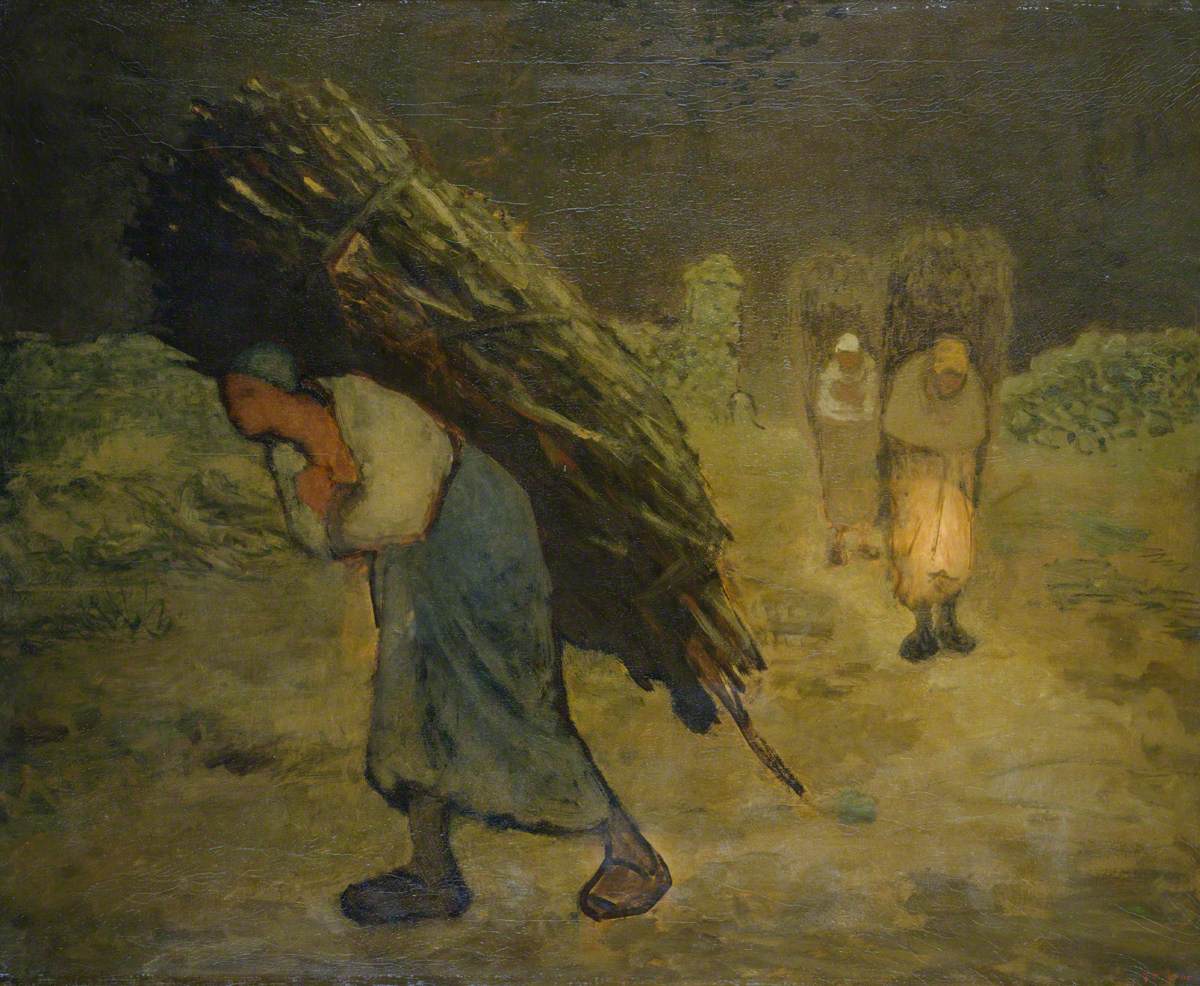
Having just visited the National Gallery and an exhibition on Millet:

https://www.nationalgallery.org.uk/exhibitions/millet-life-on-the-land

Dr Sanil Rege on twitter provided:


Seeing, and reading (again?) about 'The Faggot Gatherers' I couldn't help but see socio-economic history enacted:

'Two women are taking a short rest from gathering tree branches for sale as firewood. The older woman’s hunched back and clawed hands betray a lifetime of physical toil. The setting is the forest of Fontainebleau, south of Paris, close to the village of Barbizon. Millet was an exponent of Realism, a movement that rejected historical art and idealisation in favour of a truthful view of contemporary reality.'

Text: https://www.nationalgalleries.org/art-and-artists/232271
Winter, The Faggot Gatherers Jean-François Millet (1814–1875) National Museum Cardiff

The National Gallery's accompanying text reads:

'Three women are on their way home trom the forest of Fontainebleau. One of its entrances, the Porte aux Vaches, is visible at the back right. The staggering scale of their loads threatens to overwhelm them in their stumble homewards. The scene evokes Millet's 1851 letter to his biographer Alfred Sensier, in which he described how seeing 'a poor figure laden with a faggot reminded him of the constant fatigue of people's lives.
While the painting is unfinished, the elemental figures are typical of Millet's vork. The extreme simplification of their forms results in austere silhouettes.'

Mental illness has always been a facet of humanity, evidence of trephination from prehistoric times and across cultures and geographies bears testimony to the mind - body divide. Life was brutish physically too. What chance did the weakest stand? If, that is a broken bone: you could be left behind? But perhaps we underestimate the knowledge and experience of our ancient ancestors. Knowledge gained and passed orally, culturally, even before written history. Perhaps too, we struggle to understand how early humanity expressed itself beyond the big-stick of nature and the struggle for survival as the hominids that led to 'us' were winnowed down?

Even as recent as the 19th century life was hard. As the notes above attest, Millet's work seeks to record the sheer physicality of labour, even as the industrial age emerged. The advent of the industrial revolution brought its own pressures and privations, as pastoral life is replaced with change work at home (spinning cotton) to urban and factory growth. 

Severe mental illness would have been institutionalised in poor houses, religious and charitable organisations. Parity of esteem is grounded, to some extent in the questions: "What happened to you?", or "How are you feeling today?" In Millet's work the physical cost and strain stands out. While in the L'Angelus there is debate about prayer, or grief. What is visible usually speaks first, and stands for itself. This is why self-awareness, reflection, critical thinking, observational and interpersonal skills are important; and why mental health nursing calls for specific knowledge and skills. And, in psychiatry too, even when the same is contested.

Image source: Oil on carvas Lent by Amgueddfa Cymry - Museum Wales. Bequeathed by Gwendoline Davies in 1952.

Saturday, June 17, 2023

'Process-based art' in Hodges' model

Process-based art appears to confirm my association of 'process' with the sciences care (knowledge) domain in Hodges' model. Hopefully, we all have the opportunity to confirm this as small children #PaintOnTheHandsFeet 

INDIVIDUAL
|
INTERPERSONAL    :     SCIENCES              
HUMANISTIC --------------------------------------  MECHANISTIC
SOCIOLOGY :   POLITICAL
|
GROUP


“I layer the lidocaine [the numbing agent used by dentists before uncomfortable procedures] onto the white,” explains Estep, “which has been painted around the edges with black paint.” At this point he takes the canvas off of the stretcher and, in a nod to his former work as an art technician, restretches it, but this time disturbing the still-wet borders and creating smudgy mistakes as he loses all feeling in his hands. This audacious dulling of the senses raises questions of authorship, randomness and the very idea of painting – while also creating beautiful works.

The materials and methods sit mostly within the canon of manual labour,” Estep explains, hinting at the discrepancy between the physical work that goes into his paintings and their eventual impracticality. Asked about the safety of the procedure, Estep, a robust and charismatic 33-year-old, shrugs his lack of concern. More worryingly, he then laughingly recalls one time when he got the measurements wrong and lay completely immobilised on his studio floor for several hours."


Art
Culture


Artists mentioned include:

Oscar Tuazon: https://www.luhringaugustine.com/artists/oscar-tuazon#tab:thumbnails

Ryan Estep: https://www.artnet.com/artists/ryan-estep/

Analia Saban: https://analiasabanstudio.com/

Holmes, Pernilla, A piece of the action, FT Weekend, HTSI, Nov-Dec 2014? pp.14-18.
(I did not record the date on the pages.)

See: https://www.arthistorynews.com/articles/3143_Guffwatch__Processbased_art

Wednesday, December 14, 2022

In health, education, in work: We are all - Four Loom Weavers


"The author Michael Morpurgo (War Horse, Private Peaceful) explores the ways in which folk songs have reflected timeless human experiences, both in the past and today. 

Michael Morpurgo
With help from singers, songwriters and other passionate experts, Michael admires the indelible stories within classic songs that deal with migration, war, protest and love. Over the four themed episodes, Michael considers the locations and historical contexts that gave rise to much-loved traditional songs, and finds out how the same topics are inspiring new folk songs in the 2020s.

In the second episode, Michael considers a song of protest: Four Loom Weaver. 

With Professor Lawrence Goldman, Muireann Nic Amhlaoibh, Nancy Kerr, Karine Polwart, Nicola Kearey, Ian Carter, Blair Dunlop and Ashley Hutchings." BBC Radio 4

Michael Morpurgo's Folk Journeys

"Many Lancashire folk, can give personal testimony of relative having worked in such a role.

My maternal grandmother was a four loom cotton weaver until the mill, where she worked, in Rawtenstall, Lancashire, was closed and relocated to India in the 1920s approx. Mill workers worked their way up to four looms which were rented from the mill. Four was the maximum so my nan told me, so a four loom weaver was an indication of the level of attainment in the industry. So I think the title is probably correct and not a corruption of a poor loom weaver.

Will Lever, Malpas, Cheshire" Wikipedia


 INDIVIDUAL
|
 INTERPERSONAL    :     SCIENCES               
HUMANISTIC --------------------------------------  MECHANISTIC      
SOCIOLOGY  :   POLITICAL 
|
GROUP


Sunday, February 21, 2021

Hands, feet, heart, mind #MHNursesDay

INDIVIDUAL
|
INTERPERSONAL : SCIENCES
HUMANISTIC----------------------------------------------- MECHANISTIC
SOCIOLOGY : POLITICAL
|
GROUP - COMMUNITY - POPULATION

#MHNursesDay

Plus:


'One Pair of Feet' - How many marches to Downing Street ...?

My source: Katsoulis, M. Rereading, The Happy Prisoner by Monica Dickens, Saturday Review, The Times, 19 December, 2020, p.20. 

Book cover: Goodreads https://www.goodreads.com/book/show/18161452-one-pair-of-feet


Sunday, December 20, 2020

Information Overload: We live in challenging times ...

individual
|
INTERPERSONAL : SCIENCES
humanistic ----------------------------------------------- mechanistic
SOCIOLOGY : POLITICAL
|
group
"Perhaps of no time is this truer than of to-day, when the mass of cheap books and papers and cinema pictures fill up every minute of leisure and leave no time for individual thought. The average man becomes incapable of knowing an original thought, or of feeling a genuine emotion. His own experience is translated into novel or cinema-language; his emotions are second-hand effects modified and devitalized by the fancies and romances of other men's minds.
The average brain like a photographic plate, covered with layer upon layer of rapid and perishable impressions; originality and reasoning power are stunted, and finally killed. Machinery likewise has destroyed the labourer's pleasure in work; he has no opportunity for the expression of his original and personal gifts. To this numbing effect of routine, with its discouragement of individuality, and hence the impossibility of joyous interest in work, can be traced ...
... the undercurrent of discontent, envy and hatred, which, uncorrected, lead along defiantly recognized channels to social upheaval ...... and revolution."


Savill, A. (1923) Music, Health and Character, London: John Lane The Bodley Head. pp.181-182. 


Sunday, January 26, 2020

Books: Technology, Capital and Ideology - captured in h2cm...

individual
|
INTERPERSONAL : SCIENCES
humanistic ----------------------------------------------- mechanistic
SOCIOLOGY : POLITICAL
|
group - population


My sources:
The Times and FT Weekend.

Friday, February 01, 2019

Book: Digital Objects, Digital Subjects: Interdisciplinary Perspectives on Capitalism, Labour and Politics in the Age of Big Data

individual
|
INTERPERSONAL : SCIENCES
humanistic ----------------------------------------------- mechanistic
SOCIOLOGY : POLITICAL
|
group

Digital Objects Digital Subjects
DIGITAL OBJECTS


DIGITAL SUBJECTS


Capitalism, Labour, Politics


My source: EUROPEAN-SOCIOLOGIST list

Cover image: Amazon