Hodges' Model: Welcome to the QUAD: social sciences

Hodges' model is a conceptual framework to support reflection and critical thinking. Situated, the model can help integrate all disciplines (academic and professional). Amid news items, are posts that illustrate the scope and application of the model. A bibliography and A4 template are provided in the sidebar. Welcome to the QUAD ...

Showing posts with label social sciences. Show all posts

Wednesday, September 30, 2026

Prof. George William Brown OBE, FBA (1930–2026)

"George Brown was a huge figure in sociology and social psychiatry. At a time when social science and psychiatry were so riven with conceptual differences they could not work constructively, George’s approach was collaborative, courageous and imaginative. His work addressed real-world problems and in so doing greatly enriched mental health research."

Professor Matthew Hotopf, Executive Dean, Institute of Psychiatry, Psychology & Neuroscience:
https://www.kcl.ac.uk/news/professor-george-william-brown-obe-fba-19302026

Starting in Warrington School of Nursing (Winwick Hospital) as a student mental health nurse in October 1977 you can how that curriculum and programme of study came about; and influences on Brian Hodges' early career.
 
Hodges' Health Career - Care Domains - Model
 
 An individual's 'health career' is impacted by their life chances and life events.
 
 
individual
|
INTERPERSONAL
: SCIENCES             
humanistic ------------------------------- mechanistic
SOCIOLOGY : POLITICAL   
|
group

Individual Psychology

Life events

PSYCHIATRY

psycho-

Life events

EVOLUTIONARY
PSYCHIATRY

social

Group Psychology

Life events

SOCIAL & CULTURAL 
PSYCHIATRY


LIFE EVENTS

 PSYCHO-POLITICAL
PSYCHIATRY


See also:

Wing, J.K., & Brown, G.W. (1970). Institutionalism and Schizophrenia: A Comparative Study of Three Mental Hospitals 1960–1968. Cambridge; Cambridge University Press. 

Brown, G. & Harris, T. (1978) Social Origins of Depression. A Study of Psychiatric Disorder in Women. London: Tavistock.Google Scholar 

Brown G.W. & Harris, T. (1979) Social origins of depression: a study of psychiatric disorder in women, London: Tavistock Publications.

Brown, G. W., & Harris, T. O. (Eds.). (1989). Life events and illness. The Guilford Press.

My source: Patrick Kidd. Forum, Obituary, The Observer. 20th September, 2026, p.42.
https://observer.co.uk/profile/obituary/article/george-brown-the-former-post-office-boy-who-unlocked-the-mystery-of-depression

Previously: 'social sciences' : 'psychiatry' : 'determinants'

Wednesday, July 01, 2026

Tricotyledons, systems and social problems

'If scientists and engineers are to be able to attack social problems with the same validity and effectiveness with which physical problems have been attacked, then a much more sophisticated and rigorous system design methodology is needed.

Such methodology, called the tricotyledon theory of system design, has been developed as a synthesis of: empirical and speculative approaches to system design [2], the methodology of operations research [10], classical optimization techniques [18], results in specialized branches of mathematical system theory [1,4,6,7], and the constructs of general mathematical system theory [12,13,14].

Experimental applications of the tricotyledon theory of system design to several problems in widely differing contexts [3,4,8,9,16,17] indicate that the methodology holds great promise for validity and effectiveness in attacking any large-scale, complex, man/machine system design problem with precision and rigor. There are no theoretical limitations (such as differentiability, linearity, finiteness, or discreteness) for the problems that can be attacked within the tricotyledon theory of system design.

In this short abstract the theory is only described in terms of set and system theoretic concepts as presented in Reference [12), [13], or [14]; no exploitation of the theory, either theoretical or practical is attempted here.' ..' p.224-225.

'The task of defining a large-scale, complex, man/machine system design problem P=(S,T,α,β,γ,D) often requires an interdisciplinary team in practice. An interdisciplinary team requires, in turn, that the above definitions be translated into non-mathematical methodology. This has been done in Reference [15].' p.229.
15. Wymore, A.W., Systems Engineering Methodology for Interdisciplinary Teams, unpublished manuscript. (Another loss?)


Wymore, A.W. (1975) The Tricotyledon Theory of  System Design. In. Category Theory Applied to Computation and Control: Proceedings of the First International Symposium, San Francisco, February 25-26, 1974 (Lecture Notes in Computer Science, 25) by E.G. Manes (Editor).

See also: 

https://en.wikipedia.org/wiki/A._Wayne_Wymore

http://sysengr.engr.arizona.edu/wymore/bookreview.html 

https://lockywolf.wordpress.com/2019/02/16/a-mathematical-theory-of-systems-engineering-the-elements-by-a-wayne-wymore/ 

style="font-family: helvetica; font-size: small;"

Sunday, October 26, 2025

'Politics as a science' ...

'The science of politics is the oldest of the social sciences but still perhaps the most dependent: it derives much of its methodology from statistics (the science of the state turned into the science of numerical data), from economics and from sociology and it steals much of its substance from anthropology, from history and from law. Yet there is little doubt about the core of the subject: it focuses on the ways in which decisions are taken by men acting within territorially or functionally defined networks and constellations of organizations. And the hallmark of the discipline is 'its systematic analysis', whether couched in verbal and literary terms or in the formalized language of statistics or of mathematical logic.' Preface vii
Hayward R. Alker, Karl W. Deutsch, Antoine H. Stoetzel (eds.), Mathematical Approaches to Politics, Amsterdam, Elsevier, 1973, pp. 475.

Friday, March 07, 2025

'Critical Notes on the Nature of Sociology as a Science'

4Ps

As a model of care (education, management, safety, systems, ...)*, or a conceptual model, conceptual framework, or however described, Hodges' model, as with its many peers is idealised.

You quickly 'see' that the 4Ps I've associated with the knowledge - care domains of Hodges' model are far specific, or limited to that domain alone.

In our dialogues, media and literature it becomes obvious that in addition to physical, sequential, and  natural (scientific) processes, there are also political,  sociological, and psychological, or mental  (interpersonal) processes.


I've always been drawn to the diagonal distances between the interpersonal-political domains; and that between the sociological-scientific. The latter I think about often as it makes the news regularly, when education is raised, literacy, the state of our schools, colleges, universities and (globally) the public's understanding of the sciences. So finding a paper heading for its centennial birthday caught my attention. Not just that, but the journal - Social Forces is (very much!) still with us aged 103 this year. Unsurprisingly, I like the way Woodard contrasts the mechanistic and humanistic:


Hodges' model
'For there is a further distinction to be made among evaluations of functional appropriateness. I may analyze the functional appropriateness of the gears and pulleys of a machine. That is applied mechanics, not the pure science of mechanics. For the function of the machine is tacked on to it arbitrarily and does not emerge from the data of the science of mechanics. But the same may not be said of hearts and lungs, of mental and emotional processes, or of social structures, functions, and processes. Here the functions are not extraneously tacked onto an arbitrarily assembled collation. They are inescapable emergents from the process of scientific analysis and are warp and woof of our data as it confronts us, in situ, in the natural universe. They are not in any sense superimposed.' p.32.

Interesting point regarding 'hearts and lungs' - to possibly return to? Also, as a template Hodges' model provides a 'warp and woof' for data gathering - a foundation.

Woodard, J. W. (1932). Critical Notes on the Nature of Sociology as a Science. Social Forces, 11(1), 28–43. https://doi.org/10.2307/2569615 

*Please give it a try whatever your field, and let me know your thoughts. ... h2cmng AT yahoo.co.uk

Saturday, July 20, 2024

Frayn - on maths

"Pure arithmetic is not about particular things but about particular relations between things. Algebra preserves an even loftier detachment from the world. It is not about relations between things - it about relations between relations. Numbers are variables that can be quantified in the physical world. Algebraic terms are variables that can be quantified in the world of numbers." pp.154-155.


Frayn, Michael (2006). The human touch: our part in the creation of a universe. 'Fingerhold', Chapter 5. London: Faber & Faber. pp.139-170.

individual
|
INTERPERSONAL : SCIENCES
humanistic ------------------------------- mechanistic
SOCIOLOGY : POLITICAL
|
group

human


TOUCH


... human human  human  human human ...


Don't you dare!
Yes, please do!


Tuesday, May 21, 2024

'Holistic pluralism'

Individual
|
      INTERPERSONAL    :     SCIENCES               
HUMANISTIC  --------------------------------------  MECHANISTIC      
 SOCIOLOGY  :    POLITICAL 
|
Group
Rational choice theory

Natural sciences

theoretical & methodological pluralism

functionalism


Social sciences - Humanities


policy


from Abstract:

"The theoretical and methodological pluralism that we suggest here, holistic pluralism, is one way to overcome incommensurability between the natural and the social sciences while avoiding functionalism, technological and environmental determinism, and over-reliance on rational choice theory." 

from Introduction:

"The fact that sustainability science is “dealing with interconnected problems” (Kauffman and Arico 2014:413) requires that researchers in the field take a comprehensive, integrated, and participatory approach to science and reality (Sala et al. 2013). This explicit ambition to integrate knowledge—across scales, sectors, and substance domains, and across the nature-society, science-society, and knowledge-action divides—implies that sustainability science must inherently live up to (at least) three things. It must build on several foundational disciplines and have the capacity for interdisciplinarity; it must embrace theoretical and methodological pluralism and have the capacity for reflexivity (Isgren et al. 2017); and it must integrate knowledge generated from engaging with different disciplines, theories, methods, and contexts, and thus aspire to transdisciplinarity. Rather than merging or unifying the actual disciplines or their theories and methods into integrated frameworks, we argue that pluralism is the best way forward for dealing with sustainability challenges, such as biodiversity loss, climate change, land use change, water scarcity, and ill health. In this article, we use ontological, epistemological, and theoretical reasoning to support our argument. The critical ambition is to provide the rationale for a new approach that has the potential to capture the best available knowledge on social and natural dimensions of sustainability; we call it social fields and natural systems. The problem-solving ambition is to describe the approach and illustrate it in two empirical examples. If successful, this will show how holistic pluralism is one possible way of integrating knowledge across the social and natural science divide."
Figure 2 Olsson, L., & Jerneck, A. (2018).

It may be useful to consider figure 2, using the domains of Hodges' model?

Note how in Hodges' model, as 'political ecology' seeks to interrogate the relationship between society and nature (the environment, the sciences): we see a diametric relation. Inevitably then, the political ecologist must also negotiate, interpret, seek the policy evidence from within; perhaps an output, a creation of citizens?

Olsson, L., & Jerneck, A. (2018). Social fields and natural systems: integrating knowledge about society and nature. Ecology and Society, 23(3). https://www.jstor.org/stable/26799148

Friday, May 10, 2024

Towards isomorphisms in Hodges' model

"The concept that best captures the process of homogenization is isomorphism. In Hawley's (1968) description, isomorphism is a constraining process that forces one unit in a population to resemble other units that face the same set of environmental conditions. At the population level, such an approach suggests that organizational characteristics are modified in the direction of increasing comparability with environmental characteristics; the number of organizations in a population is a function of environmental carrying capacity; and the diversity of organizational forms is isomorphic to environmental diversity." p.149.

"We identify three mechanisms through which institutional isomorphic change occurs, each with its own antecedents: 1) coercive isomorphism that stems from political influence and the problem of legitimacy; 2) mimetic isomorphism resulting from standard responses to uncertainty; and 3) normative isomorphism, associated with professionalization. This typology is an analytic one: the types are not always empirically distinct." p.150.

DiMaggio, P. J., & Powell, W. W. (1983). The Iron Cage Revisited: Institutional Isomorphism and Collective Rationality in Organizational Fields. American Sociological Review, 48(2), 147–160. https://doi.org/10.2307/2095101

"Some of them went further, using approaches based in political economy, world systems theory, and theories of neocolonialism and underdevelopment to show that economic imperatives on a global scale were a major force in shaping education worldwide. Others interpreted such change through an institutional lens, arguing that the convergence toward accepted models of modernity has resulted in a process of educational isomorphism within and across countries." p.1.

Carnoy, M., & Rhoten, D. (2002). What Does Globalization Mean for Educational Change? A Comparative Approach. Comparative Education Review, 46(1), 1–9. https://doi.org/10.1086/324053

"The movement is inspired by Rudolf Virchow (1821-1902), who coined the term zoonosis, arguing that there should be no dividing lines between animal and human medicine. This position has been gathering momentum in the last fifteen years. The One Health Initiative is a rather daring interdisciplinary alliance that unites physicians, osteopaths, veterinarians, dentists, nurses, and other scientific-health and environmentally related disciplines, on the basis of a simple hypothesis, which is the isomorphism of structures between humans and animals in immunology, bacteriology, and vaccine developments. This means that humans are both exposed and vulnerable to new diseases, like bird flu and other epidemics, which they share with animal species." p.16.

Rosi Braidotti. (2015). Yes, There Is No Crisis. Working Towards the Posthumanities. DiGeSt. Journal of Diversity and Gender Studies, 2(1–2), 9–20. https://doi.org/10.11116/jdivegendstud.2.1-2.0009

"The chapter begins by developing the logic of strategic voting in a single- member district system, thus won by whichever party or candidate gets the most votes (first past the post, or FPTP). This represents the simplest and easiest case for the logic of strategic voting, and similarities (and sometimes theoretical isomorphism) exist between strategic voting— sometimes called instrumental voting (or voting as an investment)— and expected- utility maximization." p.3.

Aldrich, J. H., Blais, A., & Stephenson, L. B. (2018). Strategic Voting and Political Institutions. In J. H. Aldrich, A. Blais, & L. B. Stephenson (Eds.), The Many Faces of Strategic Voting: Tactical Behavior in Electoral Systems Around the World (pp. 1–27). University of Michigan Press. http://www.jstor.org/stable/j.ctvh4zhzr.4 

"Let us take a closer look at this important topic: what might be termed the isomorphism between the realm of care and the realm of perception/oikeiôsis-allotriôsis." p.57.

Joaquim Braga & Mário Santiago de Carvalho (eds.) (2021). Philosophy of Care - New Approaches to Vulnerability, Otherness and Therapy. Cham: Springer Verlag.
https://link.springer.com/book/10.1007/978-3-030-75478-5

- will add here ... suggestions welcome h2cmng AT yahoo.co.uk

Thursday, February 15, 2024

Questions in eclipse

 Last Friday 9th I had a Zoom chat for 30 mins, regards Hodges' model with faculty in the USA.

We touched upon:

  • background to Hodges' model
  • courses taught across the water and interests
  • overlaps, inc. person-centered care - socio-technical
  • informatics & literacies
  • maths/logic

As an outcome it was suggested I forward some questions I'm currently of Hodges' model. Questions that for me, are challenging, put me in the dark, and may not even be valid?

Going through my draft notes I picked out 20, beginning with the working title:

Hodges’ Model as a mathematical object and relational ontology:
category theory or category mistake?

  1. Can it be argued there is what amounts to a care locus - that can 'locate' person-centredness?

  2. Can the model's domains be seen as functions?

  3. Are the domains placeholders?

  4. Is there a case to test, and if logical implement co-domains (e.g. parity of esteem)?

  5. Are there other 'structures' in Hodges' model,  for example L-shaped forms, that is relations that involve three domains and (seemingly) omit one?

  6. Are there practical - case studies - that can be associated with such structures?

  7. Can Hodges' model be considered as a single conceptual space (Gärdenfors), or a series of four? (blog posts)

  8. Can Hodges' model be used to identify and apply threshold concepts (Meyer & Land)? (blog posts)

  9. Can we argue that the structure of Hodges’ model as defined by the axes extent, provides and invites inverse relations?

  10. Is Hodges' model as a structure only (a template) equivalent to an empty set (empty set as an initial object)?
  11. Is this a mathematical analogue (being neutral) to a practitioner's unconditional positive regard?

  12. Taking its axes and four (care/knowledge) domains can Hodges' model be reduced to a graph?

  13. If Hodges' model acknowledges/incorporates Cartesian duality, are there Cartesian products?

  14. In these Cartesian products are critical operations, e.g. relating to psychotropics - physical health; eating disorder - physical/mental health; complex emotional needs - policy (evidence-based care)?

  15. If the model is inverted, mirrored ... what follows: is the structure - function - consistency retained?

  16. Is Hodges' model 'closed' in comparison with Buzan's (open?) approach to mind-mapping?

  17. There is an 'equation of time': is there an 'equation of care'?

  18. Thought experiments: (semantic distance... cognitive linguistics)

    Which concept (INTERPERSONAL :: SCIENCES) is closer to the ‘INDIVIDUAL’ axes; which is closest to the ‘GROUP’ (SOCIOLOGY :: POLITICAL)?

    Which concept (SOCIOLOGY :: INTERPERSONAL) is closer to the HUMANISTIC axes; which is closest to the MECHANISTIC (SCIENCES :: POLITICAL)?

  19. Role of 'types' in Hodges' model - that is, patient / model as a whole as objects (with identity)?

  20. What significance can be gleaned given commonality between several mathematical terms, e.g. group, object, (co-)domain and Hodges' model?

I can no doubt structure - group these questions, and I've not picked out many concerned with Hodges' model as a set, or, as yet, those venturing into category theory. I am wondering, what the commutative law might tell us about holistic, integrated care, and parity of esteem when applied through Hodges' model? Also refining 3-4 case examples to explore and illustrate the same?

While it is maths that prompts this diversion, perhaps ultimately health care disciplines can determine its own formal approach that can produce its own context-sensitive rules, that straddle mathematics/logic and the humanities?

In initial emails, I'd noted the forthcoming eclipse across the USA. Checking, my interlocutor is just N of the path of totality (I wish!) for April's total eclipse. I'm enjoying the darkness here too.

https://science.nasa.gov/eclipses/future-eclipses/eclipse-2024/where-when/

#TotalEclipse2024 #SolarEclipse2024

Thursday, January 25, 2024

James's 'terrible algebra'

“You are right in your consciousness that we are all echoes and reverberations of the same, and you are noble when your interest and pity as to everything that surrounds you appears to have a sustaining and harmonizing power. Only don’t, I beseech you, generalize too much in these sympathies and tendernesses — remember that every life is a special problem which is not yours but another’s, and content yourself with the terrible algebra of your own. Don’t melt too much into the universe, but be as solid and dense and fixed as you can." 
Henry James.

Source - and in full: 
https://www.goodreads.com/quotes/1242340-you-are-right-in-your-consciousness-that-we-are-all

My source: Berwick, I. Over the limit, Life&Arts, FTWeekend, 20-21 January, 2024, p.10. (Review of "How We Break").

Why not a 'care algebra' - across the five domains?


 Individual
   |
      INTERPERSONAL    :     SCIENCES               
HUMANISTIC  --------------------------------------  MECHANISTIC      
 SOCIOLOGY  :   POLITICAL 
|
Group
reasoning

thought

James's ...

'terrible algebra'

THEORY
<gap>
PRACTICE

mathematics & logic

abstraction

algebra


PRACTICE
<gap>
THEORY

Applied Mathematics
in the Social Sciences


Equity, Equality,
Efficiency, Effectiveness, Efficacy
Difference, Comparison
Inclusion, Exclusion


My emphasis.

Friday, December 15, 2023

Person to object: Surely you're joking* ...!

 INDIVIDUAL
  |
     INTERPERSONAL    :     SCIENCES               
HUMANISTIC --------------------------------------  MECHANISTIC      
SOCIOLOGY  :   POLITICAL 
|
GROUP

identity

person

choice


identity

person, age

integer


people

father - mother

election

voting age


By @Eyesomorphic - https://www.youtube.com/@Eyesomorphic 

"A gentle introduction to the study of Category Theory and Abstract Algebra, done from the ground-up by exploring the mathematical weapon of abstraction. This video aims to give an overview of the fundamental tool at the forefront of pure mathematical research: abstraction. By seeing this tool in various contexts, and how it allows us to encounter Category Theory in a natural and intuitive manner, we'll see how beautiful the abstract can really be."

  ― Timestamps ― 
 0:00 - Intro 
1:49 - Abstraction and Algebra 
7:30 - Examples of Abstraction 
8:49 - Set Theory 
13:25 - Category Theory 
21:16 - Outro 
― Credits ―
All animation and voiceover created by Eyesomorphic. Background music: 'Abstraction', composed by Caleb Peppiatt.

― Further Reading ―
Category Theory for Programmers: The Preface, by Bartosz Milewski: https://bartoszmilewski.com/2014/10/28/category-theory-for-programmers-the-preface/

Category Theory for Computing Science, by Michael Barr & Charles Wells (Book)

 *Person to object - and back again - assuring and preserving the humanistic.

Wednesday, August 30, 2023

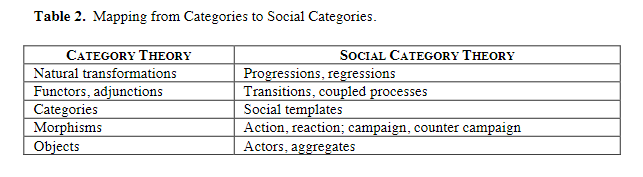
Paper - Categorical Social Science: Theory, Methodology and Design by Sallach (2012)

This conference paper from 2012 - cited at length here - is very encouraging as I try to work on category theory within Hodges' model. This is timely too, as a new (northern) academic year begins - post to follow ...

Sallach, D.L. Categorical Social Science: Theory, Methodology and Design. In: Conference Paper - 4th World Congress on Social Simulation. Taipei, Taiwan (September 2012). https://www.researchgate.net/publication/275584554

"The prospect of representing social processes at multiple scales, at an arbitrary level of detail, is likely to produce rich, interwoven models with the potential to provide a more effective map of historical and policy-oriented dynamics. However, this potential will also raise significant challenges in validating such a model [15].

One approach to managing the complexity (both conceptual and computational) of social models is to move them toward a higher level of abstraction."

"Category theory requires specification of a type of mathematical object in terms of identity, composition, and a group of morphisms that preserves their structure. This definition of objects and morphisms, in conjunction with two standard axioms (associativity & identity), defines a framework that is simple enough to be broadly applicable."

Conclusion:

"The present analysis introduces more analytical potential than can currently be demonstrated. Nonetheless, it makes a case for the relevance of category theory for the representation of social applications, and illustrates a variety of ways in which these conclusions are, or ultimately can become, compelling.

Category theory provides a rigorous yet expressive formalism for representing and integrating challenging modeling domains. It is also a formalism that can support extensive theoretical and modeling syntheses, while still maintaining appropriate levels of exactness. These strengths make CT particularly appropriate for providing a mathematical foundation for computational social science.

Ultimately, it is important to return to the issue of the validation of social models. The practical use of historical and/or policy-oriented models is highly dependent upon their credibility. Category theory provides a formalism that can be precise when applied to theory, explicit during the design stage, and definitive at the assessment stage, while also attending to the consistency of intermediate stages. It deserves serious exploration and investigation."

Sunday, July 16, 2023

Reflexivity - c/o Rose G. (2012)


Visual Methodologies
"In the social sciences, reflexivity is claimed to be unnecessary for work that defines itself as scientific. Thus the practitioners of content analysis and semiology - discussed in Chapter 5 and 6 here - do not engage in reflexivity, since both, for different reasons, claim their work is scientific. However, reflexivity is a crucial aspect of work that participates in the so-called cultural turn. There, reflexivity is an attempt to resist the universalising claims of academic knowledge and to insist that academic knowledge, like all others knowledges, is situated and partial. Reflexivity is thus about the position of the critic, about the effects that position has on the knowledge that the critic produces, about the relation between the critic and the people or materials they deal with, and about the social effects of the critic's work." p.183. 


Rose, Gillian (2012). Visual Methodologies: An Introduction to Researching with Visual Materials (3rd ed.). London: Sage. PB.  [Now in 5th edition.] Image - Amazon.

I wonder if the fifth edition has revised content on photography and other content, such is the pace of change?

Monday, July 10, 2023

5th Multidisciplinary International Symposium on Disinformation in Open Online Media


Call for Contributions

The Multidisciplinary International Symposium on Disinformation in Open Online Media (MISDOOM) is returning for its 5th edition on 21 and 22 November 2023. This time, the conference will be hosted by the National Research Center for Mathematics and Computer Science (CWI) at Amsterdam Science Park (Netherlands). MISDOOM values multidisciplinary research and is designed to be inclusive of different academic disciplines and practices.

The symposium provides a platform for researchers, industry professionals, and practitioners from various disciplines such as communication science, computer science, computational social science, political science, psychology, journalism, and media studies to come together and share their knowledge and insights on online disinformation.

My source - ERCIM NEWS posted previously:

https://hodges-model.blogspot.com/2023/07/ercim-news-134-xai.html

Wednesday, February 08, 2023

Automation by Design: Politics, Culture, and Landscape in an Age of Machines That Learn

The virtual one and a half-day symposium will be held Friday, February 17 & Saturday, February 18, 2023.

Thursday, November 17, 2022

Social Sciences, measurement ... c/o Outhwaite (1991)


"the conceptual aspect of the subject matter of the social sciences circumscribes the possibility of measurement. . . . For meanings cannot be measured, only understood. Hypotheses about them must be expressed in language, and confirmed in dialogue. Language here stands to the conceptual aspect of social sciences as geometry stands to physics. And precision in meaning now assumes the place of accuracy in measurement as the a posteriori arbiter of theory. It should be stressed that in both cases theories may continue to be justified and validly used to explain, even though significant measurement of the phenomena of which they treat has become impossible." Chapter 3, Realism and Social Science. p.60.


William Outhwaite (1991) New Philosophies of Social Science: Realism, Hermeneutics and Critical Theory. London: MacMillan.

 INDIVIDUAL
|

 INTERPERSONAL    :     SCIENCES               
HUMANISTIC --------------------------------------  MECHANISTIC      
SOCIOLOGY  :   POLITICAL 
|
GROUP


quality


subject/subjective
geometry, physics (time)
metric / measurement / magnitude
quantity
*or, automated systems, robots

object/objective

social sciences - humanities

"Society consists of people. Groups consist of people. Institutions consist of people plus rules and roles. Rules are followed (or alternately not followed) by people and roles are filled by people.* Also there are traditions, customs, ideologies, kinship systems, languages: these are ways people act, think, and talk." p.108.
Chapter 7, Conclusion. (Citing Steven Lukes.)

Institutions

"There is thus an important sense in which Marx's explanandum in Capital is a conceptual question (though one whose answer required detailed empirical as well as conceptual investigation): 'why labour is expressed in value and why the measurement of its duration is measured in the magnitude of the product.'
Chapter 6, Critical Hermeneutics ... p.96.


Hodges' model:
The Individual - Group(s) axis: The subjects and agents of health and social care (theory, practice, management, policy, research, history, future studies ...)

Tuesday, August 30, 2022

August 2022 - Journal of Health Care for the Poor and Underserved

To JHCPU readers,

 
The August 2022 issue of the Journal of Health Care for the Poor and Underserved (JHCPU) has been released:

https://muse.jhu.edu/issue/48370

The Note from the Editor appears below. Following the link will bring you to the full table of contents.

With best wishes for the new academic year,

Ginny Brennan


Note from the Editor

Public Health and Politics

Positioned at the nexus of social science and health, the Journal's work is necessarily political. One of the many concerns in the U.S. as we approach the Fall of 2022 is the U.S. Supreme Court's June decision in Dobbs v. Jackson Women's Health Organization to overturn Roe v. Wade and with it the Constitutional guarantee of the right to abortion, abrogating women's moral autonomy over their reproductive health. In this issue, Frohwirth and colleagues consider another contested site in the reproductive health care landscape—contraception affected by abortion policy—as they assess the impact on women in Iowa of a 2017 reduction in Medicaid coverage of contraceptive care. Due to the new law, patients enrolled in the state family planning program could no longer access subsidized care at publicly funded clinics affiliated with abortion provision, and over 15,000 patients had to find to find a new family planning provider. The researchers learned in their qualitative study that high fees for visits and contraceptive methods, restrictive or inadequate insurance coverage, and access barriers such as long appointment wait times were the most common barriers to preferred contraceptive care, and these barriers compounded one another. Furthermore, barriers grew once the more restrictive Iowa Medicaid policy was in place. The authors conclude that policy changes supportive of contraceptive care would decrease vulnerability and increase reproductive autonomy.

Several papers in this issue bear on the construction of datasets or use datasets in new and sophisticated ways. We publish them aware of the fact that database construction is central to many highly political debates. Qato and colleagues introduce an intermediate-level variable—the nursing home—into an analysis of the distribution of COVID19 vaccination among nursing home residents. Looking at over 12,000 nursing homes in terms of the racial heterogeneity of the residents, the authors find that residents of the quantile of homes that were more predominantly non-Hispanic White were significantly more likely to be vaccinated (mean vaccinated 85.65%) than residents of the quantile that was least predominantly non-Hispanic White (mean vaccinated 72.74%). The authors of this short article conclude, "A higher proportion of White residents per facility was associated with higher resident COVID-19 vaccination rates reflecting continued disparities in quality of care during the pandemic."

While it is not construed formally as a variable, the construct of neighborhood in the paper by DiFiore and colleagues reveals significant patterns in the distribution of food insecurity. They assess food insecurity in relationship to perceived neighborhood safety, social cohesion, informal social control, and crime, adjusted for demographics, socioeconomic status, and neighborhood characteristics. The participants in the study were 300 mothers and female caregivers of Medicaid-enrolled two- to four-year old children in Philadelphia. Greater food security was associated with higher perceived neighborhood safety and social cohesion, and lower police-recorded violent crime rates. The evidence of this research suggests that the structural condition of living in a supportive neighborhood social environment may protect against food insecurity.

Kong and colleagues conducted COVID19/food security research, using longitudinal data to assess the interrelationships among food insecurity, mental health, and the COVID19 pandemic. They found that food insecurity was associated with stress, depression, and anxiety. They also found that these conditions improved over time during the pandemic among food-secure participants but worsened among food-insecure participants. The pandemic appears to worsen the already vicious cycle connecting food insecurity and mental health.

Two papers based on the Youth Risk Behavior Survey (YRBS) argue for enriched variables for coding race and ethnicity. Jones and Satter analyze mental health outcomes based on race and ethnicity and, in doing so, they observe that over 80% of respondents to the YRBS who self-identified as American Indian/Alaska Native also self-identified as Hispanic. American Indians/Alaska Natives are often multi-racial and of Hispanic/Latino ethnicity, and therefore outcomes differ widely depending on whether one examines American Indian/Alaska Native alone or in combination with other racial/ethnic variables. Also using the YRBSS, Braun and colleagues assessed tobacco and alcohol use and adolescent sexual practices among Black, bi/multi-racial, and White adolescents. They find that results differed across all three groups, leading them to conclude that nuanced racial categories are called for.

It is our hope that these and the many other papers in this quarter's issue—through their attention to social, scientific, and political decisions affecting health and health care—will serve to advance health justice, either through or in spite of the political process.

Virginia M. Brennan, PhD, MA
Editor, JHCPU
Associate Professor, Meharry Medical College

My source:
Spiritof1848 Listserv WWW.SPIRITOF1848.ORG #Spiritof1848

Tuesday, September 15, 2020

Chaotic Modeling & Simulation Web Conference 22-24 October 2020

Dear Colleague,

Please see the announcement for the October CMSIM2020 International Web-Conference, 22-24 October 2020. You are invited to contribute by a presentation, a special session or workshop and suggest a keynote talk.

We already have done the appropriate provisions for an important meeting following the successful previous Virtual events.

The deadline for Abstract submissions and Special and Invited session and Workshop proposals is set to September 18, 2020, see at http://www.cmsim.org/cmsim2020webconference.html

We already invite papers for the Conference Proceedings where accepted papers will be included along with Book and Journal publications (submit following the conference paper guidelines to Secretariat AT cmsim1.org ).

On behalf of the Conference Committee,

Prof. Christos H Skiadas,

Conference Chair

________________

Over the years several Books from leading publishers emerged from the CMSIM and CHAOS Conferences and events.

Please see the last years Books published by Springer

11th Chaotic Modeling and Simulation International Conference, 2019,

https://www.springer.com/gp/book/9783030152963  and

12th Chaotic Modeling and Simulation International Conference, 2020,

https://www.springer.com/gp/book/9783030395148

13th Chaotic Modeling and Simulation International Conference, Springer (in preparation)

Monday, January 27, 2020

What should be written in a HC Professional's DNA?

Before putting twitter down for a break, I was reminded about a form of DNA.

There are previous posts on the 6Cs in nursing here on W2tQ and taking these essential qualities as an obvious starting-point:

  1. care,
  2. compassion,
  3. courage,
  4. communication,
  5. commitment
  6. and competence
- and mapping them to the care (knowledge) domains of Hodges' model, you realise how they apply across the model. Care, Compassion and Communication are the essence of what it is to be human and humanistic. If however the time 'allowed', environment and accessibility are not attended to, then the mechanistic domains can disrupt the most caring of efforts.

What about courage? This is surely a very individual character trait? A personal quality in this context, with an emphasis on the humanistic domains.

Care is relational and we can consider courage in respect to scientific knowledge. As a member of the multidisciplinary team, or specialist practitioner a nurse may need courage to share scientific knowledge, evidence concerning genomics, for example. The public's knowledge and understanding of science is brought to the fore. There is the alternate scenario with the 'patient' as expert, for example in the case of rare diseases (especially next month).

Courage is a continua, that like strands of DNA runs through all the domains of Hodges' model and the 2020s ... will see the political realisation of courage in nursing and healthcare; locally, regionally, nationally and globally.

Reading (another) book for review, the authors draw attention to how Maslow's hierarchy says little, if anything, about altruism (but is implied?).

As these brief observations should demonstrate, Hodges' model facilitates relational, person-centredness, the cross-fertilization of ideas and high standards of care.

Who needs a double-helix when you can have a quadruple form?

individual
|
INTERPERSONAL : SCIENCES
humanistic ----------------------------------------------- mechanistic
SOCIOLOGY : POLITICAL
|
group - population


My source:
MindScience, Biochemistry, FT Magazine, FT Weekend. 26-27 January 2013, p.50.

Reminded via:

Tuesday, September 17, 2019

"Time to care: why the humanities and the social sciences belong in the science of health" c/o BMJ Open

Reflections on this BMJ Open paper:


Care must become a truly pluralistic concept

THE SCIENCE OF HEALTH
has a requirement -
<  HOLISTIC (conceptual) BANDWIDTH  >

Consider the meaning of:

interdisciplinary
"radical interdisciplinary"
multidisciplinary
transdisciplinary
systems of systems


individual
|
INTERPERSONAL : SCIENCES
HUMANITIES ------------------------------------------- SCIENCES
SOCIOLOGY : POLITICAL
|
group - population
Psychological -
Sense of Well-being
Emotional contentment
purposes
mental health
conceptual integration
individual action (intentionality)
PsychoSocial OR Socio-Psychological
Youth activity
Subjective
Biological (models here)*
"Time to care"?
Pre-morbid, Diagnosis, Present, Prognosis
Chronological : Pathological TI:ME
TI:ME Clinical encounter
obesity, cancer, diabetes ...
methodologies, methods, practical
process
-TECHNICAL
         Objective
Qualitiative
 SOCIO-
practice
parenting, civil society
(families, school, churches, scout, unions)
Social Sciences (Medical Sociology)
Social Determinants
"psychosociocultural"
'folk' theories, group dynamics
CUL- deep knowledge -TURE
History (Community Memory)
Social Learning / UnLearning
Quantitative
Government
policy
individual - WHO - POPULATION
Burden of Disease, Budgets
public health programmes
 inc. immunization 
Healthcare systems
HIC ---- LMIC
sugar tax, commerce
Transportation
SDGs

*remote from the 'real' action?

Interdisciplinarity, or even radical indisciplinarity is insufficient to solve the problems of the 21st Century - ask our children... It not only sounds like they can see the evidence, but they are prepared to act on it. They have no choice:

A transdisciplinary approach with AI in humanistic harness will be essential.


Reference:
Clarke B, Ghiara V, Russo F Time to care: why the humanities and the social sciences belong in the science of health BMJ Open 2019;9:e030286. 
doi:10.1136/bmjopen-2019-030286


Saturday, August 10, 2019

Threshold Concepts: Reflection on chaos, complexity and AI

Here are the reflections on the photograph posted in June following the Conference on Threshold Concepts:


Chaos can occur in any one ... or all of the four domains of Hodges' model. The same applies to order.

http://homepages.math.uic.edu/~kjerland/Lorenz/lorenz_attractor.html


This is a characteristic of chaos and chaotic systems.

Chaos can arise at any time: in the here and now, being sown now for the future (climate change?), or springing from the past, as in pleasurable, or traumatic memories.

While the Lorenz attractor and other graphical examples are grounded in mathematics and science, in #h2cm we need to imagine the butterfly diagram extended across and simultaneously at work across the models four domains.


individual - self
|
INTERPERSONAL : SCIENCES
humanistic ----------------------------------------------- mechanistic
SOCIOLOGY : POLITICAL
|
group- population


Even in instances of riot and anarchy there will be pockets of 'order', but would you would want to take your chance of finding one? Amid talk of being in the wrong place, at wrong time; to what extent is this dependent upon who we associate with socially? Or, what we believe is the political course we might, should, will, must follow?

The context of Prof. Land's slide is learning and decision making. As a 'political' matter when chaos occurs, how is it manifested in disintegration? Can we hear the 'gears grind'? What exactly goes awry? Is it the processes as in the timing, leadership and with it responsibility?

The slide is powerful in giving support, to clinical decision-making as a context in which complex decision making is very common and simultaneously encompasses political, rationale and judgemental (ethical) forms of decision making.

Hodges' model can also facilitate recognition of differentiation between relational chaos and the explicit state of decision-making. For example, a healthcare practitioner and client/patient/carer may have achieved empathy and rapport, but the complex demands of the clinical decision still presents a great deal of uncertainty. Alternately in instances when the relationship is being forged then the communications: verbal and non-verbal (and a function of the clinical team) can be a confounding factor if not negotiated professionally (and in socially acceptable terms by members of the public). Another useful perspective is Personal and Public Involvement (PPI) at what point is this achieved? What are the thresholds in the public's learning, as they engage and are engaged if they are not to label the initiative as a checkbox exercise? Again Hodges' model can help us to reflect upon the scope and complexity of such situations.


AI, artificial intelligence was mentioned (I'm sure?) in the presentation and the benefits of AI in healthcare are already being realised. This is tempered with the requirement for AI systems to be able to explain their 'reasoning', rather than this be taken at face value. As AI takes on tasks that include initial automated screening of job applications that include videos then another dimension of learning is presented to students.

Health and justice is by default complex. Consider, the task of being seen by society that justice is duly served and doing so with a duty of care and welfare of the prisoners. To this, we can add the aspiration of custody being rehabilitative. For a prisoner, even on remand, there will be times when health needs and patiency must be recognised. When a long-term prisoner becomes chronically ill, this can present a major challenge to law-makers, prisoners, their families, the healthcare team and society.

individual - self
|
INTERPERSONAL : SCIENCES
humanistic ----------------------------------------------- mechanistic
SOCIOLOGY : POLITICAL
|
group- population

Identity (use of name, touch ...)
(My) PURPOSE
Beliefs, Personal values
 Safety (personal) Thresholds
Trigger warning
Critical - critique 
not taking it personally


PROCESS
[Space] - physical &
degrees of freedom in decision making
constraints
Rationale*
Evidence
Theory
Quantitative Research


Qualitative Research


Patient : Healthcare practitioner
decision making
 PRACTICE
Critical - agreeing to disagree

Schism - 'distance'

Consensus (bridge building)
 Autonomy (in decision making)
Administration / Bureaucracy
Professionalism
Anti- 'X' movements
Riot and anarchy
safety (POLICY)
Critical - political


*While placed within the sciences domain, 'rationale' can be evidenced physically, psychologically,  politically and socially.  It is this that forces us to acknowledge the several edges of chaos.

See also:
Inaugural Scottish Threshold Concepts Conference: TCs in Action [i]


Images:
http://homepages.math.uic.edu/~kjerland/Lorenz/lorenz_attractor.html

https://www.thingiverse.com/thing:3774260/comments
(Original image)