Hodges' Model: Welcome to the QUAD: thought

Hodges' model is a conceptual framework to support reflection and critical thinking. Situated, the model can help integrate all disciplines (academic and professional). Amid news items, are posts that illustrate the scope and application of the model. A bibliography and A4 template are provided in the sidebar. Welcome to the QUAD ...

Showing posts with label thought. Show all posts

Wednesday, October 07, 2026

Hodges' model: Is it a virus: or a universal vaccine?

The arrival of 'imposter syndrome' well-over a decade ago(?), from the speaker's podium was an interesting surprise. A case of lived experience, as I'd felt this in trying (and failing) to grapple with the ever-growing, morphing development stack of a software program. Long gone are the days of Sinclair and BBC BASIC. The mountain and learning cliff, was CMS content management system: Drupal. 

What contributed to that feeling back then? Well there was the people I was sat by and sharing time at various European DrupalCons. It was I who was the 'con'. A hobbyist, from pre-PC days. Seeing and hearing what they were creating and the great community. Fascinating also, to see web design fashions come-and-go.

I've written before about Hodges' model being an over-valued idea to me. As a mind-mapping meme it infected me decades ago. Is it a virus? If it is I clearly had no resistance, no immunity. I've always tried to acknowledge, reminded myself that the model is not the be-all-and-end-all.

While the specific mathematical is complex, it is worth trying to grasp some of the intent and meaning (even at the risk of exacerbating imposter reactions). Hestenes provides a paper (and several others):

'ABSTRACT. The discovery of Mathematical Viruses is announced here for the first
time. Such viruses are a serious threat to the general mental health of the mathematical
community. Several viruses inimical to the unity of mathematics are identified, and their
deleterious characteristics are described. A strong dose of geometric algebra and calculus
is the best medicine for both prevention and cure.'

Hestenes, D. (1992). Mathematical Viruses. In: Micali, A., Boudet, R., Helmstetter, J. (eds) Clifford Algebras and their Applications in Mathematical Physics. Fundamental Theories of Physics, vol 47. Springer, Dordrecht. https://doi.org/10.1007/978-94-015-8090-8_1

'The computer virus (CV) owes its name and perhaps its genesis to the biological virus
(BV). Like a BV, a CV cannot function by itself, but when attached to a host it replicates
repeatedly until it impairs the functioning of the host, sometimes to the point of disabling
the host altogether. ...

My purpose here is to call your attention to another kind of virus - one which can
infect the mind - the mind of anyone doing mathematics, from young student to professional
mathematician. As I believe this is the first published paper to explicitly identify
such viruses, I take the liberty of naming and describing them as follows: A mathematical
virus (MV) is a preconception about the structure, function or method of mathematics
which impairs one's ability to do mathematics. Just as a CV is program which impairs the
operating system of a computer, an MV is an idea which impairs the conceptualization of
mathematics in the mind. Indeed, as one definition of "virus," Webster gives "something that
corrupts the mind or soul." Since the identification and classification of MVs has only
just begun, it would be premature to attempt a more precise definition. The better course
is to examine some specific viruses to form a form empirical base for further study.
My first example is an easily recognized MV which is extremely virulent and as common
as the common cold. I call it the coordinate virus, designating it by MV/C to denote genesis
and type, and characterizing it as follows:' pp.1-2. (online copy)

Hestenes' biohistory is an interesting conceptual and interdisciplinary bridge. Another construct to add to our  collection. Is there a virus in the models deployed within medicine and healthcare to date? You know, the bed-round of the medical, biomedical, bio-psycho-social? The round were you don't need to count the number of beds, except in the event of a pandemic. Is the omission of the political, even as the socio-economic reality is now a constant point of reference a symptom of a centuries-long infection? 

For a long time now* the legacies that successive cohorts of students, and newly qualified professionals encounter have stood out. Another question is, just how far back in time do we need to travel to find can the origin of this situation? Was there an initial crisis involving the overt expression of 'power'? Can this be found the as the Hippocratic oath butted up - literally - against triage on the battlefield?

Now: Time won't tell (or will it?). Now that - is some virus.

Wednesday, September 30, 2026

Prof. George William Brown OBE, FBA (1930–2026)

"George Brown was a huge figure in sociology and social psychiatry. At a time when social science and psychiatry were so riven with conceptual differences they could not work constructively, George’s approach was collaborative, courageous and imaginative. His work addressed real-world problems and in so doing greatly enriched mental health research."

Professor Matthew Hotopf, Executive Dean, Institute of Psychiatry, Psychology & Neuroscience:
https://www.kcl.ac.uk/news/professor-george-william-brown-obe-fba-19302026

Starting in Warrington School of Nursing (Winwick Hospital) as a student mental health nurse in October 1977 you can how that curriculum and programme of study came about; and influences on Brian Hodges' early career.
 
Hodges' Health Career - Care Domains - Model
 
 An individual's 'health career' is impacted by their life chances and life events.
 
 
individual
|
INTERPERSONAL
: SCIENCES             
humanistic ------------------------------- mechanistic
SOCIOLOGY : POLITICAL   
|
group

Individual Psychology

Life events

PSYCHIATRY

psycho-

Life events

EVOLUTIONARY
PSYCHIATRY

social

Group Psychology

Life events

SOCIAL & CULTURAL 
PSYCHIATRY


LIFE EVENTS

 PSYCHO-POLITICAL
PSYCHIATRY


See also:

Wing, J.K., & Brown, G.W. (1970). Institutionalism and Schizophrenia: A Comparative Study of Three Mental Hospitals 1960–1968. Cambridge; Cambridge University Press. 

Brown, G. & Harris, T. (1978) Social Origins of Depression. A Study of Psychiatric Disorder in Women. London: Tavistock.Google Scholar 

Brown G.W. & Harris, T. (1979) Social origins of depression: a study of psychiatric disorder in women, London: Tavistock Publications.

Brown, G. W., & Harris, T. O. (Eds.). (1989). Life events and illness. The Guilford Press.

My source: Patrick Kidd. Forum, Obituary, The Observer. 20th September, 2026, p.42.
https://observer.co.uk/profile/obituary/article/george-brown-the-former-post-office-boy-who-unlocked-the-mystery-of-depression

Previously: 'social sciences' : 'psychiatry' : 'determinants'

Sunday, September 27, 2026

Book review: 'Categories: A Study of a Concept in Western Philosophy and Political Thought'

Categories


To - Edinburgh University Press. 

Many thanks for this book -

O’Sullivan L. Categories: A Study of a Concept in Western Philosophy and Political Thought. Edinburgh University Press; 2024.

Requested in May, your response was quick. So, my apologies for the delay in picking this up. In mitigation, what I have been learning since, will help my reading of O'Sullivan's text.

As readers of W2tQ will have realised, there is a built in bias to my reading of any text. In short: It's all about the model. 

Categories was spotted in Foyles on a visit to London. It recommended itself instantly: title, Venn diagrams, sets and all.

A larger format paperback of 335 pages, the print quality, font and design match the values and usual care of the publisher. 

Given the subject, there are appropriately distinct indices of subjects and proper names.

At pages 2-3, I have already succumbed (my emphasis):

'As a result, there is widespread contemporary recognition that categories are both important and problematic. A non-exhaustive list of academic fields and disciplines in which issues to do with categories arise includes anthropology, critical theory, cultural studies, feminist studies, history, linguistics, philosophy, political science, political theory, post-colonial studies, post-modernism, post-humanism, psychoanalysis, psychology, rhetoric and sociology. It is clear, moreover, that this recognition reflects the situation in society at large. Popular authors articulate a pervasive feeling that "Things are in the wrong place. Religion is in the box where science used to be. Politics is on the shelf where you thought you left science the previous afternoon." Categorical worries have penetrated public as well as academic discourse.' pp.2-3.

But how did Luke O'Sullivan know? On page 3 having given us the informal uses of the word 'category':

'These, moreover, are only the informal uses; there are also formal, logical and mathematical, senses which we shall largely have to pass over.'13

For me it is a disappointment that the formal aspects will be passed over. It is also a relief. 

For a model that is situated, as far as nursing theory, and models of nursing/care were concerned in 1997-8; Hodges' model had been left on the shelf - gathering dust.

I recognised a slide from a Youtube video this past week, care of Cheng I think? I'll share soon.

More to follow.

13 Eugenia Cheng, Cakes, Custard, and Category Theory Easy Recipes for Understanding Complex Mathematics (London: Profile Books, 2015) provides an introduction to mathematical category theory.

Saturday, September 12, 2026

TED - Talks & Listenings

THOUGHT

EDUCATION

DESIGN

  
individual
|
INTERPERSONAL
: SCIENCES             
humanistic ------------------------------- mechanistic
SOCIOLOGY : POLITICAL   
|
group
 
THOUGHT
 
Cognitive maps

Your -
Sense of direction?

Maps

DESIGN

'True South'


Ancient maps - periplus

EDUCATION for All


Maps - Power
 

Our -
Sense of direction?


Previously: 'thought' : 'education' : 'design' : 'cognitive map'

My source:  https://x.com/NobelPrize/status/2098073718371262921?s=20 and @TED_ED

Friday, September 04, 2026

Call for Submissions: Fall-Winter 2026 Intima Journal of Narrative Medicine


OUR CALL FOR SUBMISSIONS  FOR OUR FALL-WINTER 2026
JOURNAL IS OPEN. SUBMIT YOUR WORK TODAY.


Intima: A Journal of Narrative Medicine
is a literary journal dedicated to promoting the theory and practice of narrative medicine, an interdisciplinary field that enhances healthcare through the effective communication, empathy and understanding between clinicians, caregivers and patients. Our name Intima has a specific resonance in the field: For us, narrative involves the intimate interface between people, who yield and gain from the experience of stories involving the clinical encounter.

 The word itself has an anatomical reality: intima is  the thin layer lining a blood vessel, speeding blood to the heart and brain, an apt analogy for the kind of narratives we publish that speak to the emotions and the intellect, the feelings and facts that engage the senses in stories with meaning and impact..


individual
|
INTERPERSONAL
: SCIENCES             
humanistic ------------------------------- mechanistic
SOCIOLOGY : POLITICAL   
|
group


©The Art of Anatomy by Khalil Harbie.
Intima, Fall 2013


Art - https://www.theintima.org/missionandvison also reminded of Escher and Byte Magazine.

My source: Intima list

Previously: 'creativity' : 'crossroads' : 'narrative'

Friday, August 14, 2026

Sometimes it can take an old model ...


'Sometimes it can take an old model, 
to build a new one, 
that makes the existing model obsolete.'

To borrow from Buckminster Fuller.                         

 
Resurgence & Ecologist, Sept/Oct 2020, Issue 322, p.33.

Tuesday, June 30, 2026

'Oh Thomasina!' Such a drama in a diagram

Arcadia

Last evening I really enjoyed a performance of Tom Stoppard's Arcadia at the Duke of York's, or soon to be - The Tom Stoppard Theatre:

Act I, Scene 2  

'Septimus ... You should no more grieve for the rest than for a buckle lost from your first shoe, or for your lesson book which will be lost when you are old. We shed as we pick up, like travellers who must carry everything in their arms, and what we let fall will be picked up by those behind. The procession is very long and life is very short. We die on the march. But there is nothing outside the march so nothing can be lost to it. The missing plays of Sophocles will turn up piece by piece, or be written again in another language. Ancient cures for diseases will reveal themselves once more. Mathematical discoveries glimpsed and lost to view will have their time again. You do not suppose, my lady, that if all of Archimedes had been hiding in the great library of Alexandria, we would be at a loss for a corkscrew? ...'^ p.20.

 Act II, Scene 3

'Lady Croom We are intruding here - this will not do, Mr Hodge. Evidently, nothing is being learned. (To Noakes) Come along, sir! 

Thomasina Mr Noakes - bad news from Paris! 

Noakes Is it the Emperor Napoleon? 

Thomasina No. (She tears the page off her drawing block, with her "diagram" on it) It concerns your heat engine. Improve it as you will, you can never get out of it what you put in. It repays eleven pence in the shilling at most. The penny is for this author's thoughts. 

She gives the diagram to Septimus who looks at it.' p.74
...
Now Septimus retrieves his book from Thomasina. He turns the pages, and also continues to study Thomasina's diagram. ... 

Septimus Why does it mean Mr Noakes's engine pays eleven pence in the shilling? Where does he say it? 

Thomasina Nowhere. I noticed it by the way. I cannot remember now. 

Septimus Nor is he interested by determinism -------

Thomasina Oh... yes. Newton's equations go forwards and backwards, they do not care which way. But the heat equation cares very much, it goes only one way. That is the reason Mr Noakes's engine cannot give the power to drive Mr Noakes's engine. 

Septimus Everybody knows that. 

Thomasina Yes, Septimus, they know it about engines! 

Pause. He looks at his watch 

Septimus A quarter to twelve. For your essay this week, explicate your diagram. 

Thomasina I cannot. I do not know the mathematics. 

Septimus Without mathematics, then.' p.75.

 
Tom Stoppard, (1993) Arcadia (Playscript), Faber & Faber, pb. ISBN 9780571169344.
https://www.faber.co.uk/product/9780571169344-arcadia/

My text source:
https://collegearts.yale.edu/sites/default/files/attachments/arcadia_by_tom_stoppard.pdf 

^ n.b. This was therapeutic, but I still mourn the losses from Alexandria and other libraries ... today.

Saturday, June 06, 2026

"step inside" TO "think outside"

  
individual
|
INTERPERSONAL
: SCIENCES             
humanistic ------------------------------- mechanistic
SOCIOLOGY : POLITICAL   
|
group


             c/o Somerset House, 6th June 2016.

Tuesday, May 26, 2026

By Helen Frankenthaler - 'A Green thought in a Green Shade'

individual
|
INTERPERSONAL : SCIENCES
humanistic ------------------------------- mechanistic
SOCIOLOGY : POLITICAL
|
group
 
Helen Frankenthaler: A Green Thought in a Green Shade, 1981
119 × 156 1/2 in. (302.3 × 397.5 cm). Acrylic on canvas


© 2026 Helen Frankenthaler Foundation, Inc. / Artists Rights Society (ARS), New York

Image used with kind permission of The Helen Frankenthaler Foundation - and with thanks.
My source: Phoebe Evans. Opening Shot, FT.com/HTSI FTWeekend. 23rd April, 2026, p.13.
 
Gagosian. Helen Frankenthaler: The Moment and the Distance
April 30–July 2, 2026 West 21st Street, New York 
 

Monday, May 18, 2026

CfP: Nonsense in Language and Thought

CFP: Nonsense in Language and Thought

Guest editor: 
Krystian Bogucki (Polish Academy of Sciences)

Deadline for submissions: 
the 31st of July 2026 

Description:

Studia Semiotyczne (Semiotic Studies) invites submissions for a special issue of the journal. Papers should be written in English and prepared for blind review. 

An interest in nonsense was a hallmark of the early analytic philosophy. Bertrand Russell (1908) thought that a theory of nonsense could help us avoid some daunting paradoxes in logic. Ludwig Wittgenstein (1922, 1953) and Rudolf Carnap (1931) recognised nonsense as a fundamental concept for philosophical criticism. They claimed that much of philosophical discourse is defective in the most fundamental way: it is neither true nor false, it does not consist of thoughts and propositions ? it is nonsense. According to the early Wittgenstein, philosophers want to describe the nature of the world, thought, language and ethics, but they unwittingly fall into nonsense. The Tractatus was supposed to free us from this troublesome position by presenting a perspicuous notation. On the other hand, the later Wittgenstein claimed that we should compare deceptive philosophical images with our ordinary ways of thinking and speaking in order to avoid nonsense. Philosophical problems arise when language goes on holiday, so we must always remember the everyday use of concepts. For Carnap, propositions should be reducible to sense data and constructed according to the rules of logical syntax in order to be meaningful. 

Later, the topic of nonsense was discussed by Alfred Ayer, Gilbert Ryle, Willard V. O. Quine, Arthur Prior, Richard Routley and Georg H. von Wright, among others. Since the late 1970s, however, the interest in nonsense has faded. Only recently, some important works have been published. The first important stimulus came from foundational works on theories of nonsense (Cappelen 2012, 2013; Camp 2004; Glock 2015; Magidor 2009, 2013). The second source of the revival of interest in nonsense was Wittgenstein scholarship on the austere and substantial conceptions of nonsense (Conant 2001; Diamond 1995, 2005; Glock 2004; Hacker 2003; Moore 2003; Sullivan 2003). Some works also examined the relation of nonsense to other phenomena (Gotham 2017, Keller and Keller 2021, Shaw 2015, Sorensen 2003). 

The important questions to be addressed in the forthcoming volume are (to name but a few):

  • What are the sources of nonsense? 
  • Are some parts of philosophical and non-philosophical discourse nonsense?
  • What is the relation between nonsense and figurative speech?
  • Is it at all possible to be wrong whether our own thoughts are meaningful? 

We hope that the special issue of Studia Semiotyczne will further strengthen and deepen the scholarly interest in nonsense. 

Possible topics include, but are not limited to:

Theories of nonsense
Nonsense and logical syntax
Nonsense and category mistakes
Nonsense and figurative speech (e.g. metaphor, metonymy)

Nonsense and fiction
History of the concept of nonsense (in particular Wittgenstein's and the Vienna Circle's views on nonsense)
Nonsense and understanding
Nonsense and illusions of sense
Nonsense and quantification
Nonsense and linguistics
Nonsense and ineffability
Nonsense, knowledge-how and knowledge-that
Logics of nonsense

Nonsense and semantic paradoxes
How to diagnose philosophical nonsense?
Metaphilosophical and methodological issues concerning nonsense
In order to submit the paper one is kindly asked to submit the manuscript by sending it to:
krystian.bogucki AT ifispan.edu.pl and studiasemiotyczne AT pts.edu.pl 

All submitted papers will be double-blind peer-reviewed.

My source (and emphasis):
Philos-L "The Liverpool List" is run by the Department of Philosophy, University of Liverpool 
https://www.liverpool.ac.uk/philosophy/philos-l/

Sunday, May 17, 2026

Wittgenstein's - Tractatus

Apparently, Wittgenstein walked away from philosophy after publication of the Tractatus. He thought he had solved the problems of philosophy, logic and reality.

In trying to ‘see’ Hodges’ model, in mathematical terms, there may be lessons in Wittegenstein’s approach, both in content and style. Of course, as a non-mathematician, I probably should leave well-alone; and stick to nursing. But that is the problem: from 1987-88 there is a need for a different perspective, even if this is a personal challenge. As with many ‘reviews’ here, we can look at Wittengenstein’s work, reflect upon it, and consider how it relates to the purposes, structures and content of Hodges’ model.

The Tractatus’s first line then, offers a warm welcome.

‘The world is everything that is the case.’ [I]

Making the decision to become a nurse and enrolling as a student makes you an educational and workforce demographic case.

Once a student in the university lecture theatre, you hopefully whether consciously, or not are exposed to the theory – practice gap; as you yearn to be on your first placement. Now it you who is seeking ‘cases’. As we live, and statistics roll and tally, the question of caseness (and categories) is key, one that is carried around even if not always active, recognised as such.

As noted in the previous post, we can for Hodges’ model (and other models, frameworks it must be said) think of ‘case’ as a, or the situation. 

A mathematical approach to Hodges’ model involves looking at things, concepts, people as objects. This includes patients and carers. In terms of a project worthy of pursuing in nursing and other disciplines involved in healthcare, this mathematization presents a non-trivial challenge. A fully-deserved response would be: 'What have you done to the aptitude for care and caring attitude? You've cancelled - subtracted it!' Humour aside:

'In order to know an object, I must know not its external but all its internal qualities.' [2.01231] 

Is this equivalent to us getting to know our patient / client and their socio-political context? 

‘The way in which objects hang together in the atomic fact is the structure of the atomic fact.’ [2.032] 

It is a help that Wittgenstein points to structure (crumbs of understanding are welcome here, as incremental steps). In formulating Hodges’ model we first identify the axes. It is the axes that then provide a space, four domains in total, to frame the objects that we decide; or, as the situation dictates, what concepts are placed in the domains of Hodges' model.

There is a successive series that follows, combining place, space and logic: ‘The proposition determines a place in logical space: the existence of this logical place is guaranteed by the existence of the constituent parts alone, by the existence of the significant proposition.’ [3.4]

‘The propositional sign and the logical coordinates : that is the logical place.’ [3.41]

‘The geometrical and the logical place agree in that each is the possibility of an existence.’ [3.411]

‘Although a proposition may only determine one place in logical space, the whole logical space must already be given by it.
(Otherwise denial, the logical sum, the logical product. etc., would always introduce new elements -in co-ordination.) 
(The logical scaffolding round the picture determines the logical space. The proposition reaches through the whole logical space.)' [3.42]

While Wittgenstein came to view ‘the picture theory of meaning’ as incorrect, as a conceptual framework and diagrammatic resource Hodges’ model is closely tied to this form of representation.

Of course, the logic at work here, is far from mathematical, but there is surely a logic.

'Formal concepts cannot, like proper concepts, be presented by a function.' [4.126]

'There is therefore really a sense in which in philosophy we can talk of a non-psychological I.
The I occurs in philosophy through the fact that the "world is my world'".
The philosophical I is not the man, not the human body or the human soul of which psychology treats, but the metaphysical subject, the limit - not a part of the world.' [5.641] 

'Although the spots in our picture are geometrical figures, geometry can obviously say nothing about their actual form and position. But the network is purely geometrical, and all its properties can be given a priori.

Laws, like the law of causation, etc., treat of the network and not of what the network describes.' [6.35]

There is much more in this work, and much that remains a challenge. Many commentators have written and said in interviews that the Tractatus rewards re-reading and some sentences stay with you for life (The Great Philosophers BBC TV). 

I'm still seeking mine.

https://www.gutenberg.org/files/5740/5740-pdf.pdf

Thursday, May 07, 2026

Interviews, playwriting, and clinical encounters: pause for breath - Roger Lewin

It can be surprising how you know something. Something that should be obvious to you. It's your 'Bread and Butter' as the saying goes. And yet for a variety of reasons, you persist in not seeing it, or you frame it in a way that ultimately reveals a bias, influence, and may even mask several aspects of truth. It might be the influence of work over four decades plus. Sitting down, or frequently finally getting out for a walk after several weeks of nudging, in a one-to-one therapeutic context. Or, ever since secondary school, that distant performed encounter with the Crucible. And, more recently as 'Ken', a Post Office subpostmaster and his wife (a brief 10-12 mins), and over the years a desire to write dialogue.

Reviews of Roger Lewin's Complexity, vary in their conclusions about the book's quality. No surprise there, but reading the book it was a revelation to see the method: a series of interviews and the resulting dialogues. 

'In this revision of his book originally published in 1992, Roger Lewin explains what the science of complexity is all about through interviews with some of its most important practitioners (and critics) organized around some of the central ideas. As such this is both a fine introduction to the subject and an interesting read. Lewin includes 16 pages of photos of the scientists he interviewed captioned with a significant quote from each. He has added an afterword on the application of complexity science to business, and an appendix about John Holland, whom he dubs, "Mr. Emergence."

"Everything works toward an ecology" is an old dictum of mine. I have the sense that I came up with that myself, but I probably read it somewhere years ago. At any rate, what is being said here is that complex systems work toward a state of equilibrium near a transition phase, near "the edge of chaos." This equilibrium can be an ecology (Darwin's "tangled web"); indeed it can be the entire planet, as in the concept of Gaia in which "the Earth's biological and physical systems are tightly coupled in a giant homeostatic system" (quoting Stuart Kauffman on page 109).'

Source: https://www.goodreads.com/en/book/show/384547.Complexity

There's nothing profound in this post, and yet this melange of interviews, playwriting, and clinical encounters gives me pause for breath.

Previously: 'Our broken sticks' c/o Roger Lewin "Complexity: life at the edge of chaos"

Sunday, March 08, 2026

Women Reading Deleuze c/o Edinburgh University Press

Celebrating Women in Philosophy

This International Women's Day, we're amplifying the work of women philosophers.


Our Women Reading Deleuze virtual issue pulls out articles from the Deleuze and Guattari Studies journal, chapters from the Deleuze Connections series and blog posts from our Deleuze Centenary celebrations, all written by women.


20 articles, chapters and blog essays by women

Browse the virtual issue


I have now read Bill Ross's 'Order and the Virtual - The Philosophy and Science of Deleuzian Cosmology'. A challenging and yet rewarding experience, further post to follow.

Monday, February 23, 2026

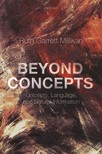
Millikan's Unicepts and Unitrackers

An underpinning theory of Hodges' model must help us make sense of what is happening within the care domains, between the domains, and possibly say something about what may be significant relation[s]-ships that are diametric. Arriving at threshold concepts I wondered in Hodges' model about there being compound threshold concepts. Consider, when 2-3 thresholds are (b)reached in one (the sciences) domain? Contrast this then, with 4-5 thresholds across care domains? There may also be care concepts applicable that are for example, person-centred: that is, patient, carer, 'management', or policy defined? These concepts while not threshold related per se, are nonetheless relevant.

I came across the work of Ruth G Millikan in London, several years ago as I followed 'epistemology' around the shop. It is time to pick this up and earlier work:

Millikan, Ruth Garrett. “Biosemantics.” The Journal of Philosophy 86, no. 6 (1989): 281–97. https://doi.org/10.2307/2027123

https://www.researchgate.net/publication/235734046_Biosemantics 

INTRODUCTION TO PART I

0.4 Unicepts and Unitrackers

'Neither the clusters in the world nor their properties are found at the sensory surfaces. The properties characterize distal objects and events. They are manifested in diverse and irregular ways through signs impinging on the sensory surfaces, energy patterns that are contingent on shifting intervening circumstances.' ...

'A unitracker is a mechanism or faculty for same-tracking something, for recognizing when incoming information concerns it, then linking and storing this information together as information about one and the same thing. Only then can it can be brought to bear together on inference and action. The link connecting stored information about the same thing together is a "unicept." The information is recognized, paradigmatically,by the initiation or strengthening of an intentional attitude of credence, which we tentatively model as a temporary or enduring connection between the unicept and unicepts for other things.'

'Both unicepts and unitrackers are particulars. You and I do not have any of the same unicepts or unitrackers. What we have in common is unicepts and unitrackers for many of the same things.' ...

'Unitrackers are same-trackers used for collecting knowledge about their targets.' pp.7-8.

Millikan, Ruth Garrett, Beyond Concepts: Unicepts, Language, and Natural Information (Oxford, 2017; online edn, Oxford Academic, 19 Oct. 2017), https://doi.org/10.1093/oso/9780198717195.001.0001, accessed 16 Feb. 2026.

Thursday, February 12, 2026

Just saying i

INDIVIDUAL
|
    INTERPERSONAL    :     SCIENCES               
HUMANISTIC --------------------------------------  MECHANISTIC      
SOCIOLOGY  :   POLITICAL 
|
GROUP

Imaginary

numbers


Social

care?


Saturday, January 31, 2026

International Conference: the Concept of Attention - IEF

Filosofia na Agenda

international conference
the concept of attention

Theme and Objectives

Attention constitutes one of the most fundamental yet under-theorized dimensions of human experience. Despite its centrality to perception, cognition, action, and intersubjectivity, the philosophical investigation of attention as a concept in its own right remains surprisingly underdeveloped. This international conference represents the first major initiative of a four-year research program (2025-2029) dedicated to establishing the philosophy of attention as a major field of contemporary philosophical inquiry.

The philosophical engagement with attention has deep historical roots. Already in ancient Greek thought, we find attention implicitly at stake in the Socratic contrast between an 'examined' and an 'unexamined' life and in the dialectical reform of ordinary reason pursued throughout Plato's dialogues. Medieval philosophy anticipates later developments through its emphasis on representation and intentionality (intentio), particularly in the works of Augustin, Aquinas and Duns Scotus. Yet it is only with Descartes's Meditations that attention receives explicit philosophical treatment, emerging as the crucial mediating link between radical doubt and epistemic certainty. This Cartesian innovation opens a rich trajectory of reflection, pursued by thinkers as diverse as Malebranche, Berkeley, Locke, and Wolff.

The scope of philosophical inquiry into attention expands dramatically from the late 18th century onwards. No longer confined to epistemological questions, attention becomes central to investigating the fundamental structures of subjectivity itself. French spiritualism, phenomenology, and philosophies of existence explore how attention relates to apperception, sensation, emotion, and volition—a trajectory that runs from Maine de Biran and Bergson through the phenomenological movement, encompassing figures from Paul Ricoeur to Michel Henry. Meanwhile, William James's psychological and philosophical investigations, along with later thinkers like Merleau-Ponty, Simone Weil, and Iris Murdoch, demonstrate attention's significance across multiple philosophical domains.

Indeed, contemporary philosophy recognizes attention as fundamental to a remarkable range of inquiries. In ethics, attention emerges as an essential vehicle for exercising personal and collective virtues. Aesthetics invokes attention in debates about the nature of beauty and our engagement with works of art—their creation, appreciation, and critique. Social and political philosophy identifies attention as a central component of the modern media landscape, where it functions as a valuable and increasingly contested economic resource. Environmental philosophy calls upon attention to help conceptualize our evolving and often precarious relationship with the natural world. Across these diverse contexts, attention appears as a fundamental human capacity whose nature and quality largely determine the kinds of bonds we can establish with each other and our surrounding world.

This conference seeks to bring these rich historical engagements into systematic dialogue with contemporary philosophy. We welcome contributions from all philosophical traditions and approaches, including but not limited to: the reflexive tradition, hermeneutics, phenomenology, empiricist and analytic philosophy, philosophy of mind, cognitive science, pragmatism, and non-Western philosophical traditions. We aim to explore how different philosophical frameworks have conceptualized attention's structure, dynamics, and normative dimensions, and how these varied perspectives can illuminate both historical debates and current research.

Full details: international conference: the concept of attention

Image: https://www.wikiart.org/en/theo-van-doesburg/heroic-movement-1916

Wednesday, January 21, 2026

v Book: Bill Ross - 'Order and the Virtual'

'The Philosophy and Science of Deleuzian Cosmology'

Systemists will find much here: 'principle of least action', 'principle of least resistance', equilibrium, open / closed systems, and entropy. A useful question is posed: 'Is complexity increasing? Is that average complexity across the universe; or the complexity of the most complex object? Deleuzes's Difference and Repetition is quoted:

'The values of implication are centres of envelopment. These centres  are not the intensive individuating factors themselves, but they are their representatives within a complex whole in the process of explication. ...' (p.255-6)'

Reading this I immediately thought of Bohm, who followed shortly after (still in Chapter 1!). In chapter 1, 'Chaos' could be read as Cosmos, hence the term rolling them together - chaosmos. This is the tract from which existence and becoming arise (re-reading). Deleuze's awareness of physics and quantum theory and its influence on his work is discussed, with chapter 2 providing continuity reaching to Leibniz (and 'The Calculating God'), also contributing is 'the complete concept', 'principle of sufficient reason', 'intensive individuating factors' and 'principle of identity of indiscernibles', for example. Even while the context is metaphysics (and it is not!), (for me) this seemingly presages a comprehensive health assessment:

'The necessity in question is the necessary inclusion of all predicates pertaining to an individual in the complete concept of that individual.' p.24.

A reason to look up Lautman's philosophy is that it - 

'... entails a dialectic; a dialectic comprised of the movement of Ideas. While a given theory may achieve the desired tractability of the paradoxical element in question, this can only be the provisional resolution of the problem. This does not imply that the paradoxical element is in itself resolved; it retains its disruptive powers, its `remainder` within the explanatory framework, which will itself once again redistribute, redeploy, in an inevitable encounter with the next explanatory framework. In this sense (a sense which Deleuze embellishes), the 'problem' and the 'solution' are profoundly different in kind to question and answer. Whereas an answer might be understood to put a question to rest, the solution cannot resolve the problem finally.'


Plato's perpetual questioning wins the day and night (that is 24 hour care). This is why, for me Hodges' model is powerful - "Nursing: Be the difference"^ - and more relevant than ever:

INDIVIDUAL
|
 INTERPERSONAL    :     SCIENCES               
HUMANISTIC --------------------------------------  MECHANISTIC      
SOCIOLOGY  :   POLITICAL 
|
GROUP

Self-Knowledge/Care
Literacies
Reasoning*

KNOWLEDGE - FACTS ...
Self-Knowledge for
Self-care
Dialectic*
Guided discovery
Perpetual questioning

Education
Government provision
Access for all
Voice(s): being heard*


Ross explains that Deleuze is not limited to the realm of mathematics: 

and: 'By Ideas, we do not mean models whose mathematical entities would only be copies, but in the true Platonic Idea sense of the term, the structural schemas acccording to which effective theories are organised.'

Is the 'paradoxical agent' at work here, now a digitalized homonculus ready to preside acting as a superior dialectic that runs over the stream of conciousness? Hodges' model is a conceptual framework and ever-ready (we hope) aide-mémoire:

'Problems are always dialectical; the dialectic has no other sense, nor do problems have any other sense. What is mathematical (or physical, biological, psychical or sociological) are the solutions' (DR, 179).' (p.43).

In Hodges' model, the solutions are fixed in time, for what is (usually) an ongoing situation and context. Certain results in mathematics may be fixed, appear as a standing wave, but the flux, dyanamic remains. And, with it noise that is incessant and increasingly political.

This is a challenging, but rewarding read. 

^Have constant regard for representation, creation, being, becoming and how this affects and impacts (the) becoming.

Many thanks to Edinburgh University Press for my review copy.

More to follow here ...

Bill Ross (2024) Order and the Virtual: The Philosophy and Science of Deleuzian Cosmology. Edinburgh: Edinburgh University Press.
https://edinburghuniversitypress.com/book-order-and-the-virtual.html

Monday, January 19, 2026

iv Book: Bill Ross - 'Order and the Virtual'

'The Philosophy and Science of Deleuzian Cosmology'

Systemists will find much here: 'principle of least action', 'principle of least resistance', equilibrium, open / closed systems, and entropy. A useful question is posed: 'Is complexity increasing? Is that average complexity across the universe; or the complexity of the most complex object? Deleuzes's Difference and Repetition is quoted:

'The values of implication are centres of envelopment. These centres  are not the intensive individuating factors themselves, but they are their representatives within a complex whole in the process of explication. ...' (p.255-6)'

Reading this I immediately thought of Bohm, who followed shortly after (still in Chapter 1!). In chapter 1, 'Chaos' could be read as Cosmos, hence the term rolling them together - chaosmos. This is the tract from which existence and becoming arise (re-reading). Deleuze's awareness of physics and quantum theory and its influence on his work is discussed, with chapter 2 providing continuity reaching to Leibniz (and 'The Calculating God'), also contributing is 'the complete concept', 'principle of sufficient reason', 'intensive individuating factors' and 'principle of identity of indiscernibles', for example. Even while the context is metaphysics (and it is not!), (for me) this seemingly presages a comprehensive health assessment:

'The necessity in question is the necessary inclusion of all predicates pertaining to an individual in the complete concept of that individual.' p.24.

There are several 'completes' to be unwound, and so better understood. Ross provides a key. This isn't a book to read and pass-on to a student, second-hand bookshop. It really deserves re-reading, mandatory here - to get hold of the ideas and interplay of Deleuze, Ross's understanding and it must be said interpretation, that also calls upon Dan Smith's Essays on Deleuze, (EUP) and directly Leibniz's work. 

'The complete concept idea of predication is furnished to map faithfully onto these principles concerning the nature of things.' p.26.

The expanse of thought and literature from across the channel, 'French Theory' has long tempted, teased and taunted (not-quite as severely as mathematics!). At least here you can get a sense of the traffic in thought and ideas. Deleuze is difficult (in-/compossibilities, kuklos exothen ...), until you relate: becoming over being, difference over identity, and creation over representation. Order and the Virtual helps in this task. Delueze is 'embedded' in the mechanics of complexity, and mathematics, but Deleuze and Ross can see - across - to the humanities (virtual and actual). 

'Lastly, while mathematical concepts are frequently adopted to illuminate Deleuze's argument, they should not be taken as metaphorically representative of processes in the world; this would be to ignore the broadside and extended attack on representation as a mode of thinking as such which occupies so much of Difference and Repetition. Rather, they serve as a particularly direct example of the differential processes to which all phenomena - natural, social, psychological are subject. In an unambiguous sense, it is eminently possible for problems prompting a mathematical response to express themselves in altogether different domains - natural, social, etc. The problem is, so to speak, a common root of all domains.' p.39.

Still grappling, I noted integration, actualization, parity of esteem, maths - the linear and non-linear. It seems Deleuze was challenged by the question of integration. Leibniz's contribution of the calculus is acknowledged. History and even the present remain preoccupied with finding boxes. Ross explains how for Deleuze, we should not discount turbulent phenomena that cannot be simply integrated, written off as random disorder.

If we associate complication, with implication and explication, do we invite two-fold (as a minimal - keyhole) 'surgery': (re-)constructive and destructive? Thank you Mr Ross. I see now, how the (infinity →) continuum will not be exhausted. Exploring axioms for Hodges' model, and what is axiomatic, I must check Albert Lautman's model of dynamic structuration, especially when set (against / with?) the problematic mode:

'The two modes relate to each other dialectically - a period of exploration followed by the resulting period of axiomatisation. Deleuze recognises both modes and their respective utility, but for his philosophy the problematic mode is by far the more important.' p.41.

Do our boxes still have a purpose? To tame the situation - at hand/mind/virtual?

More to follow here ...

Bill Ross (2024) Order and the Virtual: The Philosophy and Science of Deleuzian Cosmology. Edinburgh: Edinburgh University Press. 
https://edinburghuniversitypress.com/book-order-and-the-virtual.html

Tuesday, January 13, 2026

iii Book: Bill Ross - 'Order and the Virtual'

'The Philosophy and Science of Deleuzian Cosmology'

My book 'reviews' are unconventional in that they are not journal fare (format and quality-wise...); the book, or my reading of it - invariably refers to Hodges' model. I could argue that is not my fault, but a quality, something built in to the model. Anyway, what of the physical book itself?

The cover image is a marvel: Stone Quartet 1 by Patrick Haughton. 
[ Did someone say 'quartet'!* 😉]

Cover design by www.paulsmithdesign.com

Typeset in 10.5/13 Sabon, the fonts and styling through the book is clear, and easy to read (without regard to the technical content). The paper is thick, the quality contributing to a high contrast. 

The contents:

Abbreviations
Preface by Robin Durie and David Webb
1. Chaos
2. Entropy and the Complete Concept in Leibniz and Deleuze
3. Order
4. Order as Complexity
5. Sufficient Reason as Dissymmetry and the Evolutionary Paradigm

Conclusion
Notes
Bibliography
Index

The EUP website only lists four chapters for Order and the Virtual, but the book clearly has five. The conclusion is similarly omitted online: running from pp.175-181, I wish I'd written it.

That nursing and healthcare practice are bound up in philosophical considerations, values and ethics is fairly obvious. Care dilemmas would arise, calling for a multidisciplinary approach, and cross-disciplinary advice. Through this book, Bill Ross keeps highlighting for me, the way that once the uniform is donned, or the clock denotes an inbetweenness '0900-1700' for community staff, philosophy goes on the back-burner. The heat of the issue, and first rule of first-aid is felt, but it is not the primary concern. There is an international group of scholars for philosophy in nursing (and journal), but practitioners have, by definition - a job to do. If time is chaos and complexity (or appears as), then in health it is continuity, avoiding disruption and more often trying to 'heal' it.

Although Hodges' model presents as a symmetry; it is anything but. If we wish to symmetry-break, Hodges' model may assist. The flux and dynamics of care [insert your context] means that Hodges' model constantly changes its shape, form. Not as an objective statement, but an interpretation. Bill Ross's discussion on Nietzchean chaos and the superior principle of sufficient reason, demands and rewards a close reading (as does the whole text). Whether it is chaos, equilibrium, law and possibility cognitive - conceptual spaces invite ergodic (a cyclic) exploration. The mix of Deleuze and Leibniz's system makes for complex ideas, one probably needs to swim in. The book's first chapters are deep, technical but also inviting. There are encouraging links to psychotherapeutic thought, in the philosophy of difference, and how this is recognised, and change negotiated.

The scale is cosmological, with a section on ergodicity; and (inevitably) time, as per the quotation (p.10):

'Everything which happens and everything which appears is correlated with orders of differences: differences of level, temperature, pressure, tension, potential, difference of intensity. Carnot's principle says this in one way, Curie's principle in another, Gilles Deleuze (DR, 222)' (DR - Difference and Repetition).
There is a ponderous sense when assessment is routinized: assessment must be comprehensive. Do: tick all the boxes. Don't miss anything! How many levels of assessment should there be? If you want this number of assessments, what should I leave out? It is fascinating how we can frame time, not just 'set' against the axes of  Hodges' model, but a product of lifestyle, bio-physics, and even bio-psycho-social-politics. Is back to Earth - back to the individual? Not now. Contrast chronological and pathological time and not just for humanity. Ross follows Deleuze, Poincare, Neitzche and others in the long-term diagnosis of the universe, no less. A heat-death: the anti-fever. Now there's the collective, while in mental health, a diagnosis (or two ...) is still (often) contested, at least on twitter/X.

'The distinction for me is that metaphysics lives in that plane above where the concepts are not tied specifically to one field, but remain free to mobilise the salient questions as they play out among several fields.' p.15.

I don't think this just applies to metaphysics, but the extent (now) to which problems (clinical and generally) are multi- inter- and transdisciplinary (Ross acknowledges the pragmatic). Otherwise, with each step across a disciplinary boundary, our concepts lose their meaning, and the ergodic action (the around and around, back and forth ... our models and frameworks) is more akin to a drunken random-walk.

More to follow ...

Bill Ross (2024) Order and the Virtual: The Philosophy and Science of Deleuzian Cosmology. Edinburgh: Edinburgh University Press. 
https://edinburghuniversitypress.com/book-order-and-the-virtual.html

*And is that the fifth domain floating above?

The preface is titled 'Playing Cortázarian Hopscotch':
https://en.wikipedia.org/wiki/Hopscotch_(Cort%C3%A1zar_novel)

There is also a brief  'Series Editor's Preface'