Hodges' Model: Welcome to the QUAD: mathematics

Hodges' model is a conceptual framework to support reflection and critical thinking. Situated, the model can help integrate all disciplines (academic and professional). Amid news items, are posts that illustrate the scope and application of the model. A bibliography and A4 template are provided in the sidebar. Welcome to the QUAD ...

Showing posts with label mathematics. Show all posts

Wednesday, October 07, 2026

Hodges' model: Is it a virus: or a universal vaccine?

The arrival of 'imposter syndrome' well-over a decade ago(?), from the speaker's podium was an interesting surprise. A case of lived experience, as I'd felt this in trying (and failing) to grapple with the ever-growing, morphing development stack of a software program. Long gone are the days of Sinclair and BBC BASIC. The mountain and learning cliff, was CMS content management system: Drupal. 

What contributed to that feeling back then? Well there was the people I was sat by and sharing time at various European DrupalCons. It was I who was the 'con'. A hobbyist, from pre-PC days. Seeing and hearing what they were creating and the great community. Fascinating also, to see web design fashions come-and-go.

I've written before about Hodges' model being an over-valued idea to me. As a mind-mapping meme it infected me decades ago. Is it a virus? If it is I clearly had no resistance, no immunity. I've always tried to acknowledge, reminded myself that the model is not the be-all-and-end-all.

While the specific mathematical is complex, it is worth trying to grasp some of the intent and meaning (even at the risk of exacerbating imposter reactions). Hestenes provides a paper (and several others):

'ABSTRACT. The discovery of Mathematical Viruses is announced here for the first
time. Such viruses are a serious threat to the general mental health of the mathematical
community. Several viruses inimical to the unity of mathematics are identified, and their
deleterious characteristics are described. A strong dose of geometric algebra and calculus
is the best medicine for both prevention and cure.'

Hestenes, D. (1992). Mathematical Viruses. In: Micali, A., Boudet, R., Helmstetter, J. (eds) Clifford Algebras and their Applications in Mathematical Physics. Fundamental Theories of Physics, vol 47. Springer, Dordrecht. https://doi.org/10.1007/978-94-015-8090-8_1

'The computer virus (CV) owes its name and perhaps its genesis to the biological virus
(BV). Like a BV, a CV cannot function by itself, but when attached to a host it replicates
repeatedly until it impairs the functioning of the host, sometimes to the point of disabling
the host altogether. ...

My purpose here is to call your attention to another kind of virus - one which can
infect the mind - the mind of anyone doing mathematics, from young student to professional
mathematician. As I believe this is the first published paper to explicitly identify
such viruses, I take the liberty of naming and describing them as follows: A mathematical
virus (MV) is a preconception about the structure, function or method of mathematics
which impairs one's ability to do mathematics. Just as a CV is program which impairs the
operating system of a computer, an MV is an idea which impairs the conceptualization of
mathematics in the mind. Indeed, as one definition of "virus," Webster gives "something that
corrupts the mind or soul." Since the identification and classification of MVs has only
just begun, it would be premature to attempt a more precise definition. The better course
is to examine some specific viruses to form a form empirical base for further study.
My first example is an easily recognized MV which is extremely virulent and as common
as the common cold. I call it the coordinate virus, designating it by MV/C to denote genesis
and type, and characterizing it as follows:' pp.1-2. (online copy)

Hestenes' biohistory is an interesting conceptual and interdisciplinary bridge. Another construct to add to our  collection. Is there a virus in the models deployed within medicine and healthcare to date? You know, the bed-round of the medical, biomedical, bio-psycho-social? The round were you don't need to count the number of beds, except in the event of a pandemic. Is the omission of the political, even as the socio-economic reality is now a constant point of reference a symptom of a centuries-long infection? 

For a long time now* the legacies that successive cohorts of students, and newly qualified professionals encounter have stood out. Another question is, just how far back in time do we need to travel to find can the origin of this situation? Was there an initial crisis involving the overt expression of 'power'? Can this be found the as the Hippocratic oath butted up - literally - against triage on the battlefield?

Now: Time won't tell (or will it?). Now that - is some virus.

Wednesday, September 23, 2026

'Compositionality' - Journal

'Compositionality is a diamond open-access journal for research using compositional ideas, most notably of a category-theoretic origin, in any discipline. Compositionality describes and quantifies how complex things can be assembled out of simpler parts. Topics may concern foundational structures, an organizing principle, or a powerful tool. Example areas include but are not limited to: mathematics, computation, logic, physics, chemistry, engineering, linguistics, and cognition.

Compositionality is free of cost for both readers and authors (diamond open access). You can find our editorial policies here. Our first issue was published, under ISSN 2631-4444, in December 2019.'

Continued ... 

Saturday, July 04, 2026

Tricotyledons, systems and social problems: TAKE ii iii iv

Act I, Scene 3 
'Thomasina What a faint-heart! We must work outward from the middle of the maze. We will start with something simple. (She picks up the apple leaf) I will plot this leaf and deduce its equation. You will be famous for being my tutor when Lord Byron is dead and forgotten.' p.31.

It appears that polycotyledon seed growth beyond tri-form is rare:

https://en.wikipedia.org/w/index.php?title=Cotyledon&oldid=1356872880

We must hope that the four-leaf clover is recognised and not just trampled underfoot.

One of the benefits of a four-leaf conceptual framework is that should you have the germ of an idea, you can reflect in (relative?) safety, exploring the conceptual ecosystem, its cognitive environs and nurture it to realisation.

n.b. In care making a difference, does not mean you have to be exceptional. ...

See post i: Tricotyledons, systems and social problems

https://hodges-model.blogspot.com/2026/07/tricotyledons-systems-humanities.html

Wednesday, July 01, 2026

Tricotyledons, systems and social problems

'If scientists and engineers are to be able to attack social problems with the same validity and effectiveness with which physical problems have been attacked, then a much more sophisticated and rigorous system design methodology is needed.

Such methodology, called the tricotyledon theory of system design, has been developed as a synthesis of: empirical and speculative approaches to system design [2], the methodology of operations research [10], classical optimization techniques [18], results in specialized branches of mathematical system theory [1,4,6,7], and the constructs of general mathematical system theory [12,13,14].

Experimental applications of the tricotyledon theory of system design to several problems in widely differing contexts [3,4,8,9,16,17] indicate that the methodology holds great promise for validity and effectiveness in attacking any large-scale, complex, man/machine system design problem with precision and rigor. There are no theoretical limitations (such as differentiability, linearity, finiteness, or discreteness) for the problems that can be attacked within the tricotyledon theory of system design.

In this short abstract the theory is only described in terms of set and system theoretic concepts as presented in Reference [12), [13], or [14]; no exploitation of the theory, either theoretical or practical is attempted here.' ..' p.224-225.

'The task of defining a large-scale, complex, man/machine system design problem P=(S,T,α,β,γ,D) often requires an interdisciplinary team in practice. An interdisciplinary team requires, in turn, that the above definitions be translated into non-mathematical methodology. This has been done in Reference [15].' p.229.
15. Wymore, A.W., Systems Engineering Methodology for Interdisciplinary Teams, unpublished manuscript. (Another loss?)


Wymore, A.W. (1975) The Tricotyledon Theory of  System Design. In. Category Theory Applied to Computation and Control: Proceedings of the First International Symposium, San Francisco, February 25-26, 1974 (Lecture Notes in Computer Science, 25) by E.G. Manes (Editor).

See also: 

https://en.wikipedia.org/wiki/A._Wayne_Wymore

http://sysengr.engr.arizona.edu/wymore/bookreview.html 

https://lockywolf.wordpress.com/2019/02/16/a-mathematical-theory-of-systems-engineering-the-elements-by-a-wayne-wymore/ 

style="font-family: helvetica; font-size: small;"

Tuesday, June 30, 2026

'Oh Thomasina!' Such a drama in a diagram

Arcadia

Last evening I really enjoyed a performance of Tom Stoppard's Arcadia at the Duke of York's, or soon to be - The Tom Stoppard Theatre:

Act I, Scene 2  

'Septimus ... You should no more grieve for the rest than for a buckle lost from your first shoe, or for your lesson book which will be lost when you are old. We shed as we pick up, like travellers who must carry everything in their arms, and what we let fall will be picked up by those behind. The procession is very long and life is very short. We die on the march. But there is nothing outside the march so nothing can be lost to it. The missing plays of Sophocles will turn up piece by piece, or be written again in another language. Ancient cures for diseases will reveal themselves once more. Mathematical discoveries glimpsed and lost to view will have their time again. You do not suppose, my lady, that if all of Archimedes had been hiding in the great library of Alexandria, we would be at a loss for a corkscrew? ...'^ p.20.

 Act II, Scene 3

'Lady Croom We are intruding here - this will not do, Mr Hodge. Evidently, nothing is being learned. (To Noakes) Come along, sir! 

Thomasina Mr Noakes - bad news from Paris! 

Noakes Is it the Emperor Napoleon? 

Thomasina No. (She tears the page off her drawing block, with her "diagram" on it) It concerns your heat engine. Improve it as you will, you can never get out of it what you put in. It repays eleven pence in the shilling at most. The penny is for this author's thoughts. 

She gives the diagram to Septimus who looks at it.' p.74
...
Now Septimus retrieves his book from Thomasina. He turns the pages, and also continues to study Thomasina's diagram. ... 

Septimus Why does it mean Mr Noakes's engine pays eleven pence in the shilling? Where does he say it? 

Thomasina Nowhere. I noticed it by the way. I cannot remember now. 

Septimus Nor is he interested by determinism -------

Thomasina Oh... yes. Newton's equations go forwards and backwards, they do not care which way. But the heat equation cares very much, it goes only one way. That is the reason Mr Noakes's engine cannot give the power to drive Mr Noakes's engine. 

Septimus Everybody knows that. 

Thomasina Yes, Septimus, they know it about engines! 

Pause. He looks at his watch 

Septimus A quarter to twelve. For your essay this week, explicate your diagram. 

Thomasina I cannot. I do not know the mathematics. 

Septimus Without mathematics, then.' p.75.

 
Tom Stoppard, (1993) Arcadia (Playscript), Faber & Faber, pb. ISBN 9780571169344.
https://www.faber.co.uk/product/9780571169344-arcadia/

My text source:
https://collegearts.yale.edu/sites/default/files/attachments/arcadia_by_tom_stoppard.pdf 

^ n.b. This was therapeutic, but I still mourn the losses from Alexandria and other libraries ... today.

Saturday, May 23, 2026

The alchemy of terminology, symbols, and signs ...

Or, 'What is a nurse doing … in a chemistry class?' [Ack. See Estrada]

In reading, I was reminded that chemistry adopted mathematical symbols for its own use. Not only that, but as a core science (with physics and biology, emerging from natural philosophy) there is a historical development from the time of alchemy:

Please see (with a graphical abstract):

C.Wentrup, The Transition from Alchemical to Modern Chemical Symbolism: from Bergman and Guiton de Morveau to Hassenfratz and Adet, Higgins, Richter, Dalton, and Berzelius. ChemPlusChem. 2024, 89, e202400033. https://doi.org/10.1002/cplu.202400033

This journey matters today as the use of symbols, in mathematics or other fields can be a barrier to learning and hence personal and disciplinary progress:

Ollie Hunter. Lost in translation: Demystify scientific symbolic language to help your chemistry students overcome any potential learning barriers. Royal Society of Chemistry, 23 May 2022.

As acknowledged many times, it is easy to take a word, or concept from one discipline and 'fit' it to - or in another. Or is it? Estrada concludes:

“The complexities of modern science and modern society have created a need for scientific generalists, for men trained in many fields of science.” This is a paradigm of science in the XXI century, where the advent of such fields like the study of complex systems requires multidisciplinary approaches. But the previous phrase was not written in the XXI century. It is the starting sentence in The education of a scientific generalist” published in Science in 1949 (Bode et al. 1949).' p.161. 

'Mathematics has been defined as the science of patterns. Thus, mathematicians search for “numerical patterns, patterns of shape, patterns of motion, patterns of behavior, voting patterns in a population, patterns of repeating chance events, and so on” (Byers 2010). Once a pattern is identified either in chemistry or in mathematics, the researcher can proceed to the clarification of the systematic rule which is behind that pattern. This is evident in the analogy used here between code-breaking and structure elucidation. This attachment to patterns makes both chemists and mathematicians very prone to the use of pictures. An organic chemist hardly can say anything about the chemical reactivity (or any physical or chemical property) of a molecule from its exact quantum-mechanical Hamiltonian. However, she will construct a complete narrative about the physical and chemical properties of a molecular structure drawn in a piece of paper, even if such a molecule is completely imagined. The power of pictures in mathematics is discussed in the book Mathematics and the Unexpected by Ivar Ekeland (1990) where its value is recognized as fundamental in the early stages of the development of mathematical ideas. This also introduces a very important analogy among chemists and mathematicians. Namely, that they use a proper language in their respective fields. While physicists use the mathematical language in their investigations, chemists use the sophisticated language of chemical formulas and specific symbols to represent charges, rearrangements, partial equilibria, etc. These “invented” languages mainly appear only in Chemistry and in Mathematics, making them unique intellectual activities.' p.162.

With thanks to the author, Ernesto Estrada IFISC for additional thoughts and insights:

Estrada, E. What is a mathematician doing…in a chemistry class?. Found Chem 26, 141–166 (2024). https://doi.org/10.1007/s10698-023-09497-4

Sunday, May 17, 2026

Wittgenstein's - Tractatus

Apparently, Wittgenstein walked away from philosophy after publication of the Tractatus. He thought he had solved the problems of philosophy, logic and reality.

In trying to ‘see’ Hodges’ model, in mathematical terms, there may be lessons in Wittegenstein’s approach, both in content and style. Of course, as a non-mathematician, I probably should leave well-alone; and stick to nursing. But that is the problem: from 1987-88 there is a need for a different perspective, even if this is a personal challenge. As with many ‘reviews’ here, we can look at Wittengenstein’s work, reflect upon it, and consider how it relates to the purposes, structures and content of Hodges’ model.

The Tractatus’s first line then, offers a warm welcome.

‘The world is everything that is the case.’ [I]

Making the decision to become a nurse and enrolling as a student makes you an educational and workforce demographic case.

Once a student in the university lecture theatre, you hopefully whether consciously, or not are exposed to the theory – practice gap; as you yearn to be on your first placement. Now it you who is seeking ‘cases’. As we live, and statistics roll and tally, the question of caseness (and categories) is key, one that is carried around even if not always active, recognised as such.

As noted in the previous post, we can for Hodges’ model (and other models, frameworks it must be said) think of ‘case’ as a, or the situation. 

A mathematical approach to Hodges’ model involves looking at things, concepts, people as objects. This includes patients and carers. In terms of a project worthy of pursuing in nursing and other disciplines involved in healthcare, this mathematization presents a non-trivial challenge. A fully-deserved response would be: 'What have you done to the aptitude for care and caring attitude? You've cancelled - subtracted it!' Humour aside:

'In order to know an object, I must know not its external but all its internal qualities.' [2.01231] 

Is this equivalent to us getting to know our patient / client and their socio-political context? 

‘The way in which objects hang together in the atomic fact is the structure of the atomic fact.’ [2.032] 

It is a help that Wittgenstein points to structure (crumbs of understanding are welcome here, as incremental steps). In formulating Hodges’ model we first identify the axes. It is the axes that then provide a space, four domains in total, to frame the objects that we decide; or, as the situation dictates, what concepts are placed in the domains of Hodges' model.

There is a successive series that follows, combining place, space and logic: ‘The proposition determines a place in logical space: the existence of this logical place is guaranteed by the existence of the constituent parts alone, by the existence of the significant proposition.’ [3.4]

‘The propositional sign and the logical coordinates : that is the logical place.’ [3.41]

‘The geometrical and the logical place agree in that each is the possibility of an existence.’ [3.411]

‘Although a proposition may only determine one place in logical space, the whole logical space must already be given by it.
(Otherwise denial, the logical sum, the logical product. etc., would always introduce new elements -in co-ordination.) 
(The logical scaffolding round the picture determines the logical space. The proposition reaches through the whole logical space.)' [3.42]

While Wittgenstein came to view ‘the picture theory of meaning’ as incorrect, as a conceptual framework and diagrammatic resource Hodges’ model is closely tied to this form of representation.

Of course, the logic at work here, is far from mathematical, but there is surely a logic.

'Formal concepts cannot, like proper concepts, be presented by a function.' [4.126]

'There is therefore really a sense in which in philosophy we can talk of a non-psychological I.
The I occurs in philosophy through the fact that the "world is my world'".
The philosophical I is not the man, not the human body or the human soul of which psychology treats, but the metaphysical subject, the limit - not a part of the world.' [5.641] 

'Although the spots in our picture are geometrical figures, geometry can obviously say nothing about their actual form and position. But the network is purely geometrical, and all its properties can be given a priori.

Laws, like the law of causation, etc., treat of the network and not of what the network describes.' [6.35]

There is much more in this work, and much that remains a challenge. Many commentators have written and said in interviews that the Tractatus rewards re-reading and some sentences stay with you for life (The Great Philosophers BBC TV). 

I'm still seeking mine.

https://www.gutenberg.org/files/5740/5740-pdf.pdf

Saturday, April 18, 2026

'Our broken sticks' c/o Roger Lewin "Complexity: life at the edge of chaos"

Chapter 4 Explosions and Extinctions

  'Is Stu being led astray? I asked. "There's something called the broken stick model in statistics," said Dave. In this trick, a random number generator "breaks'' a stick a hundred inches long at twenty-five points, and produces twenty-six short sticks. Measure them, count the number that are one inch long, the number two inches long, and so on, and draw a histogram. You get a skewed distribution, toward the short end, just like many natural phenomena, including the distribution of sizes of U.S. cities, for instance. "One thing you have to remember about extinctions is that some species are more likely than others to die out, just because they exist as small, isolated populations,'' explained Dave. "This sort of statistical quirk can skew your results, easily." So, you would be suspicious of anything that looks like a power law? "I would, because it's common, just in the nature of statistics. It may tell you that a system is poised at a critical point, whatever that means, but it may not. In any case, when Stu says that the curve he gets from my data is close to a power law, he knows that there are many other mathematical models that could fit equally well."
  Clearly, there were many reasons to be cautious about drawing the conclusion that global ecosystems are poised at the edge of chaos, using just the extinction data.' p.80.
 
Hodges' model: Axes (structure) and Domains (content)

If we take the axes of Hodges' model, and break them at twenty-five points, I wonder what we end-up (or start) with?
 
Lewin, Roger. (1993) Complexity: life at the edge of chaos. London : Phoenix [Dent, 1993] ISBN: 1857990285.

Previously: 'complexity' : 'system'

Monday, March 30, 2026

Lavoisier: Math - Chemistry; Quantity, Quality, Principle ...

The philosophy of science, can not avoid being viewed historically, which leads us to learn how mathematics literally took hold, from physics, to chemistry and biology. The application of mathematics to chemistry provides many and ongoing insights:

'Curiously enough, Kant’s own student, Jeremias Benjamin Richter (1762-1807), would only a few years later disprove his professor with his PhD dissertation On the use of the mathematical method in chemistry (Richter 1789). It laid the groundwork for stoichiometry as an algebraic approach to chemistry, including what was later called the ‘law of constant proportion’ that John Dalton used for his atomism on chemical grounds (Richter 1792-3, Dalton 1808). Moreover, at the time of Kant’s writing, experimental philosophy was taking over most of the centers of European research to become the mainstream methodology of modern science, which would later denounce the ideal of a priori knowledge in science as ‘mere’ metaphysics. Although some philosophers of mathematical physics still adhere to that ideal today, Kant was a late partisan in the struggle for the methodological priority of mathematics in the study of nature as it was exemplified by the old field of ‘rational mechanics’. Yet, his view on science became marginalized as much as his verdict on chemistry, that it would be alien to mathematics, was refuted.'

The pitfalls presented and Schummer's 2.4 A methodological suggestion for defining mathematical chemistry are helpful.

Joachim Schummer. Why Mathematical Chemistry Cannot Copy Mathematical Physics and How to Avoid the Imminent Epistemological Pitfalls. HYLE--International Journal for Philosophy of Chemistry, Vol. 18, No.1 (2012). pp. 71-89. https://www.hyle.org/journal/issues/18-1/schummer.htm

Maths is filled with tragedy, but the personal manifestation in my lack of ability, pales to insignificance to the many scientific and human tragedies history reveals. Consider Galois, and Lavoisier:

‘Only a moment to cut off that head and a hundred years may not give us another like it,’ lamented the 18th-century French mathematician Joseph Louis Lagrange. The head in question had belonged to the French aristocrat and chemist Antoine Laurent Lavoisier, who was executed at the hands of French revolutionaries on 8 May 1794. Lavoisier’s ideas changed the face of chemistry. He is best remembered for overthrowing the phlogiston theory, but perhaps his greater and more lasting achievement was to impose order on the language and symbolism that have shaped the thoughts of chemists.'

Paul Board, The Aristocrat who revolutionised chemistry, New Scientist. May 7, 1994 (Volume 142, Issue 1924). https://www.newscientist.com/article/mg14219243-300/

In an essay in the Charles Coulston Gillispie's essay in the history of scientific ideas, Chapter VI. The Rationalization of Matter, describes how Lavoisier sought to develop an algebraic approach:

'But what is most interesting is Lavoisier's mode of representing these results, so correct in quantity, so wrong in principle. In order to sec what he was about, one has to follow him into some detail. It is obvious, he writes, that acidification of a metal involves many variables-heat, concentration, chemical affinities, etc. each of which is a force acting with characteristic energy. Therefrom results a problem complex and difficult of solution: [my emphasis]

"Better to exhibit the state of the question in this respect, and in order to show at a glance the result of what happens in metallic solutions, I have constructed formulas of a sort, which could at first be taken for algebraic formulas, but which have not the same object, and do not derive from the same principles . . ."'

Gillispie, Charles Coulston. The Edge of Objectivity: An Essay in the History of Scientific Ideas. Princeton, N.J.: Princeton University Press, 1960.

Gillispie quotes at length to demonstrate Lavoisier's approach*. There is a more accessible (for me, here) source in -

Stefano Zambelli (2012). Chemical Kinetics, an Historical Introduction, Chemical Kinetics, Dr Vivek Patel (Ed.), ISBN: 978-953-51-0132-1, InTech, Available from: 
http://www.intechopen.com/books/chemicalkinetics/chemical-kinetics-an-historical-introduction

Please see page 6: 3. Chemical equilibrium conception: The law of mass action.

To close, there is reading and advice to be carried forward in:

Guillermo Restrepo & José L. Villaveces, "Mathematical Thinking in Chemistry". Special Issue: Chemistry and Mathematics, Part 1. HYLE--International Journal for Philosophy of Chemistry, Vol. 18, No.1 (2012). pp. 3-22. https://www.hyle.org/journal/issues/18-1/restrepo-villaveces.htm

Gillispie concludes his illustrated exploration of Lavoisier:

'Is this not the most tantalizing memoir in the history of chemistry, and in Lavoisier's the most appealing? Here alone, one gets a sense of modesty. He never claims for these expressions the dignity of algebra. "We are still very far from being able to introduce mathematical precision into chemistry, and I beg, therefore, that no one consider these formulas . . . as more than simple annotations, of which the object is to ease the labors of the mind." (But compare this disclaimer with what he says of algebra itself in the Method of Chemical Nomenclature: "Algebra is the analytical method par excellence: it was invented to facilitate the labors of the mind, to compress into a few lines what would take pages to discuss, and to lead, finally, in a more convenient prompt and certain manner to the solution of very complicated questions.")' p.245.

*in - Lavoisier, A.L. (1782). Considerations sur la dissolution des metaux dans les acides, Mémoires de l’Académie des sciences 1782, pp. 492-527, Available from http://www.lavoisier.cnrs.fr/ice/ice_book_detail-fr-text-lavosier-Lavoisier-49- 5.htm

Wednesday, January 28, 2026

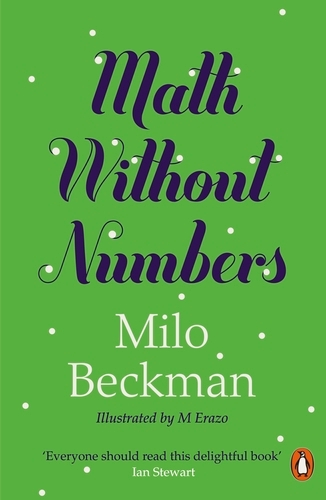
ii Math Without Numbers - final notes & obs

In Math Without Numbers the chapters and topics flow and slot in really well, even for novices. There is no index, the inclusion of which is a first-check usually. The book's appeal was its non-technical title and invitation reading the sleeve notes. The title throws up words and visuals, the latter, to repeat, are ably and simply furnished by M Erazo. Remaining notes to highlight (record here) include (and capture overthinking!):

Math Without Numbers

Reference to 'ideology space', 'conceptual space' and the role of visual analogies, idioms, and how 'the list of spaces to choose from is always the same.' ... pp.28 & 29. On page 30, 'When you say that gender is a spectrum rather than a binary, that's a topological claim: You're  saying gender space is one-dimensional (a line) rather than zero-dimensional (two separate points). 'Questions about which conceptual paradigm to use sometimes boil down to questions of dimensionality.' Discussion of an infinite continuum had me making an axis of Hodges' model warp, this way and that: concave-convex (p.59). Maps and correspondence is already well established, as per a new paper (abstract and thanks to follow 1st Feb):

S. Bettiol, P. Jones, H. A. Onyedikachi, and W. G. Kernohan, “Bridging Gaps in Oral Health Frameworks: Mapping With Hodges' Health Career - Care Domains - Model”, Journal of Public Health Dentistry (2026): 1–14, https://doi.org/10.1111/jphd.70034 

Interesting to read of general map facts, flowing substances inside a rigid container, and vector maps. A pencilled note to share:

'Because when you look at things in the abstract like this, dusting off the specifics of a situation to focus on underlying dynamics, you start to realize there are only so many different patterns and structures out there. These patterns and structures are called mathematical objects, and thinking about them is called math.' p.79

The chapter on (generalised) Algebra, forced me to reconsider the Socratic, guided discovery and arrival at the structure of Hodges' model. (lines & points : nodes & edges). For page 88, I noted 'generic' invites abstraction. Isomorphism is discussed. Again I tested this against Hodges' model. I've always found it helps to immerse oneself in a new vocabulary: so welcome (anew) - structures, fields, rings, groups, loops, graphs, lattices, orderings, semigroups, groupoids, monoids, magmas, modules . . . algebras, p.101. Some are named only, but on graphs raises questions ... p.103.

'How densely interconnected is it? How segregated into different cliques? Does it cut clean into two subgraphs, with no connections between them? Can it be drawn without any lines crossing? Are there any lone dots without any connections?' 

There's the matter of 'friend of a friend' who have broken out of the sociological domain. Other notes to self: Significance of concepts - patient-centred, service-centred? The distance between between (vertical, horizontal, diametric)? There are weighted graphs (p. 104) and acknowledgement of category theory (p.115). A chapter on modelling pp.161-175, and models p.164 & p.169 are just a selection of highlights on a marvellous tour.

A hidden puzzle in the book remains a mystery for me.

Milo Beckman (2021) Math Without Numbers. London, Penguin Books. Illustrated by M. Erazo.

Previously: 'math' : 'diagrams' 
Plus, now archived Science domain links: 
https://web.archive.org/web/20150414125339/http://www.p-jones.demon.co.uk/linksTwo.htm

Believe it or not, this 'diversion' does help my reading of Order and the Virtual. 

Sunday, January 25, 2026

'Maths Without Numbers' by Milo Beckman

'Before you go tell your loved ones that you read a book about math and learned that a square is a circle, keep in mind: Context matters. A square is a circle, in topology. A square is most certainly not a circle in art or architecture, or in everyday conversation, or even in geometry, and if you try to ride a bike with square tires you won't get far.' pp.7-8.

'Like a line:

(Illustration - pen drawing of a line, a 'C' and an almost closed circle.)

A line can be bent almost into a circle, but to finish the job we'd need to click the ends together--not allowed. No matter how you manipulate a line, you'll always have those two special points on either end, where the shape just stops. You can't get rid of end-points. You can move them around and stretch them apart, but the two end-points are an unchanging feature of the shape.

For a similar reason, a figure-eight is a different shape too. There aren't any end-points, but there's still a special point in the middle where the lines cross, where there are four arms reaching out instead of the usual two at any other point. Stretch and squeeze all you want, you can't get rid of a crossing-point either. p.9.

Math Without Numbers
'The circle (aka S-one) and the infinite line (named R-one) are the only manifolds in the first dimension. To avoid end-points, you either have to loop back around or just go on and on forever. And don't forget: Because all the shapes in topology are stretchy, this also covers any closed-loop shape and any goes-on-forever shape. It doesn't have to be literally a circle or a straight line.' p.16.

The third dimension, dough-type manifolds, is pretty well understood at this point, though it took a hundred years and a million-dollar prize to get there, and we still don't have a totally neat and clean classification like the lower dimension. In dimensions five and up, topologists use a set of techniques called "surgery theory" to operate on manifolds and construct new ones.

That just leaves dimension four.

I wish I could tell you what's going on in dimension four. I'm not sure there's anyone who really knows. It's a weird boundary case: too many dimensions to do visually, but not enough to use sophisticated surgery tools. There are entire textbooks dedicated to what little we know about four-manifolds, and I couldn't make sense of anything past the opening pages. A professional topologist once told me she'd wanted to work on four-manifolds as an undergraduate but was advised to steer clear.' pp.23-24.

"Like a line" ... Yes. Take two that cross. Then the universes open up. 

Milo Beckman (2021) Math Without Numbers. London, Penguin Books. Illustrated by M. Erazo.

Previously: 'surgery'

Sunday, December 28, 2025

Feedback on Hodges' model in 'mathematical' terms

Through HIFA, I noticed an introduction by a new subscriber - Mr James Twahirwa; and noted a maths-oriented skillset:

'HIFA profile: James Twahirwa works on Research and data analysis in Rwanda. He is deeply interested in contributing to the global effort to improve health equity through reliable, accessible information. His background in statistics, data analysis, and research methods equips him to support evidence-based decision-making and strengthen health systems.

By email, I got in touch seeking an independent reading of the draft h2cm-maths paper (part 1).

Prior to this, Mr Twahirwa kindly made the following observations on Hodges' model which he is happy for me to post here:

==============

Dear Peter Jones 

I find your work interesting and really well-positioned.

Overall impression

Your work is intellectually ambitious and unusually well-positioned. You are attempting something that many disciplines struggle with: creating a unifying conceptual framework that can bridge practice, theory, and abstraction without collapsing into reductionism. The fact that Hodges’ model originates in nursing and has sustained relevance across decades already gives it credibility as a practice-informed epistemic structure, not just a diagram.

Your effort to reinterpret it through mathematics and category theory is especially interesting, because health economics often suffers from exactly the fragmentation your work seeks to address: disconnected models of behavior, outcomes, ethics, and systems.

1. The 2x2 structure aligns naturally with health systems thinking

Health economics constantly balances dualities such as:

  • Individual vs population
  • Clinical outcomes vs social value
  • Quantitative evidence vs lived experience
  • Efficiency vs equity

A 2x2 framework provides a powerful way to hold these tensions without collapsing them into a single metric. This is one reason cost-effectiveness frameworks often feel incomplete. Hodges’ model appears capable of holding multiple dimensions of value simultaneously.

2. Conceptual clarity over mathematical dominance

Health economics has increasingly recognized that mathematical rigor alone does not guarantee insight. Your attempt to treat Hodges’ model as a conceptual object rather than a predictive algorithm is aligned with modern critiques of over-formalization in economics and health policy.

Where your work could be strengthened

1. Clarify the “mathematical” claim carefully

From a health economist’s perspective, the risk is not that the model lacks mathematics, but that readers may misunderstand what kind of mathematics is being invoked.

You may want to explicitly distinguish between:

  • Mathematics as computation or formal proof
  • Mathematics as structural reasoning (relations, mappings, constraints)

Making this distinction early will help avoid criticism that the model is “not really mathematical,” while still defending its rigor.

2. Connect to applied decision-making

To attract health economists and policy researchers, it may help to show how Hodges’ model could:

  • Frame health technology assessment decisions
  • Structure evaluations of complex interventions
  • Support mixed-methods research designs

Even one concrete example (e.g., health service redesign, chronic disease management, or resource allocation) would strengthen its practical relevance.

3. Position the work in relation to existing frameworks

Your work resonates with, but is distinct from:

  • Systems thinking in health
  • Capability approach (Sen, Nussbaum)
  • Complex adaptive systems
  • Multi-criteria decision analysis

Explicitly stating how Hodges’ model complements or improves upon these will help readers locate it intellectually.

I hope this feedback may be of help

Happy festive season.

=================

Thank you Mr James Twahirwa. These comments are very helpful. You have identified the many strengths of Hodges' model and its uses. On the mathematics, you make many points for me to address and balance in terms of the overall intent and content of this 'project'.

Mr Twahirwa is now in possession of the draft paper. Any further thoughts are always welcome. While rather remote from clinical practice (a debate in itself) health economics is ultimately grounded in health services and health systems development. So this perspective provides a critical counterbalance to my clinical (business) as usual approach.

Point #1 is a primary motivating factor for this 'project'. I'm sure I can use structure as an anchor, while acknowledging that Hodges' model is a conceptual model, an idealisation. Additional feedback regards reasoning, decision making and Bayes also apply here:
[ ii Learn your lines and the hyperplanes will follow ].

In Point #2 I may be able to leverage research, drawing from #1:

'Mathematics as structural reasoning (relations, mappings, constraints)'.

Point #3 will be considered in-part through April's complexity conference; and revisiting former work on systems.

Both points #2 and #3 may find their home in a second paper (part 2), but this is fine, as it may support a step-wise workflow, and something akin to a logical progression(?).

As posted before any assistance greatly appreciated.

Sunday, November 30, 2025

Interesting ... 'Incidence structure(s)'

Unsurprising, in studying 'Hodges' model, I've been aware of Wilfrid Hodges and model theory for many years.


Now, trying to look at (Brian) Hodges' model using maths, I've wondered about possible connections with Wilfred Hodges' work.

Dr W. Hodges was listed in searches on lines, axes, and structure:
'Algebraists and geometers like to classify structures by the laws which they obey. A typical law for incidence structures reads:

"For any two different lines L and M, there is exactly one point which lies on both L and M."'
My imagination may be getting the better of me, but there seems something profound in the intersection of the model's two axes and the care - knowledge domains that are created (proposed - adopted..)?

So, is Hodges' model a form of 'incidence structure', or does it contain several incidence structures? 

Hodges, W. (1985). Truth in a Structure. Proceedings of the Aristotelian Society, 86, 135–151. http://www.jstor.org/stable/4545041

Monday, November 24, 2025

Working title: 'Can Hodges’ model provide a foundation for a mathematically informed ...

... epistemology and relational ontology? Part 1'

Abstract

Aims: To begin a process of examining a ‘model of care’ and conceptual framework known as Hodges’ model as a mathematical object. This paper examines the structural elements of this model, its axes and domains through a formal, logical and mathematical lens. To establish the extent to which a combined relational understanding and mathematical approaches can provide avenues for further research.

Design: This study adopts the design of a two-part exploratory and descriptive paper, using an inquiry-based approach throughout.

Methods: The method is interdisciplinary, descriptive, and involves conceptual analysis. Rather than Hodges’ Model acting as a model of, and for care, here the model is used to investigate how health and social care can be better conceptualised. The question is: What is the result when Hodges’ Model is treated as a mathematical object? Here, Hodges’ model is used as an inquiry-based model with reflection and critique.

Results: Readers will see the development of ideas, driven by the structure of a model of care, existing taxonomy defined by nursing theory, associated with foundational mathematical concepts.

Conclusion: The questions introduced and deliberated here will identify avenues for further study. And highlight Hodges’ model to other researchers; less familiar with Hodges’ model, and yet more skilled – adept mathematically.

What does this paper contribute to the wider global clinical community?

Re-assert the importance of theory development in nursing and health disciplines.

Draw attention to the relational (and reflexive) potential of Hodges’ model and in healthcare to abstract the collective dimensions of healthcare, especially those that are political.

Given the problems faced in the century to follow, e
ncourage researchers within and without healthcare to further develop these ideas.

Impact:

Extend the relevance and scope of mathematical abstraction, in healthcare disciplines and the humanities, beyond statistical analysis.

This paper confirms: the conceptual utility of Hodges’ model; the challenge of requisite mathematical skills; the need for interdisciplinary cooperation.

Theorists in health and social care, policy makers and researchers seeking to apply mathematical techniques, especially category theory in the social science may find this work helpful and encouraging.

Reporting Method: N/A

Patient or Public Involvement: This study did not include patient or public involvement in its design, conduct, or reporting.

Keywords: nursing, theory, relational ontology, health, Hodges’ model, 
mathematics

Friday, November 21, 2025

Hodges' model - Locus of Care & Control?

Draft notes:

There are obvious geometric features (Stewart, 1981) in Hodges’ model. Application of the model is a holistic affair. The centre of the model is its centre (as a template), but in application it is not fixed. There are several degrees of freedom, determined by the context of application. Consider figures 4a, 4b and 4c. Perhaps it can be argued there is what amounts to a care locus? As Persons (2025) notes:
‘Primary care is considered the first line of defense in health care, and it is the locus of the maintenance of both individual and population health.‘ p. 15.

 Emphasis can be placed on selected domains, as the situation dictates:


Stewart, I. (1981) Concepts of Modern Mathematics, Harmondsworth: Penguin Books.

Persons, G. A. (2025). Health Care Safety Nets: Vital Participant Roles and Varying Policy Contexts. Phylon (1960-), 62(1), 5–30. https://www.jstor.org/stable/27396595

Wednesday, November 12, 2025

The INDIVIDUAL ↔ GROUP axis

Looking at the axes of Hodges' model, specifically the INDIVIDUAL ↔ GROUP axis, I realise (as ever) there's more than meets the eye. 

The labels for the axes are placeholders. To a certain degree they are open, flexible. In the template (link and figure in the sidebar), the what should now be familiar labels are provided for guidance, and convenience.

The care, knowledge domains can be viewed as giant - compound placeholders, even as an opportunity to abstract away a lot of detail. In care delivery, as we concentrate on patient care, , clinical interactions, procedures ... we tend to do this in political terms. Until that is, we are jolted to the wider situation and the true realities of policy, law, and practice.

While the HUMANISTIC ↔ MECHANISTIC labels are fixed, I've often shown how the I ↔ G is itself situated, so you could variously have (titles & names to follow...):

person, self, I, individual, client, patient,
carer, student, nurse x, dr y, allied health z ..

|

nurse .., husband, wife, partner, kin, couple, guardian, friend, family, team, group, community, region, nation, populations, Planet

Usually, what we have is a ONE-TO-MANY relationship, that is 1:N.

In Hodges' model can we also say that the team is the 'individual' and the organisation the group?

Another thought regarding self-care. ... Some times this state might be concurrent with being a patient.

Part of the journey in a patient's recovery. But at some point the person does not need a professional and is indepedently self-caring. Care episodes are not what they used to be. Although when 'true' self-care is achieved, it might appear One-to-None, but this is not correct. Not correct, that is, if we can credit society acting as a safety net. Usually, it would be One-to-Family; if there is no family, then the One-to-Community should (must) be the placeholder of choice.

On self-care, and the vertical axis of Hodges' model, is this also a way to define sustainable health and social care?

See also: https://hodges-model.blogspot.com/2025/10/l-shaped-model.html

Thursday, October 30, 2025

In Browder, 'care' is mentioned over 150 times!

OK - so now you're teasing ...

'Surgery theory investigates the homotopy types of manifolds, using a combination of algebra and topology. It is the aim of these notes to provide an introduction to the more algebraic aspects of the theory, without losing sight of the geometric motivation.' Ranicki, 2001. 
'IV. Surgery and the Fundamental Theorem

In this chapter we develop the techniques of surgery for constructing normal cobordisms and use them to prove the Fundamental Theorem. The ideas of surgery have their origins in the theory of 2-manifolds, in the process of "cutting off handles", and in general, in the theory of Marston Morse of non-degenerate critical points of differentiable functions.' Browder, 1972.

In Browder, care is mentioned over 150 times!

'Poincaré' that is.

individual
|
INTERPERSONAL : SCIENCES
humanistic -------------------------------------------  mechanistic
SOCIOLOGY : POLITICAL
|
group-population


'The Classifying Spaces for Surgery
and Cobordism of Manifolds'

Try to - follow the language* ...

"Follow the money!"


Ranicki, A. (2001) An introduction to algebraic surgery. Surveys on Surgery Theory, Volume 2, edited by Sylvain Cappell, Andrew Ranicki and Jonathan Rosenberg, Princeton: Princeton University Press, 2001, pp. 81-164. https://doi.org/10.1515/9781400865215-005

Browder, W. (1972) Surgery and the Fundamental Theorem. In: Surgery on Simply-Connected Manifolds. Ergebnisse der Mathematik und ihrer Grenzgebiete, vol 65. Springer, Berlin, Heidelberg.
https://doi.org/10.1007/978-3-642-50020-6_4

Madsen, I. H., and Milgram, R.J., (1979) The Classifying Spaces for Surgery and Cobordism of Manifolds. Princeton University Press.

Image: https://m.media-amazon.com/images/I/41THEeVvpdL.jpg

*concepts!

Sunday, October 26, 2025

'Politics as a science' ...

'The science of politics is the oldest of the social sciences but still perhaps the most dependent: it derives much of its methodology from statistics (the science of the state turned into the science of numerical data), from economics and from sociology and it steals much of its substance from anthropology, from history and from law. Yet there is little doubt about the core of the subject: it focuses on the ways in which decisions are taken by men acting within territorially or functionally defined networks and constellations of organizations. And the hallmark of the discipline is 'its systematic analysis', whether couched in verbal and literary terms or in the formalized language of statistics or of mathematical logic.' Preface vii
Hayward R. Alker, Karl W. Deutsch, Antoine H. Stoetzel (eds.), Mathematical Approaches to Politics, Amsterdam, Elsevier, 1973, pp. 475.

Saturday, July 05, 2025

'Axiomatic' - according to Simondon

Glossary:

Fifty Key Terms in the Works of Gilbert Simondon, pp.203-231.
Jean-Hugues Barthélémy, translated by Arne De Boever. 
In. De Boever A, Murray A, Roffe J, eds. Gilbert Simondon: Being and Technology. Edinburgh University Press; 2012.
'Axiomatic
In Simondon, this notion does not designate a formal system as in the case of logico-mathematical axiomatics, but simply a set of principles, or first propositions, that enable the linking fundamental concepts. It is in this sense that Simondon, in IPC in general and more specifically in FIP, struggles to work out a 'common axiomatic' (FIP, in IPC 35 or ILFI 533) for the human sciences - which enables the unification of psychology and sociology.' p.208.


Simondon holds hope for me (I think) in terms of the extent of formality I (and others) might seek for Hodges' model. Is there a set of principles - and simple at that? The structure of Hodges' model 'places' the knowledge (care) domains of psychology (intrapersonal & interpersonal) and sociology next to each other, as if to encourage unification. The bridge: psycho-social and a great many others, are there, to take walk and reflect on what we find there. If we choose to. ...

I'll check on the abbreviations. 

FIP : « Forme, information, potentiel » (conférence datant de 1960, ajoutée par l’éditeur), in Simondon, ILFI et IPC (voir ci-dessous).

ILFI : L’individuation à la lumière des notions de forme et d’information, Grenoble, Éditions Jérôme Millon, 2005 (Thèse principale de Simondon pour le Doctorat d’État, écrite de 1954 à 1958). 

IPC : L’individuation psychique et collective, Paris, Aubier, 1989 et 2007 (cet ouvrage contient le dernier tiers d’ILFI, ainsi que son Introduction et sa Conclusion).

https://journals.openedition.org/appareil/2253

Thursday, March 06, 2025

Understanding Mathematics + Domains towards Corridors

It is for others to judge - whether it is helpful or distracting; but I find concepts defined by other disciplines, or professions illuminating and insightful. Especially so, when it comes to 'domain'. In Hodges' model - all four of them. Five! When (not if), we include the spiritual:
'Greeno (1991) argued that students develop understanding when

"a domain is thought of as an environment, with resources at various places in the domain. In this metaphor, knowing is knowing your way around ir the environment and knowing how to use its resources. This includes knowing what resources are available in the environment as well as being able to find and use those resources for understanding and reasoning. Knowing includes interactions with the environment in its own terms - exploring the territory appreciating its scenery and understanding how its various components interact. Knowing the domain also includes knowing what resources are in the environment that can be used to support your individual and social activities and the ability to recognize, find, and use those resources productively. Learning the domain, in this view, is analogous learning to to live in an environment: learning your way around, learning what resources are available, and learning how to use those resources in conducting your activities productively and enjoyably. (p. 175)"

In particular, in chapter 8, Nemirovsky et al. use the metaphor of becoming familiar with a new place (e.g., a town, a train station) and the process of learning a new mathematical concept.' p.7.

Greeno, J. (1991), Number sense as situated knowing a conceptual domain.,Journal for Research in Mathematics Education, 22(3), 170-2 18. 

Understanding Mathematics and Science Matters
. Edited by Thomas A. Romberg Thomas P. Carpenter Fae Dremock University of Wisconsin-Madison. EA LAWRENCE ERLBAUM ASSOCIATES, PUBLISHERS 2005 Mahwah, New Jersey London. (I hope there is a 2nd edition?)

(I will try to add the Nemirovsky et al. reference when I can.)

Previously: 'territory' : 'map' : 'vocabulary'