Hodges' Model: Welcome to the QUAD: intersectionality

Hodges' model is a conceptual framework to support reflection and critical thinking. Situated, the model can help integrate all disciplines (academic and professional). Amid news items, are posts that illustrate the scope and application of the model. A bibliography and A4 template are provided in the sidebar. Welcome to the QUAD ...

Showing posts with label intersectionality. Show all posts

Sunday, November 30, 2025

Interesting ... 'Incidence structure(s)'

Unsurprising, in studying 'Hodges' model, I've been aware of Wilfrid Hodges and model theory for many years.


Now, trying to look at (Brian) Hodges' model using maths, I've wondered about possible connections with Wilfred Hodges' work.

Dr W. Hodges was listed in searches on lines, axes, and structure:
'Algebraists and geometers like to classify structures by the laws which they obey. A typical law for incidence structures reads:

"For any two different lines L and M, there is exactly one point which lies on both L and M."'
My imagination may be getting the better of me, but there seems something profound in the intersection of the model's two axes and the care - knowledge domains that are created (proposed - adopted..)?

So, is Hodges' model a form of 'incidence structure', or does it contain several incidence structures? 

Hodges, W. (1985). Truth in a Structure. Proceedings of the Aristotelian Society, 86, 135–151. http://www.jstor.org/stable/4545041
Tuesday, October 14, 2025

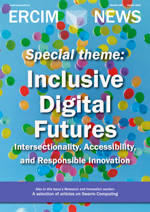
ERCIM News No. 142 Special theme: "Inclusive Digital Futures: Intersectionality, Accessibility, and Responsible Innovation"

Dear ERCIM News reader,

The October 2025 issue of ERCIM News (Number 142) is now online! The special theme of this issue looks at how Computer Science can help build more inclusive and diverse communities. This includes both the digital world and its own research and work environments. The issue features contributions from diverse fields of research and innovation, as well as reports on applied initiatives and policies that promote inclusion and diversity.

This special theme was coordinated by our guest editors Magdalini Chatzaki (FORTH-ICS) and Anna Szlávi (Johannes Kepler University)

Next Issue

No. 143 – January 2025
Special Theme: AI for Science

Call for Contributions

Announcements in this issue
  • Dagstuhl Seminars & Workshops – Call for Proposals
  • ERCIM Forum “Beyond Compliance” – 4th Edition | 29–31 October 2025 | Registration still open
  • 33rd IEEE International Conference on Software Analysis, Evolution, and Reengineering (SANER 2026) | Tracks Call for Papers
  • Welcome to the 45th SAFECOMP 2026 | Call for Papers
  • 21st International Workshop on Dependable Smart Embedded Cyber-Physical Systems and Systems-of-Systems (DECSoS 2026) | Pre-Announcement
  • ERCIM “Alain Bensoussan” Fellowship | Next application deadline: 30 April 2026
    This issue includes:

Introduction to the Special Theme 
  • p.8 Inclusive Digital Futures: Intersectionality, Accessibility, and Responsible Innovation
Inclusive Digital Futures – Intersections of Technology, Security, Discrimination, and Bias
  • p.10 Securing Open Source for a Trusted and Inclusive Digital Future
  • p.11 The Role of AI-Based Age Estimation in Promoting Safer Digital Environments for Children: Ethical and Accessibility Considerations 
  • p.13 SafeLine.gr - The First Official Trusted Flagger Organisation under the Digital Services Act (DSA) in Greece
Education & Training, Interventions, Policies, Protocols, and Tools 
  • p.27 When Used Outdoors, Augmented Reality Amplifies Situational Disabilities 
Research and Innovation
  • p.40 Forecasting Air Pollution at Construction Sites: A New Framework for Environmental and Social Sustainability
Thank for reading ERCIM News. If you’ve enjoyed this issue, please feel free to forward it to colleagues who may find it interesting and help us reach even more by sharing it on LinkedIn.

If you’re considering an even deeper partnership, advertising in ERCIM News not only helps sustain our publication but also puts your message in front of an expert, highly qualified audience.
My source with thanks: 
Peter Kunz
ERCIM
https://www.ercim.eu
https://ercim-news.ercim.eu

Join the ERCIM LinkedIn Group: https://www.linkedin.com/groups/81390/
Follow us on X: https://x.com/ercim_news

Wednesday, December 18, 2024

Hornberger (1989) 'Continua of Biliteracy'. Review of Educational Research

The axes of Hodges' model present a problem in:

  • theory
  • practice
  • evidence - research terms (data!).

The easiest to resolve is practice, which is were Hodges' model can lay claim to being a pragmatic solution. Of course, it isn't the axes that are the difficulty, it is the labels that Brian Hodges originally applied in the early-mid 1980's, followed by other users of the model since. From:

INDIVIDUAL <> GROUP - variations here in 'Welcome to the QUAD' [W2tQ] Patient <> Carer - Family : Client <> Health professional. You can progress to the "patient zero" and a population in an pandemic.

These are fundamental elements in clinical encounters, whether face-to-face, online, and across settings.

The same applies to the horizontal axis: HUMANISTIC <> MECHANISTIC.

As presented - in the sidebar, and the two-by-two table found in many posts - the model has a distinct dichotomous quality. It seems to set up, or invite opposition, or polarities. Sometimes I've viewed the axes as continua, but they are not graduated, incremental in a quantitative sense.

Do the axes of Hodges' model serve a need (do their work) by allowing the user to differentiate through opposition and relational appraisal (testing)? Perhaps, qualified in a respective profession / subject area, the user of Hodges' is employing other axes?

This brings us to intersectionality and the cognitive work of placing the person (couple, family, community ... biosphere) at the centre of our deliberations.

In biliteracy studies, Hornberger (1989) is perhaps more accurate in seeing a series of multidimensional and interrelated continua (p.273) which form a framework.

There are three figures in this paper and many other points of use:

"Contexts of biliteracy are defined, then, by these three continua. Any particular instance of biliteracy is located at a point of intersection among the three." p.280.

In health care this is readily understood given the varied contexts of the centre, the nexus of Hodges' model. When we say Hodges' model is situated, the centre of the model is the sweet and sour spot. For Hornberger, the context determines the use and significance of the continua.

This opens up Hodges' model as a potential tool to better understand the dimensions of diversity, inclusion and intersectionality.

Hornberger, N. H. (1989). Continua of Biliteracy. Review of Educational Research, 59(3), 271–296. https://doi.org/10.2307/1170183

No! This post hasn't been in draft since 1990. ;-)

Monday, April 09, 2018

Paper: Understanding the micro and macro politics of health [Mapped to h2cm]

"Almost a decade after WHO Commission on Social Determinants of Health published its influential report (2008), health inequalities within and across countries remain high on the research agenda. Acknowledging the complexity of the issue, scholars increasingly stress the need for the development of a theoretical framework that will integrate the multiple factors involved in shaping health inequalities, from individual social positions and experiences to institutions (Beckfield et al., 2015; Krieger, 2012, 2011)." p.92.

From Google:
intersectionality
ɪntəsɛkʃəˈnalɪti
noun
noun: intersectionality; plural noun: intersectionalities
  1. the interconnected nature of social categorizations such as race, class, and gender as they apply to a given individual or group, regarded as creating overlapping and interdependent systems of discrimination or disadvantage.

    "through an awareness of intersectionality, we can better acknowledge and ground the differences among us"

individual
|
INTERPERSONAL : SCIENCES
humanistic ------------------ INTERSECTIONALITY ------------------ mechanistic
SOCIOLOGY : POLITICAL
|
group
category salience and individual experience

"Intersectionality as an analytical tool of social stratification (Yuval-Davis, 2015) challenges the idea of a single, fixed social hierarchy. It perceives social positioning as a spot within a matrix of intersecting power axes (Crenshaw, 1992). Hence, there are no sociological categories (e.g. race, gender) that have an a priori greater significance in shaping individual experience." p.93.


qualitative

methods & methodology
analysis - synthesis

"Yuval-Davis (2015) elaborates on that and describes intersectionality as a context informed analytical tool (situated intersectionality) that focuses on the categories that reflect the social divisions shaping most people's lives (e.g. race and gender) in certain contexts and simultaneously it is sensitive enough to render visible other divisions shaping the experience of individuals and groups at marginal positions (e.g. sexuality)." p.93.
quantitative
race, ethnicity, class, gender, sexuality


social history 
social class
social exclusion  
stratification


"... intersections between social categories -

socio
"Studies have focused mainly on welfare states classified across certain typologies (eg. Esping-Andersen, 1990) as mechanisms that rank people into social hierarchies and (re)distribute social determinants of health." p.94.

Institutions, immigrant status
political minority struggle
 colonisation, enslavement


are .. reflections of intersecting systems of power" p.94

economic

Anna Gkiouleka, Tim Huijts, Jason Beckfield, Clare Bambra, Understanding the micro and macro politics of health: Inequalities, intersectionality & institutions - A research agenda, Social Science & Medicine, Volume 200, 2018, 92-98, ISSN 0277-9536.
https://doi.org/10.1016/j.socscimed.2018.01.025.
(http://www.sciencedirect.com/science/article/pii/S027795361830025X)
Keywords: Health inequalities; Intersectionality; Institutions; Health politics; Social positioning


My source: Prof. Dennis Raphael
Politics of Health Group Mail List Messages
Visit PoHG on Facebook: https://www.facebook.com/282761111845400
Follow us on Twitter: @pohguk
