Hodges' Model: Welcome to the QUAD: feedback

Hodges' model is a conceptual framework to support reflection and critical thinking. Situated, the model can help integrate all disciplines (academic and professional). Amid news items, are posts that illustrate the scope and application of the model. A bibliography and A4 template are provided in the sidebar. Welcome to the QUAD ...

Showing posts with label feedback. Show all posts

Monday, January 26, 2026

'Drama classes help GPs handle difficult patients' c/o BBC

'Hull Truck Theatre has just won the Innovation prize at the Stage Awards for their new training scheme for GPs. Associate Director Tom Saunders and GP Dr Eman Shamsaee discuss why drama classes are helping doctors treat patients.' 

BBC Radio 4 'Front Row' https://www.bbc.co.uk/sounds/play/m002q2jz (15 mins ...)

Holly Phillips, East Yorkshire and Lincolnshire and Ian Youngs, Culture Reporter

Published - 21 January 2026

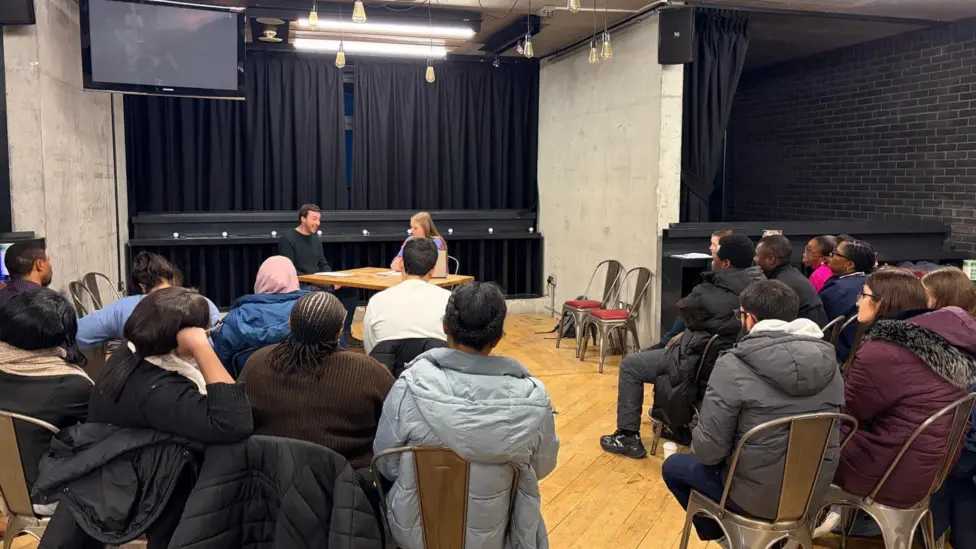
'A theatre company is using drama training to help doctors deal with challenging patients.

Hull Truck Theatre's classes feature actors performing difficult GP consultations, with GPs giving feedback before taking over the consultation themselves.

The theatre recently won the Innovation Award at the Stage Awards for the programme.

Dr Eman Shamsaee, who has taken part in the training scheme, described it as a "really creative way of doing GP training".'

BBC News:  Drama classes help GPs handle difficult patients

INDIVIDUAL
|
 INTERPERSONAL    :     SCIENCES               
HUMANISTIC --------------------------------------  MECHANISTIC      
SOCIOLOGY  :   POLITICAL 
|
GROUP


The training programme has completed its pilot stage and is now in the delivery phase


A reminder of co-working to deliver STORM training with a Clinical Psychologist colleague. 

See also: 'communication' : 'primary care' : 'GP' : 'drama'

Sunday, December 28, 2025

Feedback on Hodges' model in 'mathematical' terms

Through HIFA, I noticed an introduction by a new subscriber - Mr James Twahirwa; and noted a maths-oriented skillset:

'HIFA profile: James Twahirwa works on Research and data analysis in Rwanda. He is deeply interested in contributing to the global effort to improve health equity through reliable, accessible information. His background in statistics, data analysis, and research methods equips him to support evidence-based decision-making and strengthen health systems.

By email, I got in touch seeking an independent reading of the draft h2cm-maths paper (part 1).

Prior to this, Mr Twahirwa kindly made the following observations on Hodges' model which he is happy for me to post here:

==============

Dear Peter Jones 

I find your work interesting and really well-positioned.

Overall impression

Your work is intellectually ambitious and unusually well-positioned. You are attempting something that many disciplines struggle with: creating a unifying conceptual framework that can bridge practice, theory, and abstraction without collapsing into reductionism. The fact that Hodges’ model originates in nursing and has sustained relevance across decades already gives it credibility as a practice-informed epistemic structure, not just a diagram.

Your effort to reinterpret it through mathematics and category theory is especially interesting, because health economics often suffers from exactly the fragmentation your work seeks to address: disconnected models of behavior, outcomes, ethics, and systems.

1. The 2x2 structure aligns naturally with health systems thinking

Health economics constantly balances dualities such as:

  • Individual vs population
  • Clinical outcomes vs social value
  • Quantitative evidence vs lived experience
  • Efficiency vs equity

A 2x2 framework provides a powerful way to hold these tensions without collapsing them into a single metric. This is one reason cost-effectiveness frameworks often feel incomplete. Hodges’ model appears capable of holding multiple dimensions of value simultaneously.

2. Conceptual clarity over mathematical dominance

Health economics has increasingly recognized that mathematical rigor alone does not guarantee insight. Your attempt to treat Hodges’ model as a conceptual object rather than a predictive algorithm is aligned with modern critiques of over-formalization in economics and health policy.

Where your work could be strengthened

1. Clarify the “mathematical” claim carefully

From a health economist’s perspective, the risk is not that the model lacks mathematics, but that readers may misunderstand what kind of mathematics is being invoked.

You may want to explicitly distinguish between:

  • Mathematics as computation or formal proof
  • Mathematics as structural reasoning (relations, mappings, constraints)

Making this distinction early will help avoid criticism that the model is “not really mathematical,” while still defending its rigor.

2. Connect to applied decision-making

To attract health economists and policy researchers, it may help to show how Hodges’ model could:

  • Frame health technology assessment decisions
  • Structure evaluations of complex interventions
  • Support mixed-methods research designs

Even one concrete example (e.g., health service redesign, chronic disease management, or resource allocation) would strengthen its practical relevance.

3. Position the work in relation to existing frameworks

Your work resonates with, but is distinct from:

  • Systems thinking in health
  • Capability approach (Sen, Nussbaum)
  • Complex adaptive systems
  • Multi-criteria decision analysis

Explicitly stating how Hodges’ model complements or improves upon these will help readers locate it intellectually.

I hope this feedback may be of help

Happy festive season.

=================

Thank you Mr James Twahirwa. These comments are very helpful. You have identified the many strengths of Hodges' model and its uses. On the mathematics, you make many points for me to address and balance in terms of the overall intent and content of this 'project'.

Mr Twahirwa is now in possession of the draft paper. Any further thoughts are always welcome. While rather remote from clinical practice (a debate in itself) health economics is ultimately grounded in health services and health systems development. So this perspective provides a critical counterbalance to my clinical (business) as usual approach.

Point #1 is a primary motivating factor for this 'project'. I'm sure I can use structure as an anchor, while acknowledging that Hodges' model is a conceptual model, an idealisation. Additional feedback regards reasoning, decision making and Bayes also apply here:
ii Learn your lines and the hyperplanes will follow ].

In Point #2 I may be able to leverage research, drawing from #1:

'Mathematics as structural reasoning (relations, mappings, constraints)'.

Point #3 will be considered in-part through April's complexity conference; and revisiting former work on systems.

Both points #2 and #3 may find their home in a second paper (part 2), but this is fine, as it may support a step-wise workflow, and something akin to a logical progression(?).

As posted before any assistance greatly appreciated.
Saturday, December 06, 2025

The critical pathway leads to ...?

I missed the most salient information on this book's cover - at least for me. My copy is secondhand, but I picked the copy up recalling Dr Walsh's many publications on models of nursing.

The critical pathway for me is plural. It would include, the CPN(Cert.) course when I first encountered Hodges' model in 1987-8. Plus the fact that the pathway is not unidirectional, with some backward steps and reviews, but is multifold. Running the axes of Hodges' model to - pre-op, surgery, post-op, rehab ... we can add the whole corpus of nursing, social, self, and global health care.

The cover is of course illustrative, intended to support the title and suggest an explicit critical pathway. Apart from possibly pointing to collaboration "Mr Jones ... Let us discuss your critical pathway!" what has changed? Since the book's publication in 1997, we need health care services and systems to be sustainable. We are bit late here. Mr Jones is already a 'patient', bedecked in dressing gown and slippers.


This critical pathway needs to be replaced by one informed and oriented towards Mr Jones as self-caring citizen. This is of course easier said than done in policy terms. While governments globally and institutions stress the need for health literacy, informed life style choices, self-care, health promotion and prevention how much progress is being made? Nutrition remains a profound issue.*

The environmental challenges of climate change, pollution and waste disposal are seemingly contested even as the effects and cost of non-action are increasingly obvious.

The policy of 'care in the community' even while incomplete in the community, has provided me with a stimulating, challenging and rewarding career 1985 ... In the 21st century though, we have to ask of the assessment of mobility to follow and effort of the up-hill walk to 'home' begs the critical pathway that is now Planetary Health.

<>

Several points from Walsh (1997):
'Introducing a model to a clinical area is not an easy task to be undertaken lightly, as it involves fundamental changes in the way staff think and work. Luker (1988) has suggested that each nurse carries around their own informal model of nursing which guides their practice. It is probable that a formal model will be significantly different, although these differences can be minimized by full consultation and involvement with staff to ensure that the model chosen reflects their views of nursing as far as possible.' p.36.
Hodges' model can be 'carried around'. In truth it not strictly a model of nursing. Its scope extends beyond nursing and yet the model can incorporate thought about the patient, nurse, environment and what health, illness, recovery and self-care entail. Hodges' model is meta-cognitive and meta-conceptual, and (very) capable of mapping the terrain (p.26) of nursing from these and other perspectives. A nurse's 'views of nursing' will be dictated by the situation presented to them. Hodges' model can be retrospective, prospective and operate in the here-and-now: situated.
'There is a further point, however, that follows on from Luker's observation for expert nurses have an internalized model of care which is unique to them, it is possible that they may have internalized some practices which are outdated, taken for granted or inappropriate (Paley, 1996) but which are never made explicit as their care is not based upon a commonly understood model of nursing. This notion of every nurse having their own model therefore can lead to the situation where outdated rituals can be propagated under the guise of expert practice. Having a series of explicit models whose aims and ideas are common knowledge, shared by all, opens up care to critical scrutiny in a way that is not possible if each nurse has their own private internal model.' p.37.

Hodges' model can be used with other models, conceptual frameworks and systems across disiplines. Hodges' model is not intended to be prescriptive or prospective. It can be utilised for learning and unlearning. As a registered General Nurse who studied in the 1980s this does not mean I would be competent and safe to practice now. Continuing professional development, mandatory training and revalidation of nursing registration are all geared to support professional practice that has currency, validity, and is safe.

If nursing ever needed a commonly understood model ...?

'It will be apparent from the previous sections that use of a model will lead nursing into some new and unfamiliar territory that will involve seeing the patient in a more holistic fashion'. p.63.

'The nurse may find that models start to identify environmental problems whose solutions lie beyond the boundaries of nursing at present. This is particularly true of the community nurse.' p.63.
Walsh's concern here is the immediate community, but we can recognise the prescience of environmental problems here. Plus the need for the POLITICAL domain in Hodges' model:
'On a larger scale still, perhaps some patient's problems have their origins in political decisions made by national govemment or perhaps it is the factory down the road producing unacceptable levels of pollution. If nursing models make us recognize the political and environmental causes of some patient problems, there should ee no logical reason why nursing should not go forward into theee arenas as a legitimate part of nursing intervention.' p.63.
'There are senior NHS managers and health academics in so-called 'policy thínk tanks' who simply do not recognize the value of nursing and see only a collection of simpie tasks which anybody with an NVQ level 2 can perform. Nursing therefore has to demonstrate its worth; it has to evaluate what it is doing for patients.
Here it is important to remember that the care given may be very different from what is written down. Consequently, how a nurse evaluates care mentally may be very different from how this care is recorded in nursing process documentation. ...' p.64.
Hodges' model can (imho) have a role in argumentation for the quality and scope of healthcare, for nursing as a profession, evaluating and assuring nursing's values in the constant that are the demands of complexity and change. The (several) determinants of health are the other constant.

Mike Walsh (1997) Models and Critical Pathways in Clinical Nursing. London: Bailliere Tindall.

Luker K. (1988) Do Models Work? Nursing Times, 84 (5), 27-29.

Paley, J. (1996), Intuition and expertise: comments on the Benner debate. Journal of Advanced Nursing, 23: 665-671. https://doi.org/10.1111/j.1365-2648.1996.tb00035.x

*Jones P, Wirnitzer K. Hodges’ model: the Sustainable Development Goals and public health – universal health coverage demands a universal framework. BMJ Nutrition, Prevention & Health 2022;5: doi:10.1136/bmjnph-2021-000254

Wirnitzer KC, Motevalli M, Tanous DR, Drenowatz C, Moser M, Cramer H, Rosemann T, Wagner K-H, Michalsen A, Knechtle B, Fras Z, Ritskes-Hoitinga M, Marques A, Mis NF, Stanford FC, Schubert C, Goswami N, Leitzmann C, Fredriksen PM, Ruedl G, Wilflingseder D, Lima RA, Kessler C, Jeitler M, Khan NA, Joulaei H, Fatemi M, Knight A, Kratky KW, Palmer KK, Haditsch B, Jakse B, Kofler W, Pfeiffer T, Cordova-Pozo K, Tortella P, Straub S, Lynch H, Schätzer M, Krishnan A, Fathima A. S, Gatterer L, Kriwan F, Abhishek M, Nandgaonkar H, Nandgaonkar S, Adedara AO, Haro JM, Gericke C, Neumann G, Akhtar A, Rashidlamir A, Thangavelu M, Ngoumou GB, Perpék É, Klaper M, Bhattacharya B, Kirschner W, Bessems KMHH, Jones P, Peoples G, Bescos R, Duftner C, Seifert G (2025). Toward a roadmap for addressing today's health dilemma–The 101-statement consensus report., 
Frontiers in Nutrition, Volume 12:1676080. doi: 10.3389/fnut.2025.1676080. https://doi.org/10.3389/fnut.2025.1676080

Sunday, December 18, 2022

CLOSE(D) CARE: Group climate in a secure forensic setting for individuals with mild intellectual disability

This morning ResearchGate alerted me to a new paper/thesis citing Hodges' model. 

I will add this to the bibliography and post again in the new year, relating selected conceptual content of Elien's thesis to Hodges' model.

Background

CLOSE(D) CARE
CLOSE(D) CARE
This study examines associations between group climate, aggressive incidents and coercive measures in adults with mild intellectual disability or borderline intellectual functioning (MID‐BIF) of a secure forensic setting.

Method Participants (N = 248) were interviewed about their perception of group climate utilizing the Group Climate Instrument. Data on aggressive incidents and coercive measures were retrieved from the facilities’ electronic database. A multilevel structural equation model was fitted in which variability in perception of group climate within and between living groups was examined.

Results An open and therapeutic group climate was associated with lower levels of aggression within and between groups. A higher number of aggressive incidents were significantly associated with a higher number of coercive measures.

Conclusions The findings have implications for the understanding of how group climate may play a role in reducing aggressive incidents at the living group in treatment of individuals with MID‐BIF in secure forensic settings.


Elien G Neimeijer (2021) "CLOSE(D) CARE: Group climate in a secure forensic setting for individuals with mild intellectual disability." Radboud University, ISBN: 978-94-6416-713-9
https://www.trajectum.nl/sites/default/files/proefschrift_e._neimeijer_pdf.pdf

Tuesday, July 05, 2022

Two policy initiatives related to Digital and eHealth - RCN

Dear eHealth forum members 

[c/o RCN]

We just wanted to alert you to two policy initiatives related to Digital and eHealth.

1. The Digital Nursing programme in England is seeking feedback on their consultation on having a Standard for Nursing Documentation. The draft standard and form to give feedback [by 21st July] are available on the NHS futures website (https://future.nhs.uk/DigitalNursesNetwork/view?objectID=36339504). 

You may need to register to access the site:

image: FutureNHS - Digital Nursing Programme


2. NHS England has just released their plan for Digital health and social care (https://www.gov.uk/government/publications/a-plan-for-digital-health-and-social-care/a-plan-for-digital-health-and-social-care).

With very best wishes

The eHealth forum committee

n.b. Closing date for feedback added in text.


Friday, January 10, 2020

Review: vi Kinchin's Visualising Powerful Knowledge to Develop the Expert Student

I have had a look at CMAP Tools over the years. My not actually using this software is an omission I must admit.. This year I will give CMAP a concerted try (and a review)?

My notes at the end of chapter 5 include: from bedside manner to fireside with regard to well-being. I think this was prompted by the conclusion students developing expertise (knowledge structures) not just as part of the curriculum, but motivation to extend their knowledge to "integrate characteristics of their future profession within their current studies" (p.84). My thought points to an increasing challenge to the 'professions' that governing bodies must be acutely mindful of, but also sustains and expands the space for non-professional experts - hence the 'fireside'. In mental health were lived experience continues to be pathologised and governments look to economise (professional rates of pay) this really brings home the future agenda.

Chapter 6 "Embedding Wider Theory" begins with a timeline from the 1960s that identifies key steps in theories, software conferences and journals (p.87).

By default Hodges' model can help transcend differences in terminology and make the links and overlap between the theories of Ausubel (in Psychology) and Bernstein (sociology, p.89). Diagrams being used to depict their respective work and support a more holistic view (my wording). Threshold Concepts are introduced (pp.89-92) and the discussion that follows of semantic gravity is a great insight (pp.93-100) together with the idea of punctuated learning. Perhaps the latter is also assisted by having a conceptual Swiss army knife ready-to-hand for when a burst (a step) of learning is initiated? There are many quotes here that I might return to later in the year.

As a student previously and mentor feedback is central and chapter 7 builds on chapter 6 and continues a call for change in feedback on learning AND teaching. 'Recipience' is stressed with its own section (pp.111-12); students may bemoan a lack of feedback but when provided do they engage with it? The book is rich throughout including this chapter and chapter 8 (final). As already noted an index would help, but I'm still bound to consider the related titles.

These posts have been text heavy, but for illustration purposes, the pièce de résistance is figure 44 on page 124:


Figure 44, page 124

I wonder if there is a common model that can act as a generic structure for readers and students disciplinary AND experiential knowledge structures?


Roland Tormey (2014) The centre cannot hold: untangling two different trajectories of the ‘approaches to learning’ framework, Teaching in Higher Education, 19:1, 1-12.
DOI: 10.1080/13562517.2013.827648

Novak, J.D. and Symington, D.J. (1982) Concept mapping for curriculum development. Victoria Institute for Educational Research Bulletin, 48: 3–11.

Kinchin, I., (2016) Visualising powerful knowledge to develop the expert student. Rotterdam: Sense Publishers.


Many thanks to Brill for the review copy:

https://brill.com/view/title/37823

BRILL  | Plantijnstraat 2 | 2321 JC Leiden | The Netherlands
BRILL  | P.O. Box 9000 | 2300 PA Leiden | The Netherlands


See also:

Intro post

Review One

Two

Three

Four

Five

Wednesday, June 20, 2018

Would you like to help design a new risk assessment tool?

On Tuesday, 19 June 2018, 19:06:42 GMT+1, Charlotte Christiane Hammer, UK wrote:

We are looking for experts in the fields of health protection and humanitarian aid who are interested in helping us with the content validation for a new risk assessment tool for communicable diseases in humanitarian emergencies. The validation will be in the form of a short interview (between 20 and 35 minutes) via Skype during which you will have the opportunity to examine the tool and comment on it. If you are interested or know anyone who might be interested, please send us an email and we will give you further details regarding the project and the consent procedure. Your help is greatly appreciated. Please also forward this email to any colleagues who might be interested.

Kind regards,
Charlotte Hammer

Charlotte Christiane Hammer, MA, MPH
PhD Candidate

Health Protection Research Unit in Emergency Preparedness and Response
University of East Anglia
c.hammer AT uea.ac.uk

Related post - Dec 2017  
My source:
HIFA: Healthcare Information For All: www.hifa.org
HIFA Voices database: www.hifavoices.org

Wednesday, January 06, 2010

BBC R4 Friday 8th Jan: NHS Punters Speak Out

This programme (episode 1) is on BBC Radio 4 on Friday 11.00:

With the help of dissatisfied NHS patients, Liz Barclay asks if the growing popularity of online feedback can really make a difference to standards of health care and treatment.
The culture of customers offering brickbats and bouquets to service providers has now extended beyond hotels and coffee chains to the NHS. Hospital rating websites invite patients to grade their hospital stay out of five stars, and to leave comments about the care they received.
Liz invites NHS patients who have used one of these patient rating websites to discuss their experiences and puts their points to the hospitals where they were treated.
She asks if the idea of online feedback can be really be applied to our health service and if it can genuinely improve standards of care. Critics suggest the sites are merely window-dressing and that NHS patients are not 'consumers'. Some health professionals claim that the sites can easily just become places where personal scores are settled against NHS staff.
<->

Introductions to Hodges' model for different audiences -

"Patiency"
(person-centred care)
Health, Social Care professionals
(inc. all in a student capacity)
The Public, CitizensManagers, Policy Makers


These introductions will be re-written for the new website and represent possible projects for volunteers / students...?

Saturday, May 31, 2008

Journeys of work and socio-technical kinds

It has been a very busy and taxing week with preparation for a job interview on Thursday. On this occasion I did very well with the presentation, but I really need to get myself sorted when it comes to anticipating and answering the questions....

Note to self: How many times!!! Read the job & person spec Dopey! You don't have to empathise (even if it helps) you're not@work - you're seeking work - be ready to answer the questions.

Interview panels need more, much more - so next time... As it happens I understand that no appointment was made. Although very disappointed I learned an awful lot*. There may be news of another opportunity this week, which would actually be a preparatory step along where I believe I am heading....? Fingers x'd anyway. I'm really looking forward to next time: with both eyes wide open.

14 May I received feedback on the socio-technical chapter proposal, but until now I've not had time to take a peek (nerves too!). It seems the editors and publishers consider the draft 'definitely publishable' which is another great step forward. One negative comment highlighted the fact that the introduction to Hodges' model has been published previously. This introduction does work - it is history. I will acknowledge this in the text and the references. The need to produce new introductory material is (still) on my to-do-list. If you would like to add this to your td-list please let me know.

After the interview I visited Tate Modern (which closed at 6pm sadly) and the National Portrait Gallery - which reminded me of the draft scripts still awaiting mic's attention (apparently podcast 1 with notes, summary slides and questions has been downloaded 345 times).

I'm making the required changes to the chapter (deadline 6th June), then I can think about the next effort. Already raised on W2tQ case formulation is one possibility with some notes and references gathered. This week's experience made me wonder about the way terms like e-Health, telehealth and telecare are defined and the very fact of their being defined. ...

Just to note also - the BCS magazine 'ITNow' features ethics within ICT and includes a short but interesting item on caring systems.

This weekend I'll also try and post an update on my Drupal efforts.

Best wishes Discovery!

*Aim to prove that one of these days... ;-)