Hodges' Model: Welcome to the QUAD: engagement

Hodges' model is a conceptual framework to support reflection and critical thinking. Situated, the model can help integrate all disciplines (academic and professional). Amid news items, are posts that illustrate the scope and application of the model. A bibliography and A4 template are provided in the sidebar. Welcome to the QUAD ...

Showing posts with label engagement. Show all posts

Tuesday, April 21, 2026

WCCS26: World Conference on Complex Systems 20-22nd April

It was good that today I could relax a little sooner than I expected with my presentation delivered over lunch time instead of 1730. To recap, at the 6th edition conference theme of:

“Navigating Contemporary Complexity:
Transdisciplinary Approaches to Economic, Social, Political, and Environmental Challenges”

- my talk (I added "Hodges' model" in the slides):

'Hodges’ model: PRESENTING a UNIVERSAL and SIMPLE CONCEPTUAL WORKBENCH to SITUATE and ENCOMPASS COMPLEXITY'

This after arriving back from a conference dinner near Marrakech at 0100, but the event at Chez Ali was different and most enjoyable. 

I'm conscious that unlike other speakers I (still!) did not have 'data' to share and discuss. Equations have been necessary over the first two days. But overall all sessions have proved accessible. From comments received Hodges' model was understood and deemed relevant. One delegate noted how the visual nature of Hodges' model was apparent, the illustrations revealed the model more clearly than a verbal description the evening before.

There were two questions. I eventually recalled awareness of Franco Basaglia, the Italian pioneer of community mental health and mental health law in Italy. Another questions concerned were I though the arts, drama and culture sit, or fit in Hodges' model? I suggested a search of the blog for posts tagged 'art', 'theatre', or 'culture'; with a warning that it can be a bit of a rabbit-hole.

Discussion, in-sessions and outside have proved refreshing, and not just as a welcome change from 'world news'. There were reminders too of early career researchers, professionals, and policymakers and the need to phone home.

While I pack for a transfer to Marrakech tomorrow afternoon, I will reflect and look to add more here.

In adition to data, I need new angles so I am not self-plagiarizing; hence the attempt to see Hodges' model as a mathematical object.

Many thanks to the WCCS26 Committee for being able to participate and share this model made in the 20th century for the challenges of the 21st.

More to follow and in the meantime, you can read the programme yourself.

Wednesday, December 31, 2025

‘Life & health’: overview of global health, climate crises, SDGs and Africa Agenda 2030

26 December, 2025 

Afrihealth Optonet Association (AHOA) proudly announces its Maiden ‘Life & Health’ Symposium, a landmark convening designed to inspire dialogue, innovation, and collective action around one of the most pressing issues of our time: “Overview of Global Health, Climate Crises, SDGs and Africa Agenda 2030.” This inaugural symposium represents AHOA’s commitment to shaping forward-looking conversations that connect health, environment, and sustainable development across Africa and beyond.

The world is experiencing an unprecedented convergence of health challenges and climate-related crises. Rising temperatures, extreme weather events, environmental degradation, and biodiversity loss are reshaping disease patterns, food systems, water security, and livelihoods. These realities disproportionately affect low- and middle-income countries, particularly in Africa, where fragile health systems and socioeconomic inequalities amplify vulnerability. The ‘Life & Health’ Symposium seeks to interrogate these realities and offer integrated, actionable pathways aligned with the Sustainable Development Goals (SDGs) and Africa Agenda 2030.

At the heart of the symposium is a bold premise: health is both a driver and an outcome of sustainable development. Achieving good health and well-being (SDG 3) is inseparable from progress on climate action (SDG 13), clean water and sanitation (SDG 6), zero hunger (SDG 2), sustainable cities (SDG 11), and reduced inequalities (SDG 10). By convening experts across disciplines, the symposium will explore how these interconnected goals can be pursued through coordinated policies, resilient systems, and inclusive partnerships.

The Maiden ‘Life & Health’ Symposium is designed as a multi-stakeholder platform, bringing together policymakers, health professionals, climate experts, development practitioners, civil society leaders, academics, youth advocates, and the private sector. Participants will engage in high-level discussions, evidence-based presentations, and solution-oriented exchanges that bridge science, policy, and practice. The symposium will also provide a space for emerging voices and community perspectives, ensuring that local realities inform global ambitions.

A key focus of the symposium is Africa’s Agenda 2030, which contextualizes global commitments within the continent’s development aspirations. Africa stands at a pivotal moment: with a rapidly growing youth population, expanding urban centres, and increasing climate exposure, the choices made today will define health and development outcomes for decades. The symposium will highlight opportunities to harness Africa’s demographic dividend, promote climate-resilient health systems, and foster innovation that aligns with the continent’s priorities.

Participants can expect rich thematic sessions addressing:

I. Global health trends and emerging risks in a changing climate;

II. Climate-sensitive diseases and the future of prevention and preparedness;

III. Universal Health Coverage (UHC) in the context of climate resilience;

IV. Policy coherence and governance for integrated SDG implementation;

V. Financing and partnerships for sustainable health and climate action; and

VI. Youth leadership and community engagement as catalysts for Agenda 2030.

Beyond knowledge exchange, the symposium is action-oriented. It aims to catalyze policy-relevant recommendations, foster cross-sector partnerships, and inspire practical initiatives that can be scaled across regions. Afrihealth Optonet Association envisions the symposium as a springboard for sustained collaboration, research, advocacy, and capacity-building that advance health equity and climate justice.

The ‘Life & Health’ Symposium also reflects AHOA’s broader mission to promote evidence-informed decision-making and civil society leadership in health and development. By creating a recurring platform for dialogue and learning through the 52 Sessions in the 2026 ‘Life & Health’ Dialogue Series, AHOA seeks to strengthen the role of civil society in shaping inclusive policies, amplifying marginalized voices, and holding stakeholders accountable to shared commitments.

As the world accelerates toward 2030, time is of the essence. The interlinked crises of health and climate demand urgency, innovation, and solidarity. AHOA’s Maiden ‘Life & Health’ Symposium offers a timely opportunity to rethink silos, align strategies, and recommit to a future where people and planet thrive together, a future that will always seek to ‘Leave No One Behind’.

Afrihealth Optonet Association warmly invites policymakers, practitioners, scholars, development partners, youth leaders, and all stakeholders committed to sustainable development to be part of this historic inaugural symposium, as well as partner with AHOA through the 2026 Dialogue Series. Together, we can deepen understanding, strengthen partnerships, and chart a resilient pathway toward better health outcomes, climate resilience, and the realization of the SDGs and Africa Agenda 2030.

Continued - with links (and my source):

https://www.hifa.org/dgroups-rss/%E2%80%98life-health%E2%80%99-overview-global-health-climate-crises-sdgs-and-africa-agenda-2030

And - Happy New Year to All!

Wednesday, October 29, 2025

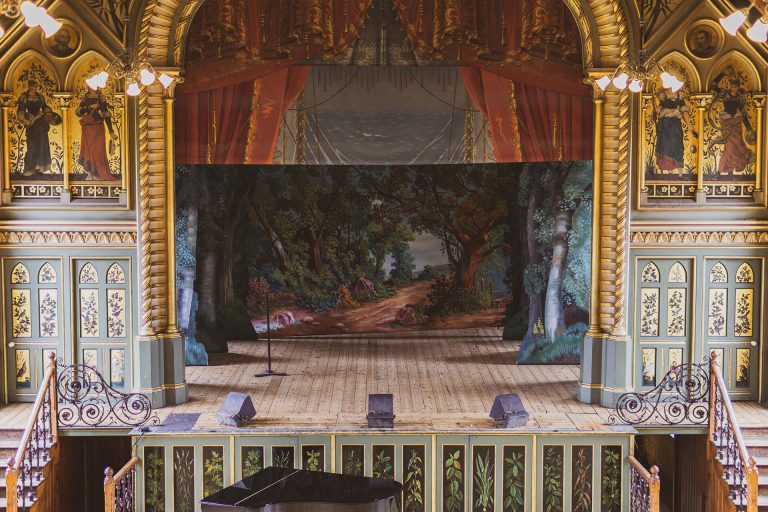
Normansfield Theatre in Teddington

Normansfield Theatre in Teddington

'My favourite building is the amazing Normansfield Theatre in Teddington that John Langdon Down (1828-1896) built to provide positive and stimulating education for learning disabled people (Down syndrome is named after him). At a time when most disabled people would have been shut away in horrific asylums, Down adapted his own house as a residential home, and built a beautiful theatre for creative rehabilitation. It's one of the few surviving private theatres from the period, with original painted scenery and other ornate fixtures, recently remodelled. For me, it's also a reminder of how the wealthy often used their money for good causes, which feels less common now. Jos Boys, guest curator and co-director of The DisOrdinary Architecture Project'


My source: The pick of London Open House. House&Home, FTWeekend. 6/7 September 2025. p.8.

Image: Langdon Down Centre

Previously: 'learning disability' : 'theatre' : 'architecture'

Saturday, June 28, 2025

Jayasinghe (2025) 'People‑centred care: a systems view of a new paradigm'

C/o HIFA

Dear friends,

It is my pleasure to share the link to my article "People-centred care: a systems view of a new paradigm". It is published online in Discover Health Systems and Open Access. Please see full-text access to your paper by using the following link:

https://rdcu.be/ejNUq

Kind regards Saroj
ABSTRACT People-Centred Care (PCC) is an emergent property in an “open” system. Policies aiming at promoting PCC can be categorized under four nested levels: Micro-level; Meso-level; Macro-level; and Mega-level and used to draw systems diagrams. We develop a single composite diagram which demonstrates interactions and feedback, within and across subsystems, resembling panarchy.
Jayasinghe, S. People-centred care: a systems view of a new paradigm. Discov Health Systems 4, 43 (2025). https://doi.org/10.1007/s44250-025-00215-9.

Saroj Jayasinghe MBBS (Col), MD (Col), MRCP (UK), MD (Bristol), PhD (Col), FRCP (Lond), FCCP, FNASSL Fellow of the International Science Council, Emeritus Professor, University of Colombo, Former Head, Department of Medical Humanities, University of Colombo, Sri Lanka Consultant Physician sarojoffice AT yahoo.com, saroj AT clinmed.cmb.ac.lk

Professor Jayasinghe's paper provides several informative figures on centredness, scale and levels, micro-mega; and affords a way to use Hodges' model to help define person, patient, people and service-centred care. These definitions could be developed, refined and validated using a relational formulation.


Individual
|
      INTERPERSONAL    :     SCIENCES               
HUMANISTIC  --------------------------------------  MECHANISTIC      
 SOCIOLOGY  :    POLITICAL 
|
Group

PERSON- 
PATIENT-CENTRED


psycho-

PERSON-
PATIENT-CENTRED

location

bio-
social

PEOPLE-CENTRED

'Health systems and services designed ‘for and with people’ are captured by the concept of People-Centred Care (PCC) defined as an approach “to care that consciously adopts individuals’, carers’, families’, and communities’ perspectives as participants in, and beneficiaries of, trusted health systems that are organised around the comprehensive needs of people rather than individual disease, and respects social preferences.' Duong, et al. (2024).

political


policy - engagement - design

SERVICE-CENTRED

panarchy

'Let us together forge a new way of knowing and practicing health care in the post-Sustainable Development Goal era, using people-centred care as our guide to achieve Universal Health Coverage.' Duong, et al. (2024).


Duong DB, Holt B, Munoz C, Pollack TM. For and with people: announcing the Lancet Global Health Commission on people-centred carefor universal health coverage and a call for commissioner nominations. Lancet Glob Health. 2024:S2214-109X(24)00216-X.
https://doi.org/10.1016/S2214-109X(24)00216-X.

Previously: 'design' : 'patient' : 'person' : 'system' : 'people'

Tuesday, May 13, 2025

Tanzania Health Summit (THS) Conference & Partnership

Warm greetings from the Tanzania Health Summit (THS) Conference:

1 - 3 October 2025
Julius Nyerere International Convention Center (JNICC)
Dar es Salaam

THEME:
"Harnessing Data Utilization and Technologies
to Accelerate Universal Health Coverage"

'Tanzania Health Summit is a non-profit health organization which was founded in May 2014. The aim was to promote healthcare to the underprivileged and vulnerable (70% of the population) who cannot easily access health services in the country. We focus on facilitating health information dissemination to the public taking into account that only 32.9% of the population has adequate literacy level in the country, mostly living in resource poor setting. In addition, we want to support youth (which comprise 32% of the population) to help build a more sustainable future and prevent them from high-risk behaviors and practices.'

THS is also seeking partnership: 
'I am writing to explore the possibility of partnering with your esteemed platform to feature the upcoming Tanzania Health Summit 2025, scheduled for October in Dar es Salaam. As one of the largest independent health conferences in the region, THS brings together government leaders, healthcare professionals, researchers, NGOs, and development partners to discuss key priorities in health systems strengthening and innovation.

With an active and growing portfolio of over ,2,500 participants, including decision-makers and thought leaders across Africa and globally, the Summit offers a unique platform for knowledge exchange, collaboration, and visibility.

We are seeking media partners to help us amplify our call for abstracts, participation, and partnership opportunities. In return, we are happy to offer media partners: • Logo recognition on our website and Summit program materials • Complimentary access to the conference (virtual and/or in-person) • Acknowledgment in select promotional content • Opportunities to feature your platform during media briefings or side sessions

We believe that a partnership with HIFA.ORG would be mutually beneficial in advancing shared goals of health equity, research dissemination, and stakeholder engagement.

Please let us know if this proposal would be of interest, and we would be happy to provide further details or set up a brief call to discuss how we can collaborate effectively.

Thank you for your time and continued commitment to global health.

Regards, Dr. Omary Chillo President - Tanzania Health Summit Lecturer - Muhimbili University of Health and Allied Sciences Fellow Bernard Lown Scholars in Cardiovascular Health - Havard T. Chan School of Public Health, USA Fellow Scientist Walter Brendel Center for Experimental Medicine - Ludwig Maximilian University, Munich, German Member Steering Committee - InterAcademy Partnership, Young Physician Leaders Email: chillo AT ths.or.tz '

My source: HIFA (Edited with conference & background).

Thursday, April 17, 2025

Community - Kids - Photographer - Police

My maternal grandfather was a man of few words (WWI). He did recount tales of when as a lad, he and his friends would knock the policeman's (and it was a 'man' back then) helmet off and leg it. It was, another time in several senses. Given his war experiences, I now wonder how easy it was to end up working at a gas works? Passive, re-traumatisation? Or, just grateful to have a job in the 1920-30s? 


After he retired he had a job as a 'cocky watchman' in a park. I remember visiting him in his hut with my mother. 

These photographs more 'recent' from the 1970s suggests 'community' policing, and calls for its return here in the UK in the 1990s(?). 

The policewoman on the right, also put me in mind of the 'nurse/doctor ...' running in the opening credits of MASH. 

individual
|
INTERPERSONAL : SCIENCES
humanistic ------------------------------- mechanistic
SOCIOLOGY : POLITICAL
|
group


Leonard Freed Police scooter patrol. New York City, USA. 1978. © Leonard Freed | Magnum Photos

Leonard Freed | Police Work A policewoman plays with local kids in Harlem. New York City, USA. 1978. © Leonard Freed | Magnum Photos

Police Work by Leonard Freed (Reel Art Press, £49.95) reelartpress.com.
https://www.reelartpress.com/catalog/edition/240/leonard-freed:-police-work

My sources:
The Daily Telegraph, Review, 7 December 2024, p.14. 
Neighbourhood Watch. Sunday Times Magazine, 17 November 2024. pp.42-47.

Images: Magnum Photos
https://www.magnumphotos.com/newsroom/police-work-leonard-freed-magnum-photos/

Wednesday, April 02, 2025

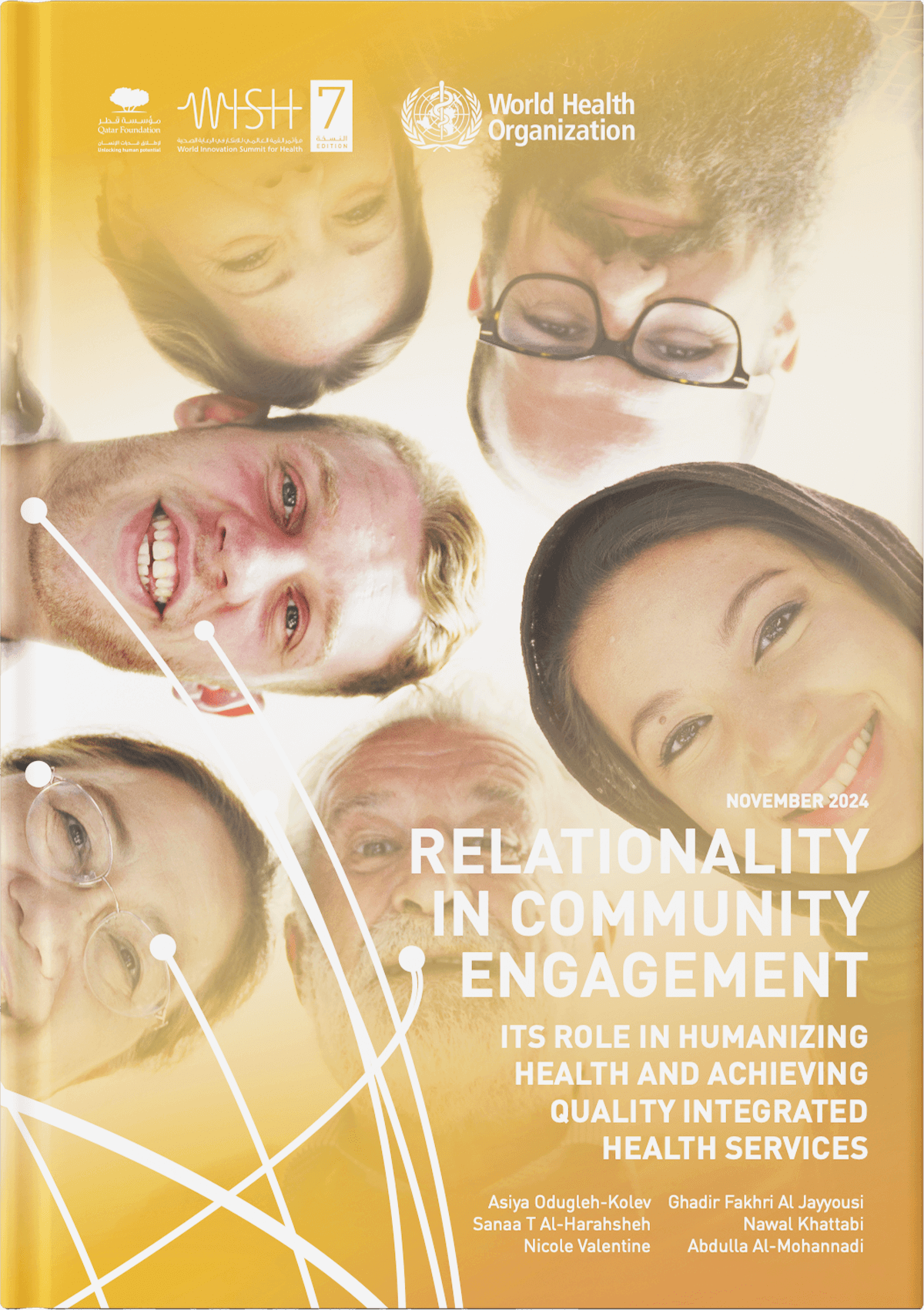
Webinar: 8 April Humanizing Health Care Through Relationality -

Exploring The Science And Practice Of Community Engagement


Join us for the first of four webinars co-hosted by the WHO Department of Integrated Health Services (IHS) and the Global Health Partnerships (GHP) (formerly THET). This webinar series is based on a new policy report launched at the World Innovation Summit for Health (WISH) -

https://wish.org.qa/wp-content/uploads/2024/09/Relationality-in-Community-Engagement.pdf 

The report revisits foundational concepts of community and examines how a deeper understanding of the relational nature of community engagement can contribute to improving quality of health care and transforming health systems. The webinar series hopes to inspire a shared understanding of community engagement’s transformative potential and how it can be leveraged for people-led change.

Continued ...


 Previously: relational :: community :: scale

Sunday, March 02, 2025

Alliance for Responsible Citizenship

Last month on two occasions, I came across the Alliance for Responsible Citizenship (which is a registered company). 


In the Sunday Times, "Philippa Stroud: ‘Everyone’s moaning — I think humanity can sort things out’":

https://www.thetimes.com/uk/politics/article/philippa-stroud-alliance-responsible-citizenship-km8z26b8b

and Financial Times "'Part megachurch, part political rally: inside London’s ‘rightwing Davos’".

https://www.ft.com/content/7ff1614c-38a2-4b5c-81d3-80cea1196dad 

Apparently, a right wing, conservative movement with a three-day conference, one commentary suggested it has struggled to define itself, which is understandable given the ongoing (increasing?) prompts for its creation.

You recognise early on in your nursing career and not just as a student (pre-Project 2000 UK), but as a Nursing Assistant that character is a key element in your professional development. By the time you qualify, you more accurately see that without a doubt it is your formative education that is a critical factor. That and your 'home' circumstances - and not necessarily the two-parents good, one bad formulation. This is why with students excluded from school, society is taking a wrong turn. There is obviously a problem but what is the 'correct' approach?

An 'alliance' already suggests a given level of organisation. By definition 'grassroots movements' must struggle to establish and retain their identity.

This is a project Hodges' model can help address - with a balanced but not necessarily a neutral output.


Individual
|
      INTERPERSONAL    :     SCIENCES               
HUMANISTIC  --------------------------------------  MECHANISTIC      
 SOCIOLOGY  :    POLITICAL 
|
Group

identity
personality
attitude aptitude
character
faith
individual beliefs
religious engagement
courage
hope
threshold concepts
my destiny
well-being
trust


future
physical thresholds 
waste
climate change
circular economy
AI
truth - information disorder
science
technology
PAST - work - FUTURE
our future destiny -
(what does the clock say?)
future generations?

grassroots social movement
arts
family
community
culture - diversity
social - cultural identity
society - support
social change
social capital
social contract
social values
our shared destiny
our children's children
welfare - living wage
employment - leisure
quality of life

power
political systems
past policy UK: 'Troubled Families'
economics
organisations, institutions
corporations
political (manifest! - 
colonialism ) destiny
policy
systems
political engagement
health of leaders
trust
international law - justice
control of fraud, corruption, crime
human rights
political thresholds


Thursday, January 02, 2025

"Hi! I'm new to Hodges' model - and this blog - what's it about?"

INDIVIDUAL
|
   INTERPERSONAL : SCIENCES              
humanistic ------------------------------- mechanistic
 SOCIOLOGY : POLITICAL   
|
GROUP

The model was created in the early - mid 1980's with four purposes in mind - to facilitate:

1. reflection & develop reflective practitioners;
2. person-centred, integrated (holistic) care;
3. help bridge the theory-practice gap;
4. curriculum design, planning and development.

This was prompted by the change in the UK to university-based nurse education, which was to commence in (Project) 2000.

Learning and applying Hodges' model in 1987-88, and creating a website 1998-2015, I am clearly invested in Hodges' model and biased, questions and debate are welcome.

Created by Brian E.

Hodges' model is a generic framework - 
a conceptual framework.

This model is situated, as 'generic' suggests
which means of course it is universal.

If you've a problem, scenario forthcoming project, or one that is nearing completion Hodges' model can assist in reflection and critical thinking to plan, scope, or evaluate as per your purpose.

This blog has posts about papers, events that interest me (PJ), plus many posts using this two-by-two table approach that suggests how the model can be applied in a variety of contexts.

This blog also has a bibliography
and template in the sidebar.

Hodges^

As noted previously (and last month!), it is marvellous to hear news of a paper citing Hodges' model. If you are planning a piece of writing, research and believe that Hodges' model may be of help please get in touch.

If you don't and can see merit in Hodges' model asit is presented, that is fine also. In fact, although I mention collaboration unique - untainted perspectives are probably much needed. Learning of a citation after publication is great news and encouragement.

This could and should be an amazing community:
Welcome to the QUAD

Thank you for your visit and interest.
Any questions pleased to try to help:
h2cmng AT yahoo.co.uk

As a nurse who trained in learning disability, Brian Hodges was acutely aware of the political in health care, the role of the institutions and the aspiration of community-based and person-centred care.

Yes, you can use the model. It is open source. 
All we* ask is that you cite and credit the source.

With the 'politics of health' much in mind there are many papers to write on the model that includes: reflection; person-centredness; integration of care; self care TO planetary health FROM ?; Inter- multi- transdisciplinary in Hodges' model; A model of healthcare viewed mathematically: Surely you're joking Mr Hodges?

This blog started in 2006, the template is dated, comments are disabled. A new site - repository is needed.

*In Brian's memory too : Brian E. Hodges (1942-2022) RIP^

Tuesday, December 10, 2024

Webinar: 11 December - Universal Health Coverage (UHC) Day 2024

"The UHC Compass and Social Participation:
empowering patient organisations to hold governments
 accountable for universal health coverage"

Register for the UHC Compass launch!

To mark Universal Health Coverage (UHC) Day 2024, IAPO will officially launch the UHC Compass at an exciting webinar titled "The UHC Compass and Social Participation: empowering patient organisations to hold governments accountable for universal health coverage" on 11 December 2024, from 11:30 to 13:00 GMT via Zoom.

The webinar will be conducted in English with simultaneous interpretation into Spanish.

Panellists include:
  • Dani Mothci – International Alliance of Patients’ Organizations (IAPO) 
  • Dr Pamela Cipriano – UHC2030 & International Council of Nurses
  • Lara Brearley – Special Programme on Primary Health Care Universal Health Coverage - Life Course, World Health Organization
  • Dumiso Gatsha – Success Capital NGO & Civil Society Engagement Mechanism for UHC2030 (CSEM)
  • Nicola Bedlington – Global Patient Think Tank & Millwater Partners
  • Smitha Sadasivan – Global Patient Think Tank, Inclusive Health Policy, Disability Rights India Foundation & CSEM 
  • Paul Mendoza – Psoriasis Philippines and Psoriasis Asia Pacific & IAPO
The UHC Compass is a dynamic tool created by patients for patients, empowering local leaders and communities to advance universal health coverage (UHC). In the context of the World Health Assembly resolution on social participation and UHC Day 2024, this session will explore how the Compass can serve as a tool to hold governments accountable for investing in UHC.

Co-created by the Global Patient Think Tank (GPTT), a diverse group amplifying the patient voice in the UHC movement, the Compass is proudly hosted by IAPO. Our mission is to ensure this resource reaches and benefits our global network of patient organisations.

Join us to discover how the UHC Compass can help make UHC a reality for everyone!

Learn more & register [https://www.iapo.org.uk/node/15686] Share https://iapo.cmail19.com/t/d-fb-sfiudt-iuqjytrli-o/ Tweet https://iapo.cmail19.com/t/d-tw-sfiudt-iuqjytrli-b/ Share [https://iapo.cmail19.com/t/d-li-sfiudt-iuqjytrli-h/]

[http://www.iapo.org.uk]

The International Alliance of Patients’ Organizations is registered in England and Wales as charity no.1155577 and company limited by guarantee no.08495711.

Registered office: Hounslow House, 7 Bath Road, Hounslow TW3 3EB, UK.

It is also the IAPO's 25th Anniversary.
More details at:

https://www.iapo.org.uk/node/15687

I will post again in the New Year.

My source: HIFA

Previously: compass : UHC : patients

Saturday, November 30, 2024

"Integrated - care": What's in a word, or two?

This blog post was sat in 'drafts' since 28/01/2007 (yes, I know what that suggests). It concerns an issue, or more properly a theoretical and experiential aspiration in health AND social care that should in truth have provoked many papers for Hodges' model by now.

In the almost 18 years since, I wonder about the total number of papers devoted to this subject, the service's delivery, policy, outcomes, reviews and reports on integrated care? In nursing theory, philosophy and the start of many 'learned papers', it is customary to begin with a definition of terms. What happens when we divide 'integrated care' and first treat integrated and care separately? Does this aid our understanding? Do we divide and conquer? Is there a difference in results? Conceptual analysis would see us do both, and conduct a literature search.

In practice, (and clinical - especially) we often use words in rather lackadaisical way. Not surprising really, after all we've got a job to do! When pronouncements are made regards health and social policy I hear it as good intentions. I also reach for my soap box. It is often hyperbole, rhetoric. The same applies to the related idea and ideal(?) of holistic care, and person-centredness. I'm biased, of course, but I believe that Hodges' model can help to scope, and define these idealised features of health and social care (and education). As noted, people don't have the luxury of time to stop and deliberate on the precise meaning of the language they routinely use. As noted, at the end of the day - if it gets the job done then that's sound.

In a poll of words that are both much used and the meaning taken for granted integrated must be near the top for several reasons:
  • its seniority: it has been around for decades.
  • its scope across sectors and day-to-day life.
  • our dependence on its fulfillment.
N-Gram suggests some possible insights into integrated and related forms of care:


https://books.google.com/ngrams/graph?content=integrated+care,holistic+care,person-centered+care&year_start=1800&year_end=2022&corpus=en&smoothing=3 
[Trying to embed, results in 1/3 white space at the bottom?]

It seems that integrated care [IC] has been a standing agenda item in health and social care media, education, the workforce, conference, exhibition and policy for several decades. Perhaps, things have calmed somewhat? So either IC is either very important, complex, a hard thing in practice or maybe it's all of these and more besides? IC is a undeniably a compound concept. Is this a cop-out though? You declare something 'compound' then sit back - job-done? I've suggested the same of threshold concepts in health (and probably other contexts?). Time will tell. In the meantime I have reflected on 'integrated care' across the domains of Hodges' model:
self
|
INTERPERSONAL : SCIENCES              
humanistic ------------------------------- mechanistic
SOCIOLOGY : POLITICAL   
|
other
INTEGRATION OF:
PRACTITIONER; Team; service; org... Philosophy*
assessments
threshold for acceptance into service
(referral criteria)
patient experience & engagement
health education / literacies programmes
spiritual
research involvement

INTEGRATION OF:
health record (e- or paper)
location - team base
care disciplines
geographical area
referral sources
assessments - tools/scales
data and statistics
research involvement


INTEGRATION OF:
HEALTH & SOCIAL CARE
public engagement
hospital 
carer (parent/guardian) experience
community services
social care - NHS
family experience
public engagement in research
Patient / Public Community Advocacy
Treat demand :: Support prevention


INTEGRATION OF:
funding
leadership / management
accountability - complaints
(not the same thing!)
outcome measures
ILLNESS - PREVENTION / education
self-care <> planetary care - 
Sustainability
assisted dying! palliative care!
Public - Private - Voluntary Sectors
Provider :: Purchaser [Systems]
All-Party Parliamentary Groups^


*ethics, values.
^One aspect of so-called 'joined-up government'.

Tuesday, October 22, 2024

Consultation: CHANGE NHS


Our NHS is broken, but not beaten. Together we can fix it.    
[ c/o https://change.nhs.uk/en-GB/ ]

The NHS has been there for us for over 76 years. But to make sure the NHS is here for the next 76 years, doing all it can to support the health of everyone, we need your help.

We want to have the biggest ever conversation about the future of the NHS.

It doesn’t matter whether you have a lot or a little to say. Your views, experiences and ideas will shape a new 10 Year Health Plan for England. 

This is open to everyone. If you are a member of the public or someone who works in health and care in England, 'Start Here', to tell us how the NHS needs to change.

If you are contributing as a representative of an organisation, complete the organisation questionnaire. This is an early opportunity to share your insights as we begin an extensive programme of engagement to develop the 10 Year Health Plan. 

If you register your email address, we will stay in touch to seek your views as the 10 Year Health Plan develops.

[video no longer available]

'change' in Hodges' model

The NHS and people's health is more than 
a machine, more than a mechanistic thing 
that if broken can be fixed.

By definition you cannot be 'inclusive'
if you do not achieve balance
with the humanistic; and the
values of humanity and
 the spiritual as per context.


individual
|
INTERPERSONAL : SCIENCES
humanistic ------------------------------- mechanistic
SOCIOLOGY : POLITICAL
|
group

purposes

person-centredness

personalised care experiences

continuity

mental state; mental health

attitudes - mindset

expectations (public education)

my health literacy (all of them: education)


processes
(care inc. 'writing' records, 'gates' access)
demographically-driven care 

define 'success' - metrics - data

utilise evidence

peak CO2
peak obesity

physical health:
chronological age - pathological age

encourage self-care to support sustainability

social care

social attitudes

child support - support for families

proven practices that delivers

community as resource

community: homes for living in -
not profiting from

Public involvement: 
#NHSCHANGE #CHANGENHS

Protect / Create green spaces for outdoor play


funding, finance, budgets, economics

POLICY:
FROM: National ill-Health Service
TO: National Health Service 

long-termism

E3^ for all the literacies

address: food quality, 
air, water, noise, litter

SOCIO-tech approach to applied technology

Teach Hodges' model to teens, and prisoners
as part of PSHE and rehab programmes


E3^ education, education, education - by literacies we include: information, emotional, media, finance, spiritual, cultural, scientific, religious, climate...

'delivers' includes: improved care experiences, integrated care (related to all the domains), patient, carer, public safety, cost effectiveness, research questions, accurate - valid reporting.

All health disciplines / professionals, social care, and APPGs ... share a common model - a conceptual framework for critical thinking and reflective practice.

Sunday, June 16, 2024

Occupational therapist Joël inspires elderly to get in motion ...

Or, "Excuse me. How many movements are there in that watch?"*

"Joël Kruisselbrink’s creativity in designing exercises and games inspires elderly people to keep moving and live life to the fullest.

Nursing home residents are often understimulated and have little motivation to exercise. As an exercise instructor, Joël Kruisselbrink knows better than anyone how important exercise is for the elderly. His passion for creating exercises and games enables older people to continue enjoying life while keeping them moving."
Individual
|
      INTERPERSONAL    :     SCIENCES                   
HUMANISTIC  --------------------------------------  MECHANISTIC      
 SOCIOLOGY  :    POLITICAL 
|
Group


What do
you think
the impact
is upon
the resident's mental
health
and
emotional
well-being?


Psycho-
-Social?


Standards & Quality of Care
Policy


*Hodges' model: A tool to watch the complications of Care

My source: https://x.com/Rainmaker1973/status/1802268229361967404

Sunday, October 22, 2023

New animated film Social Care Future - #SocialCareFuture


Individual
|
     INTERPERSONAL    :     SCIENCES               
HUMANISTIC --------------------------------------  MECHANISTIC      
SOCIOLOGY  :   POLITICAL 
|
dyad / couple  family  group COMMUNITY population


Government(s)
politics
power
policy
social care funding
integration of care


"Watch our story

Without big changes to the way we think about social care, we and the people we care about face losing control of our lives and contact with the people and things that make our lives worthwhile. It doesn’t have to be this way.

Watch our new film, narrated by actress, comedian, broadcaster and international disability rights activist Liz Carr and directed by multi-award winning filmmaker Yoav Segal.

View accessible versions, including BSL, subtitles and comic book."


Animating our #SocialCareFuture – the story behind our animated film

My source: 
https://x.com/socfuture/status/1714909895416242221?s=20


Monday, May 29, 2023

Humanistic motivations for study - c/o Harris et al.

 "Asking '[I]n what sense . . . can mathematics be considered a democratic regime . . .' open to all, Pimm and Sinclair quote (Supergiant) Henri Poincaré to the effect that 'only mathematicians are privy to the aesthetic sensibilities that enable' the decision of 'what is worth studying.' The article, published in a journal for educators, is motivated by the 'view that mathematics can do something for me in a humanistic sense that repays the the careful attention and deep engagement it may require; one that may expose students to a fundamental sense and experience of equality . . . and provide them with another sense of human commonality.'" p.33.  

Harris, M. (2015) Mathematics without Apologies: Portrait of a Problematic Vocation. Princeton University Press.

Hodges' model - Axes - Structure :: Domains - Content

Friday, February 24, 2023

Call for Papers (i) Community Development and Preventative Care With Older People: New Values and Approaches

Editors: Fiona Verity, Frances Barker, Mark Llewellyn, Simon Read, and Jonathan Richards

Deadline for Abstracts: 15 March 2023
Deadline for Articles: 31 July 2023
Publication of the Issue: January/March 2024

Social Inclusion, peer-reviewed journal indexed in the Social Sciences Citation Index (Web of Science; Impact Factor: 1.543) and Scopus (CiteScore: 2.5), welcomes new and exciting research papers for its upcoming issue "Community Development and Preventative Care With Older People: New Values and Approaches," edited by Fiona Verity (Swansea University), Frances Barker (Solva Care), Mark Llewellyn (University of South Wales), Simon Read (Swansea University), and Jonathan Richards (University of South Wales).


The subject of this thematic issue is a prevention agenda in social care for older people, with a focus on community development values and approaches. Though current policy direction across many countries suggests opportunities for re-imagining how prevention may be best conceptualised, numerous studies have highlighted that there remains considerable confusion and disparity in how this plays out in practice. 

Prevention in social care can be implemented from mixed starting points, i.e., economic objectives, social justice objectives, and look different in practice. Included within this broad agenda are community development approaches and service delivery models driven by the needs of older people in their communities/localities, and collectively focused on common concerns and solutions.

This thematic issue will canvass questions such as:

  • What can be learnt from social care preventative practices with older people that use community development approaches?
  • How might older people be part of a reimagination of a preventative agenda in social care?
  • What can social enterprises and cooperatives contribute to advancing a prevention agenda in social care?
  • What might the marketisation of service delivery systems (e.g., individualised/direct payments) mean for community development solutions and approaches?
  • How can prevention in social care be better conceptualised?
  • What has been learnt from the impact of the COVID-19 pandemic on older populations to inform a prevention agenda in social care?

Authors interested in submitting a paper for this issue are encouraged to read the full call for papers:
https://www.cogitatiopress.com/socialinclusion/pages/view/nextissues#PreventativeCare

Abstracts welcome by 15 March 2023.

Kindest regards,
Mariana

Mariana Pires Social Inclusion Cogitatio Press 1070-129 Lisbon Portugal New issues (open access): Vol 11, No 1 (2023): Disability and Social Inclusion: Lessons From the Pandemic
https://www.cogitatiopress.com/socialinclusion/issue/view/332 Vol 10, No 4 (2022): Networks and Contested Identities in the Refugee Journey
https://www.cogitatiopress.com/socialinclusion/issue/view/331

My source:
EUROPEAN-SOCIOLOGIST list

Post ii: https://hodges-model.blogspot.com/2023/02/h2cm-relational-ontology.html

Sunday, January 22, 2023

Philosophy in Pubs - Liverpool Weds 25th Jan 7.30pm

Subscribed to Philosophy in Pubs for many years, I've posted to the list also in the distant past, but I've never attended a meeting. This past week I noticed a message about a new subgroup - Young Philosophers - in Liverpool from Mike (phone numbers removed). Below, I've posted some of the online chat:

On Saturday, 14 January 2023 at 14:38:50 GMT, <info AT philosophyinpubs.co.uk> wrote:
Hi everybody,
 
Its Mike from the Keith's PIP and the young philosophers group.
I am currently re-launching the latter as a new PIP group at
Thomas Rigby's in town
(23-25 Dale St, Liverpool L2 2EZ)
 
The first meeting of the Philosophy group will be
Wednesday evening the 25th January at 7.30pm.
Please come along, all welcome, all ages.
 
If you need anymore  information, please email me (email below) or call me on ...
 
Thanks
Mike Green.
michaelljohngreen AT gmail.com 

This piqued my interest, given my love of Liverpool (born in Walton) and the question of at what age can younger people - children be introduced to Hodges' model?

I replied expressing interest in the possibility of contributing, once the group is established, or as a 'starter for 10', seeking critique as to what sense young philosophers would make of the model.

Responding with an introduction to Hodges' model, and expression of interest, Paul and Rob replied as per below, to which I've tried to add some clarification.

Rob's thoughts are very helpful. The upshot is, I'm looking f/w to a full day in Liverpool this Wednesday, meeting Mike, Paul, Rob and possibly others before the meeting starts at 7.30pm.

Paul's message (intended for me):

info AT philosophyinpubs.co.uk
Sunday, 15 January 2023 at 13:00:12 GMT
Subject:
Re: New PIP group!

Hi Mike, Peter

Yes, you seem to be part of quite a sizeable group of people on our general members/mailing list that have not gotten round to attending one of the groups yet. But that's okay, absolutely no need for apologies, your interest is appreciated anyway.

I've had a quick glance at your attachments; found what I read very interesting and would like to know more. I don't think I've heard of the Hodges' model, or at least not in relation to what we generally practice (Community of Enquiry method).

It's great that you would like to contribute or provide a session regarding the Hodges' model, but I'm not sure if doing that would fit well with this particular opening meeting of a new PIP group. Having said that, I could be very mistaken, and an introduction in the manner you mention, might be a great way to get people thinking and herald a fruitful meeting. The meeting is due to start at 7.30pm - (meetings usually take one and a half to two hours), but if you like I could meet you there half an hour earlier. Let me know.

We have something called the Enquiry Development Series (EDS) running at the moment. It's a monthly Online event which is run for PIP members and others to learn/refresh their undertanding and practices. You would be most welcome to attend.

Best regards,

Paul ...

PS: I have cc'd some members of the EDS in with this reply.

From Rob:

On 2023-01-16 12:44, fappyhealing02 AT yahoo.co.uk wrote:

Hi Everyone,

From my very limited reading on Hodge's model. It seems to be concerned with very similar issues to those of PIPs and the CofE community, which is an expression of prior analysis, critique and reflection coming from people like Dewey, Postman, Freire, Lipman and so on. I have a basic grasp of the model as a conceptual framework and a means to better care and understanding across society. What I don't seem to have picked up so much is a more fully developed methodology rooted in practice and realisation of these ideas.

This leads me wonder whether this model/framework is mainly conceptual, with limited  methodological guidance towards how the ideas in the framework are to be expressed and realised. PIPs is at the stage where it has a very successful methodology which realises and expresses in practice the ideas that Hodge points to, along with the philosophy of education eluded to earlier and various other frameworks such as the Paul and Elder model of critical thinking.

So, we have the history and philosophical education from Socrates onwards, the comes a distillation of these ideas into a framework or model, which is where we find Piaget, Bloom, Paul and Elder, along with Hodge and others. These models then have to be cashed out in practice. At this point, we are now thinking about methodology, there is of course connection, influence and overlap with the history, philosophy and subsequent frameworks. Methodologies vary from being barely formed to being well formed and robust. I would say PIPs and CofE have a well formed and somewhat robust methodological practice. It has been well tested and critiqued for over 40 years in different countries, communities and contexts. It has stood the test of time with a good pedigree. Matt Lipman was a key figure in developing a methodology out of his research into philosophy of education and various frameworks/models. However the methodology he produced to deliver in practice was something of a prototype rather than the more fully formed, finished article. Through time and careful reflection people like R Sutcliffe and Karin Muris took Lipman's methods improved and polished them into the practice we see and use 40 years later. This is of course still developing along democratic and dialogic lines.

In the case of Edward De Bonno, Paul and Elder, Illich and Dewey we find some powerful insights, some partially formed models and some fully formed models but not that much guidance on how to implement these ideas. Yes, they provide some ideas and pointers on how to go about the realisation of these things in practice but methodology on the whole is pretty sparse. I guess it's a case of focussing on a specific group of concerns comes at the cost of other concerns, though, I don't want to take this too far and slip into zero-sum thinking. Anyway, based on limited understandings I'd provisionally put Hodge in this category of well formed model, limited methodology in terms of the nuts and bolts of how to best realise the model in practice.

Questions I'm left with:

Is the distinction between model and methodology a significant and useful one here - why? Yes/No, because...?

Given our current point of development and understanding, by doing what we do, are we already cashing out a good deal of the key ideas in Hodge's model?

Could we just clarify what Hodge's model is a model of?

Do I need some help in understanding Hodge better in terms of both 'model' and 'methodology'?

This isn't to say we should not draw inspiration and ideas or take time to explore and experiment with Hodge's model, just that I need to be clearer about what it is, what it's trying to do, how it is going to do it. Once more secure with this, I feel I'd be in a better position to make more competent judgements and recommendations about its uses and benefits.

Best wishes,

Rob

My reply:

Subject: Re: New PIP group!

Thanks for the messages - just caught up I think...

I wondered originally Mike - about your young philosopher's group and once established asking the group the questions that Rob has posed and responded to.

I'm seeking critique, not proposing that Hodges' model is adopted by PIP.

The questions posed by the model - might gainfully exercise younger minds, and provide me with some pointers - which I would make clear (from ethics / consent perspective).

I greatly appreciate Rob's thoughts*.

A question I have educationally is from what age (literacy level) which Hodges' model #h2cm might be taught (discovered?).

I'd be pleased to come through on the 25th Mike and Paul, arriving a bit earlier.

I'll get to Liverpool early a.m. train and make a day of it.

As per Rob, I'm still asking these questions of the model and enjoying the journey ... so, briefly in response:

There is no methodology associated with the model, it is 'agnostic' (whatever that means).

The model is situated - so clinically, the way the model is used is influenced by the patient, client, carer, student, manager ...

The model can provide a relational ontology - it incorporates several polarities, dichotomies, oppositions and instrumentally can facilitate dialectic engagement.

It can be applied (imho) for a variety of research and philosophical stances, standpoints - Qual , Quant, Mixed-methods ... all the -isms?

As you will no doubt appreciate, in education and health care (especially) we need *evidence-based* interventions.

In seeking possible theoretical underpinnings for #h2cm think (as Rob suggests) of the model as a giant conceptual corpus (drawing from Tim Berners-Lee's giant global graph).

The axes of the model represent the (conceptual) holistic bandwidth of the situation.

The model can wax and wane as per the context (scale, scope). In a reductive sense I see the four (care) knowledge domains as four 'conceptual spaces' (Gärdenfors).

h2cm can also find a 'home' in the semantic web and in education - the idea of 'threshold concepts' (Meyer and Land).

There is another tool, but this calls for a logician - if not a totally erroneous idea?

[ Note diametric oppositions in the model: e.g.
  • public understanding of science;
  • the extent of visualization in the humanities;
  • mental health (the self) and the State (politics, law) current Psycho-Economic crisis. ]
*ROB - and all - I'd be pleased to post your thoughts / response on the blog, if this is appropriate with links and text on PIPs.

I hope this helps and look f/w to next week - thanks for your interest too.

Best to all.

Peter
====

Clearly not the last word. Look f/w to Wednesday and learning more.
Thursday, December 01, 2022

Threshold Concepts 2023: "Roads Less Travelled"

Call for Papers 2023

Date 4-6th July 2023

Location: Charles Sturt University, Port Macquarie Campus, NSW, Australia (google map link)

Theme: Threshold Concepts: Roads Less Travelled

The 2023 Threshold Concepts Biannual International Conference is a special one. It marks twenty years since the original 2003 Threshold Concepts paper by Eric Meyer and Ray Land. In the intervening time, Threshold Concepts have become an accessible way of conceptualising learning, and the barriers to mastery that learners encounter. We are taking inspiration from Julie Timmerman’s (2023) provocative question, “Do thresholds always propel us outward, forward, and towards an identified threshold, or might they reveal alternative and unanticipated landscapes for transformation?” 

We propose an exploration of movement “outward, forward, and towards” threshold concepts, and the journeys we undertake as learners and researchers. These pathways may be known or unknown, familiar or alien, hidden or exposed. We have identified a number of subthemes, which you may interpret according to your context.

  • Inter(tidal)disciplinary Zones
  • Learning Spaces and Places 
  • Cultures of Engagement and Connectivity
  • UnOthering 
  • Liminality 

We invite you to submit proposals under one of the subthemes and we look forward to seeing you in Port Macquarie in July 2023 to celebrate twenty years of Threshold Concepts. #9BiTCC2023

.... https://thresholdconcepts.home.blog/

Tuesday, October 11, 2022

Social Prescribing Student Champion Scheme - APPLICATION FORM

 
APPLICATION FORM

There is a QR code to apply too.