Hodges' Model: Welcome to the QUAD: listening

Hodges' model is a conceptual framework to support reflection and critical thinking. Situated, the model can help integrate all disciplines (academic and professional). Amid news items, are posts that illustrate the scope and application of the model. A bibliography and A4 template are provided in the sidebar. Welcome to the QUAD ...

Showing posts with label listening. Show all posts

Saturday, October 10, 2026

Poppy's Promise: "What happened next would change our lives forever"

April 2021:

'After my due date passed, I was admitted to hospital to be induced. Labour began and everything appeared normal. As first-time parents, we trusted that our baby was safe and that if something was wrong, someone would tell us. We had no reason to think otherwise.

During labour, opportunities to recognise that Poppy was in distress were missed.

Monitoring that should have taken place did not happen.

By the time concerns were recognised, panic had replaced reassurance.

I was rushed to theatre frightened, confused and not fully understanding what was happening to my baby. ...'


Poppy's Promise read more ...

My source: BBC Radio 4 Today 0736 mins:

https://www.bbc.co.uk/sounds/play/m0032fq8

Saturday, September 12, 2026

TED - Talks & Listenings

THOUGHT

EDUCATION

DESIGN

  
individual
|
INTERPERSONAL
: SCIENCES             
humanistic ------------------------------- mechanistic
SOCIOLOGY : POLITICAL   
|
group
 
THOUGHT
 
Cognitive maps

Your -
Sense of direction?

Maps

DESIGN

'True South'


Ancient maps - periplus

EDUCATION for All


Maps - Power
 

Our -
Sense of direction?


Previously: 'thought' : 'education' : 'design' : 'cognitive map'

My source:  https://x.com/NobelPrize/status/2098073718371262921?s=20 and @TED_ED

Saturday, July 11, 2026

"Train midwives as nurses" - Ockenden

Re. Ockenden Report

Catching up on the newspapers, I noticed in the Times reporting of Ockenden calling for midwives to train as nurses first. Provoking debate about nurse education.

Within maternity services there are problems with continuity of care and skills in dealing with complex cases:

'Maternal Deaths 

60. The Review examined 27 maternal deaths that occurred between 2006-2024. Five cases fell outside of the Terms of Reference of the Review. Of the 22 remaining cases, reviewers identified failures in care that may have or substantially impacted on the outcome in six deaths. 

61. The profile of maternal deaths at NUH over this period broadly aligned with the known demographics and causes as identified by MBRRACE. 11 of the deaths occurred to women living in the most deprived areas of the city and 14 occurred amongst women who were not white British.

62. The common failures reviewers identified that might prevent future maternal deaths included: listening to women and families and acting promptly on concerns; continuity of care particularly for those with additional social/medical complexities; robust clinical governance to ensure timely information sharing across organisations and prompt access to imaging for women presenting with concerning neurological symptoms.' xiv

AI Overview (Ecosia) suggests that although direct entry to midwifery has always been possible(?), the English National Board created the pathway some 39 years ago.

The Ockenden Report describes how in combination health systems, culture, leadership and training can contribute to compassion fatigue (p.313).

When you look at Hodges' model and our languages, a great many challenges for curricula, training and education programmes can be found. The most powerful of what can be progressive, or threats are invariably mechanistic:

  • shorten
  • bypass
  • shortcut
  • cutting corners
  • short-circuit

Nursing must always move forward, continuous professional development is built on this principle. In the late 70s and 1980s post-registered qualifications were held in high esteem. Especially midwifery, paediatrics, health visiting, emergency and intensive care. 

Clearly, decision and policymakers can underestimate the value of basic nurse training. Having an idea since childhood is brilliant, but at interview saying you're compassionate and want to make a difference will soon be tested. Sometimes as a student rather bluntly, as with a first placement in forensic nursing. I wonder how many students have been lost there? I'm sure the majority will cope, manage, enjoy and prosper, but I've seen the student peers who miss these cohort members on subsequent learning experiences. What preparation is employed?

Basic nurse training, is just that. Demonstrating competence in communication, awareness of basic needs and how these are expressed behaviourally. What interpersonal skills and knowledge are needed. As highlighted before, the director of nurse education worried about those of us who worked as nursing assistants risked being trained in poor care. Not recognising 'bad practice', a 'poor attitude', not using observation and most important of all listening: to what is said and unsaid. When I started I remember thinking about not responding - as individually programmed to do so, through a reflex action. That was a worry back then. 

While the news in the Ockenden Report is bleak. The depth of the report (for me) is manifest in identification of not only socioeconomic factors, but sociotechnical too (with five mentions) and the critical interplay of seeing (and hearing!) the individual amid the collective:

'2. Fetal monitoring

Rather than reflecting simple failures of individual interpretation, growing evidence suggests that intrapartum fetal monitoring is best understood as a complex sociotechnical practice, shaped by system design, workload, team dynamics, guideline variability and organisational culture.119 Continuous CTG itself has well-recognised limitations, including poor specificity for predicting long-term neonatal outcomes and substantial inter- and intra-observer variation in interpretation.5 Reviews of intrapartum care are therefore unavoidably influenced by retrospective bias, with greater apparent clarity afforded by knowledge of the outcome than was available to clinicians at the time. 

However, despite this, a sociotechnical understanding does not negate the importance of examining individual cases in which intrapartum monitoring was demonstrably substandard. National inquiries and confidential reviews repeatedly describe cases involving sustained failure to recognise pathological fetal heart-rate patterns, delayed escalation despite repeated triggers, and missed opportunities for timely intervention. 2,3,120,121 These cases cannot be explained solely by the inherent limitations of CTG or by hindsight bias.' p.143.

It is quite shocking to hear this conclusion: the need to train as a nurse first. Counterarguments: where is the evidence(?!) - have followed. But then if you undervalue and miss the fundamentals (see Hodges' model!) then individuals, families, communities, students, practitioners, services and systems suffer.

Previously: 'maternity' : 'report' : 'safety'

Wednesday, June 24, 2026

Independent report - Ockenden review into maternity services at Nottingham University Hospitals NHS Trust

FINAL REPORT: 

'This independent review of maternity services at the Nottingham University Hospitals NHS Trust (NUH) considered the quality of care relating to newborn, infant and maternal harm at the trust.

This report covers the findings, conclusions and essential actions of this independent review of maternity services.

Based on a review of over 2,500 family cases that formed part of this investigation, the final report outlines:

  • local actions for learning that staff at the trust must do
  • system-wide learnings
  • immediate and essential actions to improve maternity and neonatal care

The Independent Maternity Review (known as the Ockenden review) was led by Donna Ockenden and involved a multi-professional team of more than 160 reviewers. The review team held individual meetings with over 500 families, and more than 830 current and former staff at NUH engaged with the review.'


https://assets.publishing.service.gov.uk/media/6a3bb59c4c7605ab567238ec/ockenden-report-review-of-maternity-services-nottingham-university-hospitals-nhs-trust-e-lay.pdf

https://www.ockendenmaternityreview.org.uk/

individual
|
INTERPERSONAL
: SCIENCES             
humanistic ------------------------------- mechanistic
SOCIOLOGY : POLITICAL   
|
group
 

listening

 
 Communication
Processes 
Health Systems
mothers
families
experience
LISTENING
staffing
funding

Previously: 'maternity' : 'risk' : 'safety' : 'compassion'

Thursday, March 19, 2026

'Loud' noises and silences - Martin Luther King

INDIVIDUAL
|
    INTERPERSONAL    :     SCIENCES               
HUMANISTIC --------------------------------------  MECHANISTIC      
SOCIOLOGY  :   POLITICAL 
|
GROUP


... We are confronted with the fierce urgency of now. In this unfolding conundrum of life and history, there is such a thing as being too late. Procrastination is still the thief of time. Life often leaves us standing bare, naked, and dejected with a lost opportunity. ... We may cry out desperately for time to pause in her passage, but time is adamant to every plea and rushes on. Over the bleached bones and jumbled residues of numerous civilizations are written the words, "Too late." There is an invisible book of life that faithfully records our vigilance or our neglect. Omar Khayyam is right: "The moving finger writes, and having writ moves on."
    -DR. MARTIN LUTHER KING, J.,
    Beyond Vietnam - A Time to Break Silence


Monday, October 13, 2025

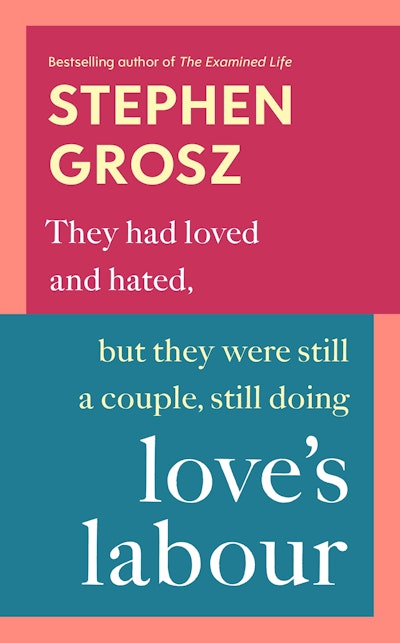
Book: Love's Labour by Stephen Grosz

They had loved and hated,
but they were still a couple, 
still doing love's labour ...

Luminous and necessary stories from the psychoanalyst's consulting room; on desire, heartbreak and learning how to love.

When it comes to love why do we find things so difficult? Drawing on over forty years of candid and surprising conversations with his patients, Stephen Grosz asks, what gets in the way of our falling in love? And what must we do to stay there? Penguin UK.
<>
'Ravi, a maths lecturer, is tormented by his wife Sonal's supposed infidelity, but won't look at the CCTV - even though that might reveal her to be innocent. This chapter has a sting in its tail when 19 years later Grosz is contacted by Sonal. She is dying of cancer and Ravi is cruelly neglecting her. Grosz feels that he missed a vital clue all those years ago, concerning Ravi's ingratitude and envy.

This moment of "failure" on Grosz's part forms an aspect of this small book's power. It shows that the psychoanalyst is not a machine, and the process is fallible. But it is also a testament to human complexity. When he hasn't understood the patient sufficiently, Grosz brings the case to his supervisor, and we, the reader, are witness to their exchange.' Life&Arts, FTWeekend.
Individual
|
      INTERPERSONAL    :     SCIENCES               
HUMANISTIC =========================  MECHANISTIC      
 SOCIOLOGY  :    POLITICAL 
|
My source: Kathy O'Shaughnessy. The hard work of seeing ourselves. Books, Life&Arts, FTWeekend, 27-28 September 2025, p.11.


Iamge: https://cdn2.penguin.com.au/covers/400/9780701188979.jpg

Thursday, August 07, 2025

'Finding the Signal through the Noise' - WHO EARS

It is deprived communities who desperately want to do their best for family, but struggle to have access to and make sense of many sources of information. News and information not just through 'traditional' channels, but social media. Trying to be objective, non-judgemental it can still be surprising how TVs and smartphones are the key personal and furniture items.

Outside of London, Liverpool has a low uptake of immunisation against measles:

Liverpool, now has cases and a child's death from measles:

https://liverpool.gov.uk/council/public-health-liverpool/measles-on-the-increase/

https://www.liverpoolecho.co.uk/news/liverpool-news/alder-heys-plea-after-child-32050189

Located in-between, I often visit Manchester and Liverpool. I wonder now if I should visit Liverpool less. My daughter and her partner expecting their second child have a decision to make next year.

I noticed on X a reference to 'social listening'. This was missed while drafting a paper on COVID, technology, social media and information disorder. More positively, work on 'infodemic' was captured and posted. 

Blowing the dust of another draft, I will reassess this stream of work and seek specific literature, especially contributions to improved outcomes - public (mental) health.


McGowan B. S. (2022). World Health Organization's Early AI-supported Response with Social Listening Platform. Journal of the Medical Library Association : JMLA, 110(2), 273–275. https://doi.org/10.5195/jmla.2022.1398

See also:

Fryer, Jon. “Information Literacies – Learning, to Thrive in a Digital Age” IRMS Bulletin 230 (2022): 16-21.

Jones, P. (1996) Humans, Information, and Science, Journal of Advanced Nursing, 24(3),591-598.

Sunday, June 22, 2025

In Theatre, Silence is a genre, and therapeutic ally

'As a playwright it may be your intention to build a vehicle to take us to the stars. But do make sure you have people aboard.' (p.9).^
Alan Ayckbourn in The Crafty Art of Playmaking.

Sound of silence in activism

Quite fitting in the two decades since publication, given the rise of AI and the impact upon the arts, specifically human imagination, creativity, and livelihoods. Meaning: silence as a tool for protest, and activism is also a genre and a can be a therapuetic ally. 

Going backwards - Sir Alan writes: 'Theatre for me has always been, in a way, a reflection of life writ somewhat smaller'. p.10.

While the point concerns the faith and trust placed in theatre directors by the company, there is an analogue in healthcare. The belief of the patient, in their doctor and the medical team. Or, at least the knowledge and skills they should, and appear to possess. For Ayckbourn '... the director looked as if he knew.' (p.10).

Obvious rule no. 4: 'Use the minimum number of characters that you need' (p.13).

What can I say? Society, has peeled back the patient - doctor (substitute health profession as needed) to the person whose monologue seeks confirmation of illness x,y, or z. Apparently here in the UK 1 in 4 adults have a mental health condition. The debate is ongoing as to what is going on. But the subject of Hodges' model as a possible crucible for a work of drama can certainly keep to character count down.

Not only that, but is this a book on counselling - interpersonal skills?

'An audience that doesn't care stops listening in the end. '. p.14. 

As part of -

'Obvious Rule no. 5: They need to care about your characters. (So you should too.)'

So, for both playwrights and carewrights, there is a duty of care (for all of course - despite the actions of so many governments).

In health the patient is the character study. There is, should be, must be - a plan of  care, a care plan. As a 'play', Hodges' model begins as a template of at least five acts [Spiritual (Four domains) ]. That is whether or not they are all 'written'. The attitude though should be unconditional positive regard.

There's no Waiting for Godot here, unless the character is social care?

Could it be that as organisational hierarchies have been flattened, the notion of character has been under siege? The onion that is our identity, personality, persona unpicked, skin-by-skin by social media, social change, and policy affecting education. Character building used to be a thing didn't it? No longer needed now is it?

Sir Alan, supports this hypothesis in his 'Obvious Rule No. 28:

People in general are reluctant to reveal themselves.' (p.65).

I still wonder about the potential of Hodges' model in secondary level education. More than ever, with all the talk about resilience, recovery, mental health issues, the rising UK welfare bill, may beg the question: What is character today? But, it is not defined by a stiff upper lip.

Not to sound 'ableist', but the 'crafty' in Ayckbourn's title, can be read in health terms; the disciplines drawing on science and the arts. Plus, they involve craft - use of the self, empathy and rapport. Not limited to, but in mental health care, it could be 'crafty' in the exercise of power, so frequently a theme central in drama and the human condition.

^A nice reminder too, of a Poul Anderson's SF classic Tau Zero (and a previous post).

The Crafty Art of Playmaking by Alan Ayckbourn. Faber, 2004, softcover, ISBN 0571215106.

https://www.concordtheatricals.co.uk/s/45898/the-crafty-art-of-playmaking

https://www.isthiswhatwewant.com/

Image: https://upload.wikimedia.org/wikipedia/commons/thumb/b/b0/Is_This_What_We_Want%3F.jpg/250px-Is_This_What_We_Want%3F.jpg

https://www.amazon.com/Zero-Coronet-Books-Poul-Anderson/dp/0340163364
Thursday, June 12, 2025

Rain, Library, and a Poem on a Neon Line

'It is raining in the library,
and leaking between theory and practice.'

Rain by Faroese poet and novelist Carl Jóhan Jensen


My source: BBC Radio 4 The Verb. Poetry and performance with Ian McMillan.

8th June 2025. 1710-1750. https://www.bbc.co.uk/sounds/play/m002d88g

Previously: 'theory' : 'practice' : 'library' : 'poetry'

Friday, May 30, 2025

Martha's mum, dad, guardian ...

Hayward, E. Parents really do know when
their child is sick, The Times,
30 May 2025, p.1.

The previous post highlighted the fact that while practice (and theory) based upon research finding that are 'evidence-based' and scientifically rigorous are a 'gold standard; there are other means by which knowledge is obtained. Cultures, often have systems to transfer knowledge - that which matters to the society, even if is not written in the conventional meaning of the term.

Intution is another source, and within social groups can be a powerful spur to action, and help seeking. This is demonstrated regularly in the knowledge that a parent, or guardian has about what is the normal presentation for a child in their care. 

In the UK Martha's Rule is being tested in NHS hospitals. It is encouraging then to hear and read news of a study in Australia (so in combination a 'multicenter' effort?).


Mills, E., Lin, P., Asghari-Jafarabadi, M., West, A., & Craig, S. (n.d.). Association between caregiver concern for clinical deterioration and critical illness in children presenting to hospital: A prospective cohort study. The Lancet Child & Adolescent Health. https://doi.org/10.1016/S2352-4642(25)00098-7


individual
|
INTERPERSONAL : SCIENCES
humanistic ------------------------------- mechanistic
SOCIOLOGY : POLITICAL
|
group

"Not herself ..."

Martha

"Not well"

Martha
Mills

parents, guardians, friends & family


Martha's Rule*


Hayward, E. Parents really know when their child is sick, The Times, 30 May 2025, p.1.

*Under test in the UK.

Previously: 'intuition'

Sunday, November 19, 2023

Attending: Active listening c/o Baggini & TPM

Reading through more past issues of The Philosopher's Magazine, I came across Baggini's short contribution of Attending one of "50 New Ideas".

That Hodges' model has a role in attention must follow from its main purpose as an aide-mémoire. To 'know', to recognise that your memory has been jogged is surely to attend.

I realise that Hodges' model represents a philosophical smörgåsbord, rather like the 50 ideas in this issue.^

Baggini draws on a film for inspiration on empathy, feelings for other, humanity and moral philosophy. For Hodges' model our context can encompass media, but the focus remains empathy, ability to relate in the clinical, social care context. Attention and interpersonal skills come the fore here.

If you are not hungry, the model (smörgåsbord) can be considered as empty. This is a precondition for 'attending' - having unconditional positive regard. Apart from information that relates to the patient's, student's, and your safety the domains of Hodges' model are vacant spaces. How they are populated depends on how we attend. There are important lessons for students here. The first is their phone. Its being on their person, may impact their ability to attend to the other (person). The window to outside isn't a screen either.

 Individual
  |
     INTERPERSONAL    :     SCIENCES               
HUMANISTIC --------------------------------------  MECHANISTIC      
SOCIOLOGY  :   POLITICAL 
|
GROUP

previous experience
cognitive furniture -
elephants in the room (for all?)

attend/attending
attention
active listening
authenticity
observation

empathy - rapport
therapeutic relationship

unconditional +ve regard

I see, I hear you ...

physical space
physical environment measurements
furniture - layout
position / posture
observation


Attending needs to be active listening. This includes all the senses, although sniffing the air is probably  best avoided - body odour may announce itself. Attention, then is synonymous with observation and in this context must span an individual's physical and their psychological presentation. You may draw social, political and spiritual assumptions, it is human to do so. Intuition has a role in healthcare but initial conclusions must be recognised as potentially premature and be verified. 

To initiate, be-in, partake-in such situations is to attend to the verbal, and non-communication; the data you already have and information communicated, including in a referral. Is this confirmed, challenged, what is your opinion? What about your colleagues? Most importantly, what does the person (patient, client... say)? What is unspoken? Do you understand? Did you seek clarification? 'Where' have you been / not been in Hodges' model? What picture is emerging at this stage?

It is gratifying that this is the first of the 50 'new' (2016) ideas in TPM #72. 

More to follow - drawing on TPM and (I think, Hodges' model as a 'philosophy? Surely not!)

Baggini, J., Attending, The Philosopher's Magazine, 1st Quarter 2016. Issue 72. pp.21-22.

TPM #72 cover image: https://ericthomasweber.org/correcting-political-correctness/

Thursday, October 27, 2022

The Listener ... and remarkable hearing


The Listener
Giuseppe Penone


 INDIVIDUAL
|
 INTERPERSONAL    :     SCIENCES               
HUMANISTIC --------------------------------------  MECHANISTIC      
SOCIOLOGY  :   POLITICAL 
|


My source:
Heathcote, E. 'Space - but not as we knew it', Venice Biennale, Life&Arts FT Weekend, 22-23 May 2021. p.1.

I see and hear you too Talio Havini, 'Deep listening across time', p.3.

Wednesday, May 12, 2021

HSJ: Human centred systems - the case for [disintegrated] integration

individual
|
 INTERPERSONAL : SCIENCES 
 humanistic ----------------------------------------------- mechanistic  
SOCIOLOGY : POLITICAL 
|
group
Listening, communication slip ups

YOU! are a -
“bed blocker” “frequent flyer”

My purpose

Valuable or Vulnerable person?

“PROTECT the Person”
Services, Teams, Silos

Repeated doubling up, duplication
Threshold raising
simplify the steps

1940s style factory production line model

? 5-year cycle, interventions, (budget) ?

Place-based
Neighbourhoods

Anthropology of Communities

PUBLIC - 'shared purpose'

lived experience - develop a more flexible multidisciplinary workforce


coproduction :: purchaser provider led model of commissioning

social scaffolding in neighbourhoods -  
initiatives

Organisation
'INTEGRATE'

Sovereignty, governance structures, pooled budgets

“PROTECT the NHS”

Public Service reform: 
local government, dept of work and pensions,  police, housing and community and voluntary organisations.

 - joint investment models
 
Human centred systems - the case for integration, By Donna Hall, 15 February 2021. HSJ. https://www.hsj.co.uk/service-design/human-centred-systems-the-case-for-integration/7029472.article 
 
My source: https://twitter.com/antlerboy/status/1392547724201971716?s=20

Thursday, July 02, 2020

Book: The Ungrateful Refugee

individual
|
INTERPERSONAL : SCIENCES
humanistic ----------------------------------------------- mechanistic
SOCIOLOGY : POLITICAL
|
group - population
listen to me


"Why do we 
listen to refugees
in one way ...
The Ungrateful Refugee


... and 
Harvard Business School 
students in another?"

listen to us


"Anyone with a boss knows the basics: lock eyes, shake hands firmly, under-promise, over-deliver, repeat. At HBS, we picked up other ways to affect the need-potential calculus: when pitching something, dismantle scepticism by arguing against yourself. If a narrative lacks complexity, put it into an intellectually satisfying framework. And so on.
The most important signal is this: you don't need them - they need you. Your value lies in the vastness of your potential, walk into every room potential first." p.24.

My source:
Nayeri, D. (2020) How to be believed, FT Weekend, Magazine, 7-8 March, pp.24-27.

Sunday, October 13, 2019

"All Heart, No Technique"

 individual
|
INTERPERSONAL : SCIENCES
humanistic ----------------------------------------------- mechanistic
SOCIOLOGY : POLITICAL
|
group - population
All heart ...
"Dear 


margins
... No technique
 Hearing World"

Space
sound, volume, voice


Deaf people - Literacy - Statistics

margins


education - system


My source: c/o @READEnglish
https://twitter.com/READEnglish

Raymond Antrobus
http://www.raymondantrobus.com/ 

https://twitter.com/READEnglish/status/1182583335962497026?s=20

Wednesday, September 19, 2018

After 41 years of listening - now it's your turn [ please ]...

If you are a researcher, author, lecturer or editor ... (you get the gist already...) and the project that currently has your undivided attention (well, almost) is a draft paper or literature review on any of the following:

metamodels of care / nursing / healthcare / global health
metacognition of care / nursing / healthcare / global health

holistic care / nursing
integrated care / nursing
models of care
models of nursing
theories of nursing
models of healthcare
conceptual frameworks in health, social care or education
(across - theory, practice, commissioning, funding)
history, current state, future of the above..
(I could add more)

- then please consider this request.

If there is no reference in the work to Hodges' model, as in:

The Health Career Model
Hodges' Health Career Model
Hodges' Health Career - Care Domains - Model
The Health Career - Life Chances - Model

- then I would humbly suggest to you that the work in front of you is incomplete.

Yes. I am variously disappointed, dispirited, desperate* since the terms of a well thought out, comprehensive search strategy should surely pick up a breadcrumb leading to Hodges' model? Fellow mentors and supervisors I need some help.

But, help with which one you may well ask?

Well, here's some background to account for the seeming lack of version control:

The Health Career Model
 &
Hodges' Health Career Model

These were the original titles for the model. The 'health career' has always referred to the idea and phenomena of 'life chances' (see bibliography in sidebar for Hughes).

Hodges' Health Career - Care Domains - Model

The original website from 1998 appeared to cause some confusion with visitors taking career to relate to work and professional opportunities. The 'care domains' addition sought to distract from that, to emphasize the care knowledge quality of the model.
The Health Career - Life Chances - Model

I have always tried to include Hodges' in the titles I have employed. More recently, it appears that using a name appears to accentuate the perception for others that the model was "Not invented here". Plus, there may be copyright and other proprietary provisions.

The reference to Hughes and life chances goes back to 1958, but seems even more relevant now given the importance of epigenetics, technology, sustainability, ecology, universal health care, access to information and healthcare knowledge and global health.

So, even if not germane to the main arguments of the paper or work at hand I would hope that the model might at least be referenced, as per:
Maffissoni, André & Vendruscolo, Carine & De Lima Trindade, Letícia & Zocche, Denise. (2018). Redes de atenção à saúde na formação em enfermagem: interpretações a partir da atenção primária à saúde. Revista Cuidarte. 9. 1-13. https://revistacuidarte.udes.edu.co/index.php/cuidarte/article/view/549
Many thanks!

Saturday, July 29, 2017

No Body... No Mind...

Hodges' model: an open conceptual space for the naive beginner and expert alike...

individual
|
INTERPERSONAL : SCIENCES
humanistic --------------------------------------- mechanistic
SOCIOLOGY : POLITICAL
|
group
NO BODY...!?NO MIND...!?


"I also find it helpful to be both expert and naive. Following Shunryu Suzuki’s saying, “in the beginner’s mind there are many possibilities; in the expert’s mind there are few,” I find it helpful to approach each client with an attitude of “we don’t really know anything about this, let’s explore it together.” On the other hand, clients expect (and have a right to expect) some level of expertise and the fact as clinicians is we do have a body of knowledge which is valuable. By being both “expert and naive,” simultaneously teacher and student, we can model a kind of being-with-a-problem, which is most paradoxical but most essential: I (and you) are both healthy and ill, distressed and just fine." p.23.
Rosenbaum, R., & Shahar, Golan. (2012). Thoughts on Mrs. T: No Body, No Mind. Journal of Psychotherapy Integration, 22(1), 19-26.

Thursday, April 13, 2017

Sunday, April 17, 2016

Book: Skills for Communicating with Patients


Skills for Communicating with Patients

Part 1 of my studies at Lancaster has been a busy two years. Picking up this book which I used in a research paper, the delivery note was a surprise. The book arrived c/o Radcliffe Health in April 2014. Since then Radcliffe is no more, but the title is available through CRC Press.

An established text given a 3rd edition it is accessible, thorough and well organised. The content presents the Calgary - Cambridge Guides as described on the back cover (PB).

Initiating the session. Gathering information. 
Providing structure to the interview. Building the relationship. Explanation and planning. Closing the session.

(As a non-medic) what I like about this CPD certified book is the clear path through the chapters that explain the Calgary - Cambridge Guides. Other models, frameworks and approaches are described. The Calgary - Cambridge Guides is process-centric as is evident in 'gathering information', but the complexity that arises in achieving competence is included and fully referenced (pp. 263-293) throughout the book. Framing questions in open and closed form is covered, with example dialogue between patient and doctor on many practical points. Person-centredness, uncertainty, motivational interviewing, mental health - psychosis, risk (suicide) are also explained. While person-centredness is not the main focus, 'patient' ... is very well served in the index. There is much here about shared understandings and planning and how to make suggestions and raise options rather directives (concordance, p.193). Although it might be viewed as 'cold', I liked the emphasis on information and inclusion of health literacy.

In a very brief break from my proposal I've brushed off two draft papers I've mentioned before on W2tQ at some point. They relate Hodges' model respectively to:
  • threshold concepts 5,000 words 
  • case formulation 4,000 words
In a way the Calgary - Cambridge Guides is a means to a formulation, but a formulation that is consultation (appointment, session) specific. Perhaps in future we will see developments that are more integrative and consider continuity as a vital part of this critical activity. This is the challenge in communication getting the scalability of communication and communication skills right. Clearly beyond the scope of this book but how much of that communication gets passed-along (communicated!)?

This is however a very complete, readable and informative read. Without expanding the book further: but more on technology-mediated communication (beyond computers in the consultation) must be essential in a 4th edition? I am biased but in dusting off the above papers, more on the challenges within mental health, especially self-harm, body-image, mental capacity, and forensic might highlight troublesome (threshold) concepts. Understandably, the disease-illness model is highlighted (p.65). Living well through self-care, living with chronicity, strengths and recovery perspectives may also deserve mention? Working towards a 'meeting of experts' (p.184) helpfully begins to address such developments. With my project in mind I also looked for 'evaluation'. If "research" had its own place in the index - what would the content be?

It proved helpful having a break from the draft papers I wished I'd picked this text up sooner and that I can look at my research proposal similarly refreshed...

Silverman, J., Kurtz, S., & Draper, J. (2013). Skills for Communicating with Patients, 3rd Edition, CRC Press.

Below I have mapped some of the elements of the Calgary - Cambridge Guides to Hodges' model (disrupting the original).

individual
|
INTERPERSONAL : SCIENCES
humanistic ---------------------------------------  mechanistic
SOCIOLOGY : POLITICAL
|
group
1. Initiating the session:
Preparation
Exploration of the patient's problems
patients's perspective
background information - context
Aiding accurate recall and understanding
Identifying the reasons for the consultation


Providing STRUCTURE:

2. Gathering information:

biomedical perspective

3. Physical examination:

Providing the correct type and amount of information


Building the RELATIONSHIP:
Approp. non-verbal behaviour
Developing rapport
Involving the patient
Achieving a shared understanding: incorporating the patient's illness framework
4. Explanation and planning:


Making organisation overt
Planning: shared decision making
5. Closing the session:
Ensuring appropriate point of closure
Forward planning 


Image source:
CRC Press

Saturday, August 15, 2015

In order to listen... 4 holistic care...

As we 'listen' to patients, carers and others in need of care - verbally and non-verbally - we need for safety's sake to be aware of our starting point and where we are heading. Even if only roughly, amid raw emotions, pain, confusion, fear and hope - that next step must be a safe one.

Is there a logic to the steps being taken? There may not be. Sometimes it is listening and being there. There may not be a clear destination, but how will we know when we have arrived at that point in-between? If the way becomes unclear, what signs do we read that might point to the need for an extra hand on the tiller?

Do we have the tools to remain oriented? Is there a compass-4-care? A re-source to map the journey we are both being taken upon?

If listening is but a part of holistic care, is there a tool we can utilise to integrate these many and yet unique journeys?


Source - title:
Alicea-Planas, J. (2015). Listening to the Narratives of Our Patients as Part of Holistic Nursing Care. Journal of Holistic Nursing, Volume XX, Number X, XXXX. doi:10.1177/0898010115591396
