Hodges' Model: Welcome to the QUAD: reviews

Hodges' model is a conceptual framework to support reflection and critical thinking. Situated, the model can help integrate all disciplines (academic and professional). Amid news items, are posts that illustrate the scope and application of the model. A bibliography and A4 template are provided in the sidebar. Welcome to the QUAD ...

Showing posts with label reviews. Show all posts

Thursday, November 20, 2025

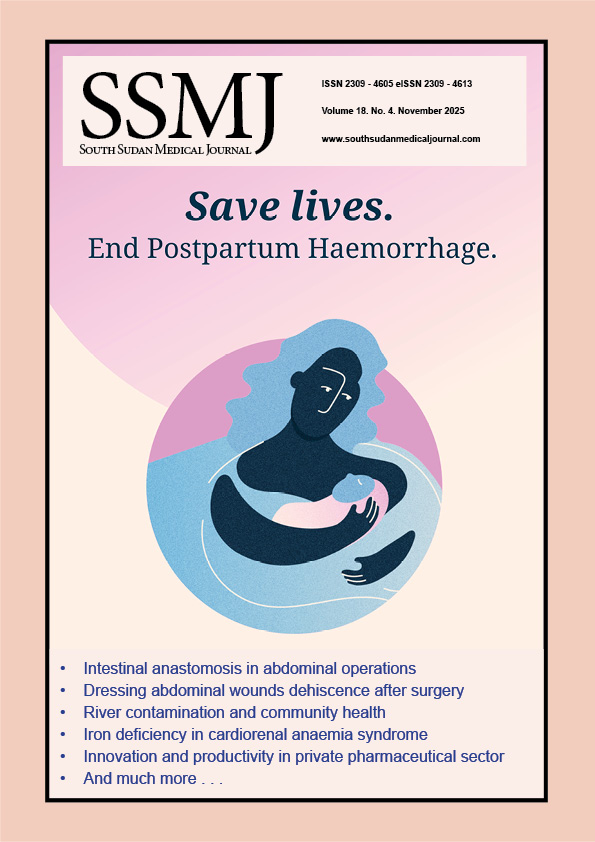
South Sudan Medical Journal - November 2025

SSMJ Vol 18 No 4 November 2025

 Dear reader,

The full issue of our November 2025 issue is now online; this is a bumper issue featuring 14 full articles and other news items, listed below. We thank the copyeditors and reviewers who helped prepare these papers. Let us know if you would like to join the Editorial team. We need you if you have time and editing skills.
 
Editorial

Research Articles

  • Comparative study between classical two-layer and one-layer extra-mucosal intestinal anastomosis in elective and emergency abdominal operations. John Chol Ajack, Galal Abouelnagah, Haytham Fayed
  • Comparison of improvised negative pressure wound therapy and conventional wound dressing in abdominal wounds dehiscence after surgery. Nasra Lichika, Edward Ketson Msokwa, Alphonce Chandika
  • River contamination and community health: mining impacts in rural central Kalimantan, Indonesia. Nawan, Septi Handayani, Agnes I. Toemon, Hepryandi L. D. Usup, Seth Miko, Joni Rusmanto
  • Iron deficiency in cardiorenal anaemia syndrome in Dodoma, Tanzania Gidion Edwin
  • Guerrilla investors: Firm-level innovation and productivity in South Sudan’s private pharmaceutical sector Garang M. Dut
  • Paediatric deaths at Al-Sabbah Children’s Hospital, Juba, South Sudan – an audit Zechariah J. Malel, Garang Dakjur Lueth, Mary Poni Jackson, Nicolas Kazimiro Sasa
  • Prevalence of anaemia among pregnant women attending the antenatal clinic at Bor State Referral Hospital. Mark Kuoi Jongkuch Kuoi and Shalini Ninan Cherian
  • The impact of dietary compliance on diabetic foot ulcer healing: A cross-sectional study. Dadi Santoso, Rajesh Kumar Muniandy, Putra Agina Widyaswara Suwaryo

Review Articles

  • Personal determinants of gender-based violence: a review of intimate partner violence in South Sudan. Nyinypiu Adong
  • Misdiagnosing Muslims: The hidden risk of using the CAGE questionnaire in some Islamic contexts. Anas Ibn Auf and Sayed Halaly
  • Impact of healthcare worker training on paediatric tuberculosis detection and reporting: A systematic review. Suryanti Chan, Hamzah Hamzah, Miftahul Falah

Case Reports

  • Lupus nephritis overlap syndrome in a male with albinism: A case report. Adam Gidion Edwin, Baraka Alphonce, Sabina Mmbali, Alfred Meremo
  • Rare isolation of Pseudomonas mendocina from a postoperative wound in a diabetic patient: A case report. Vimal Kumar Karnaker, Asem Ali Ashraf, Bhadra Jyothikumar

Short Communications

  • News: Physicians Association of South Sudan and Association of Gynecologists and Obstetricians of South Sudan. Sudan

Back Page: Supporting Wet Nursing During Emergencies
 
Articles in SSMJ are indexed by Scopus, African Journals Online (AJOL), and the Directory of Open Access Journals (DOAJ), and as well as being on our website. SSMJ is included in the EBSCO scientific research collection.
 
Thanks to everyone who supports SSMJ. Tell your colleagues they can join our mailing list here.
 
The SSMJ team
Email: southsudanmedicaljournal AT gmail.com
Website: http://www.southsudanmedicaljournal.com

Friday, April 11, 2025

The 'animal' in Hodges' model i

The New York Review of Books


'The fact that a horse has his eyes on the sides of his head identifies horses as animals of flight rather than fight, in contrast with animals like tigers, who have their eyes in the front.' p.17.


Hodges' model has two pairs of 'eyes'.

Can you see them?


Hodges' model: Axes & Domains
Structure AND Content :: Fight OR Flight

Doniger, Wendy. The Rise and Fall of Warhorses. The New York Review of Books. April 10, 2025. Volume LXXII, Number 6. pp.17-19. https://www.nybooks.com/issues/2025/04/10/

Wednesday, November 04, 2020

Lockdown ii :: Writing, Reading, Drupal...

As we start Lockdown 2 in the UK - England, plus the long nights to follow it's an opportunity to weigh up plans, projects and progress here.

I've nearly finished my review and posts on "The Power of the 2x2 Matrix":

Q. What is Hodges' model? A. It is NOT a 2x2 matrix

Next up - to read and review-  are two books:

Leave No One Behind: Time for Specifics on the Sustainable Development Goals, Homi Kharas, John W. McArthur and Izumi Ohno, Brookings Institution Press.
Leave No One Behind

Last weekend on behalf of my co-author I (re-)submitted a paper on public health, Hodges' model and the sustainable development goals SDGs.

It does pain me that the publisher kindly sent a review copy in the spring, but sadly it's not in the reference list. That subtitle is tantalizing. I will get to this after picking up "After Ethnos":
 

After Ethnos

To be clear, I'm a nurse not* an ethnographer or anthropologist, but this research approach featured large in studies at Lancaster University 2014-2016. 
 
 
A further rationale for reading this book is to maintain insight into research methods and methodologies.
 
Returning to the writing front, just before I found a co-author for the SDG draft, I'd worked on the two-part Threshold Concepts draft dealing with Deprivation of Liberty (now, Liberty Protection Safeguarding) c/o feedback from Mark Bird.
 
This is next up, especially hoping that the Threshold Concepts can proceed next July at UCL, London.
 
The other paper is a 'legacy' item which started in 2013 (yes, I know!). Mentioned here on W2tQ no doubt on diagrams, case formulations and h2cm. There is a paper here, he says? It is quite advanced in terms of words and references.
 
In addition to the legacy issues:
  • person-centred care;
  • integrated care;
  • holistic care;

the standout personal legacy - is this blog and the lack of a website. Soon I'll put twitter down and blog less to try (again) to focus on Drupal and related tools.
 
*I would like to think that successful nursing interventions (that really 'make a difference') calls for an  ethnographic and anthropological orientation.

Wednesday, May 06, 2020

Call for Book Reviewers: LGBTQ Titles c/o [spiritof1848]

Would you please share this information with your networks? Thanks! We have some new LGBTQ books. Reviewers get to keep the free copy of the book they review! We welcome reviews of books not listed. We support student reviewers through the publication process.

Call for Book Reviewers: World Medical & Health Policy.

World Medical & Health Policy is dedicated to the intersection of policy, politics, medicine, and public health. The Journal's objective is to help improve global health by broadly considering policy context, processes, outcomes, and influences.

World Medical & Health Policy is seeking book reviewers.

If you are interested in reviewing a book, please send me an email at the address below. This call for book reviewers is open to graduate students, health professionals, professional academics of all levels, and independent scholars. We welcome your ideas for books to review and we will gladly also help you find a book that matches your area of expertise. We are especially interested in book reviews associated with health equity and open to a wide range of topics.

Thank you for your time and consideration,

Cynthia Golembeski, MPH
World Medical & Health Policy Book Review Editor
cag348 AT rutgers.edu

LGBTQ Titles. Complete list of other books at bottom.

Broqua, Christophe. Action = Vie: A History of AIDS Activism and Gay Politics in France. Temple University Press, 2020.
http://tupress.temple.edu/book/0562

Cheng, Jih-Fei et al. AIDS and the Distribution of Crises. Duke University Press, 2020.
https://www.dukeupress.edu/aids-and-the-distribution-of-crises

Guadalupe-Diaz, Xavier. Transgressed: Intimate Partner Violence in Transgender Lives. NYU Press, 2019.
https://nyupress.org/9781479827855/transgressed/

Haldeman, Douglas. Sexual Orientation and Gender Identity Change Efforts: Evidence, Effects, and Ethics. Columbia University Press, 2020.
https://cup.columbia.edu/book/sexual-orientation-and-gender-identity-change-efforts/9781939594365

Lakkimsetti, Chaitanya. Legalizing Sex: Sexual Minorities, AIDS, and Citizenship in India. NYU Press, 2020.
https://nyupress.org/9781479826360/legalizing-sex/

Liu, Hui et al. Marriage and Health: The Well-Being of Same-Sex Couples. Rutgers University Press, 2020. https://www.rutgersuniversitypress.org/marriage-and-health/9781978803480

Shanker, Adrian. Bodies and Barriers: Queer Activists on Health. PM Press, 2020.
https://www.pmpress.org/index.php?l=product_detail&p=1079

Stall, Ron et al. LGBT Health Research: Theory, Methods, Practice. Johns Hopkins University Press, 2020.
https://jhupbooks.press.jhu.edu/title/lgbtq-health-research

Varghese, Ricky. Raw: PrEP, Pedagogy, and the Politics of Barebacking. NYU Press, 2019.
https://nyupress.org/9780889776838/raw/

Additional books for review:
https://drive.google.com/file/d/1rc9_nGmAINFJ769Uj1byqVkg7pFPV3Ok/view?usp=sharing


Thank you!

New article: COVID-19 Amidst Carceral Contexts: The Overton Window of Political Possibility and Policy Change

Cynthia A Golembeski
Robert Wood Johnson Foundation Health Policy Research Scholar
NJ Scholarship & Transformative Education in Prisons Faculty
JD/PhD Student | Rutgers University School of Public Affairs
orcid.org/0000-0002-0749-5566
cag348 AT rutgers.edu

Posted from the Spiritof1848 Listserv WWW.SPIRITOF1848.ORG


Thursday, January 30, 2020

Books, Papers and Conferences ...

At present I'm reviewing a paper for a journal on an education topic - nearly complete.

Communication Skills
for Effective Dementia Care


I'm five chapters into the ten chapter book -

Communication Skills for Effective Dementia Care

A Practical Guide to Communication and Interaction Training (CAIT)

- this is for a journal so it will be a 'review'.


800 words, or thereabouts are needed on Hodges' model and its utility in reflecting, deliberating and comprehending the environment and climate change. I have some notes already. 

Mathematics and Art: A Cultural History

Yesterday I had to visit a neighbour. A card for an undelivered item: a parcel. 

What could this be? 

It was quite a big box. 576 pages worth to be exact and a larger format book 9.5 x 12 in that instantly shouted 'quality'.

The book is not new, but is lovely to discover ... 

In my message to the publisher I highlighted my non-mathematical status, but great interest in topics within mathematics and the disciplinary bridges from maths - physics; sciences and humanities and of course mathematics and art.

I'm really grateful (especially to Princeton University Press) to receive both these books.

The dementia care title will also help me complete the two-part paper on Hodges' model, deprivation of liberty and threshold concepts. There are so many strategies and techniques outlined for carers both formal and informal. In July reading this book will also assist with a presentation at the Threshold Concepts conference.

Now well into the new year - the revisions to the paper on the SDGs and Hodges' model is also a priority.

To manage time I've put twitter down, but clearly with the above some tweets will follow in due course.

Then finally it will also be time to leave this blog alone for a time - well fewer posts at least ...


Wednesday, September 19, 2018

After 41 years of listening - now it's your turn [ please ]...

If you are a researcher, author, lecturer or editor ... (you get the gist already...) and the project that currently has your undivided attention (well, almost) is a draft paper or literature review on any of the following:

metamodels of care / nursing / healthcare / global health
metacognition of care / nursing / healthcare / global health

holistic care / nursing
integrated care / nursing
models of care
models of nursing
theories of nursing
models of healthcare
conceptual frameworks in health, social care or education
(across - theory, practice, commissioning, funding)
history, current state, future of the above..
(I could add more)

- then please consider this request.

If there is no reference in the work to Hodges' model, as in:

The Health Career Model
Hodges' Health Career Model
Hodges' Health Career - Care Domains - Model
The Health Career - Life Chances - Model

- then I would humbly suggest to you that the work in front of you is incomplete.

Yes. I am variously disappointed, dispirited, desperate* since the terms of a well thought out, comprehensive search strategy should surely pick up a breadcrumb leading to Hodges' model? Fellow mentors and supervisors I need some help.

But, help with which one you may well ask?

Well, here's some background to account for the seeming lack of version control:

The Health Career Model
 &
Hodges' Health Career Model

These were the original titles for the model. The 'health career' has always referred to the idea and phenomena of 'life chances' (see bibliography in sidebar for Hughes).

Hodges' Health Career - Care Domains - Model

The original website from 1998 appeared to cause some confusion with visitors taking career to relate to work and professional opportunities. The 'care domains' addition sought to distract from that, to emphasize the care knowledge quality of the model.
The Health Career - Life Chances - Model

I have always tried to include Hodges' in the titles I have employed. More recently, it appears that using a name appears to accentuate the perception for others that the model was "Not invented here". Plus, there may be copyright and other proprietary provisions.

The reference to Hughes and life chances goes back to 1958, but seems even more relevant now given the importance of epigenetics, technology, sustainability, ecology, universal health care, access to information and healthcare knowledge and global health.

So, even if not germane to the main arguments of the paper or work at hand I would hope that the model might at least be referenced, as per:
Maffissoni, André & Vendruscolo, Carine & De Lima Trindade, Letícia & Zocche, Denise. (2018). Redes de atenção à saúde na formação em enfermagem: interpretações a partir da atenção primária à saúde. Revista Cuidarte. 9. 1-13. https://revistacuidarte.udes.edu.co/index.php/cuidarte/article/view/549
Many thanks!

Sunday, November 23, 2014

Antipsychotics & Dementia: Managing medications (across Hodges' model)

individual
INTERPERSONAL : SCIENCES
humanistic ------------------------------------------- mechanistic
SOCIOLOGY : POLITICAL
group
person-centered care, communication

diagnosis
medication management
assessment - review
premature deaths, stroke
side-effects
observation
Anti-psychotics:
Traditional - 1st generation
Atypical - 2nd generation
de-prescribing
pain, analgesia, 
research
anti-depressant
cholinesterase inhibitors
titration
trial reduction
avoid benzodiazepines if possible
Team working, collaborative care, family
nursing homes
challenging behaviours -
shouting, aggression, psychosis, agitation
Behavioural and psychological symptoms of dementia (BPSD)
psychosocial interventions, reassuring staff, knowledge and skills
Policy, Reports, Governance, Audit, Consent, Capacity, Consultation, Multi-disciplinary approach, institutions, choice

My source: AlzheimersAustralia via twitter
https://www.dementia.org.au/

Sunday, July 06, 2014

Excuses found: "premature definition of variables"

Currently reading:

MURPHY E., DINGWALL R., GREATBATCH D., PARKER S., WATSON P. (1999). Qualitative research methods in health technology assessment: a review of the literature. Health Technology Assessment. 2(16), p.84.
Marshall (1985) presented the flexibility of qualitative research as one of its strengths. She argued that, in qualitative research, the researcher does not assume that (s)he knows, at the outset, the exact nature of the research question. Rather, qualitative research offers the opportunity of discovery. In fact, researchers vary considerably in the extent to which they formulate the precise nature of the research question in advance of the study. Most seek to avoid what Silverman (1993) referred to as “premature definition of variables”.

Ah, so this is what I've doing!

Yes, but for how long with h2cm, with Drupal...?

1997... 2007...  and counting... :-(

Thursday, January 16, 2014

Book review: Values-Based Commissioning of Health and Social Care

This book was a welcome change from the last review, being quite brief in comparison at 155 pages including the index. This isn't a criticism, it just helps in clearing the decks for other reading and distance learning.

The text is no lightweight, however; and should be mandatory reading for all health and social care personnel. Well maybe not all; but that is part of the problem. The clinical and social care workforce are trained to care. Commissioning (and clinical coding) is something done in another location, by other personnel.

If there is a recurring criticism of public services it is that they are cossetted, protected, removed from many of the financial realities of the world. The book, published in 2012, was written anticipating the structural and financial change brought in by the Coalition government and the need for austerity. Therefore, the public sector and clinical staff are not  immune from the vagaries of finance as might be assumed. For the past couple of years I've witnessed the regular shakes of the sieve and heard of the same within local authorities.

Christopher Heginbotham's book provides the background and tensions of commissioning and delivers much needed insight on several fronts by conjoining what so often seems remote. The lesson of the book for me is how distinct finance and commissioning are. I can sum this up as: if person-centred clinicians are concerned with sense-making for and with patients and their families, then commissioning is the sense-making of the available finance. Viewed this way you see the importance of commissioning.  Clinicians are concerned with evidence-based care, ethics, the health reforms, outcomes, quality, and of course values. Add to this patient involvement and public engagement and you have a read that opens a field that many clinicians dash by (in the public sector?*) as they manage various clinical priorities.

Chapter 1 and 2 set the scene of values-based commissioning, definitions, the fact-value distinction; and the post-Labour NHS. The health reforms (chapter 3) are central to the text, but despite the date of publication which the author acknowledges there is little loss of significance. The health and social care commissioning landscape is still taking shape, outcomes based commissioning (chapter 9) can make the news as implementation is delayed (Williams, 2013). Chapter 4 describes the seven fat years followed by seven lean years; an excellent overview with the major influences at work, The Wanless Reports and Marmot Review for example. It is salutary in these times to see NPfIT as a footnote, with IT benefits still to be accrued (p.32). The need to respond to the public health challenges are noted (chapter 6), as with the potential mental health impact of climate change.

The book's figures and tables are a great asset, very useful to educate student nurses about commissioning, value and values. There are a couple of references to colour (p.72) in what are black and white - grey illustrations. 'Reading' the diagrams you can follow them. The author's background comes across, as with location and mental health experience. The book is I believe relevant to readers across all sectors. Heginbotham also indicates that the book is one of a series by CUP, and points to Fulford et al. as a sibling. There are a couple of repeated words but otherwise the production is excellent.  I was a little surprised to find a catastrophe in the text - catastrophe theory (p.51). It is well deployed in explaining complexity and values. When I say surprised perhaps I would really like to see more on this theme of complexity and emergence, but Mr Heginbotham stays clearly on track.

My bias - Hodges' model - found the following standout points:

http://www.cambridge.org/gb/academic/subjects/medicine/medicine-general-interest/values-based-commissioning-health-and-social-careThe number of sentences and figures that describe the individual, group, community and population (the structure of Hodges' model). The way that values can act as a counterpoint and essential adjunct to evidence (subjective - objective; qualitative - quantitative).

Some situations are more biological than others - in certain sorts of surgery, for example - and some have a much larger values base - such as in psychiatry (p.40).

 Reference to (Cronje and Fullan, 2003):

The medical literature demonstrates an equivocal attitude which suggests a 'collective need to better integrate scientific quantitative data . . . and the art of human judgement . . . into a common definition of "rational" medical practice (p.40).
Figure 7.8 Filtering the evidence through a values-based matrix (values across four care domains?).

The use of models to test the real world and reference to a values space.

I posted previously about the nhm - new holistic model (p.80).
(back to the review..!)

Technical aspects (a law and index) and ethical issues that beset commissioning are introduced (space is limited), and recur helping to integrate the book as a whole. Chapter 5 deals with public involvement and engagement and how it can be enacted. Chapter 7 on integrative commissioning invariably raises patient and service user care pathways.

Is this the Rorschach test for patient, care professional and commissioner: please draw your care pathway? 

The book admirably deals with the ideal and realised in the space available. As such even when there is a linear care pathway it is how it is experienced that counts (values and outcomes...). (It is sadly the person-affirming life-story pathway that is so often lost.) 

Perhaps, this is what I have in mind above in referring to emergence. Despite the existence of care pathways in practice the route in-through health and social care is probably found in a rather chaotic way (sudden care transitions); with delays, placement changes, ward movement(s)-stasis, choices to be taken into account, lack of attendance, missed appointments. ... This is why trying to define pathways may certainly assist, but it is the granularity of those definitions and their experience that snags at our clothes along the way. As Heginbotham advises - care pathways are not something to use in a slavish way. This excellent and well referenced book should provoke and establish interest in this very important health and social care activity. An activity and process that must be informed by the values of the public and those of patients and be more than a process, but realised in shared purposes and practise.

*When we stop and reflect we also recognise ourselves as tax-payers and so seek value-for money, and the other e's of efficiency, effectiveness, efficacy...

Many thanks to CUP for the copy.

Williams, D. Trust forces delay in outcomes based commissioning plan, Health Service Journal, 6 December 2013. p. 4-5.

Heginbotham, C. (2012) Values-Based Commissioning of Health and Social Care. Cambridge, Cambridge University Press.

Wednesday, January 01, 2014

Book review: "Nursing Informatics and the Foundation of Knowledge" (long book - long review)

Happy New Year to everyone!

Last spring I requested a book for review and received three c/o and with thanks to Jones & Bartlett Learning Nursing. Finally, I've picked up the second - and about time it seems - as on this first day of 2014 the publishers are planning the 3rd edition. This book provided a break from virtual matters being a door-stop of a book; 538 pages, excluding abbreviations, glossary and index. In addition to this physical rendering the publishers emphasize an online presence for this and other books. Inside the cover there is a card with an access code to unlock the companion website for online resources for readers, students and lecturers. The account setup is straightforward and there are additional student exercises beyond those in the book.

Informatics is by definition a challenge for authors and publishers. Even though published in 2011 - 2012 time is at work. From the outset then the team involved in this text are to be congratulated on what is a monumental task in scale and time.

The foundation of knowledge in the title refers to the adopted conceptual framework - the foundation of knowledge model, which is illustrated at the start of the book's sections and especially section I on the building blocks of nursing informatics.

The foundation of knowledge model was itself quite a hook for me.
The model includes bits, bytes, data and information and from this arise:
  • knowledge acquisition
  • knowledge processing
  • knowledge generation
  • and knowledge dissemination
- with all of these influenced by and influencing feedback (there is an illustration in the sample chapter). The model describes people as information systems. Although the diagram presents a structure for the model, and it fits this informatics context very well and provides a link throughout the book it is not convincing in terms of subjects, agents, and knowledge disciplines. Admittedly the foundation of knowledge model is high level like Hodges’ model. Similarly, it is not prescriptive in terms of how events, phenomena are characterised. Data, information, knowledge and wisdom are however, the most fuzzy of concepts and subject to ongoing philosophical debate. I'll reflect a little more on this later. As already noted the model works here and I see online that a couple of students (and no doubt a great many more) have utilised the model in e-portfolios.

Each chapter has a listing of key terms, which are highlighted in the text. There are reflective questions at the end of each chapters. Chapters are concise, well referenced across various media and are all accessible and evident of a great editorship. There are a couple of longer treatments of certain and well chosen topics. Within chapters there are brief diversions in boxes on a related theme, for example in chapter 3, box 3.2 on ‘storage capacities’. I’d almost forgotten about EPROM and RAM, even though I used to purchase computer programs on EPROMS and ROMS in the 90s. Although abbreviations still abound, these abbreviations have become rather transparent now - and may say more about the generational scope of the authors - including this one? If these are going to be included then where is ‘GPU’, ‘SSD’ …? This is a difficult balance to strike, but mention of these struck me as antiquated and date the text. ('GPU' is hardly new - 1998 c/o Nvidia)

With two major companies referred to early on, open source is explained on page 43 and in the examples of software programs that are listed. The book is courageous in several respects introducing the model, listing software and specific technology examples, some of which can be brief in terms of market longevity. The emergence of the cloud is discussed and provides a current flavour, as with usability (‘UX’). Although the authors are clearly leaders and advocates for nursing informatics and the technologic, the enthusiasm is tempered.

The limits and complexity of AI artificial intelligence are raised in addition to the revolutionary progress. Chapter 4 on cognitive informatics I found personally fascinating, as it reassures me about my interest in the potential of combining conceptual spaces, threshold concepts with Hodges’ model. As a result I previously posted items from the book about cognitive informatics and another relating Beauchamp and Childress’s four principles of health care ethics to Hodges’ model.

Chapter 5 continues the consideration of the limits and challenges posed by technology in exploring the theoretical approaches to health care ethics. The standards for e-health ethics will now be tested with the fate of the .health domain (deliberated online at HIFA2015 to follow...). I wonder if this debate will figure in the 3rd edition? Clearly there are implications for the governance of such a domain. As the chapter points out many ethical e-health standards are voluntary.

As an individual and a reviewer of book with international scope and a discipline with international global aspirations you are acutely aware of your parochial situation. When I look at the UK (Northwest England!) and nursing informatics it seems, with some exceptions to have failed to make a mark in nursing. Yes, colleagues and I use an electronic health record, but there is so much more that could be provided in terms of purposes, functionality and reports. The majority of student nurses I speak to do not seem to be primed let alone tutored for the wider informatics world they will enter as practitioners. So much more that could be done with mobile technology, caseload management tools, research tools. Perhaps this is why as I read of - the use of decision support systems and expert systems (p.77) – I thought “Get real!”. How accessible are such tools to the majority of nurses? Speaking from Wigan Pier at least, if it is 'nursing informatics' you seek then you must be westward bound. It appears there is quite a difference in the esteem of nursing informatics in the USA and UK? - and my review reflects this. Jocularity aside there are two serious points here.

1. The book is clearly USA centric, but it really is relevant to readers elsewhere (I thought there might be a problem registering on the website, but there was no .
2. The other point concerns activism.

When there is an opportunity should we advocate for nursing? Is there scope for this within a nursing informatics text? Even in ‘developed’ nations we should take nothing for granted be that the UK - rickets, TB, sexually transmitted diseases in older adults, obesity; or the United States with the potential impact of climate change and health inequality (MacKenzie, 2013, America's hidden epidemic of tropical diseases). The complexity of nursing and health is also apparent while reading that informatics can serve to check compliance with antibiotic regimes, you simultaneously reflect on the need to reduce the general prescribing of antibiotics and the correct administration and management when they are utilized.

My interest in and exposure to informatics and the humanistic-mechanistic axis within Hodges’ model brought me to the socio-technical literature. Even though socio-technical aspects of nursing and nursing informatics abound implicitly in the book (chapter 6, page 100 and elsewhere – chapter 16) ‘sociotechnical’ or ‘socio-technical’ does not have a place in the index. Although they rarely come across it – hence my thoughts above – I explain something of classification and coding to the student nurses who visit our team. Chapter 7 is a very informative contribution on this subject by one of several international contributors (all listed at the book’s start). How can nursing informatics make an impact if nursing students are not aware of the existence of nursing terminologies and approaches – enumerative and ontological - to the same? Nurses should be aware of the international standards associated with their profession - nursing terminologies included. Chapter 8 on nursing roles, competencies and skills prompted me to wonder about other forms of informatics and to what extent there can (should) be dialogue between these other disciplines?

In, Information and Knowledge needs of nurses in the 21st century (chapter 9), as an individual practitioner you are always situated (p.531) in a local nursing experience. I think this is where the model needs to be extended to facilitate the incorporation of local, global and glocal perspectives. Surely informatic's role as the latest technical means to communicate across a diaspora and it seems create a reverse diaspora through online communities and virtual worlds is worthy of a political stance? Global initiatives such as Health Information for All 2015 (what year is it next and still so much to do...) and other groups (maternal and infant care) need nursing's support and this extended information-informatics awareness (wisdom!) might also pay local and national dividends?

Chapter 10 is lengthy as befits legislative matters which nevertheless maintain the readable tone, clearly there is an ongoing evaluation by systems suppliers and users on the potential of the Cloud (Chapter 17). Chapter 11 was a nice surprise and the impact of which I have already referred to in e-portfolios. Individuals act as their own portal – p.187. This is a subject that (I hope) will occupy me for the next couple of years. The use of e-media by nurses for reflective commentary using web publishing tools is addressed very well. Having just ordered a second hand copy of Etienne Wenger’s book on communities of practice I find this discussed here:
In the future it is hoped that the use of communities of practice in nursing will grow beyond knowledge sharing and promote more knowledge discovery and sense making. p.189.
I’m not sure if e-portfolios have affected the EU populace with the rapidity and extent expected (by 2010), but there is a series of ongoing conferences dedicated to the cause. In the 1990s and early 2000s you could not miss the emphasis on benefits realization. If this concept has had its day what exactly happened? (There is no longer a need to prove the worth, potential of the computer at the bedside, nurses station.) We should still focus on outcomes as noted in several  chapters.

The sections also take on a practical – application focus across administration and nursing functions. Open source is further examined p.212. If SQL is mentioned would it help to acknowledge the development of noSQL approaches? Memory and processing power (for indexing) are less of a constraint on systems now. There is another challenge presented to editors: is 2004 really a ‘recent’ study? ‘Recent’ and its synonyms ‘currently’ need to be checked throughout the book and revised accordingly. The same applies to references to demographics and changes in nursing numbers (p.320-321). The trends in the numbers are established and remain, but perhaps there are more up-to-date sources? Throughout the book there are also case studies and pointers to research that provide practical and personal insights to the subject at hand.

While the context is nursing and informatics I think the discussion on ‘health literacy’ requires a critical review. It seems that health literacy may be being construed as synonymous with health technology literacy, computer and information literacy which are also noted in the text. There is admittedly a great deal of overlap.

‘Health literacy’ needs to be considered before a specific health problem arises – it is too late then. Health literacy does not mean, should not be equated with the deployment and use of e-tech applied to people with diabetes, coronary heart disease. Is this specific health education aimed at self-care, relapse prevention, staying well? Is health literacy concerned with positive health?

I’m sure the authors – editors are only too aware of this but this understanding of the wider context of ‘health literacy’ as a field of research and practice is not conveyed at present. I also don't necessarily see a wiki as a search tool, yes you can search a wiki but it is a type of repository and as such the effectiveness of a search must depend on the contributions made and the preceding searches. Perhaps a dedicated wiki could become a form e-grey literature?

A highpoint for this reviewer was to read: Learning is a multispatial function, … (p.406). It certainly is. The discussion on creating learning resources is an excellent introduction, especially on using the electronic health record as the learning resource.

In considering the future chapter 29 does not explicitly utilize the framework of knowledge. This may provide an opportunity to extend the framework to more readily integrate bio-psychosocial-political and spiritual perspectives through time. The framework of knowledge within informatics is a great resource. As mentioned this drew my interest to the book, in 1996 I sought to relate informatics concepts to nursing and mental health (redundancy, entropy.... see bibliography). Whatever the differences between the USA and UK nursing informatics the framework might benefit from a way to integrate context, specific concepts and practices, self-care, interprofessional education and wisdom.

This is a great book, one that is also courageous in its scope and execution. The third edition will be very well worth not just purchasing, but applying. Thanks again to Jones & Bartlett Learning for this copy.

MacKenzie, D. (2013). America's hidden epidemic of tropical diseases, New Scientist. 11 December 2013, 2947.
http://www.newscientist.com/article/mg22029473.200-americas-hidden-epidemic-of-tropical-diseases.html?full=true
 
McGonigle, D., Mastrian, K.G. (2012) Nursing Informatics and the Foundation of Knowledge, Second Edition. Jones & Bartlett Learning, Burlington, MA.
Sunday, September 15, 2013

Book review "Clinical Intuition in Psychotherapy: The Neurobiology of Embodied Response"

Clinical intuition is something that in formal learning terms is intangible, but in practice is earned and relied upon as a gift of experience. When I first received this book from the author Terry Marks-Tarlow, leafing through I thought the emphasis was on the neurobiology presaging a rather technical read. The references to brain structures, neocortex, brain waves ... seemed to suggest a reductive approach, remote from my conception of intuition in clinical practice. I need not have worried, the initial discussion on the brain and evolutionary development is not just a foundation for what follows but as the title suggests underpins and integrates the whole text. Despite the title and as the foreward advises you do not have to be a psychotherapist to read and appreciate this book. The stall is set from the outset in the introduction which explains that chapter one defines clinical intuition:

Clinical intuition is defined from a neurobiological perspective as a right-brain, fully embodied mode of perceiving, relating, and responding to the ongoing flows and changing dynamics of psychotherapy. (p.3)

The introductory material here is essential foundation reading for people starting a career in psychology and mental health related disciplines. The evolutionary development of the brain from reptile through to the mammalian brain is invaluable. Tying this to specific brain functions and circuits - care, fear, panic, play, lust, rage and seeking - helps integrate brain anatomy, perception, emotion, and behaviour. The advances in neurobiology to follow will no doubt demand that we all extend our understanding of this interdisciplinary fusion.

Clinical Intuition in Psychothreapy
The book itself (hardback edition) is very well produced, the type face easy to read and the book well structured and with a well balanced mix of illustrations and photographs. The reference listing at the end runs over thirteen pages and is well grounded historically and in having regard to ongoing research. The index is comprehensive (fourteen pages) and a resource itself providing a look-up approach. The book's use of case studies, thirteen in total informs the text and provides some continuity through the book. Dialogue between therapist and client is easy to follow and illustrations are provided with ample explanation in situ. The references also utilize web-based resources.

I recall intuition coming up as a thread on several occasions on the psychiatric-nursing list especially between 1998 and 2004. Intuition is a central quality for all personnel working in health and social care. We must also recognise intuition as a human trait as when non-health professionals exercise the judgement that: "Wait a minute, we need a clinical opinion here." Self-care is also discussed. I had a Pythonesque moment - "Is this the right room for an argument?" - considering psychotherapy as a therapeutic modality within therapies as a whole. Here in the UK (and no doubt elsewhere) self, brief and solution based therapies rule economically. Even though the shortage of psychological intervention is recognised in the UK through IAPT improving access to psychological therapies, we need to ask: how does psychotherapy fare in the current (austerity) climate? To what extent can clinicians exercise intuition? Therapy relies on caseness, relationships and narrative, but to what extent can these be acknowledged and delivered within the economical time frames that frequently operate? 

Although there's no specific chapter on training for clinical intuition, Marks-Tarlow provides a list of how researchers have characterized clinical intuition (more recently in the 1980-1990s); five characteristics are proposed:
  • Sudden recognition;
  • Immediate knowledge;
  • Emergent awareness;
  • Non-verbal insight; and 
  • Holistic integrative sensibilities. (pp.42-43).
 Of the first two sudden recognition and immediate knowledge, I thought of the intuitive sense that is applied upon receiving a referral. That is the assumptions (not always helpful) that arise from the information provided (and missing) and where this leads you? But of course, is this clinical intuition? Intuition as the author makes clear (p.3 and) throughout the book is in psychotherapy. Intuition here (and for me) depends on interpersonal - therapeutic - interaction. What precedes is something else (data integration, hypothesizing, reasoning...?). I can however still see explanatory avenues in the above that can help us travel from the conceptual (reduced) to a holistic whole. I did wonder about the role of intuition in suicidal ideation and risk management, but this is also a question of referral criteria and caseness.

I would very much like to write myself about information and complexity and these themes recur in the text, especially the latter. Several 'spaces' are discussed too: social, physical and spatial schemas. The work of Buzsáki on the hippocampus, navigation and maps - landmark navigation - is fascinating in chapter 7 Navigating the Seas. I have likened Hodges' model to a cognitive periplus - an ancient maritime map. Over the next few months I'll post some quotes from the book.

This is an excellent book that I heartily recommend. The discussion of what is implicit in the brain and so in therapy, what is embodied and wisdom in mentoring invites re-reading. Finally but vitally there is much humour and humanity here too.

Many thanks to Terry Marks-Tarlow for the review copy.

Saturday, June 01, 2013

Review: Philosophical And Theoretical Perspectives For Advanced Nursing Practice

If you are a miner for insight, a pearl diver for knowledge or seeking blue sky wisdom this book can deliver and sign-post in plenty through its references. In summary: this book is a history book that nods at futurology.

I had high expectations for the text, also anticipating an exacting read. After all, as a 5th edition this is a well established text. The expectations were not wholly realized, however; many of the papers are quite dated being published originally in the 1990s.

The book is an important collection and can certainly be regarded as essential reading for advanced nursing practitioners and those pursuing post-graduate nursing studies. Several chapters hail from the same journal publisher and perhaps - as a positive - this contributes to the readable and accessible style throughout the book. The text format and size are also easy to read. I found one spelling mistake within the index entry for 'diagnosis' p.387. In addition to the historical development in part 1 the book's division into five parts - 31 chapters in total - acknowledges the reliance on the past and from it appears from a previous edition the arrival of the 21st century. Apart from the current date of issue 2013 I cannot accurately place the most recent additions to the volume. The contents listing and preface are limited in this respect. Judging from the references they are not that recent. 2010 is one of the most recent references I could find, and this, the 75ed of Toby & Mariner.

Many of the papers are seminal and include an overview of particular aspects of nursing thought - analysis and synthesis. Unsurprisingly, there is philosophy and ethics in great abundance, together with ecocentricism, several forms of feminism, aboriginal peoples and their world views, evidence, health, beliefs, art, professionalism, research, patterns, advanced practice, theory and much more. The distinction between evidence based theory and evidence based practice is something of which all nurse students should be aware.

There is specific reference to Advanced Nursing Practitioners. There could obviously be some variation in how this professional group are considered as opposed to Advanced Nursing Practice. Having just returned from Belfast and the University of Ulster there is ongoing currency in McCormack's chapter 17 A Conceptual Framework for Person Centered Practice with Older People. While dated 2003 McCormack's work was emphasized at a recent conference in Ulster I was able to attend (and there are plans for another). I am sure other chapters may be enlivened by such reviewer found co-incidences as this.

I wonder if the scope of the book and acknowledgement of the passing of time seems to shout for a two-volumed approach. As suggested above, the previous acknowledgement of the future seems to have hailed from the 20th century and got lost. We are now after all more than a 1/10 of the way into the 21st century.

Having started my nursing career in the RN, chapter 22 on military metaphor in nursing and the need for another. A researcher contacted me several years ago about using Hodges' model (a conceptual framework) in a study on bullying in nursing. I've never heard anything since, but Hodges' can help in such research in two respects. The inclusion of a political domain and the organization of groups of people, emphasizes process, procedure, protocol, routine, and may proceed to regimentation, discipline, hierarchy so to a degree language games will follow. As this chapter notes, several professions, including nursing are said to eat their young. A commentary after the chapter provides a useful balance and makes this point. The chapter is nonetheless a reminder of the role of language and how professionalism arises and is sustained (disciplines too?). The proposal of frontier as a new metaphor is fitting as Hodges' model identifies five conceptual fronts - frontiers that must be integrated. 

As a frontier - Chapter 21 on rapture and suffering with technology in nursing holds many lessons and insights. Heidegger's "standing reserve", the human-technology interface, what it means to live like a human being and the distinction of being a human being. Mobile technology, m-health, e-health are making a huge contribution to global health and need a place here. I found Macurdy's four principles 326-327 on what patients need to assume power and control over their care very illuminating, especially in highlighting information access and the importance of health literacy.

In the text and the index I could not find specific reference to capacity, as in mental capacity, informatics, global health, information (access), justice, law, legal, management, human rights, literacy, mental, political, psych-, long-term medical conditions and recovery. While the book would become incoherent if a disease/diagnosis-based approach was adopted, we might ask: does dementia deserve specific inclusion? This is an interesting (and potentially vociferous) debate in itself - to what extent should such a book record change through several decades? Of course the book is not an encyclopedia and it is easy to critique according to omission. These are pressing times demographically, however; while there is a population focus: global communities and aboriginal communities in chapter 23 and 24, this merely scratches the surface of very large world.

This book is a valuable asset and has stimulated many ideas here (and potential blog posts). I am very pleased to have read it and would recommend it to students and practitioners alike. I am grateful to the publishers for the review copy.

Friday, October 05, 2012

Book review: Nursing Knowledge: Science, Practice, and Philosophy

Searching for an up-to-date nursing theory book I wanted something different from the usual fare. The usual fare being a description of the various nursing theories, models and frameworks to date. I needed a text that would help me in two ways: firstly, deal with and critique the foundations of nursing theory; secondly, to provide some insights that would inform my own study into Hodges' model. I quickly found a book with a bonus: it is written by a philosopher.

Mark Risjord's - Nursing Knowledge: Science, Practice, and Philosophy (Wiley-Blackwell, 2010).

This is not a large book considering the literature within its potential purview at just 246 pages in total. The text is very readable both visually and in style. Even if points need to be re-read this isn't a chore. Evidence of structure and discipline runs from paragraphs to the overall division into seven parts, with the usual reference listing and index. As a nursing student of the late 70s and early 80s this book needed to reframe this subject for lifelong learning student of the 2010s. Risjord starts by examining the history - prehistory no less - of the problem. 

Key questions that have arisen in nursing and directed thought are discussed. The influence of what was happening simultaneously in the philosophy of science and culture is also related. The writing is succinct (as already suggested) on page 18 we have an explanation for the appearance of the relevance gap, how this gap endures and how it might be closed.

Central to the demographic, media and political challenges that nursing faces part II covers values. This brings in nursing's standpoint and more direct reference to cultural influences on nursing knowledge in particular feminism. This discussion is again brief, standpoints are very relevant for me. The combination of depth of analysis, brevity with a clear focus are a great achievement. A lesson in how to write, how to argue, how to communicate. You can only do this if you know your subject.

If I missed anything it is technology and information, but the book is probably all the better for this whether considered an omission or diversion. Seeing specific reference to multidisciplinary in the index and a discussion of nursing knowledge in relation to other disciplines would be helpful. Risjord's purpose for this book is however, clear from start to finish. It's there in the title. The book is no glossary, or dictionary, and yet the treatment of many concepts here, such as; axioms, borrowed theory, coherence, context, grand theory, and paradigm (a chapter)... will help reader's appreciate their definition and use. Seminal papers from the literature are identified and re-examined. Much of the book is devoted to research and methods with illustrative examples.

There is much to inform my studies, in particular chapter 15: Conceptual models and the fate of grand theory. Here I can conclude from Risjord that Hodges' model creates an orientation picture rather than an abstraction picture:
On this understanding, nursing models are expressions of the philosophical background to nursing research. Conceptual models orient research and practice by guiding the selection of problems or making phenomena salient. They make no theoretical pronouncements. A conceptual model can guide research and practice only in the light of some values and goals. Nursing values and goals are thus crucial components of the conceptual model on the orientation picture. They set the agenda for nursing research by articulating what is important. p.173.  
I've long considered Hodges' model to be a map. Initially, a blank map - a space within which values can be deliberated. In pedalling this particular bike since 1998 I know how tired nursing theory is. Now students don't need to get on the bike, they stand on one pedal and freewheel the short distance that represents the curricula space devoted to nursing theory (and philosophy). A packed curriculum provides the momentum for the (values) by-pass. Mark Risjord concludes with new questions about nursing theory, new maps and new directions. I've outlined other points from the text for future reference. This book will remain a companion for quite some time: a great compass.

Acknowledgement: Many thanks to Wiley-Blackwell for the review copy.

Thursday, March 29, 2012

Tied to the mast: achieving anonymity

It isn't just me - is it?
Other people must have this problem.
No?

It isn't that it's an embarrassing body problem -
although time will tell on that
- it's just Frustrating.

If you venture to write a paper for publication then the submission process usually asks you to render the paper Anon. This makes good sense: right and proper. While some scholars can spend decades on a specific problem, or project the majority of academics must be fleet of foot. Usually, they have to  chase funding, publish, publish and shift from flower to flower garnering citations and increasing aplomb. There must be exceptions I suppose, were researchers become a 'known' quantity, associated not just with particular research subject, but with a set of peers and establishments. Of course I'm Generalizing.

Here though I can't help wishing it was different - that's what this mission is all about. Trying to get other people on board, to recognize the potential value of Hodges' model in health, social care and beyond.

Speaking
of
beyond
it is
marvellous 
to note that the past two days have seen over 100 
visitors 
to 
W2tQ. 
Thanks
everyone.


As to the anonymity bit, well I've climbed the pole, I've balanced on the beam and yet sadly this new gymnastic element the anonistic-maneuver is beyond me.

I don't want to moan, but in this case models offer no anonymity.

If I could hide I would: the long and short of it is I'm stuck ....

If it is not Brian Hodges himself writing about the model, then who is?

Now clearly I'm no Odysseus, but it seems I'm tied to this thing. This conceptual contraption. This mast.


Jokes aside though, it makes you wonder how many other innovations, worthy projects, ideas of merit, struggle against what appears to be a figure ground illusion?

You see with h2cm even when duly anonymised -  one moment we have an unknown - a personally, politically neutral entity. The next moment - ah! hold on. Now I can see who it is and hear this 4-track song.

Oh wondrous enchanted music ....


There is a way around this...!

Additional link:
http://hodges-model.blogspot.co.uk/2007/01/hodges-model-what-is-it-1-house-of.html

Original image sources:
Figure ground labelled
http://psylux.psych.tu-dresden.de/i1/kaw/diverses%20Material/www.illusionworks.com/html/figure_ground.html
Odysseus
http://www.prospectmagazine.co.uk/tag/social-structures/

Monday, November 07, 2011

Bortz's Next Medicine: Defining 'health' and h2cm

On page 137 of Next Medicine, Walter Bortz assembles the Health Equation:

Genes (A) + Extrinsic Agency (B) + Intrinsic Agency (C) + Aging (D) = Health

After providing values for the other elements Bortz notes that:

Intrinsic Agency = Health - 0.45

In other words, such reckoning, though admittedly coarse, means that internal agency accounts for around 55% of the values we need for health, which is similar to the figure obtained by Mike McGinnis of the Institute of Medicine and Bill Foege of the Gates Foundation. (p.137)
'Conceptual frameworks' are referred to frequently in the literature and in a way quite distinct from h2cm. I've just posted about h2cm as a conceptual framework - a potential conceptual space. Bortz stresses the value of having several conceptual frameworks that, for example: enable pursuit of preventive strategies; and the conceptual framework provided by thermodynamics that informs our understanding of life, health and not surprisingly - ageing.

Bortz's conclusion above however also serves to highlight:
  1. The need for a global, generic, universal (data-, information-, knowledge-centric) conceptual framework to pull the elements of this equation together (and much more besides).
  2. This IS essential as those elements include the various disciplines. agents (stakeholders)  involved.
  3. Bortz's conclusion that internal agency accounts for around 55% also acts as a definition of person-centered health care.
From 1 - 3 perhaps h2cm can also serve as an indicator of a (the) prerequisite literacy level that an individual needs to achieve self-efficacy in health terms?

Chapter 10 next and posts on last week's Cardi conference - which was excellent.

Acknowledgement: I am very grateful to Oxford University Press for the review copy.

Monday, October 24, 2011

h2cm, Bortz's Next Medicine and self-efficacy

Here on W2tQ I've written about the primacy of the individual within the health care domains model. The person, the unique human being is at the center of the nurses' focus and values.

I had a gut instinct with Bortz's book Next Medicine which I am now half-way through. This book is a real gift to me searching for evidence that supports the model's original creation and its purposes. As the book's title attests I'm also seeking evidence that highlights the model's potential today. On page 92-93 Bortz writes:
Self-efficacy. It sounds like an erudite, vacuous, scholarly term of little relevance. But just a moment's reflection leads to the recognition that self-efficacy is the centerpiece, the keystone on which all other body and mind functions depend. Self-efficacy: self-sufficiency, intactness, wholeness, autonomy, independence. These concepts embody the essence of what it means to be fully alive, fully functional.  ...  Self-efficacy, he [Albert Bandura] says, is health. Health is self-efficacy. Rather than being a remote scholarly label, it comes close to being the central axis for health and Next Medicine.
(My emphasis.)
Bortz also highlights Bandura's notion of self-efficacy and self-efficacy prescriptions.

Friday, September 23, 2011

Books: Bortz's Next Medicine, a summer break and an oath

As the Northern autumnal equinox rolls in I've a book to read and review with thanks to OUP for the copy:

Next Medicine: The Science and Civics of Health
Walter Bortz, MD

Even though the health care systems of the USA and UK differ markedly the book caught my interest on several levels:

First the title: the next & civics aspects stand out. As for next something has to give in health care systems, not just in the USA but globally. Civics to me suggests a public and collective responsibility and level of engagement. The book's description also highlighted issues that I can relate to here in the UK nursing community. In the first chapter Bortz considers medicine's mission:
As I search for the first principle(s) from which to all else derives, I offer as a terse definition: "Medicine's mission is to assert and assure human potential." In a parallel vein, Norman Cousins ventured that "the physician's role is to help mankind make of itself the most of which it is capable (4)". Put yet another way, the physician's job is not only to cure illness or to fix broken bones, but to serve first as a mirror into which the patient peers to see the reflection of the problem, and secondly as a prism showing not just what is, but what might be. The physician's role transcends that of simple mechanical repair. The human body is infinitely more than than a deterministic machine. p.6.
I was delighted to enjoy a vacation in Kos this past week. Early on Walter Bortz refers inevitably to Hippocrates who was born and lived on Kos. By quite a coincidence the BBC Radio 4's In Our Time featured Hippocrates last week. Already, as the quote above shows (and Bortz stressing the need to attend to the big picture!) I'm really pleased to have this copy and look forward to a fascinating read and reflecting more here.

Wednesday, April 13, 2011

Mind & Body in Markup: (Book review to follow)

I am writing up my reading of From A to <A> Keywords of Markup, Bradley Dilger and Jeff Rice, editors, University of Minnesota Press for the Journal of Community Informatics.

In reading the text I noticed how Cartesianism is alive and well not only in Hodges' model but in HTML markup also:

INTERPERSONAL : SCIENCES
SOCIOLOGY : POLITICAL
<HEAD>
<BODY>
narrativeprotocol

Yes, I mean 'MIND' really...

Amongst the various aspects of markup dealt with in communication and media, the discussion on narrative forms and protocol also emphasize the SOCIOLOGICAL and POLITICAL (care) domains.

Saturday, March 12, 2011

Reading: From A to <A> Keywords of Markup

On the way to Colombia I started to read this book in order to review it - more on that to follow. I've only read four chapters so far and it is a fascinating read. A collection of essays each deals with a particular HTML tag and each so far provides new insights for me and resources.

When I came across the invitation for reviewers I read through the index. HTML 5 was not there so I thought the book might suffer from the rate of change in the interval from original conception to publication. Well HTML 5 is not in the index (just HTML), but it is in the text. Drupal and Ruby on Rails also get a mention.

Of particular interest is chapter 4 'alt' by Colleen A. Reilly which combines accessibility and definitions of disability.

I'll start writing the review soon for the Journal of Community Informatics trying to be more concise than previous efforts (I volunteered to learn too). As for W2tQ I've already found several interesting quotes too, such as the example below. This struck me because it's possible to describe h2cm as a keyword collage ...

Book cover
<A> evokes collagist writings, "interesting networks that open up a conceptual map" McLuhan (258).
Indeed, collage often is the focus of this type of educational/digital education or writing that asks students to merge texts and ideas. <A>, as a social space, though, is not a collage. As a network, <A> builds relationships while also becoming relationships. To enact a pedagogy of <A>, I have to imagine a social software logic as opposed to connection or merging among things. That logic is not bound to a specific platform, such as the Web, but instead informs institutional practices through the generation of large-scale spaces.p.61.

Sunday, October 11, 2009

Book review: Curriculum Development In Nursing Education (2nd. Edition)

It is high time I reviewed a book on nursing so when I came across Curriculum Development In Nursing Education by Carroll L. Iwasiw, Dolly Goldenberg and Mary-Anne Andrusyszyn, I was really pleased to receive a review copy. While I am not a full-time academic I learned a little about curriculum development on the PG Cert. Ed. course. As for all qualified nurses I take the mentoring role seriously, enjoy it immensely and of course we are all life long learners. The other benefit comes from curriculum planning being one of the original purposes for Hodges' model.

https://www.jblearning.com/catalog/productdetails/9781284143584
To begin the book is a very comprehensive and yet accessible introduction to this subject. The language is clear and not technical, the print is also clear (and large - for an ageing readership!) the format is modern. The book is well referenced overall, leaving me with several leads to follow-up. Although grounded in and with case studies based on hypothetical North American institutions the scenarios, questions and critque are easy to appreciate and relate to, whether you are faculty, nurse (student), or other stakeholder. Iwasiw et al. stress how curriculum development (CD) is ongoing, recursive and the limitations of a 2-D representation of the process on paper. A model is provided on pages 6-10 and in figure 1.1 with many very useful definitions.

The politics of educational settings and their activities are clear as Iwasiw and colleagues explain the 'sales pitch' for CD and the importance of interpersonal skills and foresight. CD the authors make clear is a non-trivial pursuit. It should be ongoing all the time with established curricula under review. At first I was surprised about the lack of mention of project management, specialist consultants are referred to and Gantt charts and project plans are discussed subsequently. The book starts and ends with the nursing and faculty shortage (which seems ironic from here).

In chapter 3 leadership is covered and the need for formal preparation of staff to manage CD.  Faculty development for CD features in the majority of chapters. The case studies engaged me throughout. Chapter 4 leads on to the organizational context of CD, with helpful introductions to change theories and their application. So we have Kotter's 8-Stage process; the Transtheoretical Model of Behaviour Change. Talk of leadership and organizations inevitably leads to the adminstration and management of CD and types of committees. Not exactly page-turning content, but essential to planning, collaboration and ongoing success. CD is viewed as a golden opportunity for change, so decision making and critical reading is emphasized, with several methods of ideas generation outlined in a table (wither Hodges' model?). There is a 2 year Gantt chart, despite my initial reservations about 'project management'. (I am still surprised and must address my impression that academia is largely untainted by external project management and consultancy speak?). Page 80 sees an explanation for the book's cover.

There is a crucial point made in programs and courses taught and how these can act as an assett or a constraint:

Knowledge from the physical, biological and psychological sciences, as well as from the arts and humanities, contributes significantly to the nursing knowledge and well-rounded graduates p.106.
I have always been interested in this word 'infrastructure'. The complexity of education and CD is revealed as the author's explore human resources, physical resources, resources to support teaching and learning. These headings do not do justice to the content here which is dealt with economically, but effectively. Moving to external contextual factors and I can see how Hodges' model is ideally suited to helping to frame CD. The authors also cover demographics, culture, health and health care, professional standards and trends, technology and information and the environment. There is a summary of the social, political and economic conditions and their impact and influence on CD p.115-16.

The section on Approaches to data gathering for CD, seemed familar, reminding me of Management Information System books of old. Here the contrast is between data gathering for CD and data collection for research. Perhaps the distinction here is less important if we are equally open to quantitative and qualitative methods and triangulated approaches p.116-17. Tables 6.3 & 6.4 over four and a half pages run through data, data sources and data gathering methods for internal and external contextual factors. The initial definitions are supported by a further collection (p.136-7) curriculum concepts, professional abilities, curriculum possibilities, curriculum limitations, administration and curriculum nucleus. Data collection is one thing, but it is in subsequent analysis, interpretation and synthesis that value is found. In response five processes are introduced:
  1. Examining and integrating contextual data - identifying patterns and trends
  2. Inferring curricula conceptions and professional abilities
  3. Proposing curriculum possibilities
  4. Deducing curriculum limitations
  5. Identifying administration issues
Although not stated in the text, I enjoyed reading about the over-riding, over-arching ideas that nurses should learn and apply. The fundamental ideas that shape how nurses relate to their clients, how they think and behave. How are these ideas to permeate and be promoted through the curriculum? In confirming the curriculum nucleus (and another bread and butter point for Hodges' model) has anything important been missed p.148?

Educational establishments are of course living entities. Continuity is essential and is attended to here in the Popularfield case study p.150-169. If things get heavy in the book then currculum philosophy is the focus of chapter 8, and considers the role of different audiences of curriculum outcome statements. Program models (p.201-09) leads (inevitably) to models of nursing - listing Orem, Leininger, Watson. The nitty-gritty of teaching and learning is discussed in contemporary organisational structures and course sequence patterns p.211. Table 9.1 provides an interesting matrix of core curriculum concepts. The table headings include:

health promotion : empowering interpersonal relationships : caring : social justice

Deliberating curriculum delivery requires selection of delivery application, program model, and organizational strategy and course sequencing pattern - all discussed across chapters 9-10. I've been wondering about 'process' across the humanistic-mechanistic divide and there are some lines that set me to thinking:
Process-orientated courses further integrative learning, de-emphasize specific content and reduce reliance on the lecture method p.243.
Of particular interest to me is designing individual classes with table 10.5 providing example of instructional events and teacher activities. Gagne, et al., may be a primary source, but the date of 1992 troubles me. It is undoubtedly difficult to encompass the whole range of instructional events and activities in 2-3 pages, but future editions would benefit from a revision of the 'state of technology' in the book as a whole.

Chapter 11 throws CD into a public light in planning curriculum improvement and making curriculum plans public. Discussion includes division of criteria along structural and process lines. The former - adherence and duration; the latter - quality of delivery and program of differentiation. Contractual agreements are raised between health care and community agencies, legal areas of concern and insurance. The human side of CD cannot be ignored looking at the existing work force - skills - and demands and requirements of a new curriculum. The phasing of the change to a new curriculum from an old needs to be handled sensitively is an issue well made in the text. New students must not feel they are missing out and being experimented upon, while students on existing programs feel they are missing out on what is 'new and shiny'. As noted faculty development remains a constant throughout the book.

Chapter 12 is an excursion through planning curriculum evaluation taking in outcomes, human and physical resources, learning climate and policies. Skills and means in judging curriculum quality, reporting results, and reflecting on the process are explored with further definitions supplied. Utilization-focussed evaluation is described - in which the focus is on the intended use by the intended users. Program evaluation is broken down into internal and external forms (p.281) and as if to give credence to the adage "All work and no play makes Jack (and Jill) dull people"... the benefits of CD for faculty are explored.

Typologies of Curriculum Evaluation Models are presented, a generational view 1st-4th, again with resort to a table. The 4th generation - the post-late 1970s is described as holistic and inclusive. RCAR stands out Relevance-Congruence-Adequacy-Reasonableness and other examples. I thought about learning management systems here and was surprised that there is no tie-in, or mention in the index as a reporting resource. Planning evaluation of curriculum components also touched on philosophical aspects.

Chapter 13 on Flexible Delivery of Nursing Education Curricula is central to my interest and criticism of the book if there is one. Distance education and flexible delivery are differentiated. Guidance at a distance is stressed not technology (p.315). There may be be too much reliance on 2-way communications between tutor and student, and the important thing for me to remember here is the focus is on CD (academic responsibility, obligations, affirmation), not teaching methods, multimedia and instructional technology. That said, the problem of instructional technology models and their integration into curricula appears to be a key challenge: [ previous discussion on http://it.coe.uga.edu/itforum/ ] Tied to this as the authors state are the politics of schools of nursing who are obliged to follow the strategic plans of their institutions. There is reference here to an online critical care nursing course p.318. Plus integrating pedagogy and technology with Blackboard Learning System, Moodle, Desire2Learn and Knowledge Hub, so this book is far from a technology-software desert. Virtual reality is in the index.

Surprisingly or highlighting how enclosed (institutionalized) CD is, 'open source' is not considered. Too risky perhaps? Nevertheless, this is a surprising omission from the index (unless I have missed it in the text?). There are some marvellous open source projects in education, and surely some of these touch on curriculum development, especially in the developing world? Drupal the content management system (and many other open source tools) is increasingly being adopted. Libraries are deploying Drupal on the 'front desk'. The closing chapter 14 draws attention once again to the nursing and nursing faculty shortages and related politics. This really is an important message with global implications for the future of local training of nurses, job readiness, the refocus of existing nurse curricula, subsequent migration and standards within the profession. In summary:
  • I enjoyed reading CDiNE.
  • Learned a great deal about this important subject.
  • It is accessible and readable.
  • I have many leads - references to follow up.
  • The book is a comprehensive in its treatment of CD in nursing education.
  • The many definitions are informative.
  • The tables are a great signposting and summary resource.
  • The book encourages further reading and study - and actual engagement
    in the CD process.
If the book has a problem for me there is not enough on technology AND information - as a lever for change and source of metrics. My impression admittedly from one book is how untainted academia is by project management and an information (consultancy?) driven ethos. This is just an impression and I am biased as this blog demonstrates. I do believe that in discussing CD (p.195-99) that while the Web is clearly mentioned, more could be made of learning management systems. I would have thought that 'systems' to a organization of any sort, would be viewed across operational, tactical and operational levels. Where is the management dashboard here? If it is an issue of maturity this could be stated. I thought these may feature in a more integrated way, also being used as a data gathering resource. To the author's credit the book is nicely balanced as an introductory source.

Recent students have highlighted that they do not cite (unless the work is historical) references older than four years. The references here that relate to technology are for me quite dated and should be revisited and considered afresh. Recent literature suggests that the days of the university are numbered. Whether you take this seriously or not the position of instructional technology, the web, scholarship and future of academic publishing - the smoke under the door - should at least merit examination. Otherwise - from my external locale - this a very comprehensive, informed and accessible account of CD in nursing education that continues and must continue to build on previous editions. Meanwhile thanks to this good book - I must also re-visit Boyer's model of scholarship.

Acknowledgement: Thanks to Clare McMillan, Marketing Specialist and Jones & Bartlett International for the review copy.

Ref:
Carroll L. Iwasiw, Dolly Goldenberg abd Mary-Anne Andrusyszyn, (2009) Curriculum Development In Nursing Education (2nd edition), Jones and Bartlett Publishers.
(My) additional image:
Möbius Strip As Quotient Space
