Hodges' Model: Welcome to the QUAD: inequity

Hodges' model is a conceptual framework to support reflection and critical thinking. Situated, the model can help integrate all disciplines (academic and professional). Amid news items, are posts that illustrate the scope and application of the model. A bibliography and A4 template are provided in the sidebar. Welcome to the QUAD ...

Showing posts with label inequity. Show all posts

Tuesday, July 14, 2026

Health Literacy UK (HLUK) Conference 4 March 2027 in Manchester

Communicating and delivering health
and care that people can understand and use

Manchester 2027 – Where Health Literacy Takes Centre Stage

Join Health Literacy UK on 4 March 2027 for an exciting national conference bringing together passionate voices from across healthcare, public health, academia, local government and the voluntary sector. Expect inspiring keynote speakers, practical learning, fresh ideas and powerful conversations focused on making health information and services accessible to all. Whether you’re new to health literacy or leading change in your organisation, this is an event you won’t want to miss.

Please see HLUK where additional details are provided and will follow:

https://healthliteracy.org.uk/hluk-conference-4th-march-2027/

n.b. I hope to see you there!

Wednesday, October 01, 2025

Julian Tudor-Hart 'The Inverse Care Law' - c/o The Lancet

On the bottom of my notes re. Giarchi and 'distance decay' I'd written:

'Inverse Care law - p.60. - Giarchi. "those who suffer more ill health are less likely to be assisted."

It made me wonder about the origin of this law having posted about it in 2020.

The Lancet has an editorial and an associated podcast:

50 years of the inverse care law. The Lancet, Volume 397, Issue 10276, 767. February 27, 2021.

'“The availability of good medical care tends to vary with the need for it in the population served. This inverse care law operates more completely where medical care is most exposed to market forces, and less so where such exposure is reduced.”

These understated opening lines of Julian Tudor Hart's paper, The Inverse Care Law, are as relevant now (50 years to the day since publication) as in 1971. The paper is one of the landmark publications in The Lancet's near 200-year history, and the resonance of Tudor Hart's definition of the inverse care law has global and timeless importance. Simply expressed, Tudor Hart observed that disadvantaged populations need more health care than advantaged populations, but receive less.
Tudor Hart's life and career took him from highly privileged beginnings in London and Cambridge to decades spent in the deprived and deeply socialist Welsh valleys. His experience and work has inspired a generation of influential health-care leaders including Andrew Haines, Allyson Pollock, Cesar Victora, and Graham Watt. Today's anniversary issue of The Lancet explores both the global reach of the inverse care law and primary care initiatives in deprived areas around the UK.
Although inequality in health and its many causes are widely understood, inequity in health-care service provision is enduring and fundamental: an intractable concept that lies at the heart of the inverse care law. The inverse care law is primarily about inequity (injustice) in health care that results in unfair social inequalities (imbalances) in health. Since the inverse care law was published, the UK's National Health Service (NHS) has strived to reduce inequity with mixed success. Notably, long-lasting progress was achieved through the 1970s resource allocation formula, which reduced geographical inequality in hospital and institutional expenditure. In the early 2000s, the NHS strengthened primary care provision in disadvantaged areas, leading to a temporary reduction in social inequality, although this progress has reversed following shifts in funding, a slowing of spending, and years of living with austerity.'

See also: 

https://en.wikipedia.org/wiki/Julian_Tudor-Hart

https://www.chpi.org.uk/blog/julian-tudor-hart-and-the-essence-of-primary-care/

Monday, August 25, 2025

c/o SDOH list "Liberal/Individualized Versus Materialist/Structuralist Approaches"

Abstract

Background: While consensus exists that the sources of health inequalities are social inequalities brought on by the experience of qualitatively different living and working conditions, means of addressing these conditions continue to be the subject of dispute. Whether to emphasis education or income as a social determinant of health is one such example of differing views on the sources of these inequalities and the means of addressing them. These different emphases are often justified through the narrow examination of the magnitude of statistical relationships between educational attainment and income with health outcomes.
Purpose: We offer a broader view, seeing these differing emphases as indicative of contrasting views of the nature of society and means of responding to these inequalities with emphasis on education representing a liberal reformist view of the issue while an emphasis on income representing a materialist structuralist view.
Research design and study sample: We examine, the validity of this hypothesis through an analysis of content of five representative publications that consider educational attainment as a social determinant of health and five that do so for income.
Analysis and results: We find that the emphasis on education as a social determinant of health focuses on the attributes of the individual and is generally accepting of the structures and processes of the existing economic and political order. In contrast, an emphasis on income – when placed within a materialist analysis – views existing systems as inequitably distributing income and other resources thereby requiring their reform or transformation.
Conclusion: Considering evidence of deteriorating living and working conditions for many in Canada and elsewhere, we see the latter emphasis as more useful for understanding and addressing these disturbing developments.

Ervin A, Raphael D. Liberal/Individualized Versus Materialist/Structuralist Approaches to Addressing Social and Health Inequalities: Education and Income as Social Determinants of Health. Community Health Equity Research & Policy. 2025;0(0). doi:10.1177/2752535X251316086

At present differentiating and conceptualising the individual and the collective (society) is ongoing. Ervin and Raphael's paper is helpful then:

'Grabb’s definition of social inequality leaves room for the importance of individuals’ attributes such as educational attainment and income – while Crossman’s definition directs explicit attention to the structures and processes of society9,10:'

Individual
|
      INTERPERSONAL    :     SCIENCES               
HUMANISTIC  --------------------------------------  MECHANISTIC      
 SOCIOLOGY  :    POLITICAL 
|
Group

'Social inequality can refer to any of the differences between people (or the socially defined positions they occupy) that are consequential for the lives they lead, most particularly for the rights or opportunities they exercise and the rewards or privileges they enjoy.9, p.1'

Physical processes

Physical structures

Infrastructures

'Social inequality is characterized by the existence of unequal opportunities and rewards for different social positions or statuses within a group or society. It contains structured and recurrent patterns of unequal distributions of goods, wealth, opportunities, rewards, and punishments.10'

Political processes 
(bureaucracy)

Political structures
(inc. Institutional)

Power

In Ervin and Rapahael (2025) there are also two tables:

Table 1. Four Primary Aspects of How Educational Attainment Comes to be a Social Determinant of Health.

Table 2. Five Primary Means of Conceptualizing How Income Comes to be a Social Determinant of Health.

- the main headings of which I have mapped to Hodges' model below.


Individual
|
      INTERPERSONAL    :     SCIENCES               
HUMANISTIC  --------------------------------------  MECHANISTIC      
 SOCIOLOGY  :    POLITICAL 
|
Group

Personal cognitive and
decision-making skills

(Cognitive) Access - Literacies


(Physical) Access to healthcare


Behavioural risk factors


SOCIO-

Life Chances - Health Career

-ECONOMIC status

Wednesday, July 30, 2025

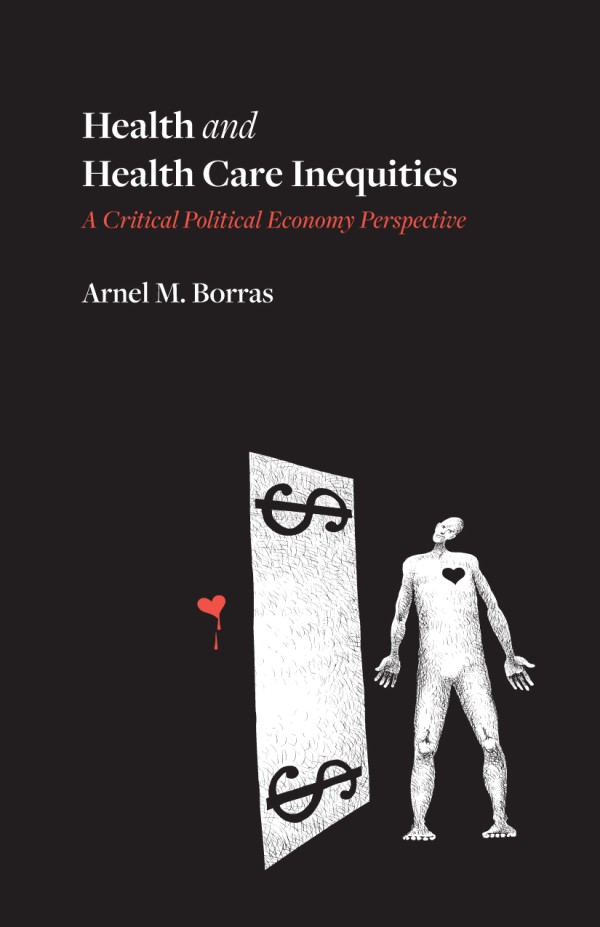
Book: 'Health and Health Care Inequities' iv

Fittingly, chapter 4 brings us to Political Power and Policy Advocacy. In Hodges' model you can both have your cake; and gratefully receive the cake you're given. This is the health in politics and the health in politics (as, for example, revealed in the health status of political leaders).


As a framework structure, the axes of Hodges' model initially give rise to four symmetric domains (spaces). There is an invitation to begin where you choose. Chapter four reveals some truths, as the 'nexus' - center of the model is mobile (unlike many citizens!) as the 2x2 rendition below suggests, if not illustrates. Borras takes us through health politics, political participation and representation, unequal power and politics, and policy change approaches with illustrative cases.

In an institution (like the NHS), bureaucracy, aka an organisation, the workforce are often acutely aware of policy and procedure. It is like the Force. It permeates everything - the meetings - and yet is remote. Borras seek to shed light on unequal resources and policy influence. Again Borras's literature informed discussion and argument, includes some historical gems, such as Lasswell (1958).

Individual
|
      INTERPERSONAL    :     SCIENCES               
HUMANISTIC  --------------------------------------  MECHANISTIC      
 SOCIOLOGY  :    POLITICAL 
|
Group


Political Power and
Policy Advocacy


In chapter 5 on evidence and ideas, discussion of Katherine Smith's 'under 'Six Travelling Ideas' is an excellent resource, with several references including:

Smith, Katherine E (2013) Institutional filters : the translation and re-circulation of ideas about health inequalities within policy. Policy and Politics, 41 (1). pp. 81-100. ISSN 0305-5736 (https://doi.org/10.1332/030557312X655413).

I love the image of ideas as and on a journey, some successful, others fractured, weak, re-contextualised, even non-journeys (falling - 'dead from the press' - I suppose?). At least the journey of Hodges' model is ongoing. A baton for our times. As I wrote in post i, chapter 5 tackles 'evidence' (there's a post or two). It does so in relation to information, ideology, and interests:

If you've read many posts on W2tQ, you may see: I've a chip on my shoulder. Evidence for the safety, benefits, theoretical underpinning ... of Hodges' model is still to be realised. To the satisfaction, that is: of course to the powers that be. Speaking of which: the axial (for me) subtitles arise again in chapter 6; capitalism-imperialism-colonialism-racism nexus (p.87).

To demonstrate the utility of Hodges' model, this is significant.

Please feel free to search for these terms - capitalism-imperialism-colonialism-racism in the search bar above.

I've been interested in drama since playing the part of Francis Nurse in Miller's The Crucible. It took some 50 years to go from armchair to treading the boards again. I played Ken, supported by his wife, trying to run a post office, amid a chaotic and injurious IT system. An 8-9 minute sketch which was part of a Living Newspaper. Interested in writing - as previous posts may reveal, I also keep trying get to the theatre. With the themes of chapter 6, Liberation was thought provoking.

Mind-Body, Private-Public, Socialist-Conservative, Borras adds the global health North-South schism. A prompt for suggesting a brief glossary is expropriation and exploitation^ (p.88). Four stages of capitalism too. This chapter - A critical political economy approach is essential reading for me (and you!?) - a path to a critical care economy (self-care to planetary health).

^There is a note #3 about these on page 99.

See also: Post i : Post ii : Post iii : Post v (to follow)

Merelman, R. M. (1981). Harold D. Lasswell’s Political World: Weak Tea for Hard Times. British Journal of Political Science, 11(4), 471–497. http://www.jstor.org/stable/193766

Arnel M. Borras. (2025) Health and Health Care Inequities - A Critical Political Economy Perspective. Fernwood Publishing.

Liberation image: The Agency
https://theagency.co.uk/news/cast-announced-for-ntombizodwa-nyonis-liberation-at-royal-exchange/

Tuesday, July 29, 2025

Book: iii 'Health and Health Care Inequities'


This book, or similar should be read by 3rd year student nurses and other healthcare learners. I wondered if, for students, a brief glossary might be useful. But key terms are explained and clearly, with typologies numbered and expanded when needed. There seems an aversion in nursing academia to avoid the acutely 'political'. Even though of course in psychiatry, the need for considersation of human rights, consent, capacity, law, personal and public safety, risk is inevitable. Should we only learn of the politics of our role on a post-registration/license course of learning? As mentioned in post i, Borras duly notes the asymmetric impact COVID. The disproportinate deaths of frontline healthcare workers from ethnic minority groups (UK). A sign of the impact, is reflected in COVID recurring through the text.

The device of using axes, e.g. Class-Gender-Health (p.11) rightly draws in commentary on nutrition, pay gaps - heterosexual white men, terms of employment, and design and occupational health for woman. Gender politics is also reflected in the text. The relational dimensions of this discussion also stands out. The Class-Race-Health axis (had me return to the question of parity, but beyond the mental - physical divide. 

These axes employed by Borras seemingly traverse a path and are extensible (across pages). Briefly, in Hodges' model the domains and axes act as stepping stones: 

We can ‘walk’ the model:

Humanistic INTERPERSONAL Individual SCIENCES Mechanistic: adding - Humanistic SOCIOLOGY Group POLITICAL Mechanistic 

A global perspective is matained, even though the focus is Canadian health, government, policy and policy. The press have often highlighted the global nature of the housing crisis. Canada is not immune; as discussed in chapter 2. For what is in many nations a 'housing disaster', Borras covers the history too. Reflecting on: 
'Around the world, neoliberal programs have resulted in over a billion people living in slums (Davis 2017, 23). In wealthier countries, there was rampant privatization of social housing units.' p.25. 
- you feel like a nodding dog toy. Where is the leadership, the strategy and integrity to provide housing for all? Arnel also stresses the link between mental health status and housing. The SDGs place emphasis on security (yes, at the level of what is happening in Ukraine, Gaza, South Sudan...), then housing follows. And with climate refugees to follow ...! I have seen gentrification, and listened to an account in 2007 as Manchester started to experience high-rise growth. I used to try to walk to community visits with students when possible. Observational skills come in many forms, safety still depends upon them. With no place to call home, safety and security is a stark issue for people. A foundation for health, wellbeing and ironically productivity. The rise of foodbanks is also damning. 

Gambling is not indexed, but there appears a denial in the UK government, with other nations 'folding' to the influence of lobbying and corporate influence reducing or removing restrictions in gambling and crucially: advertising. What's the denial you say? Yes, well governments seem to be in denial that there are vulnerable groups in their respective populations. It is laudable that they bestow upon the citizenry the freedom of choice, but that can spell trouble.

If Canada - Ontario has its housing scandal:
'Housing insecurity and homelessness occur because the state and its goencies support real estate and banking corporations that continuously increase housing prices. This setup is a huge problem because these enti- ties focus on generating profit and capital accumulation. The Greenbelt Scandal in Ontario revealed how the government made decisions that served the interests of big companies instead of the public (McGrath 2023; Office of the Auditor General of Ontario 2023). This scandal is an example of neoliberalism and a corrupt style of governance (Moscrop 2023). We need to stop using neoliberal strategies and focus on socialized housing.' p.27.

So does the UK: Grenfell Tower Inquiry No doubt, other nations have their tragic examples. It seems 'international Standards', quality, integrity can never be taken for quality. They too are precarious, vulnerable. Borras's work in chapter 2 on housing security, and differenciation of core housing need is laudable, informative and welcome. Re-reading Arnel's point: 'There is no doubt that housing insecurity affects health'. p.28. His book as a whole makes the point that of course more evidence will always be needed. In healthcare for decades the basics of public health have been identified, studied, established, placed in models and frameworks. Yet we find we are found wanting (UK - Awaab's Law) dragged back to the first steps; and despite the urgent issues we now face.

"Universal health care" is not exactly new:

The Canadian Association of Social Workers. (1961). The Social Worker, Volume 29, Numbers 1 to 2. 29(1to2), 1to78. The Canadian Association of Social Workers. The Social Worker - Le travailleur social. Canadian Association of Social Workers. https://jstor.org/stable/community.39672572.

Borras is correct to write of 'The Continuing Private War against Universal Health Care' (p.36). Looking at NGRAM it appears the private sector has been winning in recent decades. Working previously as a community mental health nurse for older adults, chapter 3 explores Canada's health care systems. Table 3.1 compares the ownership of long-term care homes in figures. The discussion deals with the quality of care and variation. Policy intentions, plans, research and what follows in practice is also debated. Is there any comfort  in learning that Canada is not alone in being skilled at kicking-can-down-the-road. To be fair many developed nations face the same demographic cliff (whichever way you it!), just one of the urgent issues noted above. The contribution of informal carers is also highlighted.

Here in the UK the commissioner - provider split and models of care at the finance level are a maze: amazing in their bureaucracy. Borras does a marvellous job, in providing enough detail without weighing the narrative flow, and losing the reader. The close of chapter 3 offers hope that Hodges' model will continue to be found:
'Therefore, shifting away from neoliberalism toward a new societal system where health care is seen as a fundamental human need and a universal right, not a profit-driven commodity, is crucial. This alternative system requires a new societal framework built on solidarity, fairness, and humanity, prioritizing health over financial and personal gain.' p.50.
See also: Post i : Post ii : Post iv : Post v (to follow)

Arnel M. Borras. (2025) Health and Health Care Inequities - A Critical Political Economy Perspective. Fernwood Publishing.

In addition:

Messing, K., & de Grosbois, S. (2001). Women Workers Confront One-Eyed Science: Building Alliances to Improve Women’s Occupational Health. Women & Health, 33(1–2), 125–141. https://doi.org/10.1300/J013v33n01_08  (Borras - pp.11-12).

https://nhsrho.org/news/tender-maternal-and-neonatal-image-library/

Monday, July 28, 2025

Book: ii 'Health and Health Care Inequities'

In the introduction to Health and Health Care Inequities - A Critical Political Economy Perspective, Borras concludes:

'This book aims to spark thoughutful conversation and collaboration by moving away from capitalism to improve society and health. Health is not just about nursing and medicine; it is integrally connected to economic, political, cultural, and institutional systems. Moreover, it encompasses philosophy and ethics. Capitalism's focus on individualism and competition harms people and the environment,making it all but impossible to achieve health equity. We must work together to envision and create a new world that ensures fairer and better health for all.' p.3.
This sets the tone for a short 163 page book, with a page of acknowledgements, (said) introduction pp.1-3, reference listing pp.136-153; 10 page index, and eight chapters:

Chapter 1: Social Determinants of Health Inequities
Chapter 2: Neoliberalism and Canada’s Housing Policies
Chapter 3: Neoliberalism and Canada’s Health Care System
Chapter 4: Political Power and Policy Advocacy
Chapter 5: The Role of Evidence and Ideas
Chapter 6: A Critical Political Economy Approach
Chapter 7: Searching for Socialism
Chapter 8: Mobilizing for Health Equity
Chapter 1 on 'Social Determinants' provides the first of many political points to underscore the effort with Hodges' model here. If income and poverty come second the preceding paragraphs on wages reveal the socialist stance stand of the author, and the acknowledged networks. Throughout the book the relational nature of determinants, inequality, inequity, protected characteristics, socio-economics and political struggle is raised. In the discussion on wages the importance of education is described in cross-cultural and gender-based terms. The book possibly turns on the sentence:
'To effectively address poverty, we need to unite those who are in poverty with individuals who have more economic stability but are still ulnerable within our capitalist system. These individuals are at risk of falling into poverty if they lose their jobs due to workplace closures or privatization. It is essential to acknowledge that certain groups experience higher poverty rates, but we should see them not as victims but as protagonists and capable workers facing unique but connected challenges.' p.7.
For the people who follow the news, the majority of 'us' are (even if only roughly) aware of the distribution of wealth across national and the global population: the injustice. The erosion and lack of union representation within many workforces, especially 'Big-tech'. The way utility enterprises have provided dividends for shareholders at the expense of ongoing investment in infrastructure, the quality of service provided to the public and even public safety. COVID (p.7), crystalised 'difference' for us all. I came to now substitute collective for 'group' in Hodges' model. Suddenly all those individuals, many working in health, were collectively vulnerable:

Individual
|
      INTERPERSONAL    :     SCIENCES               
HUMANISTIC  --------------------------------------  MECHANISTIC      
 SOCIOLOGY  :    POLITICAL 
|
Group
PSYCHOLOGICALLY
EXISTENTIALLY
BELIEFS
SCIENCE
PHYSICALLY
data, information, knowledge
SOCIALLY
CULTURALLY
SOCIAL MEDIA
wisdom, leadership, truth
LAW - POLICY
FREEDOM - CHOICE

Throughout the text, I like the concise coherence Borras demonstrates in the steps from wages, income and poverty to investigate the state of health inequities. Once again (from i) the context is Canada, but the lessons are for all - as globalisation should/must demand?  There is public health history too. As expected Canada's First Nation, Indigenous, and Nunavut populations are frequently referenced regards exclusion and disparity in health services access and provision. Under health inequities, after infant mortality and life expectancy there is a convention(?) adopted of several axes being identified. The first (p.9) is the class-health axis, then class-gender-health and others. No surprise I found the relational and organisational aspects of these 'constructs' very helpful. As I try to think of Hodges' model as a mathematical object I realise (through oft impromtu conversations^) that we don't have two 'axes' in Hodges' model. Still musing on this; and more to follow ...

Arnel M. Borras. (2025) Health and Health Care Inequities - A Critical Political Economy Perspective. Fernwood Publishing.

^A pure maths lecturer, Gower St Waterstones, London.

See also: Post i : Post iii : Post iv : Post v (to follow)

Wednesday, July 23, 2025

Book: 'Health and Health Care Inequities' i

I didn't attend online the book launch for Health and Health Care Inequities. It appeared to be in the early hours for the UK. Making good progress on a week's break last month, upon return, a presentation and some writing proved a distraction. I've picked it up again, a task that was smooth and straightforward such is the style and writing. H&HCI is - as expected - academic. The statistics, politics and government publications come thick and fast. But they literally do count here.

Borras and the Fernwood are based in Canada. The focus of Borras's thesis is then Canadian politics, economics, society, social and cultural challenges, poverty, exclusion, global standing, statistics and reporting (and more) are all relevant globally. Especially as COVID, climate change, and the current state (or stasis?) of global health provision attests. The book is unashamably Marxist, but not heavy with it. If that makes sense. I was drawn to the publisher too. Well: critical books for critical thinkers; how could I resist!
The influence of Marx and Marxism on the 20th century is profound and full of contradictions. There's the history, and its lessons of Marxism as a political ideology and the geopolitical exemplars that have given Marxism a 'bad' name. To the extent that 'socialism' is also tainted. What other term can be applied that captures 'Marxism', Marxist thought and its relevance today? And that is, relevance in terms of health, health care and social care inequities? 'Struggle' seems utterly inadequate amid current news?

Amidst the history of various revolutions, some arguably on-going, fizzled out, on life support ...? it is, it seems, capitalism that goes marching on. To keep time, the metronome is the tick of central processing unit, and now the graphics 'pu' and tensor; for we live in the 'information age'. I've been keeping notes, but will begin with some reading today, which is an excellent point to 'healthcare professionals', obsessed as we are, with evidence.
'I often go back to Carol Weiss. Years ago, she said three things that go into the decision making ... information, ideology, and interest. And then she went on to say, don't for one moment think that information can trump either ideology or interest. So if you look at the whole climate debate right now, it's actually an ideological debate, The right-wing, the Republicans, some Conservatives here, their rejection of the evidence has nothing to do with the evidence. It's really an ideology ... our group thinks this way, and we are aligned with the fossil fuel industry because they're rich and powerful. Our whole system is based on cheap energy. And so we have to keep going kind of thing. And bugger the evidence.

And that second one, which is actually very closely related to that, is interest. By interest, she meant power and wealth and stakeholders. So, who gets the policy they want? The people who have the money and power to influence it. So, the fossil fuel industry is very powerful ... And so, no matter what the evidence is, they have a financial interest in not having any controls upon them having the minimum of controls. And so, that will triumph usually. So, you put together ideology and interest, and it will almost always overcome evidence or information.' p.78.
More to follow and a return here is essential.

Weiss, C.H. (1983). Ideology, Interests, and Information. In: Callahan, D., Jennings, B. (eds) Ethics, The Social Sciences, and Policy Analysis. The Hastings Center Series in Ethics. Springer, Boston, MA. https://doi.org/10.1007/978-1-4684-7015-4_9

Arnel M. Borras. (2025) Health and Health Care Inequities - A Critical Political Economy Perspective. Fernwood Publishing.

See also: Post ii : Post iii : Post iv : Post v (to follow)

Tuesday, July 15, 2025

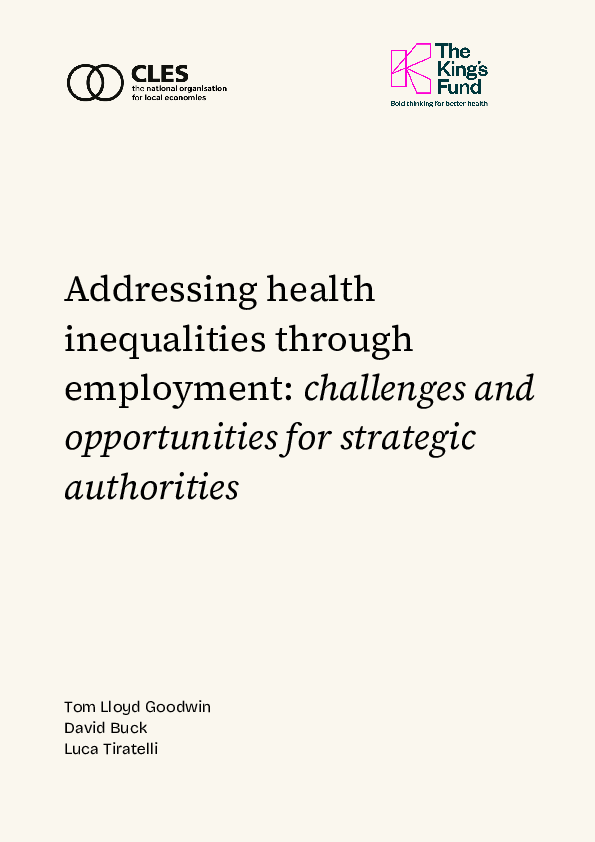
Essay: 'Addressing health inequalities through employment' July 2025


Four priorities:
  1. Establish closer working relationships across the SA [Strategic Authorities] ecosystem to prioritise action on health inequalities.  

  2. Align resources to support people on their journey to sustainable employment.

  3. Negotiate with government for greater permissions.

  4. Harness the power of anchors.
 

Many useful references are also provided, e.g. Building Blocks of Health. Plus the discussion of anchors.


Individual
|
      INTERPERSONAL    :     SCIENCES               
HUMANISTIC  --------------------------------------  MECHANISTIC      
 SOCIOLOGY  :    POLITICAL 
|
Group
employment as a determinant of health

mental & emotional health

Early intervention, employer-employee liaison, health coaching*


PLACE - PLANET

physical health - life-expectancy

LOCAL - accessible
SOCIO-

people & communities

flourishing communities

neighbourhood

People in communities on 
LONG-TERM SICKNESS

WORKWELL grants*

WIDER DETERMINANTS OF HEALTH

SOCIAL VALUE OF HEALTH

low-quality jobs - poorer health

Poverty - HOUSING SECURITY


-ECONOMIC

NHS 10 Year plan: 1. GP / dental access
2.  waiting lists hospital and community care
3. staff demoralised and demotivated
4. outcomes on major killers like cancer lag behind other countries.

STRAGEIC AUTHORITIES - DEVOLUTION
shift of wealth & power

HEALTH INEQUALITIES
inequity

WHOLE GOVERNMENT
APPROACH TO HEALTH

ECONOMIC VALUE OF HEALTH

low-quality jobs

Local strategic response


See also -

Opinion: Failing to collect, analyse, and report ethnicity data in clinical research leads to healthcare inequalities. BMJ 2025; 390 doi: https://doi.org/10.1136/bmj.r1457 (Published 14 July 2025)
Cite this as: BMJ 2025;390:r1457

 'hospital' : 'community' : 'analogue' : 'digital' : 'prevention' : 'sickness'

My source: https://x.com/TheKingsFund/status/1944678280461734226

Tuesday, May 27, 2025

‘Nursing Narratives: Racism and the Pandemic’

This film was made as part of ‘Nursing Narratives: Racism and the Pandemic’. A research project funded by the Arts and Humanities Research Council under the UKRI Covid-19 Urgent Response Call.


'Exposed is a groundbreaking documentary that combines the stories of 19 Black, brown and migrant nurses and midwives to speak about their powerful experiences of racism before, during and after the pandemic. If you want to organise a screening of the film please send us the details of date, time and location so we can let people know about opportunities for people to watch, share and discuss the issues that have come out of the film, as well as what action can be taken.'  
https://www.shu.ac.uk/centre-culture-media-society/projects/nursing-narratives

RCN North West Region - North West Multicultural Group


What does 'exposed' mean . . ?

individual
|
INTERPERSONAL : SCIENCES
humanistic ------------------------------- mechanistic
SOCIOLOGY : POLITICAL
|
group
exposed

exposed

Exposed

EXPOSED

Thursday, May 22, 2025

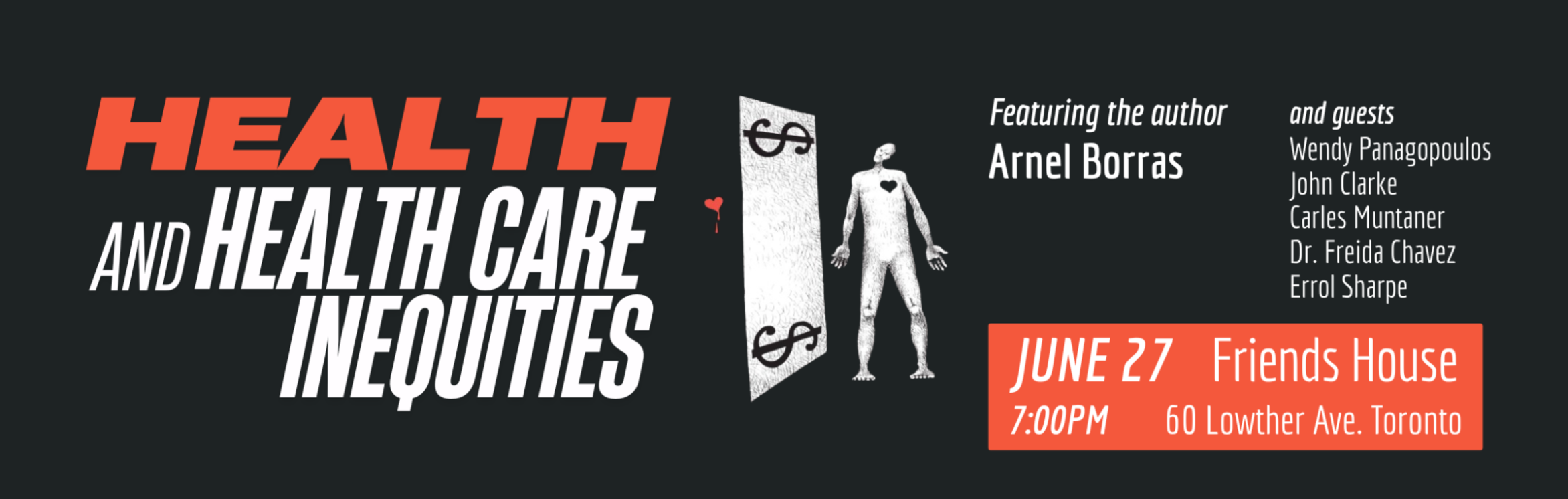
Invitation: Health and Health Care Inequities – Book Launch (June 27)

Hi everyone,

You are warmly invited to the Toronto launch of Health and Health Care Inequities, taking place on Friday, June 27, 2025, from 7:00 to 9:00 PM EDT.

This event is free and open to the public, with both in-person and online attendance options.

👉 Please register in advance:

Select tickets – Health and Health Care Inequities - Toronto Book Launch – Friends House

The launch is co-hosted by the Leo Panitch School with the support of Fernwood Publishing.

Featuring the author Arnel Borras and guests:

  • Wendy Panagopoulos
  • John Clarke
  • Carles Muntaner
  • Dr. Freida Chavez
  • Errol Sharpe

We hope to see you there!

Warm regards,
Arnel

Arnel Borras
*****************

My source: Politics of Health Group Mail List Messages

Visit the PoHG website for lots of interesting links and publications: http://www.pohg.org.uk/

Follow us on Twitter: @pohguk

You can subscribe to / unsubscribe from the PoHG mail list here: http://www.jiscmail.ac.uk/POHG

Wednesday, October 23, 2024

Book received: 'Handbook on the Ethics of Artificial Intelligence'

Many thanks to Edward Elgar Publishing for a review copy of this book which arrived today:

Edited by David J. Gunkel, Professor of Communication, Northern Illinois University, US, and Professor of Applied Ethics, Łazarski University, Poland

Publication Date: 2024 ISBN: 978 1 80392 671 1 Extent: 336 pp
This engaging Handbook identifies and critically examines the moral opportunities and challenges typically attributed to artificial intelligence. It provides a comprehensive overview and examination of the most pressing and urgent problems with this technology by drawing on a wide range of analytical methods, traditions, and approaches.

This is timely, prior to next month's event on AI and Planetary Health, about which news to follow shortly, especially if you are based near London and southern England.

I also can't believe it is 34 years since publication of the following case study:

Davies, M. and Owen, K. ‘Complex uncertain decisions: medical diagnosis’, Case Study 10 in Expert System Opportunities from the DTI’s Research Technology Initiative, HMSO 1990.

Ethics in AI 2024 :: Expert Systems 1990

Thursday, August 01, 2024

Hodges' model? Simple: it's a rich, complicated, complex picture

In wider reading (relations, maths... and) drafting a post concerned with 'universal construction' I came across:

Rasanathan, K., Montesinos, E. V., Matheson, D., Etienne, C., & Evans, T. (2011). Primary health care and the social determinants of health: essential and complementary approaches for reducing inequities in health. Journal of Epidemiology and Community Health (1979-), 65(8), 656–660. http://www.jstor.org/stable/23050931


Figure 2 stood out for rather obvious reasons:

individual
|
INTERPERSONAL : SCIENCES
humanistic ------------------------------- mechanistic
SOCIOLOGY : POLITICAL
|
group


Figure 2 'works' and not merely because it is clearly 'all political', but I would have swapped 'leadership reforms' with 'service delivery forms'. Trying to emphasize leadership at the individual level empowered to actually effect change. This could quickly change as per the situation. I also appreciate the jigsaw graphic.

You soon appreciate the complex nature of health care:

Primary, Secondary, Tertiary, Quaternary care and prevention. Add social care, welfare, all the fields of medicine, surgery, nursing, education, policy, information, literacies, human rights, consent, mental capacity, mental health law, forensic psychiatry, self-care, local, national and global health, urban, rural, remote, virtual environments, ethics, developed and developing nations, ecosystems and funding.

And this just scratches the surface ...

Sunday, June 02, 2024

Black Mental Health Manifesto

"Concrete action is needed to improve mental healthcare for black communities otherwise generations will keep being “held back from achieving their full potential”, a new coalition has warned.

The group said it is calling for “positive change” to alter a system within which it said black people are being failed when they at their most vulnerable.

The coalition – which includes the Black Minds Matter charity, the Centre for Mental Health and Mind as well as smaller grass-roots organisations – has launched what it called the Black Mental Health Manifesto."

        continued ...

Individual
|
      INTERPERSONAL    :     SCIENCES               
HUMANISTIC  --------------------------------------  MECHANISTIC      
 SOCIOLOGY  :    POLITICAL 
|
Group
Mental Health / Illness - Parity of Esteem

Holistic:
Assessment, Planning, Intervention, Evaluation - Competency?

Diagnosis of Psychoses

Physical health

change/revision - WHEN?

Objectivity of assessment / Cultural literacy


Black communities and Families

Culture, History

Radical future?

Stigma, Stereotype

Social determinants


Racism. Economic, Political determinants

Poverty, Housing insecurity

Statistics - Admissions / Recourse to MHA

Incarceration, Injustice

Mental Health Law - Mental Health Act

CHANGE/REVISION - when? Coalition


Friday, January 12, 2024

Book: Rethinking Global Health - open access

Rethinking Global Health

INDIVIDUAL
  |
     INTERPERSONAL    :     SCIENCES               
HUMANISTIC --------------------------------------  MECHANISTIC      
SOCIOLOGY  :   POLITICAL 
|
GROUP

psy-disciplines: 
intra- interpersonal domains

subjectification - objectification 

learning

emotional labour
burnout

precarious researchers -
 acknowledgement of contributions

equity

personal truth

ebola, cholera, HIV/AIDS,
COVID-19, PTSD ...

'emergency', natural diasters

climate crises: geography
local - global - glocal
remote - rural - urban

(physical) systems

tarmac bias

data, information access (SDGs?)

digital  divide, epistemic justice

collective 'truth'

violence against the 'others' -
women, children ...

symbolic, structural and 

collaboration, cooperation, 
co-production, co-design, co-owned with communities

socialisation -
(into global health work)

civil society mobilisation

inclusion, empowerment

social/cultural/ethnic history

social - community - group:
 psychology

POWER, poverty

global -
mental health - physical health
(parity of health: determinants^)

institutional violence

co-ownership

paternalism, colonialism
humanitarianism

NGOs - WHO - Institutions

(political) systems

decision-making
(where, when, who, how ...?)
finance - resources
'development'

political history


^All of them...

Burgess, R.A. (2023). Rethinking Global Health: Frameworks of Power (1st ed.). Routledge. https://doi.org/10.4324/9781315623788

My source: Twitter

Please also note the inter- multi- transdisciplinary bridges provided by Hodges' model, including well established 'avenues' of psycho-social, socio-technical, psycho-political, geo-political, socio-economic and others.

Tuesday, June 13, 2023

Book - Free and Equal: What Would a Fair Society Look Like

INDIVIDUAL
|
INTERPERSONAL    :     SCIENCES               
HUMANISTIC --------------------------------------  MECHANISTIC      
SOCIOLOGY  :   POLITICAL 
|
GROUP
psychology

Subjective experience:
of freedom and being equal

self-interest


"Rawls transformed political philosophy, Chandler says. But his thought can be used to transform and reimagine 'progressive politics for the twenty-first century', too. After a half-decade of populist insurgency, the democratic world is at a 'crossroads', he contends, and we are in desperate need of new ideas to renovate a tattered social contract. That's where Rawls comes in." Derbyshire, p.9.

"Imagine being asked to cut a cake into five slices without knowing which slice you'll end up with. Rational self-interest dictates you'd cut slices of roughly equal size. Similarly, the participants in Rawl's thought experiment, behind the veil of ignorance, choose two fundamental principles of justice: a 'basic liberties principle', which says that every one has an equal claim to a suite of fundamental rights and liberties, obviously a precondition of liberal democracy; and a 'difference principle', according to which social and economic inequalities can only be justified to the extent that they benefit the worst off." p.9

trickle-down   ||  'drip'

Society
Social Justice
Fairness
Social contract


     economics    ||  'pricing' 

Free and Equal


Derbyshire, J. (2023) Justice, fairness and why Rawls still matters today. FT Weekend, Life&Arts, Books, 22-23 April. p.9.

Chandler, D. (2023) Free and Equal: What Would a Fair Society Look Like? London: Penguin.

Monday, June 05, 2023

The Flying Cholitas c/o Luisa Dörr

 INDIVIDUAL
|

 INTERPERSONAL    :     SCIENCES               
HUMANISTIC --------------------------------------  MECHANISTIC      
SOCIOLOGY  :   POLITICAL 
|


"In traditional Bolivian dress, on the outskirts of El Alto, the Flying Cholitas launch themselves at each other. At first, I was fascinated by the skill of these indigenous women flying through the air, reclaiming the clothing their community was forced to wear as servants for Spanish occupiers. But then I saw it went beyond the ring. They are fighting for their rights, for recognition, for equality. They're fighting for their lives." Luisa Dörr 

This image, would also 'sit' in the POLITICAL domain, if the women would stay still; but they clearly have individual and collective purpose.

My source:
Luisa Dörr ON THE FLYING CHOLITAS (2019). The Daily Telegraph, 4 March, 2023. p.9.

[Please note: I contacted Luisa Dörr, seeking permission to use the photograph above, but received no response.]

See also:
'What We See: Women and Nonbinary Perspectives Through the Lens' (White Lion, £22). 
Details: womenphotograph.com

Wednesday, April 19, 2023

Aftershocks: Dispatches from the Frontlines of Identity

“Race matters in England. So too does class. So too does voice.”


INDIVIDUAL
|

 INTERPERSONAL    :     SCIENCES               
HUMANISTIC --------------------------------------  MECHANISTIC      
SOCIOLOGY  :   POLITICAL 
|
GROUP
Aftershocks:
Dispatches from the
Frontlines of Identity
Race
Class
Voice

Race
Class
Voice

Voice
Class
Race


Aladesuyi, O. (2021) A map of pain and privilege. Life&Arts. FTWeekend. 6-7 March 2021. p.10.
 
Owusu, N. (2021) Aftershocks: Dispatches from the Frontlines of Identity. London: Sceptre.

See also:

https://mixedracestudies.org/?p=60498

https://gal-dem.com/nadia-owusu-aftershocks-extract/
(site available but now closed).