Hodges' Model: Welcome to the QUAD: Search results for boys

Hodges' model is a conceptual framework to support reflection and critical thinking. Situated, the model can help integrate all disciplines (academic and professional). Amid news items, are posts that illustrate the scope and application of the model. A bibliography and A4 template are provided in the sidebar. Welcome to the QUAD ...

Showing posts sorted by relevance for query boys. Sort by date Show all posts

Saturday, November 21, 2009

Nurses as modellers and informaticians: surely not!

Nursing is still trying to escape and evade the sexual 'Carry On' stereotypes that have plagued the profession in the popular imagination. For the majority of people talk of nursing and models more readily conjures up visions of catwalks than an academic pursuit.

You can still see and hear the response of bright-eyed girls and boys (aged 9-10...) to the age-old question: "What do you want to be when you grow up?" The answer: "I want to be a nurse and help people get better!" Even though youngsters are more sophisticated these days (the reference to girls and boys is not just me being politically correct), they are still most likely primarily motivated by humanistic leanings as opposed to wanting to pursue the necessary studies in the sciences.

Despite efforts worldwide practicing nurses do not all see themselves as data modellers enthralled by IcT. IT isn't usually why they came to nursing, although many mature students may have started their career in the IT sector. Chapter 1 of Programming the Semantic Web highlights how a basic table is a model (p.6-7). So of course gifted with natural language we are all data modellers. Hodges model then is the ubiquitous high-level data model - a two-by-two table and a whole lot more.

An invitation to mine data, gather information and deliver nuggets of knowledge.

Ref:
Programming the Semantic Web: Build Flexible Applications with Graph Data
By Toby Segaran, Colin Evans, Jamie Taylor
Publisher: O'Reilly Media
Released: July 2009

Friday, January 03, 2025

How 'divine' is the language of care?

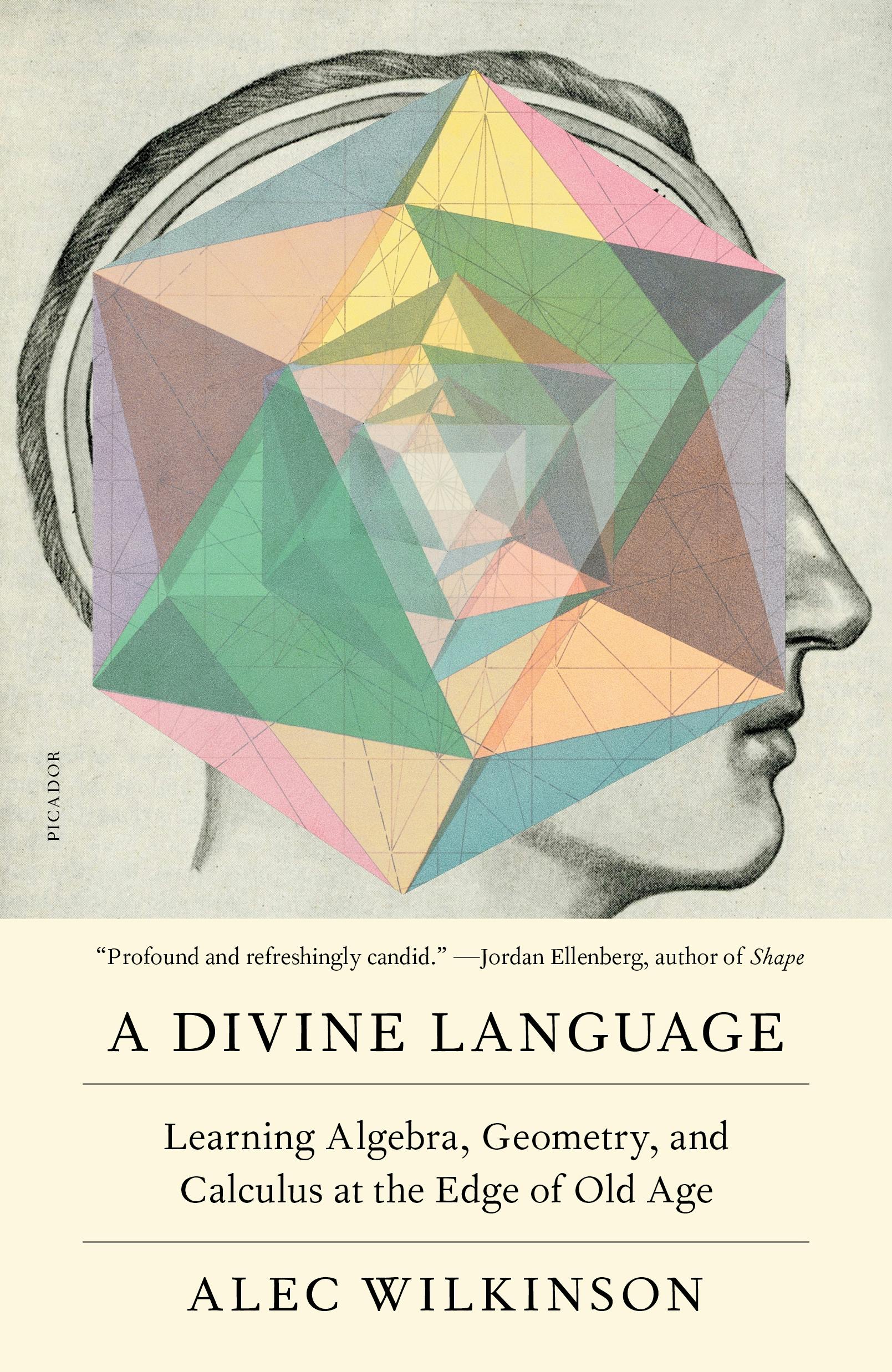
'My impression was that algebra was less a subject than a practice into which one was inducted by the algebra priests after a series of mortifications. The letters and equations that the teacher drew on the board did not seem related to the numbers I had handled in other classrooms. For one thing, a problem in arithmetic was vertical, one number beneath another, and a problem in algebra, an equation, was horizontal. I felt as if in a permanent present, unable to see how the past and the future were joined. In Ulysses James Joyce writes that the present is the drain that the future goes down on its way to becoming the past.' p.12.
'The mathematician Alonzo Church, who taught Alan Turing, told another of his students, David Berlinski, "Any idiot can learn anything in mathematics. It requires only patience." I would sit with a pencil and paper trying to solve an algebra problem and sometimes go only so far before my mind would halt, because I had could used up what little I knew that might apply. It hadn't occurred to me to think of algebra as the bright boys and girls I had been among had thought of it, as a series of related procedures. They were constructing a map. I was collecting postcards from places where anxiety or incuriousness had kept me from leaving my hotel.' p.31.
(my emphasis)


Alec Wilkinson. (2022) A Divine Language. Learning Algebra, Geometry, and Calculus at the Edge of Old Age. New York: Farrar, Straus and Giroux. https://us.macmillan.com/books/9781250168580/adivinelanguage/

Previously: math :: logic

Wednesday, October 29, 2025

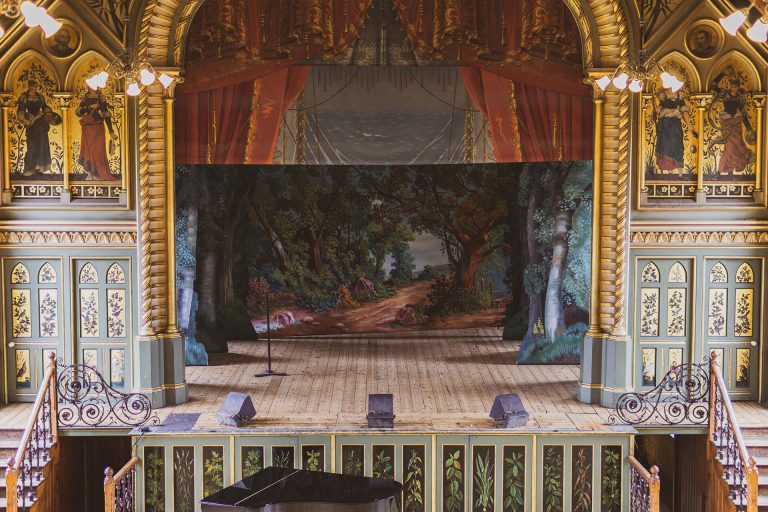
Normansfield Theatre in Teddington

Normansfield Theatre in Teddington

'My favourite building is the amazing Normansfield Theatre in Teddington that John Langdon Down (1828-1896) built to provide positive and stimulating education for learning disabled people (Down syndrome is named after him). At a time when most disabled people would have been shut away in horrific asylums, Down adapted his own house as a residential home, and built a beautiful theatre for creative rehabilitation. It's one of the few surviving private theatres from the period, with original painted scenery and other ornate fixtures, recently remodelled. For me, it's also a reminder of how the wealthy often used their money for good causes, which feels less common now. Jos Boys, guest curator and co-director of The DisOrdinary Architecture Project'


My source: The pick of London Open House. House&Home, FTWeekend. 6/7 September 2025. p.8.

Image: Langdon Down Centre

Previously: 'learning disability' : 'theatre' : 'architecture'

Saturday, August 16, 2025

Women, human rights after 4 years ...

. . . in Afghanistan


Individual
|
      INTERPERSONAL    :     SCIENCES               
HUMANISTIC  --------------------------------------  MECHANISTIC      
 SOCIOLOGY  :    POLITICAL 
|
Group

A woman
A girl

Personhood
Personal identity
Dehumanisation
Self-expression


objectification
defined


A girl
A women

Cultural life
Psycho-Social
Community life
- denied


Gender crimes against girls & women
Human Rights denial
Law?

National identity
Nationhood?

Previously: 'women' : 'girls' : 'boys' : 'gender'

Saturday, January 09, 2021

Book review: "Leave No One Behind" i #LNOB

Leave No One Behind

This book is like a favourite CD or LP [that's vinyl ;-) ], every track - chapter - is an ace - no duds. I wanted to start this review with the final chapter, but I'll pick that up in due course (iv?).

The book is structured in three parts:

  1. People
  2. Problems
  3. Places

I don't read horror specifically, so it is not often a book scares me from the get-go; but this one did. 

Chapter 1 gets specific on the statistics of LNOB and sustainable development. The numbers make for grim reading and had me wondering how much sense I could make of the book overall from the albeit COVID tainted comfort of Wigan Pier. What stood out was the way the intro chapter set out the stall. Obviously, that's the purpose and while depressed at what was follow from the initial graphs, the structure and cogency provided its own impetus to read. The text is clear and very readable, the data, graphs, notes all have bite. While the SDGs are Sisyphean in nature, the intro is like a snowball that starts from the upper peaks and grows chapter by chapter in  meaning and significance.

Obviously, Agenda 2030 looms large, but if you think in first reading of poverty, or to be more specific ultra-poor, income, education, Africa, development and finance you know the agenda to follow then for this community mental health nurse there are insights aplenty.

Chapter 2 combines two central issues in gender equality (by 2030) with 'Women on the Move'. The book draws significance to decade long issues that now constitute a specific SDG - #5 in this case. The book is up-to-date - oozing contemporaneity with #MeToo and background on the cussedness of the root causes of gender inequality. There's common sense too in the need for 'adaptable solutions that are fit for the complexity of the problem'. On first reading about the progress of feminist movements, but more recently experiencing resistance in access to and being able to inhabit civil spaces, this is more 'scary' than a horror story. Reflecting on the 'other' challenges and climate change especially and the role that feminism can play, this retrograde motion could be the stuff of nightmares. The chapter and book, as I will explain, drew my attention to the fact that while I tweet and post here on feminist issues: I am no feminist. The notes provide references and pointers to specific books on feminism. From this book I can see I should read one.

Organizations, such as, BRAC, Camfed, CARE Int. and Oxfam with authors clearly experts from academia and such key players in the field. The balances are not just financial, but a community program on women and girls can potentially prompt a backlash if men and boys and not engaged. I can see further relevance of being able to traverse individual-group, as Matthews and Nunn debate the merits and limitations of individual-based and need for social-based interventions. Yes, I can see how individual-based interventions can be apolitical (and how an axis can invoke several thresholds). To a text on feminism, I must add formal reading on intersectionality too, as the analysis called upon here (box 2.2) to make sense of social and income-based factors. 

Several chapters raise the problem of scale, the lack of data, especially what is and can be measured. Without due care, false proxies can be used for measures and more simple interventions may be pursued because they are more easily quantified. This may be insufficient to fully understand the complexity of gender equality. The book is 'dynamic' throughout; with project and service-based action for the individual progressing then to movement-based at the social change level (CARE, 2017, p.31. Gender Equality Framework -- through Individual, Group, Communities to deliver Social Change).

Although in this first review-post I refer to feminism, the treatment in the book is balanced and also essential. I usually equate 'hope' with the intra- interpersonal domain. Of the many sources in this to follow-up, is evidence on the "science of hope" with Coates and MacMillan in chapter 3.

individual
|
INTERPERSONAL : SCIENCES
humanistic ----------------------------------------------- mechanistic
SOCIOLOGY : POLITICAL
|
group - population
hope

SCIENCE of HOPE


Homi Kharas, John W. McArthur and Izumi Ohno, (Eds.) 2020. Leave No One Behind: Time for Specifics on the Sustainable Development Goals, Washington D.C.: Brookings Institution Press.  


Saturday, September 15, 2007

Child well-being, Silver Superdreams, DEEP care and DEEPer voices

On the website [archived 2015 - page may not remain] there's a small page that highlights DEEP things...

That is DEEP ECOLOGY, DEEP TIME, DEEP SPACE and of course DEEP CARE. These days it seems everything is DEEP. So it isn't noise that's damaging your ear drums it's pressure.

When I wrote that page deep care was left to fend for itself (there's a books worth there I bet); but then I remembered a day as a student...

In those days I had a silver Honda 250cc Superdream. I'd swear that bike had a built in gyro (except for the time I dropped it in the snow). The bike not only helped me with the a2b; on community experience I had to spend a day at a children's home...

The day started at 2pm working through to 9-10pm. Many of the kids were not yet home from school. So I was able to chat with the house-mothers as the two female staff members were called and I do remember their names. This was a quiet interlude before the chaos ensued. It was spring and the 'instructions' were - when the children are home, join-in outside while tea is prepared.

Well, arrive they did and there I was in this big garden playing football and inevitable rough and tumble with the lads. While all this was going on I could see the house-mothers at the window watching. Watching a bit more. Then not just watching: staring. Was I doing something wrong (and who was cooking tea)?

Anyway, a bell announced tea time to be followed with more antics outside then some indoor games and then time for bed. Stories first of course. I was asked to take a youngster upstairs and settle him down. He couldn't have been more than 5. On my shoulders up the stairs. A brief flight through the air along a carefully judged flight-path suddenly filled with giggles to find the book...

As I started to read one of the house-mothers came in and started to tidy the room and I suppose keep an eye on me. I like reading. As I read that feeling returned - being watched just like in the garden. This time it was a pair of very young eyes doing the staring, with an open-mouthed intensity that was dry-mouth disturbing. Next, I noticed the house-mother had stopped what she was doing to watch and listen. OK: What was going on? We reached a point were the book closed and it was time for lights out and prayers.

Then I was asked for a kiss.

It wasn't that I was upset or anything, but it was the way this little guy asked.

Now I know there are all sorts of considerations these days, equality and diversity, sex and gender roles. This WAS ALL about equality and diversity and something wasn't right.

I responded with that student-male awkwardness that I wasn't about to kiss him, but it would be great to shake his hand and say thanks for everything - the soccer, chocs, drawings, thumbs up for the bike....

So, phew - lights out upstairs - it was time for twenty questions downstairs.

As the home got quieter by the second, the questions were well-formed, but had to wait as I joined the two house mothers sitting at the kitchen table for tea/coffee. Straight away they guessed my star-sign: Aquarius. OK... Then they apologised for staring earlier. I acknowledged that this hadn't gone unnoticed. They explained how pleased and totally fascinated they were to see the young boys able to interact in ways that they - try as they might - just cannot manage. The house-mothers usually read the stories and while I'm no bass-baritone, my voice - a lone male voice - had really struck a cord.

Unfortunately, back then there were issues about recruiting male staff members. I passed on those same concerns and my experience to the school of nursing. The house-mothers agreed that as a consequence there were potential future mental health issues being incubated there - the clients of tomorrow. They were trying to bring about change themselves.

That day will stay with me - I hope. As I rode home I knew it was a real gem in terms of learning experience. Scary, the notions of 'self' and 'others'. I wonder how things have changed in the homes and in society at large?

Saturday, May 10, 2014

Genetic disorder: belief's a-gender

individual
INTERPERSONAL : SCIENCES
humanistic ------------------------------------------- mechanistic
SOCIOLOGY : POLITICAL
group

Y
I tell you what you will believe and IF you can have an education!
X
Wither women in science and engineering?
X
Whose place is this?
'Who' is the community?
#BringOurGirlsBack
Y
Human Rights for Girls and Boys

Friday, February 02, 2024

Guinea worm announcement

"13 Human Cases of Guinea Worm Reported in 2023 – Remaining at the Lowest Level Since the Eradication Campaign Began"

Individual
   |
      INTERPERSONAL    :     SCIENCES               
HUMANISTIC  --------------------------------------  MECHANISTIC      
 SOCIOLOGY  :   POLITICAL 
|
Group
mental health

emotional distress

anxiety -

impact on life chances, ability to study, earn

knowledge - awareness

my health literacy

access to knowledge brokers

respect what is 'old'
but
what is new - insight?


"Dracunculiasis is a crippling parasitic disease on the verge of eradication, with 27 human cases reported in 2020.

From the time infection occurs, it takes between 10–14 months for the transmission cycle to complete. About this time, a mature female worm emerges from the body.

The parasite is transmitted mostly when people drink stagnant water contaminated with parasite-infected water fleas.

Dracunculiasis was endemic in 20 countries in the mid-1980s.
"


rural - remote communities
daily practices

access to information
(valid, evidence-based)

stigma - disgust


"March 27 is the anniversary of the start of the Guinea worm cease-fire that former U.S. President Jimmy Carter brokered in 1995 during the Second Sudanese Civil War."


Individual
   |
      INTERPERSONAL    :     SCIENCES               
HUMANISTIC  --------------------------------------  MECHANISTIC      
 SOCIOLOGY  :   POLITICAL 
|
Group


SUN & AMON (2018). Addressing Inequity: Neglected Tropical Diseases and Human Rights.
Health and Human Rights, 20(1), 11–25. http://www.jstor.org/stable/90023050


"Two boys drink through pipe filters at Kuse Dam, Terekeka County, Southern Sudan, in 2010. During the 1995 Guinea worm cease-fire, health workers distributed 200,000 cloth household filters. Both types of filter strain Guinea worm larvae out of water, making it safe to drink."
Curtis, V. (2011). Why disgust matters. Philosophical Transactions: Biological Sciences, 366(1583), 3478–3490. http://www.jstor.org/stable/23035750

AMON & ADDISS (2018). “Equipping Practitioners”: Linking Neglected Tropical Diseases and Human Rights. Health and Human Rights, 20(1), 5–10. http://www.jstor.org/stable/90023049


See also: 'Noma'

My source: Times Radio UK