Showing posts with label consciousness. Show all posts
Showing posts with label consciousness. Show all posts
Monday, August 31, 2026
Monday, August 17, 2026
'Becoming family with place' - Wooltorton et al. (2020)
The second R&E piece 'spoke' immediately of distance, peoples - their societies, culture, heritage and communities, plus place and connection to land, landscape, water, fauna, flora and sky.
individual
|
INTERPERSONAL : SCIENCES
INTERPERSONAL : SCIENCES
humanistic ------------------------------- mechanistic
SOCIOLOGY : POLITICAL
|
group
|
|
| Place and Planet |
Wooltorton, Sandra, Collard, Len, Horwitz, Pierre, Poelina, Anne & Palmer, David. (2020). Sharing a place-based indigenous methodology and learnings. Environmental Education Research. 26. 1-18. 10.1080/13504622.2020.1773407.
https://www.tandfonline.com/doi/full/10.1080/13504622.2020.1773407.
My source: Wooltorton et al. (2020) 'Becoming family with place'. Resurgence & Ecology, Issue 322. 2020. pp.34-35.
See also:
Jones, P. (2008) Exploring Serres’ Atlas, Hodges’ Knowledge Domains and the Fusion of Informatics and Cultural Horizons, IN Kidd, T., Chen, I. (Eds.) Social Information Technology Connecting Society and Cultural Issues, Idea Group Publishing, Inc. Chap. 7, pp. 96-109.
Hayward, B.A. (2020), Mental health nursing in bushfire‐affected communities: An autoethnographic insight. Int J Mental Health Nurs. doi:10.1111/inm.12765
Previously: 'Australia' : 'Indigenous' : 'South' : 'landscape'
Friday, November 14, 2025
Filosofia - What is wrong with distraction? Sebastian Watzl c/o IEF
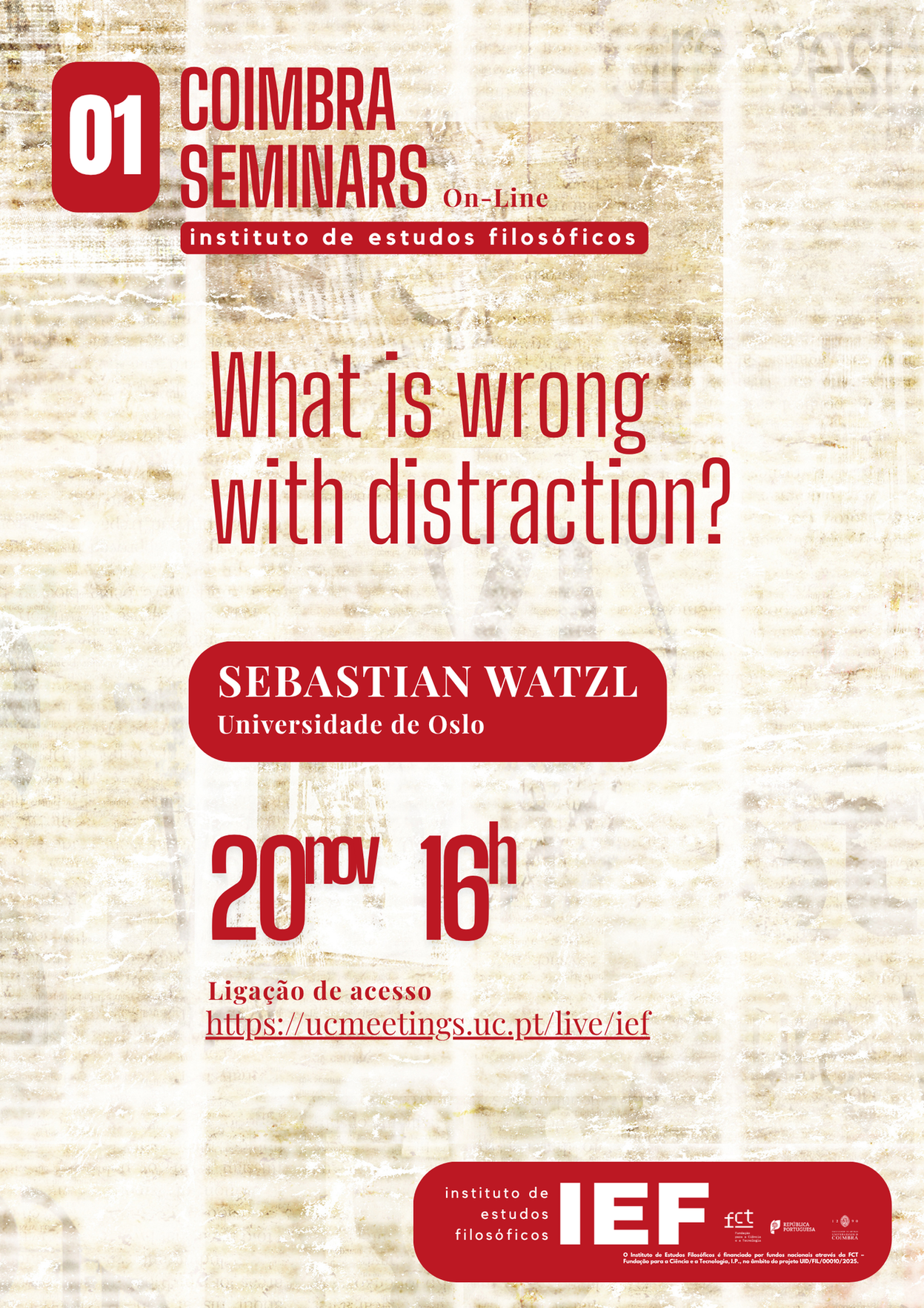
His research investigates the nature of attention, how it shapes consciousness, and the normative role and assessment of attention. Some of his current work is on the ethics of attention, the commodification of attention and its ethical assessment, the epistemic role of attention, and the use of attention as a political weapon.'
Sebastian Watzl - UoO Norway
Website: https://www.uc.pt/fluc/ief/agenda/coimbra-seminars-01/
LinkedIn: https://www.linkedin.com/posts/iestudosfilosoficos_ief-filosofia-philosophy-activity-7394448924947779584-fLSV
Instagram: https://www.instagram.com/p/DQ96aNVka0A/?igsh=MXJsejg0ZWE4bnBvZw==
Facebook: https://www.facebook.com/share/p/16uSVu9mNK/?mibextid=wwXIfr
individual
|
INTERPERSONAL : SCIENCES
humanistic ------------------------------------------- mechanistic
SOCIOLOGY : POLITICAL
|
group-population
My Mind My Attention My choice(s)? | Sources of distraction Devices - access Exposure - time |
| Social media Assessment of attention Children's education | Corporate Ethics of Attention 'Attention economy' Policymakers & Policy Attention as a political weapon |
C/o IEF and thanks to Marta Santos (Secretariat).
Wednesday, February 19, 2025
Frayn's - shared 'Home Address'
Frequently I've made the point that 'person-centred' means placing the individual, patient, carer ... whatever the context, at the centre of Hodges' model. At the same time this is of course an idealisation:
individual
|
INTERPERSONAL : SCIENCES
humanistic ------------------------------- mechanistic
SOCIOLOGY : POLITICAL
|
group
What is your 'home' address? | 'Science, it turns out, is in this respect simply an extension of all the other means we have found of representing the world. As with pictures and narratives, the world is unimaginable without the focus of a viewpoint. To understand the world in any way whatsoever scientifically, historically, artistically, anecdotally, imaginatively we find ourselves compelled to assume a potential point of convergence from which everything is viewed, measured, and recounted. About the entity that defines this point we know only that it is by definition invisible to us. And since the instruments of science, of logic and mathematics, and of art, are all products of this invisible entity, they will not serve to represent or explain it to us. Anything in the world, or out of it, can be perceived or thought about, or both, and represented in our various codes. The only thing that systematically eludes us, whichever way we turn, is the something upon which everything else depends. The conscious subject that gives meaning to the objective universe cannot give meaning to itself. Without it nothing can be understood; about it nothing can be said. 'The point of convergence . . .' And already we've gone wrong. The self isn't a point, in any remotely geometrical sense, but a complex organisation; and the consciousness that it generates, and by which it is animated, is a complex phenomenon.' pp.401-402. (my emphasis) |
Frayn, Michael (2006). The human touch: our part in the creation of a universe. 'Home Address', Chapter 5. London: Faber & Faber.
A final post from my paperback copy, next - off to a good secondhand home. Previously: 'Frayn'.
Friday, February 14, 2025
Curtains ...
'I'm not sure many rational designers would set out to emulate, or even to echo the interiors in David Lynch's films. These are rooms that haunt us: the chevron carpets, the red velvet curtains, the peeling wallpaper suggesting that our environment is somehow theatrical, temporary, a dream - an expression of our subconscious. ..."I don't know where it came from, but I love curtains," Lynch - famously reluctant to explain his work - said in 2014. "There is something so incredibly cosmically magical about curtains opening and revealing a new world. It resonates on a deep level with people."'
INDIVIDUAL
|
INTERPERSONAL : SCIENCES
HUMANISTIC -------------------------------------- MECHANISTIC
SOCIOLOGY : POLITICAL
|
GROUP
IMAGINE a curtain: What colour is it? Imagine opening the curtain - | <<== CURTAIN [a room: LxDxH] - is the wallpaper peeling? ... |
Edwin Heathcote, Head spaces, Interiors, House&Home, FTWeekend, 1-2 February 2025. p.4.
Friday, August 30, 2024
Still sorting books: "The holographic paradigm and other paradoxes"
There has been overlap in my subscription to the Laws of Form mail list and a (David) Bohm list. With the difference, I unsubscribed from the latter, in an effort to focus. The work of Bohm is still very much on the radar and book shelves (well, boxes currently). Continuing to clear books, I've been reading through some relevant sections and quote here at length from:
Wilber, K. (Ed.), (1982) The holographic paradigm and other paradoxes. Boulder, CO: Shambhala.
The Enfolding-Unfolding Universe: A conversation with David Bohm (pp.44-104)
BOHM: Yes, we could come to that. The point is that consciousness is confused. Confusion is nonclarity. And if you say, a person is not clear, you mean he's confused, although it is more polite to say he's not clear. And confusion means "melting together." Things that are different are seen as one and things that are one are seen as broken up into many. So confusion clearly causes chaos." p.61.
"BOHM: Well, yes, we can consider that maybe that is what is, but, at the same time we have to be very careful to say that thought cannot grasp it, so at some stage thought has to put this question aside as to what is, you see. Thought cannot grasp that which is. And any attempt to grasp that which is engages us in serious self-deception which confuses everything. So that thought has to learn or somehow come to a state of discipline, or whatever you want to call it, spontaneous discipline, its own discipline.
WEBER: Order?
BOHM: Yes, order, in which it does not attempt to grasp the questions which are beyond it, such as the question of that which is. It can grasp any relative question which is conditioned, or in some way, conditional. So even the nonmanifest consciousness of the nonmanifest matter, which is highly subtle, is still within the possible area of thought." p.64.
"WEBER: Deeply. So you're saying that prior to this current awareness of the centrality of consciousness, what we've been trying to do is hopeless because we've addressed small social problems all in the wrong domain, so to speak.
BOHM: Yes. Well, really not going to their source at all." p.80.
"WEBER: Which was the old Cartesian or dualistic model.
BOHM: Right. It also leads to infinite regress, unless you end it by God or somewhere.
Now I think we come to a point where we're raising a question which was similar to what was raised in yesterday's discussion. How long can we go on trying to talk about what is beyond thought by making an intellectual construction? You see, because when we make such an intellectual construction we have a content and we have implied that the one who is constructing it is also supposed to be beyond that content. So he evades the very thing we attempt to include him in and in that very attempt he gets out. And so it seems that there is some limit to how far you can go in that process, in that approach. Therefore it's best to say that in this approach in which we attempt to make a map, or a sketch of some kind of what reality is, that we are really dealing with something limited. Korzybski used to say: "Whatever we say it is, it isn't."
WEBER: The map is not the territory. . . .
BOHM: That's right. Yes. And therefore what we are doing is making maps, making sketches, making concepts. And see, that's why I said the other night that science, for example, theoretical science, is not primarily concerned with observing things but with observing ideas. ..." p.84
The Tao of Physics Revisited (pp.215-248)
"CAPRA: Yes, they would look at genetics, individual parts and so on.
WEBER: They have the Cartesian view, whereas you're saying that this is the new vision, emphasizing interdependence, interconnectedness, the dynamics of the whole.
CAPRA: But I should say that both reductionism and holism are necessary.
WEBER: I understand. You are not suggesting that we abolish the other. You are saying we should supplement one with the other.
CAPRA: If you want to get the full story, then you need both views. Because either one gives you only half of the story. This is what I see as the future of science, and I see a future science as no longer distinguishing between disciplines.
WEBER: That's a very radical view.
CAPRA: Yes, and by the way Heinsenberg already said that years ago. In one of his books, The Part and the Whole, he ends with his view of future science, and I agree very much with that. I have come to believe that in the future we will apply a network of models, and we will use different languages to describe different phenomena at different levels. We will not worry any longer whether we are doing biology or psychology or physics or anthropology or whatever; we won't be worried about these classifications." p.241.
Reading of The Systems View of Life - A Unifying Vision is also ongoing (p.240 ... and a joy) with posts to follow.
See also:
https://kfoundation.org/krishnamurti-and-david-bohm/
Saturday, June 08, 2024
'Earthrise' c/o Bill Anders RIP
Earthrise in 4K
"In December of 1968, the crew of Apollo 8 became the first people to leave our home planet and travel to another body in space. But as crew members Frank Borman, James Lovell, and William Anders all later recalled, the most important thing they discovered was Earth."
See also:
Earthrise: The Story of the Photo that Changed the World | Short Film Showcase
https://www.youtube.com/watch?v=BsShNeDvccc
Thank you Bill and all the Apollo team and subsequent space faring families across the Home planet.
P.S. I'll leave it to you to relate the significance of Apollo 8's 'Earthrise' to Hodges' model.
Wednesday, April 10, 2024
"David Lynch: A Thinking Room"
Where is the Thinking Room?
Individual
|
INTERPERSONAL : SCIENCES
HUMANISTIC -------------------------------------- MECHANISTIC
SOCIOLOGY : POLITICAL
|
Group
Ah! Surely this one? It's deep! | Is it here? This is deep too! Please take a chair. |
I trust you are comfortable, so what about this place? | Yes, you can think here - but you must check first before you do: Think. If you must ... N.B. Please rate your experience too. |
Soraya Roberts. A Room Of His Own, FT Magazine, 30-31 March, 2024, 1067: pp.38-41.
https://www.ft.com/content/bf6a6eaa-30d1-4704-9aea-4ff2d117f407
David Lynch’s dreamlike rooms at the Salone del Mobile.Milano 2024:
https://www.salonemilano.it/en/articles/david-lynchs-dreamlike-rooms-salone-del-mobilemilano-2024
https://www.salonemilano.it/en/articles/david-lynchs-dreamlike-rooms-salone-del-mobilemilano-2024
Thursday, February 22, 2024
AI in the Creative Industries: An Interdisciplinary Conference [One week left!]
[reposting as there's just over one week left to submit abstracts for our summer conference on AI]
AI in the Creative Industries: An Interdisciplinary Conference [EXTENDED DEADLINE]
7th June 2024 - Hosted by Futureworks, Manchester UK
Artificial Intelligence has advanced extremely rapidly over the past months. Responses have been polarized; with some predicting the end of the world and others celebrating a technology with the potential to create a new industrial revolution. The biggest difference between these new algorithmic technologies and those that preceded them are the potential for new AI models to generate creative content. Visual art, photography, literature and digital scripting have been produced by AI, to varying levels of success. To the existing debates around AI (questions of ethics, consciousness, or cyborg theory, for example) have arisen new problems regarding the role of art and the artist in the age, not of mechanical reproduction, but mechanical production. Can a robot be creative?
This conference aims to bring together researchers from across media studies, music and sound, the visual arts, video games, film and TV, animation, sociology, history, literature, politics, philosophy and aesthetic theory, to interrogate the growing role of AI in the creative industries, its potentials (both negative and positive), and how we are to react to the rise of AI as both tool and creator.

- AI creativity: is it truly creative?
- AI and transhumanism
- AI and the question of consciousness
- Copyright law and artificial intelligence
- Utilization of AI as a creative tool
- The depiction of AI in creative media
- The ethics of AI usage and its potential to help or harm
- The aesthetics of artificial intelligence
Submissions are encouraged from academics, postgraduate researchers and non-academic speakers alike. Creative practitioners are also welcome, as are those working in the production or utilization of AI.
<>
This message was issued to members of www.jiscmail.ac.uk/AI-SGES, a mailing list hosted by www.jiscmail.ac.uk, terms & conditions are available at https://www.jiscmail.ac.uk/policyandsecurity/
Friday, October 13, 2023
Hodges' model: How the I-G axis is idealised
As a conceptual model, Hodges' model is idealised.
As an example, take the concept individual in the vertical axis. Whether a patient, client, carer, student or teacher, the individual is where the self also resides.
As an example, take the concept individual in the vertical axis. Whether a patient, client, carer, student or teacher, the individual is where the self also resides.
'I' - INDIVIDUAL 'Self'
|
INTERPERSONAL : SCIENCES
HUMANISTIC -------------------------------------- MECHANISTIC
SOCIOLOGY : POLITICAL
|
GROUP
spiritual - emotional self (my mind) Identity? | material / physical self (my body) identity? |
social self (realised, or not; loneliness, excluded, isolated, ostracized, or loner by choice/character. Socio-Politically we arrive at 'civil society', if indeed it is civil.) | political self (whether or not politically motivated / engaged. Self as a citizen arises here, with the law in whether in States voting is mandatory.) |
James, W. (1892). The conscious self. In W. James The principles of psychology (Volume 1), Chapter 10. Harvard university Press: MA.
"From the very beginning of the chapter, James established that he was going to take a fresh approach to his subject. "In its widest possible sense," he wrote,'a man's Self is the sum total of all that he CAN call his, not only his body and his psychic powers, but his clothes and his house, his wife and children, his ancestors and friends, his reputation and works, his lands and horses, and yacht and bank-account.' (p. 279)The explication James offered for this claim is telling: All these various things and persons are part of an individual's self insofar as they give that individual the same emotions (pp. 279-280). In pointing thus toward the emotional foundations of the self, James indicated right at the start that he was going to follow Bain (1859, chap. 7) and others in reaching beyond the old rationalist approach to "the soul" in order to ground his treatment of the human self on the experience and makeup of the whole person, emotional as well as intellectual." (p.107)
Leary, David E. "William James on the Self and Personality: Clearing the Ground for Subsequent Theorists, Researchers, and Practitioners."Reflections on The Principles of Psychology: William James after a Century. Ed. William James, Michael G. Johnson, and Tracy B. Henley. Hillsdale, NJ: L. Erlbaum Associates, 1990. 101-37. Print.
Friday, June 09, 2023
'The Body Politic' c/o Dennett
"Evolution embodies information in every part of every organism. A whale's baleen embodies information about the food it eats, and the liquid medium in which it finds its food. A bird's wing embodies information about the medium in which it does its work. A chameleon's skin, more dramatically, carries information about its current environment. An animal's viscera and hormonal systems embody a great deal of information about the world in which its ancestors have lived. This information doesn't have to be copied in the brain at all. It doesn't have to be 'represented' in 'data structures' in the nervous system. . . .
By using the old bodily systems as a sort of sounding board, or reactive audience", or critic, the central nervous system can be guided - sometimes nudged, sometimes slammed - into wise policies. Put it to the vote of the body, in effect." p.79.
INDIVIDUAL
| INTERPERSONAL : SCIENCES
HUMANISTIC -------------------------------------- MECHANISTIC
SOCIOLOGY : POLITICAL
|
GROUP
| MIND CONSCIOUSNESS COGNITION | ANATOMY - PHYSIOLOGY EVOLUTION BODY |
| POLITIC |
Monday, October 10, 2022
World Mental Health Day: Forms of Esteem ...
Tua Tagovailoa
Miami Dolphins, Quarterback
INDIVIDUAL
Miami Dolphins, Quarterback
INDIVIDUAL
|
INTERPERSONAL : SCIENCES
HUMANISTIC -------------------------------------- MECHANISTIC
SOCIOLOGY : POLITICAL
|
GROUP
psychological trauma (or^, personal trauma) personal choice Identity Memory Motivation My.. 'Skill-set' SELF-ESTEEM Expectations: *on the field *off the field | physical trauma "Chronic Traumatic Encephalopathy" motor impairment "He lost consciousness as he instinctively assumed the "fencing position" position and his fingers curled and tightened." "Bennet Omalu, the neuropathologist who discovered CTE in American football players, watched the Dolphins v Bengals game in horror. He messaged Tagovailoa, saying: .." |
social (family) trauma my children's names "[ Bennet Omalu ]... If you love your life, if you love your family, your kids - if you have kids, it's time to gallantly walk away. Go find something else to do. Tua, my brother. I love you. I love you as much as I love my son. Stop playing. Stop. Hang your helmet and gallantly walk away." 'pluralistic ignorance' |
'Plausible ignorance' Informed consent MENTAL CAPACITY High risk - High reward "Think of what is still happening in the NFL, of what is happening in rugby, and soon you reach the conclusion that players need to be protected from themselves. Something their sports are absolutely not doing." p.24. PARITY OF ESTEEM |
David Walsh, Latest NFL concussion scandal is a sickening indictment of ... Sport, The Sunday Times, October 9th, 2022, p.24. (Paper copy.)
Mr Walsh also refers to - Head On: Rugby, Dementia and Me (BBC 2 TV)
^ Person-centred?
Sunday, January 16, 2022
SHAME AND MEDICINE PROJECT: 2022
‘PHENOMENOLOGY AND SHAME EXPERIENCES’
SPECIAL PANEL BSP ANNUAL UK CONFERENCE 2022
Call For Papers for special panel for the 2022 British Society for Phenomenology Annual Conference
Location: University of Exeter, UK, in-person and virtual (hybrid)
Date: Tuesday 30 August – Thursday 1 September 2022
CFP deadline: Thursday 31 March 2022 (midnight UK).
The “Phenomenology and Shame Experiences” Call for Papers invites abstracts to be considered for a special panel for the 2022 British Society for Phenomenology Annual Conference on the theme of Engaged Phenomenology II.
This panel is sponsored by the Shame and Medicine Project and the aim of the panel is to encourage an engaged phenomenological approach to considering shame in its various forms, and how it relates to and effects features of lived experience such as embodiment, affective life, consciousness, sociality, intersubjectivity, intercorporeality, health, among others.
Check out the full CfP for ‘Phenomenology and Shame Experiences’.
https://shameandmedicine.org/call-for-papers-phenomenology-and-shame-experiences/
Individual
|
INTERPERSONAL : SCIENCES
humanistic ------------------------------------------ mechanistic
SOCIOLOGY : POLITICAL
|
Group
COGNITION lived experience emotions mental health interpersonal skills self-conscious shame self-stigma subjectivity |
physical health dis-ability place - privacy medicine health care HEALTH STATUS objectivity |
STIGMA SHAME SOCIAL COGNITION communication meanings dignity and respect |
health status [REAL?] power health professionals (whose parity of esteem, autonomy, control?) 'Cost' to health systems? |
My source:
Philos-L "The Liverpool List" Department of Philosophy, University of Liverpool https://www.liverpool.ac.uk/philosophy/philos-l/
@PhilosL @LiverpoolPhilos
Wednesday, December 30, 2020
Weighty matters ...
individual
|
INTERPERSONAL : SCIENCES
humanistic ----------------------------------------------- mechanistic
SOCIOLOGY : POLITICAL
|
group
| I have due regard for my 'footprint'? |
"The weight of roads, buildings and other constructed or manufactured materials is doubling roughly every 20 years, and authors of the research said it currently weighed 1.1 teratonnes (1.1 trillion tonnes)." |
|
Our 'footprint'? | Our 'footprint'? |
https://phys.org/news/2020-12-manmade-mass-outweighs-life-earth.html
My source: several
Global human-made mass exceeds all living biomass, Nature (2020). DOI: 10.1038/s41586-020-3010-5 , www.nature.com/articles/s41586-020-3010-5
Saturday, November 25, 2017
Surgery, Medicine and Nursing: Art & Science
individual
|
INTERPERSONAL : SCIENCES
humanistic --------------------------------------- mechanistic
SOCIOLOGY : POLITICAL
|
group

My source: Various - newspaper reviews, visits to Waterstones, Foyles, & Hatchards
Tuesday, November 21, 2017
"Hallucination Machine" = Humanistic insights?
individual
|
INTERPERSONAL : SCIENCES
humanistic --------------------------------------- mechanistic
SOCIOLOGY : POLITICAL
|
group
See also:
Sussex Centre for Consciousness Science
Video source - Wired How scientists are manipulating the mind with VR
[Preprint] The Hallucination Machine: A Deep-Dream VR platform for Studying the Phenomenology of Visual Hallucinations Keisuke Suzuki, Warrick Roseboom, David J. Schwartzman, Anil K. Seth
bioRxiv 213751; doi: https://doi.org/10.1101/213751
My source:
Moody, O. (2017) Trip without the high on Sussex University’s hallucination machine, The Times, 20 November. p.21.
Monday, March 28, 2016
Unconscious Patient (Sense of Smell)
individual
|
INTERPERSONAL : SCIENCES
humanistic --------------------------------------- mechanistic
SOCIOLOGY : POLITICAL
|
group
| |||

My source: Adam, G. (2016) Lighting up the territory, Collecting, Financial Times, 19-20 March. p.6.
Image source: 'New' Rembrandt, The Unconscious Patient, debuts at Dutch art fair
Monday, February 22, 2016
Phi and the cruellest cut
"The measure of how a system integrates information is called phi.
One way of calculating phi involves dividing a system into two and calculating how dependent each part is on the other. One cut would be the "cruellest", creating two parts that are the least dependent on each other. If the parts of the cruellest cut are completely independent, then phi is zero, and the system is not conscious." p.10
individual
|
INTERPERSONAL : SCIENCES
humanistic --------------------------------------- mechanistic
SOCIOLOGY : POLITICAL
|
group
|
INTERPERSONAL : SCIENCES
humanistic --------------------------------------- mechanistic
SOCIOLOGY : POLITICAL
|
group
| Consciousness: | an Integrated Information Theory |
Reference:
Ananthaswamy, A. (2016) The 1-second test of consciousness, New Scientist, 20 February, 229: 3061, p.10.
arxiv.org/abs/1601.02626
Thursday, June 17, 2010
tpm50: the philosophers' magazine

tpm50 The best ideas of the 21st century
A 50th issue special (3rd quarter 2010) is on news stands. Possibly very useful insights for those managing or contemplating information projects - at No. 13:
Philosophy of information
Luciano Floridi
Luciano Floridi
It looks as if there is an ironic subtext for ICT professionals here as the first idea featured is -
Conscious machines,
Igor Aleksander
Igor Aleksander
And while the Floridi's Philosophy of information had me running to the till - it is followed by:
Non-critical thinking,
Nick Fotion
Nick Fotion
This is a 128 page little gem at £5.99 $US 9.99. More to follow me thinks. ...
Subscribe to:


 orcid.org/0000-0002-0192-8965

