Hodges' Model: Welcome to the QUAD: commodification

Hodges' model is a conceptual framework to support reflection and critical thinking. Situated, the model can help integrate all disciplines (academic and professional). Amid news items, are posts that illustrate the scope and application of the model. A bibliography and A4 template are provided in the sidebar. Welcome to the QUAD ...

Showing posts with label commodification. Show all posts

Friday, November 14, 2025

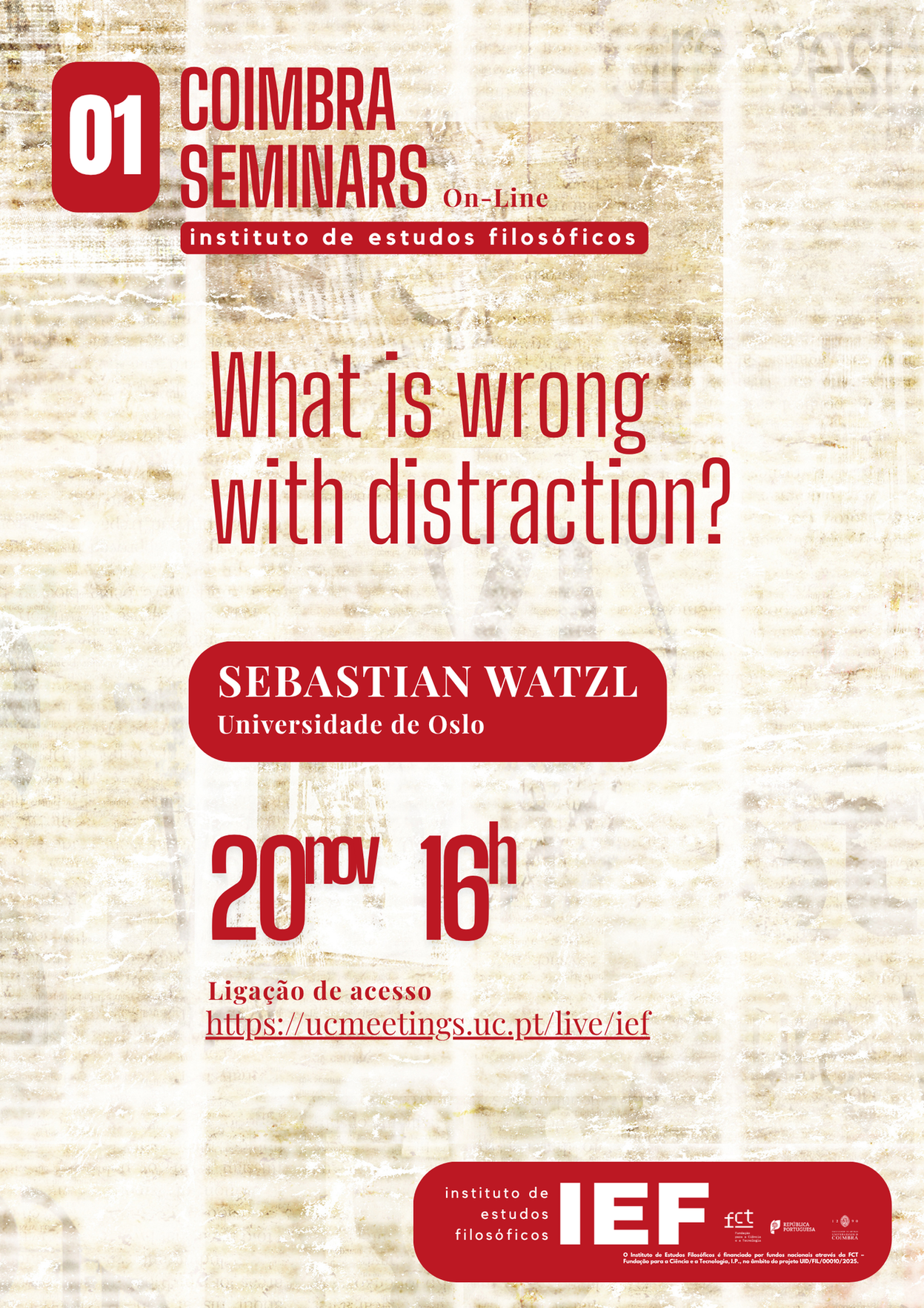
Filosofia - What is wrong with distraction? Sebastian Watzl c/o IEF


'Sebastian Watzl is a professor of philosophy at the University of Oslo (Norway). He specializes in philosophical issues about attention. He is the author of Structuring Mind (OUP), and recipient of an ERC grant on GoodAttention.

His research investigates the nature of attention, how it shapes consciousness, and the normative role and assessment of attention. Some of his current work is on the ethics of attention, the commodification of attention and its ethical assessment, the epistemic role of attention, and the use of attention as a political weapon.'

Sebastian Watzl - UoO Norway


Website: https://www.uc.pt/fluc/ief/agenda/coimbra-seminars-01/
LinkedIn: https://www.linkedin.com/posts/iestudosfilosoficos_ief-filosofia-philosophy-activity-7394448924947779584-fLSV
Instagram: https://www.instagram.com/p/DQ96aNVka0A/?igsh=MXJsejg0ZWE4bnBvZw==
Facebook: https://www.facebook.com/share/p/16uSVu9mNK/?mibextid=wwXIfr


individual
|
INTERPERSONAL : SCIENCES
humanistic -------------------------------------------  mechanistic
SOCIOLOGY : POLITICAL
|
group-population

My Mind
My Attention
My choice(s)?

Sources of distraction
Devices - access
Exposure - time
Social media
Assessment of attention
Children's education

Corporate Ethics of Attention
'Attention economy'
Policymakers & Policy
Attention as a political weapon


C/o IEF and thanks to Marta Santos (Secretariat).

Friday, April 08, 2022

"Death and Dying in COVID Times: Necropolitics of ECMO"

c/o Radical Philosophy Hour


INDIVIDUAL
|
 INTERPERSONAL    :     SCIENCES               
HUMANISTIC --------------------------------------  MECHANISTIC      
SOCIOLOGY  :   POLITICAL 
|
GROUP

consciousness

conceptualization


'distance' from power?

vulnerability


"Abstract: The realities forged - and exacerbated by - the COVID19 pandemic have occasioned broader engagement with an otherwise esoteric means of life-support, Extracorporeal Membranous Oxygenation. Commonly known as “ECMO,” this technology functions as a simulated placenta, an exogenous system for oxygenating and circulating blood in gravely ill folks. ECMO is a so-called “heroic measure,” a last ditch and often futile intervention in the care of critically ill adults who are out of other options. ...

death
dignity


ACHILLE MBEMBE
NECRO-POLITICS


... In this talk, we attend to Mbembe’s necropolitics, determinations of who will live and who will die, that inhere in the healthcare rationing of ECMO. We contrast the necropolitical economies of healthcare across three distinct nursing milieux, the United States, the United Kingdom, and Germany. The analytics of necropolitics in ECMO leads us to a critique of the transhuman impulse to attenuate death in the context of neoliberal healthcare economies. We examine the possibilities afforded by new materialist perspectives on the liminality between living and dying in the work and enactment of nursing care. We conclude with a call to speculative ethics for healthcare, attending to current realities while cleaving to what else is possible, a reparatory intervention for the white, cisheteronormative, ableist, colonial, patriarchal structures that enclose terrains of possibility for healthcare and beyond."


Tuesday, July 25, 2017

Advertising: The air that we breathe; or don't?

individual
|
INTERPERSONAL : SCIENCES
humanistic --------------------------------------- mechanistic
SOCIOLOGY : POLITICAL
|
group

Mental Pollution
Adbusters

Unbranded Advertising

Unbranded advertising of prescription medicines to the public by pharmaceutical companies (Protocol) 

Health - Literacy?

Digital Ad# Fraud
False / Fake Ads


Hodges' model makes explicit the divide between the public and the public's understanding of science.

Consider here the increased noise in advertising channels since the millennium as the media multiply, in addition to false advertising the rise of fake ads. Fake ads for jobs, drugs, goods and a littering of click-bait. Contactless plastic that touches the deepest oceans. Consumerism has become post-truth as any sense of 'standards' are undermined on several fronts.

The overlaps and increased complexity then become apparent.

# 'information'?

n.b. If I recall the source for the paper I will add it here!

Friday, July 31, 2015

Workshop & CfP: The post-Fordist Care Regime

A workshop series organised by the Centre for Philosophy and Political Economy (CPPE), School of Management, University of Leicester, UK
Workshop 1: The Business of Care

Keynote Speaker: Silke Roth (Southampton)

Convened by Vanessa Beck, Steve Brown and Fabian Frenzel

CPPE, School of Management, University of Leicester, UK

Date: 10th December 2015

Certain transformations in our political economic landscape can be distilled according to regimes of care. Fordist care was provided primarily by female ‘free labour’ within the family context, while the state played a large role through institutions like schools, pensions, prisons and hospitals. By contrast the private sector role was rather limited although, of course regimes are uneven and varied across different countries and social sectors. The post-Fordist regime of care was triggered, in part, by a rebellion against the invisible and unvalued nature of female ‘free labour’ in the care domain, for example in housework or child care. Demands for more autonomous, neither market nor state based forms of care were made and realised in new social and urban movements that pursued attempts to create new forms of social reproduction and care in communes, housing co-ops or self organised childcare. Despite the progressive impetus of many of these initiatives, it is possible to see, with hindsight, how demands for autonomous care were subsumed within the general move away from state provision and towards privatisation as well as individualisation of care responsibility. In the post-Fordist regime the provision of care is increasingly organised around the needs of capitalist valorisation. This drive towards privatisation is ostensibly about efficiency and budgetary restraint, the underlying motives, however, may well be more diffuse, pointing to the opening of new sources of surplus value capture for a growing sector of market oriented care provision.

Yet as the State outsources care jobs (in prisons, health, schools, etc), the organisation of markets has taken on specific characteristics. This includes the internationalisation of the care regime with transnational businesses of care, a transnational labour force and the expanding mobilities of care receivers. A further aspect is the increasing financialisation of care, which includes the creation of ever-new financial vehicles, from Private-Public Partnerships to social impact bonds that aim at ensuring efficiency in the care sector but often do the exact opposite. Both nationally and internationally we witness the renewed mobilisation of ‘free labour’. Unlike in the Fordist regime of care, this now aims at volunteers across age and gender groups and framings such as the ‘big society’ and 'international volunteering'. Beside this unremunerated work we see increasingly precarious conditions of labour in the care sector, often migrant labour, on zero hour contracts and minimum wages. The precise composition of this labour market is another area of interest. What novel forms of organisation are emerging in response to our present regime of care? And what resistance is emerging?

Finally, although price is often taken to be the primary concern of post-Fordist care provision, the quality of care cannot be ignored, though it is difficult to measure. Beyond a private industry of care provision we also find a new ‘industry of measurement’ that claims to assess the value and quality of privately administered care. The organisation of these new organisational patterns and industries of care are the subject of this workshop.

We invite papers that interrogate the shift to a post-Fordist care regime. We are interested in a variety of scales, from local to global in which this shift becomes visible and invite contributions from across care sectors broadly defined, from health (including mental health) to housework, from medicine to (social) housing, from education to welfare. We are interested in analyses of businesses of care, including care evaluation and financialisation, in investigations of the labour of care, national and international, waged, ‘free’ and precarious and the struggles of this labour. Finally we are also interested in receivers of care and their responses to the post-Fordist care regime.

Organisation:
The broad scope of the call is intended to allow for a comprehensive investigation of the post-Fordist care regime. Some of the threads of this workshop will be picked up in two following workshops that chart ‘Alternatives of Care’ and the ‘Cosmologies of Care’, to be announced separately in due course.

Please submit abstracts of up to 750 words to describe your paper. Invited papers will be presented in Pecha Kucha style. Presentations consist of 20 slides that have to be presented in 20 seconds each. (Follow this link to find more information on Pecha Kucha). The organisation of the day aims to encourage shared discussion and the format of Pecha Kucha allows for succinct presentations. Papers will be commented on by our invited keynote Silke Roth as well as the three workshop convenors. We also invite all speakers to submit outline papers (of about 2000 words) to be shared among participants prior of the workshop.

Dates:Please submit abstracts to ff48 AT le.ac.uk by the 30th September 2015. We will respond by mid October 2015. Presenters should submit an outline paper (of max. 2000 words) by the 1st December 2015 to circulate among participants of the workshop.

We also plan to facilitate a publication of full papers from the event.

The workshop is free of charge, and refreshments and lunch will be provided during the day. A limited number of travel bursaries is available. They will be targeted at presenting PhD students and researchers without access to institutional funding in the first instance. Please indicate if you would like to be considered for a travel bursary as you submit your abstract.

---------------------
Dr Fabian Frenzel
Lecturer in Organisation
PRME Officer
School of Management
University of Leicester
LE1 7RH
UK

My source:
Dr Vanessa Beck via ESA-ALL AT JISCMAIL.AC.UK (some extra text also emboldened as relate to Hodges' model).
Saturday, June 07, 2014

This May Hurt A Bit ...

individual
INTERPERSONAL : SCIENCES
humanistic ------------------------------------------- mechanistic
SOCIOLOGY : POLITICAL
group

 Here -


Here -


- Here (especially)
and Here...


and here - all around these care domains in the Spiritual domain.

Sunday, March 09, 2008

CARE = Plastic + Paper + Packages

The commodification of health seems to be a new phenomena and yet of course the search for 'cures' and 'spells' to ease this universal aspect of human existence has been with us for millennia. Now though the world of pyramid selling has ramped things up. The world at large has stepped on the gas. Plastic may well rule as the means to pay for the COS-plas-ME-tic surgery and presents a public face to the digital world of bits and bytes.

Now as we've seen the superstores and global IT players are getting in on the act (is that an unfortunate turn of phrase?) with Tesco, Google and Microsoft on board the bus with their respective partners. Health tourism clearly extends the notion of 'package holiday' AND 'care package'.

So - 'global health' anyone?

There must be a risk that the real messages of global health will get lost in the fog of contrails and business transactions.

In the meantime the heady interplay of plastic and paper and getting the biometrics to fit just right - points to the need for vigilance. As this blog and website makes clear I'm an ICT champion. I'm also a community mental health nurse. This means with fellow champions that two perspectives need to taken into account and monitored for risks and opportunities. I just wonder whether the move from paper to paperless records opens the door to the dilution of high standards of care?

Fragile warning tapeLook at it this way: there we are in our care sectors with our care packages. In health we are trying to get leaner, stripping out redundant processes, delays, duplication, trying to magnify real purposes and strengths. As for the superstores well they (and we!) still need to get to grips with packaging. I hope this does not just prove to be a straight swap - variously labelled -

'FRAGILE'
'THIS WAY UP'

Fragile tape: image source http://adifferentvoice.wordpress.com/2007/09/18/labels/

Friday, July 13, 2007

Soc. Philosophy & Technology Conf: Charleston, S.C. 8-11 July 2007

Home - safe and sound and really pleased I travelled despite the air-miles.

Charleston is beautiful and the heat was actually refreshing given June in the UK. I passed by New York in the day going, and at night coming home - it was an amazing sight.

The Society conference is biennial and alternates between the USA and Europe.

So, if jet-lag has not fogged my recall the 2009 conference will be at the University of Twente and I certainly plan to attend, even if I don't present.

The organisers, session chairs and assistants did a great job. I really do hope to meet again the fellow delegates I managed to speak to and share ideas - China, Netherlands, South Korea, UK, USA, Portugal...

I did not get to meet everyone and while I wish more people attended my presentation that's par for the course. I was prepared for that. You learn patience if not anything else riding the h2cm quad bike. Those who did attend appreciated the content and more people are aware of Hodges' model. I'm really grateful to Hugh the session Chair and the assistant for their help.

What did I learn?

Well, it was the 1980s when I first studied philosophy, so the conf-vocab was a good reminder and prompt (get the books out).

While a lot of effort had obviously been put into all the presentations, the plenary sessions stood out for me as a learning experience:

  1. Friedman's The World Is Flat: The Globalized World in the Twenty-first Century (noticed new updated copy at Newark airport).
  2. Repo-Tech - Reproductive Technologies and Risks of Commodification in the Global Context
The morning session on Aesthetic Computing - infovis was also of particular interest. I've many notes to reflect upon and follow up from the whole event. It was gratifying that I was able to ensure that some issues for older adults and memory loss were represented.

The Society members were all very friendly and supportive. This certainly isn't surprising, but as acknowledged at the conference close there was a real collegiate atmosphere.

Deliberations at the conference close included whether to publish Techné: Research in Philosophy and Technology - the Society journal as a paper journal as well as electronic.

As an independent scholar I gather you can currently join the Society for $15. Yet another sub, but it's high time I rationalised. I'm at a crossroads and looking at and pursuing other avenues. And who knows - might meet you in 2009!

P.S. Coming home and reading of the U-turn regards the UK supercasino struck a cord with good vibrations - thanks Prime Minister!
