Hodges' Model: Welcome to the QUAD: USA

Hodges' model is a conceptual framework to support reflection and critical thinking. Situated, the model can help integrate all disciplines (academic and professional). Amid news items, are posts that illustrate the scope and application of the model. A bibliography and A4 template are provided in the sidebar. Welcome to the QUAD ...

Showing posts with label USA. Show all posts

Monday, September 29, 2025

Raven Chacon - graphical musical scores

Individual
|
      INTERPERSONAL    :     SCIENCES               
HUMANISTIC  --------------------------------------  MECHANISTIC      
 SOCIOLOGY  :    POLITICAL 
|
Group
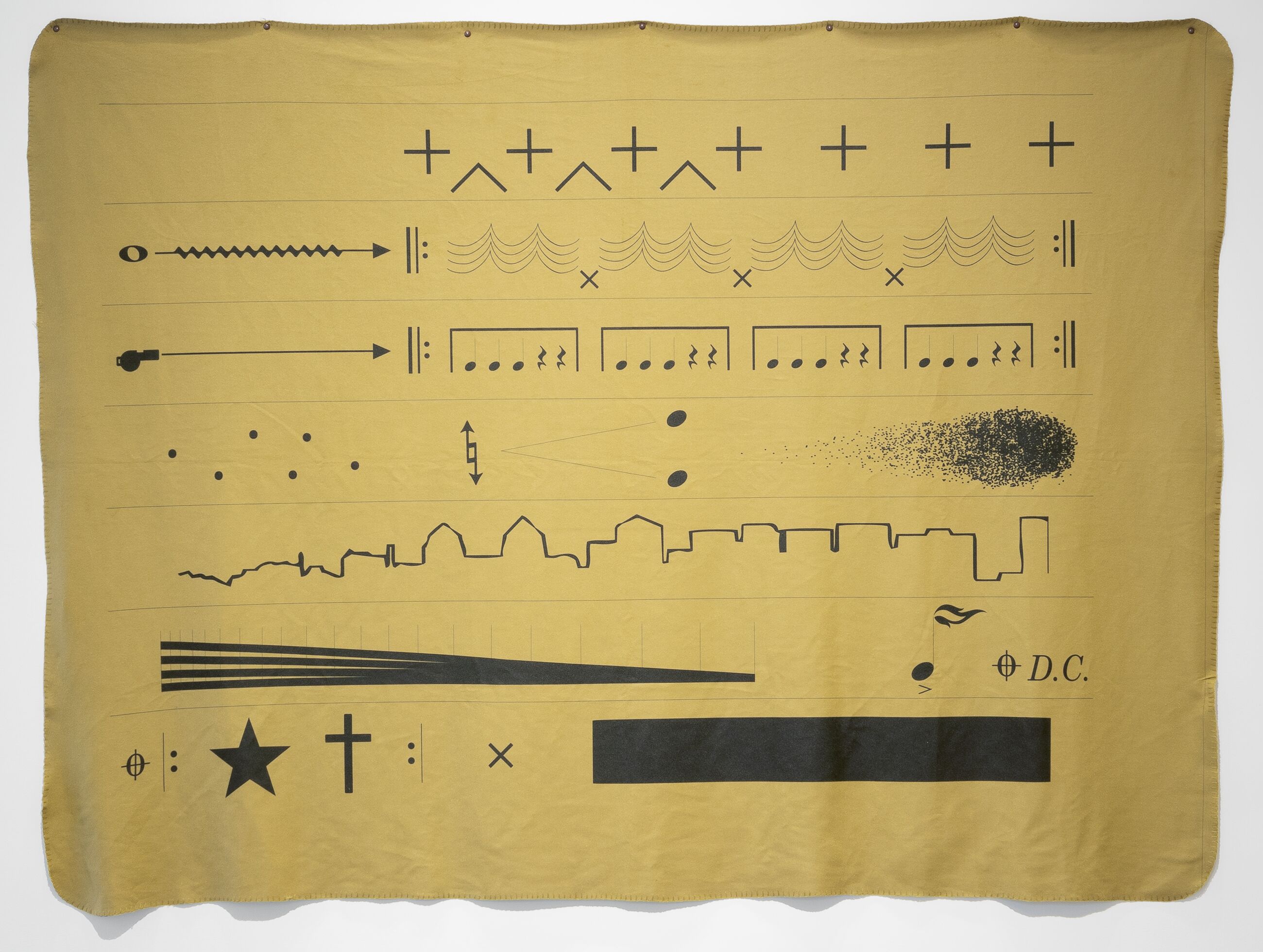
'The artist and composer Raven Chacon, 46, who grew up in Albuquerque and now divides his time between the city and upstate New York, used to explore these lava fields as a youngster, ingesting psychoactive plants such as jimson weed and searching for petroglyphs on the sides of rocks. Some - spirals, zigzags and dotted lines, for example - have found their way into the graphic musical scores for which he is now known. When I visited him in Albuquerque, he drove me out to see them.'
Raven Chacon, American Ledger No. 1 (Army Blanket), 2020. Graphic score


My source: Griffin, J. Sound of a different music. Life&Arts. FT Weekend. 24/25 February 2024. p.17.

Image: ECHOES OF A PLACE - Raven Chacon on transforming land, memory and political resistance into sound: https://www.hauserwirth.com/ursula/echoes-of-a-place-raven-chacon/

See also: RAVEN CHACON - https://spiderwebsinthesky.com/

https://en.wikipedia.org/wiki/Raven_Chacon

Previously: 'music'

Thursday, August 28, 2025

Lessons NOT learned: Bhopal, Brumadinho, Fundão, Kafue River ...?

Individual
|
      INTERPERSONAL    :     SCIENCES               
HUMANISTIC  --------------------------------------  MECHANISTIC      
 SOCIOLOGY  :    POLITICAL 
|
Group


Kafue River -
( clearly - not a 'person', nor the Rio Doce )

Signs of Life
Signs of Government, Law & Accountability


Monday, August 18, 2025

28th Annual International Hybrid Nursing Philosophy Conference, July 22-24, 2026


Join the UC Irvine Sue & Bill Gross School of Nursing Center for Nursing Philosophy in association with the International Philosophy of Nursing Society (IPONS) for the 28th International Nursing Philosophy Conference.

The HYBRID conference will take place physically at the University of California, Irvine in sunny, coastal Southern California, USA, as well as virtually via Zoom.

This hybrid, multidisciplinary conference aims to generate conversations between philosophy and nursing through a series of invited panel conversations and events. Cutting-edge peer-reviewed abstract panels on current scholarship and ideas in nursing philosophy will also be featured.

Contacts and site ...

Wednesday, July 17, 2024

'Land Back' - Owens Valley, California

"The vast territory known as Owens Valley in California was home for centuries to Native Americans who lived along its rivers and creeks fed by snowmelt that cascaded down the eastern slopes of the Sierra Nevada. Then came the European settlers, and over time, the Native Americans tribes lost access to nearly all of that land. Eventually, the water was lost too: ...
Less familiar is what happened to the Owens Valley, and the people who lived there, after most of the water was sent south. Owens Lake is now a patchwork of saline pools covered in pink crystals and wetlands studded with gravel mounds designed to catch the dust. And today, the four recognized tribes in the area have less than 2,000 acres (800 hectares) of reservation land, estimated Teri Red owl, a local Native American leader. 
But things are changing, tribal members say. They have recently reclaimed corners of the valley, buoyed by the growing momentum across the United States to return land to Indigenous stewardship, also known as the "Land Back" movement." p.7.

Individual
|
      INTERPERSONAL    :     SCIENCES                   
HUMANISTIC  --------------------------------------  MECHANISTIC      
 SOCIOLOGY  :    POLITICAL 
|
Group


LAND
culture

indigenous peoples

history
BACK


justice


Cowan, J. Native Americans reclaim lost land in California, The New York Times International Edition, June 18, 2024. p.7.

Tuesday, July 16, 2024

Honouring 'Wheatfield: a Confrontation' by Agnes Denes

"In the summer of 1982, two acres of wheat were planted and harvested by artist Agnes Denes, two blocks from Wall Street and the World Trade Center and facing the Statue of Liberty.

Planting and harvesting a field of wheat on land worth $4.5 billion created a powerful paradox. Wheatfield was a symbol, a universal concept; it represented food, energy, commerce, world trade, and economics. It referred to mismanagement, waste, world hunger and ecological concerns. It called attention to our misplaced priorities.

The harvested grain traveled to twenty-eight cities around the world in an exhibition called “The International Art Show for the End of World Hunger”, organized by the Minnesota Museum of Art (1987-90). The seeds were carried away by people who planted them in many parts of the globe." twistedsifter

Individual
|
         INTERPERSONAL    :     SCIENCES                   
HUMANISTIC  --------------------------------------  MECHANISTIC      
 SOCIOLOGY  :    POLITICAL 
|

http://agnesdenesstudio.com/

'Honouring Wheatfield: a Confrontation' - ArtBasel from June 10:
https://www.artbasel.com/stories/ecology-pioneer-american-artist-agnes-denes-basel-messeplatz-wheat-field-climate-change-awareness

Images: 

In 1982, An Artist Harvested Two Acres of Wheat on Land Worth $4.5 Billion by TwistedSifter

https://twistedsifter.com/2018/03/new-york-city-wheat-field-by-agnes-denes/

Roux, C. Reaping what you sow, Collecting, FTWeekend, 8-9 June 2024, p.4.
https://www.ft.com/content/346ad7e8-9ddf-4802-9658-053d1c5758a8

Saturday, July 06, 2024

Take II? Fit for Government . . ?

As a community nurse, driving is obviously pretty essential to your being able to work. I have come across non-driving community nurses (earlier this year) but they are still few(?). As a boy going to work with my father you could see how dependent he and workmates were upon a string of vans, cars and be able to drive both being on the 'right-side' of the law and his health. It was always an 'event' a new van, fitting out with racks, shelves, nooks, hooks and crannies for all sorts.*

Then as a community nurse older adults you come across individuals who still have their driving license, still have their car on the drive / front, and still have the car keys. Perhaps family have suggested to mum, dad, brother, sister, aunt: "Look, isn't it time to call it a day and give up driving?" Ouch! There's a crash - in itself.

Re-working the two-part draft paper on deprivation of liberty safeguarding, threshold concepts, Hodges' model within residential care, some thresholds are difficult, challenging to call. But some are safety critical, and perhaps need a more 'proactive' stance, without giving way to ageism. Is it the local community's job - the public's job to proffer a diagnosis: and what about persons on the world stage? Diagnosis by social media?

I quickly admired those people who, though reticent, gave up the literal fast-lane. Inevitably you wonder how you will react when the time comes. Will you have the humility, the goodness of grace to hand over the keys? To call it a day. With an ageing population, I've warned the children when driving to expect the unexpected. Cars going the wrong way. It was a struggle for my father: but safety as it so often does - did the trick - with the impetus of physical illness.

Sometimes, at work, after a family trying, and a fracas, when they've tried to hide / remove the car keys, suddenly a near-miss has upped-the-ratchet. Neighbours have seen the 'driver' reversing out into the road, with numerous car horns announcing the event. Then perhaps you are intercepted outside, a call comes to the day center (the transport is also going), the community team, or the GP's surgery (the neighbours have helped with medication).

I've had to speak to GPs for them to visit, meeting them on occasion. Do GPs - family physicians still have the same gravitas today?

This is a care transition: what can be a difficult one. A helpful point (diplomatic argument) that often gets through is the matter of car insurance and the status of the existing policy?

Does a political leader carry insurance?

It is difficult for all, a person's human rights, choices, freedom; their life story, former career perhaps, their health career - most definitely.

With events in the USA and the Democrat Party, and seeing the cover of The Economist I had to TAKE II.

Individual
|
      INTERPERSONAL    :     SCIENCES                   
HUMANISTIC  --------------------------------------  MECHANISTIC      
 SOCIOLOGY  :    POLITICAL 
|
Group

cognitive state

memory

insight

Fitness for Office:
Mentally & Physically
Legally
The Economist


safety of Others

community - duty of care -
safeguarding
 (however realised)

This is global problem that is set to increase and not just for reasons of health.

Ack. The Economist

Owen, D. (2009) In Sickness and in Power: Illnesses in Heads of Government during the Last 100 Years, London: Methuen Ltd. ISBN: 978-0-413-77689-1

Listen also ... BBC Radio 4 Moral Maze 

'The Morality of Stepping Down'

Previously:

*I suspect he's still driving around somewhere. x

Saturday, April 13, 2024

'Political sovereignty' by JFK


Individual
|
      INTERPERSONAL    :     SCIENCES               
HUMANISTIC  --------------------------------------  MECHANISTIC      
 SOCIOLOGY  :    POLITICAL 
|
Group


John F.


Kennedy


"Political sovereignty is but a mockery without the means of meeting poverty, illiteracy, and disease."


My source: 

Alan Capps, Alexandria, VA, US - FT Letters.
https://www.ft.com/content/de67db92-3e7b-45ee-b39e-0140d582306a 

Sunday, June 11, 2023

Reflections: "Reimagining the nursing workload: Finding time to close the workforce gap"

Redesigning care models through intentional delegation and
potential tech enablement can free up nurses’ time.

I learned of this study through twitter (see below) and ongoing awareness of the work, contribution and debate regards management consultants over the years. The research study was conducted in USA and I have no work experience there. As stated many times on W2tQ: my context is UK-based and public sector - NHS. I have been seconded in the past to a project which engaged management consultancy companies, the work involving IT and communications. The latter was focussed upon (much needed) IT engagement and being 'on message'. 

If employed long enough in the UK public health sector, you will come across consultancy employees eventually (whoever is in government too). Through news, media, consultants (friendly, with wide experience, eager to engage and deliver) will be introduced to the team, on placement for several weeks to collect data through a series of meetings, and conduct a presentation about impending change. The management consultancy sector  often have a bad press, with ongoing critique and debate regards their role, across the Atlantic and globally. More on that to follow.
McKinsey: LinkedIn


A brief introduction to the study follows:
"We conducted a survey of 310 registered nurses across the United States from February 8 to March 22, 2023. Our goal was to understand nurses’ perception of time spent throughout the course of a shift and to identify existing and desired resources to help nurses provide high-quality care. Our sample focused on nurses in roles that predominantly provide direct patient care in the intensive-care unit, step-down, general medical surgical, or emergency department settings. Insights were weighted by length of shift (the minimum shift time included was six hours)." p.2.
To begin, I like 'reimaging' in the title. Healthcare should always be about imagination, envisioning, and action - on an individual and collective basis. Organisational reimaging is also what management consultancy is predicated upon. 'Care model' here, appears to refer to the care environment (and experience?) as found. Gap, also in the title is another positive. Gaps must be seen, to see how we might close, bridge and span them.
 
Over several decades a preoccupation with 'process' has been apparent: the nursing process and processes as events and sequential series in project management. But what is this? No 'process' but one instance of processes. While this was encouraging, as presented, emphasis is placed on activities and tech - both of which can engender reductive and task-based perspectives. Allied with tech, improved delegation is the stated aim of the study. 'What do you expect?' - might be the rejoinder. As per the twitter replies the study conforms to type, brief and 'message':
"Achieving this may require health systems to invest heavily in technology, change management, and workflow redesign.

Realizing these changes will require bold departures from healthcare organizations’ current state of processes. It will be critical for hospitals to bring both discipline and creativity to redesigning care delivery in order to effectively scale change and see meaningful time savings. Close collaboration beyond nursing is also paramount to ensure alignment across the care team and hospital functions including administration, IT, informatics, facilities, and operations." p.8.
Technology is often described as the catalyst, but the impact (and risks - safety?) are often missed - a case of 'wag the dog'?
 
There is a global shortfall in the nursing workforce. National governments take a local perspective tempered (we hope) with international agreements on overseas recruitment. From the shortage in the USA listed (below), to the potential time saving equivalence is a significant outcome:
"When we translate the net amount of time freed up to the projected amount of nursing time needed, we estimate the potential to close the workforce gap by up to 300,000 nurses." p.2.
I am a technology enthusiast outside of work, but a technology realist at work (I do enthuse with students and enjoy hearing their views and experiences - personally, at university, on placement). I've used two electronic health record systems in mental health over the past four years. It is usable, but - as ever - could be improved. Thoughts re. tech are currently clouded by the UK use of telecoms and IT as the access point for primary care. Unfortunately this acts as a 'gate'. More tech is not necessarily better. Can it be argued that the pace of technical change (hardware and software - cloud, devices, decision support ...) is so fast that it is constantly contested? New systems need to be re-evaluated for patient benefits, improvements in care, safety, fit for purpose and other desiderata. Many consultants and advisors point to the existence of disciplinary and (hence) knowledge silos. What is key, is how IT can disrupt existing practice through these silos, especially in the form of AI. 

To return to the study(!), it is primarily in-patient hence hospital based. Perhaps hospitals are the biggest silos of all? These management studies flow, forming a series, a work-stream that includes:

How ‘Care at Home’ ecosystems can reshape patient care
Virtual hospitals could offer respite to overwhelmed health systems
Nursing in 2023: How hospitals are confronting shortages
 
These are cross-referenced online, but what price integrated care - and person-centred care at home?

Prof Alison Leary's tweet highlights research that has demonstrated the improved patient outcomes when care is delivered by Registered Nurses. The importance of training, registration and need to study the 'work' of nurses and their workload is not new:

Robb, I. H. (1903). The Quality of Thoroughness in Nurses’ Work. The American Journal of Nursing, 4(3), 168–177. https://doi.org/10.2307/3401722
Plus, 

"One of the new applications for decision analysis derives from the realization that if physicians are to become effective advocates for quality health care delivery under the incentives engendered by the newer cost-containment strategies, a common language is required to permit communication between physicians, regulators, policy makers and patients relative to what comprises effective care and why physicians do what they do." Preface, v. (my emphasis)
Knoebel, S.B. (1986). Perspectives on Clinical Decision-Making. New York: Futura Publishing Co., Inc., Mt. Kisco.

Whether 'physician', 'doctor' is cited as the user - an electronic health record should cohere across disciplines including nurses - the multi-disciplinary team; even as disciplinary system use may have its own signature (subsets). We are still seeking a language. For me this remains SOCIO-technical.

Innovations are mentioned in the study, but the specifics are not stated in explicit nursing terms, but related to the role of technology, electronic health records (yes, a care record is critical), building on existing tools and reducing implementation risk. Sadly, the informational environment (body politic?) appears to place constraints on the nursing 'care models' referred to here.

On delegation, the following makes a lot of sense: "While nurses report wanting to spend more time overall on direct patient care, there are specific tasks that could be delegated both vertically and horizontally to ensure that the work nurses perform is at the top of their license and promotes professional satisfaction." p.5. (my emphasis)

INDIVIDUAL
|

INTERPERSONAL    :     SCIENCES               
HUMANISTIC --------------------------------------  MECHANISTIC      
SOCIOLOGY  :   POLITICAL 
|
GROUP
Nurses thinking of leaving - reasons include: "not feeling valued by their organization and not having a manageable workload." with additional settings inc. home care and long-term care facilities.

This is a common expressed wish by nurses: "spend more time with their patients" but how often is it qualified psycho-socially?

310 subjects - nurses

".. estimates still suggest a potential shortage of 200,000 to 450,000 nurses in the United States, with acute-care settings likely to be most affected."

Settings include: intensive-care unit, step-down, general medical surgical, or emergency department.


Direct patient care - relationship building, empathy and rapport?


effectiveness,
efficiency and equity*

The politics of health systems and health service delivery globally.


In the 1990s organisational hierarchies were flattened, middle management roles were reduced. Technology played its part, but there are many other factors:

https://www.nber.org/system/files/working_papers/w9633/w9633.pdf

At a time when applied AI is increasing, nursing is open to innovation, but synergy and assurance of high quality, safe, person-centred care is essential. 

Socially we also need to preserve forms of work that have a role in well-being and community health - care of older people. Hierarchies and the services they 'deliver' will be flattened further and rationalised - if as nurses we are sufficiently passive. Consider the thoughts of Prof. Acemoglu, Economist, MIT:
"He [Acemoglu] imagines a day when teachers could use AI to create individual lesson plans for every student, or nurses might be able to take on much greater roles in, for example, diagnosing disease. 'Why is it that nurses cannot prescribe medications? Why must everything go through this very hierarchical approach where you have to call a doctor [to do that]?' As it is today, the people who spend the most time with patients - nurses, not doctors - are those who are paid and valued the least." p.3.
Foroohar, R. 'When mistakes involve powerful technologies, you're going to have trouble', Lunch with the FT: Daron Acemoglu, FT Weekend, Life&Arts, 20-21 May, 2023, p.3.

There is most likely a 'corporate' signature common to these reports as there will be to the posts here (2006 ... ). For nursing's sake - vested in the sustainable development goals, the determinants of health, and climate change - we need to preserve 'models of / for care' defined, applied and refined by nurses, the profession and professionalism, registration and holistic bandwidth.

See also:

Moisoglou, I., Galanis, P., Meimeti, E., Dreliozi, A., Kolovos, P. and Prezerakos, P. (2019), "Nursing staff and patients’ length of stay", International Journal of Health Care Quality Assurance, Vol. 32 No. 6, pp. 1004-1012. https://doi.org/10.1108/IJHCQA-09-2018-0215 (I have accessed the abstract only).

Kim, J., Lee, J.Y., Lee, E. Risk factors for newly acquired pressure ulcer and the impact of nurse staffing on pressure ulcer incidence. J. Nurs Manag. 2022 Jul;30(5):O1-O9. doi: 10.1111/jonm.12928. Epub 2020 Feb 25. PMID: 31811735; PMCID: PMC9545092.

[ Thanks to Phil Wilson: https://twitter.com/ph_wilson1/status/1667869284305977346?s=20 ].


*Apply the 3Es across the domains of Hodges' model.

Reimagining the nursing workload: Finding time to close the workforce gap
https://www.mckinsey.com/industries/healthcare/our-insights/reimagining-the-nursing-workload-finding-time-to-close-the-workforce-gap
 

Sunday, June 04, 2023

Applications for the 2023-2024 Nursing Philosophy Fellowship are Now Open!

"The Center for Nursing Philosophy Fellowship program supports promising nursing PhD students or interested nursing faculty to pursue targeted scholarship in nursing philosophy. The PhD Nursing Fellowship comes with a small stipend to be used at the fellow’s discretion for support during the fellowship period. The fellowship is a 1-quarter (10 week) commitment for intensive mentored scholarship in the Center for Nursing Philosophy (either virtually or in person depending on context), followed by 2 additional 10-week quarters of virtual mentorship to support scholarship completion. The expectation is that the end of the Fellowship corresponds with submission of the completed scholarship as a manuscript for publication in a peer-reviewed journal.

The application period opens June 1 of each year.

The CNP Nursing Fellowship application period is NOW OPEN, please click here to learn more and apply!"


Sunday, February 12, 2023

Tuskegee Healing, the Moral Determinants of Health, and the Ethics of Research on Black Health

My source: SpiritOf1848 list - Lachlan Forrow

This will build from two November 2022 events (see their flyers below) commemorating the 90th/50th/25th anniversaries of the USPHS Study of Untreated Syphilis in the Negro Male at Tuskegee and Macon County, the first organized/hosted by the National Center for Bioethics at Tuskegee University, the second organized/hosted by CDC (see details and video of that here; the first 2min30sec include Dr. Termika Smith’s wonderful intro [60 seconds] and President Biden’s remarks [90 seconds]. 

I would also strongly recommend watching ~5 minutes starting at 11min45sec – Mrs. Lillie Head, daughter of Fred Tyson, one of the men in the Study, and founder/leader of Voices for Our Fathers Legacy Foundation, explaining what the Study was really about (i.e. the moral issues were racism, dehumanization, etc. etc., not just “failures of informed consent”). 

For our Feb 17 session, after presentations by Carmen J. Thornton (Lillie Head’s daughter, i.e. granddaughter of Fred Tyson) and Susan Reverby (arguably the leading historian of the Study), and then presentations about applying this framework to 3 concrete areas of severe and ongoing “Black health disparities” (Jesse Milan, President/CEO of AIDSUnited on HIV/AIDS; Wangui Muigai on the history and current realities of Black maternal/infant mortality; and I hope [not yet confirmed] Rev. Jeffrey Brown [co-chair of Embrace Boston] on gun violence) the “Commentators” will be Dr. David Hodge, Associate Director of the National Center, who organized their Nov 2022 event, and Dr. Termika Smith, who organized and moderated the CDC event. Then Carmen J. Thornton, as granddaughter, will have closing words -- what her grandfather might say, and what she herself thinks, about MLK’s question: Where Do We Go From Here? 

Tuesday, December 06, 2022

BBC Reith Lectures 2022 - The Four Freedoms


 INDIVIDUAL
|

 INTERPERSONAL    :     SCIENCES               
HUMANISTIC --------------------------------------  MECHANISTIC      
SOCIOLOGY  :   POLITICAL 
|
GROUP

FEAR

WANT

WORSHIP


SPEECH


Are fear and worship interchangeable? 

Can I follow my faith / beliefs?

Many communities and groups live in fear.

Do the freedoms begin (and end!) with speech?

The ability to meet basic needs 'wants' - relies upon socioeconomic means; but basic needs are material in the first instance, through shelter, water, and food. All these depend upon security (locally, nationally, globally) as reflected in the Sustainable Development Goals (SDGs):

BBC Radio 4 The Reith Lectures


See also:
Jones P, Wirnitzer K. Hodges’ model: the Sustainable Development Goals and public health – universal health coverage demands a universal framework. BMJ Nutrition, Prevention & Health 2022;0:e000254. doi:10.1136/bmjnph-2021-000254

Monday, May 09, 2022

'Supplication In Alabaster' by Wangari Mathenge

 INDIVIDUAL
|

 INTERPERSONAL    :     SCIENCES               
HUMANISTIC --------------------------------------  MECHANISTIC      
SOCIOLOGY  :   POLITICAL 
|
GROUP


Ack. Wangari Mathenge (and sources for a means to illustrate the 'self' and 'other' in h2cm)

My source and image: @tanita_tikaram

https://twitter.com/tanita_tikaram/status/1364293961184075781?s=20&t=Zn0-jlIRF_n_yyUVkW-f-g

Caption: "'Supplication In Alabaster' - detail, 2019 Oil on canvas 52” x 72.5” All works have been copyright protected, Wangari Mathenge © 2019"

Saturday, May 07, 2022

"The Ascendants XIV (She Is Here Too But Why Are You?)" 2021, by Wangari Mathenge

 INDIVIDUAL
|

 INTERPERSONAL    :     SCIENCES               
HUMANISTIC --------------------------------------  MECHANISTIC      
SOCIOLOGY  :   POLITICAL 
|
GROUP


Ack. Wangari Mathenge

My source: FT.COM/HTSI "HOME is where the ART is".

https://www.ft.com/content/c02b4cec-005b-4fed-9fa2-bfaa648f10c6

Original image: https://www.houldsworth.co.uk/artists/44-wangari-mathenge/works/ 

Caption: The Ascendants XIV (She Is Here Too But Why Are You?), 2021, by Wangari Mathenge © Brian Griffin. Courtesy the artist and Pippy Houldsworth Gallery, London. © Wangari Mathenge 2021


Tuesday, November 03, 2020

Migrants, Picnic across the border c/o JR

individual
|
INTERPERSONAL : SCIENCES
humanistic ----------------------------------------------- mechanistic
SOCIOLOGY : POLITICAL
|
group - population


Migrants, Picnic across the border


My source:

Harvey, C. 'At first, they used to arrest me...'. The Daily Telegraph, Review, 31 October, 2020, pp.4-5.

See also:

JR: Chronicles

https://www.saatchigallery.com/art/jr_chronicles.php


Sunday, July 12, 2020

Nursing: The Adult Patient 1966

"To the Student"

"To the Teacher"


individual
|
INTERPERSONAL : SCIENCES
humanistic ----------------------------------------------- mechanistic
SOCIOLOGY : POLITICAL
|
group - population

"The ways in which the nurse helps people are infinitely varied, and she is being called on constantly to exercise the very delicate judgment." p.xiii


"Nurses respond to pressure in many different ways. Some withdraw, going as far from patients as possible. (They clean the medicine cabinet; it does not complain.) Some go about their work mechanically, refusing to get involved emotionally because involvement brings too much worry." p.xiv


"The  particular aim of the authors of this book is to assist you in understanding and helping each individual patient for whom you care. ...

"For a particular patient at a particular time, one aspect of nursing care may outweigh all others in importance."

"We believe that nurses need to develop a broad orientation to the care of patients, wherever the patient may be." p.xii

"All divisions in the study of nursing are arbitrary. There is unity of nursing, regardless of whether it is practiced at home, in a hospital, in a jungle or a desert; whether the patient is a child or an adult; whether the illness is physical, mental, or both." p.xiii

"Neither the "intercom" system nor the monitoring device that indicates the patients' vital signs was meant to supplant the nurse. ... In the future there will be more machines to perform mechanical tasks, but no machine can establish the creative, sustaining relationship with people that helps them to get well." p.xiv.
... Whatever their differences in social and economic background, temperament or relative state of health, your patients will have in common certain basic human requirements - skilled care, understanding and respect." p.xiii 

"Some try old social skills in new situations. These may or may not be applicable. Social chit-chat may make the nurse feel at ease but may be one way to avoid learning abount the patients' needs. Some nurses manage t ofind a a formula that is exactly right for them. They become involved enough to be concerned about helping patients, while continuing to grow and learn." p.xiv

"The nursing situation today is far from ideal. Many nurses face a staggering workload - not only in relation to the number of patients for whom they are responsible but also because of the greater responsibility that is being delegated to them as advances are made in medical science." p.xiv.

"Chapters on disaster nursing and world health problems have been included in the conviction that the profession of nursing has an important role to play during any disaster." p.x-xi


There is a definition of 'health' in this book (p.53), but no specific reference to nursing theory or models of nursing. Reading the references, the definition of health is neither derived from nursing or a WHO source. The definition does refer to health being more than the absence of illness.

Addressing acute contemporary issues, Chapter 59 'Nursing in Accident Disaster' includes Nuclear Disaster pp.1103-1114; while Chapter 60 on 'World Health Problems' is more comprehensive than I expected in such a book and at this time. Although the Cuban missile crisis was only fours years prior to publication.

Smith, D. W., & Gips, C. D. (1966). Care of the adult patient: Medical-surgical nursing. Philadelphia: Lippincott.

Saturday, May 30, 2020

'Space' - 'travel' and aftercare

individual
|
INTERPERSONAL : SCIENCES
humanistic ----------------------------------------------- mechanistic
SOCIOLOGY : POLITICAL
|
group - population
'Of Course I Still Love You'


"Aftercare"

5 4 3 2 1 0
.
MAX Q
..
1st STAGE (MECO)
...
2nd STAGE 
 (SECO)
....
1st STAGE
ENTRY BURN
.....
Governments must know
there are many spaces to understand and assure
 that human rights are upheld for all.

Congratulations USA!


Wednesday, November 07, 2018

Articulating the Socio-Technical and much more c/o @Atul_Gawande

individual
|
INTERPERSONAL : SCIENCES
HUMANISTIC ----------------------------------------------- MECHANISTIC
SOCIOLOGY : POLITICAL
|
group


John ---- Atul

"The story of modern medicine is the story of our human struggle with complexity. Technology will, without question, continually increase our ability to make diagnoses, to peer more deeply inside the body and the brain, to offer more treatments. It will help us document it all—but not necessarily to make sense of it all. Technology inevitably produces more noise and new uncertainties.

Perhaps a computer could have alerted me to the possibility of a genetic disorder in John Cameron, based on his history of skin lesions and the finding of high calcium. But our systems are forever generating alerts about possible connections—to the point of signal fatigue. Just ordering medications and lab tests triggers dozens of alerts each day, most of them irrelevant, and all in need of human reviewing and sorting. There are more surprises, not fewer. The volume of knowledge and capability increases faster than any individual can manage—and faster than our technologies can make manageable for us. We ultimately need systems that make the right care simpler for both patients and professionals, not more complicated. And they must do so in ways that strengthen our human connections, instead of weakening them."
Cameron ---- Gawande

"I had more time for his questions now, and I let him ask them. When we were done and I was about to get off the phone, I paused. I asked him if he’d noticed, during our office visit, how much time I’d spent on the computer.

“Yes, absolutely,” he said. He added, “I’ve been in your situation. I knew you were just trying to find the information you needed. I was actually trying not to talk too much, because I knew you were in a hurry, but I needed you to look the information up. I wanted you to be able to do that. I didn’t want to push you too far.”

It was painful to hear. Forced to choose between having the right technical answer and a more human interaction, Cameron picked having the right technical answer."


Atul Gawande, Why Doctors Hate Their Computers. Annals of Medicine, November 12, 2018 Issue


Thursday, January 25, 2018

Conference: The Foundations of Conceptual Engineering

A conference on The Foundations of Conceptual Engineering at NYU, on Sept 14 and 15, 2018. To attend, please register by following this link no later than August 31, 2018.

One dimension of cognitive success is getting it right, i.e gaining knowledge of facts. Another dimension of cognitive success is using the right concept, i.e. framing a topic in the right way. This view, if correct, tasks inquirers with critically examining the concepts they are using and perhaps replacing those concepts with new and better ones. This task is often known as “conceptual engineering”.

The idea that conceptual engineering is an important task for inquirers in and outside philosophy has recently gained traction. Some philosophers think conceptual engineering is an important task for inquirers to pursue.  The conference is focused on foundational issues in connection with conceptual engineering. Topics to be addressed include the following:
  • What are the semantic mechanisms that underlie conceptual engineering?
  • What are concepts, and which role (if any) do they play in conceptual engineering?
  • How can a theory of conceptual engineering be integrated with large-scale semantic theories? 
  • Which precise changes does a language undergo when its speakers engineer concepts?
  • Is conceptual engineering something that speakers can ever purposefully bring about?
  • What is the relation between changing concepts and changing reality? 
The planned conference will focus especially on the semantic foundations of conceptual engineering and push towards a better understanding of the process.

The conference is organized collaboratively by members of NYU (Vera Flocke and David Chalmers) and members of the research project ConceptLab, located at the University of Oslo (Herman Cappelen and Andrew Peet).

 More...

<>

If this conference needs a workshop, a workbench, or conceptual engineering facility they might care to look at Hodges' model. Whether for conceptual brainstorming, requirements, prototyping, refactoring, combination ... Hodges' model can have a role. Some musings in this vein follow...

individual
|
INTERPERSONAL : SCIENCES
humanistic --------------------------------------- mechanistic
SOCIOLOGY : POLITICAL
|
group

One dimension of cognitive success is getting it right,
i.e gaining knowledge of facts.
Another dimension of cognitive success is using the right concept,
 i.e. framing a topic in the right way.
Acceptable to the patient (or advocate) and ethical?
Achieving concordance - agreed 
relevant to the context, issue, problem?
Logical consistency, coherence and permanence?
Holistic bandwidth is tested - semantic scope?
Conceptual Engineering instantiated in software, argumentation? AI? Conceptual Spaces?
Topic is person-centred 
(patient, student, carer...)
Testing: Concepts with positive :: negative are switched - re-framed? 
Other dichotomies? Conceptual slide-rule?
Known 'semantic drift' in vocabulary - concepts: disuse, archaic, new, re-purposed?
Assessment is comprehensive?
Knowledge of 'conceptual engineering' 
how to - rules, laws (mechanisms)?
Concepts were measurable (as were previously defined) quantifiable?
Flagged interdisciplinary use of concept? Transdisciplinary?
Visual tools - representation, diagrams?
Reversible quality: 'engineering' disassembly?
Conceptual dependency on threshold(s)?
Engineering concepts: 
tolerance, project, professionalism, failure, risk, benefits, techne?
'Conceptual engineering' defined units & standards: word, words ... corpora?
Research methodologies, methods?
Literature
Available social sources were utilised, or at least pursued?
Narrative derived from concepts references life history (story)?
Tested and accepted by peers - multidisciplinary team?
Inclusive?
Quality criteria were met
Cultural, ethnic due regard  met

legal?
concepts used were appropriate
 to outcome(s)?
'Space' for uncertainty, constraints, unwise decisions?
Policy influence on language, examples found in health and social care 2008-2018 austerity?
Accords with and assures the Sustainability Development Goals?
'Macro conceptual engineering' - 
Level of required change in health systems: 
new & existing
