Hodges' Model: Welcome to the QUAD: teachers

Hodges' model is a conceptual framework to support reflection and critical thinking. Situated, the model can help integrate all disciplines (academic and professional). Amid news items, are posts that illustrate the scope and application of the model. A bibliography and A4 template are provided in the sidebar. Welcome to the QUAD ...

Showing posts with label teachers. Show all posts

Saturday, January 17, 2026

European Character and Virtue Association (ECVA) Conference 2026

Theme: Bridging the Knowledge – Action Gap in Character Development

Re: invitation to the ECVA 2026 conference: reminder ...

Established in 2022, the European Character and Virtue Association offers a forum for promoting research, training and networking in the field of character education. We bring together educational institutions in Europe and scholars from around the world, providing unrivalled opportunities for members to share best practices and shape European policies affecting higher education and research. 

The 2026 conference of ECVA will take place in Trnava University, Slovakia, in cooperation with the Jubilee Centre for Character and Virtues, University of Birmingham, the Private University College of Teacher Education of Christian Churches, and the Virtues and Values Education Center of Francisco de Vitoria University. 

The Executive Board of the European Character and Virtue Association (ECVA) cordially invites you to attend the 2026 ECVA Conference in Trnava, Slovakia. 

  • President: Prof. Dr. James Arthur (Harvard University)
  • Vice President: Prof. Dr. Verónica (Francisco de Vitoria University Madrid)
  • Secretary: Prof. Dr. Tom Harrison (Jubilee Centre for Character and Virtues, University of Birmingham)
  • Treasurer: Prof. Dr. Roland Bernhard (University of Teacher Education of Christian Churches Austria)

Conference Information Trnava, Slovakia, 2026, 24th to 26th of June 

We expect more than: 📍100+ researchers 🏫 40+ universities 🌍 20+ countries 🎤 60+ presentations & keynote addresses 

📝 Submit your abstract and find all conference details at the link below:

👉 https://ecva-character.org/ecva-conference-2026

Deadline for Abstract Submission: 31st of January, 2026.

All abstracts will undergo a review process over the course of the following month. Once your proposal has been accepted, you will receive detailed information about registration, conference fee (275,- EUR) processing, accommodation options, and other necessary information.

Notification of Acceptance: 1st of March 2026.

Contributions that demonstrate high quality and close relevance to the main theme of the conference will be accepted for review in preparation for the next scientific monograph produced by the ECVA.

Warm regards,

Dr. Martin Brestovanský
(Trnava University, Slovakia)

on behalf of the ECVA Steering Group

Prof. James Arthur (Harvard University)
Prof. Verónica Fernández (Universidad Francisco de Vitoria, Madrid)
Prof. Tom Harrison (Jubilee Centre for Character and Virtue, University of Birmingham)
Prof. Roland Bernhard (University of Teacher Education of Christian Churches, Vienna)
Prof. Claudia Navarini (Università degli Studi Europea di Roma)
Prof. Ines Weber (Paris Lodron Universität Salzburg)

Conference description 

Bridging the Knowledge – Action Gap in Character Development 

Moral education often assumes that ethical knowledge or cognitive competence alone will result in moral behaviour. Yet lived experience, philosophical reflection, and empirical research consistently show otherwise. A persistent gap exists between what individuals know is right and what they actually do—a phenomenon recognized since antiquity. 

Aristotle observed that “we reason here not to know what virtue is, but to become good” (Nicomachean Ethics, 1103b), highlighting that moral reasoning is directed toward formation, not just information. Immanuel Kant similarly acknowledged that a person may clearly understand moral duty and yet lack the will to act accordingly, pointing to the human struggle between reason and inclination. 

David Hume went further, arguing that “reason is, and ought only to be the slave of the passions,” insisting that moral knowledge without rightly ordered desires lacks the power to move us to action. And Martin Buber wittily adds: “The worst notorious liar in the classroom will write a brilliant treatise on the destructive power of falsehood”. 

This enduring challenge – now referred to as the knowledge–action gap – remains a pressing concern across education, psychology, and the social sciences. Scholars have described related phenomena in various conceptualizations, such as the reason–action gap, attitude–behaviour gap, intention–behaviour gap, or the knowledge–attitudes–practice (KAP) gap. Each term reflects a common concern: knowing what is right does not reliably lead to doing what is right. 

Bridging this divide is a complex task, compounded by the dynamic, deeply personal, and context-sensitive nature of character formation. Educational and behavioural sciences are increasingly turning to integrative approaches that go beyond cognitive instruction. Interventions such as moral sensitization, dramatization, habit training, and reflective practice are being explored to enhance the coherence between values and actions. 

There is growing consensus that this so-called “gappiness problem” cannot be resolved through one-size-fits-all solutions (e.g., moral emotions alone or identity-based interventions). Instead, promising “multi-component” models are emerging that draw on diverse disciplines and methodologies to address the challenge. 

Conference Goals 

By bringing together interdisciplinary perspectives and diverse methodologies, the ECVA 2026 conference aims to deepen our understanding of the knowledge–action gap and to promote innovative, research-informed strategies for strengthening moral coherence and character development in real-world settings. 

We look forward to welcoming those committed to advancing theory-informed practice and practice-informed theory in the service of ethical integrity and flourishing lives.

Previously: 'character' 

Wednesday, February 14, 2024

Distance: Shoulders and ships that pass ...

James Lovelock, 2005 (cropped).jpg
Lovelock in 2005: Wikipedia

Over the past 10-20 years I've become more aware of the distance from scholars and people whose work is relevant to Hodges' model. Distance in the sense of their concomitant 'celebrity', hence the issue of how to make contact; and the stage of their career and my discovery of their relevance. Three people come to mind ... 

I've long admired the work of James Lovelock, and when writing on ecological themes in -

Jones, P. (2008) Exploring Serres’ Atlas, Hodges’ Knowledge Domains and the Fusion of Informatics and Cultural Horizons, IN Kidd, T., Chen, I. (Eds.) Social Information Technology Connecting Society and Cultural Issues, Idea Group Publishing, Inc. Chap. 7, pp.96-109.
- I wondered about trying to contact Dr Lovelock. As the majority of people are aware his thought and books, especially the Gaia hypothesis with Lynn Margulis caught the public's imagination from first publication and through the 1970s. Was there a Horizon TV programme? James Lovelock's influence was not just in ecology, but also earth (planetary) sciences through work for NASA. In early 2021 I thought I would reach out, through his most recent book and publisher/agent. I passed a message, which was forwarded but I never heard anything more.

As a nurse - with experience in older adult community mental health, I was acutely aware that this senior gentleman - in every sense of the word - may not want to be mithered by a scouser*, now living near Wigan Pier. I stressed not wanting to disturb the Dr. I also thought, given Dr Lovelock being of independent mind - a maverick, he might on the contrary love to be disturbed. 

Sadly, I was too late, hearing the news of Dr Lovelock's death in 2022. Of course, I was seeking validation (and still am) for the project here. I can't help thinking though, that Dr Lovelock really would have 'got' Hodges' model.

James Lovelock: BBC Radio 4 The Life Scientific

<>

Philosophy has long been an interest B.A.(Joint Hons.) Comp./Phil.. In a way you have no choice as a nurse, especially trained in mental health and general nursing: the theory and practice invariably touch reality, consciousness, perception, subjectivity, objectivity, knowledge, being, perception, data, information, time and so on.

Once acquainted with Hodges' model, scale is the dimension that asserts itself. I wrote about this and referenced Mario Bunge in about 1998, on the old, now archived website:

https://web.archive.org/web/20100329050839/http://www.p-jones.demon.co.uk/infintro.htm

Scale is a constant and multicontextual focus, but interest was piqued once again as I try to look at Hodges' model mathematically (yes, who am I trying to kid!) - as an object and relationally. I was reminded of Prof. Bunge's work noting a paper that included 'isomorphic-ism':

Bunge, M. (1969). Corrections to “Foundations of Physics”: Correct and Incorrect. Synthese, 19(3/4), 443–452. http://www.jstor.org/stable/20114653

https://link.springer.com/article/10.1007/s10838-021-09553-7

Mahner, M. Mario Bunge (1919–2020): Conjoining Philosophy of Science and Scientific Philosophy. J Gen Philos Sci 52, 3–23 (2021). https://doi.org/10.1007/s10838-021-09553-7

There may be a brief email exchange with Prof. Bunge, a request for a paper or two. Any emails are now stored (CD-ROM and portable drive) in a Turnpike folder, an old email client. Last year I was disappointed again, to learn of Dr Bunge's passing in 2020. His focus on science, philosophy, and systems - hard / soft is also very informative.

<>

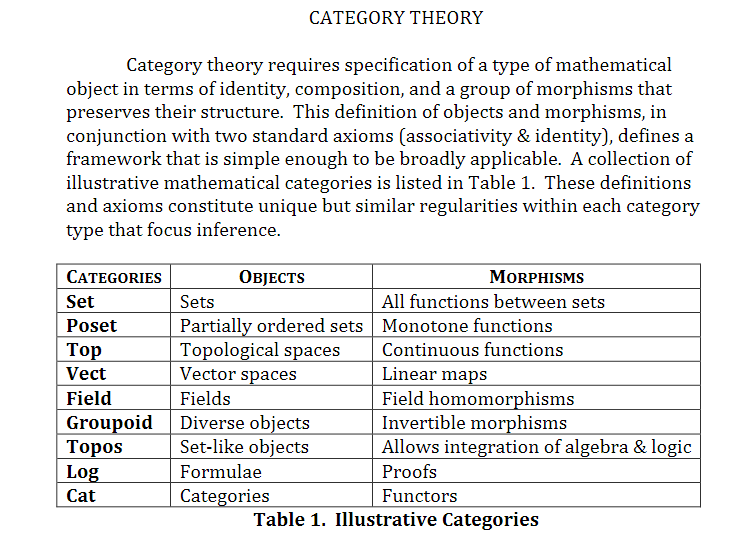
More recently, I came across the fascinating work of David Sallach, one paper (a conference from 2012) includes:


Sallach, D.L. Categorical Social Science: Theory, Methodology and Design. September 2012
Conference: Fourth World Congress on Social Simulation. Taipei, Taiwan.
https://www2.econ.iastate.edu/tesfatsi/Sallach2012CategoricalSoSci4.WCSS-SS.pdf

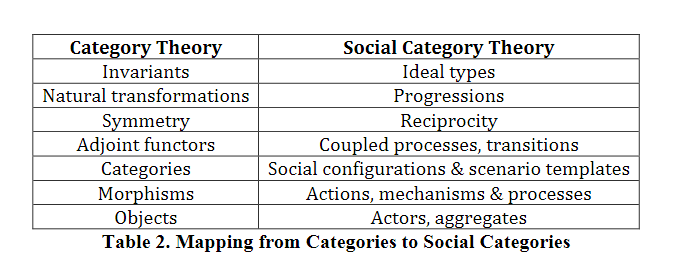
Plus, developed further in table 2:

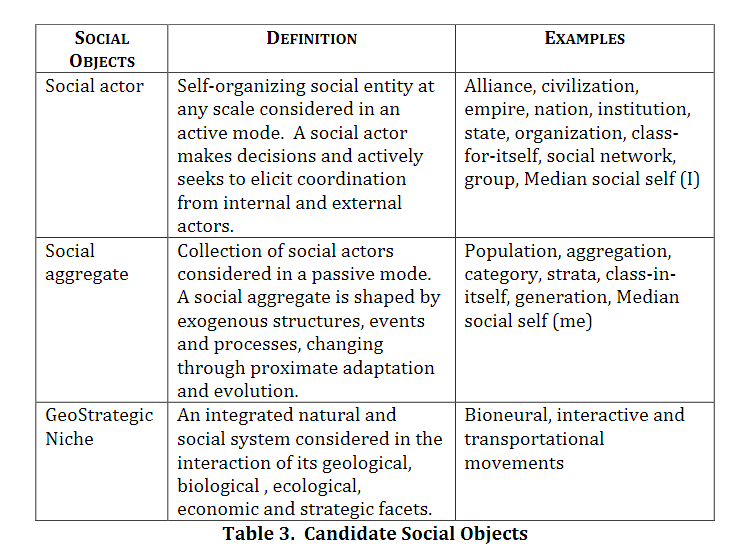
If time permits as an exercise, please consider Sallach's table 3 below. It may be interesting to map this to the domains of Hodges' model(?) [template]:
:

If you can see the potential utility of Hodges' model, you may also appreciate why Sallach's paper  resonates. Having emailed Dr Sallach, without reply, I did some checking. More sad news followed.

I, and no doubt many people will continue to discover and appreciate the legacy left behind by the above and many other pioneers. 

<>

I must acknowledge - Enid Mumford - whose work on socio-technical systems continues to inform my study and application of Hodges' model. This includes recognition of the many x-disciplinary bridges (or, barricades?) that can be found within Hodges' model. 

Clearly, much reading still to do.
<>

Returning to Hodges' model as a mathematical object, the 'distance' above is suddenly interstellar (and yes, sudden, as in faster than light!). I'm following videos, papers, and specific work-streams by  universities (I won't mention presently...) seeking to apply category theory to the social sciences. This suggests, at least, I'm not (completely!) wasting my time. If you have thoughts yourself on Hodges' model, the journey from Sallach's tables 1 - 2 not just 3, I'd be delighted to hear from you. 

There is another approach I will share this (N) spring. This author - researcher I have been able to contact.

*Scouser - https://en.wikipedia.org/wiki/Scouse
(Re. Liverpool - further post to follow).

James Lovelock image:  Bruno Comby, CC BY-SA 1.0, via Wikimedia Commons.

Friday, September 01, 2023

Brian E. Hodges (1942-2022) RIP Creator of Hodges' Health Career Model

The end of 2022 and start of 2023 brought loss, reflection and change in terms of family, friends and educational ties. My children said goodbye to their grandmothers in the space of two months. 

Brian E. Hodges c/o Family.
Then I was contacted by Brian Hodges’s daughter Sarah, with the news her father had died. November through to January saw me attend three consecutive funerals. I’m grateful I was able to visit Sheffield and say goodbye to Brian and meet his extended family.

Yes, it has taken a while to post this. For six months I have been sorting, clearing, rationalising books, papers with a house-sale now imminent, liaising with Brian's family too. 

It is fitting to share this sad news now and celebrate lives well-lived, cast in the promise of a new academic year. I think Brian would have liked this - the potential, and prospects for students in the semesters to follow, lecturers wrestling with how best to communicate and engage their students.

I first met Brian in 1987 when he was a Senior Lecturer at Manchester Polytechnic - which is now Manchester Metropolitan University. Brian taught on the ENB 911 Care of the Mentally Ill in the Community Certificate course. On the course Brian explained his eponymous model. This was more than a decade before Project 2000 made nursing an undergraduate programme. Brian created the model as a response to this. Brian’s qualification in Learning Disability Nursing is key to the inclusion of individual, group (carers) and the POLITICAL domain.

The model contributed to our assessment on the course, which required we complete a case study applying the model to a client/patient on a placement which was conducted with another service. Seconded from Chorley my placement experience was at Bolton. I still have my case study and a set of Brian’s original lecture notes.

Straight away I knew there was something special about Brian’s model. I suspect I’d been primed after watching Tony Buzan’s TV programmes in the 1970s, ‘Use Your Head’ and related books on mind-mapping. By the time I joined the Internet-age it was 1997. I’d written some microcomputer programs on the ZX81 and BBC Micro ‘B’: Nursing Process, Computer Aided Patient Assessment; HAEM; and Shades of Grey. Several were published by Open Software Library (no longer operating).

An ongoing interest developed in nursing theory and models of care, from reading about the nursing process. An early thought about creating a computer program about Hodges’ model crystallised in March 1997 when I came across the Nursing Development Site. This was hosted by the University of Alberta, Canada. Seeing that Hodges’ model was not listed, I contacted the site’s administrator. The response was: “Why don’t you create something and let us know.” Brian was very patient and offered his thoughts via email exchanges (saved, but in Turnpike format). In 1998 I finally got in touch with Alberta and they added a link.

The notes below are from the resulting website (1998-2015 now archived). The product of an interview with Brian at Manchester Polytechnic and my interpretation of model:
“Brian thought up HCM on the then British Rail train service, commuting between Sheffield and Manchester in 1983. He was stimulated by the need to impose structure on a curriculum for a BSc Nursing Studies course. Having defined the model in 1983 a scheduled teacher was unable to take a class, providing an opportunity for Brian to share the model and his thoughts with students. Despite this impromptu start, within a short time academic colleagues recognized the value of HCM in curriculum design and development, in addition to clinical practice.
 
A problem for practitioners has always been ensuring a comprehensive assessment has been made. The HCM facilitates that process, as an aide-mémoire, especially critical when faced with child care / abuse assessment and care evaluations. HCM was adopted as a tool for use by students on courses. Not surprisingly a key area of application is Health Visiting. Other nursing fields includes the use of case studies in post-basic education - Community Psychiatry Nursing Certificate; community and mental handicap - now learning disabilities.
 
Key phases in development
 
The main development work following initial conception, was up to 1987. Due to illness in 1990 Brian has been unable to engage in in-depth development work with the HCM. Hence Brian's bemused surprise at my contacting him. Despite this there are many educators, clinicians and no doubt health care managers who having been exposed to HCM carry it, like myself, as part of their mental toolkit. So if you have taught or used HCM in the past, or (even better) use it currently Brian and I would be delighted to hear from you. Given the duration of courses at Manchester then of course many colleagues in other parts of the north west of England have heard of HCM, used the HCM, or possess a college set of notes on HCM. Do you?” . . .

<> 

Sarah and family have kindly forwarded the eulogy which includes:
“Dad was born on 30th January 1942 to Vera and Gilbert Hodges, he was the eldest of three with a sister, Rita and younger brother Philip. He grew up in Kingswood, a suburb of Bristol and attended the local Grammar school. He loved being a Scout and was a member of the YMCA.

When he left school, he went to work for Boots the Chemist, telling us often about his’ behind the counter’ days. However, a conversation with a colleague led him to rethink his career and he applied to train as a nurse at a hospital for patients with learning difficulties. Being a male nurse in the 1960’s was quite ground-breaking, and so typical of Dad who was always pushing boundaries and taking the ‘road less travelled’.

Dad realised that he enjoyed teaching the students and became determined to raise the profile of nursing those with learning difficulties. This led to him to taking a year’s teacher training at Bolton College and with his new qualification he was determined to make an impact on nursing. In 1972 this lead to the move to Sheffield to set up a nurse training course at Sheffield Polytechnic and Middlewood hospital. He loved this job and the impact he could have on training nurses, alongside this he embarked on an Open University Degree and also developed the Hodges Health career model for nursing, which facilitated integrated care, person centredness, reflective practice and helped to bridge the theory and practice gap. He was very proud of this work, and it remains in use.
 
Alongside his work interests Dad decided that he would learn to sail, and not only how to sail, but also how to build a boat. The boat started life in the hallway of the house in Meadow Grove Road, and whilst it amused me and Sarah, there must have been a moment where Mum asked him to move it somewhere more suitable. He successfully built the boat and taught us all how to sail.
Back to his work life he was offered a job as a lecturer at Manchester University and later became Head of Nursing Studies there. He loved his job and invested a lot of time in encouraging his students with his indomitable wit and zest for life. Always wanting to learn more, he also studied for an MSc in Health Education, which meant he travelled to London and loved to tell us about his walks around Chelsea.

Life changed dramatically in 1990 when aged only 48 Dad had a severe stroke which led to a left side paralysis; and a medical assessment that he would not walk again. His sheer determination meant that he did in fact walk, although never regained use of his left arm, which made a lot of day to day tasks very difficult. He had no hesitation about asking strangers to help on his trips to London in his electric wheelchair.

Although Dad returned to work a year after the stroke, he found he could no longer do the job the way he wanted to and took early retirement. Being Dad, he did not stop working and continued to do some teaching, and travelled to other education centres as an external examiner. He also took up a number of volunteering activities which could make use of his skills. He became really involved in health care improvement through service user input and ultimately Chair of Shop Mobility in Sheffield.

One volunteering opportunity led to many and he took up a number of positions in both Sheffield and London. He loved to travel to London on his own on the train, where after his meetings, he would meet Sarah for dinner. He always said ‘focus on what you can do’ so that is what he did. After the stroke he learned to swim again and joined his grandchildren in the pool at Centre-parcs, and played badminton on one of his much loved family holidays.

He did not let the stroke stop him travelling at all and visited France, Florida, Barbados and even St Petersburg in his wheelchair. He also loved trips to Chatsworth for ice cream.

He loved listening to jazz music and rock, had learned to paint and draw. He loved the theatre and bird watching and was an avid reader. In fact, he was interested in everything, knew so much on any topic you could choose, and always more up to date than those around him, often much younger, on all the latest thinking or technology.

His philosophy of life meant that even after the catastrophic event of the stroke, it did not mean an end to living and he found other opportunities which he grasped enthusiastically.

So many people were amazed and inspired by Dad for what he achieved. He was one of life’s cheerleaders always encouraging and supporting others to fulfil their ambitions and this is what we will take with us. When we are not sure in our lives going forward we know we will think ‘What would Brian / Dad / Grandad say’. He had many sayings which we will remember and whenever anyone was facing difficulties or challenges, he would say ‘You will be alright’, and we will be alright because he has have taught us to be so.

Above all he will be remembered for his sense of humour, his huge sense of purpose and service to others and for the determination to live life to the full and never be stopped by anything or anyone. He was so proud of his family and all they have achieved. He was an inspiration and encouragement to everyone he met.

This is the final page of Dad’s life, but it is not the end. Everyone who’s life Dad touched, and all the people present here today carries a little bit of him with them, his humour, his smile, his sayings, his tenacity. So, he will live on with all of us, it is a fond farewell and not a goodbye.”
<> 

Train ticket 28/05/97 (also from 1st website)
Since the Community Psychiatric Nursing (Cert.) course in the 1980s and our initial interview 28th May 1997, Brian and I met on about ten occasions. As noted above, Brian enjoyed rail travel and in the interview I had this image of a train with thought bubbles - Brian's reflections with the model taking shape.

Image from 1st archived site
Brian’s passing and his family's observations prompted recollection of a trip to London in 1996; to an IEE Colloquium on Thinking with Diagrams (Digest No: 1996/010).

https://ieeexplore.ieee.org/xpl/conhome/5214/proceeding

I’m sure Brian met me there, demonstrating his independence, motivation and enthusiasm. I need to check but I’m fairly sure, even imagining he said he was meeting Sarah afterwards? My father accompanied me, we stayed with an aunt who lived near London Bridge back then. Happy memories for me too.

Brian knew of several sites across the UK, that used or took an interest in Hodges’ model. When the website went live in 1998, I’d hoped people with notes, insights, examples of application, pros and cons would come forward. Sadly this did not happen except for a few instances.

I’m so pleased to have met Brian and being able to carry his model forward. Even semi-retired, I rejoice in the freedom I have as a practitioner. As I believe Brian came up against many academic barriers in trying to validate, publicise and disseminate the model. There was no expressed cynicism in this however, but political realism about how the world – academia works. A lesson I know very well in trying to publish work.

I keep fretting about not completing the ‘new’ website, but perhaps I’m following Brian’s advice after all: “focus on what you can do”. Despite its limitations the blog is helping to spread awareness of Hodges’ model; learning each year of new publications citing the model. Hodges’ model isn’t just another 2x2 matrix—business/management consultancy style thinking tool.

The key is the model’s full title:

Hodges' Health Career - Care Domains - Model

‘Health career’ refers to ‘life chances’ and this was central to Brian’s values of person-centredness, advocacy, and ‘seeing’ the political in health, social care and his own educational development and health career. 

The work remains to take Hodges’ model forward, to pass on this ‘+’ shaped baton. I will reflect further, especially as I was initially determined to ensure that Hodges' model was not just left on the shelf. For me, Brian’s legacy is the increasing relevance of his eponymous model since its creation. Consider since the late 1980s developments in human rights, consent, mental capacity, safeguarding, protection of liberty, mental health act, prison health. Brian's model readily encompasses the person and the State - nationally and globally, access and provision to health services, primary care, sustainable development goals, the determinants of health. How do we switch from illness-directed to preventive, health educational services?

In addition, Hodges' model can conceptually represent all these - across time as a series of frames. Brian's model remains a gift to his students and today's learners; including, patients, carers, mental health and general nurses, district nurses, learning disability and health visitors. As suggested here - Brian's effort and work has proved a great gift to me (as friends, family and many student nurses on placement, mentored, signed-off will attest). Brian's model is not a be all and end all, he knew this. It is one of many tools, models and theories, but it can and must also help future generations: from self care, health care, to global health and planetary care.

Thank you Brian. RIP.


Friday, August 05, 2022

"Your metacognitive fingerprint"

 INDIVIDUAL
|
 INTERPERSONAL    :     SCIENCES               
HUMANISTIC --------------------------------------  MECHANISTIC      
SOCIOLOGY  :   POLITICAL 
|
GROUP

"Why are some people more self-aware than others? Studies show that metacognition is a relatively stable trait, so if you tested your metacognition today, it is likely to be similar if you do the same test again tomorrow. Strikingly, it also seems that metacognition is independent of IQ and general cognitive ability: your metacognition can still be in good form as long as you recognise you are performing badly at a task.
We still don't understand the origins of these individual differences, but one promising idea is that "explicit" metacognition is something we learn, based on feedback from our parents, teachers and social group.
A genetic "starter kit" may establish forms of self-monitoring early in life and then our parents and teachers finish the job. But even in adulthood, these things aren't totally fixed (see main story), so this is one kind of fingerprint you can change." p.38.

finger

p r i n t


- with my emphasis.

Fleming, Stephen. The power of self-reflection, New Scientist, 250,3333, 36-40. 8 May. 2021.
https://www.sciencedirect.com/science/article/abs/pii/S0262407921007946

I heard Stephen Fleming on the radio when the associated book was released last year - must buy a copy.

Still reading and enjoying 'Human Landscapes' with posts to follow.

See also: meta- meta- meta- +!

Sunday, July 12, 2020

Nursing: The Adult Patient 1966

"To the Student"

"To the Teacher"


individual
|
INTERPERSONAL : SCIENCES
humanistic ----------------------------------------------- mechanistic
SOCIOLOGY : POLITICAL
|
group - population

"The ways in which the nurse helps people are infinitely varied, and she is being called on constantly to exercise the very delicate judgment." p.xiii


"Nurses respond to pressure in many different ways. Some withdraw, going as far from patients as possible. (They clean the medicine cabinet; it does not complain.) Some go about their work mechanically, refusing to get involved emotionally because involvement brings too much worry." p.xiv


"The  particular aim of the authors of this book is to assist you in understanding and helping each individual patient for whom you care. ...

"For a particular patient at a particular time, one aspect of nursing care may outweigh all others in importance."

"We believe that nurses need to develop a broad orientation to the care of patients, wherever the patient may be." p.xii

"All divisions in the study of nursing are arbitrary. There is unity of nursing, regardless of whether it is practiced at home, in a hospital, in a jungle or a desert; whether the patient is a child or an adult; whether the illness is physical, mental, or both." p.xiii

"Neither the "intercom" system nor the monitoring device that indicates the patients' vital signs was meant to supplant the nurse. ... In the future there will be more machines to perform mechanical tasks, but no machine can establish the creative, sustaining relationship with people that helps them to get well." p.xiv.
... Whatever their differences in social and economic background, temperament or relative state of health, your patients will have in common certain basic human requirements - skilled care, understanding and respect." p.xiii 

"Some try old social skills in new situations. These may or may not be applicable. Social chit-chat may make the nurse feel at ease but may be one way to avoid learning abount the patients' needs. Some nurses manage t ofind a a formula that is exactly right for them. They become involved enough to be concerned about helping patients, while continuing to grow and learn." p.xiv

"The nursing situation today is far from ideal. Many nurses face a staggering workload - not only in relation to the number of patients for whom they are responsible but also because of the greater responsibility that is being delegated to them as advances are made in medical science." p.xiv.

"Chapters on disaster nursing and world health problems have been included in the conviction that the profession of nursing has an important role to play during any disaster." p.x-xi


There is a definition of 'health' in this book (p.53), but no specific reference to nursing theory or models of nursing. Reading the references, the definition of health is neither derived from nursing or a WHO source. The definition does refer to health being more than the absence of illness.

Addressing acute contemporary issues, Chapter 59 'Nursing in Accident Disaster' includes Nuclear Disaster pp.1103-1114; while Chapter 60 on 'World Health Problems' is more comprehensive than I expected in such a book and at this time. Although the Cuban missile crisis was only fours years prior to publication.

Smith, D. W., & Gips, C. D. (1966). Care of the adult patient: Medical-surgical nursing. Philadelphia: Lippincott.

Monday, May 28, 2007

Four knowledge domains = four audiences?

I don't know if there is any sense in this, but people look for 'signs' all the time - don't we? With the last front-end revision of the website (early 2005) I had twigged that there are at least four audiences that an introduction to Hodges' model needs to address.

Looking at the care domains the following seemed to fall just right:

Patients and Carers : Students - Lifelong Learners

Public [Citizens] : Policy makers, Managers

These may be lost to many visitors (but not you!) given the surfing attention span. If people do access and digest the first page above, which acts as a general introduction, they may not reach the second audience specific page.

Should I swap these around?

What is provided on the first page of each, is a basic h2cm graphic showing some relevant concepts for that particular domain. (It's this representation that trivialises h2cm).

The introductions do need revising and updating. I found some typos on the student - sciences piece, so not the best effort.

I think overall though this approach works - and highlights the need for collaboration and engagement on so many levels.

What do you think, any suggestions?

Ecotherapy to follow...