Hodges' Model: Welcome to the QUAD: Search results for geometry

Hodges' model is a conceptual framework to support reflection and critical thinking. Situated, the model can help integrate all disciplines (academic and professional). Amid news items, are posts that illustrate the scope and application of the model. A bibliography and A4 template are provided in the sidebar. Welcome to the QUAD ...

Showing posts sorted by relevance for query geometry. Sort by date Show all posts

Friday, November 04, 2011

PJ's project [ii]: Hodges' model An aide mémoire, or candidate Gärdenforsian conceptual space? Or would you like a mint?

This 'project' has in reality been ongoing through some thirty years. Although Hodges' model is by its very nature - broad and generic - I'm sure there is a specific research question here. For me this question combines nursing (theory and practice), informatics, health and public engagement. One possible question that h2cm provokes concerns whether the model can be considered a conceptual space?

Over a couple of years I've been adding to some notes which for want of another I've framed under the question above. These notes inevitably languish for a while given a full-time nursing job (plus learning Drupal, this blog, doing posters ...). Picking the text up recently though the intro material seems to have fallen into place. An introduction should cover the recurring issues, challenges - opportunities found in nursing. Although I have the secateurs in hand and the spring is warm, Hodges' model requires that education and cognitive science are also be considered in this way. Anyway, here is the current working outline:

Hodges' model: A mere aide mémoire, or candidate Gärdenforsian conceptual space?

Abstract

Part 1: Introducing Health & Social Care, Education, Hodges' model

1 Introduction
 1.1 Health and Social Care
 1.2 Recurring Issues in Health and Social Care

2 Education
 2.0 Introduction
 2.1 Education in the 21st Century
 2.2 Issues arising in Education

3 Health Care and Nursing Theory and Hodges' model
 3.0 Introduction
 3.1 Models of Nursing (Care)
  Definitions
 3.2 Hodges' Health Career - Care Domains - Model
 3.3 Information, energy?, records

Part 2: Cognitive Science & Conceptual Spaces

4 Cognitive Science and Computing
 4.0 Introduction
 4.1 Models, contexts, situations, the Project and (Darwinian) Justification
 4.2 Forms of Literacy, Requirements and Socio-Technical Perspectives
 4.3 Computation and Computer Graphics

5 Gardenfors' Conceptual Spaces

 5.0 Introduction

Drawing upon the cognitive science and computing literature the objectives of Gärdenfors’ Conceptual Spaces are made clear from the outset:

‘… is to show that a conceptual mode based on geometrical and topological representations deserves at least as much attention in cognitive science as the symbolic and associationistic approaches’ . p.2.

To what extent is h2cm a geometrical and topological representation? It appears on a simplistic level to qualify as a complex plane (Derbyshire, 2008). In this case, however, the closest we get to imaginary numbers in the negative sense are the null hypotheses of clinical research and reasoning amid uncertainty (REF). Gärdenfors continues:

‘This is a book about the geometry of thought. A theory of conceptual spaces will be developed as a particular framework for representing information on the conceptual level.’ p.2.

Hodges' model provides a framework, but as already noted it is not as yet theory based. It is based on practice, with appeals to experience and the knowledge and skills deployed in the health and social care sector. Could the h2cm framework work with Gärdenfors theory of conceptual spaces and his resulting framework for representing information? When Gärdenfors refers to his book being about the geometry of thought, here I would ask: What have nursing theorists sought? In addition to the stated motivations, surely a geometry of nursing thought? Nursing theorists seek rules and laws for a 'geometry' of care. A geometry of care is no less idealised, no less Platonic in form ultimately reflecting the values of the profession. A geometry of care would clearly be an achievement of harmony in the midst of discord and suffering. Additionally as the nursing discipline appears to some to be compromised in respect of practice, training, attitudes and professionalism.

 5.1 Representation, Explanation and Construction
 5.2 Background on key research methods
 5.3 Gärdenfors conceptual spaces - selected definitions
 5.4 Purposes, Holistic Bandwidth, Safety, Benefits and the Socio-Technical (repetition, move?)

Part 3:

6 Nursing, Care Theory and Care Domains
 6.0 Introduction
 6.1 Indicative literature review
 6.2 H2CM, Research methods and Data, Data, Data, (Data!)

Conceptual Spaces: Process, Practice and Domains - Hodges’ model

Part 4:

Coding and Classification, Ontologies, RDF, Semantic Web
Icons, glyphs, blobs
Patterns, wholes and parts
Users, Purposes and Scope of Application
Drupal and Ruby
Domains and Domain Specific Languages
Closing Discussion

(Back to this post:)
Don't ask why I am doing this. Chaos does reign here - 'Indicative literature review' in the midst...! In my defence these are notes, what's the question? Bits of the text move about, some disappears. Part 4 could become two, or three new parts, but no more than that! To what extent is there a case for M.I.N.T. a Modern Information-oriented Nursing Theory?*

Can you get there from a conceptual framework? When you get on the "conceptual framework" bus, can we simply change the destination to "conceptual space"? Has the academic bus already been and gone, or it drove right past: "Not in Service". Is this too big an ask of a bus? You need a ship to cross an ocean - even one that is illusory.

One thing I am sure of is that the model - #h2cm, this blog #W2tQ, my picking out Drupal, Ruby and the potential of visualization in the social sciences must come together in some way. One can inform the other. There is something really worth doing here. If in the end I don't get to do it well maybe others can finish the piece (the ambiguity here is intentional). Where's that illusory ship....

* M.I.N.T. sounds better than F.I.H.T. - you know cool and refreshing; but I do prefer and we really do need a Future & Information-oriented Health Theory?

Derbyshire, J. (2008). Unknown Quantity, Atlantic Books. p.12.

Gärdenfors, P. (2000). Conceptual Spaces, Cambridge.

Saturday, June 14, 2014

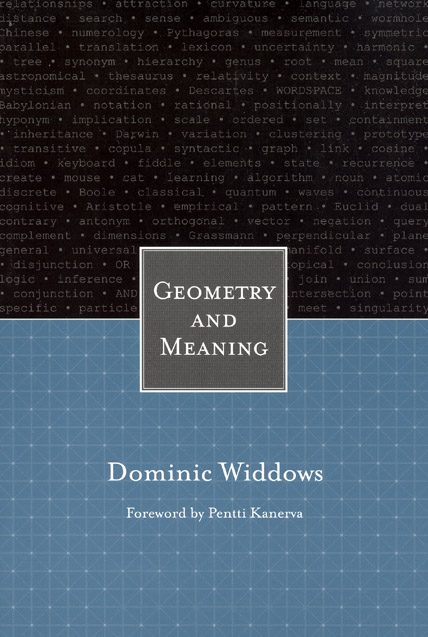
Books: The Geometry of Meaning, Gärdenfors & Geometry and Meaning, Widdows


http://www.mitpressjournals.org/doi/pdf/10.1162/coli.2006.32.1.155
There are two additions to my library. They are technical in parts and beyond my math and technical abilities, but as background this is essential reading.


Widdow's Geometry and Meaning includes details of the software used in the text. See the companion website below. While Gärdenfors' book The Geometry of Meaning is new, Widdow's text is a decade old and so demands some checking of software. I notice there are broken links on the companion site. The book, both in fact are great resources even as they increase the permanence of the geometry upon my furrowed brow...


Dominic Widdows, Geometry and Meaning - Companion website

Tuesday, August 25, 2026

Medicine - Mathematics & History

'We now come to the input of mathematics into medical history, and to the related questions of arithmetic and quantification, ratio and proportion, geometrical argument and diagrams, and probability. Mathematics (consisting in arithmetic, geometry, astrology and music) had an established place in the quadrivium of the medieval arts course; its application to medicine is demonstrated in such textbooks as the Articella, which include treatises on weights and measures, and in studies of proportion and ratio such as those of the medieval Oxford calculators which Italian doctors among others caused to be revived at the beginning of our period. In the sixteenth century, it was a vigorously debated subject; there is a well-documented discussion of the certainty of mathematics, concerning its status in respect to the logical adequacy of its proofs, in which some natural philosophers and doctors (notably Cardano) take part. It will come therefore as no surprise that it was prescribed for doctors by most Renaissance pedagogical writers;  this prescription is often specifically linked to Galen's geometrical (axiomatic) method whose operations are the constitution of objects from elements, the comparison of existing objects and their reduction into their constitutive elements.

Associated with mathematics are diagrams, that is, abstract quantified spatial representations. There is a modern debate about the contribution of technical innovations in illustration in the Renaissance (most notably perspective) to the scientific revolution: this is only relevant here insofar as some participants in this debate argue for the importance of diagrammatic symbolisation of mental abstractions above those, like perspective, which are still representations of the real world, and see the former as a step on the path to full algebraic notation of geometry. Not all Renaissance thinkers were persuaded of their usefulness: Argenterio describes the diagrams of Manardo and Akakia reproduced below as 'vain and false tables and figures'; but I shall argue here that they were related to the uptake of doctors from the arts course insofar as well-known logical diagrams reproduced above (4.3:3) were adapted by them for their own purposes.' pp.171-172.

Maclean, Ian. 2002. Chapter 5, Beyond logic: geometry, proportion, quantity. In Logic, Signs, and Nature in the Renaissance: The Case of Learned Medicine. Cambridge/New York: Cambridge University Press.

Related to ongoing reading, Maclean provides two (among several) historical illustrations (with apologies for the quality) on pp.174-175, the first is from the Wellcome Collection:

Dubois, Jacques, 1478-1555 (Boe͏̈, Jacques, Bois, J. d., Boë, J., del, Boë, J., Del Boë, J., DelBoe͏̈, J., . . . Sylvius/de Bois). (1548). Methodus sex librorum galeni in differentiis et causis morborum et symptomatum in tabellas sex ordine suo conjecta paulo fusius ne brevitas obscura lectorem remoretur & fallat. de signis omnibus medicis, hoc est salubribus, insalubribus, & neutris, commentarius / ... per jacobum sylvium ..Paris: Retrieved from https://www.proquest.com/books/methodus-sex-librorum-galeni-differentiis-et/docview/2090356749/se-2

Jacobus Sylvius, 1539

Which Maclean then translates / interprets (p.174):

Maclean. Figure 5.1, p.174.

'Manardo goes further, and causes and symptoms adapts the square of contraries to represent not only all the possible combinations of temperaments (combinations of cold and hot and wet and dry are cleverly excluded) but also inserts a mediate point to represent the absolutely temperate body: see fig. 5.2.
This adaptation of the square of contraries (which has precedents in the medieval period) shows the appropriation for their own use by doctors of the logical instruments at their disposal.

As we have seen, it is a feature of medical thinking to take into account many circumstantiae or variables, and, over time, the numbers of variables taken into consideration increases.' p.174-175.

Figure 5.2 Giovanni Manardo, p.175.

individual
|
INTERPERSONAL
: SCIENCES             
humanistic ------------------------------- mechanistic
SOCIOLOGY : POLITICAL   
|
group

quality

logic

quantity
past - present - future
diagrams

symptoms - signs


subjective

objective

Previously: 'medicine' : 'history' : 'diagram'

Tuesday, December 13, 2016

The Space of Origin - Foucault

individual
|
INTERPERSONAL : SCIENCES
humanistic -------------------------------------------  mechanistic
SOCIOLOGY : POLITICAL
|
group-population


"For us, the human body defines, by natural right, the space of origin and of distribution of disease: a space whose lines, volumes, surfaces, and routes are laid down, in accordance with a now familiar geometry, by the anatomical atlas. But this order of the solid, visible body is only one way—in all likelihood neither the first, nor the most fundamental—in which one spatializes disease. There have been, and will be, other distributions of illness. When will we be able to define the structures that determine, in the secret volume of the body, the course of allergic reactions? Has anyone ever drawn up the specific geometry of a virus diffusion in the thin layer of a segment of tissue? Is the law governing the spatialization of these phenomena to be found in a Euclidean anatomy? After all, one only has to remember that the old theory of sympathies spoke a vocabulary of correspondences, vicinities, and homologies, terms for which the perceived space of anatomy hardly offers a coherent lexicon. Every great thought in the field of pathology lays down a configuration for disease whose spatial requisites are not necessarily those of classical geometry." p.3.


"The exact superposition of the ‘body’ of the disease and the body of the sick man is no more than a historical, temporary datum." p.3.


Foucault, Michel (1973). The Birth of the Clinic. New York: Pantheon Books.

Wednesday, June 14, 2023

[ Towards . . .] A Geometry of Care*

Context -
"Introduction: We present a new model of skilled performance in geometry proof problem solving called the Diagram Configuration model (DC)." p.577.

INDIVIDUAL
|
INTERPERSONAL    :     SCIENCES               
HUMANISTIC --------------------------------------  MECHANISTIC      
SOCIOLOGY  :   POLITICAL 
|
GROUP
"A safe abstraction only ignores irrelevant details, i.e., details which only discriminate between objects that are functionally equivalent with respect to the problem solving task." p.582.

So much to consider here, I may be overstretching analogies but then Hodges' model can act as both a conceptual rack and resolver.


"For instance, to use the side-angle-side rule for inferring triangle congruence a problem solver must locate three congruence relationships - two between corresponding sides of the triangles and one between corresponding angles. In searching for a list of statements for these three relationships, one might need to consider numerous possible combinations of three statements that exist in the list. However, if these relationships are marked on a diagram, one can quickly identify them since the side-angle-side configuration comes together in each triangle at a single vertex. In other words, related information is often easier to find in a diagram because it is typically in the same locality whereas the same information may be separated in a in a list of statements. This is the locality feature of diagrams." p.584.


not just 'local' -


- but intra- interdomain -
with constant stress on safety.


Koedinger, K.R. & Anderson, J.R. (1995) Abstract Planning and Perceptual Chunks. In  Diagrammatic Reasoning: Cognitive and Computational Perspectives. Janice Glasgow, N Hari Narayanan, B. Chandrasekaran (Eds.). Massachusetts: AAAI PRESS / MIT Press. pp.577-625.

Book cover: https://dl.acm.org/doi/book/10.5555/546459

*There may be several? But -
"One of the places where the Geometry tutor expert (GTE) gets bogged down while attempting difficult problems is in the fruitless application of algebra inferences. Algebra expressions can be combined and manipulated in infinite variety and as a result, algebra inferences often lead problem solvers into black holes in the search space from which they may never return." (17.4.3 Avoiding Algebra in the Diagram Configuration Space),  p.593. 


Thursday, November 17, 2022

Social Sciences, measurement ... c/o Outhwaite (1991)


"the conceptual aspect of the subject matter of the social sciences circumscribes the possibility of measurement. . . . For meanings cannot be measured, only understood. Hypotheses about them must be expressed in language, and confirmed in dialogue. Language here stands to the conceptual aspect of social sciences as geometry stands to physics. And precision in meaning now assumes the place of accuracy in measurement as the a posteriori arbiter of theory. It should be stressed that in both cases theories may continue to be justified and validly used to explain, even though significant measurement of the phenomena of which they treat has become impossible." Chapter 3, Realism and Social Science. p.60.


William Outhwaite (1991) New Philosophies of Social Science: Realism, Hermeneutics and Critical Theory. London: MacMillan.

 INDIVIDUAL
|

 INTERPERSONAL    :     SCIENCES               
HUMANISTIC --------------------------------------  MECHANISTIC      
SOCIOLOGY  :   POLITICAL 
|
GROUP


quality


subject/subjective
geometry, physics (time)
metric / measurement / magnitude
quantity
*or, automated systems, robots

object/objective

social sciences - humanities

"Society consists of people. Groups consist of people. Institutions consist of people plus rules and roles. Rules are followed (or alternately not followed) by people and roles are filled by people.* Also there are traditions, customs, ideologies, kinship systems, languages: these are ways people act, think, and talk." p.108.
Chapter 7, Conclusion. (Citing Steven Lukes.)

Institutions

"There is thus an important sense in which Marx's explanandum in Capital is a conceptual question (though one whose answer required detailed empirical as well as conceptual investigation): 'why labour is expressed in value and why the measurement of its duration is measured in the magnitude of the product.'
Chapter 6, Critical Hermeneutics ... p.96.


Hodges' model:
The Individual - Group(s) axis: The subjects and agents of health and social care (theory, practice, management, policy, research, history, future studies ...)

Monday, March 16, 2026

Kantian Justice: A Desert-sensitive Responsibility-enhancing Theory

On Nov 3rd & 4th last year, I was able to attend a launch event in Liverpool, UK - which I intended to post:

KantianDESERT* is designed to formulate a new model of distributive justice in response to growing economic disparities globally, by offering a distinctive position within dominant egalitarianisms in current political theory/philosophy. Through several original contributions, the project builds an innovative case for a theory sensitive to individual just deserts.

This 5-year, €2 million Advanced Research Project, selected by the European Research Council and funded by the UK Research and Innovation, is led by Professor Sorin Baiasu (Liverpool). With this conference, the project will be officially launched.

The launch has been followed  by a reading group working through (now chapter 4) of Shelly Kagan's -

Chapter 3 on Desert Graphs - seemed somehow familar, at least in the structures first presented:

Abstract

This chapter is concerned with desert graphs, which help clarify and demonstrate the complexity of the topic of desert. The first section includes graphs that explain the fault forfeits first view and its two extensions. It then studies varying slopes, graphs that depict the desert line of two different individuals, and rotation. The next section discusses the concept of peak, which represents the exact level of suffering or happiness a person actually deserves. It also includes a comparison of the eastern and western slopes of one and two individuals, as well as a section on the Sym Mountain. This chapter also introduces the mountain as the characteristic shape of an individual desert line.

Kagan, Shelly, The Geometry of Desert (New York, 2012; online edn, Oxford Academic, 24 Jan. 2013), https://doi.org/10.1093/acprof:oso/9780199895595.001.0001, accessed 16 Mar. 2026. 

The main launch programme is copied below for reference:

Day 1

9.00-9.15: Coffee/tea. Welcome addresses from Professor Peter Buse (Liverpool, Dean of the School of the Arts) and Professor Michael Hauskeller (Liverpool, Head of the Philosophy Department)

9:15-10:15 Introduction; about the project. Sorin Baiasu (Liverpool): Kantian Justice: A Desert-sensitive Responsibility-enhancing Theory; Tom Bunyard (Liverpool): 'Is Desert a Viable Concept?'; Tom Whyman (Liverpool): 'Food Justice and Desert'

10.20-11.20: Sebastian Orlander (Independent): ‘Kant, Freedom, Desert and Practical Faith’
...
11.30-12.30: Tommaso Mauri (Perugia): ‘Desert and Inequality in Kant: A Theologico-Political Approach’
...
1.15-2.15: Elisabeth Widmer (LSE): ‘What’s the point of Kantian Inequality?’
2.20-3.20: Huub Brouwer (Tillburg): ‘Defending Asymmetries of Desert’
...
3.30-4.30: Tom Mulligan (Georgetown): ‘Who deserves what AI produces?

4.35-5.20: Roundtable

7.00: conference dinner ...

Day 2

9:30-9.45: Welcome; coffee

9.45-10.45: Seniye Tilev (Kadir Has University): ‘Kant on Well-Being and Virtue: A Framework for Desert Without Consequentialism’

10.50-11.50: Krishna Pathak (Delhi): ‘Institutional Desert, Injustice, and Adaptive Preference for Suicide: A Kantian Perspective’
...
12:10-1.10: Jochen Bojanowski (Illionois): ‘Luck Egalitarianism and the Limits of Desert’
...
2.10-3.10: Gabriel Maruchi (Campinas): ‘Denotational Revisionism Cannot Escape Basic Desert’

3.15-4.15: Marius Baumann (LMU): ‘Desert, Responsibility and Skepticism’
..
4.30-5.15: Roundtable & close

Commentators: Tom Whyman (Liverpool), Sorin Baiasu (Liverpool), Bertjan Wolthuis (VU Amsterdam), Christian Españo (University of the Philippines Diliman), Sung-Yeop Jo (LMU), Tom Bunyard (Liverpool), Robin Eliath Joy (Calicut), Beşir Özgür Nayır (Boğaziçi).

https://www.liverpool.ac.uk/philosophy/research/research-projects/kantian-justice/

My source: *Philos-L https://www.liverpool.ac.uk/philosophy/philos-l/ 

Thursday, October 02, 2025

Will it? Won't it? Artificial general intelligence - AGI

In the media - notably the financial press (radio, TV, Times, FT here) there have been recent questions raised about whether the generative AI bubble is about to burst. The latest releases of GAI are not the step-change that might have been expected. Artificial General Intelligence may not be quite in-sight. As a result I've been reminded of Prof. Peter Gärdenfors work on 'Conceptual Spaces':

'Within cognitive science, two approaches currently dominate the problem of modeling representations. 

1. The symbolic approach views cognition as computation involving symbolic manipulation. 

2. Connectionism, a special case of associationism, models associations using artificial neuron networks. 

Peter Gärdenfors offers his theory of conceptual representations as a bridge between the symbolic and connectionist approaches.' MIT Press.


Hodges'model facilitates a hybrid response to situations, as needed.

A further prompt is the programme for November's AI Health 2025:

https://www.bcs-sgai.org/health2025/?u=programme

Peter Gärdenfors. (2000) Conceptual Spaces: The Geometry of Thought. MIT Press.
DOI: https://doi.org/10.7551/mitpress/2076.001.0001

https://direct.mit.edu/books/monograph/2532/Conceptual-SpacesThe-Geometry-of-Thought

Friday, October 21, 2022

Mathesis Universalis - Caresis Universalis ..?

Frontispiece of Operum Mathematicorum Pars Prima (1657)
by John Wallis, the first volume of Opera Mathematica
including a chapter entitled Mathesis Universalis


"Mathesis universalis (from Greek: μάθησις, mathesis "science or learning", and Latin: universalis "universal") is a hypothetical universal science modelled on mathematics envisaged by Descartes and Leibniz, among a number of other 16th- and 17th-century philosophers and mathematicians. For Leibniz, it would be supported by a calculus ratiocinator. John Wallis invokes the name as title in his Opera Mathematica, a textbook on arithmetic, algebra, and Cartesian geometry"


 INDIVIDUAL
|
 INTERPERSONAL    :     SCIENCES               
HUMANISTIC --------------------------------------  MECHANISTIC      
SOCIOLOGY  :   POLITICAL 
|
GROUP

progress?

progress?

progress?

[PROGRESS?]

Also from: https://en.wikipedia.org/wiki/Mathesis_universalis

René Descartes

In Descartes' corpus the term mathesis universalis appears only in the Rules for the Direction of the Mind.[1] In the discussion of Rule Four, Descartes' provides his clearest description of mathesis universalis:

Rule Four
We need a method if we are to investigate the truth of things.

[...] I began my investigation by inquiring what exactly is generally meant by the term 'mathematics' and why it is that, in addition to arithmetic and geometry, sciences such as astronomy, music, optics, mechanics, among others, are called branches of mathematics. [...] This made me realize that there must be a general science which explains all the points that can be raised concerning order and measure irrespective of the subject-matter, and that this science should be termed mathesis universalis — a venerable term with a well-established meaning — for it covers everything that entitles these other sciences to be called branches of mathematics. [...]

— René Descartes, Rules for the Direction of the Mind; translated by John Cottingham[4]

Friday, September 18, 2026

Euclidean or Projective Care?

How many dimensions does a written - narrative record have?

Sketching out some ideas, I asked the question on Google and as usual an AI Overview response followed - snippet:
AI Overview

A physical written record has two primary spatial dimensions (length and breadth/width) as a flat document, or three dimensions (including thickness or depth/height) when considering its physical form or binding. [1, 2]

In archival and Records Continuum theory, a written record exists dynamically across four conceptual dimensions: [1, 2].

I put the question to the Records Management list with the above snippet and received several useful suggestions and sources. Perhaps I can share that at a future point? 

Acutely aware of not pursuing maths and category theory for its own sake, the query was driven by an attempt to look at Hodges' model in mathematical terms. Starting, rather obviously with the models structure and axes. When the model is assembled, as per many posts, the vertical axis:

INDIVIDUAL
|
GROUP

- shouts out the issue of parity and the distinction between mind and body. It does this at the individual and collective level. If we were to draw a silo, a cylinder springs to mind, and there are specific reasons for silos adopting this shape. Descartes gives us the perfect excuse, in the ongoing legacy. 

     Mathematical Visions

The question above came up from Joan L. Richards book 'Mathematical Visions' (c/o Lancaster Univ. library). Euclidean and the emergence of projective geometry is described. There is an interplay between 2D and 3D representation, that made me think about the health record and its dimensions. Not in a dataset sense (multi-dimensional), more generally and concretely(?). A patient's record on paper has physical dimensions (A4), there is a flow. An EHR has its virtual dimensions (discuss!). Abstractly the content is a time machine. At some point in a health encounter it is a literal 'history', the level of detail in accord with the context. The record might present the problem, premorbid situation, diagnosis, current state, observations and prognosis and much more.

I can revisit this, Richards provides a series of figures. We progress from two distinct circles (my silos) through to examples with a discussion of continuity and projection that sees the circles touching, then intersecting. This is a radical axis.

Richards, Joan L. (1988), Mathematical Visions: The Pursuit of Geometry in Victorian England, Boston: Academic Press, ISBN0-12-587445

Book cover: Amazon.

Sunday, May 31, 2020

Book Review: ii Mathematics and Art: A Cultural History

Last time I suggested that philosophy is missing from the title. Architecture is another very welcome theme in the book, the significance of perspective to art being obvious, but not the only focus. As mentioned the preface is an invitation to dive in. The oldest star atlas (xi), Chinese, sets the scientific and global tone to follow. My interest in diagrams, was quickly awoken as there are many in this book. I recalled the lunar cycle depicted on cave walls and bone. The first diagrams from prehistory. The preface works brilliantly as an introduction, such that I couldn't wait for chapter 7: "Scientists describe such symmetries using the mathematics of group theory" (xv).

Mathematics + Art
Mathematics + Art
For young scholars the book plays the role of sign-posting schools and history of thoughts and ideas. [Paraphrasing..] Adorno and Horkheimer ... wrote the first in-depth analysis of the loss of confidence in enlightenment ideals, a condition that came to be called postmodernism (xviii). There's an observation of artists being inspired by mathematics, but not mathematicians drawing upon art - with some rare exceptions. When possible, Gamwell's approach to the personality and intellectual environment of mathematicians and artists is psychological (noting key traumas), at others the author adopts a more sociological and cultural stance. The prose throughout is clear and flows very well, even with some inevitable and necessary cross-referencing.

Chapter 1 Arithmetic and Geometry brings home the relationships and dependencies between maths, arts, belief and changes in our understanding of the Universe. When I learned in my teens of the destruction of the Library of Alexandria, which Ptolemy would have visited, (p.30) I was shocked and still am at this loss. Sadly a loss that is not just an ancient phenomenon.* Interested in astronomy, the loss of Hipparchus's globes and co-ordinate system is a further blow. A cross-cultural perspective is maintained throughout the book, with Islamic mathematics, South America and Asia. Do you know the difference between philosophy and mathematics? There is an opinion here. From the Greeks - Neoplatonism, early Christian and medieval thought and the 'liberal arts', I knew the modern book version of the 'Quad-rivium' on my shelf was of significance:
"In the late Roman and early Christian era, scholars continued to study the ancient texts based on a curriculum - arithmetic geometry, music, and astronomy (the quadrivium, Latin combination of quadri and via meaning "the place where four roads meet") - first described by the Pythagoreans and adopted by Plato for his Academy." (p.37)
An original purpose for Hodges' model, remains curriculum planning and development, the definition of the core disciplines of learning has always been a roll call of sorts. The book can serve all, but younger scholars especially, as it sets out the formulation of scholastic traditions which have a chapter each:
  1. logicism (chapter 5): Realism - St Augustine - Platonic realm
  2. intuitionism (chapter 6) - Conceptualism - Peter Abel - distinct objects only in the mind
  3. formalism - (chapter 4) Nominalism - William of Okham - mere signs or names (p.37)
Even today we must ponder on the status of the seven liberal arts, the quadrivium plus the trivium of grammar, rhetoric and logic. To classics scholars this will be introductory, but invaluable grounding for many learners - young and more senior.

There is an account of eastern and western cultures and the relative development of mathematics. The sciences and theology feature markedly as human reason made progress - increasing certainty only to suffer from doubt with new discoveries. The 'via negativa' (Latin for "negative way", p.47) reminded me of two books on ignorance I purchased in London. I arrived there March 12th and soon thought; "What on Earth (as a nurse too) am I doing here?" Especially, being in the basement for Jazz Live at Pizza Express, Soho. These are indeed uncertain and challenging times.

You may have noticed I have not mentioned the art thus far. Well there is plenty. By page 47 we are up to plate 1.52 'The Cloud of Unknowing' 1998 by Roman Verostko.

Post iii soon.

*In lockdown I followed a conversation on the destruction of libraries from the digital Hay Festival:

(This does require a subscription to Hay Player.)

Thursday, April 09, 2026

Book: 'Complexity in Health Care - A Paradigm Shift for Clinical Practice'

This book was published in 2023, so I am most grateful to Daniela and colleagues at SpringerNature for the review copy. My reading will also inform both the presentation I've to deliver, and the learning during the conference's three days and the rest of a visit to Morocco.

With a 15 minute talk and 5 minutes for questions, I have 15 slides. The final one, is a listing of sources, plus this book:

1. Estrada, E., Submitted (2026) Emergent Geometry in Complex Systems from Relational Dynamics. I. The Classical Setting.
https://ifisc.uib-csic.es/en/publications/emergent-geometry-in-complex-systems-from-relation/
2. Napoli, P.H., Fischer, B., Salati Marcondes de Moraes, G.H. et al. (2026). When complexity does not mean chaos: nonlinear dynamics of entrepreneurial ecosystems. J Technol Transf  https://doi.org/10.1007/s10961-025-10314-7
3. Hylin MJ, Kerr AL, Holden R. Understanding the Mechanisms of Recovery and/or Compensation following Injury. Neural Plast. 2017;2017:7125057. doi: 10.1155/2017/7125057. Epub 2017 Apr 20. PMID: 28512585; PMCID: PMC5415868.
4. Zanin, M., Papo, D. (2020) Assessing functional propagation patterns in COVID-19. Chaos, Solitons & Fractals 138, 109993
5. Braithwaite J, Ellis LA, Churruca K, et al. Complexity Science as a Frame for Understanding the Management and Delivery of High Quality and Safer Care. 2020
6. Bergström, J., & Dekker, S. W. A. (2014). Bridging the Macro and the Micro by Considering the Meso: Reflections on the Fractal Nature of Resilience. Ecology and Society, 19(4), art22. https://doi.org/10.5751/ES-06956-190422
7. Rickles, D., Hawe, P., & Shiell, A. (2007). A simple guide to chaos and complexity. Journal of Epidemiology & Community Health, 61(11), Article 11. https://doi.org/10.1136/jech.2006.054254
8. Miller, K. (2007). From Fears of Entropy to Comfort in Chaos: Arcadia, The Waste Land, Numb3rs, and Man’s Relationship With Science. Bulletin of Science, Technology & Society, 27(1), 81-94.
9. Frankel, Steven & Thurber, Steven & Bourgeois, James. (2023). Complexity in Health Care: A Paradigm Shift for Clinical Practice. Cham: Springer. 10.1007/978-3-031-14949-8.

Also pointing to the bibliography in the sidebar and the template link. 

More to follow ...

Friday, January 03, 2025

How 'divine' is the language of care?

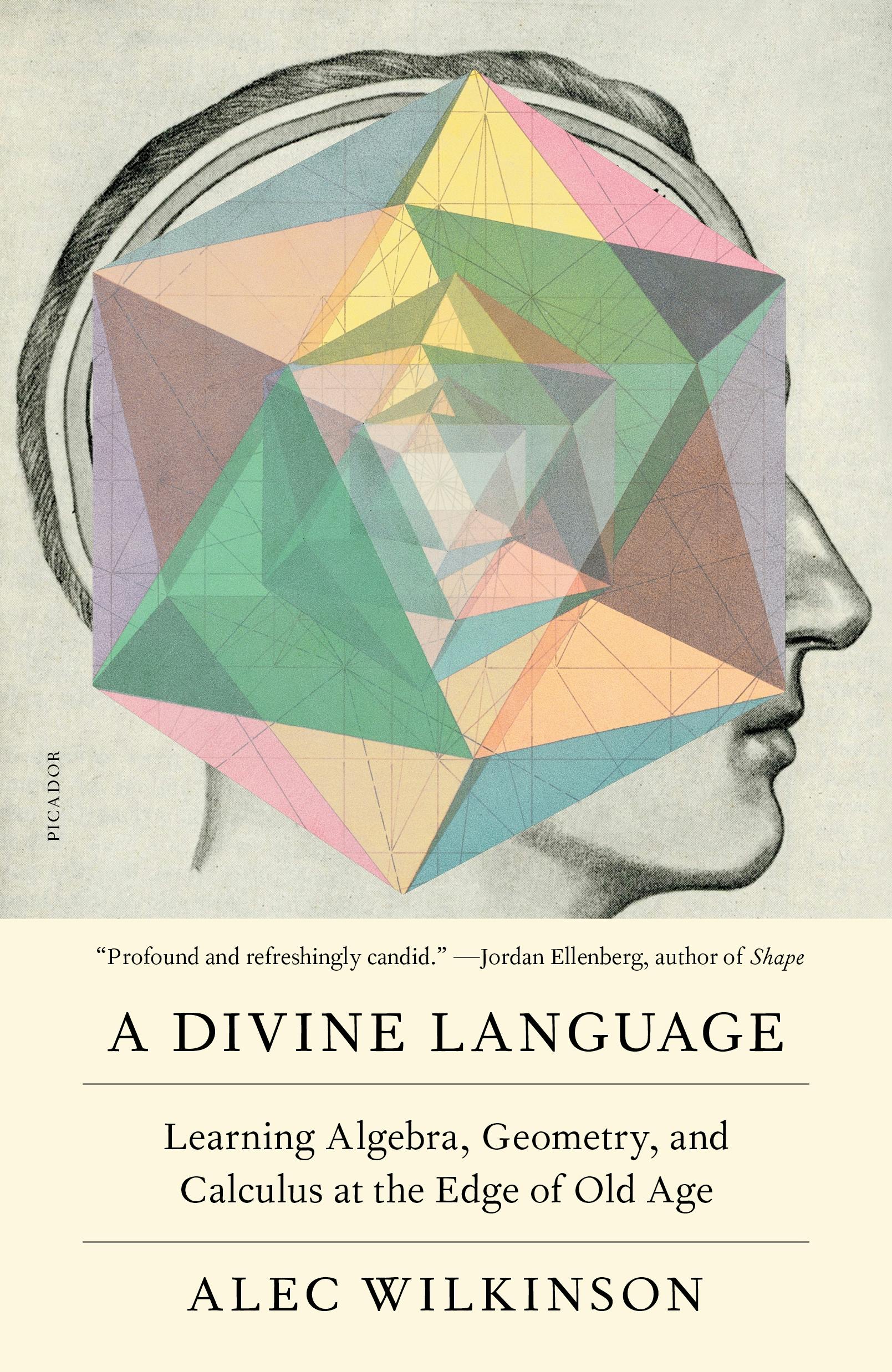
'My impression was that algebra was less a subject than a practice into which one was inducted by the algebra priests after a series of mortifications. The letters and equations that the teacher drew on the board did not seem related to the numbers I had handled in other classrooms. For one thing, a problem in arithmetic was vertical, one number beneath another, and a problem in algebra, an equation, was horizontal. I felt as if in a permanent present, unable to see how the past and the future were joined. In Ulysses James Joyce writes that the present is the drain that the future goes down on its way to becoming the past.' p.12.
'The mathematician Alonzo Church, who taught Alan Turing, told another of his students, David Berlinski, "Any idiot can learn anything in mathematics. It requires only patience." I would sit with a pencil and paper trying to solve an algebra problem and sometimes go only so far before my mind would halt, because I had could used up what little I knew that might apply. It hadn't occurred to me to think of algebra as the bright boys and girls I had been among had thought of it, as a series of related procedures. They were constructing a map. I was collecting postcards from places where anxiety or incuriousness had kept me from leaving my hotel.' p.31.
(my emphasis)


Alec Wilkinson. (2022) A Divine Language. Learning Algebra, Geometry, and Calculus at the Edge of Old Age. New York: Farrar, Straus and Giroux. https://us.macmillan.com/books/9781250168580/adivinelanguage/

Previously: math :: logic

Tuesday, February 25, 2025

So, I can proceed, fall flat on my face - [ concepts-maths iii/iii ]

- and utilise the inevitable!

'Decades after struggling to understand math as a boy, Alec Wilkinson decides to embark on a journey to learn it as a middle-aged man. What begins as a personal challenge—and it's challenging—soon transforms into something greater than a belabored effort to learn math. Despite his incompetence, Wilkinson encounters a universe of unexpected mysteries in his pursuit of mathematical knowledge and quickly becomes fascinated; soon, his exercise in personal growth (and torture) morphs into an intellectually expansive exploration.' 
https://us.macmillan.com/books/9781250168580/adivinelanguage/


A Divine Language

As observed many times in the literature and here on W2tQ writing about Hodges' model, healthcare - medicine and nursing are both a science and art. Hodges' model is an invitation to the arts in liberal form, with an emphasis on practice: social sciences, humanities, physical sciences and even mathematics. 

There is now quite a bank of posts on W2tQ tagged art/arts and more specifically prints. I still plan to attend a workshop on printing. As ever, in my head, my mind's eye - I've an amazing, brilliant .. (!?) arts project, just waiting to be released. A true collage of the care concepts.

If Hodges' model is 'simple' in its basic form, then it is clearly possible for other people to create their own artistic impressions, interpretation of Hodges' model. My effort would of course be unique, as would theirs. There could be a competition and I end-up missing out. Not even short-listed for a prize; a victm of familiarity perhaps? 

Quite 'naturally' in a way, or at least by way of childhood experiences, a need for therapy and validation; I have also arrived at a belief that there is a mathematical project here (Oh, for goodness sake! Is there no end to this?). 

As posted before, like Alec Wilkinson I am no mathematician. Embarrased, shamed to a husk at school on many occasions, I encountered math teachers who must have empathised. Well, that's one way to explain the appreciation of maths I have always felt. Or more accurately, a love of knowledge; of which maths and logic are a part? Since I can hardly understand, I am more in love with the idea of maths, than mathematics itself. I have always been in awe of maths and people who 'get it', even if that is only  mastery of the high school mathematics curriculum.

Convinced that there is more to Hodges' model than meets the eye, I have thought of following Wilkinson - who tries to be systematic - to underpin a book - back into the nightmare lands of my youth. Should I retake GCSE maths? 'There be dragons', without a doubt. The heat can be recalled, like it was yesterday. This isn't just a dragon, it is a chimera. At times it wants to be a friend, providing familiar terms, domain, set, and group. Wilkinson's quest is structured and seeks a reasoned and disciplined approach. Why am I bothering? I have a choice surely? Nursing, health, global health can all collectively furnish many items of epistemological fruit. No need for calculative flagellation. Through Hodges' model you can productively span the disciplinary bridges once again: call in - sociology, economics, policy and more. How many Königsberg bridges do you need?

While the artist in me, might waste time. In pointing to Hodges' model as a potential mathematical object, this little seed might fall on fertile and (much) more capable ground(?), as Wilkinson describes:

'Mathematics might be the only creative pursuit in which inevitability figures. Other artists might be defeated by a task beyond their capabilities, but they do not live with knowing that sooner or later, if their work is consequential, someone will do what they haven't been able to do. Mathematicians work within a discipline in which, so long as their suppositions are correct, there is always a precise and irrefutable answer, even if they can't find it.' p.135.

I can hope for this at least.

Alec Wilkinson. (2022) A Divine Language. Learning Algebra, Geometry, and Calculus at the Edge of Old Age. New York: Farrar, Straus and Giroux. https://us.macmillan.com/books/9781250168580/adivinelanguage/

Previously: How 'divine' is the language of care?

n.b. At some point I will go though all the posts and unpublish/delete items that add little to the core.

Friday, April 10, 2026

'Healing grid' - the penultimate?

Healing grid by Ryota Kanai

Hodges' model is surely a clear winner 'healing grid'? Acting not only in healing, but in recovery, rehabilitation, reablement, palliative, illness and well-being too.

Quite a grid all-in-all (which also fascinate grandchildren).

My source: 

Previously: 'grids' : 'perception' : 'vision' : 'lines' : 'geometry'

#ArtemisSafeReturn #PrecisionGridManoeuvres

Wednesday, July 08, 2020

Book Review: iv Mathematics and Art: A Cultural History

Mathematics + Art
Mathematics + Art

As a reader fascinated by the connections between knowledge and the disciplines in which it is placed, it was encouraging to note reference to "Psychophysics" (p.136) the title of a book by Fechner. This is discussed under Suprematism with the development of tools for experimental psychology and evolving consciousness. The early 1900s was a time a search for higher consciousness and not just invention but new invention, made-up words for poetry, as art strove to shed light on the mind reaching for a "transrational" level of reasoning. It seems little has changed as many artists still seek the spiritual and Absolute in their work.

Reading of psychophysics is reinforcement for me of the many disciplinary bridges of which the book presents one. In Hodges' model you often find yourself traversing psychosocial, socioeconomic, physicopolitical, psychopolitical, psychosomatic and other bridges. This book demonstrates how in the four domains (plus spiritual) of Hodges' model, art and mathematics are interchangeable with respect to mind - body (reality), the objective and subjective. There are bound to be many writings that might follow on Malevich's Black Square, his icon to the secular age. I have wondered about Hodges' model as a culturally neutral, inert space, if there can ever be such a thing. Free will and probability provides a bridge of even greater span (for me 'here') in social physics (p.145). Using mathematics to understand human behaviour. What would Quetelet make of big data today and the often 'lively' debates between psychology and psychiatry?

Chapter 4 Formalism includes a definition:
"Today we use the word "formalism" to name both the mathematical and the artistic impulse to isolate form (abstract structure), but the term has a different origin in the two fields." (p.153).
Flatland is a marvellous book (plate 4-2, p.157) as is Gamwell's outline of the perception of space: Helmholtz's learned geometry. (p.156). Key mathematicians and their work feature here; Peano, Frege, Cantor and how consistency entails existence (p.161). Language introduces noise as much as when spoken it needs air as a medium. The focus on language, meaning and poetry with resort to made up words and pictograms to analyse rhythmic patterns is fascinating. There is this too:
"The task of artists who work with paint is to provide graphic symbols for the units of our mental processes. . . . The artist's task would be to provide a special sign for each type of space. Each sign must be simple and clearly distinguishable from all the rest. It might be possible to resort to the use of color, and to designate M with dark blue, B with green." (p.171). Khlebnikov.
The book prompts you to read further: Bohm and the interpretation of Hilbert's thought, "meaning-free" and "meaningless" begs further study.

In mathematics humanity has sought to understand not just the discipline but our place in the Cosmos. In chapter 5 (pp.196-223) we learn of Leibniz's project to invent the first artificial language.

More to follow ...

individual
|
INTERPERSONAL : SCIENCES
humanistic ----------------------------------------------- mechanistic
SOCIOLOGY : POLITICAL
|
group - population


Continuous phenomena:

24 hr air temperature


Discontinuous phenomena:

Bank deposit (p.134)


Lynn Gamwell (2016) Mathematics and Art: A Cultural History. Princeton, New Jersey: Princeton University Press. ISBN: 9780691165288. p.283.

(Thanks to PUP and John Wiley for the review copy.)

Wednesday, August 28, 2019

Environment, Social, Governance [ESG]

As Greeta Thunberg arrives in New York for the:

CLIMATE ACTION SUMMIT, 23 SEPTEMBER 2019

... it is interesting to consider not just where 'health' sits within business and commerce, but the themes and issues that it has reached. Now, we are more aware of the dependencies, for example air quality, physical and mental health, but we are still to finish the chapter titled: "The Damage Done".

'Capitalism' remains rapacious in terms of resource use (ironically if the market and prices are cyclical) and we must acknowledge all of economics, from stock exchanges, to cities, to villages in developing countries, but the challenge remains to transform the geometry of our economics to that of a sustainable circle. As per the climate debate, in some instances, we might close certain industries and leave some classes of minerals, elements, fossil fuels in the ground. We should accept that while some economies are more circular than others, sometimes you cannot circle a square?

Below is an investment hierarchy in which I have highlighted health. Education, literacy and environmental awareness are, if not issues (which they are, especially their respective economics) they are much needed individual actions to achieve progress.

The media notes that next month's summit will include 'world leaders'. I wonder how many business leaders will be present? This would be an indicator of corporate social responsibility, looking very positive in the annual report (even if the self-regulation has not yet achieved homeostatis). If you can advise with figures, or if I find the information later next month I will post here.

MSCI ESG Key Issue Hierarchy

3 Pillars 


10 Themes


37 ESG Key Issues

Environment    Climate change
Carbon emissions  Product carbon footprint 
Financing environmental impact
Climate change vulnerability
Natural resources 
Water stress  Biodiversity & land use 
Raw material sourcing
Pollution & waste 
Toxic emissions & waste   Electronic waste Packaging 
Material & Waste
Environmental opportunities
Clean tech 
Green building   Renewable energy
Social    Human capital
Labor management   Health & safety
Human capital development Supply chain labor standards
Product liability 
Product safety & quality  Chemical safety
Financial product safety  Privacy & data security 
Responsible investment  Health & demographic risk
Stakeholder opposition
Controversial Sourcing
Social opportunities 
Access to communications  Access to Health care
Access to finance   Nutrition & Health
Governance  Corporate governance*
Board* Pay* Ownership* Accounting*
Corporate behavior 
Business ethics Anti-competitive practices
Tax transparency Corruption & instability
Financial system instability
* Corporate Governance Theme carries weight in the ESG Rating model for all companies. In 2018, we introduce subscores for each of the four underlying issues: Board, Pay, Ownership, and Accounting. https://www.msci.com/documents/10199/123a2b2b-1395-4aa2-a121-ea14de6d708a


My source (MSCI ESG Key Issue Hierarchy p.27):
Norrington, J. (2019) Future Proof Investments, Investors Chronicle, 18-25 April. pp.24-28.

Friday, August 07, 2009

Birds in paper cages: Cognitive spaces with a little isotropy

In Consciousness Explained, Dennett (1991) provides further support for my belief in the significance of Hodges’ model:

Any of the things you have learned can contribute to any of the things you are currently confronting. That at least is the ideal. This feature is called isotropy by Fodor (1983), the power, as Plato would say, of getting the relevant birds to come, or at least to sing out, whenever they are needed. p.279.
Dennett highlights the fact that we are not isotropic. There are many often comedic instances in which people are slow or fail to fully appraise the significance of new data. This point reinforces the need and role for Hodges’ model providing not just one of Plato’s metaphorical aviaries (with knowledge in the form of the birds), but at least four (five - with spiritual claims to know-ledge).

Next spring I will return to the conceptual spaces paper I started and last saved in September 2008, how time flies! (I do finish stuff eventually - it's not easy this 'part-time' lark). As already posted on W2tQ there is more inspiration if needed. Drawing upon the cognitive science and computing literature the objectives of Peter Gardenfors’ book Conceptual Spaces are made clear from the outset:
'... is to show that a conceptual mode based on geometrical and topological representations deserves at least as much attention in cognitive science as the symbolic and associationistic approaches’. p.2 ....

'This is a book about the geometry of thought. A theory of conceptual spaces will be developed as a particular framework for representing information on the conceptual level.’ p.2.

Further reading:

Jerry A. Fodor (2000) The modularity of mind.

The Frame Problem Stanford Encyclopedia of Philosophy.

Sunday, May 17, 2026

Wittgenstein's - Tractatus

Apparently, Wittgenstein walked away from philosophy after publication of the Tractatus. He thought he had solved the problems of philosophy, logic and reality.

In trying to ‘see’ Hodges’ model, in mathematical terms, there may be lessons in Wittegenstein’s approach, both in content and style. Of course, as a non-mathematician, I probably should leave well-alone; and stick to nursing. But that is the problem: from 1987-88 there is a need for a different perspective, even if this is a personal challenge. As with many ‘reviews’ here, we can look at Wittengenstein’s work, reflect upon it, and consider how it relates to the purposes, structures and content of Hodges’ model.

The Tractatus’s first line then, offers a warm welcome.

‘The world is everything that is the case.’ [I]

Making the decision to become a nurse and enrolling as a student makes you an educational and workforce demographic case.

Once a student in the university lecture theatre, you hopefully whether consciously, or not are exposed to the theory – practice gap; as you yearn to be on your first placement. Now it you who is seeking ‘cases’. As we live, and statistics roll and tally, the question of caseness (and categories) is key, one that is carried around even if not always active, recognised as such.

As noted in the previous post, we can for Hodges’ model (and other models, frameworks it must be said) think of ‘case’ as a, or the situation. 

A mathematical approach to Hodges’ model involves looking at things, concepts, people as objects. This includes patients and carers. In terms of a project worthy of pursuing in nursing and other disciplines involved in healthcare, this mathematization presents a non-trivial challenge. A fully-deserved response would be: 'What have you done to the aptitude for care and caring attitude? You've cancelled - subtracted it!' Humour aside:

'In order to know an object, I must know not its external but all its internal qualities.' [2.01231] 

Is this equivalent to us getting to know our patient / client and their socio-political context? 

‘The way in which objects hang together in the atomic fact is the structure of the atomic fact.’ [2.032] 

It is a help that Wittgenstein points to structure (crumbs of understanding are welcome here, as incremental steps). In formulating Hodges’ model we first identify the axes. It is the axes that then provide a space, four domains in total, to frame the objects that we decide; or, as the situation dictates, what concepts are placed in the domains of Hodges' model.

There is a successive series that follows, combining place, space and logic: ‘The proposition determines a place in logical space: the existence of this logical place is guaranteed by the existence of the constituent parts alone, by the existence of the significant proposition.’ [3.4]

‘The propositional sign and the logical coordinates : that is the logical place.’ [3.41]

‘The geometrical and the logical place agree in that each is the possibility of an existence.’ [3.411]

‘Although a proposition may only determine one place in logical space, the whole logical space must already be given by it.
(Otherwise denial, the logical sum, the logical product. etc., would always introduce new elements -in co-ordination.) 
(The logical scaffolding round the picture determines the logical space. The proposition reaches through the whole logical space.)' [3.42]

While Wittgenstein came to view ‘the picture theory of meaning’ as incorrect, as a conceptual framework and diagrammatic resource Hodges’ model is closely tied to this form of representation.

Of course, the logic at work here, is far from mathematical, but there is surely a logic.

'Formal concepts cannot, like proper concepts, be presented by a function.' [4.126]

'There is therefore really a sense in which in philosophy we can talk of a non-psychological I.
The I occurs in philosophy through the fact that the "world is my world'".
The philosophical I is not the man, not the human body or the human soul of which psychology treats, but the metaphysical subject, the limit - not a part of the world.' [5.641] 

'Although the spots in our picture are geometrical figures, geometry can obviously say nothing about their actual form and position. But the network is purely geometrical, and all its properties can be given a priori.

Laws, like the law of causation, etc., treat of the network and not of what the network describes.' [6.35]

There is much more in this work, and much that remains a challenge. Many commentators have written and said in interviews that the Tractatus rewards re-reading and some sentences stay with you for life (The Great Philosophers BBC TV). 

I'm still seeking mine.

https://www.gutenberg.org/files/5740/5740-pdf.pdf

Friday, April 30, 2021

Conference: Diagrams in Science, Science in Diagrams

Johannes Stabius, Astrolabium imperatorium: detail (Nuremberg: Johann Stuchs, 1515). Courtesy Bayerische Staatsbibliothek, Munich, Einbl. VIII, 12, broadside, 61 × 45 cm.

Diagrammatic forms of visualization are ubiquitous in scientific publications, as well as in popular mediations of scientific contents. Every computer interface relies on diagrammatic forms, combining textual and graphical elements. Diagrams abstract and encode information. They are indispensable in many scientific contexts, and, together with charts and graphs, also in the daily media, reaching a wide audience of experts and non-experts.


As natural and familiar as these abstract forms of representing information are to us, they are products of many historical developments. Their historical roots may go back to prehistoric epochs. However, the historical integration of diagrams in scientific contexts is relatively recent. Even if these developments with regard to Western cultures have their origin in antiquity and were significantly developed further in the sciences of the Middle Ages, the early modern period can be considered the first flourishing phase of the diagram in practically all areas of the sciences of that time.

This event proposes to trace this historical development in the early modern period. It takes a truly interdisciplinary approach when talking about a timespan of roughly 500 years (1300-1800) across all early modern sciences, from Architecture to Zodiac men in medicine. The talks bring together research on the culture of the diagram in various sciences of the epoch to form a large overall picture.

This event aims at tracing the emergences and the disruptions of traditions of diagrams in all fields of scientific theory and practice, e.g. (but not restricted to) geometry, astronomy, medicine, philosophy, alchemy, law, theology, and music.

It will address, among others, questions such as the following:


1. Do the diagrams under investigation come from a precise tradition or do they form the foundation of such a tradition?

2. What is the scientific/disciplinary context of the diagrams under investigation and how do they relate to it?

3. What is the aim of the diagrams under investigation (illustration, explanation, demonstration, etc.)?

4. How does the medium carrying diagrams under investigation impact their form and role (print, manuscript)?

5. What are the most intriguing visual/graphical features to be found in the diagrams under investigation?

6. How do the diagrams under investigation interact with the text and which vocabulary is used to refer to the diagrams?

7. What justifies the diagrams under investigation to be labelled as ‘diagrams’ (and not ‘tables’, ‘maps’, etc.) and what is a reasonable demarcation line here?

8. How do the diagrams under investigation relate to scientific practices (experiments, taking measures, etc.)?

More details:

https://www.biblhertz.it/3101937/conference-diagrams-in-science-science-in-diagrams.html