Hodges' Model: Welcome to the QUAD: hospitals

Hodges' model is a conceptual framework to support reflection and critical thinking. Situated, the model can help integrate all disciplines (academic and professional). Amid news items, are posts that illustrate the scope and application of the model. A bibliography and A4 template are provided in the sidebar. Welcome to the QUAD ...

Showing posts with label hospitals. Show all posts

Thursday, July 02, 2026

LAST CALL 2nd AIxIA Summer School on Artificial Intelligence for Healthcare!

[apologies for multiple postings]

A few last spots are still available for the school, taking place in Trento, Italy, on 13-17 July 2026.

The school is open to anyone interested in AI for Healthcare: Master and PhD students, researchers, clinicians, physicians, data scientists, AI engineers, and professionals working at the intersection of AI and healthcare.

Master and PhD students benefit from a reduced fee: 470 EUR.
The regular fee is 495 EUR.

This year’s edition will focus on:

  • Medical Imaging
  • Smart Hospitals
  • Patient Trajectories
- with attention to concrete healthcare problems and to different AI research perspectives, including generative AI and neuro-symbolic AI.

More information:
https://lnkd.in/dEBmQ8Rr

Registration:
https://lnkd.in/dggvaMSP

Please share with anyone who may be interested!

#AI #DigitalHealth #Healthcare #ArtificialIntelligence #GenerativeAI #NeuroSymbolicAI #MedicalImaging #SmartHospitals #PatientTrajectories #AIxIA

My source: francesco.calimeri, unical.it

Friday, March 22, 2024

Chairs and Beds: The Theatre of the Absurd [balance!]

Hodges' model: Stages of Care/Despair

Individual

|
      INTERPERSONAL    :     SCIENCES               
HUMANISTIC  --------------------------------------  MECHANISTIC      
 SOCIOLOGY  :    POLITICAL 
|
Group

Beds needed for 'treatment' mental illness and physical, preparedness for public health events.

Reduced beds for 'modern medicine', sustainable health care, reflecting health education, preventive approaches and improved health literacy (. . .?).

NHS hospital beds data analysis

We look at NHS bed data in England compared to other countries, bed stocks over time, the impact of COVID-19, safety breaches and intensive care capacity.


"The Theatre of the Absurd, on the other hand, tends toward a radical devaluation of language, toward a poetry that is to emerge from the concrete and objectified images of the stage itself. The element of language still plays an important part in this conception, but what happens on the stage transcends, and often contradicts, the words spoken by the characters. In Ionesco's The Chairs, for example, the poetic content of a powerfully poetic play doe not lie in the banal words that are uttered but in the fact that they are spoken to an ever-growing number of empty chairs." p.26.


"Bums on seats"
(Lecture theatres)


Esslin, Martin. The theatre of the absurd. London: Pelican, 1982. (3rd Ed.).

Wednesday, June 28, 2023

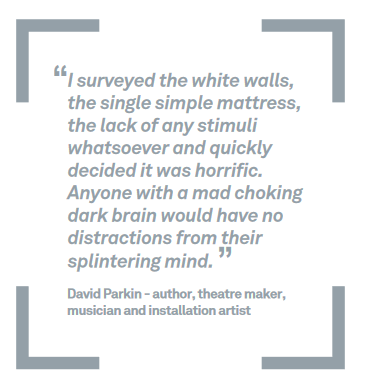
ii Design with People in Mind: Seclusion Issue related to Hodges' model

The Seclusion Issue


INDIVIDUAL
|
     INTERPERSONAL    :     SCIENCES               
HUMANISTIC --------------------------------------  MECHANISTIC      
SOCIOLOGY  :   POLITICAL 
|
GROUP

psychological harm / safety / seclusion

privacy, dignity and respect

Sensory stimuli, calm, distraction

Parity of Esteem

psychological restraint/control

Reaching for the person amid complexity

Staff / Service User attitudes to x,y,z

Lived/Patient experience
sensory -

NATURE - outdoors 'Green'

Design: (sterile?) space, colour, temperature, walls, light, warmth, cold, fresh air, homely/clinical, doors - locks, alarms, noise, violence resistant spaces ...

physical agression / harm / safety / seclusion

'built' environment / 'sensory room'

physical restraint/control, clothing, toilet, access to outdoors

Ecological and Integrative Physiology

- modulation

Social spaces

supportive spaces

scope for therapy

social autonomy

community

music / arts

experience in isolation - stigma in-situ?

trauma-informed services

in-patient services, funding

risk reduction; policies

use of technology/observation

length of stay, reporting

impact of restraint on staff


Hodges' model is situated and can be used in all health, educational and policy contexts.

Hodges' model can assist to initially scope, plan and evaluate research studies not only across all the care (knowledge) domains above (including the spiritual) but the model's structure incorporates such dichotomies as subjective-objective; qualitative-quantitative; person-services; patient-staff; therapy-control/restraint; person-centred--service-centred; private/personal-public; care-custodial; psycho-political; socio-technical and others.


There is of course much more that could be added above, and relationships considered between concepts and perspectives: the patient's, nurse's, doctor's, the multidisciplinary team, manager's, policy makers, architect,s anthropologists, public, professional and regulatory bodies and commissioners?


Please keep 'me' safe safely - yes, and the team!


Even though and especially because I may not currently know exactly who - how ...  I am?


My source: https://twitter.com/DIMHN

Related post i

Sunday, June 25, 2023

Design with People in Mind Books - The Seclusion Issue

Design with People in Mind
The Seclusion Issue


Design with People in Mind is the Design in Mental Health Network’s annual round up of the latest research evidence on therapeutic outcomes and the evidence for them relating to the built environment in mental health. In partnership with London Southbank University and Nottingham Trent, so far we’ve looked at a variety of issues, from nature to sound design to boundaries and borders. The latest issue is Seclusion, launched at this years conference and focusing on the evidence for and impact of the practice of seclusion units, how to use them if at all, and best practice in the field to maintain psychological as well as physical safety for service users and staff.


The link to the publication is: 

https://dimhn.org/wp-content/uploads/2023/06/1DWPIM_I8_250x210_24PP_AW_V02_HI_RES.pdf

It’s a member only resource, so you will need to register (free for individuals) before viewing.

Very best,

Hannah

Hannah Chamberlain
CEO
Design in Mental Health Network
m: 07811169609
www.dimhn.org


My source: https://twitter.com/DIMHN

See also:
ii Design with People in Mind

Saturday, February 18, 2023

"163 Days"

 INDIVIDUAL
|
 INTERPERSONAL    :     SCIENCES               
HUMANISTIC --------------------------------------  MECHANISTIC   
SOCIOLOGY  :   POLITICAL 
|
GROUP

163 Days - Hannah Hodgson
Poetry in [not in] motion


“Hannah Hodgson takes us to the paradoxical heart of poetry itself: to be held inside a pain both intensified and soothed by the sheer brilliant presence of the poet’s mind.” – Caroline Bird

Hannah Hodgon is an award-winning poet and a palliative care patient. In her compelling debut collection 163 Days, she uses a panoply of medical, legal, and personal vocabularies to explore what illness, death and dying does to a person as both patient and witness.  

163 Days is the length of Hannah’s longest period of hospitalisation to date. In this long poem, she probes various truths, personal and medical; truths which clash like a tray of dropped instruments in a silent operating theatre.

The speaker is a teenager on the cusp of adulthood. Doctors struggle to diagnose her complex conditions. Through daily, diary-like poems we see the children’s ward through Hannah’s eyes. It is decked out in primary colours. Volunteer clowns visit. At seventeen she is ‘too old’ to be here, ‘too young’ to move to the adult ward.

The mundanity of hospital life is marbled by a changing landscape of mood, hope and loss. Her symptoms are painful. She has numerous tests and procedures to keep her alive long enough to figure out what’s wrong. A gap yawns between the person she is, and the person in her medical notes.

In ‘Aftercare’, Hannah navigates the worlds of both nightclubs and hospice care as she embarks on a new version of her life as a disabled adult. 163 Days is an important collection, in which Hodgson’s true voice takes poetry into difficult places.

Listen to the BBC radio play adaptation of 163 Days on the New Creatives website here.

163 Days by Hannah Hodgson, Seren Books ISBN-13: 9781781726471
Publication Date: Monday, March 28, 2022

My source:
Hannah's book in Kirkby Lonsdale, The Book Lounge 17th February 2023.

Saturday, August 06, 2022

Back to the Wires

Next week I'm heading back to Warrington (Cheshire, NW England) to work in the community.

A circle of sorts will be closed, as this is where I started in 1977. Heading south on the A49 peddling a 5-speed bike, then motorbike, to my first car [early years framed by modes of transport yet again]. I got booked - a caution (?) for speeding on that bike, one Sunday morning on a 0700 start. Passing the church in Newton-Le-Willows there's a downhill ... you see ...

As a nursing assistant and then from October that year, a student nurse [RMN back then] I heard of the areas, and villages where patients lived, listening and writing the details umpteen times on admission documents. As a 'county asylum' patients were also from a very wide area. Returning as a Deputy Charge Nurse, I witnessed the initial shifts for patients to be resettled, moving closer to their original 'home' as community services expanded and the closure of Winwick was also being planned and subject to debate:

https://edm.parliament.uk/early-day-motion/1935/closure-of-winwick-and-newchurch-hospitals

'Community care' remains an ongoing project.

Being hospital-based I went out on placement with the community psychiatric nurses, but that's a blur of course.

Now for a return visit. Whilst always braced, I'm really looking forward too.


Winwick Hospital:

https://en.wikipedia.org/wiki/Winwick_Hospital

Wire in Warrington: 

https://wmag.culturewarrington.org/local-history/the-wireworks/warringtons-wire-timeline/

Previously: 

https://hodges-model.blogspot.com/search?q=Winwick


Sunday, July 03, 2022

New WHO Quality Toolkit - 'Take ii"


Further to last months post, I've worried at times about the axes of Hodges' model and their status and function. Can I let the axis stand for itself?

INDIVIDUAL
|
|
|
GROUP

Do I expand (explode) the conceptual labels?

self - INDIVIDUAL - person
|
|
|
relationship - family - GROUP - community - population

There seems to be an asymmetry, when you traverse the axis - and its horizontal counterpart; from wherever you start. Perhaps, I worry too much as if the axis was regular then the generic property of the model overall would be diminished. Is this an axis at all?

The website for the Quality Toolkit at: https://qualityhealthservices.who.int/quality-toolkit

- explains the toolkit's scope that includes:

"This new online resource is a user-friendly toolkit to support action on improving the quality of health services at every level of the health system, from national and district to facility and community levels."

I have only scratched the surface here and hope to revisit again - in more detail. Please see below for reflections on the levels by which the toolkit can support action to improve the quality of health services. I have tried to suggest proximity and distance between the SOCIOLOGICAL and POLITICAL (policy). Perhaps, what is a 'clinic' has a name, that it is known by - a key part of the community. The community is closer to the people - to the would-be users of the facility. You can appreciate(?) here the challenge of getting the local community involved in their services. What is 'NATIONAL' should not be remote. Can people compare and contrast with what they are offered? 
 
On the website I note there are video presentations also. The prospect of regular updates for the toolkit is also welcome.

INDIVIDUAL
|
 INTERPERSONAL    :     SCIENCES               
HUMANISTIC --------------------------------------  MECHANISTIC      
SOCIOLOGY  :   POLITICAL 
|
GROUP

psychological access

'My' clinic

Trust, I feel safe)

(feeling safe)

Tell others - my experience..


physical access

clinic

(appearance, facilities, safety)

controlled environment

(cleanliness, sterile..,
or more social)


'the centre'

COMMUNITY

DISTRICT

national


facility
(policy translation / coherence?)

community

district

NATIONAL


Original source: Jules Storr, Independent Consultant, S3 Global & working with WHO as part of the Quality Toolkit development team - via HIFA

Previously: New WHO Quality Toolkit

'Take II'? Quality means getting it right first time (even as you persist in what you are doing - your aspirations and quality improvement). Vitally, this means you, the team make a positive impression for the person, the individual, client .. carer, group. 

If they need to - they will recognise their own ability, knowledge, follow advice, they will come back, they leave not to return soon as they can now self-care and care for others in their home, community ...

 Please note: This post and that previous is not intended to denote endorsement of Hodges' model.


Tuesday, June 21, 2022

'Pad culture' ...

INDIVIDUAL
|
 INTERPERSONAL    :     SCIENCES               
HUMANISTIC --------------------------------------  MECHANISTIC      
SOCIOLOGY  :   POLITICAL 
|
GROUP
DEMENTIA

SELF
ORIENTATION - INSIGHT
Listened to .. 'Hear me'?
dignity and respect
Mental capacity (awareness?)
emotional distress

Appears confused -
Physical cause: dehydration, delirium..?


[A shared convenience?:
How many persons are assumed
to be diagnosed with a dementia?]


in-CONTINENCE

Place:
[Home,
Community Hospital,
Residential care, Nursing Home]
IT/Record systems

'Parity of Esteem' i
Mental Health and Physical health

'Parity of Esteem' ii
[Mental Health and Physical Health] AND Social Care

Time:
ASSESSMENT, Care Plan, Evaluation ...

'Pad Culture'


'My Pad' Culture -
buy/sell
£££ $$$


Standards of Care
Nursing - Social Care
policy - funding


File on 4 BBC Radio 4 21 June 2022 - 20:00hrs

Dementia: The Final Indignity

"Around 800,000 people have dementia in the UK. For those suffering from the illness, incontinence can often be seen an inevitable consequence - but that’s not always the case. Deemed as too embarrassing or taboo, it’s a topic that rarely hits the spotlight. Experts say preserving someone’s ability to go to the toilet is crucial to maintaining their dignity and quality of life and should be a priority in care settings. But is that always happening? A new report shown exclusively to File on 4 has looked at how continence care is being managed in hospitals – and how, in some cases, those who are continent are actively encouraged to soil themselves. Datshiane Navanayagam speaks to families who say their loved ones were ignored when it came to their continence needs in hospital and that the consequences have left them with health issues and requiring additional support. Nurses and medical staff say that continence training is often seen as a ‘Cinderella subject’. We also hear from dementia patients themselves about why maintaining your own dignity and independence is so crucial with this disease. With the government set to reveal a new dementia strategy this year, will continence care be placed higher up the agenda?"


Featherstone K, Northcott A, Boddington P, Edwards D, Vougioukalou S, Bale S, et al.
Understanding approaches to continence care for people living with dementia in acute hospital settings: an ethnographic study. Health Soc Care Deliv Res 2022;10(14). https://doi.org/10.3310/
QUVV2680
 
Source: Today BBC Radio 4, 21st June, 2022.

Monday, April 11, 2022

Into the looking glass: A collective self-assessment of health literacy

Dear friend ....

I am hoping to take a quick snapshot of health literacy around the world - and I need your help to accomplish this task.

Below is a link to 10 short and easy-to-answer questions - a very short survey - on SurveyMonkey. Responding shouldn't take more than a few minutes of your time but in the aggregate I believe will produce an actionable and meaningful understanding.

These questions are intended for people/organizations actively working on health literacy issues in communities or clinics or hospitals or states and nations and/or actively conducting health literacy research with people in any context.

I will be in your debt if you could help me by doing just two things that should not take up your time.
1. Respond to the questions - anonymously - yourself.
2. Share this email and the link with your entire network of health literacy professionals.

Here is the link:
https://www.surveymonkey.com/r/VXPZJPL

If you have any questions or concerns about this effort, please contact me directly.

Best wishes as always,
Andrew Pleasant, Ph.D.

HIFA profile: Andrew Pleasant is Director of Health Literacy and Research at Canyon Ranch Institute, United States. Professional interests: Health literacy, Prevention of disease, Integrative medicine, Health system reform. andrew AT canyonranchinstitute.org

My source: HIFA.

[ Completed. PJ ]

Thursday, November 12, 2020

Pick your corner carefully ...

individual
|
INTERPERSONAL : SCIENCES
humanistic ----------------------------------------------- mechanistic
SOCIOLOGY : POLITICAL
|
group - population


Of all the corners you can pick* take care ...


... some are even more 'political' and expressive of power, individually and collectively, than when exercised right here.


Ack. Source:


*I remember at school 1970s - our drama teacher highlighting the people who have social awareness and those who do not. 'Social awareness' covers a wide range of attitudes, behaviour, manners,  literacies, intelligences ... and with ongoing unrest, campaigning, activism, legislation, policy and human rights we  have made progress. A counterpoint and sadness in the 21st C. is that - as ever - there remains much to do: many people [still] can not exercise a choice in terms of the corners they would like to reach.

Sunday, June 07, 2020

The Greatest Wealth: In Celebration of the NHS

4 Jun – 1970s: Sister Susan, by Moira Buffini, performed by Dervla Kirwan

Which is your decade?

What of the Future ...?

individual
|
INTERPERSONAL : SCIENCES
humanistic ----------------------------------------------- mechanistic
SOCIOLOGY : POLITICAL
|
group - population
For you,
and you,
and you,
...
it's your safety net.

That's why
we should all take 
care
of it ...


[Video no longer available]

So, for you
and you,
and you,
who Occupy 
this space here;
the Public 
have been 
waiting, waiting, waiting ...
oft silent minorities suffering,
but all are
listening,
watching and willing
for a semblance of rational
 leadership with security
in national and global 
Politics:
Now.

Saturday, January 18, 2020

Book* - "Healing Spaces"


- plus, five care knowledge domains*

and a question...?


individual
|
INTERPERSONAL : SCIENCES
humanistic ----------------------------------------------- mechanistic
SOCIOLOGY : POLITICAL
|
group - population


"What is missing from the book is a precise figure on just how great a contribution a restful atmosphere makes to healing - something health chiefs are sure to demand before making changes in our hospitals. Nevertheless, it provides a pleasant glimpse of the possible future of rest and recuperation." p.45.


Which, if any, healing space - or care domain in Hodges' model should be the priority?
 
Justify your choice and subsequent ordering.


My source:
Geddes, L. (2009) Books&Arts, A view to recovery, New Scientist, 9 May 2009, 202:2707. p.45.

See also:
Ulrich, R. (1984) View through a window may influence recovery from surgery. Science, 224: 4647, 420.
https://doi.org/10.1126/science.6143402

Sunday, December 29, 2019

What's in a Name?

  Or, The First Rule of First Aid* ... #SafeStaffing

Health care is often described as complex ...

there are tools to help simplify, conjoin 

and help care navigation and learning ...


Despite this and even if people are listening

politics, politicians and policy makers seem determined to turn health care into a maze ...


INDIVIDUAL
|
INTER-PERSONAL : SCIENCES
HUMANISTIC -------------------------------------------------- MECHANISTIC
SOCIOLOGY : POLITICAL
|
GROUP

*Protect
yourself
first.


"WAITING ROOM"

"WAIT HERE"


RCN Safe Staffing Campaign:
https://www.rcn.org.uk/employment-and-pay/safe-staffing

patient safety learning hub:
https://www.pslhub.org/

'Named Nurse' 25 years ago.
Mitchell G, Strain J. The role of the named nurse in long-term settings. Nurs Older People. 2015 Apr;27(3):26-9. doi: 10.7748/nop.27.3.26.e679. Review. PubMed PMID: 25809049.

My source (and image):
https://twitter.com/helenh49/status/1210956380636663813

Sunday, April 14, 2019

Infographic: What does the UK spend on health and social care?

c/o John Appleby and BMJ


The political impact of this spending have huge ramifications for many individuals 
in terms of efficiency, effectiveness, equity and equality.

individual
|
INTERPERSONAL : SCIENCES
humanistic ----------------------------------------------- mechanistic
SOCIOLOGY : POLITICAL
|
group - population

Source:


Thursday, August 30, 2018

Medicine and Art: (Steady) Eye & Hand

individual
|
INTERPERSONAL : SCIENCES
humanistic ----------------------------------------------- mechanistic
SOCIOLOGY : POLITICAL
|
group
https://hepworthwakefield.org/whats-on/barbara-hepworth-the-hospital-drawings/
Barbara Hepworth, Reconstruction, 1947
© BownessHepworth Estate / Arts Council Collection, Southbank Centre, London

"In 2012, the NHS is threatened, its future uncertain. ... Hepworth was a Labour voter - of course she was. In these drawings, she reveals her egalitarian values. Work is goodness: she sees her own work as a sculptor reflected in the steady eye and hand of the surgeon. In one drawing he even seems to wield a hammer and chisel. But this is not mere artistic self-consciousness. The work being done in these pictures saves lives; Hepworth believes her art, too, can heal souls." p.18.


My source:
Jonathan Jones (2012) A cut above, The Guardian, Arts. 25.10.12, p.18.

Hammers and chisels are found in operating theatres and wielded by female surgeons too. The exhibition long finished, I can't believe* that I have held onto to this page from The Guardian for almost six years. I must visit Wakefield.

*others can...

Friday, June 08, 2018

Hospital Passports or Traffic Light documents


Hospital Passport / Traffic Light Poster

I hope this helps a little John-Marc and colleagues...?

The health career - life chances - model was developed with the care and positive life experiences of people with learning disability very much in mind. Consider the model's intra- interpersonal care (knowledge) domain and the political. We are prompted to simultaneously factor in individual and collective autonomy.

As a possible learning exercise (CPD!) sketch out the model and use the poster to reflect on the concepts and aspects of individual and person-centred care that are highlighted.

Identity and care in recognising that identity is paramount whatever 'condition' places members of the public in our hands (and hearts).

Monday, April 16, 2018

#EndPJparalysis - NHS 70


individual
|
INTERPERSONAL : SCIENCES
humanistic ----------------------------------- mechanistic
SOCIOLOGY : POLITICAL
|
group
For people who are agitated and living with dementia their carers may learn to remove such cues as hat, coat and shoes.

Seeing these may cause increased agitation as a need to be elsewhere.

For #EndPJparalysis perhaps we can reverse this and use the sight clothes and footwear as a cue for 'get up & try to go'.


My source:

Thursday, December 28, 2017

A Space for Reflection (fully-boxed in?)

individual
|
INTERPERSONAL : SCIENCES
humanistic --------------------------------------- mechanistic
SOCIOLOGY : POLITICAL
|
group


Total parking charges
£174 million
in a year


Parking Bays


BBC News - NHS parking charges: Hospitals made £174m in a year
Image: https://www.planningni.gov.uk/index/policy/supplementary_guidance/dcans/dcan11_draft/dcan11_draft_design/dcan11_draft_reserved.htm

Friday, April 14, 2017

Saturday, March 04, 2017

A Hospital Room with a View

individual
|
INTERPERSONAL : SCIENCES
humanistic -------------------------------------------  mechanistic
SOCIOLOGY : POLITICAL
|
group-population


Lucy
Barton


Photo: Waterstones Tottenham Court Road Window Display 4/3/2017

Book cover: Waterstones