Hodges' Model: Welcome to the QUAD: asylums

Hodges' model is a conceptual framework to support reflection and critical thinking. Situated, the model can help integrate all disciplines (academic and professional). Amid news items, are posts that illustrate the scope and application of the model. A bibliography and A4 template are provided in the sidebar. Welcome to the QUAD ...

Showing posts with label asylums. Show all posts

Tuesday, February 03, 2026

Joining the digital dots across primary care and integrated care

My partner and I both received a letter today from our respective GPs. An invitation for a 'FREE LUNG HEALTH CHECK'.

Overleaf is an information sheet in landscape about the health check, plus three more sides of A4, similarly formatted - inviting trifold presentation.

After the 'Re. ......' an opening sentence asks: 'Have you ever been a smoker?'

Suddenly, I was dragged backwards through his-tory (some things don't change); not one history, but several:

INDIVIDUAL
|
    INTERPERSONAL    :     SCIENCES               
HUMANISTIC --------------------------------------  MECHANISTIC      
SOCIOLOGY  :   POLITICAL 
|
GROUP
My personal and life experience 
and not just since my teens . . .

The letter states:
**If you have never smoked, you are not eligible for this service**


My mother and father 
smoked when I was a child and my siblings. 
 
They got the message early 1980s.
  
'Society' smoked back then!  
 
Once old enough, I refused to go to the corner shop.
 
Into the 1990s, patients, smoking (some chain-smoking) on admission, long-stay and other clinical areas. As a community mental health nurse, I learned diplomatic and health promoting skills when in the car, giving a patient a lift to hospital. And, when visiting their home where I was, of course, usually, a guest.


I wondered what has happened to the GP's records? To the primary care clinical record ? The custodians of my health record, that they should need to ask that question? 
 
Or, does confidentiality tie some bureaucratic knots?
 
Where is 'integrated care' and its driver 'clinical informatics'? 
The letter included the NHS Number.
 
 Don't get me wrong, I/we appreciate the obvious effort here, even if the chronology is confusing, or,  speaks of afterthought? The letters are dated 19/06/2025. I must admit I haven't accessed my GP record, checking it for accuracy.
 
If anything, this is a prompt to do so. And seek a general medical. 


Previously: 'smoking' : 'winwick'

Tuesday, December 02, 2025

Auction: Twenty-two photographs of psychiatric patients at the Surrey County Lunatic Asylum [1850s]

DIAMOND, Dr Hugh Welch (1808–1886)

Twenty-two photographs of psychiatric patients at the Surrey County Lunatic Asylum [1850s]

Estimate - GBP 100,000 – GBP 200,000

Christie's London - December 10th 2025

https://www.christies.com/en/lot/lot-6564110?ldp_breadcrumb=back

Asylum patient by Hugh Welch Diamond, c1850-58
Hugh Welch Diamond (English, 1808-1886)
Public domain, via Wikimedia Commons

'The women Iook out at us across 170 years of history with a variety of expressions - bold and shy, serene and distressed. Yet all of them were regarded at the time as "lunatics". These faces were the  subjects of a pioneering project by the 19th-century psychiatrist Hugh Welch Diamond, superintendent of the female division of an asylum in London and the world's first photographer to take pictures of patients for the purpose of diagnosis and therapy.

Twenty-two of Diamond's asylum portraits - the largest surviving group - will be put up for auction on December 10 at Christie's in London, as part of a sale of books, manuscripts and photographs from the library of The Royal Society of Medicine. If they achieve their estimated prices, RSM, a membership charity, will raise more than £2mn to invest in physical and digital infrastructure.' ...

'Diamond was working at a time when society's views of people suffering from mental illness were changing. The earlier practice of shutting patients away in secure "madhouses" was giving way to more humane treatment. Diamond seems to have believed that photography would help doctors both to diagnose and to treat patients. His diagnoses were based partly on the idea, popular in Victorian medical circles, that an individual's physiognomy - their physical features, particularly the face - could reveal their mental state.

"He wanted to make people better and put them back into the world," says Sharrona Pearl, a medical historian at Texas Christian University who has studied Diamond's work. "He also enjoyed experimenting and liked the idea of bridging his expertise in medicine and photography.' p.32.
individual
|
INTERPERSONAL : SCIENCES
humanistic -------------------------------------------  mechanistic
SOCIOLOGY : POLITICAL
|
group-population

Mental Illness
PERSON - SUBJECT
Patient's names not recorded
Portrait - Consent?

Diagnosis and Treatment
person - DATA - SUBJECT
Photography as records
Eagerness to classify - label
Social history
Change in social attitudes
Stigma and fear of mental illness
Current relatives?

Confidentiality
Institutional change
Power imbalance
Shift from 'custodial' to health care 


My source:
Clive Cookson, Mind Hunter, FT Magazine, November 15, 2025, 1151, pp.30-34.

I have noticed Prof. Brendan Kelly is a regular FT respondent, as with this article:

'These photographs were likely to have been taken without meaningful consent and in the context of power imbalance. Yet publication can reclaim their individuality, address historical injustice and underscore our common humanity. Compassion, respect and humility should guide decisions. 
 Proceeds should support medical, educational, or justice-oriented programmes. Most importantly honouring forgotten patients of the past demands better care for people with mental illness today, who often languish, neglected, in homeless hostels or prisons. We can do better.'

Brendan Kelly Professor of Psychiatry, Trinity College, Dublin, Ireland.
Letters, FT Weekend. 22-23 November 2025, p.10.

See also: 'asylum' : 'photos'

Tuesday, April 08, 2025

Book TSR ii - Mental illness/health: History, process and progress

As posted yesterday through a book review, I developed an awareness for the role of process much earlier than previously thought. It wasn't Enid Mumford's work on the benefits of a socio-technical approach to successful deployment of information systems. I only discovered this well after the advent of home computing with the ZX81 and BBC micro 1981-1995.

It was 1978-79 to be more exact; on an admission ward during my three year student Registered Mental Nursing course at Winwick Hospital. On first recollection, I thought it was a clinic, with patients coming in for Clomipramine (Anafranil) infusion on to the ward. As students on placement we were allocated to support the clinic, completing regular observations, including pulse and blood pressure. Clearly, it was a long time ago. There is a paper (paywall), quite a significant one for me:
O’Flanagan PM. A Clomipramine (Anafranil) Infusion Unit. Journal of International Medical Research. 1973;1(5):375-381. doi:10.1177/030006057300100519 
I remember this Consultant's name being mentioned, but this was before my time(?). From the paper's first - accessible - page I can see the patients involved were actually in-patients. Which given the procedures, safety, observation makes better sense. There is reference to a film, in a hospital newsletter 'The Standard':
'Anafranil Film
In response to the interest shown in the film on Anafranil Infusion, Dr. P. O'Flanagan was present in the In-Service Training Room on Monday, October 29th for a second showing of the film, and to answer any questions from the audience.'
I wonder if the film is archived somewhere?

It isn't a surprise to see my former Community MH manager and friend David McKendrick listed on the Publications Committee. I do miss David - a great mentor!

In the previous post about 'The Sleep Room' I contrasted the mind-body dichotomy. In terms of evidence on 'both sides' of this divide, many people have made the observation of how you can see a broken arm, or leg, and other physical ailments, but mental health issues are often not obvious:
Powell J, Clarke A. Information in mental health: qualitative study of mental health service users. Health Expect. 2006 Dec;9(4):359-65. doi: 10.1111/j.1369-7625.2006.00403.x. PMID: 17083562; PMCID: PMC5060370.

The evidence-base of general medicine - physical health and psychiatry must be dynamic. The volume of publications bears testimony to the relentless change across all the sciences, research, technologies, knowledge, theory, practice, management and policy. On Twitter there is constant 'debate' between psychiatry and anti-psychiatry. 

Studies of intravenous clomipramine continue, the intervention much changed from the 1960-70s:

Fallon BA, Liebowitz MR, Campeas R, et al. Intravenous Clomipramine for Obsessive-Compulsive Disorder Refractory to Oral Clomipramine: A Placebo-Controlled Study. Arch Gen Psychiatry. 1998;55(10):918–924. doi:10.1001/archpsyc.55.10.918

Persson M-L. Adler Mats y Hetta J. Pulse Intravenous Clomipramine as an alternative antidepressant treatment to ECT: A pilot study. Eur. J. Psychiat. [online]. 2007, vol.21, n.4 [citado 2025-04-07], pp.263-267. Disponible en: <http://scielo.isciii.es/scielo.php?script=sci_arttext&pid=S0213-61632007000400003&lng=es&nrm=iso>. ISSN 0213-6163.

Karameh WK, Khani M. Intravenous Clomipramine for Treatment-Resistant Obsessive-Compulsive Disorder. Int J Neuropsychopharmacol. 2015 Jul 28;19(2):pyv084. doi: 10.1093/ijnp/pyv084. Erratum in: Int J Neuropsychopharmacol. 2016 Apr 27;19(10):pyw031. doi: 10.1093/ijnp/pyw031. PMID: 26221004; PMCID: PMC4772819.
Perhaps, someone can please enlighten me? Given the time between William Sargant's practice, and today how much more do we know? We know the gap can't be fully closed (phenomenologically?), but has the evidence-gap been reduced? What are the evidential mile[Km]stones in psychiatry - mental health nursing? What are 'the standard' measures? If we look at a model that is bio-psycho-socio-political, what difference might this make, to the 'debate', theory, practice, research, management and politics (policy)? 

'Woke' is a tainted word these days, but in mental health care and nursing we all need to wake up and in a safe space.

Saturday, August 06, 2022

Back to the Wires

Next week I'm heading back to Warrington (Cheshire, NW England) to work in the community.

A circle of sorts will be closed, as this is where I started in 1977. Heading south on the A49 peddling a 5-speed bike, then motorbike, to my first car [early years framed by modes of transport yet again]. I got booked - a caution (?) for speeding on that bike, one Sunday morning on a 0700 start. Passing the church in Newton-Le-Willows there's a downhill ... you see ...

As a nursing assistant and then from October that year, a student nurse [RMN back then] I heard of the areas, and villages where patients lived, listening and writing the details umpteen times on admission documents. As a 'county asylum' patients were also from a very wide area. Returning as a Deputy Charge Nurse, I witnessed the initial shifts for patients to be resettled, moving closer to their original 'home' as community services expanded and the closure of Winwick was also being planned and subject to debate:

https://edm.parliament.uk/early-day-motion/1935/closure-of-winwick-and-newchurch-hospitals

'Community care' remains an ongoing project.

Being hospital-based I went out on placement with the community psychiatric nurses, but that's a blur of course.

Now for a return visit. Whilst always braced, I'm really looking forward too.


Winwick Hospital:

https://en.wikipedia.org/wiki/Winwick_Hospital

Wire in Warrington: 

https://wmag.culturewarrington.org/local-history/the-wireworks/warringtons-wire-timeline/

Previously: 

https://hodges-model.blogspot.com/search?q=Winwick


Saturday, September 24, 2016

Bedlam exhibition and Nijinsky's Mask, 1919

individual
|
INTERPERSONAL : SCIENCES
humanistic -------------------------------------------  mechanistic
SOCIOLOGY : POLITICAL
|
group-population


It is still surprising how often you are led to wonder: 'Will the real Mr - Ms X, Y please stand up?' So many people are still reliant, dependent upon psychotropic medication to the extent that they too acknowledge that to a lesser or greater degree they do not know themselves. Ordinarily, we take for granted the various roles and personas, yes: the masks that we adopt unconsciously in the course of the day. Reducing this medication, assisting in the removal of the mask can be a great challenge especially in a community setting. When the combined services of primary care, community mental health team work with patients and carers this brings its own rewards. From behind the mask a new voice emerges: independence, understanding, motivation, spontaneity, tangible happiness - contentedness. ... Before that though we still need to maintain and teach the skills to really attend and listen, to see the person behind the mask...


Bedlam: the asylum and beyond


Image source: In the Frame for December 2013 Vaslav Nijinsky's 'The Mask'

My source: Wesseley, S. (2016). Inside Bedlam, England's first mental institution, The Times, Arts. 14 September, 8-9.

Saturday, January 09, 2016

Listening with Lines - Force lin-ear

individual
|
INTERPERSONAL : SCIENCES
humanistic ---------------------------------------  mechanistic
SOCIOLOGY : POLITICAL
|
group


"The line is a force whose activities are
comparable to those of all the
natural forces." 

Henry Van de Velde

Trzebiechklatka


Henry Van de Velde (Wikipedia)

Henry Van de Velde (.pl) (some broken links)
See - The nursing house Trzebiechów

Photo: Wikipedia "Trzebiechklatka" by No machine-readable author provided. Mohylek assumed (based on copyright claims). Licensed under Public Domain via Commons - https://commons.wikimedia.org/wiki/File:Trzebiechklatka.jpg#/media/File:Trzebiechklatka.jpg

Sunday, November 08, 2015

The Divided Laing by Patrick Marmion

individual
|
INTERPERSONAL : SCIENCES
humanistic --------------------------------------- mechanistic
SOCIOLOGY : POLITICAL
|
group
Divided Laing: Arcola Theatre


Image: Arcola Theatre
My source: The Sunday Times, Culture, 01.11.15

Wednesday, August 19, 2015

Book: The Man Who Closed the Asylums

individual
|
INTERPERSONAL : SCIENCES
humanistic --------------------------------------- mechanistic
SOCIOLOGY : POLITICAL
|
group
The Man Who Closed the Asylums: 
Franco Basaglia and the Revolution in Mental Health Care

Acute care
Physical care


Mental health policy


Another book for the reading list!

Parity of Esteem
a function of:
distance, transparency, opaqueness, answerability, accountability ...?

A related resource on this theme.

Image source: Verso.

My source:
Wise, S. (2015) Taking over the asylums, FT Weekend, Life&Arts, 15-16 August. p.8.

Friday, March 27, 2015

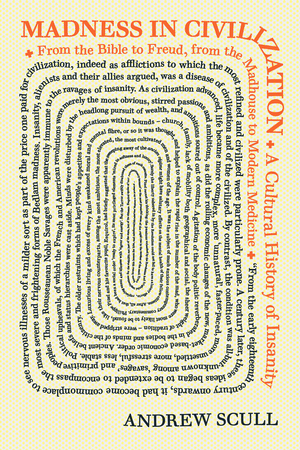
Book: Madness in Civilization - A cultural history of insanity

individual
INTERPERSONAL : SCIENCES
humanistic ------------------------------------------- mechanistic
SOCIOLOGY : POLITICAL
group
Need for asylum
http://press.princeton.edu/titles/10439.html
Book cover: Madness in Civilization
physical health
diagnosis
treatments

stigma, sense making, community care,
social history

power, institutionalised care, custodial,
parity of esteem, 'asylum'


Image source:
https://press.princeton.edu/books/hardcover/9780691166155/madness-in-civilization

Tuesday, September 16, 2008

Mental health survivors create evolving timeline of the UK survivor/user movement

From: Jill Anderson
To: MHHE AT JISCMAIL.AC.UK
Sent: Monday, 15 September, 2008 17:08:22
Subject: Survivor/User movement timeline

The survivors history group has created an evolving timeline of the UK survivor/user movement. It can be viewed online at:

http://studymore.org.uk/mpu.htm#Manchester2008

Will be an invaluable resource for teaching.

Best wishes,
Jill
----

Here is one entry of particular note for 1894:

A short story Passed is the first known published work of Charlotte Mew. The writer, walking in a poor area of London (Clerkenwell?), visits a church. She sees a gospel that the priest at the alter does not:

"Two girls holding each other's hands came in and stood in deep shadow behind the farthest rows of high-backed chairs by the door. The younger rolled her head from side to side; her shifting eyes and ceaseless imbecile grimaces chilled my blood. The other, who stood praying, turned suddenly (the place but for the flaring alter lights was dark) and kissed the dreadful creature by her side. I shuddered, and yet her face wore no look of loathing nor pity. The expression was a divine one of habitual love. She wiped the idiot's lips and stroked the shaking hands in hers, to quiet the sad hysterical caresses she would not check. It was a page of gospel which the old man with his back to it might never read. A sublime and ghastly scene."
The description may shock (See also 1916), but compare with Jayne Eyre in 1847 and the Care of Children Committee in 1946. The outstanding difference is the compassion.
The partner web resource of the survivors history timeline the - Mental Health History Timeline - is also well worth exploring.