Hodges' Model: Welcome to the QUAD: properties

Hodges' model is a conceptual framework to support reflection and critical thinking. Situated, the model can help integrate all disciplines (academic and professional). Amid news items, are posts that illustrate the scope and application of the model. A bibliography and A4 template are provided in the sidebar. Welcome to the QUAD ...

Showing posts with label properties. Show all posts

Saturday, January 24, 2026

Affordances


Affordance

An affordance is a perceptual pattern with survival significance. Affordances are relational, rather than objective or subjective properties. As Gibson, who coined the term, observes, 'An important fact about the affordances of the environment is that they are in a sense objective, real, and physical, unlike values and meanings, which are often supposed to be subjective, phenomenal and mental. But, actually, an affordance is neither an objective property nor a subjective property; or it is both if you like. An affordance cuts across the dichotomy of subjective-objective and helps us to understand its inadequacy' (Gibson 1979, 129). 
[Proust, Glossary, p.309.]


INDIVIDUAL
|
 INTERPERSONAL    :     SCIENCES               
HUMANISTIC --------------------------------------  MECHANISTIC      
SOCIOLOGY  :   POLITICAL 
|
GROUP

subjective

objective


Re. 'Survival significance' ...

Does this make affordances relevant in clinical education, and education more generally?

What of assisted dying in theory, policy, law and practice?

Are there any implications for the models employed by artificial intelligence - LLMs, neurosymbolic reasoning / AI (wave x)?

Source: Joëlle Proust (2013). The Philosophy of Metacognition: Mental Agency and Self-Awareness.  Oxford: Oxford University Press, Oxford. ISBN: 978-0-19-960216-2

Précis of The Philosophy of Metacognition:
https://joelleproust.org/wp-content/uploads/2012/09/pdf15.pdf 


See also: 'subject' : 'object' : 'affordance' : 'interface'

Friday, May 02, 2025

Book review iii: 'Categories we live by'

In thinking about (with?) Hodges' model, I often feel there is a flip-flop nature to where exactly concepts sit; or more accurately the perspective (care/knowledge domain) from which they are viewed.

Murphy introduces dual-character concepts, 'which are things that have both a prototype (or rule) and an ideal.' p.30. and quotes from:

Knobe J, Prasada S, Newman GE. Dual character concepts and the normative dimension of conceptual representation. Cognition. 2013 May;127(2):242-57. doi: 10.1016/j.cognition.2013.01.005. Epub 2013 Mar 1. PMID: 23454798.
Do dual character concepts operate at varied levels, and in their association (semantic) proximity - relationship to other concepts? All this changing according to context.

Murphy explores the dual category nature of people who claim to be scientists, but are really following a hobbyhorse. That is not lost on me. Others, a baker is following scientific principles while not technically being a scientist p.31. The discussion on art - artists is also informative; turn the page, and that on RINOs - Republican In Name Only - is very timely! There are the problems that science itself can contribute. If you don't know your oxeye daisy from osedaxes you can find out here: fascinating. 

'Health' is dual category in a great many respects (and with a chapter to follow). Many have been and will continue to be discussed here:
  • person :: service-centredness
  • parity of esteem (mental - physical)
  • confusion - dementia :: delirium (infection, dehydration)
  • mental capacity :: best interests
  • community care :: 'in care'
  • clinical risk - positive risk taking
  • healthcare :: social care
There's a need for careful deliberation too as does this apply to any situation in which there is a smell of  dichotomy: good, or bad?

Chapter 3 'Categories in the World and in the Head' helps straight away - declaring a false dichotomy. For me, it's worth revisiting natural categories, natural kinds and essential categories and psychological essentialism. Get these right and surely that's a useful toolkit, or more accurately - first aid kit?

I'm grateful for the placeholder essence (p.46) from:
Medin, D. L., & Ortony, A. (1989). Psychological essentialism. In S. Vosniadou & A. Ortony (Eds.), Similarity and analogical reasoning (pp. 179–195). Cambridge University Press. https://doi.org/10.1017/CBO9780511529863.009
'Psychological essentialism should not be equated with the classical view that concepts are representations of classes of objects that have singly necessary and jointly sufficient conditions for membership. ... More generally, we propose that the knowledge representations people have for concepts may contain what might be called an essence placeholder. There are several possibilities for what is in such placeholder. In some cases, but by no means in all, it might be filled with beliefs about what properties are necessary and sufficient for the thing to be what it is. In other cases it might be filled with a more complex, and possibly more inchoate, "theory" of what makes the thing the thing that it is (see Murphy & Medin,1985). It might, additionally, contain the belief (or a representation of the belief) that there are people, experts, who really know what makes the thing the thing that it is, or scholars who are trying to figure out exactly what it is. Just as with theories, what the placeholder contains may change, but the placeholder remains.' pp.184-185.
Hodges' model provides four placeholders. In reading and watching videos on category theory, it appears there is a role for 'placeholders'. I realise the applications - contexts differ, but analogies are powerful too.

Regards, classification as an exercise in convenience, despite the emphasis upon evidence, how often even in clinical matters does it come down to convenience? More to follow on this.

I've never wanted Hodges' model to be a grab-bag for keywords, concepts - categories! So it helps ease that concern, in chapter 4 to see words and categories contrasted. I always wondered about the media's preoccupation with the Inuit and 'snow'. 'Salient' is here as expected in 'Language, Culture and Categories' and with the Sapir-Whorf hypothesis p.53. And, of course, nursing and everything else relies on language p.57. Prof. Murphy's mention of children figuring out when it comes to language, and adults just how crazy it - the rules - can seem. While impossible, by definition, I had this thought of toddlers instigating a class action to get things put right. I like the way Murphy reaches across cultures for answers, highlighting the field of ethnobiology p.61. The appeal of this is exaggerated as it stretches across Hodges' model diametrically [sociology - sciences]. I'm still on the look out for models possessed of an 'otherness', that retain legitimacy, validity where and for whom they are employed. (There is much to debate there still.) The objective and subjective dimensions also loom large. I remember a meeting concerned with nursing terminology 1990s, with reflection on the terms used for injection across the UK. That in itself demonstrated wide regional variations that also give pause for thought.

More to follow, with Part 2 'case studies'.

Murphy, Gregory L. Categories we live by: how we classify everyone and everything. Cambridge, MA: The MIT Press, 2024.

Many thanks to MIT Press for the review copy.

See also:

Categories are destiny' Freud p.6. of 'Categories we live by'


Monday, April 28, 2025

Book review: 'Categories we live by' ii

In that first post I felt a bit guilty getting bogged down in the introduction, and not really saying much about the book itself.

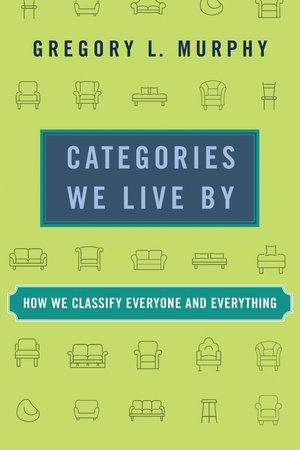
Well, Chapter 1 is the 'Introduction' so that is great, and as you may be I am swept up by what's between the covers. Speaking of which, this is an effective design, and green colour; especially for a northern reading in March - May.

The book is slim considering the topic, 164 pages, plus just over a page of notes, four and a half of references and an index. It is, I think a slightly larger format paperback but fits well in the hands for outdoors reading. The fonts and layout are clear.

Murphy's style is straightforward and readable. It is not technical, but includes terms such as classification, nomenclature, and domain [ ;-) ]. The division into two parts, lends itself to a wide readership, the second part providing case studies giving the book a pragmatic, practical emphasis. I'll post again about chapters 6 & 7 on Psychodiagnostic Categories; and Categories and Power respectively (brief, but a joy!).


Before moving on from the Intro, Murphy explains how the same category may be thought of in different ways at different times' and encourages us to be 'critical of our categories'. p.12. This stands out for me. Especially being suitably equipped to critique our categories as we use them.

Chapter 2 on The Classical Tradition, has a natural starting point; describing Aristotle (with his book Categories), essences, definitions with properties that are necessary and sufficient p.14-15.
'Necessity: If it's in the category, it has the features,
Sufficiency: If it has the features, it's in the category.' p.15.

I was prompted to reflect on relations and identities here. While I suggested the book is not technical, there is a important point about dictionaries and the definitions we seek there. We should remember that many members of the public would still rely on what is the classical way to create, confirm category membership: there must be a rule.

Wittgenstein follows pp.17-20, but I took note of:
'The problem is that necessity and sufficiency are in tension with each
other. As you make the list of properties longer and longer, it's more likely
to be sufficient but less likely to be necessary. Forming a list of features that
are both necessary and sufficient is usually impossible.' p.19.
I pencilled in (Eleanor) Rosch on p.13, and on page 21 her contribution to the destruction of the classical world is described; with other researchers. The book is well referenced, without being intrusive. Murphy provides specific pointers, suggesting further reading and skipping a chapter. Helpful, given how precious time is these days.

There is a critical invitation on page 13: 

'Want to start an argument with someone? Ask them whether a stove is a kitchen utensil or nursing is a science.'

I wonder if nursing theory colleagues in the United States and globally have already responded?

More to follow - surely!

Murphy, Gregory L. Categories we live by: how we classify everyone and everything. Cambridge, MA: The MIT Press, 2024.

Many thanks to MIT Press for the review copy.

Saturday, April 26, 2025

'Categories are destiny' Freud p.6. of 'Categories we live by'


Reading and enjoying for review:

Murphy, Gregory L. Categories we live by: how we classify everyone and everything. Cambridge, MA: The MIT Press, 2024.

Let's start at the beginning -
'Nowadays we are suspicious of categories, especially categories of people. Gender, ethnic, racial, and class categories are seen as a source of discrimination and inequity. If we saw each person as a unique individual, perhaps we wouldn't have all the problems caused by racism, sexism, and all the other -isms that afflict society.
In spite of these problems, I will argue that we cannot get rid of categories in general. They simplify and distract us from individual identities, which can be bad, yet if we didn't have them, we would find it impossible to navigate the world and deal with its incredible diversity.' p.7.


Reading what follows also from the book's introduction, I thought about public sector funded (socialist)  healthcare and the private provision:

'So, my sweater and my hair might both be brown, so we can say that they are both in the category of brown things. They are equivalent in the sense that I call both of them "brown." However, the category of brown things is not very interesting. When you know that something is in that category, you know exactly one thing about it-its color. There's nothing else to be known. Maybe the brown thing is alive or maybe it's inanimate; maybe its microscopic or maybe it's as big as a planet; maybe it moos or maybe it sings oI maybe it is silent. The category doesn't tell you any of those things These single-criterion categories are kind of degenerate. Yes, items that share the criterion (brownness, being three inches long, taking at least half an hour, or whatever) are equivalent, but only in the one property that defines the category. Indeed, you can define trivial categories that only have one ridiculous feature in common, like things that you have touched in the last forty-nine seconds, or objects that are exactly fifteen miles from Cincinnati. Those are not categories that people form, because they are not useful.' p.11.
There is much ongoing debate about parts of the UK's NHS being 'sold-off' - taken-over by private companies with consequences for the quality of care, e.g. cataract services:

https://www.theguardian.com/society/article/2024/jul/10/eye-doctors-say-private-cataract-operations-have-hurt-the-nhs?CMP=share_btn_url

Having worked for the NHS - now NHS Professionals since 1977, the current problems faced by the service and experienced by some patients, carers, friends and family members is upsetting.

Murphy's observation contrasting the utility of categories at the individual and collective level is a great opener. Especially for the basic structure of Hodges' model and the vertical axis.

I've written previously(?) how I think that it is true, throughout my career even as a ward manager (there were some exceptions!) and community MH nurse, I/we have been cocooned from having to be concerned about the budget. When you stop and think about it, how do the 'things' in the category of economics impinge on the biomedical, biopsychosocial model? The ward was a mechanism; it kind-of run itself, which for change agents (those who use the word transformation a lot) is an ongoing issue. The two categories that matter - even as they are global - are illness and prevention. The NHS puts supertankers to shame, in its inability to pivot - turn.

At the end of the day (and night - 24/7/365!) though healthcare must be paid for.

Murphy's explanation about degenerate categories is fascinating too (and this is just the intro!). It sees me (in danger of making a category mistake) as I think about singletons, and 'degenerate' as applies in mathematics, and the debate of finance. The tension of seeing the individual as a unique being, in order to be person-centred, but the service, the system would place them in all in the category of 'payer'.

Viewed across the funding divide, is the other inevitably viewed as degenerate? On page 80 now. More to follow. I'm still kicking all this around; while the government kicks the 'can' of social care down the road.

Many thanks to MIT Press for the review copy.

Tuesday, March 11, 2025

Joint-carving - 'The First Cut is the Deepest' c/o Traldi

Last Friday I joined in another online session of the Argumentation network c/o Andrew Aberdein and Kat Stevens. 

The subject was “The Epistemology and Politics of Redefinition” by Oliver Traldi.

As ever, it was interesting, technical, relevant and a prompt to concepts new, briefly encountered previously. I can't remember if in the talk, or Q&A, but mention was made of 'joint-carving' but I checked some sources:
'Because properties are so abundant, they are undiscriminating. Any two things share infinitely many properties, and fail to share infinitely many others. That is so whether the two things are perfect duplicates or utterly dissimilar. Thus properties do nothing to capture facts of resemblance. That is work more suited to the sparse universals. Likewise, properties do nothing to capture the causal powers of things. Almost all properties are causally irrelevant, and there is nothing to make the relevant ones stand out from the crowd. Properties carve reality at the joints -- and everywhere else as well. If it's distinctions we want, too much structure is no better than none.' p.346.
Lewis, D. 1983. New Work for a Theory of Universals, Australasian Journal of Philosophy, 61(4): 343–377. doi:10.1080/00048408312341131

'Though the facts or truths that the realist judges mind-independent are most commonly put in terms of a kind’s ‘naturalness’ (or lack thereof), they may be formulated in alternative locutions, such as the ‘reality,’ ‘non-reality,’ or ‘artificiality’ of a kind or kinds. For example, that human races are not real, or that protons form a natural kind, both express such facts. Equivalently, Plato’s famous carving metaphor may be used to do so, as when it is asserted that the classifications of the DSM-5 do not carve nature at the joints. For the sake of expository simplicity I will exclusively use the language of ‘naturalness’ here, but translations into alternative terminology are straightforward.'
Franklin-Hall, L. 2015. Natural kinds as categorical bottlenecks. Philosophical Studies 172 (4):925-948.


Further, Sass writes:
'The goal is to have a consistent and informative test for what counts
as a realist versus an anti-realist view about natural kinds. Bird’s(2018) taxonomy,
building on Hawley and Bird(2011), focuses on the questions of whether natural
kinds exist, and if so, what sort of entity kinds are. Franklin-Hall’s (2015) taxonomy
focuses instead on whether kinds are individuated by a mind-independent principle,
or whether kinds “carve at the joints”.1 This paper focuses mainly on the issues raised
by Bird’s (2018) taxonomy.' p.11862.
Sass, R. 2021. An ontology of weak entity realism for HPC kinds. Synthese, 198(12), 11861–11880. https://www.jstor.org/stable/48692794 [ homeostatic property cluster (HPC) theories of kinds ].

In the past, I've written about the (nursing, IT, psychological...) models muddle. At the risk of adding to my muddle, Traldi's presentation is a timely prompt. Timely, because trying to looking at Hodges' model as a mathematical object, it needs to be stripped down to its bare components (and purposes?). Is redefinition the order of the day? I will leave defining the components to one-side at present (in drafted notes). But even from Hodges' model as a template, with its (two) axes and (four) domains we can (must) consider:

1. The two axes taken as a whole - do they intersect, or not?*

Relationally, the axis between:

INTERPERSONAL | SCIENCES
SOCIOLOGY | POLITICAL
INTERPERSONAL - SOCIOLOGY
SCIENCES - POLITICAL

2. Each axis (treated independently) to the centre of Hodges' model. (See 1.)

The conjoining of axes (do they?):

The INDIVIDUAL - HUMANISTIC and INDIVIDUAL - MECHANISTIC.

The HUMANISTIC - GROUP and GROUP - MECHANISTIC.
                                
Hodges' model
I won't continue now, but I have wondered if one axis is primary? Which one comes first? Faced with a blank piece of paper, or flipchart ... which axis gets drawn first?

In guided discovery workshops, teaching sessions I have been directed by the context and duty of care. Given that this is clinical then the I-G is where I start, or lead the discussion.

Perhaps, (as per the previous post) there is a safety dividend in having to consider this question more formally (forcibly)?


I remember Rod Stewart's rendition of  'The First Cut is the Deepest' - even as governments work to make this cut as shallow as possible.

The INDIVIDUAL - GROUP cut: has it every time.

Previously: 'argumentation'

Sunday, September 22, 2019

c/o JAN: Formal Concept Analysis ... and an encouraging footnote

My source:


Andersson, N, Silver, H. Fuzzy cognitive mapping: An old tool with new uses in nursing research. J Adv Nurs. 2019; 00: 1– 8. https://doi.org/10.1111/jan.14192

This tweet prompted a reply and further reflection, as I've been aware of FCA for quite a while. A math disability (but remote fascination?) precludes me really 'getting to grips' with this. As noted before on W2tQ, visualization in the humanities (social sciences) has still not realised its potential. Those researchers, professional workers ... who could benefit from its application, being in the 'humanities', often do not understand the underlying mathematics. Even though they are not necessarily that advanced (sixth-form - undergraduate?).

Over the years I have built up a small library of related papers and books. The Macgill (1984) paper referenced below, I started to 'read' and work through and got a short way. The print quality is rather poor and obviously dated, but that is not the problem. I will try again. Since the 1980s software has changed beyond the proprietary packages of MathCad, MathLab, Maple and Mathematica and collectively they should (must?) make these methods more accessible. Of course, I thought this with regards to the use of content management system for a website (yes, that one!). Again though it's not the tools, but my choice, time and focus.

I write this and it might only be intuition, but I'm not just sure, I know there is something here.

Seeing FCA in JAN's tweet I thought of a certain footnote even though on my copy the reference seems incomplete:

Kwong, C. P. A Topological Framework for Formal Concept Analysis, The Chinese University of Hong Kong.

On the first page the footnote reads:

"The adjective "formal" is used to emphasize the mathematical substance of the objects being studied, which may be left out when such a formality is superfluous."

As you can imagine this is quite a gift for me. In a way it suggests the following from a 2x2 matrix with keywords (concepts), to an arbitrary array:

individual
|
INTERPERSONAL : SCIENCES
humanistic ----------------------------------------------- mechanistic
SOCIOLOGY : POLITICAL
|
group - population

1001
1110
0001
1111

1101
0100
1010
0011

1111
0011
0011
0110

0110
1111
0000
0110

There is a worry here. When your formative nurse education and training stressed the need to shift from a task-oriented approach to individualised, then filling the domains of Hodges' model with '1's and '0's is a bona fide task-checklist - even if a binary one.

There is a response to that concern for another post; but before that there is another source c/o:

Johana Ramírez Gaviria (2015) Aspectos topológicos en el Análisis deConceptos FormalesTopological aspects in Formal Concept Analysis, Universidad Nacional de Colombia Facultad de Ciencias Exactas y Naturales Departamento de Matemáticas y Estadística Manizales, Colombia. p.6.
c/o Google, Spanish – detected, English
En [26] se plantean nuevos modelos para el FCA usando nociones de la topología algebraica. El contexto formal convencional es reemplazado por una matriz con entradas ”1” ó ”0” denominada matriz contexto, para construir una familia simplicial (familia concepto), de ahi se desprenden propiedades que relacionan la teoría de la topología algebraica con el FCA.

Cabe resaltar que hasta el momento no se ha trabajado en dotar de estructura topológica los contextos formales en el FCA generalizado, donde los datos de las tablas toman valores difusos en lugar de valores binarios como se tiene para el FCA clásico.
In [26] new models for the FCA are proposed using notions of the topology algebraic The conventional formal context is replaced by a matrix with “1” or "0" called context matrix, to build a simplicial family (concept family), from there properties that relate the theory of algebraic topology with the FCA.

It should be noted that so far no work has been done to provide a topological structure the formal contexts in the generalized FCA, where the data in the tables take values diffuse instead of binary values ​​as you have for the classic FCA. 
[26, reference is Kwong]
  The whole thesis would need translating, but I have a sense that this too is useful.

Working through papers, files, journals, books getting rid of, sorting, re-filing ... I'll see if I can add to the reading below.

Atkin, R. (1974). Mathematical Structure in Human Affairs. London, Heinemann.

Macgill, S.M. (1984). Structural Analysis of Social Data, A Guide to Ho's Galois Lattice Approach and A Partial Re-Specification of QAnalysis, Working Paper 416, School of Geography, University of Leeds.

Previous post:
Bell jars and bell curves


Thanks to @jadvnursing for this tweet in-particular and for RTs.
(Paper e-copy received with thanks c/o Neil Andersson, 25 Oct 2019.).