Hodges' Model: Welcome to the QUAD: links

Hodges' model is a conceptual framework to support reflection and critical thinking. Situated, the model can help integrate all disciplines (academic and professional). Amid news items, are posts that illustrate the scope and application of the model. A bibliography and A4 template are provided in the sidebar. Welcome to the QUAD ...

Showing posts with label links. Show all posts

Thursday, April 24, 2025

Time to revisit Wikipedia?

Yesterday morning an email from a mail list -

https://groups.google.com/g/bytesforall_readers/about

- regards a Wikipedia entry, prompted me to look back at some personal - 'local' history. In 2006 having started this blog, I'd noticed 'models of care', and nursing theories' on Wikipedia.

I posted an entry on Wikipedia about Hodges' model.
This included the now defunct url/domain - p-jones.demon.co.uk (See below).

A request followed to remove it:

https://en.wikipedia.org/wiki/Wikipedia:Articles_for_deletion/Hodges_Health_Career_Model

I must admit there is a repetitive 'spam' quality to emails, contributions, activity on twitter and posts here. I do try to keep things relevant, in context and seek what is salient. 

Given the digital divide and ethos behind the web the 'complaints' now seem exclusive.
After a brief problem with Blogger I also wrote a blog post:

'Thanks Google ... Wiki ... oh for more time ....':

https://hodges-model.blogspot.com/2006/05/thanks-google-wiki-oh-for-more-time.html

At the time I wrote: 'I agreed the submission should be deleted - another time.' 

In writing - 'Another time...', perhaps, I should try again - or leave it to someone else?

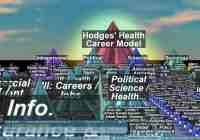
Following up, I found that the now archived POLITICAL care/knowledge links page -

original static website 1998-2015
[ Which is itself a useful 'collection' of resources. ]

Since 2006 the bibliography for Hodges' model has grown, please see sidebar:

http://hodges-model.blogspot.com/

Created in NW England higher education in the mid 1980s Hodges' model was intended for use within post-registered nursing courses - psychiatric and learning disability nursing, health visiting and district nursing. Hodges' model, is however, universal in scope and potential application.

As no doubt occurs in other professions/disciplines, advocates for tools, resources, theories, model that may also be simple, free - open access, 'neutral', pragmatic, supportive of lifelong learning, curiosity, literacy and informatics forms can be met with internal resistance - never mind external responses:

Raskin, Jef. "Humbug: Nursing Theory". Archived from the original on July 10, 2001. Retrieved December 14, 2015. (Wikipedia).

More recently the phrase 'Nursing eats its own' has resonated. A phenomena not limited to nursing no doubt?

Sunday, February 02, 2025

Social Capital - related to Hodges' model: c/o Andy Haldane FT

'The world is more diverse and interwoven than ever before - economically, culturally, ethnically, generationally. This is largely the result of the postwar explosion in cross-border flows of:'
ME
|
      INTERPERSONAL    :     SCIENCES               
HUMANISTIC  --------------------------------------  MECHANISTIC      
 SOCIOLOGY  :    POLITICAL 
|
WE

INFORMATION*

GOODS

PEOPLE

MONEY

 *Here I am treating information as analog - attached to meaning and sense-making, human reasoning - thought; information is of course also digital and an economy in itself.

'There is no ecosystem on the planet that is not enriched by increased diversity. The complexity of rainforests and oceans explains their abundance. In social systems, the cross-pollination of ideas, cultures and practices in diverse communities has been a driver of innovation and dynamism for millennia.
Yet this is a double-edged sword. A rainforest or an ocean are vulnerable to antagonistic arrivals such as humans seeking timber or fish. If cultures clash rather than cohere, diverse communities exhibit similar fragility.
Every complex system faces this balancing act, but it can be improved by strengthening ties and trust - what Harvard political scientist Robert Putnam calls social capital. The depletion of social capital over the past half-century, documented by Putnam, has tilted the scales decisively towards fragility. Today's open, connected economies are nested in brittle, disconnected societies. Neither can flourish like this.
One policy response is to reverse economic course, tightening restrictions on cross-border flows of people, goods, technologies and information. While economists (like me) tell us that doing so would diminish economic dynamism, given these policies address the insecurities felt by many at source, it is no surprise they are gaining support - especially on immigration and trade.' 

ME
|
      INTERPERSONAL    :     SCIENCES               
HUMANISTIC  --------------------------------------  MECHANISTIC      
 SOCIOLOGY  :    POLITICAL 
|
Group

My - sense of security
My - trust

 (AFTER) -
FORETHOUGHT


... Rainforest : Ocean
Wetlands : Kelp forests ...^

Maps of Social Capital1

Spatial planning


Social capital
Social mobility
Sociable housing2
Social cohesion

Social -

Policy
Curricula
Governance, Citizen Trust
Nat. Strategy for social connection3

Capitalism

'An Office of the President or Prime Minister, charged with lacing social cohesion through policy, should be hard-wired into the machinery of governments.'

(Here, here!).

1. Raj Chetty - Social Capital Atlas: https://www.socialcapital.org/
2. Richard Sennett
3. Chris Murphy

^Sometimes perhaps the map is the territory? Discuss.

With thanks to:
Andy Haldane, How to get from the me to the we society. Opinion: FT Weekend, 14/15 December 2024, p.12.

Upswing image: 
https://www.allenandunwin.com/browse/book/Robert-D.-Putnam-and-Shaylyn-Romney-Garrett-Upswing-9781800750371

Sunday, December 08, 2019

Review: ii Kinchin's Visualising Powerful Knowledge to Develop the Expert Student

Kinchin makes the point early on that if teaching relies on a linear, rote approach then the talked of experiential learning from life experience and the student's developing knowledge structures are rendered irrelevant (p.16 and figure 5).

Hodges' model is a metacognitive tool so any future research could call upon constructivist methodology. Kinchin describes Novak's (1993) summary of constructivist epistemology as "the belief that from birth to senescence or death, individuals continually construct and reconstruct the meaning of events and objects they observe." (p.16). There are three key assertions behind this:

  1. human beings are meaning-makers;
  2. the goal of education is the construction of shared meanings;
  3. and shared meanings may be facilitated by the active intervention of well-prepared teachers.
It is easy to see how this sequence can contribute to active teaching and learning. This resonates with Hodges' model too (inevitably - yes really!). In the model's title:

Hodges' Health Career - Care Domains - Model

The 'health career' is not career, as in jobs and work. 'Health career' is drawn from the idea of  'life chances'. In combination or isolation the knowledge (care) domains of Hodges' model can capture the potential range of concepts, events and objects that might be encountered by a student - lifelong learner. Hodges' model can even preempt birth if needed, incorporating epigenetic factors, the stress and trauma associated and experienced with conflict, forced migration of mother's to-be; ethical, spiritual and religious matters also.

The student's network of concepts, for example, on a first clinical placement may be rudimentary, but informed by experience in the family of a particular illness perhaps. The concepts they grasp-for initially may be rather broad, lay-terms but this is were the well-prepared teachers and mentors come into play. Kinchin refers to epistemological resonance between the curriculum and the concept mapping tool.

Can Hodges' model really facilitate both? That would be quite an educational coup surely?

A definition of  'concept' by Novak and Carnas (2007) is one to reference (pp.16-17). The definition is sufficiently broad so as to apply to all disciplines and subject areas.

In constructing concept maps Kinchin begins with a proto-map. These are produced through brainstorming to create what colleagues refer to as 'a parking lot of concepts'. From these concepts the most important concept is identified which leads to a focus question and root concept. This frames the resulting concept map. This reminds me of Tony Buzan's approach. There are marked differences and there may be merit in further future reflection (study) as Kinchin also suggests through the steps described.

Chains of prepositions are also formulated with the links between concepts following depending on the context. For example, STUDENTS--;LECTURES could be linked meaning Students should attend Lectures. The meaning could be that Students are bored in Lectures (p.18). The examples of concept maps are clear, readily followed and relevant for all students, biology and nursing students especially. The importance of constructing the links between concepts is stressed: the need for the links to help the map move from the descriptive to the explanatory. Chapter 2 is devoted to applying concept mapping. In the past I recall researchers in cognitive linguistics, nlp - natural language processing, expert systems, neural networks and artificial intelligence research being described as either 'hard' or 'fuzzy'.

Sources are provided for the dynamic relationships "as those which establish implication, functional interdependence and covariation among the concepts" (p.19). In concept maps these imply "movement, action and change".  The explanation of constructing maps and links hints at the amount of mentalising involved. I will return to this mentalising in a future (standalone) post. Kinchin's glue is referenced through Miller and Canas (2008) who differentiate between static, non-causative dynamic and causative dynamic relationships with helpful examples (p.20). I suspect that as a process this is achieved in parallel. In developing the concept maps Kinchin points out how initially the process involves something akin to brainstorming (p.22). I realise in reading this that as presented here on #W2tQ I have sold Hodges' model short, as the links between concepts are missing.

I like the formality that is not just implied but is explicit in terms of having metrics for assessment purposes, to measure the quality of concepts maps. The closing section of chapter 2 (p.26) explains and illustrates map topography. The feature of dynamism in a concept map becomes a property that can be measured. How is the quality of a concept map determined? What constitutes a good concept map, in contrast to poor? Chapter 2 points to the prospect of something tangible as Kinchin (2014) has sought to address weaknesses in the literature (pp.30-31). This is very good. Good because these questions are applicable to Hodges' model also.

to be continued...

Novak, J.D. and Symington, D.J. (1982) Concept mapping for curriculum development. Victoria Institute for Educational Research Bulletin, 48: 3–11.

Kinchin, I., (2016) Visualising powerful knowledge to develop the expert student. Rotterdam: Sense Publishers.

See also:

Intro post

Review One

Three

Four

Five

Six

Thanks to Brill for my review copy.

Tuesday, August 25, 2015

Ethics and Best Practices in Sharing Individual-level Research Data

"Welcome to the Resource Centre for ethics and sharing individual-level research data. This Centre brings together resources about ethical best practices for data sharing, policies and processes for data curation and data sharing, and links to repositories for data sharing. Please participate in this online community by posting links to your resources, and questions and comments in the discussion group or a blog. ...
A new, open-access toolkit for researchers and data managers is released today, providing guidance, resources and an eLearning course about ethics and best practices of sharing individual-level health research data in LMICs." ...

My source: Alexis Segrt, The Global Health Network 2015 list

Thursday, January 13, 2011

Help wanted: Broken links (and help upstairs)

Periodically on W2tQ I highlight the four care domain links pages, e.g.:

http://hodges-model.blogspot.com/2009/06/heroes-wanted-to-slay-monster-or-just.html
http://hodges-model.blogspot.com/2010/02/topicscape-care-domain-links-in-3d-for.html


Simon Phillips emailed me, copied below: (edited removing the actual broken links)
------------------
Peter,

I am writing to notify you of a small issue that I have just found on one of the pages of p-jones.demon.co.uk

http://www.p-jones.demon.co.uk/links.htm

There seems to be a number of broken links on this page. These are the links that I found were not working:

  • Nat. MH Info Center Substance Abuse and MH Services Admin. (SAMHSA)
  • Systematic Reviews: Centre for Reviews and Dissemination
  • Advancing literacy: A review of LIFE 2006–2009 UNESCO
  • Wearable Computer Lab
  • Keldy Forest
Obviously it is not a particularly great user experience when the links of a website don’t work, which is why I thought I would bring this to your attention. I trust you will be able to fix this issue soon.

Thanks for taking the time to read this email and for creating such a useful website.

Kind regards
Simon Phillips
-----------------

Simon runs a website about stair lifts, which provides information on choosing a stair lift and a comparison table of UK stair lift manufacturers.

In response I've corrected the links. I do check them with some automated tools, but as mentioned since 1998... they have become something of a monster. Considering the total number the vast majority are valid.

Before you all dash to check and get in touch :-) which would be greatly appreciated, please note that I can't necessarily respond to all such contacts in this way - but I can see what I can do ...

Many Thanks Simon!

Thursday, February 11, 2010

Topicscape Care Domain links in 3D - for the PC

Topicscape Hodges modelFollowing the post on Sunday, January 24, 2010 I have tried Topicscape and the 3D rendition of my links pages which is for the PC only. Unfortunately, for me the experience is very slow as my 7 year, 2 month old Pentium 4 2.6Ghz with its equally aged graphics card is really not up to the task. If you have a recent PC with a suitably endowed graphics card*, perhaps you will see what I sadly - for the time being - am missing.


Thanks again to Roy Grubb for recognising the organisation and effort behind the four links pages I have compiled from 1998 to date. There's a great irony in my viewing the links as a 'monster', then here they are rendered by GPU's that more commonly play host to a variety of game monsters. Recently people# have let me know of their surprise and pleasure to see that there is still a role for a human hand (and reflective mind) to weave something beyond raw Google. Of course the developments in the semantic web and RDF ... can take this even further.

Additional links:

Hodges' model links in 3D with Topicscape


*I plan to correct this in the near future with a new PC sporting a CUDA capable graphics card - also for SETI @ Home et al.

#Dear Peter

Many thanks for this, I look forward to reading the material and learning more on what seems to be an interesting model.
I’ve added a link on our site to yours – the wealth of links available on your site is phenomenal!

Many thanks and kind regards

Charley
---------
Charley Baker
Madness & Literature Network

Research Associate
Fellow of the Institute of Mental Health
University of Nottingham
School of Nursing, Midwifery and Physiotherapy
Education Centre,
London Road Community Hospital,
Derby, DE1 2QY

Sunday, January 24, 2010

Hodges' model links in 3D with Topicscape

Roy Grubb (Hong Kong) got in touch recently regards his appreciation of the links resource I have compiled, organise and maintain using Hodges' model. Roy's intention to create a Topicscape in 3-D has now borne fruit. Unfortunately, on my Macbook Firefox fell over trying the link below. I then learned Topicscape runs on Windows PCs only. I look f/w to trying on my (aged) PC, but despite that limitation - this is a great development. Many thanks Roy!!

Here is Roy's post from his site (the larger image below with link is from his initial post):

I wrote about this a couple of weeks ago. Now that I have permission from Peter Jones to use the lists on his pages of links organized according to Hodges’ Health Career Model, I can announce that it is on-line and live in the form of a read-only Topicscape. You can search (just type) and visit the pages (links are in the details panel – just click). Links to the four main pages of links in the Hodges’ Health Career Model site are in the four main topic cones: Intrapersonal, Political, Science, Sociology.

Topicscape image
Give it time to load the Topicscape software first time. Subsequent visits will be much quicker.

For you to fly around and explore this you will need a PC with 3D graphics hardware with an up-to-date graphics driver (requirements here).


There’s a wiki page with some helpful pictures that explain the few things you need to know to get you flying and zooming with the best of them. If you need any help, email me at r dot g at topicscape dot com.

Roy

Additional links:


Topicscape - Roy's initial post 'Hodges’ Health Career Model'

Science domain: H2CM (Visualization I & II, VR, Diagrams)

Monday, October 26, 2009

A pantological links palette

The table below displays the existing link categories for all four care (knowledge) domains of Hodges' model:

The categories included on the links pages are intended to be suggestive rather than definitive of Hodges' model. Advice regards broken links is much appreciated (I am aware that health promotion is listed twice).

Psychology I
Psychology II
Mental Health
Therapies
Anatomy & Physiology
Care Theory & Practice
Evidence Based Practice
Quant.
Research
Philosophy
Creativity Ideas
Communication Studies
Theology / Transdisc
Coding, Classification
Health Informatics
Info Sources
Diagrams
Health Promotion
Study Skills
Education
A.I. Knowledge Man.
Visualization I
Visualization II
MarkupLangs
Ajax & XML
Human-Computer Interface
Accessibility
Creativity
Graphics
Environment
Virtual Reality
Science
Astronomy
Rest & Rec
Maths, Logic
Engineering
Programming
[Toolset]
7 Ages
Health Promotion
Patients & Carers
Practitioners
Development
Poverty
Democracy
Justice
Economics
Policy
Studies
Computer Supported Collab Working
Sociology I
Sociology II
Qual Research
Activism
Citizenry
Employment
Human
Rights
Anthropology
History
Art, Tech &CultureI
Art, Tech & Culture II
Info. Gov
Assurance
Standards
Open Source
Community Informatics

News
Software
Hardware
Search
Organisations
Commercial I - IV

Definitions: pantology

Wednesday, June 03, 2009

Heroes wanted to slay monster (or just thinking aloud?)

The four links pages devoted to the knowledge domains of Hodges model are I am told quite a remarkable collection for all that to me they are a bit of a monster. Apparently the links demonstrate that there may still be a role for human web-hunter-gatherers. Wikis and social media rely on provision of tools for links. The Twitter community is built primarily on links. H2cm's links are checked regularly, tools make the task much lighter, but ...

Most urls have long lives - a slight tweak and all is well. Some are clearly '404', while a few get taken over and become a cul-de-sac for questionable advertising. I even found one or two being used for promoting candidates in the US election. It would be great to have someone else involved a caretaker just for a category in order to:

  • identify broken links
  • sites no longer maintained or representative of the category
  • any key resources missing (this might include a site you are involved with)
[I do mean 'key' resources]

You do not need to be a subject matter expert or a student, but it would help especially for the following domains and categories:

SCIENCES: anatomy & phys, nursing theory, research, astronomy, health informatics...
INTRA-INTERPERSONAL: psychology, mental health, therapies, philosophy...
SOCIOLOGY: sociology, arts and culture, patients and carers, collaborative computing...
POLITICAL: health policy, standards, democracy, activism, community informatics, citizenry, development ...

To repay your time there are a couple of options:
  • You effectively adopt a listing and I can feature a link with a small graphic to your site at the top of the listing category.
  • At least once a year I would post on the blog an acknowledgment of partners - be they companies or individuals.
OK the above is not hyperbole, but with the current website and hosting arrangements I would have to rely on e-mail to do this with me having to maintain the links.

Enter Drupal....

Considering the future site for Hodges' model I could readily drop the links, but I do feel there is potential here on several levels:
  • educational
  • community building
  • commercial
- and I need to consider the options.

The links would be one way to involve and grow a community. Using Drupal to leverage this there is also the possibility of:
  • voting on the existing categories
  • suggestions for new categories
  • use of mega-menus
  • monitor link usage and reduce the listings
  • use some of Drupal's link modules (or create a new one?)
  • introduce the site and links to the semantic web - RDF
  • start the collection from scratch and have the community submit them
  • - emphasizing basic nursing and social care
The existing pages would also be re-written to utilise CSS and jQuery (as already mentioned on w2tq) it would make a world of difference to have the categories being collapsed upon the page opening. We'll see...

Saturday, January 19, 2008

Nursing process: a lesson for interface developers

Back in the 1980s when the nursing process first appeared in the UK, amongst the pioneering early adopters there were nurses who were also worried. Would the nursing process with its mechanistic connotations lead to the person, the patient - literally being processed? There is a lesson here for nursing (health and social care) IT systems / interface developers ...

They really are star performers you know, regular high-wire runners. They have to make things simple, safe, efficient, fit for purpose and yet also deal with complexity as they juggle multiple contexts and second guess the psychological state of not just one user (crucial as that is), but several groups (disciplines, beginner-specialists, user roles and security...).

In Tidwell's Designing Interfaces the first chapter is more a psychology primer than pure IT text. The first pattern is safe exploration (and there's much more too).

This week someone e-mailed me and stated that the website and links (in particular) are 'daunting'. While for me the website and links pages have been an emergent pursuit, for 1st-xth time visitors .... well; I have to agree.

Thinking beyond a new site for an archive and book project - this is the trick, I suppose. How do you make a site or information system inviting and put the user at ease? How do you hide complexity until it is appropriate to do the non-trivial things? In order to capture data quickly and efficiently at the point of care how can those static check boxes and drop-down lists duck and weave the user's perception that:

1. They as a professional are being de-skilled;
2. or that the patient (person!) is indeed being 'processed'?

That's not just one tightrope, but several ...

Friday, December 07, 2007

Thermo, Long Way Down, Aether and Atlantis

Here's a video on a forthcoming new Adobe development tool - 'Thermo'.

Thanks Ewan and Charley - great TV.

Another journal - Aether : The Journal of Media Geography -

Aether offers a forum that examines the geography of media, including cinema, television, the Internet, music, art, advertising, newspapers and magazines, video and animation. It is our goal to provide a space for contributions to current issues surrounding these media, beginning with constructions of space & place, cultural landscapes, society, and identity.
Atlantis takes flight tomorrow (fingers x'd). For a different media mix try NASA EDGE.

In the Northern hemisphere whether you're walking the dog or E.T. is walking you, keep your eyes open for the Shuttle and ISS. In the Southern hemisphere too with those mid-summer nights - enjoy!

Tuesday, October 23, 2007

Vectors Journal & links

This link and journal came via the Humanist Discussion Group:

VECTORS Journal (2005-2007)

There is always a tension between content and interface - what do you think? IMHO great delivery that has me hooked with THINKMESH and many other projects..... There are some code views in there too.

Here's a different more direct approach to giving - KIVA - supporting entrepreneurs in developing countries.

I'm waiting for a cloudy night to explore Stellarium - a free open source planetarium.

SHIFT Happens video if your perspectives seem limited. Over the years quite a few people have highlighted the need for a simple intro to Hodges' model. I wonder if this style of presentation could do the trick? Mmmmm...

Free (legal) music downloads at We7.

And last but not least Me.dium.com - a further development of social networking, music and virtual groups. I'm struggling with these as it is...

Thanks to David & Sue McKendrick, Danny J. and Chris Allen.
Bye for now.

Saturday, September 22, 2007

Award winning educational video, Vis Lab & Martian caves

Here are a few links:

Mars is pure enigma tainted red and placed in the sky with warm cave entrances spotted at night. Drawing the retrograde motion of Mars was a powerful early lesson on the power of manual visualization (paper and pencil).

VISUALIZATION LAB UC Berkeley.

Sense.us below provides a pdf and a 20MB video:

Voyagers and Voyeurs: Supporting Asynchronous Collaborative Information Visualization

Looking at the potential of these tools health care managers and decision makers are going to have indigestion. Health care information departments will no longer be playing catch-up, but will be providing data and information (directly or through a clearing service of some sort). The key issues then will be analysis, interpretation-significance and action. That latter point seems a perfectly timed invitation for public engagement, engagement beyond tokenism.

I found this short (award winning) film entitled TEACHING TEACHING & UNDERSTANDING UNDERSTANDING, very interesting especially in light of the deep post last weekend. For me this video highlights a role for Hodges' model in education. If students arrive at university with a well-used conceptual framework will they be predisposed to deep understanding?

Sunday, September 16, 2007

SCIENCES links: Holistic Bliss or Tristram Shandy ... V

Finally: what of the content of the SCIENCES links page? Firstly, a little background -

Hodges' model has a key role to play in engagement. In health this means helping people to help themselves. Assist them to use the knowledge and experience they have of their illnesses. When necessary educate them - patients, carers and the general public. Use the latest research to further health promotion and preventive measures. These efforts, these messages though must compete with an awful cacophony of noise - political and cultural in the media - that is frequently itself awful dross.

Little wonder then that the science, educational and political communities are so concerned about the public switch-off, with citizens ill-equipped to critique and engage in debate on key SCIENCE issues - biotechnology, nanotech, astronautics - funding!

Engagement is not for everyone of course, but surely we can do better this?

Over on this right-hand MECHANISTIC side of h2cm what should political expectations (aspirations!) be regards the holistic bandwidth of a given citizenry? What does the 21st C. curriculum for the citizen look like? Is it as taught, the written, the learned, DIY, the 'take away', the media delivered or the hidden, ...?

Back to the task at hand: Like all the links pages SCIENCES also places health related subjects uppermost for ready access together with selected conferences. Not surprisingly ANATOMY & PHYS are first on the top row, followed by selected NURSING AND CARE THEORIES. If the h2cm website has any roots as a project it started here and spread.

The media in general and IT commentators in particular stress information overload. The relentless increase in the volume of information year-on-year has a prime contributor amongst the research community in medicine.

When we speak of General Practitioner (family physician) it seems increasingly difficult to determine what is general? There are so many branches of medicine even before specialised directions must be taken. The costs and risks associated with 21st C. medicine mean that filtering the research literature to find the treatment pearls is crucial to effective practice, outcomes, management and policy. So, EVIDENCE BASED PRACTICE (EBP) that utilises e-libraries and electronic databases is the tool of our times and with QUANTITATIVE RESEARCH completes the top row.

Before moving down a peg (if digression sensitive turn away now).

If you look at Hodges' model and its quadrants with a nurse's eye, you know for intramuscular injections the dorsogluteal - the upper-outer quadrant of the buttock - has been cited as a preferred site. How fitting then that the upper-right quadrant in h2cm is the SCIENCES. Problem is of course upper-outer translates as upper-right AND upper-left and sticking needles in people is a pretty invasive and mechanistic task. That upper-outer LEFT quadrant in h2cm translates to the humanistic [INTERPERSONAL] domain, so sticking needles there may be anatomically correct, but epistemologically speaking where are the talking therapies? (The model also at this point invites dialogue and debate on addiction.)

Recently, I've been researching a paper on socio-technical structures (which will also attempt to explain the hyphen), this project-making or -breaking conjunction of the social and technical for me begs the question of the locus of INFORMATICS. There are many schools of informatics in addition to HEALTH INFORMATICS I & II. If it is sensible to ask of these informatics fields, which h2cm domains would they claim as their primary home? [COMMUNITY INFORMATICS is listed in the political domain.] The great and ongoing efforts in CLINICAL CODING AND CLASSIFICATION within medicine are also listed here.

I've often wondered about how much duplication there is in the various electronic databases that are available? What metrics would you use? There's a major Phd study for someone there if not already completed or under way? We see rationalisation in other industries, business sectors until then (or the semantic web) the plethora of available resources in INFO SOURCES further extends EBP. In artificial intelligence pruning the search is an essential strategy. Is the internet tree still growing or shrinking? I understand it is actually shrinking - rationalisation has begun?

The next three categories represent a key personal interest of mine. IMHO graphics, diagrams and visualization can help conjoin health, informatics, h2cm and the wider world; hence DIAGRAMS and VISUALIZATION I & II. Is there a role for DIAGRAMmatic reasoning in health and social care?

It could be argued (and has been) that visual literacy is yet another educational milestone.

PROGRAMMING is great fun - if you are not concerned with hydraulic control systems, air traffic control software, or clinical systems. MARKUP LANGUAGES variations of XML have proved revolutionary. In reading about and my initial tinkering with Drupal, XML is in there (and so much more). In education and nursing theory much is written about the need to bridge the theory-practice gap. Perhaps the gap is necessary: a velodrome has to have a centre. XML is a software technology that can bridge gaps in transforming data, information and knowledge.

As in other domains I wondered where to place ENVIRONMENT & ECOLOGY? In the four introductions to the website, I've stressed the relationship (dependency) between green issues, health and our quality of life. ENVIRONMENT & ECOLOGY should ideally reside in each of the domains, or at the centre the 5th domain - the spiritual - made up of all four.

Our VIRTUAL creations and worlds are presented next. IF you want to conjoin data sources, users, and present information & engage users, THEN use the senses that are available. Health and social care records can benefit from visualization as tantalisingly glimpsed in early work on visualization in the social sciences. (I'll see if I can switch these around a bit.)

Next: ASTRONOMY: Orion - you started this journey from my bedroom window. Rising in Winter standing tall then giving way to Spring. We need to give the real stars back to the people:

Turn off the light,
take a deep breath and relax
[Engima - Mea Culpa]

SCIENCE could comprise so much more space permitting just one scratch of this surface - pharmacology, chemistry, physics the new disciplines all deserve listings of their own.

SCIENCE is most clearly evinced in MATHS & LOGIC that provide the basis for ENGINEERING. The final two categories return to programming. Compared with the others this final row is smaller. I have to contain this pantological journey. The H2CM links pages are big enough: I know my limits.

The final category RUBY [TOOLSET] is perhaps poetic justice since programming is oft described as SCIENCE and ART. One thing that Hodges' model is about -

folding time and space.

Thursday, September 06, 2007

SOCIOLOGY links: Holistic Bliss or Tristram Shandy ... IV

I've introduced the rationale behind the content of the INTERPERSONAL and POLITICAL links pages. Let's now look at SOCIOLOGY: Although the ticking of the clock has a mechano-quantum constancy, people are collectively nudged forward through the 7 AGES that characterise our personal and social lives. These two lives beg a question in terms of Hodges' model and its four care (knowledge) domains. From what I've already said chronological age is mechanistic; but if that is the case in which domain does pathological age reside? Perhaps it is not just one domain, but a matter of span ;-). If for you this means or includes traversing the SCIENCE and SOCIOLOGY domains; that is quite a journey, so better prepare...

Following this on the SOCIOLOGY links page - can that be HEALTH PROTECTION & PROMOTION? Again!

Well yes it is and this is not a mistake. Just an effort to emphasise the need to direct our attention and resources at health promotion and prevention at a community AND individual level. Visiting Assen in the Netherlands last month you hear of the Dutch love of bicycling. Seeing is believing though and all ages were out and about. Marvellous to behold.

If health and communities are about support then there are a multitude of groups and networks dedicated to the task for PATIENTS and CARERS. The emphasis now is also to engage the public in service and policy development. They also need to be involved in public health, health and social care research and not just as 'subjects'.

In terms of Hodges' model contrast this journey - SOCIO-POLITICAL with the SOCIO-SCIENTIFIC referred to above. Another post perhaps....?

Similarly, there are PROFESSIONAL and other associations across all disciplines. This includes the notion of integrated services, still a long way to go. These professional groups are 'political' in the [ORGANISATIONAL] sense, but I wanted to reflect the social - socialisation - aspect. (What! You've done one row! Come on Jones hurry up!)

The phrase COMPUTER SUPPORTED COLLABORATIVE WORKING (CSCW) is not used as widely these days, but it captures a key purpose in HEALTH, SOCIAL & COMMUNITY INFORMATICS whether at an international, national or local level. Although I have placed it on the INTERPERSONAL page EDUCATION is all about 'socialisation' and an ongoing debate.

SOCIOLOGY I & II speak for themselves and in there you should find medical sociology and narrative medicine. Surely, the SOCIOLOGY listings should have pride of place here? The position of SOCIOLOGY on this links page is not intended to reflect examples of various socio-political concepts such as demotion, loss of status, alienation... It is true, these can reach over the INDIVIDUAL-GROUP axis and pummel the individual; but -

No. As with the other links pages SOCIOLOGY sits on the 2nd row due to the needs of health and social care learners (ALL staff!), patients and carers (the Public) to have speedy access to the relevant links.

QUALITATIVE RESEARCH is next and the ongoing quest for more effective methods and tools to help unravel the phenomenological world. As with QUANTITATIVE RESEARCH in the SCIENCES listing, I've included some examples of software tools.

The final row presents ANTHROPOLOGY in which medicine and SCIENCE will find their earliest roots. Fittingly then HISTORY is right alongside. Two listings are devoted to ART, CULTURE, MEDIA and TECHNOLOGY; a realm I could really get lost in if I had the chance. I've tried to include some of the best examples of various genres, but they change so quickly. Please let me know (through the website) if you've a gem or two.... to share - or if you notice any broken / outdated links. I use tools to check, but they are digital and of course on this [HUMANISTIC] side of h2cm everything we touch is 'analogue'(?).

As you may have noticed this SOCIOLOGY domain is the smallest with just 12 listings. Perhaps here with the POLITICAL domain in the lower half-group hemisphere of Hodges model more (people) really does mean less? Yet, another post perhaps...?

Although ARCHITECTURE seems to epitomise -

  • the physical world with its presence (whether loved or abhorred);
  • the notion of artefact on a grand and detailed scale
  • the mix of mechanism and material
  • ....
Architecture is also associated with the human spirit, the ephemeral. I have wondered about including the subject here. It is a truly colossal micro-macro subject and also a profound factor in the health and well-being of all of us.

Like health it touches all the knowledge domains....

Next! Last but not least SCIENCES...

Monday, August 27, 2007

INTERPERSONAL links: Holistic Bliss or Tristram Shandy ... III

The INTERPERSONAL domain links are to my mind (no pun intended) fairly obvious, at least that first row complements the SCIENCES top row opposite.

Basically, who needs a talking therapy and who needs a drug therapy?

The two uppermost care domains are intended to represent the INDIVIDUAL axis, so just as the SCIENCES [ANATOMY & PHYS] domain covers physical care; so the INTERPERSONAL domain encompasses emotional and mental health care.

Hodges' model is comprised of four care domains, but it is these two [INTERPERSONAL : SCIENCES] applied to the individual that even today we struggle to balance in theory and practice.

A key factor in Brian Hodges' early nursing career (and mine) has been the role of institutions, organisations and the formal policies and structures they represent. This can be depicted as:

EMOTIONAL HEALTH : PHYSICAL HEALTH (both 'individual')
OTHERS family, society : INSTITUTIONS (both 'group')

As to the INTERPERSONAL links themselves - I arrived at mental health through reading a psychology text on Wundt and introspection, then James..... PSYCHOLOGY being of central importance in this domain has two listings, with MENTAL HEALTH and closely related THERAPIES also sharing the top row. I may swap these around: PSYCH-OLOGY as a cognitive science should be placed rightmost, while MENTAL HEALTH and THERAPIES should be further to the left being more 'humanistic'. What do you think?

Do the sciences have to be corralled in the SCIENCES domain? I think I remember Bryan Magee and John Searle in conversation noting that many disciplines with science in their title are probably not sciences - in that upper right hand quadrant sense. Maybe it is just that -

cognitive science : "SCIENCE" (physics, biology, chemistry)
social science : political science

- are still running wild out there, untamed and as yet unbroken? Cognitive science has however, clearly come of age and the 21st century will undoubtedly be the century of the brain when anatomy, physiology and genetics are linked to thought and individual (and even social) behaviour.

Already the content here highlights cognition (thought). The inclusion of other link categories in this upper-left set can be explained with recourse to cogitation. After PSYCHOLOGY, PHILOSOPHY (with ETHICS) is the rather obvious 'ology'.

For better or for worse our culture is driven more by IDEAS and ideology than philosophy. Call it the informal philosophical engine that drives CREATIVITY.

COMMUNICATION lies at the heart of all things human-e. Given the millennia that the patient-physician relationship has been around, you might expect it to be perfected by now. Well health and social care workers and the public they serve are still trying to reach empathic nirvana (although that may be to take communication a bit too far).

Hodges' model has a role to play supporting reflection for all.

IDEAS, COMMUNICATION lead us to belief and a central component in psychological therapies. Belief is also a thread can be used by one individual to lead others positively or to subvert other individual's capacity to think critically. It is in this INTERPERSONAL domain that good and evil are so proximal they create heat, fanned by a culturally driven winds of history and media from the South. Be-life indeed. Here then - THEOLOGY is purposefully placed with TRANSDISCIPLINARITY. If it is to serve humanity Religion must be bound and integrated into the corpus of knowledge and that includes reconciliation with the SCIENCES. We cannot deny myth and yet myth cannot deny evidence - a debate that will go on......

The economic emphasis placed
currently on creativity is quite remarkable, not just at a national level (cue ramble...). Cities recognise that their future development, sustainability and very survival depends on the generation and flow of ideas. Some things do not change. In myth a special place has been reserved for the isolated thinker, the one individual who takes themselves away for weeks-months, to be touched by the spiritual realm, to return to the community delivering insight, creative sustenance. Now creative individuals are needed more than ever. The isolation is virtual, the community potentially global. The energies of individuals are directed at solving problems concerning more mundane matters of cost, risk, flexibility and growth. Those creative outputs are distilled through team work and although they are then diluted they remain invaluable - such is the scale of the problems to be solved. Just as the great rivers that feed our cities have their sources - often remote and isolated in the high mountains, so ideas and creativity begin with one individual. That flow of personal knowledge now finally enters the ocean of KNOWLEDGE MANAGEMENT - EXPERT SYSTEMS (decision support systems).

I have a little mantra that I share with students. It's not perfect as there is much overlap; but I figure that what
aptitude is to engineering so attitude is to caring.

HEALTH PROTECTION and PROMOTION, SELF CARE are all about attitude.
Of course, money in the form of departmental budgets (those institutions do matter) and family income can make a huge difference, but if the right attitudes are not present then you may as well - "go fish!".

In light of the above STUDY SKILLS and EDUCATION and TRAINING speak for themselves - on this occasion at least. One of the original purposes of Hodges' model was to facilitate reflective practice
(more to follow). We are familiar with the mechanical tools in use everyday to the extent they are taken for granted. Now the focus of training is more likely on the software tools that translate IDEAS into art, artefacts and conceptual frameworks.... ;-) These graphical and design tools must be learnt and the HUMAN-COMPUTER INTERFACE and its ACCESSIBILITY 'quotient' can prove to be either a brick wall or a leg-up for the individual user (even if networked or a collaborative tool - see SOCIOLOGY links).

If the SOCIAL domain reflects the worlds of the others, then the last INTERPERSONAL row REST & RECREATION reflects something of me and my family.

"Next!" - the SOCIOLOGY domain links....

Saturday, August 18, 2007

POLITICAL links: Holistic Bliss or Tristram Shandy ... II

Having mentioned the other day that health and social care related subjects are placed at the top of the links pages, of course the POLITICAL page - as awkward a cuss as ever - differs. The political topflight is missing some obvious candidates. Although there are related links in there somewhere amongst the four links pages I have not explicitly listed:

  • mental health law
  • (patient - carer, long-term) advocacy
  • consent and capacity
  • confidentiality
  • professional (and other) codes of conduct
  • health and safety
  • or global health
Perhaps I should list these or other missing political categories? If we stop and think about it though - what do you need before you can deliver coherent health and social care? That top row are the critical determinants: the starting blocks. If DEMOCRACY, JUSTICE and LAW are absent or taken away where is care? Why in so many developing countries is health care so poor - native/ethnic medicine practices can only go so far?

In promoting 'DEMOCRACY' this in itself is a challenge of our (Western) times, given the apathy that exists in local and national politics. No surprise then that CITIZENRY & LEADERSHIP (C&L) are not far behind with their hands raised. There's a chicken and egg here: should C&L be on the front row? Then the people would have the Government they deserve on the second row. Can they be side-by-side?

HUMAN RIGHTS should be on that top row; however, HUMAN RIGHTS are surely dependent upon DEVELOPMENT to overcome POVERTY and effective LEGISLATION?

We need cognitive capacity to boot-load our person-al operating system first thing in the morning, although in terms of HUMAN RIGHTS and an individual and family's capacity to exercise choices ECONOMICS is where the buck stops. While vital money is not enough: International STANDARDS make the world go around from paper size, device operation to INFORMATION STANDARDS. I like this word GOVERNANCE because it does not have to be central, it can be peripheral - grassroots - as well and takes many forms: national, corporate, financial, clinical, information, civil, and green. Sometimes political change needs to start on the edge, that's where others can get on-board.

Communities are social entities, nebulous things as I still recall from an old course essay: Community care means whatever you want it to mean: discuss? So if community is social, then why is COMMUNITY INFORMATICS [CI] in the political links domain? Well, CI very broadly speaking seeks to promote and assure the study and use of informatics developments, specifically communications and information technologies for groups within a population who may otherwise remain disadvantaged, and so find themselves on the wrong side of the so-called digital divide. Whether your arrival is positively or negative framed in terms of social inclusion or social exclusion you must pass through Customs and Excise:

c/o the political domain.

NEWS is quite a strange thing or these days a many splendoured-multimedia-mobile kind of thing. You see the messenger is always transformed into a bizarre beast: a POLITICAL animal. The animal has long been on the endangered list, it is rarely sighted and the SCIENTISTs next door call it a 'Trust'. Because its appearance is so remarkable children are wary; so in a poll they elected to call the creature a 'can-U-really'.

Who 'owns' the news, controls it, governs the media - what difference does it make? What is news these days? The quality of health care information and news and overall what counts as news is at issue. Big brother once the epitome of totalitarianism is now equated with total trash.

Connected to the news is the global family's and a Nation's ability to SEARCH the web without censorship?

Finally then what categories are missing here politically? It's true war & peace, mass marketing, weapons of mass depletion, crime and punishment, crimes against Earth, plus management have gone AWOL.

ORGANISATIONS are in there, but personnel and human resources are not. Should they be? What do you think? What's in your political set?

"NEXT!" INTERPERSONAL links

Thursday, August 16, 2007

Holistic Bliss or Tristram Shandy and the Web Hydra I

Building the h2cm website a decade ago the links pages -

INTERPERSONAL : SCIENCES
SOCIOLOGY : POLITICAL

- were planned as a feature from early on. They started as TWO pages but have become FOUR and far more general in nature than originally planned. I first envisaged a core h2cm nursing set into which students - life-long learners could all dive.

Perhaps there's a project there for students: Specify what you consider to be a core set of links resources and justify your answer in terms of either one of the following or a combination of - models of care, health-social care policy, self-care, multidisciplinary teams? .....

Like many potential h2cm developments (XML templates, ...) which I've shared with contacts over the years, the core h2cm links set never saw the light of an HTML page. The main target audience for the links pages remains as the health and social care community (although given h2cm's universal scope I'm jumping around on this (sadly) cold-tin-roof shouting: "Hey everyone - oveeerrrr here!").

If you look at the four links pages and the model's axes INDIVIDUAL-GROUP & HUMANISTIC-MECHANISTIC you might conclude that a re-organisation is needed. So as the other potential developments are still outstanding (Drupal, ...) maybe this deserves some explanation?

Why? Well, there is too much there and many visitors may be put off? I navigate these links spaces quite readily (which as author is not surprising I suppose), but being critical the pages do represent a management overhead, a distraction from other tasks. Seeking a positive side maybe this generic set of links have emerged out of a human attempt (most searches/links resources are of course now machine-based) to push the 'holistic frontiers' and our conception(s) of what it is to care?

You'll notice on several links pages that the first row of links acknowledges the intended audience. I do not want students to have to scroll for the health and social care related resources. So, these are placed near the 'top'.

Although a domain links page is presented as a single 4-column table, it is valuable to take the main headings and view the four care or knowledge domains links together. This is listed below, if the formatting holds! (Probably need a graphic for this...)

Over several posts we'll explore the links pages one by one. Already a few things stand out...

What's there. What isn't and whether there's a why: initial observations welcome....

P.S. Shame about the weather last w/e in NW England.

Psychology I II Mental Health Therapies Anat&Phys Care T&P Evidence BP Research
Philosophy ---- Ideas Communication Theology Health Inform. II Info Sources Diagrams
Health Promotion Study Skills Education DSS Visualiz. II MarkupLangs Ajax & XML
HCI Accessibility Creativity Graphics Environment Virtual Reality Science Astronomy
------------------Rest & Rec----------------- Maths, Logic Engineering Programming [Toolset]
7 Ages Health Prom Patients Practitioners Development Democracy Economics Policy
CSCW ------ Sociology I II Qual Research Activism Citizenry Employment Human Rights
Anthropology History Art & Culture I --- II Info. Gov Standards Open Source Comm. Inform.
--------------------------------------------------- News ------ Soft-Hardware --- Search -------- Org
--------------------------------------------------- ---------------------- Commercial ---------------

Sunday, May 06, 2007

Bits and Pieces II: Better put the kettle on...

Well my tickets booked for Charleston, SC and the Society for Philosophy and Technology Conference in July. Still to sort the accommodation and conference fee. I've applied for funding from two organisations and hopefully the response will be positive on both counts, great news that I've £200 as a start.

I'm on the final stretch too for the book chapter, which combines Hodges' model, Serres and informatics - fingers x'd and just a day or two until I need to send it off! Can't wait to have this (successfully) done and dusted. Must move on...

The past month and evening I've really enjoyed the 50th birthday TV celebrations for the Sky at Night and Patrick Moore's contribution to astronomy. Absolutely - MEGA. April's Episode - Time Lord must be a TV prize winner - informative, funny and great entertainment. Looking forward to the next 50 years!

I've read through David Mercer's - Drupal and yep I'm still keen. Home for over 2/52 and not even managed to log-in to Drupal.

Getting to grips with this particular content management system is good, because I'll have to pick up some Apache, MySQL and PHP.

If you're familiar with the website on Hodges' model, you'll recognise that the links pages need checking regularly. If you are new or have never scrolled down:

INTERPERSONAL - includes:
psychology, human computer interface, accessibility, mental health, therapies, philosophy, theology, artificial intelligence and knowledge management, ideas...

SOCIOLOGY:
anthropology, qualitative research, sociology, health protection & promotion &
change theory, patients, carers and advocates, health, social & pastoral care practitioners, art, media, culture, & tech., collaborative computer supported working...

SCIENCES:
nursing theory, astronomy, science, maths and logic, quantitative research, info sources, evidence based practice, governance & complexity, informatics, diagrams, visualization, virtual reality, markup languages, environment, ecology & eco-system health...
POLITICAL:
human rights, citizenry, employment, standards, policy, democracy & law, activism, development & poverty, economics, community informatics, commercial, info. assurance & governance, organisations, open source & trade principles...

Once the chapter's submitted I'll get the links check done. Then I can focus on other things. This is my take on the links for Hodges domains. Would you move, add or delete any?

What could I do with these links pages and Drupal I wonder?

I notice that MEDINFO 2010 is to be held in Cape Town. Alpha Centauri! Sure would love to see the Southern night sky. That would be quite a project (offsetting the CO2).

Tuesday, May 23, 2006

Thanks Google ... Wiki ... oh for more time ....

Over a month since that first post ...

One thing I did not mention last time, was the existence of a blog set up using the h2cm title. This blog was not concerned with the model, merely hitching a ride.

They say all sorts about imitation and flattery, which is nice, but that needs to set alongside the impressions the Net creates. Being a part-time webslinger with h2cm online since 1998, as you seek to publicise your project this inevitably attracts link spam. Over eight years it appears that enthusiasm can be transformed into over-zealousness. Of course this gets noticed, hence the virtual monkeys on the back. So in addition to the reasons posted in April, that's why I started this blog.


I sent an e-mail to the company concerned and an Exec at Google. Searching for that blog last night the link was listed, but was not found. So if it has gone - many thanks to whoever and Blogger crew.

Does it matter? It does when that 'enthusiasm' has you post an article on Wikipedia that is deemed as ripe for deletion. In fact - hold on - yes its gone! At the time it seemed a good idea; well, we all need a lift sometime and when a bus comes along that's headed downtown - who am I to walk? The Wiki-police-team wondered about evidence as to the model's importance. The link spam was also duly noted. They concluded the site is limited to hits on Google and links that merely circle back to the home page. To be fair the links to h2cm are more credible than the Wikipedia editors stated, with some very reputable organisations and repositories providing introductory and link details.

Their comment that the site has no dedicated url was helpful. A point that was being addressed as I read their comments. I agreed the submission should be deleted - another time. They have enough (brilliant work) to do at WikiPedia without me muddying the waters. They have also merged pages connected with nursing theory/models and deleted the h2cm external link at the same time, flagged as 'did not survive'.

Well enough of me - I have to check the bus timetable, waiting for a number 4 ...
