Hodges' Model: Welcome to the QUAD: relationship

Hodges' model is a conceptual framework to support reflection and critical thinking. Situated, the model can help integrate all disciplines (academic and professional). Amid news items, are posts that illustrate the scope and application of the model. A bibliography and A4 template are provided in the sidebar. Welcome to the QUAD ...

Showing posts with label relationship. Show all posts

Tuesday, August 19, 2025

Dementia in 4x5 by Katherine Hubbard

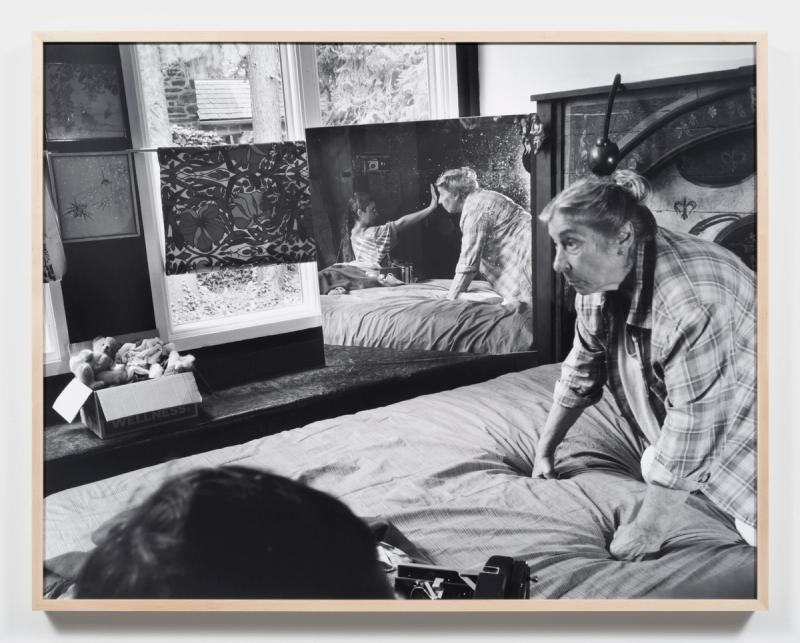
"The American interdisciplinary artist Katherine Hubbard has spent the past five years documenting her relationship with her ageing mother, Antonette Berger, who in 2020 began exhibiting the first signs of memory loss. Her book The Great Room, set between the four walls of Berger's home in Philadelphia, is a culmination of grief and intimacy, as Hubbard steps into her role as caregiver. Using two large- format 4x5 cameras (which she is both behind and in front of) and drawing on her background n performance art, Hubbard transforms the once safe, domestic space into a psychological playground as the pair navigate their new reality. ...
In this portrait, Hubbard sits with her mother on her bed. Their bodies are reflected in a square nirror offset by a series of other square and rectangular objects (picture frames, windows, the headboard) which fragment the viewer's gaze. "This photograph was taken before she had a diagnosis,' Hubbard tells me. "It was a very confusing time, with a lot of uncertainty and frustration between us. ... 
"І am using the camera as а means of creating time with my mom apart from the brutal task of managing her," Hubbard writes. And to the woman who gave her life: "You might like to know that, when І think of you and see you, it's as a whole person."  
Inès Cross. FTMagazine. 

Individual
|
      INTERPERSONAL    :     SCIENCES               
HUMANISTIC  --------------------------------------  MECHANISTIC      
 SOCIOLOGY  :    POLITICAL 
|
Group
one fifty one (hand to face), 2021. Silver gelatin photograph

'The
Great
Room'


Collaboration

Care in the Community

Direction

Gaze


Book: 
h290 x w219 mm. 88 pages
Text by Katherine Hubbard. Hardback. £46.00

https://loosejoints.biz/collections/current-titles/products/the-great-room

Photograph: https://companygallery.us/ - https://companygallery.us/exhibitions/the-great-room

Book cover: Amazon
https://www.amazon.co.uk/Katherine-Hubbard-Great-Room/dp/191271969X


My source:
Inès Cross. Katherine Hubbard, FTMagazine. August 9th 2025, #1137. pp.10-11.
Ack. Antonette Berger (mother ...).

Sunday, May 21, 2023

"How much empathy should doctors have?" c/o BBC Radio 4 'All In The Mind'

In ongoing reading and writing, I'm developing examples of care situations and contexts that extend across the domains of Hodges' model, candidates include:
  1. Eating Disorder
  2. Sense-Making in light of information disorder
  3. Public Understanding of Science
  4. Empathy and Rapport in healthcare disciplines
#4 has loomed large for quite a while. The contrast between being humanistic and mechanistic: warmth, engaged, attending, person-centred  and subjective; set apart from being objective, logical, cold, precise, mechanical, efficient, and accurate. These terms and more also indicate the scope (vertical and horizontal) of Hodges' model. In my nurse training, I remember that first intramuscular injection, and how my mentor - supervisor explained how, as a prescribed treatment - remember the patient needs it. The 'political' dimensions of this - informed consent, capacity, personal - professional ethics, mental health, and mental health act, add obvious complexity and critique to this example. 
 
In #4 I've the more general medical example of the surgeon and empathy. Then, this past week 'All In the Mind' devoted an informative feature on the topic (available for 12 months):
"A good bedside manner is a wanted quality in healthcare professionals. But as is performing procedures that can be painful or uncomfortable. As medical students train to become doctors, they can experience changes in their levels of empathy; the ability to resonate with how others feel. Learning long lists of diagnoses and pathologies, the human body starts to resemble more of a machine. But how detrimental is this? Claudia Hammond asks Jeremy Howick, director of the Stoneygate Centre for empathic healthcare at the University of Leicester, who is training healthcare professionals to express more patient empathy to improve health outcomes and reduce burnout. Lasana Harris, professor of social neuroscience at UCL, describes how too much empathy might be a cause of burnout, and medics should toggle empathy on and off depending on context. Medical students from the University of Bristol express how they feel empathy should come into their future roles. "

'Welcome to the QUAD' includes many previous posts on empathy, rapport.

Below, I have mapped key concepts and programme content to Hodges' model:

INDIVIDUAL
|
INTERPERSONAL    :     SCIENCES              
HUMANISTIC --------------------------------------  MECHANISTIC
SOCIOLOGY :   POLITICAL
|
GROUP

Empathy (regulation) and Rapport
Therapeutic alliance
Risk of burnout
Emotional curiosity


Research - BioMedical Model [machine]
First injection - 'invasive' procedure . . .
Doing Surgery - cutting a person
Body posture -
Sitting down with person - patient


Social Neuroscience
Language, presence
Pre-op contact with nurses
Restore 'humanity' Reassure

Lived experience -
Staying in hospital a night.
'Being a patient?'
Accountability - Responsibility
Time and Resources to do the job. [PJ]