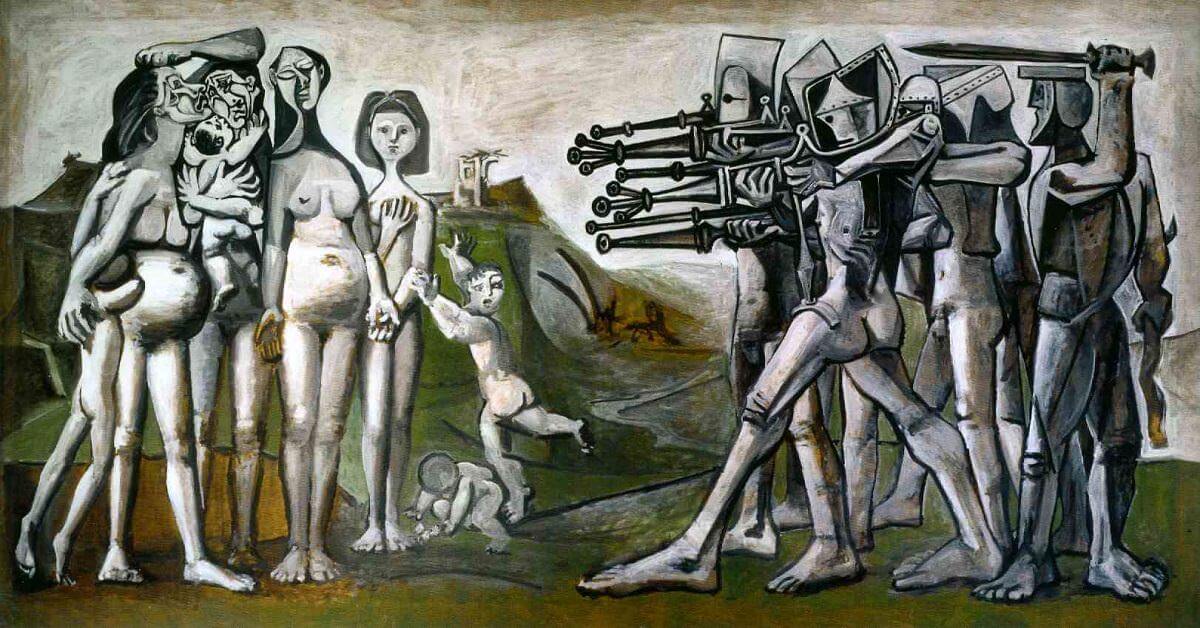
c/o Picasso - 'Massacre in Korea' (1951)
Art is a lie that makes us realize the truth.
- Pablo Picasso
HUMANISTIC - mind | body - MECHANISTIC "The 'beat' goes on"!? |
![]() |
| 'Massacre in Korea' (1951) |
Hodges' model is a conceptual framework to support reflection and critical thinking. Situated, the model can help integrate all disciplines (academic and professional). Amid news items, are posts that illustrate the scope and application of the model. A bibliography and A4 template are provided in the sidebar. Welcome to the QUAD ...
Art is a lie that makes us realize the truth.
- Pablo Picasso
HUMANISTIC - mind | body - MECHANISTIC "The 'beat' goes on"!? |
![]() |
| 'Massacre in Korea' (1951) |
Posted by Peter Jones at 9:04 am | PERMALINK
Labels: art , children , conflict , ethics , fighting , history , humanistic , lies , meaning , mechanistic , politics , power , refugees , social , truth , violence , vulnerability , war , war crimes , women
psychological well-being
vaccination against
misinformation
trust
inoculation: resistance
|
TRUE vs FALSE
epidemiology of news
broadcast dynamics
assertions - claims
gamification:
instructional, educational, app design
inoculation: resistance
|
stories ..... rumors virality role: fake news producers social media: ‘echo chambers’ and ‘filter bubbles’ inoculation: resistance | Fakenewsgame.org POLITICAL polarisation inoculation: resistance |
Posted by Peter Jones at 9:46 pm | PERMALINK
Labels: behaviour , claims , deceit , ethics , fake , games , gamification , Hodges' model , lies , misinformation , news , papers , psychology , research , risk , strategy , truth
psychological well-being
trust
"Falsehood also diffused faster than the truth. The degree of novelty and the emotional reactions of recipients may be responsible for the differences observed."
|
TRUE vs FALSE
epidemiology of news
broadcast dynamics
assertions - claims
"To understand how false news spreads, Vosoughi et al. used a data set of rumor cascades on Twitter from 2006 to 2017. About 126,000 rumors were spread by ∼3 million people. False news reached more people than the truth; the top 1% of false news cascades diffused to between 1000 and 100,000 people, whereas the truth rarely diffused to more than 1000 people."
|
social well-being stories ..... rumors virality social media social networks social bots
"We define news as any story or claim with an assertion in it and a rumor as the social phenomena of a news story or claim spreading or diffusing through the Twitter network. That is, rumors are inherently social and involve the sharing of claims between people. News, on the other hand, is an assertion with claims, whether it is shared or not."
| POLITICAL polarisation political and economic well-being 'news' = institutional source?
"Defining what is true and false has become a common political strategy,
replacing debates based on a mutually agreed on set of facts. Our
economies are not immune to the spread of falsity either. False rumors
have affected stock prices and the motivation for large-scale
investments, for example, wiping out $130 billion in stock value after a
false tweet claimed that Barack Obama was injured in an explosion (7). Indeed, our responses to everything from natural disasters (8, 9) to terrorist attacks (10) have been disrupted by the spread of false news online."
|
Born in Liverpool, NW England, UK.
Community Mental Health Nurse NHS, Part-time Lecturer,
Researcher Nursing & Technology Enhanced Learning
Registered Nurse - Mental Health & General
Community Psychiatric Nursing (Cert.) MMU
PG Cert. Ed.
BA(Joint Hons.) Computing and Philosophy - BIHE - Bolton
PG(Dip.) Collaboration on Psychosocial Education [COPE] Univ. Man.
MRES. e-Research and Technology Enhanced Learning, Lancaster Univ.
Live and work in NW England - seeking a global perspective.
The views expressed on W2tQ are entirely my own, unless stated otherwise.
Comments are disabled.
If you would like to get in touch please e-mail me at
h2cmng AT yahoo.co.uk
orcid.org/0000-0002-0192-8965-=<>=-
