Hodges' Model: Welcome to the QUAD: pedagogy

Hodges' model is a conceptual framework to support reflection and critical thinking. Situated, the model can help integrate all disciplines (academic and professional). Amid news items, are posts that illustrate the scope and application of the model. A bibliography and A4 template are provided in the sidebar. Welcome to the QUAD ...

Showing posts with label pedagogy. Show all posts

Saturday, September 23, 2023

MYTH, RITUAL AND PRACTICE FOR THE AGE OF ECOLOGICAL CATASTROPHE

Fabrice Monteiro, a garbage spirit, from his series
The Prophecy (2017)

The European Forum for the Study of Religion and the Environment

- is pleased to announce its
seventh international conference

Friday May 17 to Sunday May 19, 2024

Universität Potsdam, Potsdam, Germany

MYTH, RITUAL AND PRACTICE
FOR THE AGE OF ECOLOGICAL CATASTROPHE
 
Click here for the Call for Papers and Conference Description:

https://www.religion-environment.com/conference/open-call-for-papers

Proposals will be accepted until 31 October, 2023

This conference will explore the many questions that arise from the apparent continuing philosophical-scientific indigestibility of mythology, ritual and practice. What does or would gaia-logical mythology, ritual or practice look like? Are they, could they be more pedagogically effective with non-experts than analysis and critique? Is the solution to ecological alienation the same as the age-old solutions to spiritual alienation? Is ecological alienation parallel to the emic/etic divide in ethnography? Is “practice” the way “in”? Is “belief”? Does gaiaism demand rituals and practices? Are contemporary scholarly analyses (Haraway, Latour, Stengers, Mary-Jane Rubenstein’s pantheologies, Sloterdijk, etc.) today’s form of ecological myth? Is myth, with its associations with the archaic (despite the work of Cassirer, Barthes and others), a fitting genre for today? (Many traditional myths are hardly gaian.) Must gaian myth, rituals or practices be atheological (i.e., is theology, as some argue, inherently not deep-ecological)? Does subtractive theology (à la Badiou) better lend itself to legitimate gaian mythology? Do ecotheologies written out of specific continuing pre-modern cultural-religious traditions that are not entirely or comfortably gaian satisfactorily bridge the spaces between emic and etic genres/approaches and satisfy calls for new gaia-ologies? Is there a meaningful difference between the myths of “major religions” and “indigenous” cultures? How do or might “old” and “new” cultural material relate to one another? Must scholars-scientists, environmentalists or artists use only material from “their own” heritages in producing gaia-ologies? Are there bases for and modes of considering or evaluating the skill or usefulness of gaia-ologies, gaian myths, rituals or practices? How have religious or spiritual environmentalists created gaian myths, rituals or practices? How might they? What artists, artistic works or modalities or works of popular culture stand as noteworthy examples?

Conference Chair: Jonathan Schorsch jschorsch AT uni-potsdam.de

We will be most grateful if you could circulate this through your networks.

Kind regards,
Jonathan Schorsch
-- 
Professur, Jüdische Religions- und Geistesgeschichte
Institut für Jüdische Theologie
Universität Potsdam
  jschorsch AT uni-potsdam.de
  +49 (0)331 977 1744

Founder and Director
Jewish Activism Summer School
  www.jassberlin.org

Founder and Director
The Green Sabbath Project
  www.greensabbathproject.net


My source:

Philos-L "The Liverpool List". Department of Philosophy, University of Liverpool https://www.liverpool.ac.uk/philosophy/philos-l/
https://www.facebook.com/PhilosL/
@PhilosL @LiverpoolPhilos

Image: c/o https://www.fabricemonteiro.com/

I am planning to submit an abstract, to develop further ideas encountered and contributed at SOPHERE.

Friday, March 10, 2023

Special Issue: Health and Human Rights Journal

Dear Colleagues and friends

I am writing to share with you the special issue of the Health and Human Rights Journal, which we are publishing to commemorate the first anniversary of the death of Paul Farmer. 

https://bit.ly/HHRSpecialIssue

Special Section in Volume 25, Issue 1, June 2023, published on the first anniversary of the death of Paul E. Farmer, former Editor-in-Chief, who worked for the right to health for all.

Kulina girl
"A decolonial gaze" by Angel Martínez-Hernáez


In it, you will find articles that expand the conception of the right to health, with significant contributions from the global South. We gather contributions from Africa, South Asia, Latin America, Eastern Europe, North America, and Western Europe.

The articles are positioned from a wide range of critical perspectives, such as Social Medicine, Collective Health, Latin American Critical Medical Anthropology, the Indigenous Research Paradigm, Human Rights Pedagogy, and Structural Competency.

We hope that these works will inspire your reflections and practices. We'd like to thank you in advance for sharing them.

Yours faithfully.

Carlos Piñones-Rivera, Ángel Martínez-Hernáez, Michelle E. Morse,
Kavya Nambiar, Joel Ferrall, and Seth M. Holmes

Dr. Carlos Piñones Rivera
Departamento de Ciencias Sociales (DECSO)
Universidad de Tarapacá, Chile

Posted (and my source) from the Spiritof1848 Listserv WWW.SPIRITOF1848.ORG #Spiritof1848

(Edited from original - thanks to Carlos and Ángel).

Tuesday, July 21, 2020

Extended Call for Special Issue Editor/Editorial Team Members – COVID-19

Short extension! Apply to guest edit a Special COVID-19 issue of the International Journal of Practice-based Learning in Health and Social Care to be published in 2021.

We are extending the deadline to encourage wider participation in this interprofessional and international opportunity. We are keen to invite expressions of interest from our readers, authors, reviewers and wider network across the specialisms, whether experienced past editors or individuals who might view this as a personal development opportunity.

The guest editor may be an individual, group of two or three co-editors, or a collaboration mentored by members of the current editorial team.

We anticipate that the issue will contain articles on how practice-based learning has adapted to meet the challenges of COVID-19, and the changes that have had to be made to pedagogies that will endure. We will also consider reflective submissions, or interesting stories, about the changes experienced and encourage potential authors to contact us.

You can contact Helen Buchanan helen.buchanan AT uct.ac.za Lindy McAllister lindy.mcallister AT sydney.edu.au or Editor-in-Chief Lynn Clouder l.clouder AT coventry.ac.uk to share ideas informally.

Expressions of interest must be received by 12th August 2020.  

Please distribute this call to your colleagues.

Thursday, April 09, 2015

Some reading: e-learning, learning design, learning designs and visibility

We refer to this as the issue of 'manifestation'. A learning design that is represented in a relatively complete and explicit manner is said to be highly manifest; conversely, a fragmented or impenetrable design is said to be opaque. p.56.

Yet - and here we move on to the issue of representational forms - in order to be apprehended, a design must show not only the components of a learning experience (e.g. resources, activities and instructions) but also the relationships between them: sequential, conditional, thematic etc. Conversely, it must also represent the absence of relationships between the elements so that learners do not make incorrect inferences about them. p.57.
However, further analysis suggests that VLEs might indeed have an impact on pedagogy, but that it might be an unconscious one emerging from the phenomenon of 'design blindness', or the unconscious restriction of e-learning to the scope of one's tool. p.60.
VLEs [virtual learning environments] start as pedagogically neutral ... p.62.

Masterman, L. & Vogel, M. (2007). Practices and processes of design for learning. In Beetham. H. & Sharpe, R. (Eds.), Rethinking Pedagogy for the Digital Age (pp. 52-63). London: Routledge.

A survey: Nurse Lecturers undergraduate students, e-learning, e-portfolios, innovation in reflective skills [Now closed]

Many thanks to the lecturers who have responded so far - a great help and very informative.

Wednesday, February 04, 2015

Recent reading [module 3]: Technological Pedagogical Content Knowledge

"Over the past 5 years, we have been involved in conducting a design experiment aimed at helping us understand teachers’ development toward rich uses of technology while simultaneously helping teachers—both K–12 teachers and university faculty—develop their teaching with technology.
...
In this particular context, the implications of developing a framework go beyond a coherent way of thinking about technology integration. We argue that a conceptually based theoretical framework about the relationship between technology and teaching can transform the conceptualization and the practice of teacher education, teacher training, and teachers' professional development. It can also have a significant impact on the kinds of research questions we explore." p.1019.

Mishra, P. & Koehler, M.J. (2006) Technological Pedagogical Content Knowledge: A Framework for Teacher Knowledge. Teachers College Record. 108, 6, pp. 1017–1054.

Thursday, November 27, 2014

Threshold Concepts - one of '10 trends set to shake up education'

Professor Ray Land emailed the Threshold Concepts community following up on the conference held in July 2014. I can't believe that very soon another month and the 2016 conference in Nova Scotia will be 'next year', but there we go...

Prof. Land updated us on a prospective book, and when available I will post news of the book and the next conference here.

While I am sure Threshold Concepts are (very) applicable to Hodges' model and my research interests, I am not trying to contribute to the planned text. I'm busy enough with the third graduate study module. Reading, discussion, a 4k word draft essay, two peer student reviews...

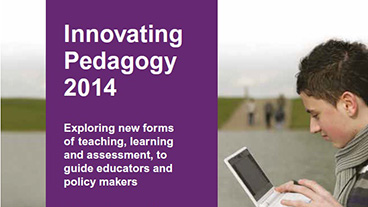
Prof Land also highlighted the following, which he's happy for me to share with you [I've added the image]:

... We were pleased to see that Thresholds were identified as one of '10 trends set to shake up education' as reported in The Times Higher magazine last week.


http://www.open.ac.uk/iet/main/files/iet-web/file/ecms/web-content/Innovating_Pedagogy_2014.pdf
Innovating Pedagogy 2014 - Report
The report, produced by the Open University and called 'Innovating Pedagogy 2014', is free to download here:

https://iet.open.ac.uk/file/innovating-pedagogy-2014.pdf

Kind regards and hope that all is well where you are.

More shortly

Ray
____________________________________________________
Professor Ray Land
Director, Centre for Academic Practice (CAP)
& Professor of Higher Education,
School of Education, Durham University,
Leazes Road, Durham DH1 1TA
United Kingdom

Sunday, August 11, 2013

Drupalcon Portland session: Collaborative Learning Systems in Drupal & tpm

I'm still following Drupal here in NW England and around Europe since version 4.7. The next Drupalcon is in Prague next month and I'm all set. As what seems a lifelong learner of Drupal there are usually many sessions of relevance to me. There's repetition creeping in too (at Munich last year), which is a good sign for me. Perhaps it's a sign of Drupal's maturing but there are sessions of specific interest in health and education. This week the program for Drupalcon Prague starts to really emerge.

Until the 13th when the program appears, there was an educational-learning example from Portland in May 2013 embedded below, by Avram Sand and Fabian Franz. The introduction for which begins...

How can you use Drupal to add value to a Learning Management System? In this case study we will show how Trellon helped Population Services International (PSI), a leading global health organization, build a collaborative learning environment using common Drupal modules.


There are some great pointers in this session, modules to consider and insights into functionality.  Whatever TLA is employed - LMS (learning management system), VLE (virtual learning environment), TEL (technology enhanced learning) ... the lessons are transferable.

In the latest edition of the philosopher's magazine tpm 3rd Quarter there's a paper on TEL by David Mossley and Clare Saunders: A revolution in philosophy teaching? (pp. 40-45). Mossley and Saunders argue the case for tempering our expectations of TEL, framing their article around constructivism:
... TEL, presents entirely new and exciting learning environments which students can engage with in more ways, with greater self-motivation, and with more creative possibilities than ever before. If constructivist pedagogy is right, the more "engagement" with a perfectly modelled environment of ideas in a virtual space a student can enjoy, the higher the quality of their learning experience will be; for they will be presented with just the "optimal" set of experiences needed to create their won meanings appropriately. However, once we start to analyse what the word "appropriately" might mean in this context, we suggest this starts to point us toward a different way of thinking about epistemology and pedagogy. p.42
More positively, they conclude that technology enhanced learning:
... can and does furnish new spaces and opportunities for social learning - it opens up new avenues for us both to practise and enhance further our philosophical knowledge and capabilities and (thereby) to co-create the future of philosophy and of knowledge more broadly. p.45.
Mossley and Saunders also refer to Hegel's idea of Bildung:
describing education as the bringing into harmony of all one's thoughts, experiences, activities and practices in existing contexts; that is, education as shared approaches to ways of making meanings, of gaining competence, based on the meanings explored by others before us. p.43.
Here is another avenue to support the role of Hodges' model in education and practice.
